


rllm
Democratizing Reinforcement Learning for LLMs
Stars: 4332
rLLM is an open-source framework for post-training language agents via reinforcement learning. With rLLM, you can easily build your custom agents and environments, train them with reinforcement learning, and deploy them for real-world workloads. The framework provides tools for training coding models, software engineering agents, and language agents using reinforcement learning techniques. It supports various models of different sizes and capabilities, enabling users to achieve state-of-the-art performance in coding and language-related tasks. rLLM is designed to be user-friendly, scalable, and efficient for training and deploying language agents in diverse applications.
README:





rLLM is an open-source framework for post-training language agents via reinforcement learning. With rLLM, you can easily build your custom agents and environments, train them with reinforcement learning, and deploy them for real-world workloads.
[2025/09/16] rLLM v0.2 is now in development and available in preview. It comes integrated with verl-0.5.0, featuring support for Megatron training. Stay tuned for more updates!
[2025/07/01] We release DeepSWE-Preview, a 32B software engineering agent (SWE) trained with purely RL that achieves 59% on SWEBench-Verified with test-time scaling,(42.2% Pass@1), topping the SWEBench leaderboard for open-weight models.
- 🍽️ An In-Depth Blog Post on our SWE Agents and RL Training Recipes
- 🤗 HF Model
DeepSWE-Preview - 🤗 HF Dataset
R2E-Gym-Subset - 📄 Training Scripts
- 📈 Wandb Training Logs—All training runs and ablations.
- 🔎 Evaluation Logs—16 passes over SWE-Bench-Verified.
[2025/04/08] We release DeepCoder-14B-Preview, a 14B coding model that achieves an impressive 60.6% Pass@1 accuracy on LiveCodeBench (+8% improvement), matching the performance of o3-mini-2025-01-031 (Low) and o1-2024-12-17.
[2025/02/10] We release DeepScaleR-1.5B-Preview, a 1.5B model that surpasses O1-Preview and achieves 43.1% Pass@1 on AIME. We achieve this by iteratively scaling Deepseek's GRPO algorithm from 8K→16K->24K context length for thinking.
# Clone the repository
git clone --recurse-submodules https://github.com/rllm-org/rllm.git
cd rllm

# create a conda environment
conda create -n rllm python=3.10 (use python=3.11 for MacOS)
conda activate rllm

# Install all dependencies
pip install -e ./verl
pip install -e .

**Note:** On macOS, GPU features (flash-attn, deepspeed, vllm) are automatically excluded for compatibility. For GPU support on macOS, you can install with: `pip install -e .[gpu]`.For a containerized setup, you can use Docker:
# Build the Docker image
docker build -t rllm .

# Create and start the container
docker create --runtime=nvidia --gpus all --net=host --shm-size="10g" --cap-add=SYS_ADMIN -v .:/workspace/rllm -v /tmp:/tmp --name rllm-container rllm sleep infinity
docker start rllm-container

# Enter the container
docker exec -it rllm-container bash-
Tongyi DeepResearch: A New Era of Open-Source AI Researchers
-
Terminal-Bench-RL: Training Long-Horizon Terminal Agents with Reinforcement Learning


- Our training experiments are powered by our heavily modified fork of verl, an open-source RLHF library.
- Our models are trained on top of
DeepSeek-R1-Distill-Qwen-1.5B,DeepSeek-R1-Distill-Qwen-14B, andQwen3-32B. - Our work is done as part of Berkeley Sky Computing Lab, Berkeley AI Research, and a successful collaboration with Together AI.
Citing rLLM:
@misc{rllm2025,
  title={rLLM: A Framework for Post-Training Language Agents},
  author={Sijun Tan and Michael Luo and Colin Cai and Tarun Venkat and Kyle Montgomery and Aaron Hao and Tianhao Wu and Arnav Balyan and Manan Roongta and Chenguang Wang and Li Erran Li and Raluca Ada Popa and Ion Stoica},
  year={2025},
  howpublished={\url{https://pretty-radio-b75.notion.site/rLLM-A-Framework-for-Post-Training-Language-Agents-21b81902c146819db63cd98a54ba5f31}},
  note={Notion Blog}
  year={2025}
}
Citing DeepSWE:
@misc{deepswe2025,
  title={DeepSWE: Training a State-of-the-Art Coding Agent from Scratch by Scaling RL},
  author={Michael Luo and Naman Jain and Jaskirat Singh and Sijun Tan and Ameen Patel and Qingyang Wu and Alpay Ariyak and Colin Cai and Tarun Venkat and Shang Zhu and Ben Athiwaratkun and Manan Roongta and Ce Zhang and Li Erran Li and Raluca Ada Popa and Koushik Sen and Ion Stoica},
  howpublished={\url{https://pretty-radio-b75.notion.site/DeepSWE-Training-a-Fully-Open-sourced-State-of-the-Art-Coding-Agent-by-Scaling-RL-22281902c1468193aabbe9a8c59bbe33}},
  note={Notion Blog},
  year={2025}
}
Citing DeepCoder:
@misc{deepcoder2025,
  title={DeepCoder: A Fully Open-Source 14B Coder at O3-mini Level},
  author={Michael Luo and Sijun Tan and Roy Huang and Ameen Patel and Alpay Ariyak and Qingyang Wu and Xiaoxiang Shi and Rachel Xin and Colin Cai and Maurice Weber and Ce Zhang and Li Erran Li and Raluca Ada Popa and Ion Stoica},
  howpublished={\url{https://pretty-radio-b75.notion.site/DeepCoder-A-Fully-Open-Source-14B-Coder-at-O3-mini-Level-1cf81902c14680b3bee5eb349a512a51}},
  note={Notion Blog},
  year={2025}
}
Citing DeepScaleR:
@misc{deepscaler2025,
  title={DeepScaleR: Surpassing O1-Preview with a 1.5B Model by Scaling RL},
  author={Michael Luo and Sijun Tan and Justin Wong and Xiaoxiang Shi and William Y. Tang and Manan Roongta and Colin Cai and Jeffrey Luo and Li Erran Li and Raluca Ada Popa and Ion Stoica},
  year={2025},
  howpublished={\url{https://pretty-radio-b75.notion.site/DeepScaleR-Surpassing-O1-Preview-with-a-1-5B-Model-by-Scaling-RL-19681902c1468005bed8ca303013a4e2}},
  note={Notion Blog}
  year={2025}
}
For Tasks:
Click tags to check more tools for each tasksFor Jobs:
Alternative AI tools for rllm
Similar Open Source Tools
rllm
rLLM is an open-source framework for post-training language agents via reinforcement learning. With rLLM, you can easily build your custom agents and environments, train them with reinforcement learning, and deploy them for real-world workloads. The framework provides tools for training coding models, software engineering agents, and language agents using reinforcement learning techniques. It supports various models of different sizes and capabilities, enabling users to achieve state-of-the-art performance in coding and language-related tasks. rLLM is designed to be user-friendly, scalable, and efficient for training and deploying language agents in diverse applications.
understand-r1-zero
The 'understand-r1-zero' repository focuses on understanding R1-Zero-like training from a critical perspective. It provides insights into base models and reinforcement learning components, highlighting findings and proposing solutions for biased optimization. The repository offers a minimalist recipe for R1-Zero training, detailing the RL-tuning process and achieving state-of-the-art performance with minimal compute resources. It includes codebase, models, and paper related to R1-Zero training implemented with the Oat framework, emphasizing research-friendly and efficient LLM RL techniques.
SWE-agent
SWE-agent is a tool that allows language models to autonomously fix issues in GitHub repositories, perform tasks on the web, find cybersecurity vulnerabilities, and handle custom tasks. It uses configurable agent-computer interfaces (ACIs) to interact with isolated computer environments. The tool is built and maintained by researchers from Princeton University and Stanford University.
RLAIF-V
RLAIF-V is a novel framework that aligns MLLMs in a fully open-source paradigm for super GPT-4V trustworthiness. It maximally exploits open-source feedback from high-quality feedback data and online feedback learning algorithm. Notable features include achieving super GPT-4V trustworthiness in both generative and discriminative tasks, using high-quality generalizable feedback data to reduce hallucination of different MLLMs, and exhibiting better learning efficiency and higher performance through iterative alignment.
CopilotKit
CopilotKit is an open-source framework for building, deploying, and operating fully custom AI Copilots, including in-app AI chatbots, AI agents, and AI Textareas. It provides a set of components and entry points that allow developers to easily integrate AI capabilities into their applications. CopilotKit is designed to be flexible and extensible, so developers can tailor it to their specific needs. It supports a variety of use cases, including providing app-aware AI chatbots that can interact with the application state and take action, drop-in replacements for textareas with AI-assisted text generation, and in-app agents that can access real-time application context and take action within the application.
SLAM-LLM
SLAM-LLM is a deep learning toolkit for training custom multimodal large language models (MLLM) focusing on speech, language, audio, and music processing. It provides detailed recipes for training and high-performance checkpoints for inference. The toolkit supports various tasks such as automatic speech recognition (ASR), text-to-speech (TTS), visual speech recognition (VSR), automated audio captioning (AAC), spatial audio understanding, and music caption (MC). Users can easily extend to new models and tasks, utilize mixed precision training for faster training with less GPU memory, and perform multi-GPU training with data and model parallelism. Configuration is flexible based on Hydra and dataclass, allowing different configuration methods.
AgentFly
AgentFly is an extensible framework for building LLM agents with reinforcement learning. It supports multi-turn training by adapting traditional RL methods with token-level masking. It features a decorator-based interface for defining tools and reward functions, enabling seamless extension and ease of use. To support high-throughput training, it implemented asynchronous execution of tool calls and reward computations, and designed a centralized resource management system for scalable environment coordination. A suite of prebuilt tools and environments are provided.
ChatDev
ChatDev is a virtual software company powered by intelligent agents like CEO, CPO, CTO, programmer, reviewer, tester, and art designer. These agents collaborate to revolutionize the digital world through programming. The platform offers an easy-to-use, highly customizable, and extendable framework based on large language models, ideal for studying collective intelligence. ChatDev introduces innovative methods like Iterative Experience Refinement and Experiential Co-Learning to enhance software development efficiency. It supports features like incremental development, Docker integration, Git mode, and Human-Agent-Interaction mode. Users can customize ChatChain, Phase, and Role settings, and share their software creations easily. The project is open-source under the Apache 2.0 License and utilizes data licensed under CC BY-NC 4.0.
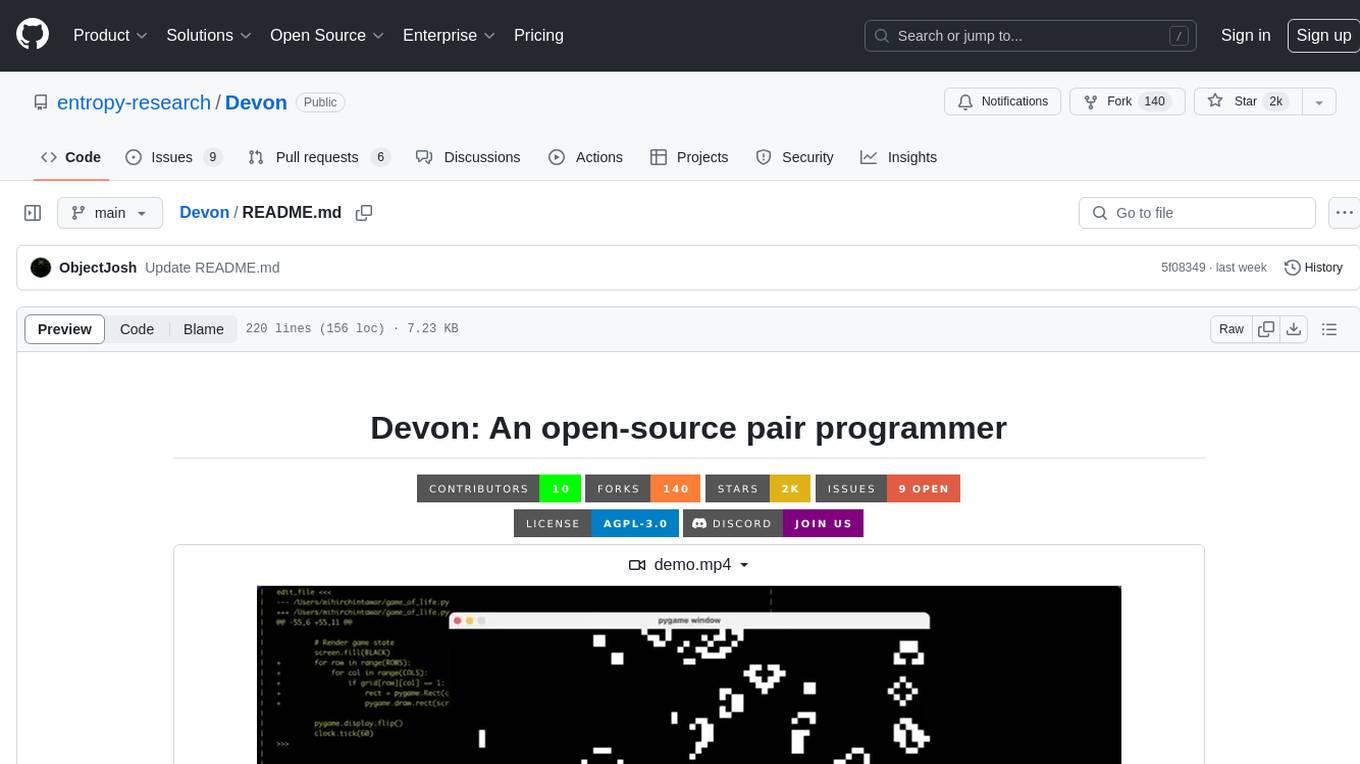
Devon
Devon is an open-source pair programmer tool designed to facilitate collaborative coding sessions. It provides features such as multi-file editing, codebase exploration, test writing, bug fixing, and architecture exploration. The tool supports Anthropic, OpenAI, and Groq APIs, with plans to add more models in the future. Devon is community-driven, with ongoing development goals including multi-model support, plugin system for tool builders, self-hostable Electron app, and setting SOTA on SWE-bench Lite. Users can contribute to the project by developing core functionality, conducting research on agent performance, providing feedback, and testing the tool.
RD-Agent
RD-Agent is a tool designed to automate critical aspects of industrial R&D processes, focusing on data-driven scenarios to streamline model and data development. It aims to propose new ideas ('R') and implement them ('D') automatically, leading to solutions of significant industrial value. The tool supports scenarios like Automated Quantitative Trading, Data Mining Agent, Research Copilot, and more, with a framework to push the boundaries of research in data science. Users can create a Conda environment, install the RDAgent package from PyPI, configure GPT model, and run various applications for tasks like quantitative trading, model evolution, medical prediction, and more. The tool is intended to enhance R&D processes and boost productivity in industrial settings.
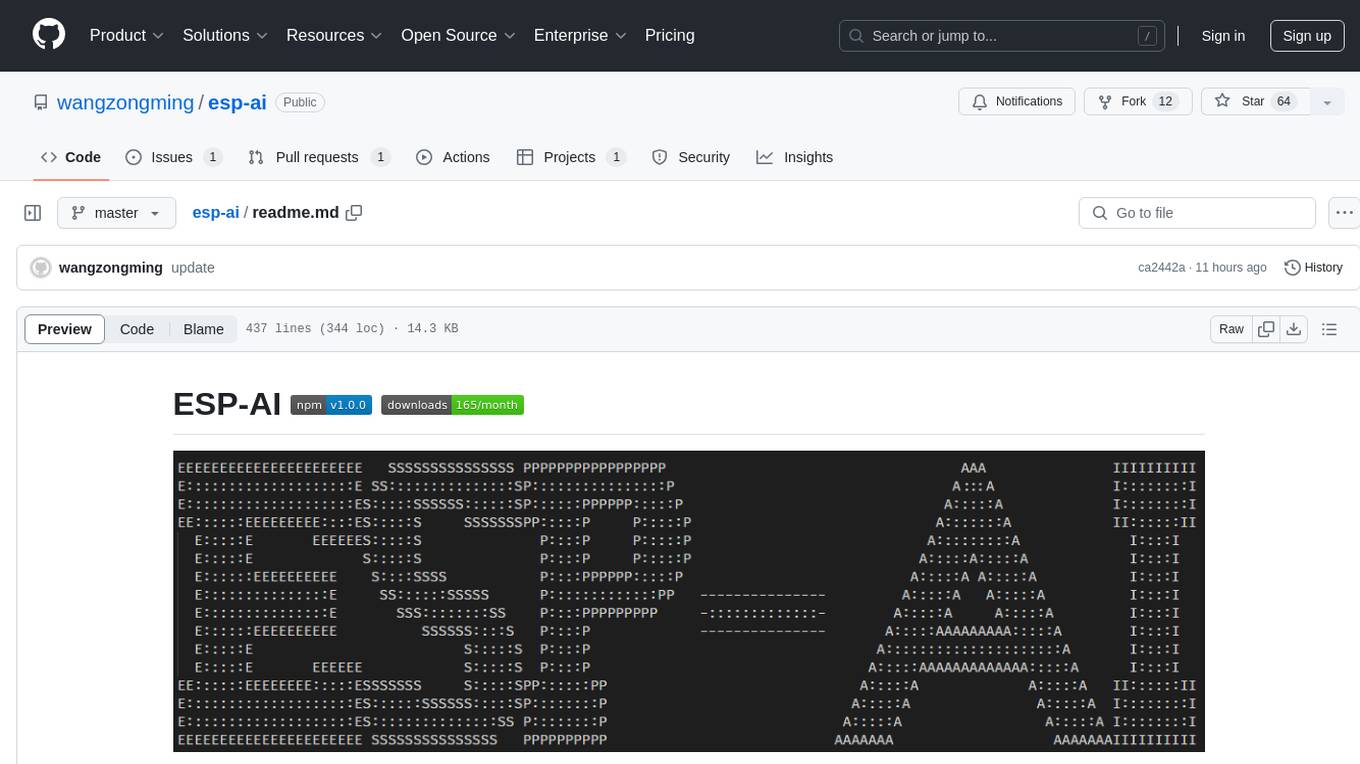
esp-ai
ESP-AI provides a complete AI conversation solution for your development board, including IAT+LLM+TTS integration solutions for ESP32 series development boards. It can be injected into projects without affecting existing ones. By providing keys from platforms like iFlytek, Jiling, and local services, you can run the services without worrying about interactions between services or between development boards and services. The project's server-side code is based on Node.js, and the hardware code is based on Arduino IDE.
SoM-LLaVA
SoM-LLaVA is a new data source and learning paradigm for Multimodal LLMs, empowering open-source Multimodal LLMs with Set-of-Mark prompting and improved visual reasoning ability. The repository provides a new dataset that is complementary to existing training sources, enhancing multimodal LLMs with Set-of-Mark prompting and improved general capacity. By adding 30k SoM data to the visual instruction tuning stage of LLaVA, the tool achieves 1% to 6% relative improvements on all benchmarks. Users can train SoM-LLaVA via command line and utilize the implementation to annotate COCO images with SoM. Additionally, the tool can be loaded in Huggingface for further usage.
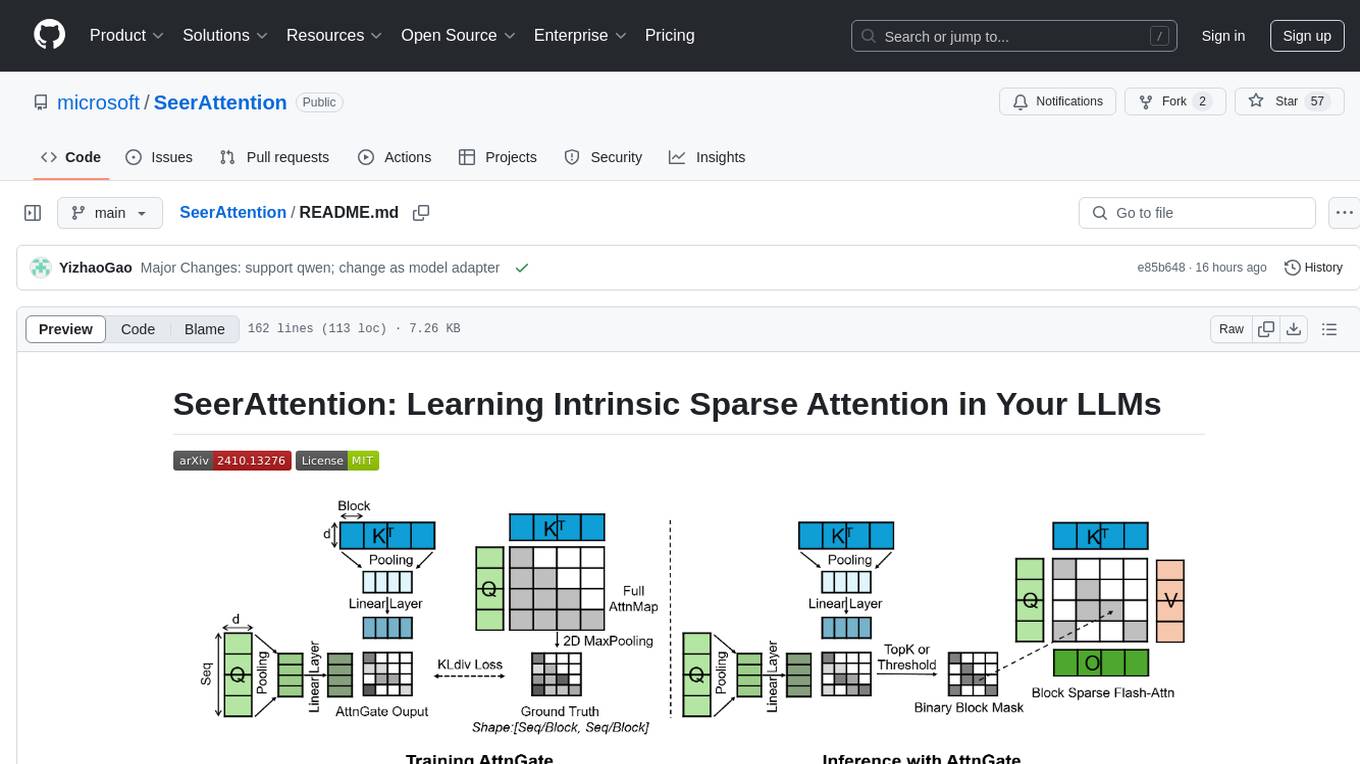
SeerAttention
SeerAttention is a novel trainable sparse attention mechanism that learns intrinsic sparsity patterns directly from LLMs through self-distillation at post-training time. It achieves faster inference while maintaining accuracy for long-context prefilling. The tool offers features such as trainable sparse attention, block-level sparsity, self-distillation, efficient kernel, and easy integration with existing transformer architectures. Users can quickly start using SeerAttention for inference with AttnGate Adapter and training attention gates with self-distillation. The tool provides efficient evaluation methods and encourages contributions from the community.
slideflow
Slideflow is a deep learning library for digital pathology, offering a user-friendly interface for model development. It is designed for medical researchers and AI enthusiasts, providing an accessible platform for developing state-of-the-art pathology models. Slideflow offers customizable training pipelines, robust slide processing and stain normalization toolkit, support for weakly-supervised or strongly-supervised labels, built-in foundation models, multiple-instance learning, self-supervised learning, generative adversarial networks, explainability tools, layer activation analysis tools, uncertainty quantification, interactive user interface for model deployment, and more. It supports both PyTorch and Tensorflow, with optional support for Libvips for slide reading. Slideflow can be installed via pip, Docker container, or from source, and includes non-commercial add-ons for additional tools and pretrained models. It allows users to create projects, extract tiles from slides, train models, and provides evaluation tools like heatmaps and mosaic maps.
finetrainers
FineTrainers is a work-in-progress library designed to support the training of video models, with a focus on LoRA training for popular video models in Diffusers. It aims to eventually extend support to other methods like controlnets, control-loras, distillation, etc. The library provides tools for training custom models, handling big datasets, and supporting multi-backend distributed training. It also offers tooling for curating small and high-quality video datasets for fine-tuning.
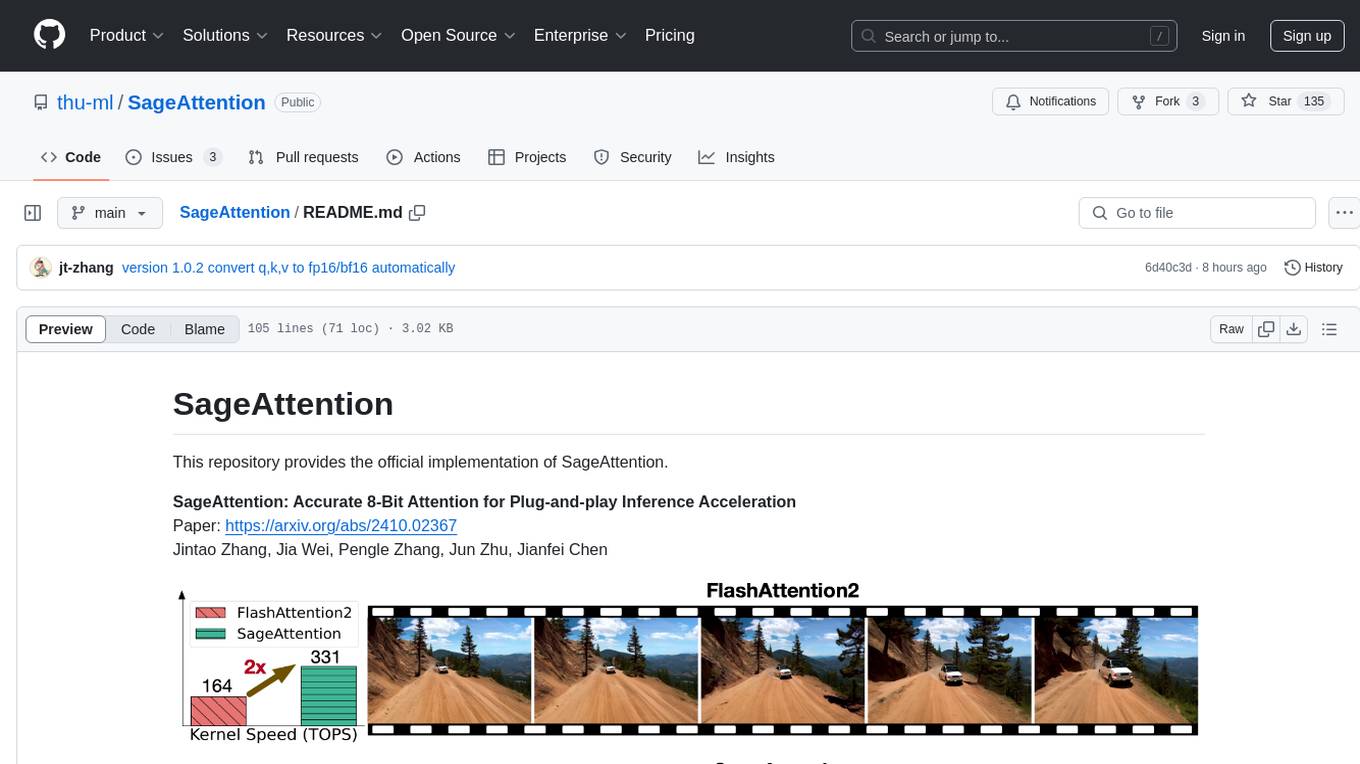
SageAttention
SageAttention is an official implementation of an accurate 8-bit attention mechanism for plug-and-play inference acceleration. It is optimized for RTX4090 and RTX3090 GPUs, providing performance improvements for specific GPU architectures. The tool offers a technique called 'smooth_k' to ensure accuracy in processing FP16/BF16 data. Users can easily replace 'scaled_dot_product_attention' with SageAttention for faster video processing.
For similar tasks
rllm
rLLM is an open-source framework for post-training language agents via reinforcement learning. With rLLM, you can easily build your custom agents and environments, train them with reinforcement learning, and deploy them for real-world workloads. The framework provides tools for training coding models, software engineering agents, and language agents using reinforcement learning techniques. It supports various models of different sizes and capabilities, enabling users to achieve state-of-the-art performance in coding and language-related tasks. rLLM is designed to be user-friendly, scalable, and efficient for training and deploying language agents in diverse applications.
multi-agent-orchestrator
Multi-Agent Orchestrator is a flexible and powerful framework for managing multiple AI agents and handling complex conversations. It intelligently routes queries to the most suitable agent based on context and content, supports dual language implementation in Python and TypeScript, offers flexible agent responses, context management across agents, extensible architecture for customization, universal deployment options, and pre-built agents and classifiers. It is suitable for various applications, from simple chatbots to sophisticated AI systems, accommodating diverse requirements and scaling efficiently.
WindowsAgentArena
Windows Agent Arena (WAA) is a scalable Windows AI agent platform designed for testing and benchmarking multi-modal, desktop AI agents. It provides researchers and developers with a reproducible and realistic Windows OS environment for AI research, enabling testing of agentic AI workflows across various tasks. WAA supports deploying agents at scale using Azure ML cloud infrastructure, allowing parallel running of multiple agents and delivering quick benchmark results for hundreds of tasks in minutes.
Upsonic
Upsonic offers a cutting-edge enterprise-ready framework for orchestrating LLM calls, agents, and computer use to complete tasks cost-effectively. It provides reliable systems, scalability, and a task-oriented structure for real-world cases. Key features include production-ready scalability, task-centric design, MCP server support, tool-calling server, computer use integration, and easy addition of custom tools. The framework supports client-server architecture and allows seamless deployment on AWS, GCP, or locally using Docker.
AutoAgent
AutoAgent is a fully-automated and zero-code framework that enables users to create and deploy LLM agents through natural language alone. It is a top performer on the GAIA Benchmark, equipped with a native self-managing vector database, and allows for easy creation of tools, agents, and workflows without any coding. AutoAgent seamlessly integrates with a wide range of LLMs and supports both function-calling and ReAct interaction modes. It is designed to be dynamic, extensible, customized, and lightweight, serving as a personal AI assistant.
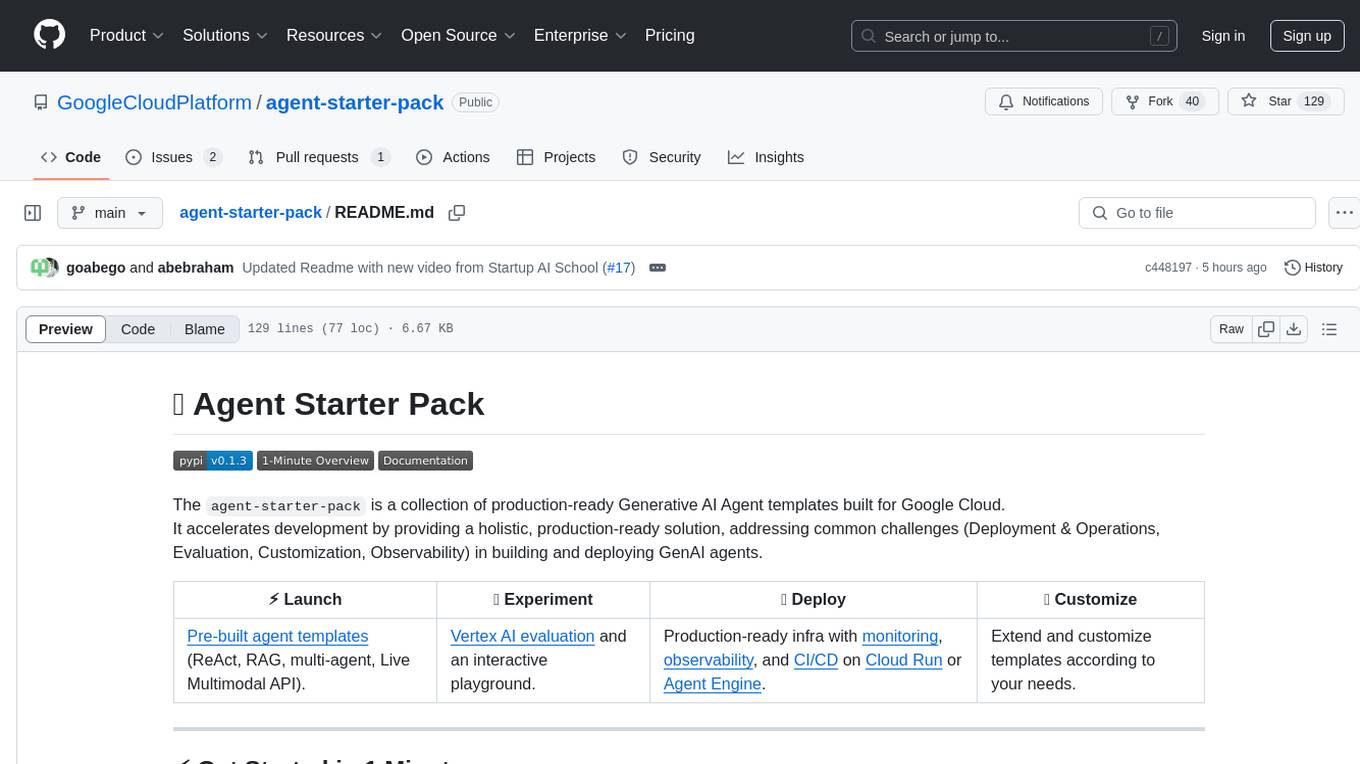
agent-starter-pack
The agent-starter-pack is a collection of production-ready Generative AI Agent templates built for Google Cloud. It accelerates development by providing a holistic, production-ready solution, addressing common challenges in building and deploying GenAI agents. The tool offers pre-built agent templates, evaluation tools, production-ready infrastructure, and customization options. It also provides CI/CD automation and data pipeline integration for RAG agents. The starter pack covers all aspects of agent development, from prototyping and evaluation to deployment and monitoring. It is designed to simplify project creation, template selection, and deployment for agent development on Google Cloud.
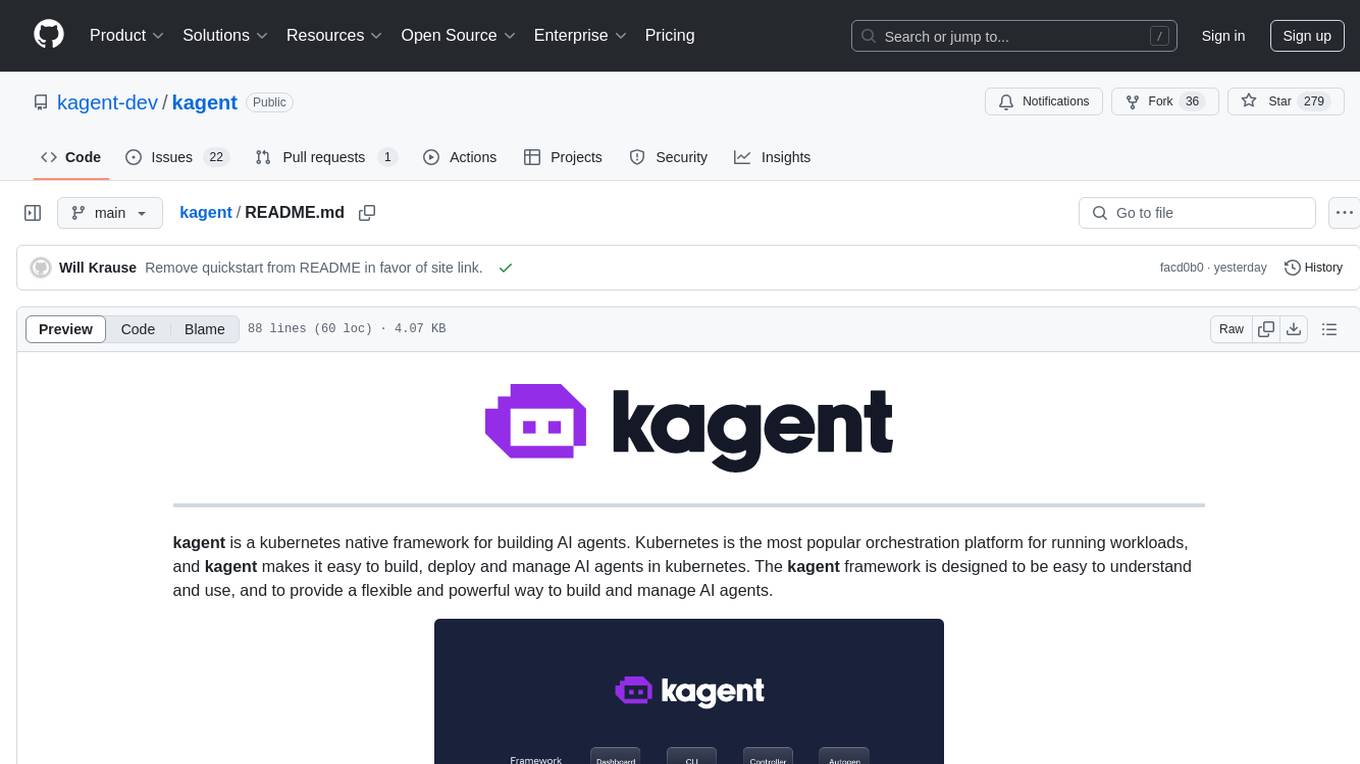
kagent
Kagent is a Kubernetes native framework for building AI agents, designed to be easy to understand and use. It provides a flexible and powerful way to build, deploy, and manage AI agents in Kubernetes. The framework consists of agents, tools, and model configurations defined as Kubernetes custom resources, making them easy to manage and modify. Kagent is extensible, flexible, observable, declarative, testable, and has core components like a controller, UI, engine, and CLI.

motia
Motia is an AI agent framework designed for software engineers to create, test, and deploy production-ready AI agents quickly. It provides a code-first approach, allowing developers to write agent logic in familiar languages and visualize execution in real-time. With Motia, developers can focus on business logic rather than infrastructure, offering zero infrastructure headaches, multi-language support, composable steps, built-in observability, instant APIs, and full control over AI logic. Ideal for building sophisticated agents and intelligent automations, Motia's event-driven architecture and modular steps enable the creation of GenAI-powered workflows, decision-making systems, and data processing pipelines.
For similar jobs
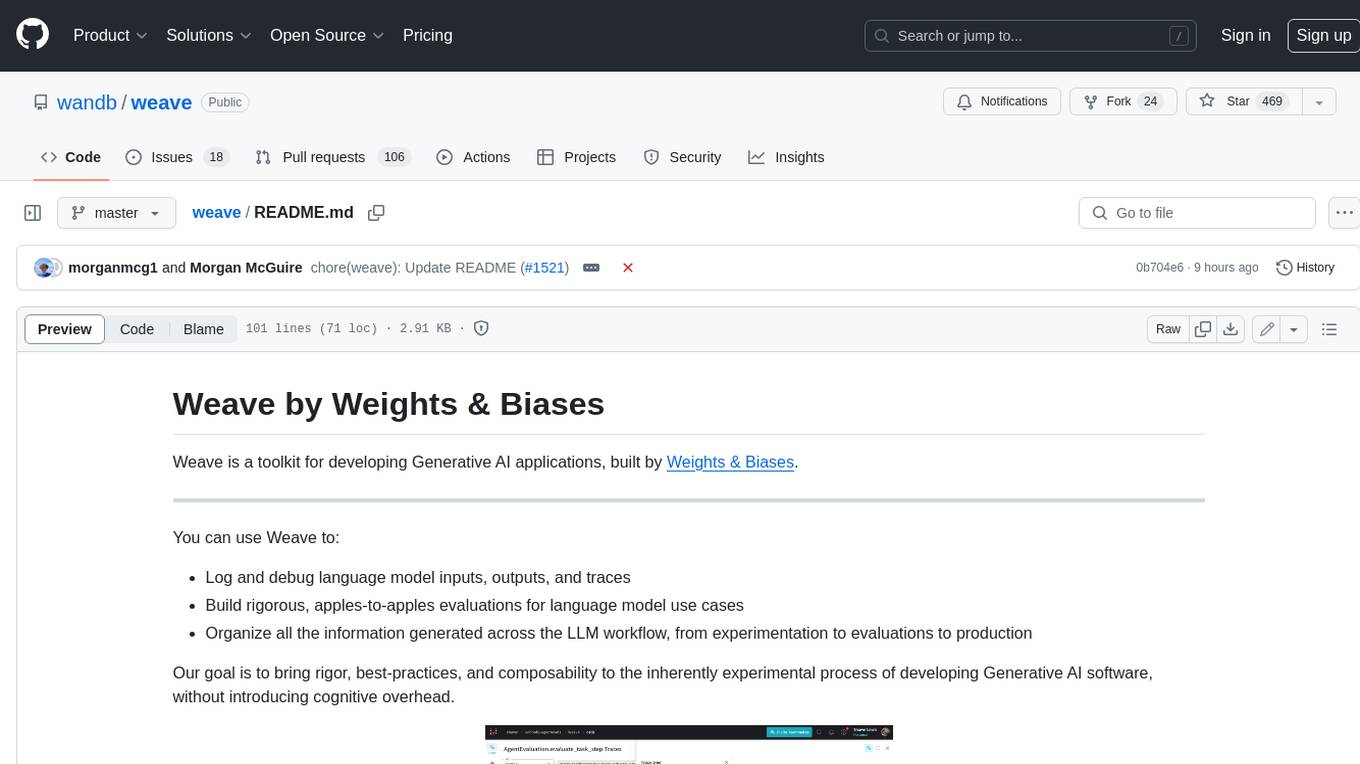
weave
Weave is a toolkit for developing Generative AI applications, built by Weights & Biases. With Weave, you can log and debug language model inputs, outputs, and traces; build rigorous, apples-to-apples evaluations for language model use cases; and organize all the information generated across the LLM workflow, from experimentation to evaluations to production. Weave aims to bring rigor, best-practices, and composability to the inherently experimental process of developing Generative AI software, without introducing cognitive overhead.
LLMStack
LLMStack is a no-code platform for building generative AI agents, workflows, and chatbots. It allows users to connect their own data, internal tools, and GPT-powered models without any coding experience. LLMStack can be deployed to the cloud or on-premise and can be accessed via HTTP API or triggered from Slack or Discord.
VisionCraft
The VisionCraft API is a free API for using over 100 different AI models. From images to sound.
kaito
Kaito is an operator that automates the AI/ML inference model deployment in a Kubernetes cluster. It manages large model files using container images, avoids tuning deployment parameters to fit GPU hardware by providing preset configurations, auto-provisions GPU nodes based on model requirements, and hosts large model images in the public Microsoft Container Registry (MCR) if the license allows. Using Kaito, the workflow of onboarding large AI inference models in Kubernetes is largely simplified.
PyRIT
PyRIT is an open access automation framework designed to empower security professionals and ML engineers to red team foundation models and their applications. It automates AI Red Teaming tasks to allow operators to focus on more complicated and time-consuming tasks and can also identify security harms such as misuse (e.g., malware generation, jailbreaking), and privacy harms (e.g., identity theft). The goal is to allow researchers to have a baseline of how well their model and entire inference pipeline is doing against different harm categories and to be able to compare that baseline to future iterations of their model. This allows them to have empirical data on how well their model is doing today, and detect any degradation of performance based on future improvements.
tabby
Tabby is a self-hosted AI coding assistant, offering an open-source and on-premises alternative to GitHub Copilot. It boasts several key features: * Self-contained, with no need for a DBMS or cloud service. * OpenAPI interface, easy to integrate with existing infrastructure (e.g Cloud IDE). * Supports consumer-grade GPUs.
spear
SPEAR (Simulator for Photorealistic Embodied AI Research) is a powerful tool for training embodied agents. It features 300 unique virtual indoor environments with 2,566 unique rooms and 17,234 unique objects that can be manipulated individually. Each environment is designed by a professional artist and features detailed geometry, photorealistic materials, and a unique floor plan and object layout. SPEAR is implemented as Unreal Engine assets and provides an OpenAI Gym interface for interacting with the environments via Python.
Magick
Magick is a groundbreaking visual AIDE (Artificial Intelligence Development Environment) for no-code data pipelines and multimodal agents. Magick can connect to other services and comes with nodes and templates well-suited for intelligent agents, chatbots, complex reasoning systems and realistic characters.