


agentfactory
Build Digital FTEs that work 24/7. Your domain expertise—whether in sales, legal, finance, or healthcare—becomes an autonomous AI agent that never sleeps.
Stars: 128
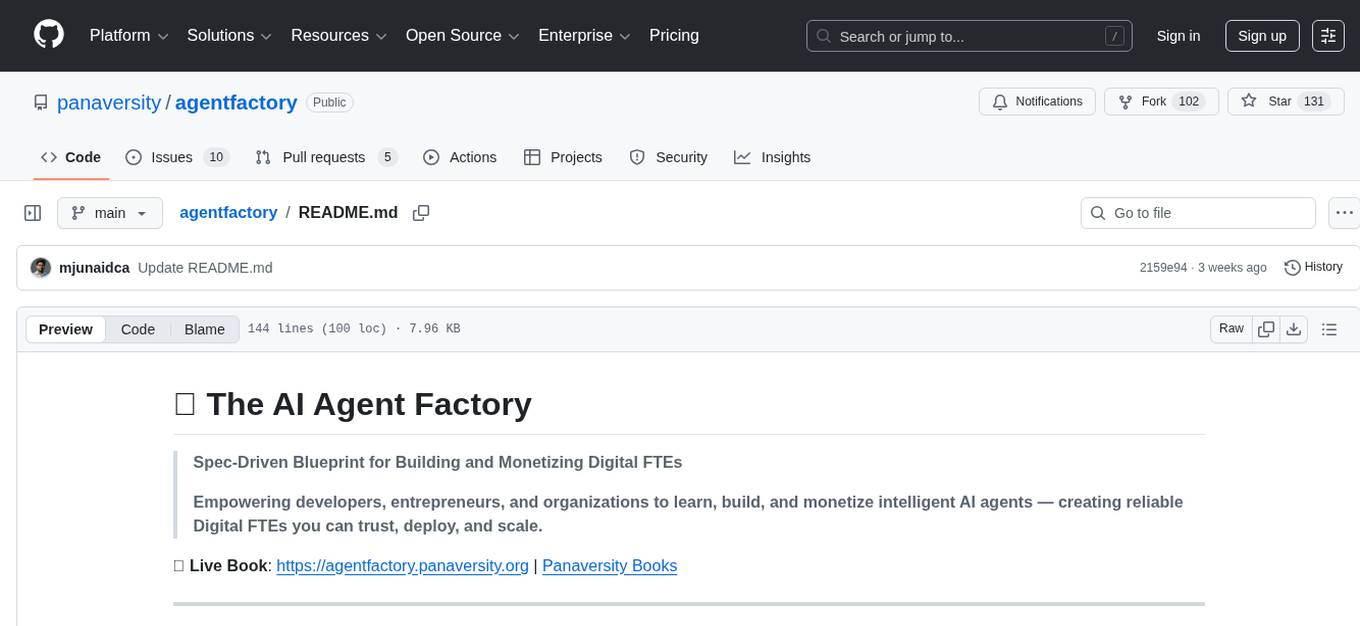
The AI Agent Factory is a spec-driven blueprint for building and monetizing digital FTEs. It empowers developers, entrepreneurs, and organizations to learn, build, and monetize intelligent AI agents, creating reliable digital FTEs that can be trusted, deployed, and scaled. The tool focuses on co-learning between humans and machines, emphasizing collaboration, clear specifications, and evolving together. It covers AI-assisted, AI-driven, and AI-native development approaches, guiding users through the AI development spectrum and organizational AI maturity levels. The core philosophy revolves around treating AI as a collaborative partner, using specification-first methodology, bilingual development, learning by doing, and ensuring transparency and reproducibility. The tool is suitable for beginners, professional developers, entrepreneurs, product leaders, educators, and tech leaders.
README:
Spec-Driven Blueprint for Building and Monetizing Digital FTEs
Empowering developers, entrepreneurs, and organizations to learn, build, and monetize intelligent AI agents — creating reliable Digital FTEs you can trust, deploy, and scale.
📚 Live Book: https://agentfactory.panaversity.org | Panaversity Books




To pioneer co-learning — education and development where humans and intelligent agents learn together, reason together, and build together.
We teach a fundamental paradigm shift:
- From automation to intelligence — moving beyond tools that execute to partners that reason
- From "coding for machines" to "collaborating with thinking entities" — where specifications enable mutual understanding
- From solo development to orchestrated intelligence — humans as teachers, students, and orchestrators
AI is:
- a co-learner, observing your intent and refining its understanding
- a collaborator, generating solutions and alternatives for your evaluation
- a creative partner, amplifying human reasoning with machine precision
This is not about replacing developers—it's about amplifying human capability through intelligent partnership.
Understanding where you are on the AI journey is essential. This book teaches all three approaches, with emphasis on AI-Driven and AI-Native Development:
- What it is: AI as a productivity tool (Copilot, ChatGPT, Claude for code completion)
- Your role: Developer who codes faster with AI suggestions
- Impact: 10-20% productivity gains in coding tasks
- Example: "Use GitHub Copilot to help write a REST API"
- What it is: AI generates significant code from specifications; you act as architect and reviewer
- Your role: Specification engineer and co-creator with AI agents
- Impact: 2-3x faster feature development; specs become living documentation
- Example: "Write a spec; AI generates complete FastAPI backend with tests and docs"
- This book emphasizes this approach
- What it is: Applications where LLMs, agents, or ML models are core functional components
- Your role: AI system architect designing reasoning and interaction layers
- Impact: New capabilities impossible with traditional software; intelligent, adaptive systems
- Example: "Build a customer support agent that reasons, learns, and coordinates autonomously"
- This book emphasizes this approach
AI-Assisted    →    AI-Driven    →    AI-Native
   Helper          Co-Creator        Core System
As you scale AI adoption in your organization, you'll progress through maturity levels. Understanding where you are helps you advance strategically:
| Level | Name | Approach | Characteristics | Timeline |
|---|---|---|---|---|
| 1 | Experiment | AI-Assisted | Individual developers try AI tools; 10-20% productivity boost | Weeks |
| 2 | Standardize | AI-Assisted | Organization-wide adoption; governance in place; 30-40% boost | Months |
| 3 | Transform | AI-Driven | Workflows redesigned around AI; specs drive implementation; 2-3x faster | Quarters |
| 4 | Build Intelligence | AI-Native | AI/LLMs are core product features; new capabilities enabled | 6-12 months |
| 5 | AI-First Enterprise | AI-Native | Entire SDLC is AI-driven; continuous learning systems; 10x productivity | 1-2 years |
Key Insight: You cannot skip levels. Master Levels 1-2 before attempting Level 3. Master Level 3 before building AI-Native products.
This book is built on a fundamental premise: software development is becoming a collaborative dialogue between human intent and machine intelligence.
-
Teach the AI through clarity — The clearer your specification, the smarter your agent becomes. Ambiguity breeds confusion for both human and machine.
-
Let the AI teach you through reflection — Every piece of AI-generated code is a lesson in reasoning. Don't just copy; analyze why it chose that structure.
-
Evolve together — Each iteration improves both your specification-writing and the AI's generation capability. This is co-evolution.
- AI as Collaborative Partner: We treat AI as intelligent colleagues, not tools. You'll learn to negotiate, iterate, and co-create.
- Specification-First Methodology: Clear, machine-readable specifications become executable blueprints. We use the "Spec-Kit Plus" methodology throughout.
- Bilingual Development: Master both Python (reasoning layer) and TypeScript (interaction layer) to build complete AI-native systems.
- Learning by Doing: Every concept is practiced through realistic, production-ready projects with AI collaboration.
- Transparency & Reproducibility: All examples, projects, and methodologies are open-source and teachable.
- Beginners — Learn programming from day one with AI as your co-learner. No prior coding experience needed.
- Professional developers — Transition from traditional coding to AI-driven and AI-native development.
- Entrepreneurs and product leaders — Understand how to build AI-native products and scale AI adoption in your organization.
- Educators — Learn how to teach programming in the age of AI tutors and agents.
- Tech leaders — Understand AI maturity levels and chart your organization's path to AI-first development.
The future of software development is collaborative, conversational, and powered by reasoning systems.
Start your journey today:
- Read the Preface — Understand the AI development spectrum and why this paradigm shift matters
- Chapter 1 — Introducing AI-Driven Development — the fundamentals you need
- Build alongside AI — Start with Python basics, gradually master AI-native architectures
- Deploy to production — By the end, you'll be running scalable, intelligent systems
📘 Read the book: https://agentfactory.panaversity.org
🎓 Panaversity Programs: https://panaversity.com/books/ai-native-software-development
Part of AI Native Software Development — redefining how we learn, build, and collaborate with intelligent systems.
Open Source • Continuously Updated • Community-Driven 🌍
For Tasks:
Click tags to check more tools for each tasksFor Jobs:
Alternative AI tools for agentfactory
Similar Open Source Tools
agentfactory
The AI Agent Factory is a spec-driven blueprint for building and monetizing digital FTEs. It empowers developers, entrepreneurs, and organizations to learn, build, and monetize intelligent AI agents, creating reliable digital FTEs that can be trusted, deployed, and scaled. The tool focuses on co-learning between humans and machines, emphasizing collaboration, clear specifications, and evolving together. It covers AI-assisted, AI-driven, and AI-native development approaches, guiding users through the AI development spectrum and organizational AI maturity levels. The core philosophy revolves around treating AI as a collaborative partner, using specification-first methodology, bilingual development, learning by doing, and ensuring transparency and reproducibility. The tool is suitable for beginners, professional developers, entrepreneurs, product leaders, educators, and tech leaders.
learn-low-code-agentic-ai
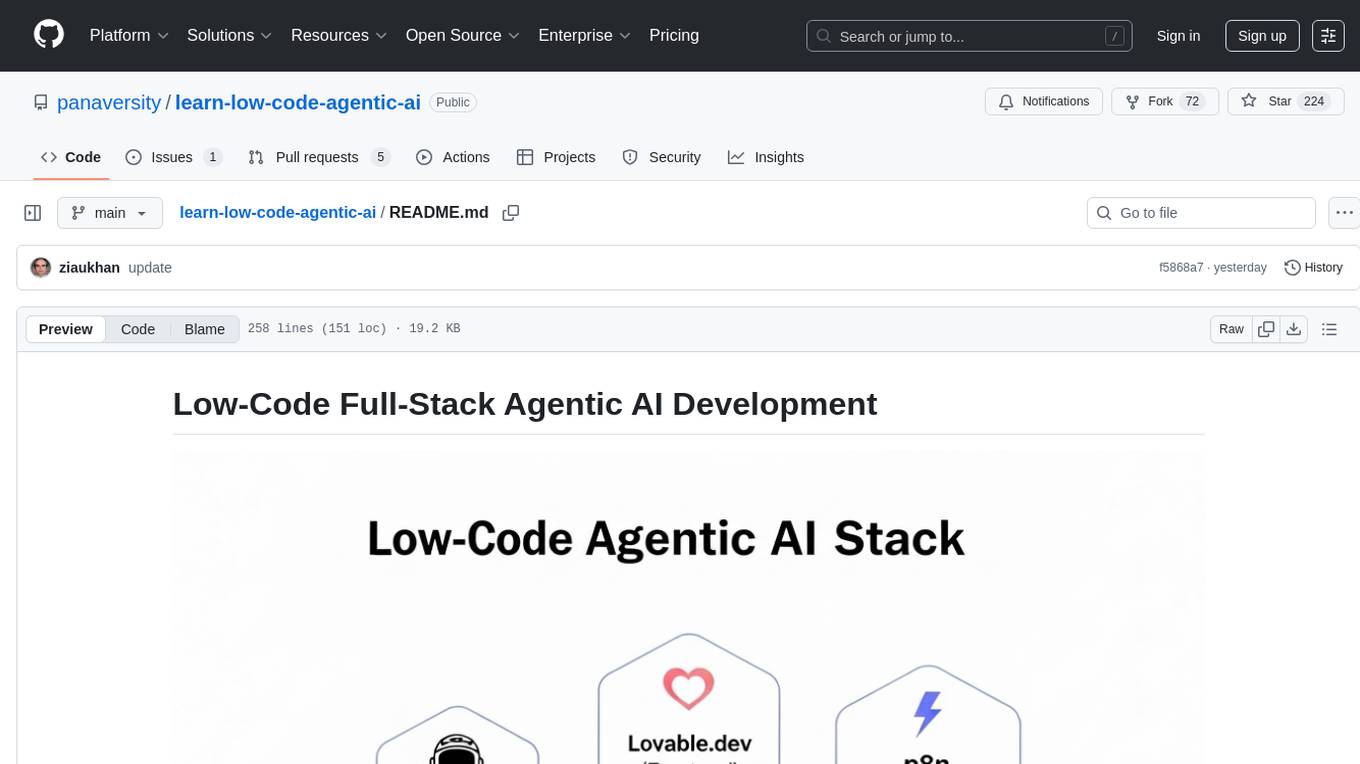
This repository is dedicated to learning about Low-Code Full-Stack Agentic AI Development. It provides material for building modern AI-powered applications using a low-code full-stack approach. The main tools covered are UXPilot for UI/UX mockups, Lovable.dev for frontend applications, n8n for AI agents and workflows, Supabase for backend data storage, authentication, and vector search, and Model Context Protocol (MCP) for integration. The focus is on prompt and context engineering as the foundation for working with AI systems, enabling users to design, develop, and deploy AI-driven full-stack applications faster, smarter, and more reliably.
gen-ai-experiments
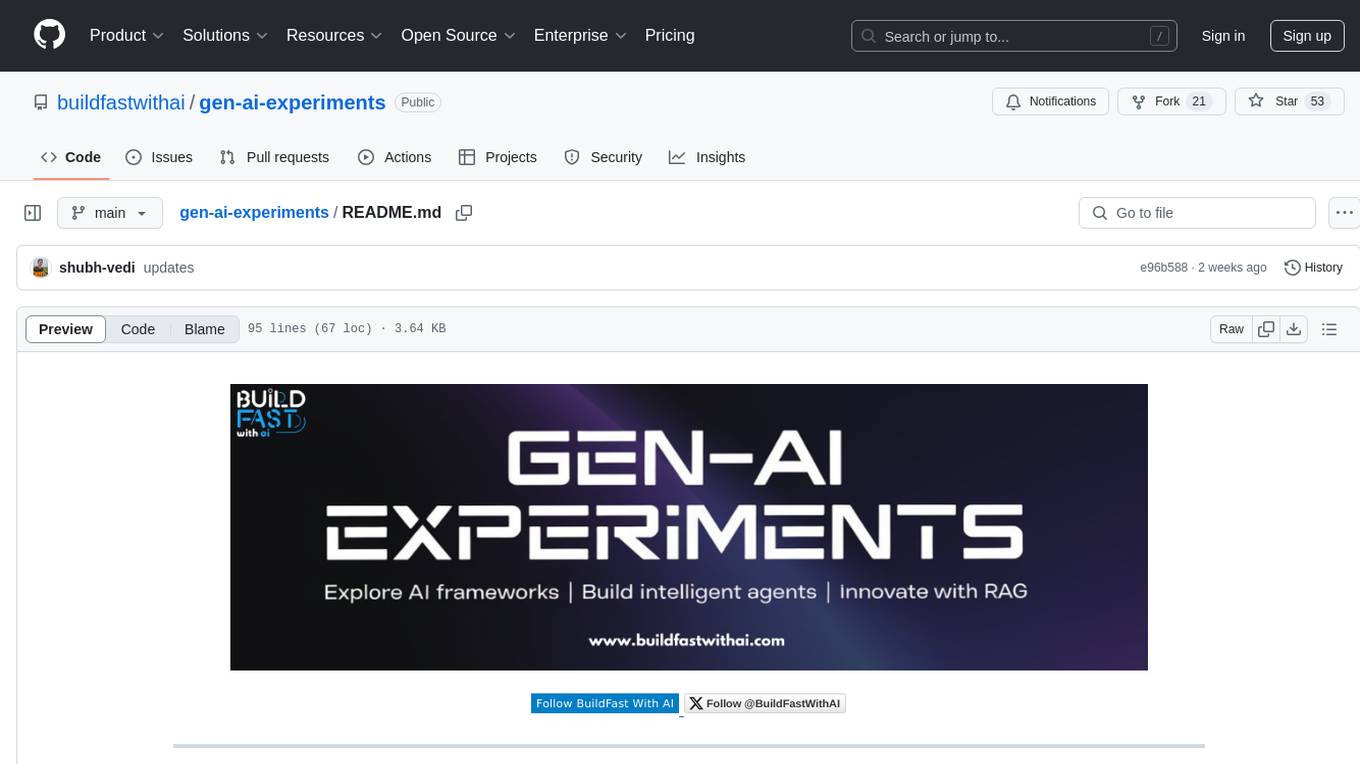
Gen-AI-Experiments is a structured collection of Jupyter notebooks and AI experiments designed to guide users through various AI tools, frameworks, and models. It offers valuable resources for both beginners and experienced practitioners, covering topics such as AI agents, model testing, RAG systems, real-world applications, and open-source tools. The repository includes folders with curated libraries, AI agents, experiments, LLM testing, open-source libraries, RAG experiments, and educhain experiments, each focusing on different aspects of AI development and application.

EpicStaff
EpicStaff is a powerful project management tool designed to streamline team collaboration and task management. It provides a user-friendly interface for creating and assigning tasks, tracking progress, and communicating with team members in real-time. With features such as task prioritization, deadline reminders, and file sharing capabilities, EpicStaff helps teams stay organized and productive. Whether you're working on a small project or managing a large team, EpicStaff is the perfect solution to keep everyone on the same page and ensure project success.
flow-like
Flow-Like is an enterprise-grade workflow operating system built upon Rust for uncompromising performance, efficiency, and code safety. It offers a modular frontend for apps, a rich set of events, a node catalog, a powerful no-code workflow IDE, and tools to manage teams, templates, and projects within organizations. With typed workflows, users can create complex, large-scale workflows with clear data origins, transformations, and contracts. Flow-Like is designed to automate any process through seamless integration of LLM, ML-based, and deterministic decision-making instances.
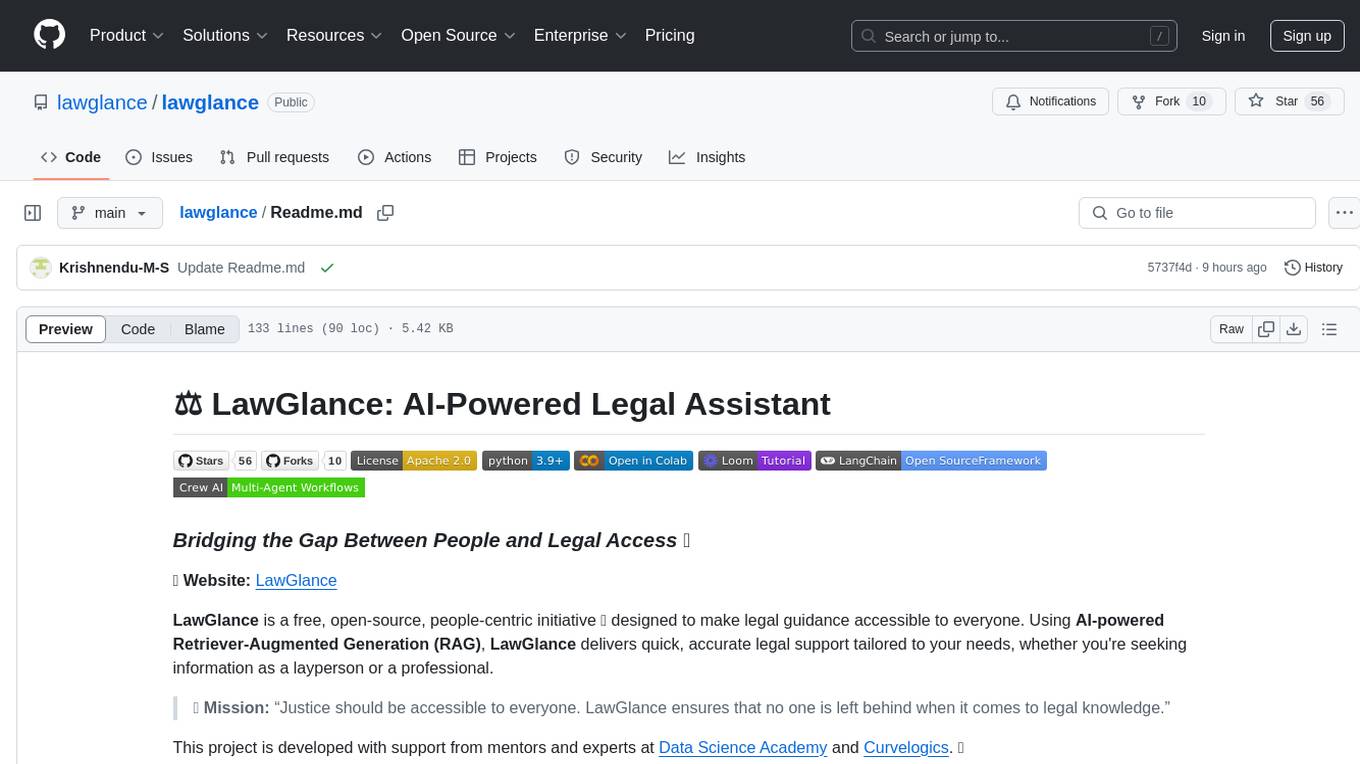
lawglance
LawGlance is an AI-powered legal assistant that aims to bridge the gap between people and legal access. It is a free, open-source initiative designed to provide quick and accurate legal support tailored to individual needs. The project covers various laws, with plans for international expansion in the future. LawGlance utilizes AI-powered Retriever-Augmented Generation (RAG) to deliver legal guidance accessible to both laypersons and professionals. The tool is developed with support from mentors and experts at Data Science Academy and Curvelogics.
memU
MemU is an open-source memory framework designed for AI companions, offering high accuracy, fast retrieval, and cost-effectiveness. It serves as an intelligent 'memory folder' that adapts to various AI companion scenarios. With MemU, users can create AI companions that remember them, learn their preferences, and evolve through interactions. The framework provides advanced retrieval strategies, 24/7 support, and is specialized for AI companions. MemU offers cloud, enterprise, and self-hosting options, with features like memory organization, interconnected knowledge graph, continuous self-improvement, and adaptive forgetting mechanism. It boasts high memory accuracy, fast retrieval, and low cost, making it suitable for building intelligent agents with persistent memory capabilities.
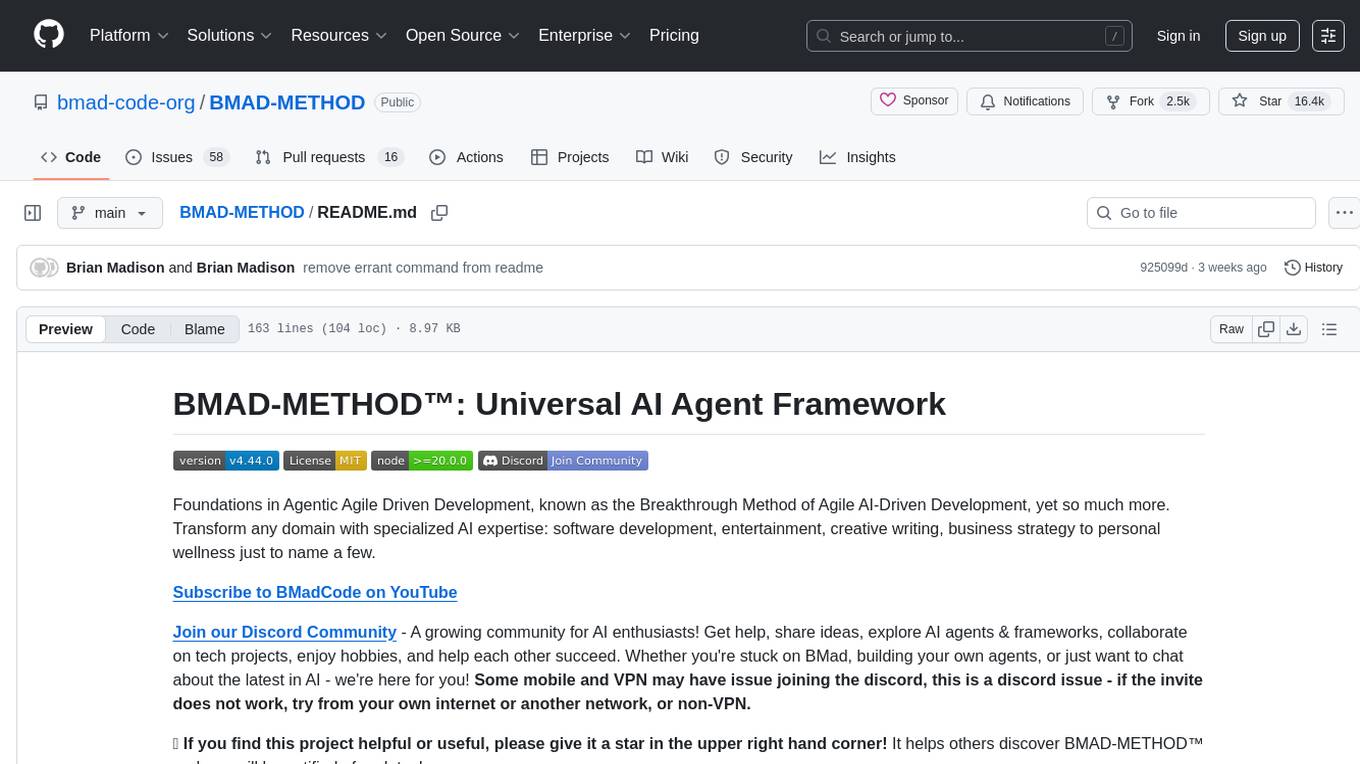
BMAD-METHOD
BMAD-METHOD™ is a universal AI agent framework that revolutionizes Agile AI-Driven Development. It offers specialized AI expertise across various domains, including software development, entertainment, creative writing, business strategy, and personal wellness. The framework introduces two key innovations: Agentic Planning, where dedicated agents collaborate to create detailed specifications, and Context-Engineered Development, which ensures complete understanding and guidance for developers. BMAD-METHOD™ simplifies the development process by eliminating planning inconsistency and context loss, providing a seamless workflow for creating AI agents and expanding functionality through expansion packs.
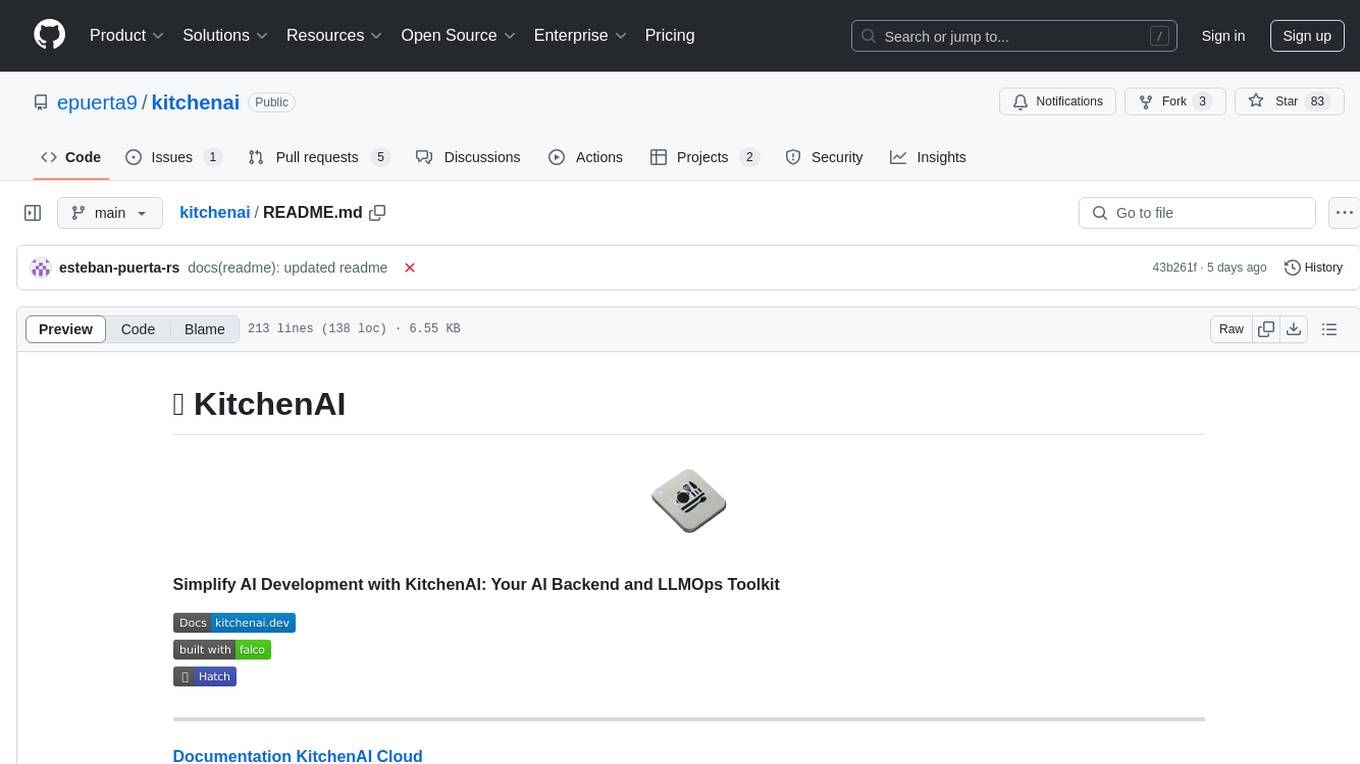
kitchenai
KitchenAI is an open-source toolkit designed to simplify AI development by serving as an AI backend and LLMOps solution. It aims to empower developers to focus on delivering results without being bogged down by AI infrastructure complexities. With features like simplifying AI integration, providing an AI backend, and empowering developers, KitchenAI streamlines the process of turning AI experiments into production-ready APIs. It offers built-in LLMOps features, is framework-agnostic and extensible, and enables faster time-to-production. KitchenAI is suitable for application developers, AI developers & data scientists, and platform & infra engineers, allowing them to seamlessly integrate AI into apps, deploy custom AI techniques, and optimize AI services with a modular framework. The toolkit eliminates the need to build APIs and infrastructure from scratch, making it easier to deploy AI code as production-ready APIs in minutes. KitchenAI also provides observability, tracing, and evaluation tools, and offers a Docker-first deployment approach for scalability and confidence.
AI-Engineering.academy
AI Engineering Academy aims to provide a structured learning path for individuals looking to learn Applied AI effectively. The platform offers multiple roadmaps covering topics like Retrieval Augmented Generation, Fine-tuning, and Deployment. Each roadmap equips learners with the knowledge and skills needed to excel in applied GenAI. Additionally, the platform will feature Hands-on End-to-End AI projects in the future.
meeting-minutes
An open-source AI assistant for taking meeting notes that captures live meeting audio, transcribes it in real-time, and generates summaries while ensuring user privacy. Perfect for teams to focus on discussions while automatically capturing and organizing meeting content without external servers or complex infrastructure. Features include modern UI, real-time audio capture, speaker diarization, local processing for privacy, and more. The tool also offers a Rust-based implementation for better performance and native integration, with features like live transcription, speaker diarization, and a rich text editor for notes. Future plans include database connection for saving meeting minutes, improving summarization quality, and adding download options for meeting transcriptions and summaries. The backend supports multiple LLM providers through a unified interface, with configurations for Anthropic, Groq, and Ollama models. System architecture includes core components like audio capture service, transcription engine, LLM orchestrator, data services, and API layer. Prerequisites for setup include Node.js, Python, FFmpeg, and Rust. Development guidelines emphasize project structure, testing, documentation, type hints, and ESLint configuration. Contributions are welcome under the MIT License.
cherry-studio
Cherry Studio is a desktop client that supports multiple LLM providers on Windows, Mac, and Linux. It offers diverse LLM provider support, AI assistants & conversations, document & data processing, practical tools integration, and enhanced user experience. The tool includes features like support for major LLM cloud services, AI web service integration, local model support, pre-configured AI assistants, document processing for text, images, and more, global search functionality, topic management system, AI-powered translation, and cross-platform support with ready-to-use features and themes for a better user experience.
talkcody
TalkCody is a free, open-source AI coding agent designed for developers who value speed, cost, control, and privacy. It offers true freedom to use any AI model without vendor lock-in, maximum speed through unique four-level parallelism, and complete privacy as everything runs locally without leaving the user's machine. With professional-grade features like multimodal input support, MCP server compatibility, and a marketplace for agents and skills, TalkCody aims to enhance development productivity and flexibility.
PromptX
PromptX is a leading AI agent context platform that revolutionizes interaction design, enabling AI agents to become industry experts. It offers core capabilities such as an AI role creation platform, intelligent tool development platform, and cognitive memory system. PromptX allows users to easily discover experts, summon them for assistance, and engage in professional dialogues through natural conversations. The platform's core philosophy emphasizes treating AI as a person, enabling users to communicate naturally without the need for complex commands. With Nuwa Creation Workshop, users can design custom AI roles using meta-prompt technology, transforming abstract needs into concrete executable AI expert roles in just minutes.
FastFlowLM
FastFlowLM is a Python library for efficient and scalable language model inference. It provides a high-performance implementation of language model scoring using n-gram language models. The library is designed to handle large-scale text data and can be easily integrated into natural language processing pipelines for tasks such as text generation, speech recognition, and machine translation. FastFlowLM is optimized for speed and memory efficiency, making it suitable for both research and production environments.
natively-cluely-ai-assistant
Natively is a free, open-source, privacy-first AI assistant designed to help users in real time during meetings, interviews, presentations, and conversations. Unlike traditional AI tools that work after the conversation, Natively operates while the conversation is happening. It runs as an invisible, always-on-top desktop overlay, listens when prompted, observes the screen content, and provides instant, context-aware assistance. The tool is fully transparent, customizable, and grants users complete control over local vs cloud AI, data, and credentials.
For similar tasks
gen-ai-experiments
Gen-AI-Experiments is a structured collection of Jupyter notebooks and AI experiments designed to guide users through various AI tools, frameworks, and models. It offers valuable resources for both beginners and experienced practitioners, covering topics such as AI agents, model testing, RAG systems, real-world applications, and open-source tools. The repository includes folders with curated libraries, AI agents, experiments, LLM testing, open-source libraries, RAG experiments, and educhain experiments, each focusing on different aspects of AI development and application.
ISEK
ISEK is a decentralized agent network framework that enables building intelligent, collaborative agent-to-agent systems. It integrates the Google A2A protocol and ERC-8004 contracts for identity registration, reputation building, and cooperative task-solving, creating a self-organizing, decentralized society of agents. The platform addresses challenges in the agent ecosystem by providing an incentive system for users to pay for agent services, motivating developers to build high-quality agents and fostering innovation and quality in the ecosystem. ISEK focuses on decentralized agent collaboration and coordination, allowing agents to find each other, reason together, and act as a decentralized system without central control. The platform utilizes ERC-8004 for decentralized identity, reputation, and validation registries, establishing trustless verification and reputation management.
agentfactory
The AI Agent Factory is a spec-driven blueprint for building and monetizing digital FTEs. It empowers developers, entrepreneurs, and organizations to learn, build, and monetize intelligent AI agents, creating reliable digital FTEs that can be trusted, deployed, and scaled. The tool focuses on co-learning between humans and machines, emphasizing collaboration, clear specifications, and evolving together. It covers AI-assisted, AI-driven, and AI-native development approaches, guiding users through the AI development spectrum and organizational AI maturity levels. The core philosophy revolves around treating AI as a collaborative partner, using specification-first methodology, bilingual development, learning by doing, and ensuring transparency and reproducibility. The tool is suitable for beginners, professional developers, entrepreneurs, product leaders, educators, and tech leaders.
Awesome-CS-Books
Awesome CS Books is a curated list of books on computer science and technology. The books are organized by topic, including programming languages, software engineering, computer networks, operating systems, databases, data structures and algorithms, big data, architecture, and interviews. The books are available in PDF format and can be downloaded for free. The repository also includes links to free online courses and other resources.
Awesome-Books-Notes
Awesome CS Books is a repository that archives excellent books related to computer science and technology, named in the format of {year}-{author}-{title}-{version}. It includes reading notes for each book, with PDF links provided at the beginning of the notes. The repository focuses on IT CS-related books, valuable open courses, and aims to provide a systematic way of learning to alleviate fragmented skills and one-sidedness. It respects the original authors by linking to official/copyright websites and emphasizes non-commercial use of the documents.

TutoriaLLM
TutoriaLLM is a self-hosted programming learning platform for K-12 Education that can be used on the web. It is designed for those who create educational content and those who learn from it. The platform provides a community for English and Japanese speakers, along with documentation and opportunities for contribution. Users can access a demo video showcasing TutoriaLLM in action.
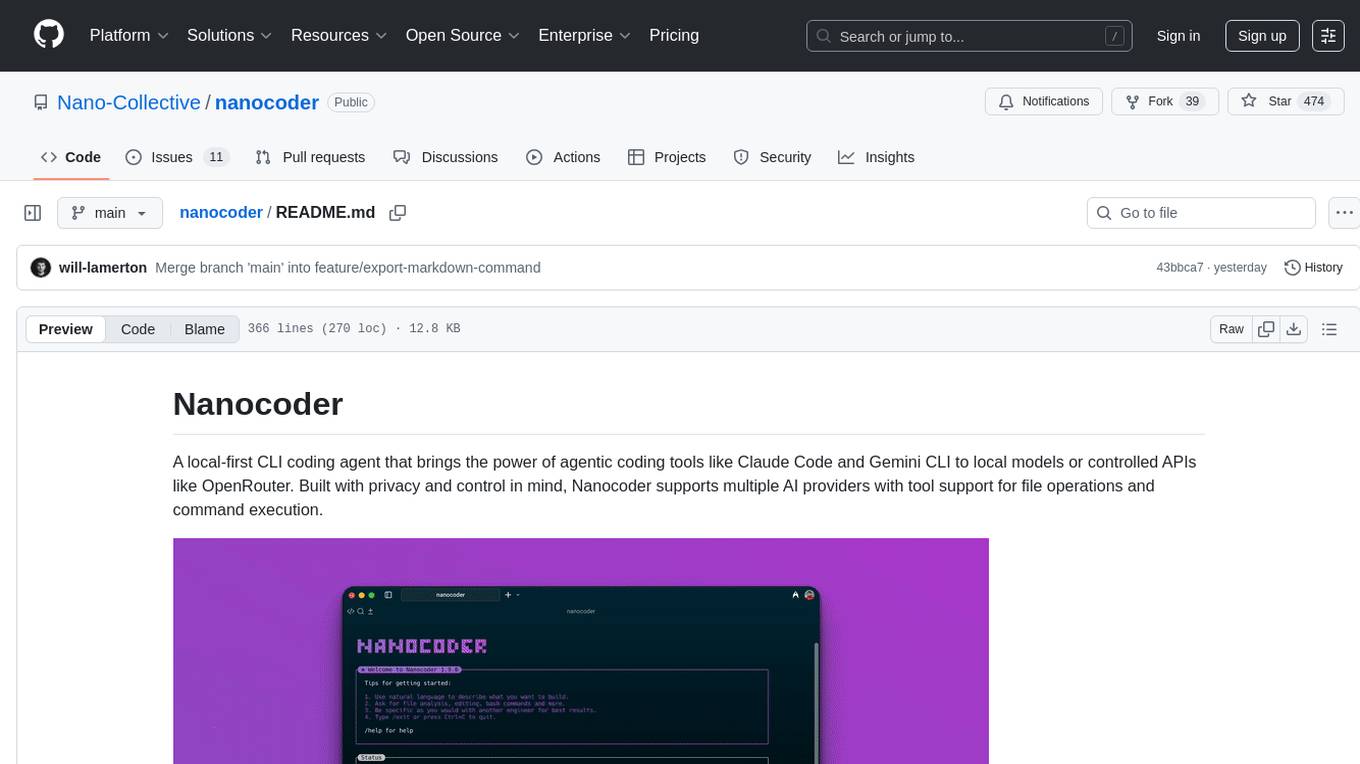
nanocoder
Nanocoder is a versatile code editor designed for beginners and experienced programmers alike. It provides a user-friendly interface with features such as syntax highlighting, code completion, and error checking. With Nanocoder, you can easily write and debug code in various programming languages, making it an ideal tool for learning, practicing, and developing software projects. Whether you are a student, hobbyist, or professional developer, Nanocoder offers a seamless coding experience to boost your productivity and creativity.
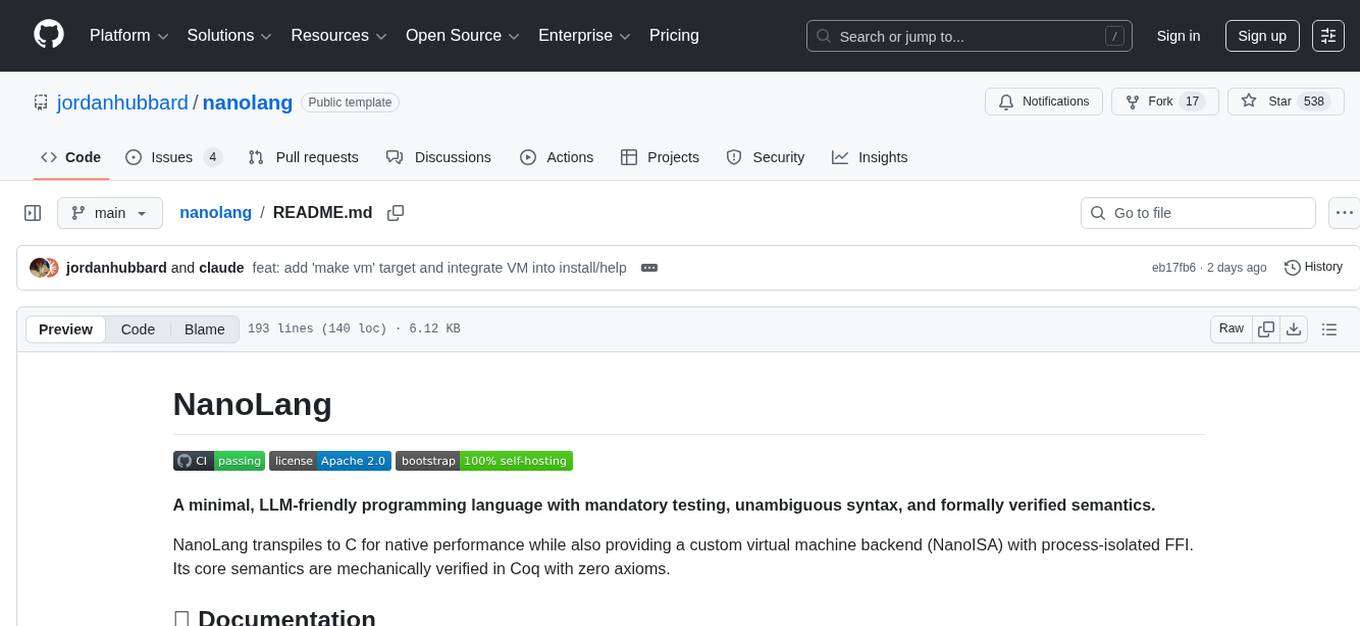
nanolang
NanoLang is a minimal, LLM-friendly programming language that transpiles to C for native performance. It features mandatory testing, unambiguous syntax, automatic memory management, LLM-powered autonomous optimization, dual notation for operators, static typing, C interop, and native performance. The language supports variables, functions with mandatory tests, control flow, structs, enums, generic types, and provides a clean, modern syntax optimized for both human readability and AI code generation.
For similar jobs
sweep
Sweep is an AI junior developer that turns bugs and feature requests into code changes. It automatically handles developer experience improvements like adding type hints and improving test coverage.
teams-ai
The Teams AI Library is a software development kit (SDK) that helps developers create bots that can interact with Teams and Microsoft 365 applications. It is built on top of the Bot Framework SDK and simplifies the process of developing bots that interact with Teams' artificial intelligence capabilities. The SDK is available for JavaScript/TypeScript, .NET, and Python.
ai-guide
This guide is dedicated to Large Language Models (LLMs) that you can run on your home computer. It assumes your PC is a lower-end, non-gaming setup.
classifai
Supercharge WordPress Content Workflows and Engagement with Artificial Intelligence. Tap into leading cloud-based services like OpenAI, Microsoft Azure AI, Google Gemini and IBM Watson to augment your WordPress-powered websites. Publish content faster while improving SEO performance and increasing audience engagement. ClassifAI integrates Artificial Intelligence and Machine Learning technologies to lighten your workload and eliminate tedious tasks, giving you more time to create original content that matters.
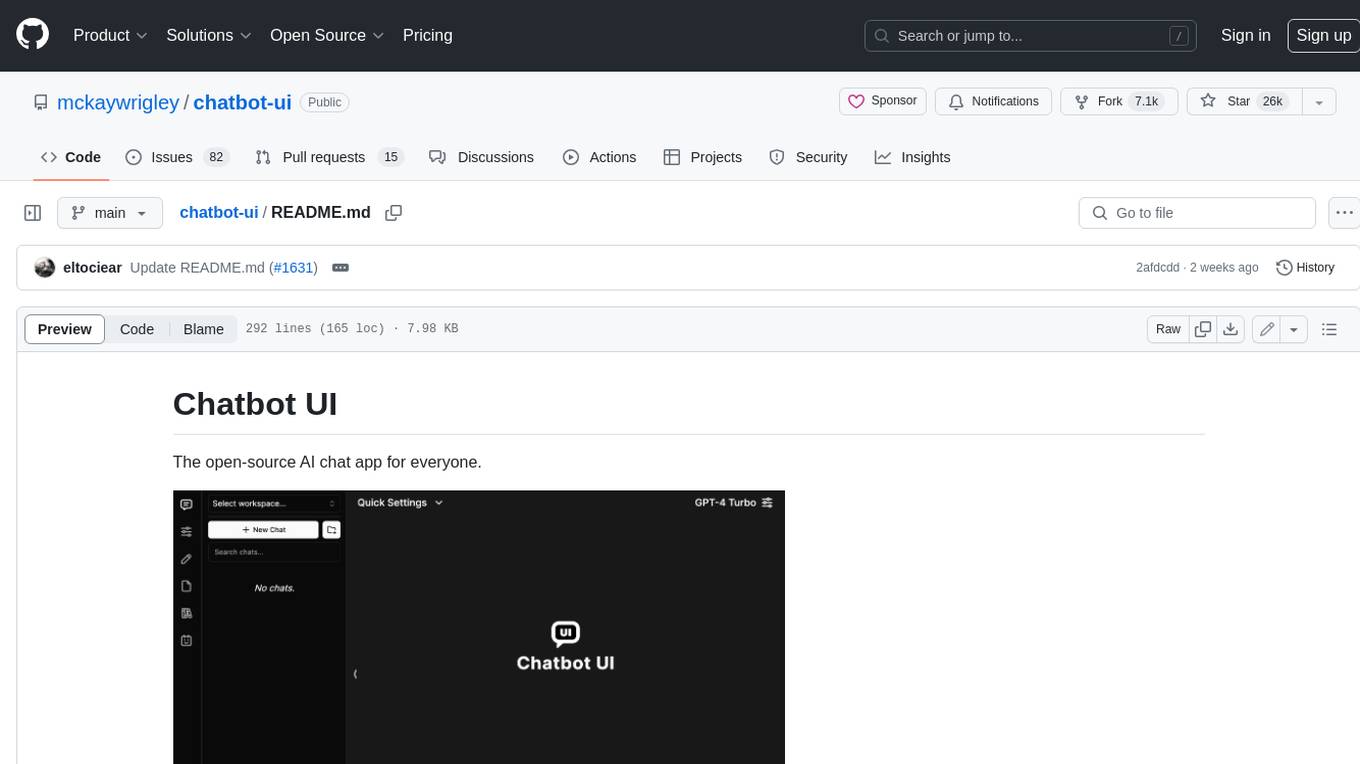
chatbot-ui
Chatbot UI is an open-source AI chat app that allows users to create and deploy their own AI chatbots. It is easy to use and can be customized to fit any need. Chatbot UI is perfect for businesses, developers, and anyone who wants to create a chatbot.
BricksLLM
BricksLLM is a cloud native AI gateway written in Go. Currently, it provides native support for OpenAI, Anthropic, Azure OpenAI and vLLM. BricksLLM aims to provide enterprise level infrastructure that can power any LLM production use cases. Here are some use cases for BricksLLM: * Set LLM usage limits for users on different pricing tiers * Track LLM usage on a per user and per organization basis * Block or redact requests containing PIIs * Improve LLM reliability with failovers, retries and caching * Distribute API keys with rate limits and cost limits for internal development/production use cases * Distribute API keys with rate limits and cost limits for students
uAgents
uAgents is a Python library developed by Fetch.ai that allows for the creation of autonomous AI agents. These agents can perform various tasks on a schedule or take action on various events. uAgents are easy to create and manage, and they are connected to a fast-growing network of other uAgents. They are also secure, with cryptographically secured messages and wallets.
griptape
Griptape is a modular Python framework for building AI-powered applications that securely connect to your enterprise data and APIs. It offers developers the ability to maintain control and flexibility at every step. Griptape's core components include Structures (Agents, Pipelines, and Workflows), Tasks, Tools, Memory (Conversation Memory, Task Memory, and Meta Memory), Drivers (Prompt and Embedding Drivers, Vector Store Drivers, Image Generation Drivers, Image Query Drivers, SQL Drivers, Web Scraper Drivers, and Conversation Memory Drivers), Engines (Query Engines, Extraction Engines, Summary Engines, Image Generation Engines, and Image Query Engines), and additional components (Rulesets, Loaders, Artifacts, Chunkers, and Tokenizers). Griptape enables developers to create AI-powered applications with ease and efficiency.