


ITBench
An open source benchmarking framework for IT automation
Stars: 306
ITBench is a platform designed to measure the performance of AI agents in complex and real-world inspired IT automation tasks. It focuses on three key use cases: Site Reliability Engineering (SRE), Compliance & Security Operations (CISO), and Financial Operations (FinOps). The platform provides a real-world representation of IT environments, open and extensible framework, push-button workflows, and Kubernetes-based scenario environments. Researchers and developers can replicate real-world incidents in Kubernetes environments, develop AI agents, and evaluate them using a fully-managed leaderboard.
README:
Paper | Leaderboard | Scenarios | Agents | How to Cite | Contributors | Contacts
- [June 13, 2025] Identified 25+ additional scenarios to be developed over the summer.
- [May 2, 2025] 🚀 ITBench now provides fully-managed scenario environments for everyone! Our platform handles the complete workflow—from scenario deployment to agent evaluation and leaderboard updates. Visit our GitHub repository here for guidelines and get started today.
- [February 28, 2025] 🏆 Limited Access Beta: Invite-only access to the ITBench hosted scenario environments. ITBench handles scenario deployment, agent evaluation, and leaderboard updates. To request access, e-mail us here.
- [February 7, 2025] 🎉 Initial release! Includes research paper, self-hosted environment setup tooling, sample scenarios, and baseline agents.
ITBench measures the performance of AI agents across a wide variety of complex and real-world inspired IT automation tasks targeting three key use cases:
| Use Case | Focus Area |
|---|---|
| SRE (Site Reliability Engineering) | Availability and resiliency |
| CISO (Compliance & Security Operations) | Compliance and security enforcement |
| FinOps (Financial Operations) | Cost efficiencies and ROI optimization |

- Real-world representation of IT environments and incident scenarios
- Open, extensible framework with comprehensive IT coverage
- Push-button workflows and interpretable metrics
- Kubernetes-based scenario environments
ITBench enables researchers and developers to replicate real-world incidents in Kubernetes environments and develop AI agents to address them.
We provide:
- Push-button deployment tooling for environment setup (open-source)
-
Framework for recreating realistic IT scenarios using the deployment tooling:
- 6 SRE scenarios and 21 mechanisms (open-source)
- 4 categories of CISO scenarios (open-source)
- 1 FinOps scenario (open-source)
-
Two reference AI agents:
- SRE (Site Reliability Engineering) Agent (open-source)
- CISO (Chief Information Security Officer) Agent (open-source)
- Fully-managed leaderboard for agent evaluation and comparison
| Timeline | Key Deliverables |
|---|---|
| July 2025 | • Refactor leading to a scenario specification generator and runner allowing for most (if not all) mechanisms to be re-used across diverse applications and microservices • Implementation of 10 of the additional scenarios identified |
| August 2025 | • SRE-Agent-Lite: Lightweight agent to assist non-systems personnel with environment debugging • Snapshot & Replay: Data capture and replay capabilities • Implementation of 15 of the additional scenarios to be developed over the summer |
| Fall 2025 | BYOA (Bring Your Own Application): Support for custom application integration |
The ITBench Leaderboard tracks agent performance across SRE, FinOps, and CISO scenarios. We provide fully managed scenario environments while researchers/developers run their agents on their own systems and submit their outputs for evaluation.
| Domain | Leaderboard |
|---|---|
| SRE | View SRE Leaderboard |
| CISO | View CISO Leaderboard |
Get Started: Visit docs/leaderboard.md for access and evaluation guidelines.
ITBench incorporates a collection of problems that we call scenarios. Each scenario is deployed in an operational environment where specific problems occur.
- SRE: Resolve "High error rate on service checkout" in a Kubernetes environment
- CISO: Assess compliance posture for "new control rule detected for RHEL 9"
- FinOps: Identify and resolve cost overruns and anomalies
Find all scenarios: Scenarios repository
Two baseline agents are being open-sourced with ITBench, built using the CrewAI framework.
- Configurable LLMs: watsonx, Azure, or vLLM support
- Natural language tools: Interactions with the environment for information gathering
| Agent | Repository |
|---|---|
| SRE Agent | itbench-sre-agent |
| CISO Agent | itbench-ciso-caa-agent |
@misc{jha2025itbench,
      title={ITBench: Evaluating AI Agents across Diverse Real-World IT Automation Tasks},
      author={Jha, Saurabh and Arora, Rohan and Watanabe, Yuji and others},
      year={2025},
      url={https://github.com/IBM/itbench-sample-scenarios/blob/main/it_bench_arxiv.pdf}
}Have questions or need help getting started with ITBench?
- Create a GitHub issue for bug reports or feature requests
- Join our Discord community for real-time discussions
- For formal inquiries, please see the contacts section
- General inquiries: [email protected]
- Saurabh Jha: [email protected]
- Yuji Watanabe: [email protected]
For Tasks:
Click tags to check more tools for each tasksFor Jobs:
Alternative AI tools for ITBench
Similar Open Source Tools
ITBench
ITBench is a platform designed to measure the performance of AI agents in complex and real-world inspired IT automation tasks. It focuses on three key use cases: Site Reliability Engineering (SRE), Compliance & Security Operations (CISO), and Financial Operations (FinOps). The platform provides a real-world representation of IT environments, open and extensible framework, push-button workflows, and Kubernetes-based scenario environments. Researchers and developers can replicate real-world incidents in Kubernetes environments, develop AI agents, and evaluate them using a fully-managed leaderboard.
atom
Atom is an open-source, self-hosted AI agent platform that allows users to automate workflows by interacting with AI agents. Users can speak or type requests, and Atom's specialty agents can plan, verify, and execute complex workflows across various tech stacks. Unlike SaaS alternatives, Atom runs entirely on the user's infrastructure, ensuring data privacy. The platform offers features such as voice interface, specialty agents for sales, marketing, and engineering, browser and device automation, universal memory and context, agent governance system, deep integrations, dynamic skills, and more. Atom is designed for business automation, multi-agent workflows, and enterprise governance.
agentneo
AgentNeo is a Python package that provides functionalities for project, trace, dataset, experiment management. It allows users to authenticate, create projects, trace agents and LangGraph graphs, manage datasets, and run experiments with metrics. The tool aims to streamline AI project management and analysis by offering a comprehensive set of features.
Zettelgarden
Zettelgarden is a human-centric, open-source personal knowledge management system that helps users develop and maintain their understanding of the world. It focuses on creating and connecting atomic notes, thoughtful AI integration, and scalability from personal notes to company knowledge bases. The project is actively evolving, with features subject to change based on community feedback and development priorities.
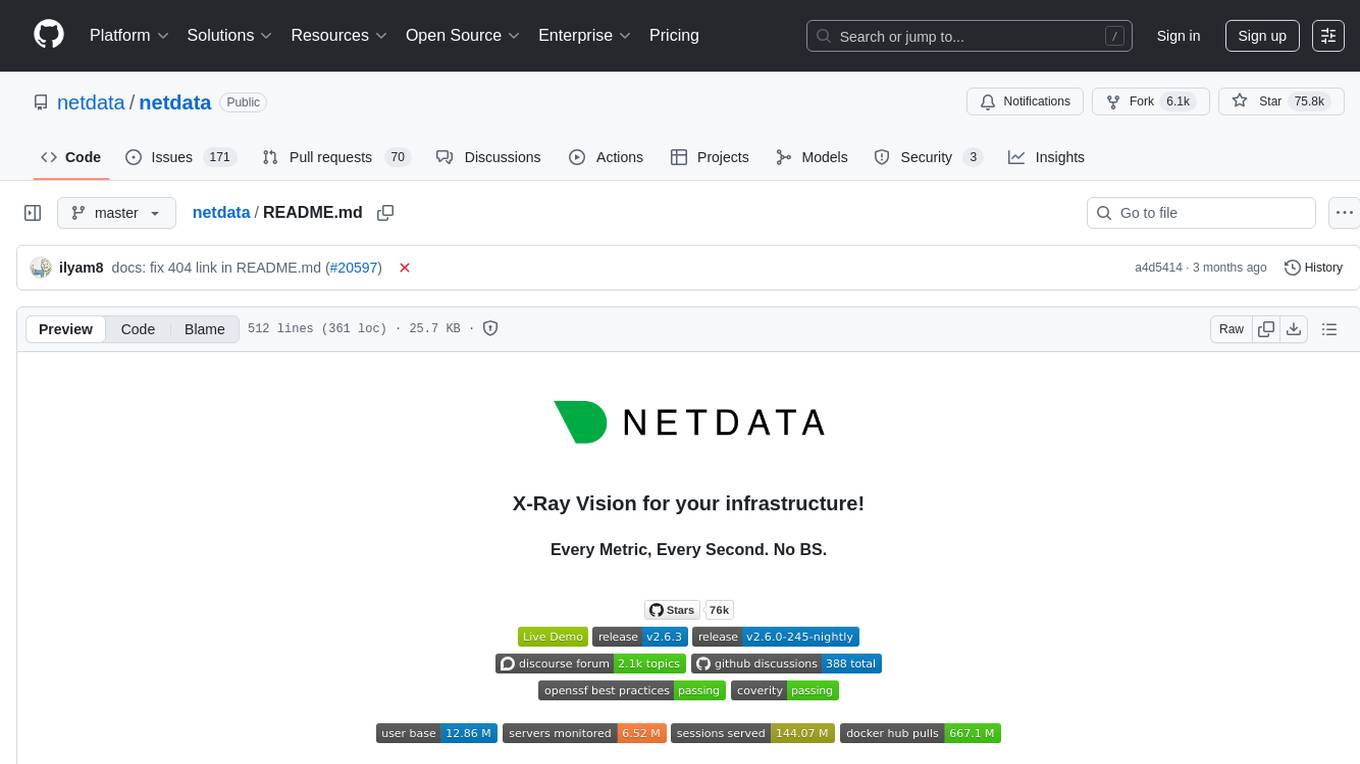
netdata
Netdata is an open-source, real-time infrastructure monitoring platform that provides instant insights, zero configuration deployment, ML-powered anomaly detection, efficient monitoring with minimal resource usage, and secure & distributed data storage. It offers real-time, per-second updates and clear insights at a glance. Netdata's origin story involves addressing the limitations of existing monitoring tools and led to a fundamental shift in infrastructure monitoring. It is recognized as the most energy-efficient tool for monitoring Docker-based systems according to a study by the University of Amsterdam.
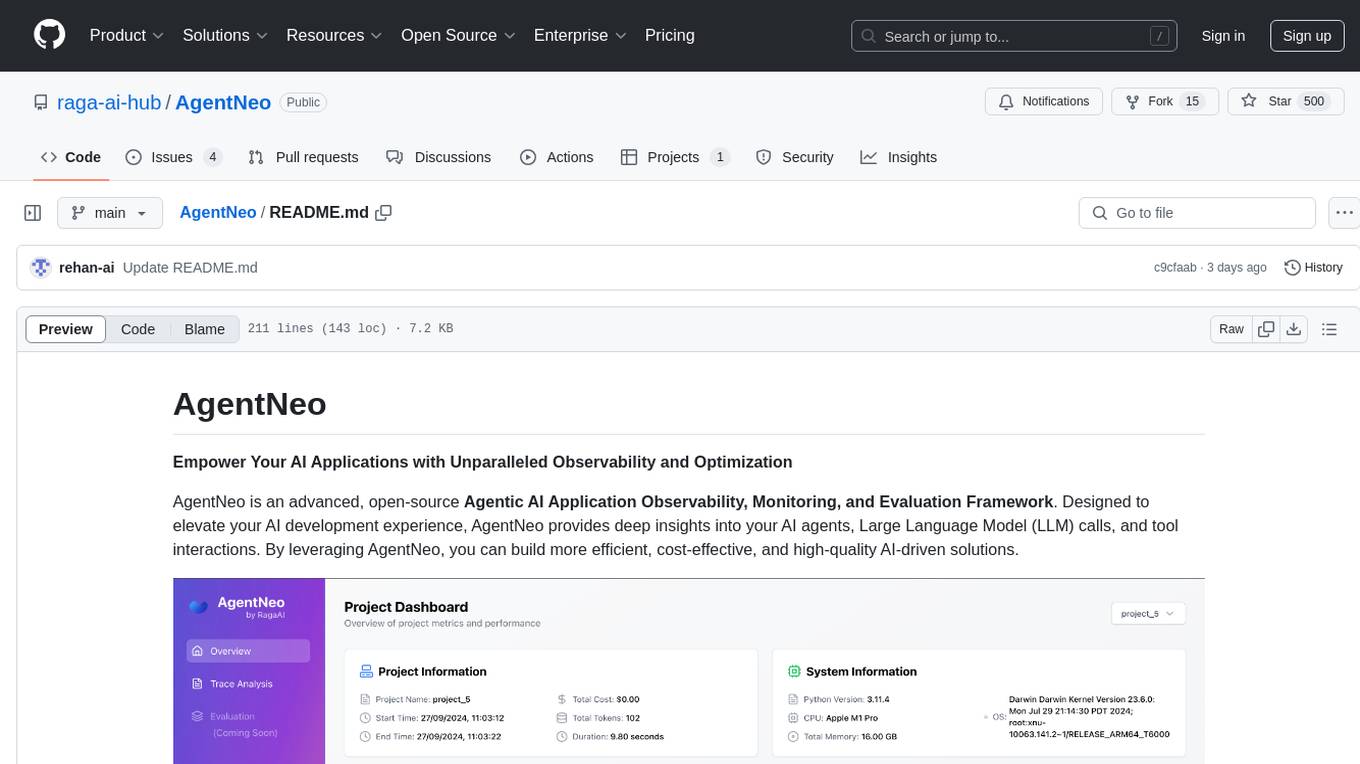
AgentNeo
AgentNeo is an advanced, open-source Agentic AI Application Observability, Monitoring, and Evaluation Framework designed to provide deep insights into AI agents, Large Language Model (LLM) calls, and tool interactions. It offers robust logging, visualization, and evaluation capabilities to help debug and optimize AI applications with ease. With features like tracing LLM calls, monitoring agents and tools, tracking interactions, detailed metrics collection, flexible data storage, simple instrumentation, interactive dashboard, project management, execution graph visualization, and evaluation tools, AgentNeo empowers users to build efficient, cost-effective, and high-quality AI-driven solutions.
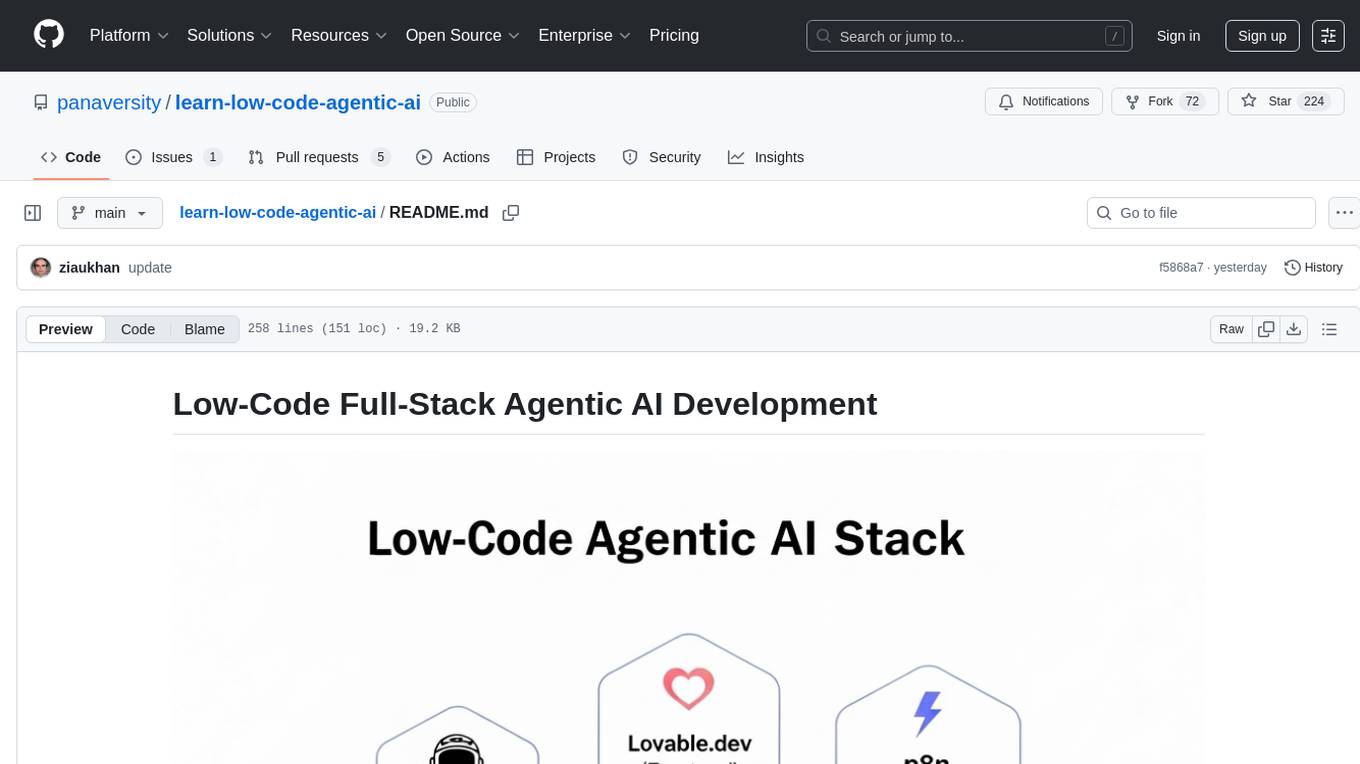
learn-low-code-agentic-ai
This repository is dedicated to learning about Low-Code Full-Stack Agentic AI Development. It provides material for building modern AI-powered applications using a low-code full-stack approach. The main tools covered are UXPilot for UI/UX mockups, Lovable.dev for frontend applications, n8n for AI agents and workflows, Supabase for backend data storage, authentication, and vector search, and Model Context Protocol (MCP) for integration. The focus is on prompt and context engineering as the foundation for working with AI systems, enabling users to design, develop, and deploy AI-driven full-stack applications faster, smarter, and more reliably.
heurist-agent-framework
Heurist Agent Framework is a flexible multi-interface AI agent framework that allows processing text and voice messages, generating images and videos, interacting across multiple platforms, fetching and storing information in a knowledge base, accessing external APIs and tools, and composing complex workflows using Mesh Agents. It supports various platforms like Telegram, Discord, Twitter, Farcaster, REST API, and MCP. The framework is built on a modular architecture and provides core components, tools, workflows, and tool integration with MCP support.
rhesis
Rhesis is a comprehensive test management platform designed for Gen AI teams, offering tools to create, manage, and execute test cases for generative AI applications. It ensures the robustness, reliability, and compliance of AI systems through features like test set management, automated test generation, edge case discovery, compliance validation, integration capabilities, and performance tracking. The platform is open source, emphasizing community-driven development, transparency, extensible architecture, and democratizing AI safety. It includes components such as backend services, frontend applications, SDK for developers, worker services, chatbot applications, and Polyphemus for uncensored LLM service. Rhesis enables users to address challenges unique to testing generative AI applications, such as non-deterministic outputs, hallucinations, edge cases, ethical concerns, and compliance requirements.
ToolUniverse
ToolUniverse is a collection of 211 biomedical tools designed for Agentic AI, providing access to biomedical knowledge for solving therapeutic reasoning tasks. The tools cover various aspects of drugs and diseases, linked to trusted sources like US FDA-approved drugs since 1939, Open Targets, and Monarch Initiative.
natively-cluely-ai-assistant
Natively is a free, open-source, privacy-first AI assistant designed to help users in real time during meetings, interviews, presentations, and conversations. Unlike traditional AI tools that work after the conversation, Natively operates while the conversation is happening. It runs as an invisible, always-on-top desktop overlay, listens when prompted, observes the screen content, and provides instant, context-aware assistance. The tool is fully transparent, customizable, and grants users complete control over local vs cloud AI, data, and credentials.
Pulse
Pulse is a real-time monitoring tool designed for Proxmox, Docker, and Kubernetes infrastructure. It provides a unified dashboard to consolidate metrics, alerts, and AI-powered insights into a single interface. Suitable for homelabs, sysadmins, and MSPs, Pulse offers core monitoring features, AI-powered functionalities, multi-platform support, security and operations features, and community integrations. Pulse Pro unlocks advanced AI analysis and auto-fix capabilities. The tool is privacy-focused, secure by design, and offers detailed documentation for installation, configuration, security, troubleshooting, and more.
tensorzero
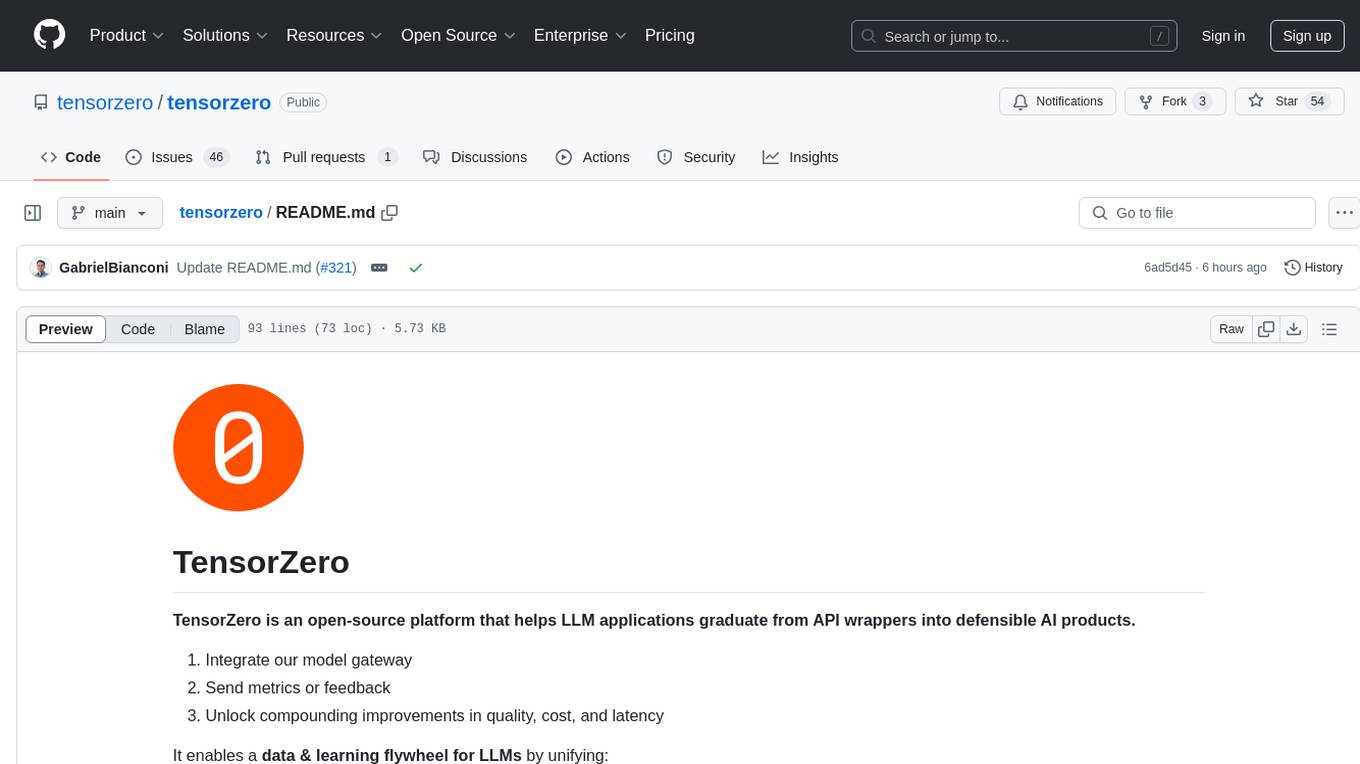
TensorZero is an open-source platform that helps LLM applications graduate from API wrappers into defensible AI products. It enables a data & learning flywheel for LLMs by unifying inference, observability, optimization, and experimentation. The platform includes a high-performance model gateway, structured schema-based inference, observability, experimentation, and data warehouse for analytics. TensorZero Recipes optimize prompts and models, and the platform supports experimentation features and GitOps orchestration for deployment.
lawglance
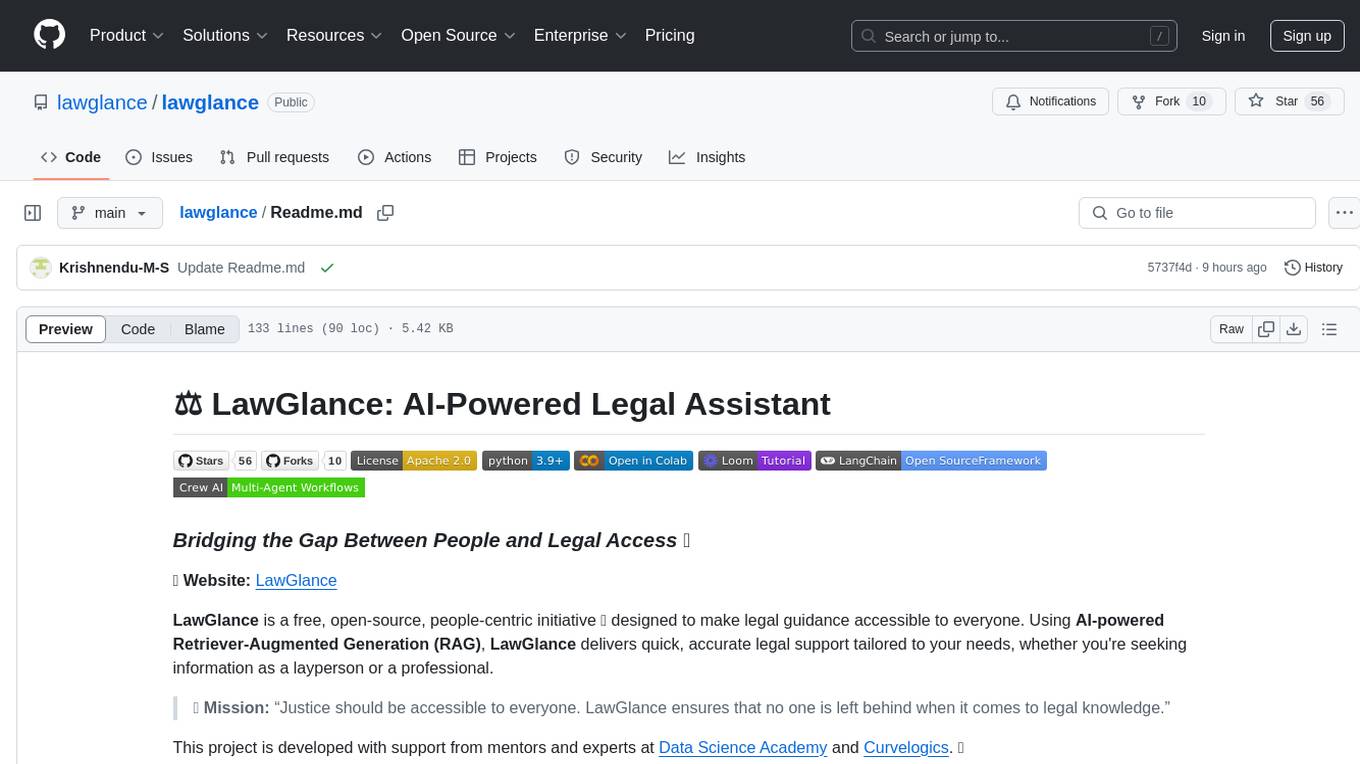
LawGlance is an AI-powered legal assistant that aims to bridge the gap between people and legal access. It is a free, open-source initiative designed to provide quick and accurate legal support tailored to individual needs. The project covers various laws, with plans for international expansion in the future. LawGlance utilizes AI-powered Retriever-Augmented Generation (RAG) to deliver legal guidance accessible to both laypersons and professionals. The tool is developed with support from mentors and experts at Data Science Academy and Curvelogics.
claude-007-agents
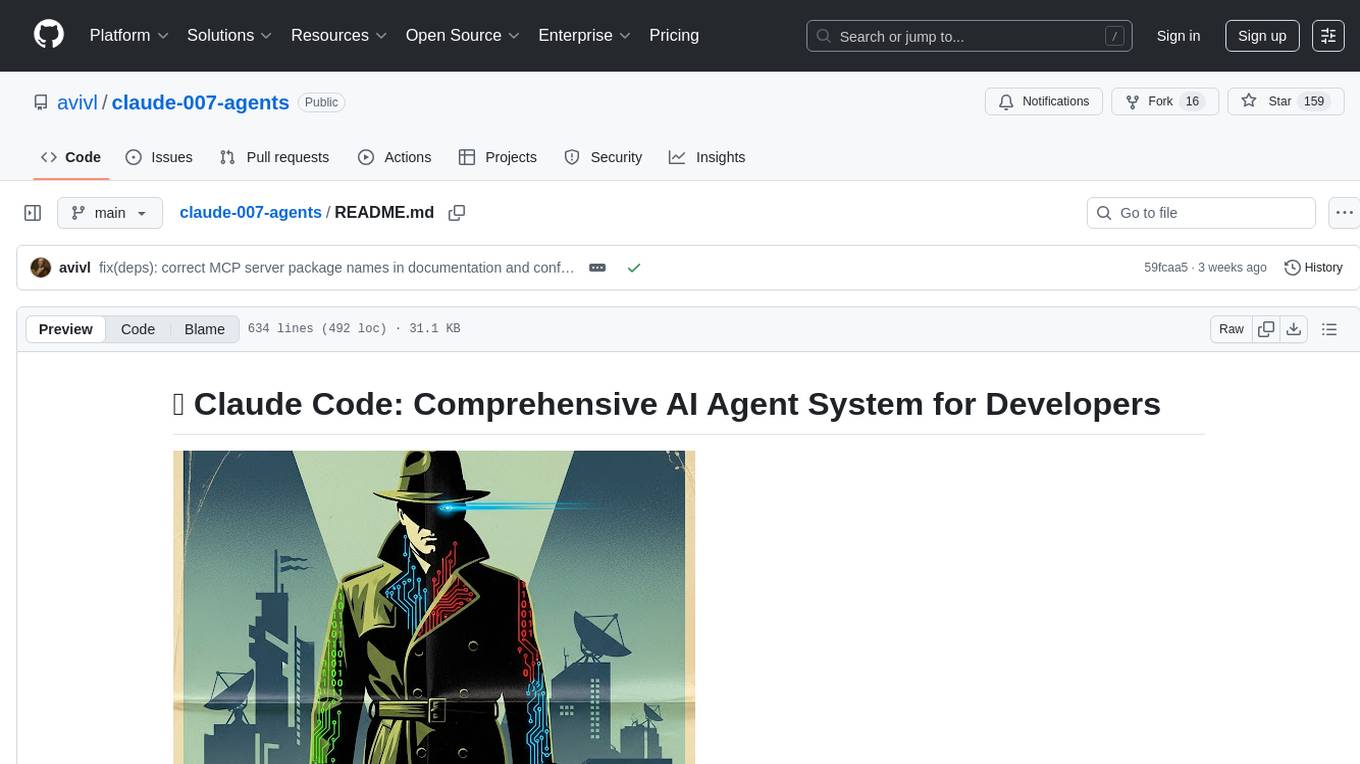
Claude Code Agents is an open-source AI agent system designed to enhance development workflows by providing specialized AI agents for orchestration, resilience engineering, and organizational memory. These agents offer specialized expertise across technologies, AI system with organizational memory, and an agent orchestration system. The system includes features such as engineering excellence by design, advanced orchestration system, Task Master integration, live MCP integrations, professional-grade workflows, and organizational intelligence. It is suitable for solo developers, small teams, enterprise teams, and open-source projects. The system requires a one-time bootstrap setup for each project to analyze the tech stack, select optimal agents, create configuration files, set up Task Master integration, and validate system readiness.
osaurus
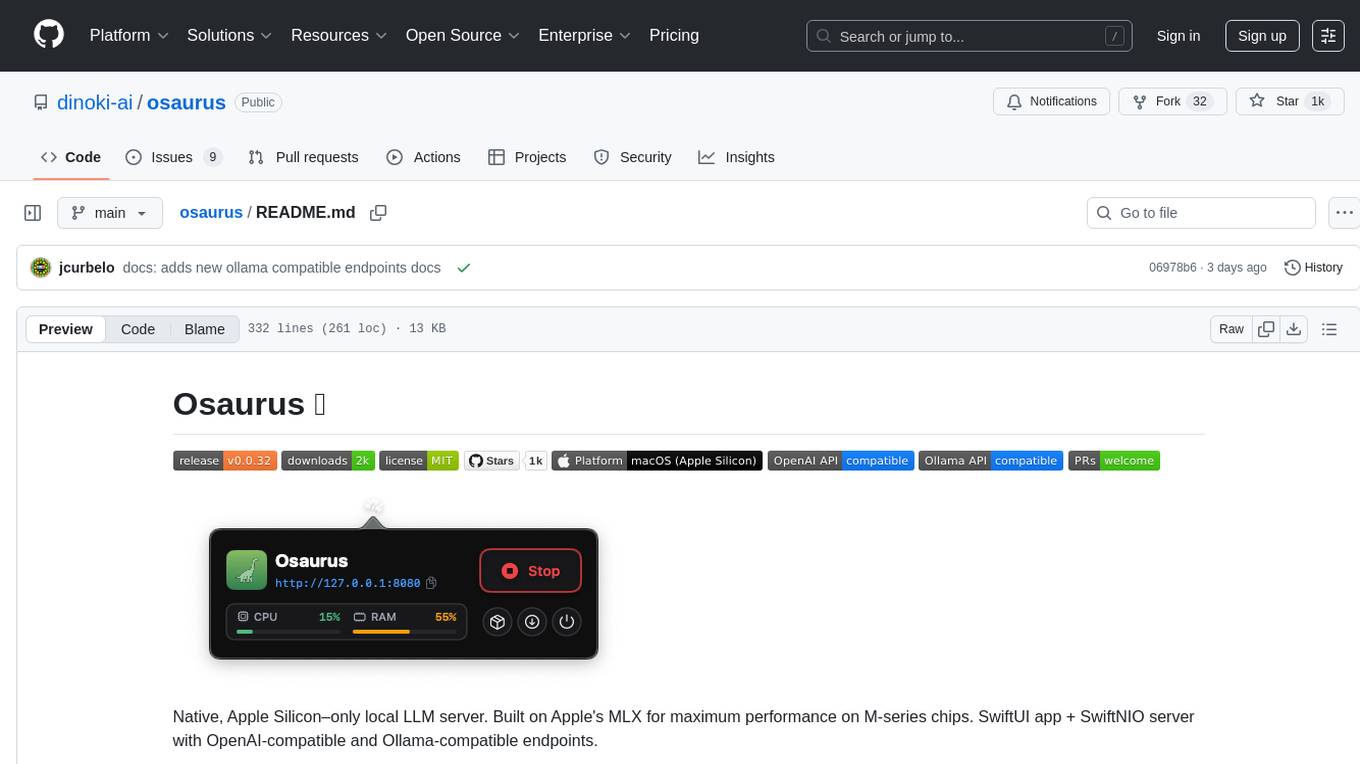
Osaurus is a native, Apple Silicon-only local LLM server built on Apple's MLX for maximum performance on M‑series chips. It is a SwiftUI app + SwiftNIO server with OpenAI‑compatible and Ollama‑compatible endpoints. The tool supports native MLX text generation, model management, streaming and non‑streaming chat completions, OpenAI‑compatible function calling, real-time system resource monitoring, and path normalization for API compatibility. Osaurus is designed for macOS 15.5+ and Apple Silicon (M1 or newer) with Xcode 16.4+ required for building from source.
For similar tasks
ITBench
ITBench is a platform designed to measure the performance of AI agents in complex and real-world inspired IT automation tasks. It focuses on three key use cases: Site Reliability Engineering (SRE), Compliance & Security Operations (CISO), and Financial Operations (FinOps). The platform provides a real-world representation of IT environments, open and extensible framework, push-button workflows, and Kubernetes-based scenario environments. Researchers and developers can replicate real-world incidents in Kubernetes environments, develop AI agents, and evaluate them using a fully-managed leaderboard.
llm-price-compass
LLM price compass is an open-source tool for comparing inference costs on different GPUs across various cloud providers. It collects benchmark data to help users select the right GPU, cloud, and provider for their models. The project aims to provide insights into fixed per token costs from different providers, aiding in decision-making for model deployment.
sre
SmythOS is an operating system designed for building, deploying, and managing intelligent AI agents at scale. It provides a unified SDK and resource abstraction layer for various AI services, making it easy to scale and flexible. With an agent-first design, developer-friendly SDK, modular architecture, and enterprise security features, SmythOS offers a robust foundation for AI workloads. The system is built with a philosophy inspired by traditional operating system kernels, ensuring autonomy, control, and security for AI agents. SmythOS aims to make shipping production-ready AI agents accessible and open for everyone in the coming Internet of Agents era.
kubectl-mcp-server
Control your entire Kubernetes infrastructure through natural language conversations with AI. Talk to your clusters like you talk to a DevOps expert. Debug crashed pods, optimize costs, deploy applications, audit security, manage Helm charts, and visualize dashboards—all through natural language. The tool provides 253 powerful tools, 8 workflow prompts, 8 data resources, and works with all major AI assistants. It offers AI-powered diagnostics, built-in cost optimization, enterprise-ready features, zero learning curve, universal compatibility, visual insights, and production-grade deployment options. From debugging crashed pods to optimizing cluster costs, kubectl-mcp-server is your AI-powered DevOps companion.
topsha
LocalTopSH is an AI Agent Framework designed for companies and developers who require 100% on-premise AI agents with data privacy. It supports various OpenAI-compatible LLM backends and offers production-ready security features. The framework allows simple deployment using Docker compose and ensures that data stays within the user's network, providing full control and compliance. With cost-effective scaling options and compatibility in regions with restrictions, LocalTopSH is a versatile solution for deploying AI agents on self-hosted infrastructure.
wtf.nvim
wtf.nvim is a Neovim plugin that enhances diagnostic debugging by providing explanations and solutions for code issues using ChatGPT. It allows users to search the web for answers directly from Neovim, making the debugging process faster and more efficient. The plugin works with any language that has LSP support in Neovim, offering AI-powered diagnostic assistance and seamless integration with various resources for resolving coding problems.
AI-Agent-Starter-Kit
AI Agent Starter Kit is a modern full-stack AI-enabled template using Next.js for frontend and Express.js for backend, with Telegram and OpenAI integrations. It offers AI-assisted development, smart environment variable setup assistance, intelligent error resolution, context-aware code completion, and built-in debugging helpers. The kit provides a structured environment for developers to interact with AI tools seamlessly, enhancing the development process and productivity.
For similar jobs
weave
Weave is a toolkit for developing Generative AI applications, built by Weights & Biases. With Weave, you can log and debug language model inputs, outputs, and traces; build rigorous, apples-to-apples evaluations for language model use cases; and organize all the information generated across the LLM workflow, from experimentation to evaluations to production. Weave aims to bring rigor, best-practices, and composability to the inherently experimental process of developing Generative AI software, without introducing cognitive overhead.
LLMStack
LLMStack is a no-code platform for building generative AI agents, workflows, and chatbots. It allows users to connect their own data, internal tools, and GPT-powered models without any coding experience. LLMStack can be deployed to the cloud or on-premise and can be accessed via HTTP API or triggered from Slack or Discord.
VisionCraft
The VisionCraft API is a free API for using over 100 different AI models. From images to sound.
kaito
Kaito is an operator that automates the AI/ML inference model deployment in a Kubernetes cluster. It manages large model files using container images, avoids tuning deployment parameters to fit GPU hardware by providing preset configurations, auto-provisions GPU nodes based on model requirements, and hosts large model images in the public Microsoft Container Registry (MCR) if the license allows. Using Kaito, the workflow of onboarding large AI inference models in Kubernetes is largely simplified.
PyRIT
PyRIT is an open access automation framework designed to empower security professionals and ML engineers to red team foundation models and their applications. It automates AI Red Teaming tasks to allow operators to focus on more complicated and time-consuming tasks and can also identify security harms such as misuse (e.g., malware generation, jailbreaking), and privacy harms (e.g., identity theft). The goal is to allow researchers to have a baseline of how well their model and entire inference pipeline is doing against different harm categories and to be able to compare that baseline to future iterations of their model. This allows them to have empirical data on how well their model is doing today, and detect any degradation of performance based on future improvements.
tabby
Tabby is a self-hosted AI coding assistant, offering an open-source and on-premises alternative to GitHub Copilot. It boasts several key features: * Self-contained, with no need for a DBMS or cloud service. * OpenAPI interface, easy to integrate with existing infrastructure (e.g Cloud IDE). * Supports consumer-grade GPUs.
spear
SPEAR (Simulator for Photorealistic Embodied AI Research) is a powerful tool for training embodied agents. It features 300 unique virtual indoor environments with 2,566 unique rooms and 17,234 unique objects that can be manipulated individually. Each environment is designed by a professional artist and features detailed geometry, photorealistic materials, and a unique floor plan and object layout. SPEAR is implemented as Unreal Engine assets and provides an OpenAI Gym interface for interacting with the environments via Python.
Magick
Magick is a groundbreaking visual AIDE (Artificial Intelligence Development Environment) for no-code data pipelines and multimodal agents. Magick can connect to other services and comes with nodes and templates well-suited for intelligent agents, chatbots, complex reasoning systems and realistic characters.