


cody-product-builder
Cody Product Builder is a spec driven product development toolkit that helps domain experts build scalable apps using AI and vibe coding techniques.
Stars: 54
Cody Product Builder is an opinionated, spec‑driven AI agent skill that helps product builders who use vibe coding techniques turn loose ideas into fully planned, production‑ready products using AI. It guides users through a structured flow of discovery, planning, chunking, and building to ensure clear thinking before generating code. The tool provides templates, commands, and a repeatable methodology for building products consistently and fast with AI integration. It bridges the gap between brainstorming and systematic development, offering structure without rigidity, iterative refinement, version-based development, and living documentation.
README:




Get the latest updates, news, and more by joining our Discord community.
⭐⭐ If you find this skill helpful, please star this repo to show your support! ⭐⭐
Cody Product Builder is an opinionated, spec‑driven AI agent skill that helps product builders who use vibe coding techniques turn loose ideas into fully planned, production‑ready products using AI. Instead of jumping straight into “vibe coding,” Cody Product Builder guides you through a structured flow - discovery, planning, chunking, and building - so you think clearly before generating code.
Cody Product Builder began as a simple spec‑driven development framework, but it has evolved into a full AI agent skill that includes templates, commands, and a repeatable methodology for building products using AI consistently and fast.
Capture sparks of inspiration and shape them into clear, aligned, well‑defined product concepts.
Use AI‑ready documents that organize your thoughts, requirements, flows, and decisions - while still letting ideas evolve naturally.
Break the work into manageable, incremental “versions” that you can build, test, and ship faster with AI.
AI coding tools are powerful - but without structure, things fall apart:
messy prompts → inconsistent code → unclear requirements → lost context → endless rework.
Cody Product Builder solves this by giving you:
- A repeatable, spec‑driven workflow AI coding tools can follow
- Templates and commands that eliminate guesswork
- A shared rhythm between you, your team, and your AI coding agents
- A clear methodology that turns vibe coding techniques into predictable building
- A consistent structure for specs, docs, tasks, and versions
- Faster progress with less rework
- Better collaboration between humans + AI
- A methodology for building products, not just writing code
Cody Product Builder blends the creativity of vibe coding techniques with the structure of professional product development - powered by AI from end to end.
- Scaffolding: Templates, docs, and patterns to help you start faster
- Agent‑friendly flexibility: Cody Product Builder guides, you stay in control
- AI‑first integration: Works directly with AI dev environments
- Consistency at scale: Solo or team, Cody Product Builder keeps everything aligned
Cody Product Builder bridges the gap between brainstorming and systematic development:
- Structure Without Rigidity – Supports you without limiting creativity
- Iterative Refinement – Built‑in loops between you and AI
- Version‑based Development – Work broken into modular chunks
- Living Documentation – Docs evolve as your product evolves
Turn raw ideas into actionable plans using three core documents:
Captures the unfiltered initial idea and starts an interactive Q&A with the AI agent. The outcome is a clear vision and baseline requirements.
Defines “what and why,” including goals, target users, features, success criteria, stories, assumptions, and dependencies.
Defines “how and when,” including architecture, components, data model, milestones, risks, tooling, and delivery strategy.
The build phase translates the plan into structured, version‑based execution.
A centralized list of all features, organized into versions with priority and status tracking (🔴 Not Started, 🟡 In Progress, 🟢 Completed).
Each version includes:
Technical implementation guidance, architecture overview, and open questions.
A detailed breakdown of tasks derived from the Feature Backlog.
Lessons learned, improvements, successes, and feedback for both you and the AI agent.
Automatically updated after each version, tracking changes, enhancements, and fixes.
-
Format:
v[major.minor.patch]-[name] -
Example:
v1.0.3-refactor-code
- Start at
v0.1.0unless specified - Names ≤ 30 characters, lowercase, alphanumeric +
- - Automatic version increment unless specified
-
[name]is optional
Commands use the format: :cody [command]
| Command | Description |
|---|---|
:cody help |
Shows help and all available commands. |
:cody plan |
Starts the PLAN phase and creates a new Cody Product Builder project. |
:cody build |
Starts the BUILD phase and creates the backlog. |
:cody version build |
Builds a specific version and updates release notes once completed. |
:cody version add |
Adds a new version to the backlog. |
:cody refresh |
Refreshes the AI agent’s memory about the project. |
:cody refresh update |
Refresh + sync: updates PRD, plan, and release notes. |
:cody relearn |
Forces the AI agent to re-learn how Cody Product Builder works. |
:cody assets list |
Lists asset files and their purpose. |
.claude/
└── commands/              # Claude Code slash commands
    └── cody.md            # Main activation command for Claude Code

.cody/
├── config/                # Configuration and core files
│   ├── activate.md        # Activation instructions for AI agents
│   ├── agent.md           # Core agent instructions and command registry
│   ├── settings.json      # Tool version and settings
│   ├── commands/          # Command implementation files (help, plan, build, etc.)
│   └── templates/         # Document templates for plan and build phases
│       ├── plan/          # Templates for discovery.md, prd.md, plan.md
│       └── build/         # Templates for feature-backlog.md, release-notes.md
│           └── version/   # Templates for design.md, tasklist.md, retrospective.md
└── project/               # Generated project files (created during :cody plan)
    ├── library/           # Project-specific resources
    │   ├── assets/        # Images, diagrams, reference files
    │   ├── docs/          # Tech stack, design system, API documentation
    ├── plan/              # Planning phase documents (discovery, PRD, plan)
    └── build/             # Build phase documents (backlog, release notes, versions)

.github/
└── prompts/               # GitHub Copilot prompt files
    └── cody.prompt.md     # Main activation prompt for GitHub Copilot
- Be thorough during discovery
- Break complexity into modular components
- Identify integrations and dependencies upfront
- Start small for early wins
- Keep the backlog current
- Use retrospectives deliberately
- Group features into logical versions
- Provide context early
- Treat AI output as drafts
- Explore alternatives and edge cases
- Iterate frequently
- Clone or download Cody Product Builder from: https://github.com/ibuildwith-ai/cody-product-builder
- Copy the
.cody,.claude, and.githubfolders into your project root.
-
Claude Code: Use the
/codycommand -
GitHub Copilot: Use the
/codycommand - Other AI Agents: Say: "Please read and execute the @.cody/config/activate.md"
-
:cody help– Overview of all commands -
:cody plan– Begin the structured PLAN phase
Cody Product Builder works with any AI Development Environment (Claude Code, Codex, Cursor, OpenCode, GitHub Copilot, etc.) with file management capabilities.
iBuildWith.ai
© Copyright 2026 – Red Pill Blue Pill Studios, LLC – All Rights Reserved.
Part of the Cody family of AI Agent Skills:
- Cody Product Builder — Build products with AI
- Cody Article Writer — Write articles with AI
Cody Product Builder is licensed under a custom license that permits free use for product building (including commercial use), but prohibits redistribution, modification, and sale of the software itself.
See LICENSE.md for complete terms.
Coming soon.
For Tasks:
Click tags to check more tools for each tasksFor Jobs:
Alternative AI tools for cody-product-builder
Similar Open Source Tools
cody-product-builder
Cody Product Builder is an opinionated, spec‑driven AI agent skill that helps product builders who use vibe coding techniques turn loose ideas into fully planned, production‑ready products using AI. It guides users through a structured flow of discovery, planning, chunking, and building to ensure clear thinking before generating code. The tool provides templates, commands, and a repeatable methodology for building products consistently and fast with AI integration. It bridges the gap between brainstorming and systematic development, offering structure without rigidity, iterative refinement, version-based development, and living documentation.
actionbook
Actionbook is a browser action engine designed for AI agents, providing up-to-date action manuals and DOM structure to enable instant website operations without guesswork. It offers faster execution, token savings, resilient automation, and universal compatibility, making it ideal for building reliable browser agents. Actionbook integrates seamlessly with AI coding assistants and offers three integration methods: CLI, MCP Server, and JavaScript SDK. The tool is well-documented and actively developed in a monorepo setup using pnpm workspaces and Turborepo.
instill-core
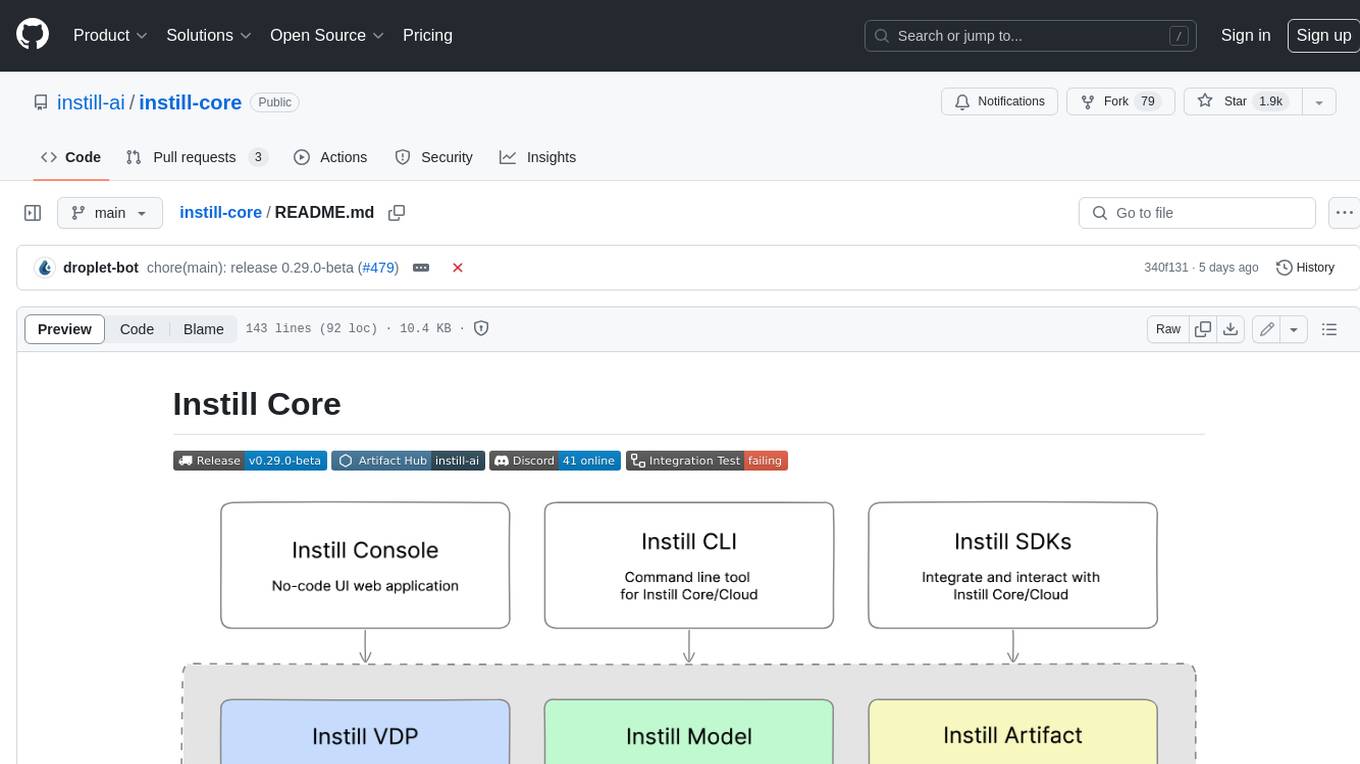
Instill Core is an open-source orchestrator comprising a collection of source-available projects designed to streamline every aspect of building versatile AI features with unstructured data. It includes Instill VDP (Versatile Data Pipeline) for unstructured data, AI, and pipeline orchestration, Instill Model for scalable MLOps and LLMOps for open-source or custom AI models, and Instill Artifact for unified unstructured data management. Instill Core can be used for tasks such as building, testing, and sharing pipelines, importing, serving, fine-tuning, and monitoring ML models, and transforming documents, images, audio, and video into a unified AI-ready format.
TaskingAI
TaskingAI brings Firebase's simplicity to **AI-native app development**. The platform enables the creation of GPTs-like multi-tenant applications using a wide range of LLMs from various providers. It features distinct, modular functions such as Inference, Retrieval, Assistant, and Tool, seamlessly integrated to enhance the development process. TaskingAI’s cohesive design ensures an efficient, intelligent, and user-friendly experience in AI application development.
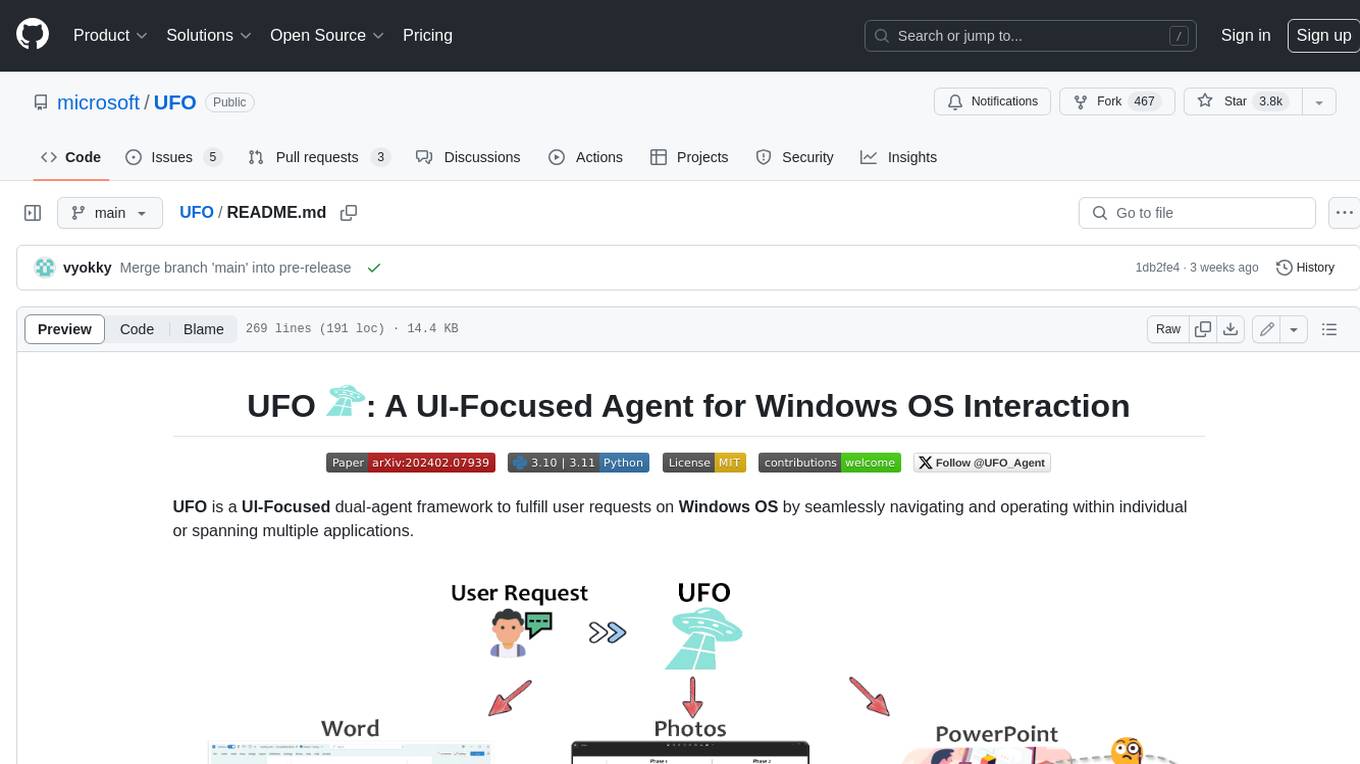
UFO
UFO is a UI-focused dual-agent framework to fulfill user requests on Windows OS by seamlessly navigating and operating within individual or spanning multiple applications.
Director
Director is a framework to build video agents that can reason through complex video tasks like search, editing, compilation, generation, etc. It enables users to summarize videos, search for specific moments, create clips instantly, integrate GenAI projects and APIs, add overlays, generate thumbnails, and more. Built on VideoDB's 'video-as-data' infrastructure, Director is perfect for developers, creators, and teams looking to simplify media workflows and unlock new possibilities.
DevoxxGenieIDEAPlugin
Devoxx Genie is a Java-based IntelliJ IDEA plugin that integrates with local and cloud-based LLM providers to aid in reviewing, testing, and explaining project code. It supports features like code highlighting, chat conversations, and adding files/code snippets to context. Users can modify REST endpoints and LLM parameters in settings, including support for cloud-based LLMs. The plugin requires IntelliJ version 2023.3.4 and JDK 17. Building and publishing the plugin is done using Gradle tasks. Users can select an LLM provider, choose code, and use commands like review, explain, or generate unit tests for code analysis.
plandex
Plandex is an open source, terminal-based AI coding engine designed for complex tasks. It uses long-running agents to break up large tasks into smaller subtasks, helping users work through backlogs, navigate unfamiliar technologies, and save time on repetitive tasks. Plandex supports various AI models, including OpenAI, Anthropic Claude, Google Gemini, and more. It allows users to manage context efficiently in the terminal, experiment with different approaches using branches, and review changes before applying them. The tool is platform-independent and runs from a single binary with no dependencies.
arbigent
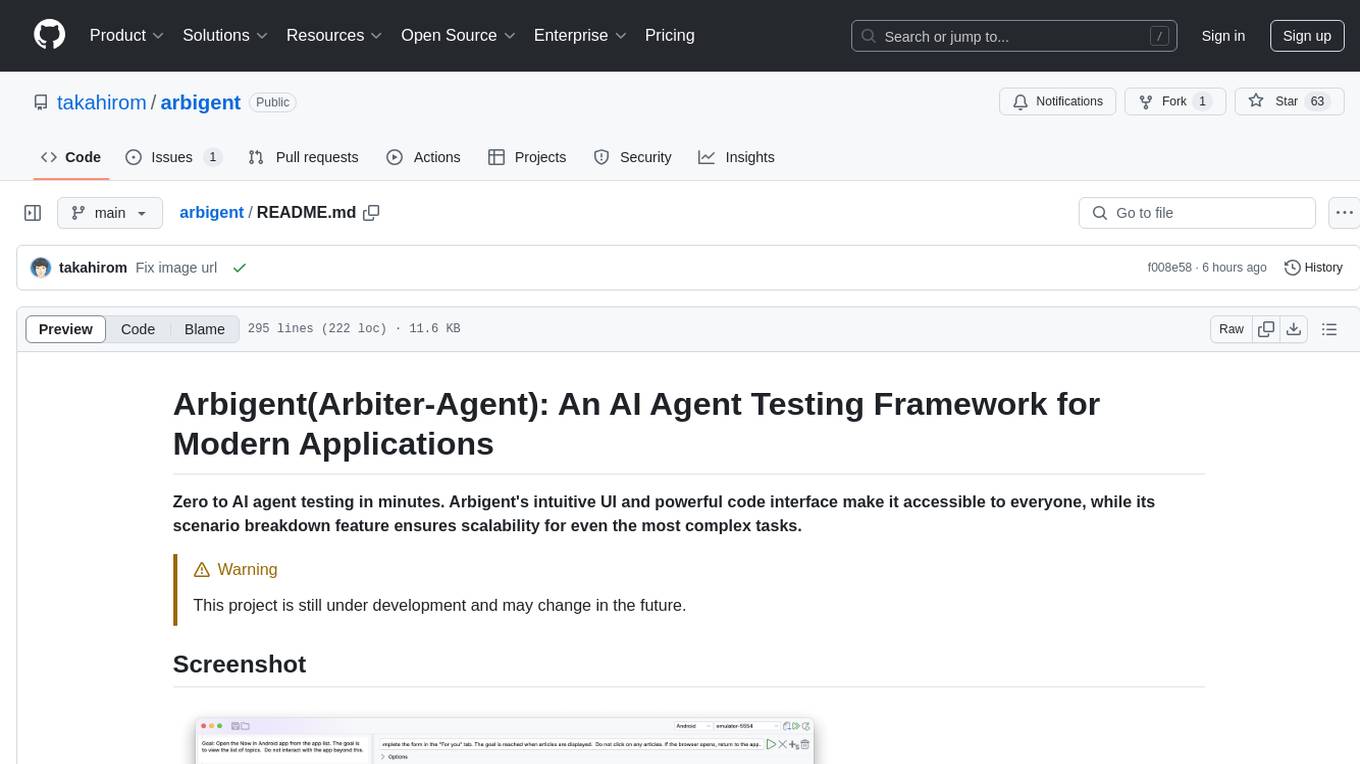
Arbigent (Arbiter-Agent) is an AI agent testing framework designed to make AI agent testing practical for modern applications. It addresses challenges faced by traditional UI testing frameworks and AI agents by breaking down complex tasks into smaller, dependent scenarios. The framework is customizable for various AI providers, operating systems, and form factors, empowering users with extensive customization capabilities. Arbigent offers an intuitive UI for scenario creation and a powerful code interface for seamless test execution. It supports multiple form factors, optimizes UI for AI interaction, and is cost-effective by utilizing models like GPT-4o mini. With a flexible code interface and open-source nature, Arbigent aims to revolutionize AI agent testing in modern applications.
zenml
ZenML is an extensible, open-source MLOps framework for creating portable, production-ready machine learning pipelines. By decoupling infrastructure from code, ZenML enables developers across your organization to collaborate more effectively as they develop to production.

DevDocs
DevDocs is a platform designed to simplify the process of digesting technical documentation for software engineers and developers. It automates the extraction and conversion of web content into markdown format, making it easier for users to access and understand the information. By crawling through child pages of a given URL, DevDocs provides a streamlined approach to gathering relevant data and integrating it into various tools for software development. The tool aims to save time and effort by eliminating the need for manual research and content extraction, ultimately enhancing productivity and efficiency in the development process.
gptme
Personal AI assistant/agent in your terminal, with tools for using the terminal, running code, editing files, browsing the web, using vision, and more. A great coding agent that is general-purpose to assist in all kinds of knowledge work, from a simple but powerful CLI. An unconstrained local alternative to ChatGPT with 'Code Interpreter', Cursor Agent, etc. Not limited by lack of software, internet access, timeouts, or privacy concerns if using local models.
tuff
Tuff is a local-first, AI-native, and infinitely extensible desktop command center designed to enhance workflow efficiency. It offers a seamless integration of core utilities, AI-powered search, contextual intelligence, and extensibility through custom plugins. With a beautiful UI design, rich functionality, simple operations, and a focus on security and reliability, Tuff provides users with a cross-platform desktop software that is easy to use and offers a good user experience.
solace-agent-mesh
Solace Agent Mesh is an open-source framework designed for building event-driven multi-agent AI systems. It enables the creation of teams of AI agents with distinct skills and tools, facilitating communication and task delegation among agents. The framework is built on top of Solace AI Connector and Google's Agent Development Kit, providing a standardized communication layer for asynchronous, event-driven AI agent architecture. Solace Agent Mesh supports agent orchestration, flexible interfaces, extensibility, agent-to-agent communication, and dynamic embeds, making it suitable for developing complex AI applications with scalability and reliability.
Easy-Voice-Toolkit
Easy Voice Toolkit is a toolkit based on open source voice projects, providing automated audio tools including speech model training. Users can seamlessly integrate functions like audio processing, voice recognition, voice transcription, dataset creation, model training, and voice conversion to transform raw audio files into ideal speech models. The toolkit supports multiple languages and is currently only compatible with Windows systems. It acknowledges the contributions of various projects and offers local deployment options for both users and developers. Additionally, cloud deployment on Google Colab is available. The toolkit has been tested on Windows OS devices and includes a FAQ section and terms of use for academic exchange purposes.
Simplifine
Simplifine is an open-source library designed for easy LLM finetuning, enabling users to perform tasks such as supervised fine tuning, question-answer finetuning, contrastive loss for embedding tasks, multi-label classification finetuning, and more. It provides features like WandB logging, in-built evaluation tools, automated finetuning parameters, and state-of-the-art optimization techniques. The library offers bug fixes, new features, and documentation updates in its latest version. Users can install Simplifine via pip or directly from GitHub. The project welcomes contributors and provides comprehensive documentation and support for users.
For similar tasks
cody-product-builder
Cody Product Builder is an opinionated, spec‑driven AI agent skill that helps product builders who use vibe coding techniques turn loose ideas into fully planned, production‑ready products using AI. It guides users through a structured flow of discovery, planning, chunking, and building to ensure clear thinking before generating code. The tool provides templates, commands, and a repeatable methodology for building products consistently and fast with AI integration. It bridges the gap between brainstorming and systematic development, offering structure without rigidity, iterative refinement, version-based development, and living documentation.
blinko
Blinko is an innovative open-source project designed for individuals who want to quickly capture and organize their fleeting thoughts. It allows users to seamlessly jot down ideas the moment they strike, ensuring that no spark of creativity is lost. With advanced AI-powered note retrieval, data ownership, efficient and fast capturing, lightweight architecture, and open collaboration, Blinko offers a comprehensive solution for managing and accessing notes.
curiso
Curiso AI is an infinite canvas platform that connects nodes and AI services to explore ideas without repetition. It empowers advanced users to unlock richer AI interactions. Features include multi OS support, infinite canvas, multiple AI provider integration, local AI inference provider integration, custom model support, model metrics, RAG support, local Transformers.js embedding models, inference parameters customization, multiple boards, vision model support, customizable interface, node-based conversations, and secure local encrypted storage. Curiso also offers a Solana token for exclusive access to premium features and enhanced AI capabilities.
blinko
Blinko is an innovative open-source project designed for individuals who want to quickly capture and organize their fleeting thoughts. It allows users to seamlessly jot down ideas, ensuring no spark of creativity is lost. With AI-enhanced note retrieval, data ownership, efficient and fast note-taking, lightweight architecture, and open collaboration, Blinko offers a robust platform for managing and accessing notes effortlessly.
For similar jobs
sweep
Sweep is an AI junior developer that turns bugs and feature requests into code changes. It automatically handles developer experience improvements like adding type hints and improving test coverage.
teams-ai
The Teams AI Library is a software development kit (SDK) that helps developers create bots that can interact with Teams and Microsoft 365 applications. It is built on top of the Bot Framework SDK and simplifies the process of developing bots that interact with Teams' artificial intelligence capabilities. The SDK is available for JavaScript/TypeScript, .NET, and Python.
ai-guide
This guide is dedicated to Large Language Models (LLMs) that you can run on your home computer. It assumes your PC is a lower-end, non-gaming setup.
classifai
Supercharge WordPress Content Workflows and Engagement with Artificial Intelligence. Tap into leading cloud-based services like OpenAI, Microsoft Azure AI, Google Gemini and IBM Watson to augment your WordPress-powered websites. Publish content faster while improving SEO performance and increasing audience engagement. ClassifAI integrates Artificial Intelligence and Machine Learning technologies to lighten your workload and eliminate tedious tasks, giving you more time to create original content that matters.
chatbot-ui
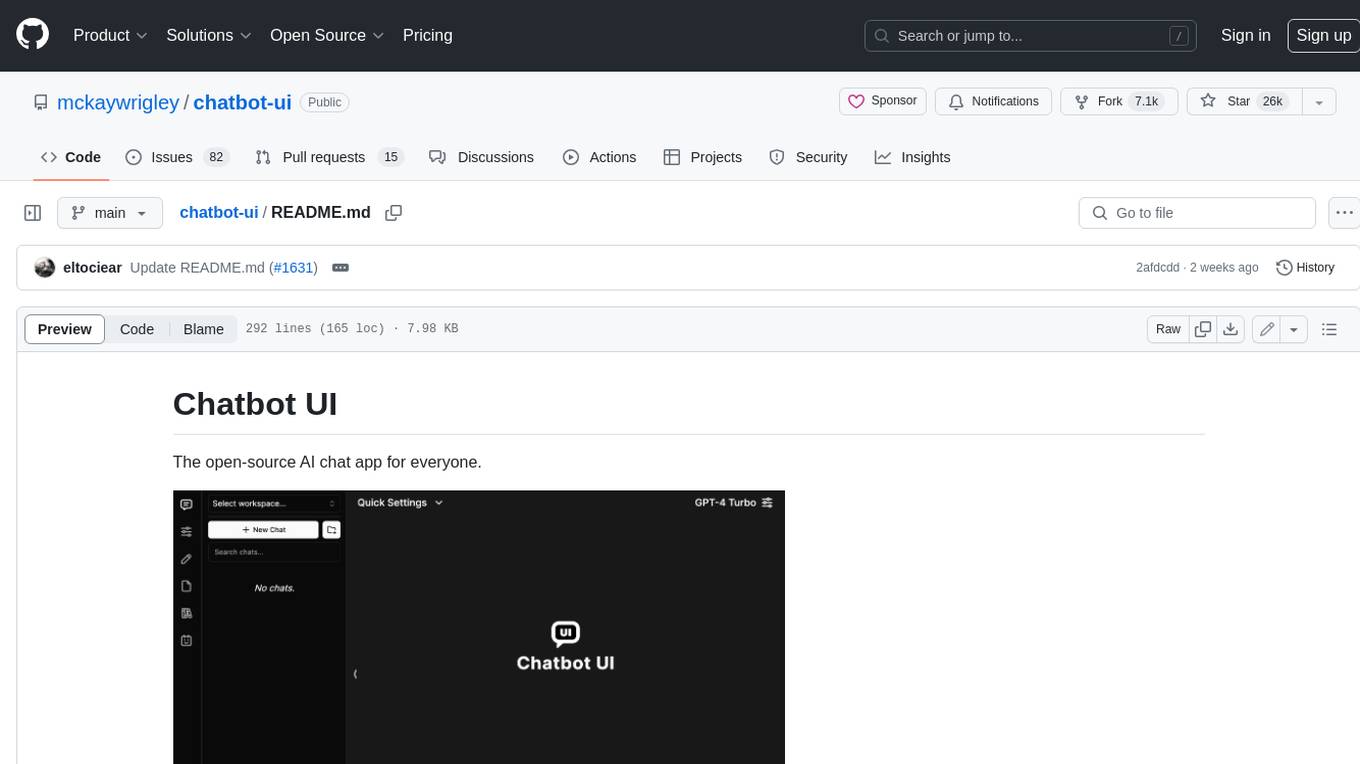
Chatbot UI is an open-source AI chat app that allows users to create and deploy their own AI chatbots. It is easy to use and can be customized to fit any need. Chatbot UI is perfect for businesses, developers, and anyone who wants to create a chatbot.
BricksLLM
BricksLLM is a cloud native AI gateway written in Go. Currently, it provides native support for OpenAI, Anthropic, Azure OpenAI and vLLM. BricksLLM aims to provide enterprise level infrastructure that can power any LLM production use cases. Here are some use cases for BricksLLM: * Set LLM usage limits for users on different pricing tiers * Track LLM usage on a per user and per organization basis * Block or redact requests containing PIIs * Improve LLM reliability with failovers, retries and caching * Distribute API keys with rate limits and cost limits for internal development/production use cases * Distribute API keys with rate limits and cost limits for students
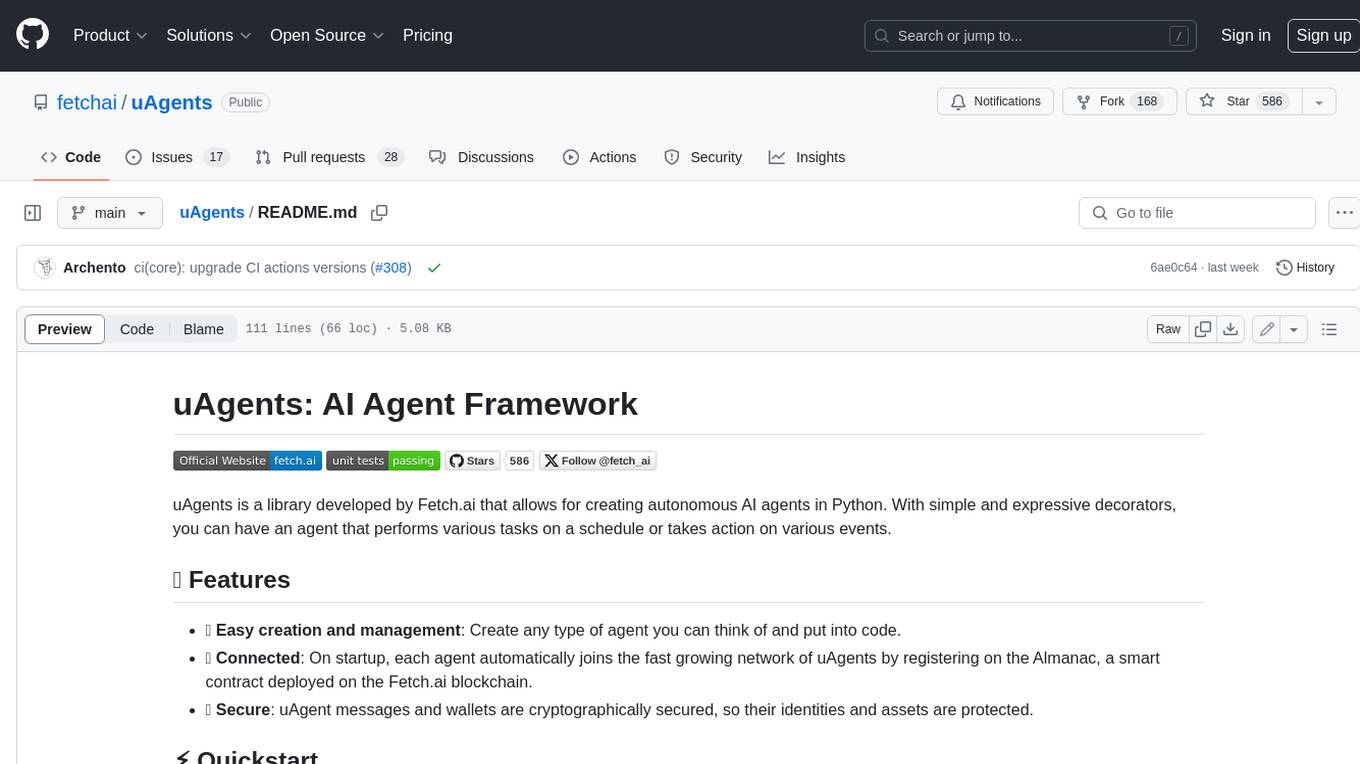
uAgents
uAgents is a Python library developed by Fetch.ai that allows for the creation of autonomous AI agents. These agents can perform various tasks on a schedule or take action on various events. uAgents are easy to create and manage, and they are connected to a fast-growing network of other uAgents. They are also secure, with cryptographically secured messages and wallets.
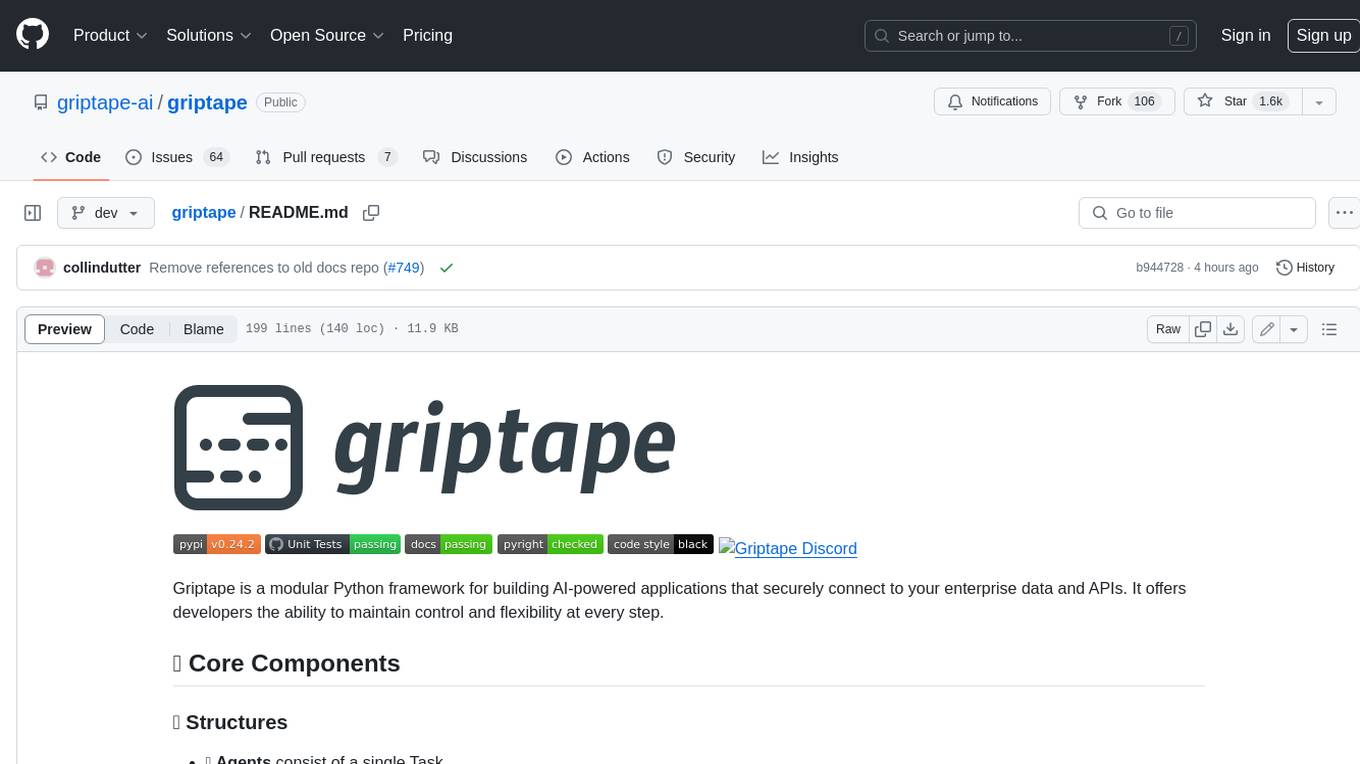
griptape
Griptape is a modular Python framework for building AI-powered applications that securely connect to your enterprise data and APIs. It offers developers the ability to maintain control and flexibility at every step. Griptape's core components include Structures (Agents, Pipelines, and Workflows), Tasks, Tools, Memory (Conversation Memory, Task Memory, and Meta Memory), Drivers (Prompt and Embedding Drivers, Vector Store Drivers, Image Generation Drivers, Image Query Drivers, SQL Drivers, Web Scraper Drivers, and Conversation Memory Drivers), Engines (Query Engines, Extraction Engines, Summary Engines, Image Generation Engines, and Image Query Engines), and additional components (Rulesets, Loaders, Artifacts, Chunkers, and Tokenizers). Griptape enables developers to create AI-powered applications with ease and efficiency.