


grafbase
The Grafbase GraphQL Federation Gateway
Stars: 1165
Grafbase is a GraphQL Federation platform that allows users to compose all their data sources into a unified graph. It helps users move faster without breaking things by providing advanced governance and analytics features.
README:
The GraphQL Federation platform
Examples · Docs · CLI · Gateway · Community · Changelog
Compose all your data sources into a unified graph. Move faster without breaking things using advanced governance and analytics features.
For Tasks:
Click tags to check more tools for each tasksFor Jobs:
Alternative AI tools for grafbase
Similar Open Source Tools
grafbase
Grafbase is a GraphQL Federation platform that allows users to compose all their data sources into a unified graph. It helps users move faster without breaking things by providing advanced governance and analytics features.
JamAIBase
JamAI Base is an open-source platform integrating SQLite and LanceDB databases with managed memory and RAG capabilities. It offers built-in LLM, vector embeddings, and reranker orchestration accessible through a spreadsheet-like UI and REST API. Users can transform static tables into dynamic entities, facilitate real-time interactions, manage structured data, and simplify chatbot development. The tool focuses on ease of use, scalability, flexibility, declarative paradigm, and innovative RAG techniques, making complex data operations accessible to users with varying technical expertise.
app
WebDB is a comprehensive and free database Integrated Development Environment (IDE) designed to maximize efficiency in database development and management. It simplifies and enhances database operations with features like DBMS discovery, query editor, time machine, NoSQL structure inferring, modern ERD visualization, and intelligent data generator. Developed with robust web technologies, WebDB is suitable for both novice and experienced database professionals.
GhidrAssist
GhidrAssist is an advanced LLM-powered plugin for interactive reverse engineering assistance in Ghidra. It integrates Large Language Models (LLMs) to provide intelligent assistance for binary exploration and reverse engineering. The tool supports various OpenAI v1-compatible APIs, including local models and cloud providers. Key features include code explanation, interactive chat, custom queries, Graph-RAG knowledge system with semantic knowledge graph, community detection, security feature extraction, semantic graph tab, extended thinking/reasoning control, ReAct agentic mode, MCP integration, function calling, actions tab, RAG (Retrieval Augmented Generation), and RLHF dataset generation. The plugin uses a modular, service-oriented architecture with core services, Graph-RAG backend, data layer, and UI components.
trustgraph
TrustGraph is a tool that deploys private GraphRAG pipelines to build a RDF style knowledge graph from data, enabling accurate and secure `RAG` requests compatible with cloud LLMs and open-source SLMs. It showcases the reliability and efficiencies of GraphRAG algorithms, capturing contextual language flags missed in conventional RAG approaches. The tool offers features like PDF decoding, text chunking, inference of various LMs, RDF-aligned Knowledge Graph extraction, and more. TrustGraph is designed to be modular, supporting multiple Language Models and environments, with a plug'n'play architecture for easy customization.
suna
Kortix is an open-source platform designed to build, manage, and train AI agents for various tasks. It allows users to create autonomous agents, from general-purpose assistants to specialized automation tools. The platform offers capabilities such as browser automation, file management, web intelligence, system operations, API integrations, and agent building tools. Users can create custom agents tailored to specific domains, workflows, or business needs, enabling tasks like research & analysis, browser automation, file & document management, data processing & analysis, and system administration.
OAD
OAD is a powerful open-source tool for analyzing and visualizing data. It provides a user-friendly interface for exploring datasets, generating insights, and creating interactive visualizations. With OAD, users can easily import data from various sources, clean and preprocess data, perform statistical analysis, and create customizable visualizations to communicate findings effectively. Whether you are a data scientist, analyst, or researcher, OAD can help you streamline your data analysis workflow and uncover valuable insights from your data.
openops
OpenOps is a No-Code FinOps automation platform designed to help organizations reduce cloud costs and streamline financial operations. It offers customizable workflows for automating key FinOps processes, comes with its own Excel-like database and visualization system, and enables collaboration between different teams. OpenOps integrates seamlessly with major cloud providers, third-party FinOps tools, communication platforms, and project management tools, providing a comprehensive solution for efficient cost-saving measures implementation.
accelerated-intelligent-document-processing-on-aws
Accelerated Intelligent Document Processing on AWS is a scalable, serverless solution for automated document processing and information extraction using AWS services. It combines OCR capabilities with generative AI to convert unstructured documents into structured data at scale. The solution features a serverless architecture built on AWS technologies, modular processing patterns, advanced classification support, few-shot example support, custom business logic integration, high throughput processing, built-in resilience, cost optimization, comprehensive monitoring, web user interface, human-in-the-loop integration, AI-powered evaluation, extraction confidence assessment, and document knowledge base query. The architecture uses nested CloudFormation stacks to support multiple document processing patterns while maintaining common infrastructure for queueing, tracking, and monitoring.

WeKnora
WeKnora is a document understanding and semantic retrieval framework based on large language models (LLM), designed specifically for scenarios with complex structures and heterogeneous content. The framework adopts a modular architecture, integrating multimodal preprocessing, semantic vector indexing, intelligent recall, and large model generation reasoning to build an efficient and controllable document question-answering process. The core retrieval process is based on the RAG (Retrieval-Augmented Generation) mechanism, combining context-relevant segments with language models to achieve higher-quality semantic answers. It supports various document formats, intelligent inference, flexible extension, efficient retrieval, ease of use, and security and control. Suitable for enterprise knowledge management, scientific literature analysis, product technical support, legal compliance review, and medical knowledge assistance.
CortexON
CortexON is an open-source, multi-agent AI system designed to automate and simplify everyday tasks. It integrates specialized agents like Web Agent, File Agent, Coder Agent, Executor Agent, and API Agent to accomplish user-defined objectives. CortexON excels at executing complex workflows, research tasks, technical operations, and business process automations by dynamically coordinating the agents' unique capabilities. It offers advanced research automation, multi-agent orchestration, integration with third-party APIs, code generation and execution, efficient file and data management, and personalized task execution for travel planning, market analysis, educational content creation, and business intelligence.
ApeRAG
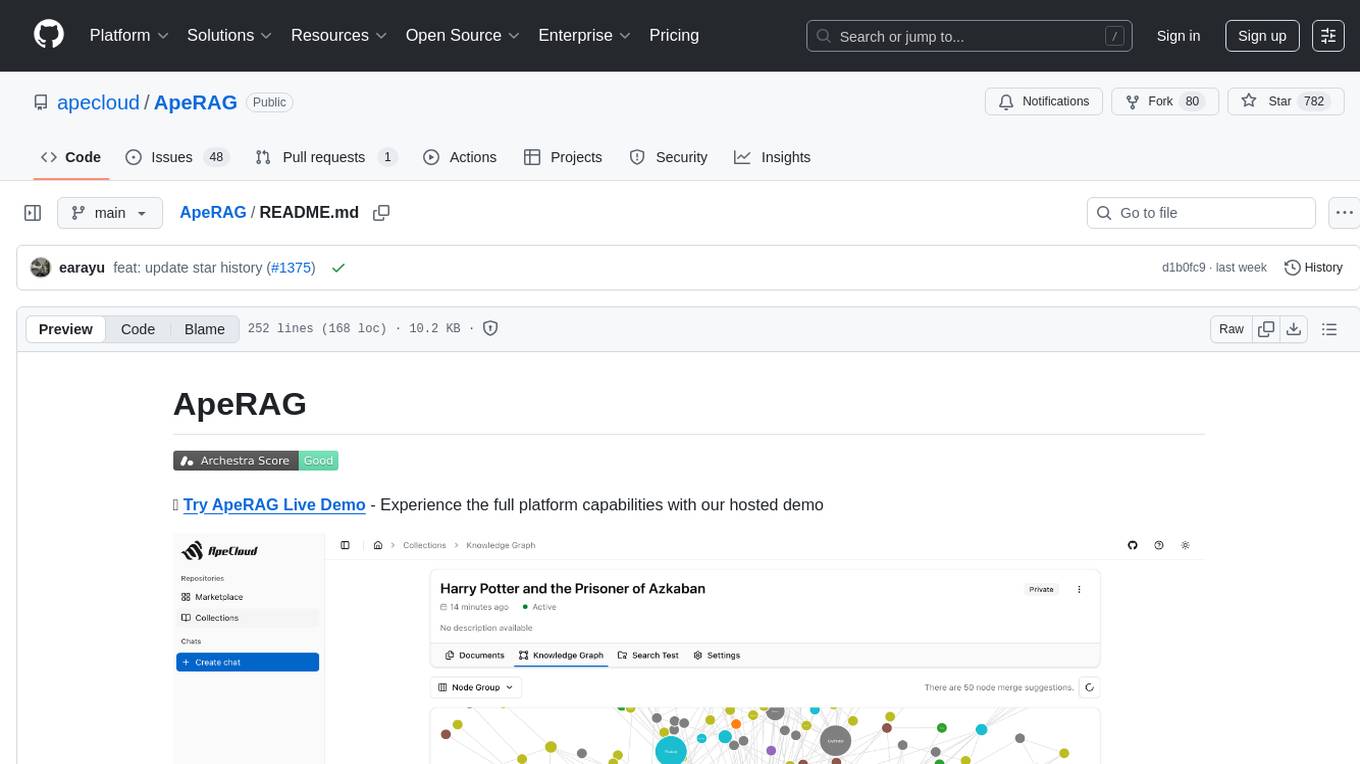
ApeRAG is a production-ready platform for Retrieval-Augmented Generation (RAG) that combines Graph RAG, vector search, and full-text search with advanced AI agents. It is ideal for building Knowledge Graphs, Context Engineering, and deploying intelligent AI agents for autonomous search and reasoning across knowledge bases. The platform offers features like advanced index types, intelligent AI agents with MCP support, enhanced Graph RAG with entity normalization, multimodal processing, hybrid retrieval engine, MinerU integration for document parsing, production-grade deployment with Kubernetes, enterprise management features, MCP integration, and developer-friendly tools for customization and contribution.
mlcraft
Synmetrix (prev. MLCraft) is an open source data engineering platform and semantic layer for centralized metrics management. It provides a complete framework for modeling, integrating, transforming, aggregating, and distributing metrics data at scale. Key features include data modeling and transformations, semantic layer for unified data model, scheduled reports and alerts, versioning, role-based access control, data exploration, caching, and collaboration on metrics modeling. Synmetrix leverages Cube (Cube.js) for flexible data models that consolidate metrics from various sources, enabling downstream distribution via a SQL API for integration into BI tools, reporting, dashboards, and data science. Use cases include data democratization, business intelligence, embedded analytics, and enhancing accuracy in data handling and queries. The tool speeds up data-driven workflows from metrics definition to consumption by combining data engineering best practices with self-service analytics capabilities.
wanwu
Wanwu AI Agent Platform is an enterprise-grade one-stop commercially friendly AI agent development platform designed for business scenarios. It provides enterprises with a safe, efficient, and compliant one-stop AI solution. The platform integrates cutting-edge technologies such as large language models and business process automation to build an AI engineering platform covering model full life-cycle management, MCP, web search, AI agent rapid development, enterprise knowledge base construction, and complex workflow orchestration. It supports modular architecture design, flexible functional expansion, and secondary development, reducing the application threshold of AI technology while ensuring security and privacy protection of enterprise data. It accelerates digital transformation, cost reduction, efficiency improvement, and business innovation for enterprises of all sizes.
synmetrix
Synmetrix is an open source data engineering platform and semantic layer for centralized metrics management. It provides a complete framework for modeling, integrating, transforming, aggregating, and distributing metrics data at scale. Key features include data modeling and transformations, semantic layer for unified data model, scheduled reports and alerts, versioning, role-based access control, data exploration, caching, and collaboration on metrics modeling. Synmetrix leverages Cube.js to consolidate metrics from various sources and distribute them downstream via a SQL API. Use cases include data democratization, business intelligence and reporting, embedded analytics, and enhancing accuracy in data handling and queries. The tool speeds up data-driven workflows from metrics definition to consumption by combining data engineering best practices with self-service analytics capabilities.
vts
VTS (Vector Transport Service) is an open-source tool developed by Zilliz based on Apache Seatunnel for moving vectors and unstructured data. It addresses data migration needs, supports real-time data streaming and offline import, simplifies unstructured data transformation, and ensures end-to-end data quality. Core capabilities include rich connectors, stream and batch processing, distributed snapshot support, high performance, and real-time monitoring. Future developments include incremental synchronization, advanced data transformation, and enhanced monitoring. VTS supports various connectors for data migration and offers advanced features like Transformers, cluster mode deployment, RESTful API, Docker deployment, and more.
For similar tasks
grafbase
Grafbase is a GraphQL Federation platform that allows users to compose all their data sources into a unified graph. It helps users move faster without breaking things by providing advanced governance and analytics features.
n8n-docs
n8n is an extendable workflow automation tool that enables you to connect anything to everything. It is open-source and can be self-hosted or used as a service. n8n provides a visual interface for creating workflows, which can be used to automate tasks such as data integration, data transformation, and data analysis. n8n also includes a library of pre-built nodes that can be used to connect to a variety of applications and services. This makes it easy to create complex workflows without having to write any code.
hash
HASH is a self-building, open-source database which grows, structures and checks itself. With it, we're creating a platform for decision-making, which helps you integrate, understand and use data in a variety of different ways.
island-ai
island-ai is a TypeScript toolkit tailored for developers engaging with structured outputs from Large Language Models. It offers streamlined processes for handling, parsing, streaming, and leveraging AI-generated data across various applications. The toolkit includes packages like zod-stream for interfacing with LLM streams, stream-hooks for integrating streaming JSON data into React applications, and schema-stream for JSON streaming parsing based on Zod schemas. Additionally, related packages like @instructor-ai/instructor-js focus on data validation and retry mechanisms, enhancing the reliability of data processing workflows.
ezdata
Ezdata is a data processing and task scheduling system developed based on Python backend and Vue3 frontend. It supports managing multiple data sources, abstracting various data sources into a unified data model, integrating chatgpt for data question and answer functionality, enabling low-code data integration and visualization processing, scheduling single and dag tasks, and integrating a low-code data visualization dashboard system.
buildel
Buildel is an AI automation platform that empowers users to create versatile workflows without writing code. It supports multiple providers and interfaces, offers pre-built use cases, and allows users to bring their own API keys. Ideal for AI-powered document retrieval, conversational interfaces, and data integration. Users can get started at app.buildel.ai or run Buildel locally with Node.js, Elixir/Erlang, Docker, Git, and JQ installed. Join the community on Discord for support and discussions.
obot
Obot is an open source AI agent platform that allows users to build agents for various use cases such as copilots, assistants, and autonomous workflows. It offers integration with leading LLM providers, built-in RAG for data, easy integration with custom web services and APIs, and OAuth 2.0 authentication.
seatunnel
SeaTunnel is a high-performance, distributed data integration tool trusted by numerous companies for synchronizing vast amounts of data daily. It addresses common data integration challenges by seamlessly integrating with diverse data sources, supporting multimodal data integration, complex synchronization scenarios, resource efficiency, and quality monitoring. With over 100 connectors, SeaTunnel offers batch-stream integration, distributed snapshot algorithm, multi-engine support, JDBC multiplexing, and log parsing. It provides high throughput, low latency, real-time monitoring, and supports two job development methods. Users can configure jobs, select execution engines, and parallelize data using source connectors. SeaTunnel also supports multimodal data integration, Apache SeaTunnel tools, real-world use cases, and visual management of jobs through the SeaTunnel Web Project.
For similar jobs
resonance
Resonance is a framework designed to facilitate interoperability and messaging between services in your infrastructure and beyond. It provides AI capabilities and takes full advantage of asynchronous PHP, built on top of Swoole. With Resonance, you can: * Chat with Open-Source LLMs: Create prompt controllers to directly answer user's prompts. LLM takes care of determining user's intention, so you can focus on taking appropriate action. * Asynchronous Where it Matters: Respond asynchronously to incoming RPC or WebSocket messages (or both combined) with little overhead. You can set up all the asynchronous features using attributes. No elaborate configuration is needed. * Simple Things Remain Simple: Writing HTTP controllers is similar to how it's done in the synchronous code. Controllers have new exciting features that take advantage of the asynchronous environment. * Consistency is Key: You can keep the same approach to writing software no matter the size of your project. There are no growing central configuration files or service dependencies registries. Every relation between code modules is local to those modules. * Promises in PHP: Resonance provides a partial implementation of Promise/A+ spec to handle various asynchronous tasks. * GraphQL Out of the Box: You can build elaborate GraphQL schemas by using just the PHP attributes. Resonance takes care of reusing SQL queries and optimizing the resources' usage. All fields can be resolved asynchronously.
aiogram_bot_template
Aiogram bot template is a boilerplate for creating Telegram bots using Aiogram framework. It provides a solid foundation for building robust and scalable bots with a focus on code organization, database integration, and localization.
pluto
Pluto is a development tool dedicated to helping developers **build cloud and AI applications more conveniently** , resolving issues such as the challenging deployment of AI applications and open-source models. Developers are able to write applications in familiar programming languages like **Python and TypeScript** , **directly defining and utilizing the cloud resources necessary for the application within their code base** , such as AWS SageMaker, DynamoDB, and more. Pluto automatically deduces the infrastructure resource needs of the app through **static program analysis** and proceeds to create these resources on the specified cloud platform, **simplifying the resources creation and application deployment process**.
pinecone-ts-client
The official Node.js client for Pinecone, written in TypeScript. This client library provides a high-level interface for interacting with the Pinecone vector database service. With this client, you can create and manage indexes, upsert and query vector data, and perform other operations related to vector search and retrieval. The client is designed to be easy to use and provides a consistent and idiomatic experience for Node.js developers. It supports all the features and functionality of the Pinecone API, making it a comprehensive solution for building vector-powered applications in Node.js.
aiohttp-pydantic
Aiohttp pydantic is an aiohttp view to easily parse and validate requests. You define using function annotations what your methods for handling HTTP verbs expect, and Aiohttp pydantic parses the HTTP request for you, validates the data, and injects the parameters you want. It provides features like query string, request body, URL path, and HTTP headers validation, as well as Open API Specification generation.
gcloud-aio
This repository contains shared codebase for two projects: gcloud-aio and gcloud-rest. gcloud-aio is built for Python 3's asyncio, while gcloud-rest is a threadsafe requests-based implementation. It provides clients for Google Cloud services like Auth, BigQuery, Datastore, KMS, PubSub, Storage, and Task Queue. Users can install the library using pip and refer to the documentation for usage details. Developers can contribute to the project by following the contribution guide.
aioconsole
aioconsole is a Python package that provides asynchronous console and interfaces for asyncio. It offers asynchronous equivalents to input, print, exec, and code.interact, an interactive loop running the asynchronous Python console, customization and running of command line interfaces using argparse, stream support to serve interfaces instead of using standard streams, and the apython script to access asyncio code at runtime without modifying the sources. The package requires Python version 3.8 or higher and can be installed from PyPI or GitHub. It allows users to run Python files or modules with a modified asyncio policy, replacing the default event loop with an interactive loop. aioconsole is useful for scenarios where users need to interact with asyncio code in a console environment.
aiosqlite
aiosqlite is a Python library that provides a friendly, async interface to SQLite databases. It replicates the standard sqlite3 module but with async versions of all the standard connection and cursor methods, along with context managers for automatically closing connections and cursors. It allows interaction with SQLite databases on the main AsyncIO event loop without blocking execution of other coroutines while waiting for queries or data fetches. The library also replicates most of the advanced features of sqlite3, such as row factories and total changes tracking.