


surf
Personal AI Notebooks. Organize files & webpages and generate notes from them. Open source, local & open data, open model choice (incl. local).
Stars: 3214
Deta Surf is an AI notebook designed for simultaneous research and thinking, minimizing manual tasks like searching, opening windows, and copying. It allows users to store various media types in a private library, organize them into notebooks, and utilize AI features. Surf offers smart notes with features like auto-generation, web searches, citations, and interactive applications. Users can work with tabs, split view, and a sidebar for easy navigation. Surflets enable the creation of interactive applets, and the tool is powered by large language models. Security, contributing guidelines, code of conduct, and licensing information are also provided.
README:

Deta Surf is an AI notebook that brings all your files and the web directly into your stream of thought.
It’s meant for simultaneous research and thinking that minimizes the grunt work: manually searching, opening windows & tabs, scrolling, copying and pasting into a document editor.
Surf is primarily built in Svelte, TypeScript and Rust, runs on MacOS, Windows & Linux, stores data locally in open formats, and is open source.

Most applications are focused on a single task, or a single media type: notes, websites, or PDFs. Real thinking requires juggling media across sources to make connections and synthesize ideas. We want to help people think better, across all their media.
Surf is built to be personal and open, in service of the user. This means local first data, open data formats, open source, and openness with respect to AI models. Read more.
Checkout the installation guide for detailed instructions.
For building from source and local development, see CONTRIBUTING.md.
- YouTube Notes: visit a YouTube video and ask a question
- PDF Notes: open a PDF and ask a question
- Create an applet: use the "app generation" tool and ask for an app
- Notes that search the web: use the "web search" tool and ask a question with "search" in it

Store almost any media in a private library on your computer, in an open and transparent format.
- Support for local files, sites & links from the web (YouTube, Tweets & more), or create media directly in Surf.
- Organize this library into Notebooks.
- Open and use much of your library offline.
- Use your library to power Surf’s AI features.
Surf's library is built on a local storage engine called SFFS (Surf Flat File System), which stores data in open and transparent formats.

Explore and think across your digital stuff without opening up a bunch of windows, clicking, scrolling and copying & pasting into your document (or chatbot).
-
@-mentionand auto-generate from any tab, website or any resource in your library. - Trigger web searches to do research, and bring the results back in your notes.
- Integrated citations deeplinked to original sources, whether a section on a webpage, a timestamp in a video, or a page in a PDF.
- Generate interactive applications without writing code using Surflets.
- Paste in images, tables or data from other applications and have Surf understand and incorporate them.
- Use rich formating, code blocks, to-do lists and more in your notes.

Surf is built around tabs, split view and a sidebar for easy navigation.
- Open local notes, files or web pages in tabs.
- Split view allows you to view and interact with multiple resources side by side.
- The sidebar provides quick access to your Notebooks & notes.

Surf can code interactive applets to help you visualize, understand or explore concepts or data that are aided with code.

Surf’s notes and Surflets are powered by large language models of your choice.
- Bring your own key for popular models
- Add a cloud model
- Use Local Language Models
Find the most common shortcuts here.
To report a security concern, please see https://github.com/deta/surf/security/policy
See CONTRIBUTING.md for details on contributing to the project and an overview of the codebase.
See CODE_OF_CONDUCT.md for details on our code of conduct.
The source code for this project is licensed under the Apache 2.0 license, with the following exceptions:
- Our patch for the @ghostery/adblocker-electron package is licensed under the Mozilla Public License 2.0 (MPL-2.0), consistent with the upstream project's licensing.
- Select files may contain their own specific license headers that override the default license.
Unless otherwise specified in the file or directory, all code defaults to the Apache 2.0 license.
See LICENSE for more details about the Apache 2.0 license.
Note: The Deta name and logos are not covered by the Apache 2.0 license.
This project makes use of the following open source packages (not a comprehensive list):
For Tasks:
Click tags to check more tools for each tasksFor Jobs:
Alternative AI tools for surf
Similar Open Source Tools
surf
Deta Surf is an AI notebook designed for simultaneous research and thinking, minimizing manual tasks like searching, opening windows, and copying. It allows users to store various media types in a private library, organize them into notebooks, and utilize AI features. Surf offers smart notes with features like auto-generation, web searches, citations, and interactive applications. Users can work with tabs, split view, and a sidebar for easy navigation. Surflets enable the creation of interactive applets, and the tool is powered by large language models. Security, contributing guidelines, code of conduct, and licensing information are also provided.
meilisearch
Meilisearch is a lightning-fast search engine that seamlessly integrates into apps, websites, and workflows. It offers features like hybrid search, search-as-you-type, typo tolerance, filtering, sorting, synonym support, geosearch, extensive language support, security management, multi-tenancy, RESTful API, AI-readiness, easy installation, deployment, and maintenance.
lluminous
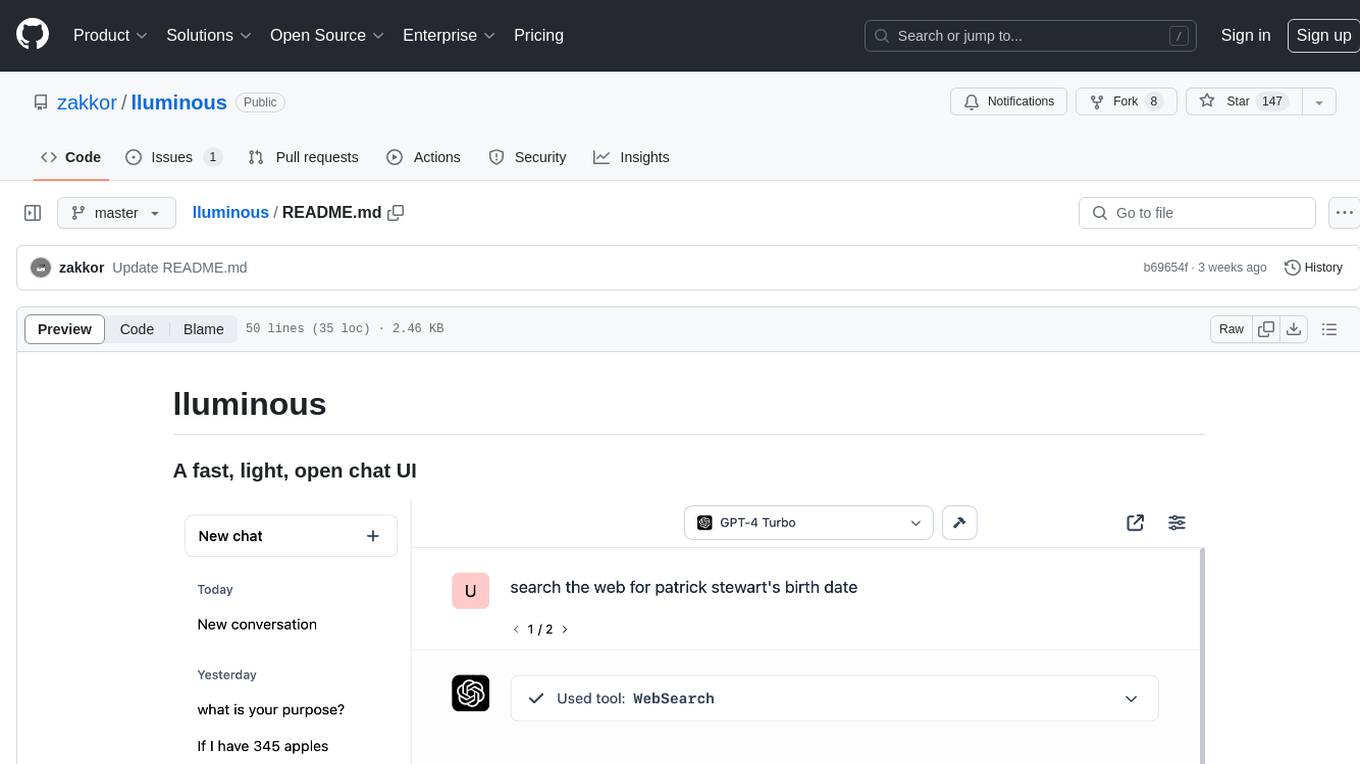
lluminous is a fast and light open chat UI that supports multiple providers such as OpenAI, Anthropic, and Groq models. Users can easily plug in their API keys locally to access various models for tasks like multimodal input, image generation, multi-shot prompting, pre-filled responses, and more. The tool ensures privacy by storing all conversation history and keys locally on the user's device. Coming soon features include memory tool, file ingestion/embedding, embeddings-based web search, and prompt templates.
danswer
Danswer is an open-source Gen-AI Chat and Unified Search tool that connects to your company's docs, apps, and people. It provides a Chat interface and plugs into any LLM of your choice. Danswer can be deployed anywhere and for any scale - on a laptop, on-premise, or to cloud. Since you own the deployment, your user data and chats are fully in your own control. Danswer is MIT licensed and designed to be modular and easily extensible. The system also comes fully ready for production usage with user authentication, role management (admin/basic users), chat persistence, and a UI for configuring Personas (AI Assistants) and their Prompts. Danswer also serves as a Unified Search across all common workplace tools such as Slack, Google Drive, Confluence, etc. By combining LLMs and team specific knowledge, Danswer becomes a subject matter expert for the team. Imagine ChatGPT if it had access to your team's unique knowledge! It enables questions such as "A customer wants feature X, is this already supported?" or "Where's the pull request for feature Y?"
llm-app
Pathway's LLM (Large Language Model) Apps provide a platform to quickly deploy AI applications using the latest knowledge from data sources. The Python application examples in this repository are Docker-ready, exposing an HTTP API to the frontend. These apps utilize the Pathway framework for data synchronization, API serving, and low-latency data processing without the need for additional infrastructure dependencies. They connect to document data sources like S3, Google Drive, and Sharepoint, offering features like real-time data syncing, easy alert setup, scalability, monitoring, security, and unification of application logic.
supervisely
Supervisely is a computer vision platform that provides a range of tools and services for developing and deploying computer vision solutions. It includes a data labeling platform, a model training platform, and a marketplace for computer vision apps. Supervisely is used by a variety of organizations, including Fortune 500 companies, research institutions, and government agencies.
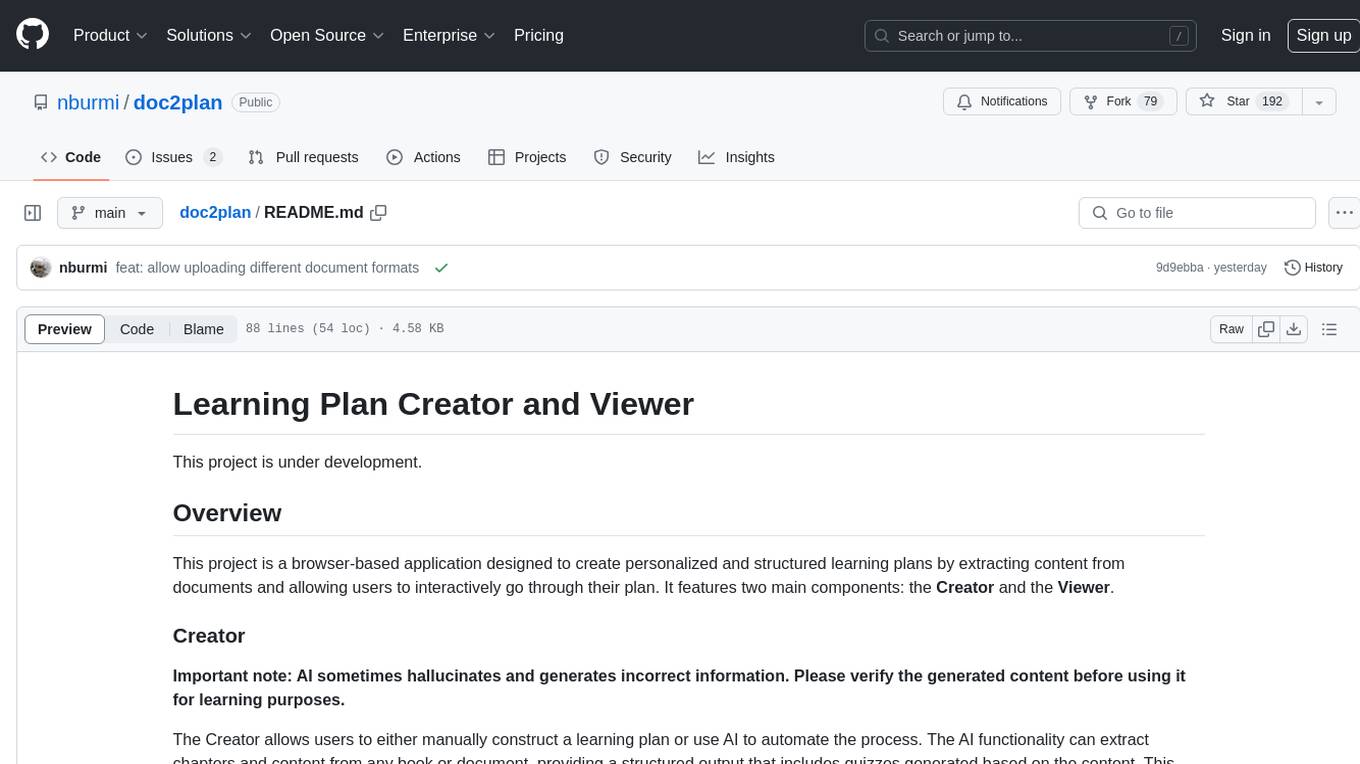
doc2plan
doc2plan is a browser-based application that helps users create personalized learning plans by extracting content from documents. It features a Creator for manual or AI-assisted plan construction and a Viewer for interactive plan navigation. Users can extract chapters, key topics, generate quizzes, and track progress. The application includes AI-driven content extraction, quiz generation, progress tracking, plan import/export, assistant management, customizable settings, viewer chat with text-to-speech and speech-to-text support, and integration with various Retrieval-Augmented Generation (RAG) models. It aims to simplify the creation of comprehensive learning modules tailored to individual needs.
airbyte-platform
Airbyte is an open-source data integration platform that makes it easy to move data from any source to any destination. With Airbyte, you can build and manage data pipelines without writing any code. Airbyte provides a library of pre-built connectors that make it easy to connect to popular data sources and destinations. You can also create your own connectors using Airbyte's low-code Connector Development Kit (CDK). Airbyte is used by data engineers and analysts at companies of all sizes to move data for a variety of purposes, including data warehousing, data analysis, and machine learning.
airbyte
Airbyte is an open-source data integration platform that makes it easy to move data from any source to any destination. With Airbyte, you can build and manage data pipelines without writing any code. Airbyte provides a library of pre-built connectors that make it easy to connect to popular data sources and destinations. You can also create your own connectors using Airbyte's no-code Connector Builder or low-code CDK. Airbyte is used by data engineers and analysts at companies of all sizes to build and manage their data pipelines.
jabref
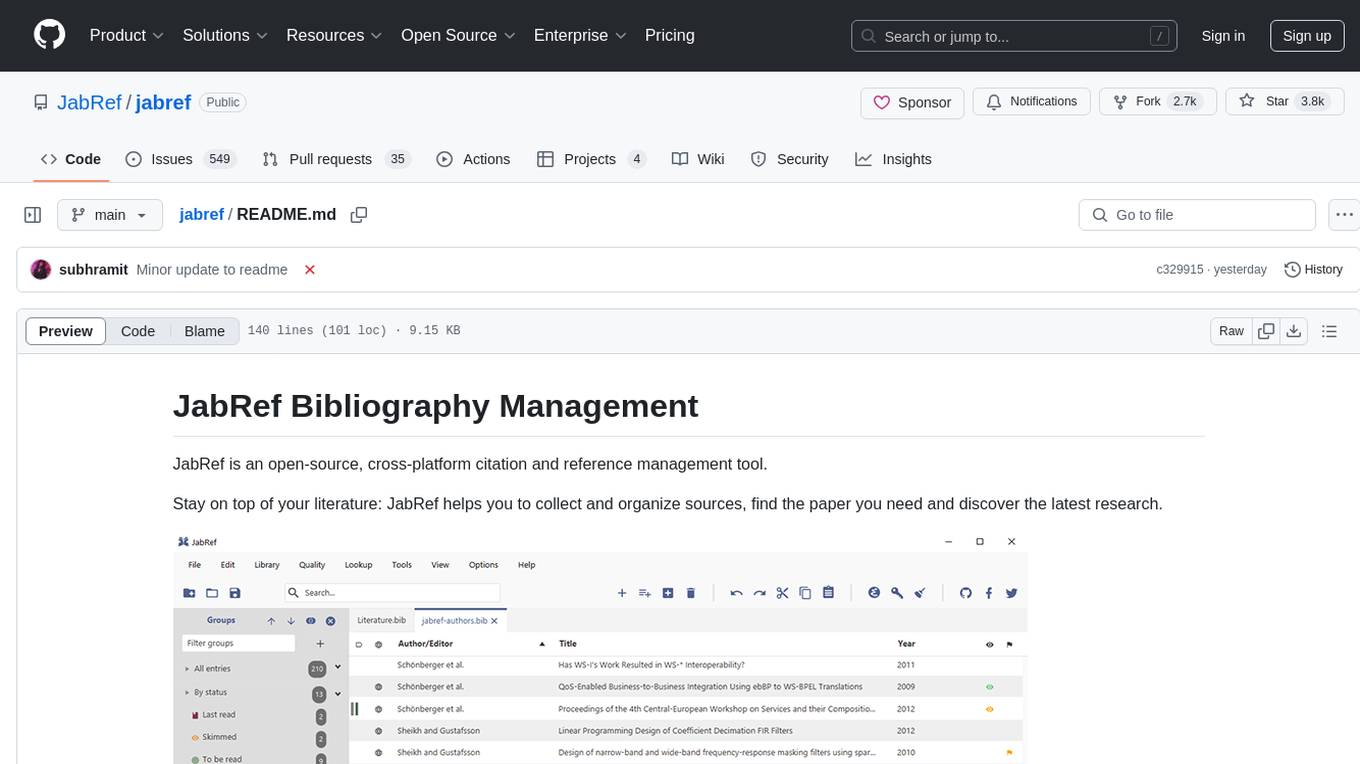
JabRef is an open-source, cross-platform citation and reference management tool that helps users collect, organize, cite, and share research sources. It offers features like searching across online scientific catalogues, importing references in various formats, extracting metadata from PDFs, customizable citation key generator, support for Word and LibreOffice/OpenOffice, and more. Users can organize their research items hierarchically, find and merge duplicates, attach related documents, and keep track of what they read. JabRef also supports sharing via various export options and syncs library contents in a team via a SQL database. It is actively developed, free of charge, and offers native BibTeX and Biblatex support.
xyne
Xyne is an AI-first Search & Answer Engine for work, serving as an OSS alternative to Glean, Gemini, and MS Copilot. It securely indexes data from various applications like Google Workspace, Atlassian suite, Slack, and Github, providing a Google + ChatGPT-like experience to find information and get up-to-date answers. Users can easily locate files, triage issues, inquire about customers/deals/features/tickets, and discover relevant contacts. Xyne enhances AI models by providing contextual information in a secure, private, and responsible manner, making it the most secure and future-proof solution for integrating AI into work environments.
obsidian-pieces
Pieces for Developers is a closed-source Obsidian plugin designed to revolutionize coding workflows by incorporating key capabilities and favorite features directly into the Obsidian environment. The plugin, Pieces Copilot for Obsidian, enhances coding and problem-solving experiences by providing insights on code snippets, generating samples, and facilitating navigation through PRs. Users can capture, manage, share, and discover code snippets and developer materials with ease, bringing efficiency and organization to their coding experience.
posthog
PostHog is an all-in-one, open source platform for building successful products. It provides tools for product analytics, web analytics, session replays, feature flags, experiments, error tracking, surveys, data warehouse, data pipelines, LLM analytics, and workflows. Users can get started with a generous free tier, self-host the platform, or use PostHog Cloud. The platform supports various SDKs and libraries for popular languages and frameworks, making it versatile and easy to integrate. PostHog is suitable for teams looking to understand user behavior, improve product performance, and automate actions or messages to users.
podman-desktop-extension-ai-lab
Podman AI Lab is an open source extension for Podman Desktop designed to work with Large Language Models (LLMs) on a local environment. It features a recipe catalog with common AI use cases, a curated set of open source models, and a playground for learning, prototyping, and experimentation. Users can quickly and easily get started bringing AI into their applications without depending on external infrastructure, ensuring data privacy and security.
commanddash
Dash AI is an open-source coding assistant for Flutter developers. It is designed to not only write code but also run and debug it, allowing it to assist beyond code completion and automate routine tasks. Dash AI is powered by Gemini, integrated with the Dart Analyzer, and specifically tailored for Flutter engineers. The vision for Dash AI is to create a single-command assistant that can automate tedious development tasks, enabling developers to focus on creativity and innovation. It aims to assist with the entire process of engineering a feature for an app, from breaking down the task into steps to generating exploratory tests and iterating on the code until the feature is complete. To achieve this vision, Dash AI is working on providing LLMs with the same access and information that human developers have, including full contextual knowledge, the latest syntax and dependencies data, and the ability to write, run, and debug code. Dash AI welcomes contributions from the community, including feature requests, issue fixes, and participation in discussions. The project is committed to building a coding assistant that empowers all Flutter developers.
super-agent-party
A 3D AI desktop companion with endless possibilities! This repository provides a platform for enhancing the LLM API without code modification, supporting seamless integration of various functionalities such as knowledge bases, real-time networking, multimodal capabilities, automation, and deep thinking control. It offers one-click deployment to multiple terminals, ecological tool interconnection, standardized interface opening, and compatibility across all platforms. Users can deploy the tool on Windows, macOS, Linux, or Docker, and access features like intelligent agent deployment, VRM desktop pets, Tavern character cards, QQ bot deployment, and developer-friendly interfaces. The tool supports multi-service providers, extensive tool integration, and ComfyUI workflows. Hardware requirements are minimal, making it suitable for various deployment scenarios.
For similar tasks
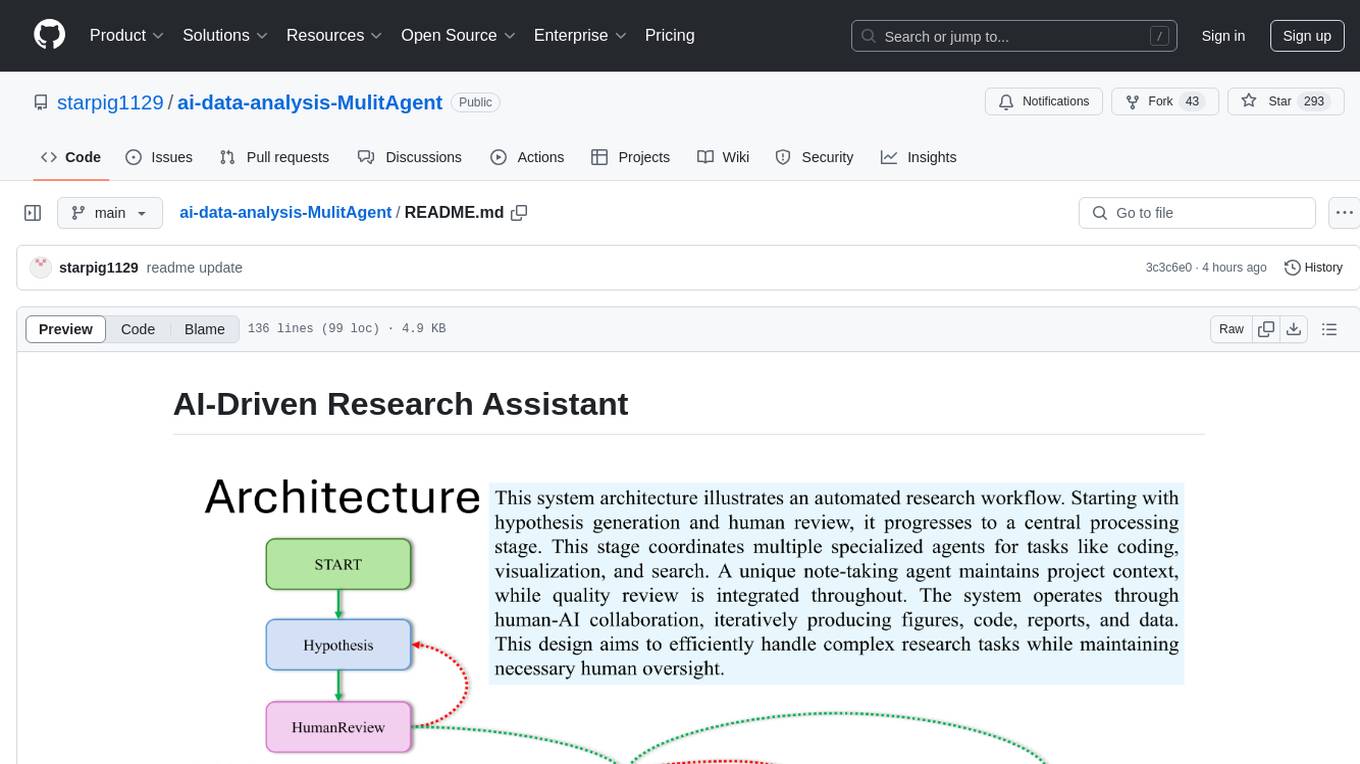
ai-data-analysis-MulitAgent
AI-Driven Research Assistant is an advanced AI-powered system utilizing specialized agents for data analysis, visualization, and report generation. It integrates LangChain, OpenAI's GPT models, and LangGraph for complex research processes. Key features include hypothesis generation, data processing, web search, code generation, and report writing. The system's unique Note Taker agent maintains project state, reducing overhead and improving context retention. System requirements include Python 3.10+ and Jupyter Notebook environment. Installation involves cloning the repository, setting up a Conda virtual environment, installing dependencies, and configuring environment variables. Usage instructions include setting data, running Jupyter Notebook, customizing research tasks, and viewing results. Main components include agents for hypothesis generation, process supervision, visualization, code writing, search, report writing, quality review, and note-taking. Workflow involves hypothesis generation, processing, quality review, and revision. Customization is possible by modifying agent creation and workflow definition. Current issues include OpenAI errors, NoteTaker efficiency, runtime optimization, and refiner improvement. Contributions via pull requests are welcome under the MIT License.
surf
Deta Surf is an AI notebook designed for simultaneous research and thinking, minimizing manual tasks like searching, opening windows, and copying. It allows users to store various media types in a private library, organize them into notebooks, and utilize AI features. Surf offers smart notes with features like auto-generation, web searches, citations, and interactive applications. Users can work with tabs, split view, and a sidebar for easy navigation. Surflets enable the creation of interactive applets, and the tool is powered by large language models. Security, contributing guidelines, code of conduct, and licensing information are also provided.
For similar jobs
lollms-webui
LoLLMs WebUI (Lord of Large Language Multimodal Systems: One tool to rule them all) is a user-friendly interface to access and utilize various LLM (Large Language Models) and other AI models for a wide range of tasks. With over 500 AI expert conditionings across diverse domains and more than 2500 fine tuned models over multiple domains, LoLLMs WebUI provides an immediate resource for any problem, from car repair to coding assistance, legal matters, medical diagnosis, entertainment, and more. The easy-to-use UI with light and dark mode options, integration with GitHub repository, support for different personalities, and features like thumb up/down rating, copy, edit, and remove messages, local database storage, search, export, and delete multiple discussions, make LoLLMs WebUI a powerful and versatile tool.
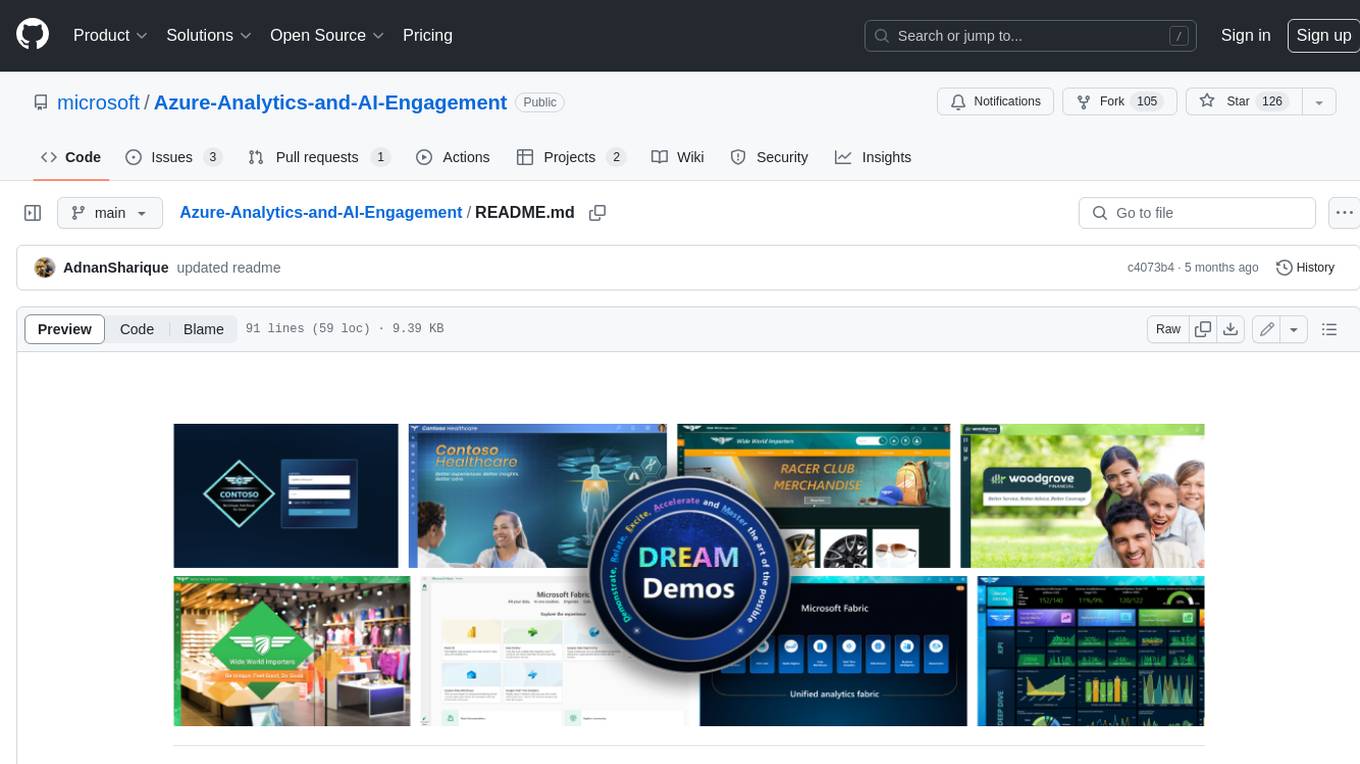
Azure-Analytics-and-AI-Engagement
The Azure-Analytics-and-AI-Engagement repository provides packaged Industry Scenario DREAM Demos with ARM templates (Containing a demo web application, Power BI reports, Synapse resources, AML Notebooks etc.) that can be deployed in a customer’s subscription using the CAPE tool within a matter of few hours. Partners can also deploy DREAM Demos in their own subscriptions using DPoC.
minio
MinIO is a High Performance Object Storage released under GNU Affero General Public License v3.0. It is API compatible with Amazon S3 cloud storage service. Use MinIO to build high performance infrastructure for machine learning, analytics and application data workloads.
mage-ai
Mage is an open-source data pipeline tool for transforming and integrating data. It offers an easy developer experience, engineering best practices built-in, and data as a first-class citizen. Mage makes it easy to build, preview, and launch data pipelines, and provides observability and scaling capabilities. It supports data integrations, streaming pipelines, and dbt integration.
AiTreasureBox
AiTreasureBox is a versatile AI tool that provides a collection of pre-trained models and algorithms for various machine learning tasks. It simplifies the process of implementing AI solutions by offering ready-to-use components that can be easily integrated into projects. With AiTreasureBox, users can quickly prototype and deploy AI applications without the need for extensive knowledge in machine learning or deep learning. The tool covers a wide range of tasks such as image classification, text generation, sentiment analysis, object detection, and more. It is designed to be user-friendly and accessible to both beginners and experienced developers, making AI development more efficient and accessible to a wider audience.
tidb
TiDB is an open-source distributed SQL database that supports Hybrid Transactional and Analytical Processing (HTAP) workloads. It is MySQL compatible and features horizontal scalability, strong consistency, and high availability.
airbyte
Airbyte is an open-source data integration platform that makes it easy to move data from any source to any destination. With Airbyte, you can build and manage data pipelines without writing any code. Airbyte provides a library of pre-built connectors that make it easy to connect to popular data sources and destinations. You can also create your own connectors using Airbyte's no-code Connector Builder or low-code CDK. Airbyte is used by data engineers and analysts at companies of all sizes to build and manage their data pipelines.
labelbox-python
Labelbox is a data-centric AI platform for enterprises to develop, optimize, and use AI to solve problems and power new products and services. Enterprises use Labelbox to curate data, generate high-quality human feedback data for computer vision and LLMs, evaluate model performance, and automate tasks by combining AI and human-centric workflows. The academic & research community uses Labelbox for cutting-edge AI research.