


agent-zero
Agent Zero AI framework
Stars: 14873
Agent Zero is a personal, organic agentic framework designed to be dynamic, transparent, customizable, and interactive. It uses the computer as a tool to accomplish tasks, with features like general-purpose assistant, computer as a tool, multi-agent cooperation, customizable and extensible framework, and communication skills. The tool is fully Dockerized, with Speech-to-Text and TTS capabilities, and offers real-world use cases like financial analysis, Excel automation, API integration, server monitoring, and project isolation. Agent Zero can be dangerous if not used properly and is prompt-based, guided by the prompts folder. The tool is extensively documented and has a changelog highlighting various updates and improvements.
README:







Introduction •
Installation •
How to update
Development Setup •
Usage
Or see DeepWiki generated documentation:

Skills System - portable, structured agent capabilities using the open
SKILL.mdstandard (compatible with Claude Code, Codex and more).Plus: Git-based Projects with authentication for public/private repositories - clone codebases directly into isolated workspaces.
See Usage Guide and Projects Tutorial to get started.

- Agent Zero is not a predefined agentic framework. It is designed to be dynamic, organically growing, and learning as you use it.
- Agent Zero is fully transparent, readable, comprehensible, customizable, and interactive.
- Agent Zero uses the computer as a tool to accomplish its (your) tasks.
Click to open a video to learn how to install Agent Zero:

A detailed setup guide for Windows, macOS, and Linux with a video can be found in the Agent Zero Documentation at this page.
# Pull and run with Docker

docker pull agent0ai/agent-zero
docker run -p 50001:80 agent0ai/agent-zero

# Visit http://localhost:50001 to start- General-purpose Assistant
- Agent Zero is not pre-programmed for specific tasks (but can be). It is meant to be a general-purpose personal assistant. Give it a task, and it will gather information, execute commands and code, cooperate with other agent instances, and do its best to accomplish it.
- It has a persistent memory, allowing it to memorize previous solutions, code, facts, instructions, etc., to solve tasks faster and more reliably in the future.

- Computer as a Tool
- Agent Zero uses the operating system as a tool to accomplish its tasks. It has no single-purpose tools pre-programmed. Instead, it can write its own code and use the terminal to create and use its own tools as needed.
- The only default tools in its arsenal are online search, memory features, communication (with the user and other agents), and code/terminal execution. Everything else is created by the agent itself or can be extended by the user.
- Tool usage functionality has been developed from scratch to be the most compatible and reliable, even with very small models.
- Default Tools: Agent Zero includes tools like knowledge, code execution, and communication.
- Creating Custom Tools: Extend Agent Zero's functionality by creating your own custom tools.
- Skills (SKILL.md Standard): Skills are contextual expertise loaded dynamically when relevant. They use the open SKILL.md standard (developed by Anthropic), making them compatible with Claude Code, Cursor, Goose, OpenAI Codex CLI, and GitHub Copilot.
- Multi-agent Cooperation
- Every agent has a superior agent giving it tasks and instructions. Every agent then reports back to its superior.
- In the case of the first agent in the chain (Agent 0), the superior is the human user; the agent sees no difference.
- Every agent can create its subordinate agent to help break down and solve subtasks. This helps all agents keep their context clean and focused.

- Completely Customizable and Extensible
- Almost nothing in this framework is hard-coded. Nothing is hidden. Everything can be extended or changed by the user.
- The whole behavior is defined by a system prompt in the prompts/default/agent.system.md file. Change this prompt and change the framework dramatically.
- The framework does not guide or limit the agent in any way. There are no hard-coded rails that agents have to follow.
- Every prompt, every small message template sent to the agent in its communication loop can be found in the prompts/ folder and changed.
- Every default tool can be found in the python/tools/ folder and changed or copied to create new predefined tools.
-
Automated configuration via
A0_SET_environment variables for deployment automation and easy setup.

- Communication is Key
- Give your agent a proper system prompt and instructions, and it can do miracles.
- Agents can communicate with their superiors and subordinates, asking questions, giving instructions, and providing guidance. Instruct your agents in the system prompt on how to communicate effectively.
- The terminal interface is real-time streamed and interactive. You can stop and intervene at any point. If you see your agent heading in the wrong direction, just stop and tell it right away.
- There is a lot of freedom in this framework. You can instruct your agents to regularly report back to superiors asking for permission to continue. You can instruct them to use point-scoring systems when deciding when to delegate subtasks. Superiors can double-check subordinates' results and dispute. The possibilities are endless.
-
Financial Analysis & Charting -
"Find last month's Bitcoin/USD price trend, correlate with major cryptocurrency news events, generate annotated chart with highlighted key dates" -
Excel Automation Pipeline -
"Scan incoming directory for financial spreadsheets, validate and clean data, consolidate from multiple sources, generate executive reports with flagged anomalies" -
API Integration Without Code -
"Use this Google Gemini API snippet to generate product images, remember the integration for future use"- agent learns and stores the solution in memory -
Automated Server Monitoring -
"Check server status every 30 minutes: CPU usage, disk space, memory. Alert if metrics exceed thresholds"(scheduled task with project-scoped credentials) -
Multi-Client Project Isolation - Separate projects for each client with isolated memory, custom instructions, and dedicated secrets - prevents context bleed across sensitive work

- Customizable settings allow users to tailor the agent's behavior and responses to their needs.
- The Web UI output is very clean, fluid, colorful, readable, and interactive; nothing is hidden.
- You can load or save chats directly within the Web UI.
- The same output you see in the terminal is automatically saved to an HTML file in logs/ folder for every session.

- Agent output is streamed in real-time, allowing users to read along and intervene at any time.
- No coding is required; only prompting and communication skills are necessary.
- With a solid system prompt, the framework is reliable even with small models, including precise tool usage.
- Agent Zero Can Be Dangerous!
- With proper instruction, Agent Zero is capable of many things, even potentially dangerous actions concerning your computer, data, or accounts. Always run Agent Zero in an isolated environment (like Docker) and be careful what you wish for.
- Agent Zero Is Prompt-based.
- The whole framework is guided by the prompts/ folder. Agent guidelines, tool instructions, messages, utility AI functions, it's all there.
| Page | Description |
|---|---|
| Installation | Installation, setup and configuration |
| Usage | Basic and advanced usage |
| Guides | Step-by-step guides: Usage, Projects, API Integration, MCP Setup, A2A Setup |
| Development Setup | Development and customization |
| WebSocket Infrastructure | Real-time WebSocket handlers, client APIs, filtering semantics, envelopes |
| Extensions | Extending Agent Zero |
| Connectivity | External API endpoints, MCP server connections, A2A protocol |
| Architecture | System design and components |
| Contributing | How to contribute |
| Troubleshooting | Common issues and their solutions |
- Skills
- Skills System replacing the legacy Instruments with a new
SKILL.mdstandard for structured, portable agent capabilities. - Built-in skills, and UI support for importing and listing skills
- Skills System replacing the legacy Instruments with a new
- Real-time WebSocket infrastructure replacing the polling-based approach for UI state synchronization
- UI Redesign
- Process groups to visually group agent actions with expand/collapse support
- Timestamps, steps count and execution time with tool-specific badges
- Step detail modals with key-value and raw JSON display
- Collapsible responses with show more/less and copy buttons on code blocks and tables
- Message queue system allowing users to queue messages while the agent is still processing
- In-browser file editor for viewing and editing files without leaving the UI
- Welcome screen redesign with info and warning banners for connection security, missing API keys, and system resources
- Scheduler redesign with standalone modal, separate task list, detail and editor components, and project support
- Smooth response rendering and scroll stabilization across chat, terminals, and image viewer
- Chat width setting and reworked preferences panel
- Image viewer improvements with scroll support and expanded viewer
- Redesigned sidebar with reusable dropdown component and streamlined buttons
- Inline button confirmations for critical actions
- Improved login design and new logout button
- File browser enhanced with rename and file actions dropdown
- Git projects
- Git-based projects with clone authentication for public and private repositories
- Four new LLM providers: CometAPI, Z.AI, Moonshot AI, and AWS Bedrock
- Microsoft Dev Tunnels integration for secure remote access
- User data migration to
/usrdirectory for cleaner separation of user and system files - Subagents system with configurable agent profiles for different roles
- Memory operations offloaded to deferred tasks for better performance
- Environment variables can now configure settings via
A0_SET_*prefix in.env - Automatic migration with overwrite support for
.env, scheduler, knowledge, and legacy directories - Projects support extended to MCP, A2A, and external API
- Workdir outside project support for more flexible file organization
- Agent number tracking in backend and responses for multi-agent identification
- Many bug fixes and stability improvements across the UI, MCP tools, scheduler, uploads, and WebSocket handling
- Projects management
- Support for custom instructions
- Integration with memory, knowledge, files
- Project specific secrets
- New Welcome screen/Dashboard
- New Wait tool
- Subordinate agent configuration override support
- Support for multiple documents at once in document_query_tool
- Improved context on interventions
- Openrouter embedding support
- Frontend components refactor and polishing
- SSH metadata output fix
- Support for windows powershell in local TTY utility
- More efficient selective streaming for LLMs
- UI output length limit improvements
- Memory Management Dashboard
- Kali update
- Python update + dual installation
- Browser Use update
- New login screen
- LiteLLM retry on temporary errors
- Github Copilot provider support
- Secrets management - agent can use credentials without seeing them
- Agent can copy paste messages and files without rewriting them
- LiteLLM global configuration field
- Custom HTTP headers field for browser agent
- Progressive web app support
- Extra model params support for JSON
- Short IDs for files and memories to prevent LLM errors
- Tunnel component frontend rework
- Fix for timezone change bug
- Notifications z-index fix
- External API endpoints
- Streamable HTTP MCP A0 server
- A2A (Agent to Agent) protocol - server+client
- New notifications system
- New local terminal interface for stability
- Rate limiter integration to models
- Delayed memory recall
- Smarter autoscrolling in UI
- Action buttons in messages
- Multiple API keys support
- Download streaming
- Tunnel URL QR code
- Internal fixes and optimizations
- Faster startup/restart
- Subordinate agents can have dedicated prompts, tools and system extensions
- Streamable HTTP MCP server support
- Memory loading enhanced by AI filter
- Memory AI consolidation when saving memories
- Auto memory system configuration in settings
- LLM providers available are set by providers.yaml configuration file
- Venice.ai LLM provider supported
- Initial agent message for user + as example for LLM
- Docker build support for local images
- File browser fix
- Kokoro text-to-speech integration
- New message attachments system
- Minor updates: log truncation, hyperlink targets, component examples, api cleanup
- Langchain replaced with LiteLLM
- Support for reasoning models streaming
- Support for more providers
- Openrouter set as default instead of OpenAI
- UI improvements
- New message grouping system
- Communication smoother and more efficient
- Collapsible messages by type
- Code execution tool output improved
- Tables and code blocks scrollable
- More space efficient on mobile
- Streamable HTTP MCP servers support
- LLM API URL added to models config for Azure, local and custom providers
- subordinate agents can use prompt profiles for different roles
- backup/restore functionality for easier upgrades
- security and bug fixes
- markdown rendering in responses
- live response rendering
- document Q&A tool
- Merge with Hacking Edition
- browser-use upgrade and integration re-work
- tunnel provider switch
- Agent Zero can now act as MCP Server
- Agent Zero can use external MCP servers as tools
Default models set to gpt-4.1
- Code execution tool improvements
- Browser agent improvements
- Memory improvements
- Various bugfixes related to context management
- Message formatting improvements
- Scheduler improvements
- New model provider
- Input tool fix
- Compatibility and stability improvements
- Remote access (mobile)
- Automatic embedding
- Planning and scheduling
- Multitasking in terminal
- Chat names
- Browser Agent
- UX Improvements
- Docker Runtime
- New Messages History and Summarization System
- Agent Behavior Change and Management
- Text-to-Speech (TTS) and Speech-to-Text (STT)
- Settings Page in Web UI
- SearXNG Integration Replacing Perplexity + DuckDuckGo
- File Browser Functionality
- KaTeX Math Visualization Support
- In-chat File Attachments
- Automatic Memory
- UI Improvements
- Instruments
- Extensions Framework
- Reflection Prompts
- Bug Fixes
- Join our Discord for live discussions or visit our Skool Community.
- Follow our YouTube channel for hands-on explanations and tutorials
- Report Issues for bug fixes and features
For Tasks:
Click tags to check more tools for each tasksFor Jobs:
Alternative AI tools for agent-zero
Similar Open Source Tools
agent-zero
Agent Zero is a personal, organic agentic framework designed to be dynamic, transparent, customizable, and interactive. It uses the computer as a tool to accomplish tasks, with features like general-purpose assistant, computer as a tool, multi-agent cooperation, customizable and extensible framework, and communication skills. The tool is fully Dockerized, with Speech-to-Text and TTS capabilities, and offers real-world use cases like financial analysis, Excel automation, API integration, server monitoring, and project isolation. Agent Zero can be dangerous if not used properly and is prompt-based, guided by the prompts folder. The tool is extensively documented and has a changelog highlighting various updates and improvements.
TaskingAI
TaskingAI brings Firebase's simplicity to **AI-native app development**. The platform enables the creation of GPTs-like multi-tenant applications using a wide range of LLMs from various providers. It features distinct, modular functions such as Inference, Retrieval, Assistant, and Tool, seamlessly integrated to enhance the development process. TaskingAI’s cohesive design ensures an efficient, intelligent, and user-friendly experience in AI application development.
refact-vscode
Refact.ai is an open-source AI coding assistant that boosts developer's productivity. It supports 25+ programming languages and offers features like code completion, AI Toolbox for code explanation and refactoring, integrated in-IDE chat, and self-hosting or cloud version. The Enterprise plan provides enhanced customization, security, fine-tuning, user statistics, efficient inference, priority support, and access to 20+ LLMs for up to 50 engineers per GPU.
neuro-san-studio
Neuro SAN Studio is an open-source library for building agent networks across various industries. It simplifies the development of collaborative AI systems by enabling users to create sophisticated multi-agent applications using declarative configuration files. The tool offers features like data-driven configuration, adaptive communication protocols, safe data handling, dynamic agent network designer, flexible tool integration, robust traceability, and cloud-agnostic deployment. It has been used in various use-cases such as automated generation of multi-agent configurations, airline policy assistance, banking operations, market analysis in consumer packaged goods, insurance claims processing, intranet knowledge management, retail operations, telco network support, therapy vignette supervision, and more.
cline-based-code-generator
HAI Code Generator is a cutting-edge tool designed to simplify and automate task execution while enhancing code generation workflows. Leveraging Specif AI, it streamlines processes like task execution, file identification, and code documentation through intelligent automation and AI-driven capabilities. Built on Cline's powerful foundation for AI-assisted development, HAI Code Generator boosts productivity and precision by automating task execution and integrating file management capabilities. It combines intelligent file indexing, context generation, and LLM-driven automation to minimize manual effort and ensure task accuracy. Perfect for developers and teams aiming to enhance their workflows.
higress
Higress is an open-source cloud-native API gateway built on the core of Istio and Envoy, based on Alibaba's internal practice of Envoy Gateway. It is designed for AI-native API gateway, serving AI businesses such as Tongyi Qianwen APP, Bailian Big Model API, and Machine Learning PAI platform. Higress provides capabilities to interface with LLM model vendors, AI observability, multi-model load balancing/fallback, AI token flow control, and AI caching. It offers features for AI gateway, Kubernetes Ingress gateway, microservices gateway, and security protection gateway, with advantages in production-level scalability, stream processing, extensibility, and ease of use.
codegate
CodeGate is a local gateway that enhances the safety of AI coding assistants by ensuring AI-generated recommendations adhere to best practices, safeguarding code integrity, and protecting individual privacy. Developed by Stacklok, CodeGate allows users to confidently leverage AI in their development workflow without compromising security or productivity. It works seamlessly with coding assistants, providing real-time security analysis of AI suggestions. CodeGate is designed with privacy at its core, keeping all data on the user's machine and offering complete control over data.
refact
This repository contains Refact WebUI for fine-tuning and self-hosting of code models, which can be used inside Refact plugins for code completion and chat. Users can fine-tune open-source code models, self-host them, download and upload Lloras, use models for code completion and chat inside Refact plugins, shard models, host multiple small models on one GPU, and connect GPT-models for chat using OpenAI and Anthropic keys. The repository provides a Docker container for running the self-hosted server and supports various models for completion, chat, and fine-tuning. Refact is free for individuals and small teams under the BSD-3-Clause license, with custom installation options available for GPU support. The community and support include contributing guidelines, GitHub issues for bugs, a community forum, Discord for chatting, and Twitter for product news and updates.
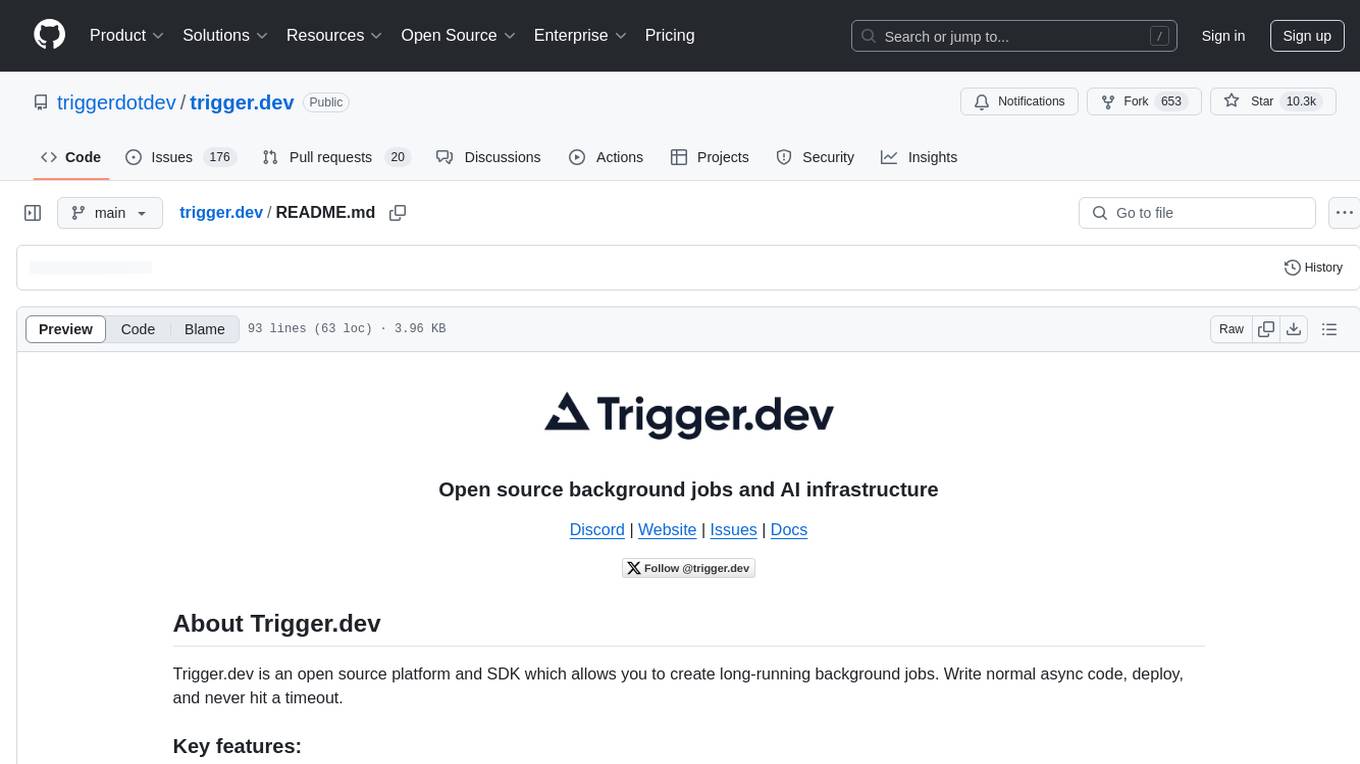
trigger.dev
Trigger.dev is an open source platform and SDK for creating long-running background jobs. It provides features like JavaScript and TypeScript SDK, no timeouts, retries, queues, schedules, observability, React hooks, Realtime API, custom alerts, elastic scaling, and works with existing tech stack. Users can create tasks in their codebase, deploy tasks using the SDK, manage tasks in different environments, and have full visibility of job runs. The platform offers a trace view of every task run for detailed monitoring. Getting started is easy with account creation, project setup, and onboarding instructions. Self-hosting and development guides are available for users interested in contributing or hosting Trigger.dev.
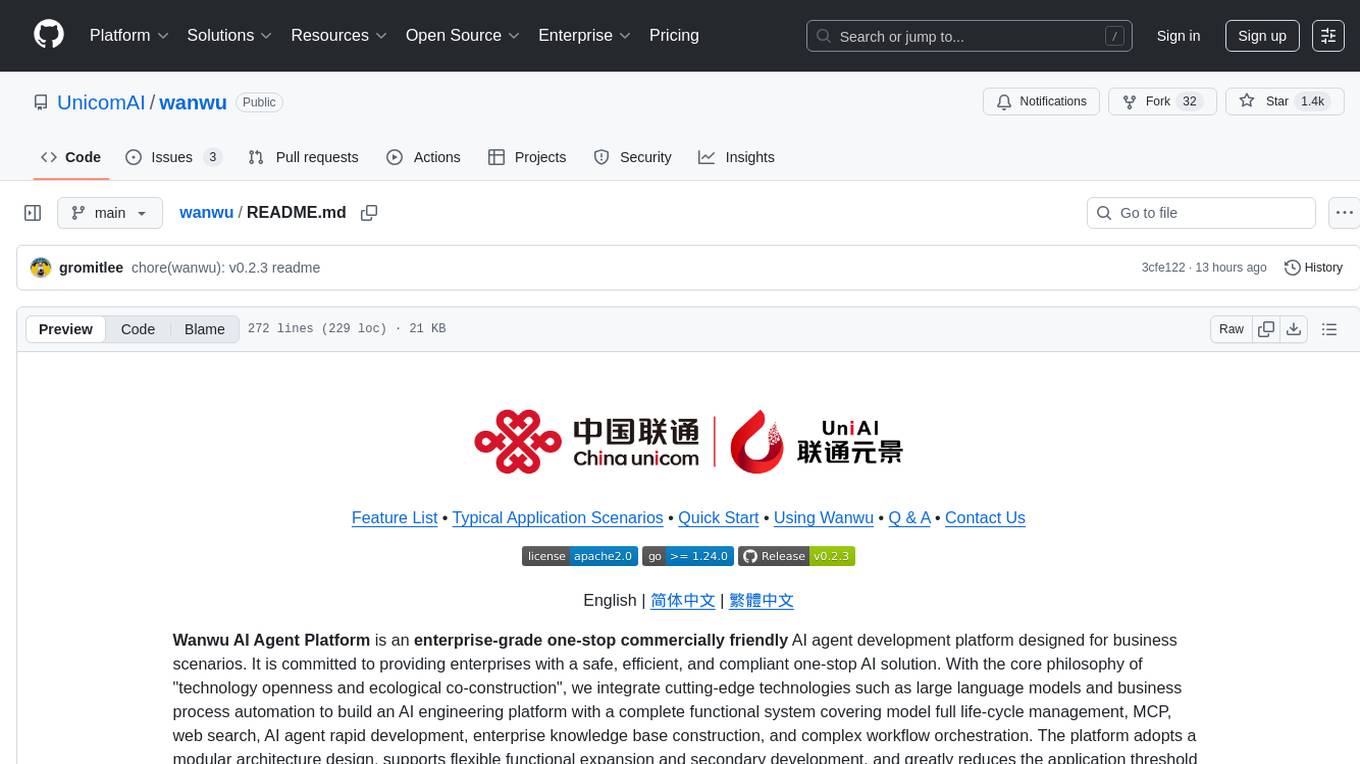
wanwu
Wanwu AI Agent Platform is an enterprise-grade one-stop commercially friendly AI agent development platform designed for business scenarios. It provides enterprises with a safe, efficient, and compliant one-stop AI solution. The platform integrates cutting-edge technologies such as large language models and business process automation to build an AI engineering platform covering model full life-cycle management, MCP, web search, AI agent rapid development, enterprise knowledge base construction, and complex workflow orchestration. It supports modular architecture design, flexible functional expansion, and secondary development, reducing the application threshold of AI technology while ensuring security and privacy protection of enterprise data. It accelerates digital transformation, cost reduction, efficiency improvement, and business innovation for enterprises of all sizes.
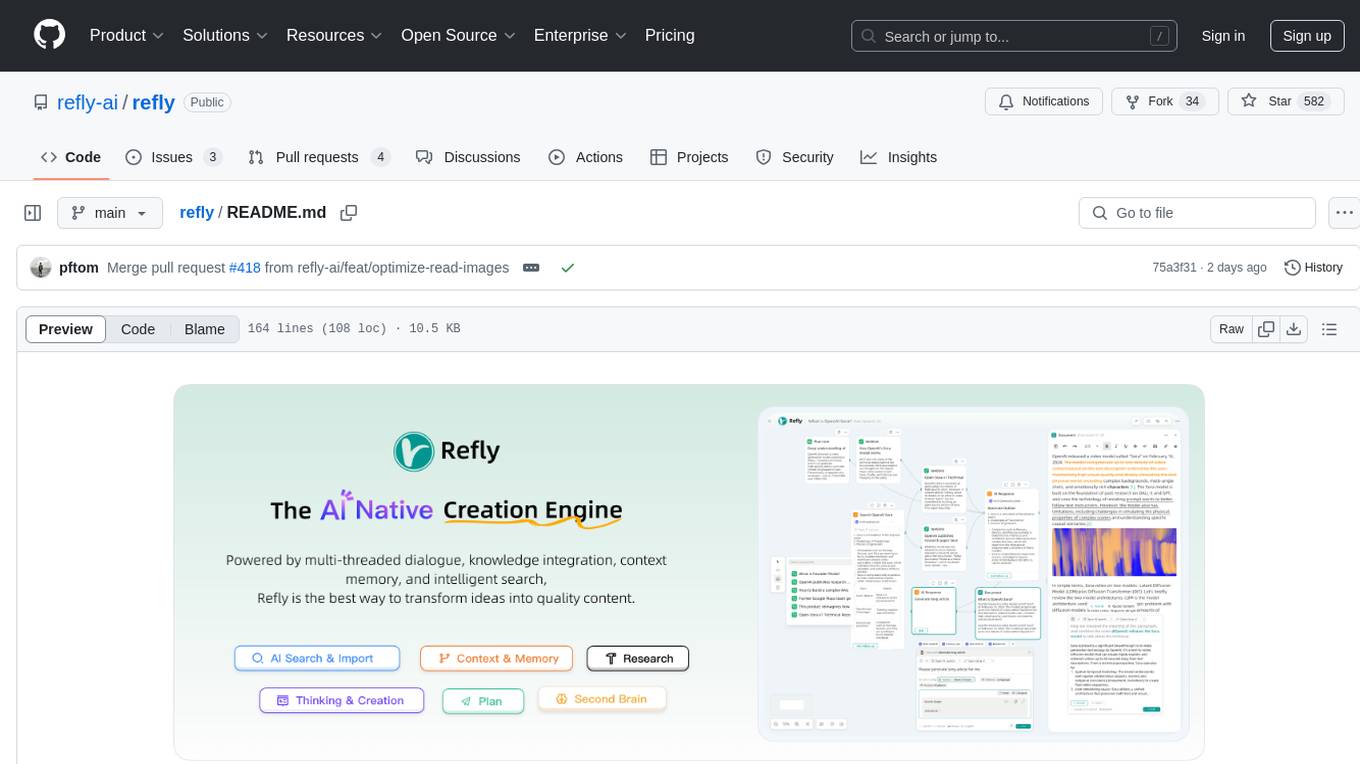
refly
Refly.AI is an open-source AI-native creation engine that empowers users to transform ideas into production-ready content. It features a free-form canvas interface with multi-threaded conversations, knowledge base integration, contextual memory, intelligent search, WYSIWYG AI editor, and more. Users can leverage AI-powered capabilities, context memory, knowledge base integration, quotes, and AI document editing to enhance their content creation process. Refly offers both cloud and self-hosting options, making it suitable for individuals, enterprises, and organizations. The tool is designed to facilitate human-AI collaboration and streamline content creation workflows.
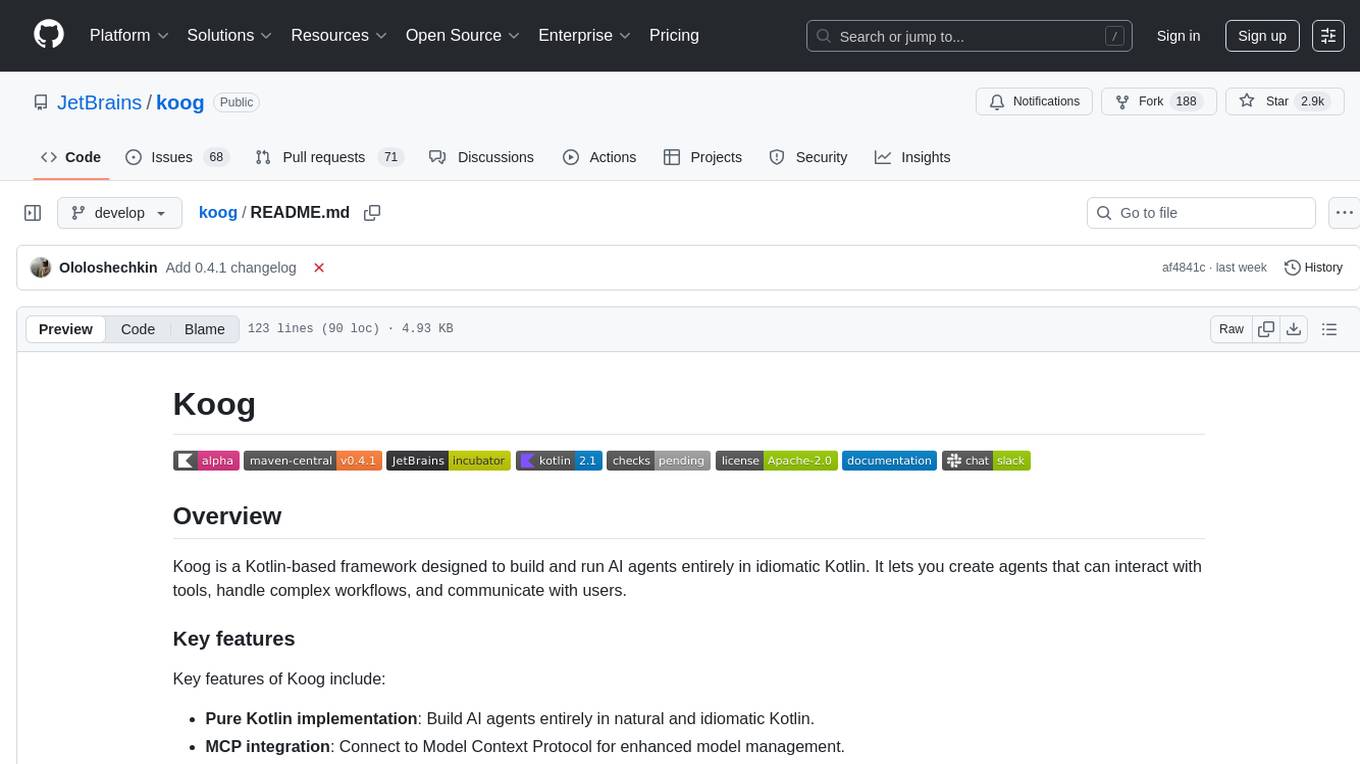
koog
Koog is a Kotlin-based framework for building and running AI agents entirely in idiomatic Kotlin. It allows users to create agents that interact with tools, handle complex workflows, and communicate with users. Key features include pure Kotlin implementation, MCP integration, embedding capabilities, custom tool creation, ready-to-use components, intelligent history compression, powerful streaming API, persistent agent memory, comprehensive tracing, flexible graph workflows, modular feature system, scalable architecture, and multiplatform support.
clearml
ClearML is a suite of tools designed to streamline the machine learning workflow. It includes an experiment manager, MLOps/LLMOps, data management, and model serving capabilities. ClearML is open-source and offers a free tier hosting option. It supports various ML/DL frameworks and integrates with Jupyter Notebook and PyCharm. ClearML provides extensive logging capabilities, including source control info, execution environment, hyper-parameters, and experiment outputs. It also offers automation features, such as remote job execution and pipeline creation. ClearML is designed to be easy to integrate, requiring only two lines of code to add to existing scripts. It aims to improve collaboration, visibility, and data transparency within ML teams.
weam
Weam is an open source platform designed to help teams systematically adopt AI. It provides a production-ready stack with Next.js frontend and Node.js/Python backend, allowing for immediate deployment and use. Weam connects to major LLM providers, enabling easy access to the latest AI models. The platform organizes AI interactions into 'Brains' for different departments, offering customization and expansion options. Features include chat system, productivity tools, sharing & access controls, prompt library, AI agents, RAG, MCP, enterprise features, pre-built automations, and upcoming AI app solutions. Weam is free, open source, and scalable to meet growing needs.
toolhive-studio
ToolHive Studio is an experimental project under active development and testing, providing an easy way to discover, deploy, and manage Model Context Protocol (MCP) servers securely. Users can launch any MCP server in a locked-down container with just a few clicks, eliminating manual setup, security concerns, and runtime issues. The tool ensures instant deployment, default security measures, cross-platform compatibility, and seamless integration with popular clients like GitHub Copilot, Cursor, and Claude Code.
clearml
ClearML is an auto-magical suite of tools designed to streamline AI workflows. It includes modules for experiment management, MLOps/LLMOps, data management, model serving, and more. ClearML offers features like experiment tracking, model serving, orchestration, and automation. It supports various ML/DL frameworks and integrates with Jupyter Notebook and PyCharm for remote debugging. ClearML aims to simplify collaboration, automate processes, and enhance visibility in AI projects.
For similar tasks
agent-zero
Agent Zero is a personal, organic agentic framework designed to be dynamic, transparent, customizable, and interactive. It uses the computer as a tool to accomplish tasks, with features like general-purpose assistant, computer as a tool, multi-agent cooperation, customizable and extensible framework, and communication skills. The tool is fully Dockerized, with Speech-to-Text and TTS capabilities, and offers real-world use cases like financial analysis, Excel automation, API integration, server monitoring, and project isolation. Agent Zero can be dangerous if not used properly and is prompt-based, guided by the prompts folder. The tool is extensively documented and has a changelog highlighting various updates and improvements.
For similar jobs
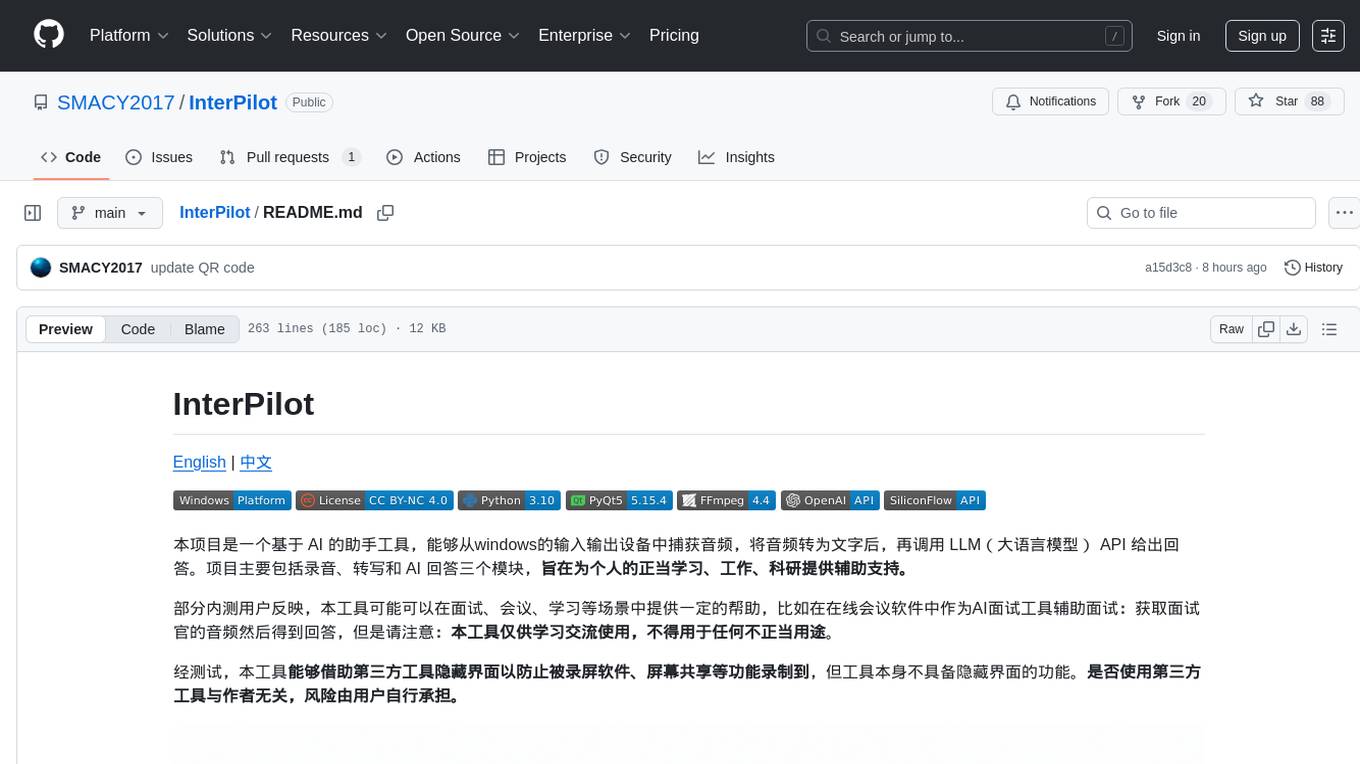
InterPilot
InterPilot is an AI-based assistant tool that captures audio from Windows input/output devices, transcribes it into text, and then calls the Large Language Model (LLM) API to provide answers. The project includes recording, transcription, and AI response modules, aiming to provide support for personal legitimate learning, work, and research. It may assist in scenarios like interviews, meetings, and learning, but it is strictly for learning and communication purposes only. The tool can hide its interface using third-party tools to prevent screen recording or screen sharing, but it does not have this feature built-in. Users bear the risk of using third-party tools independently.
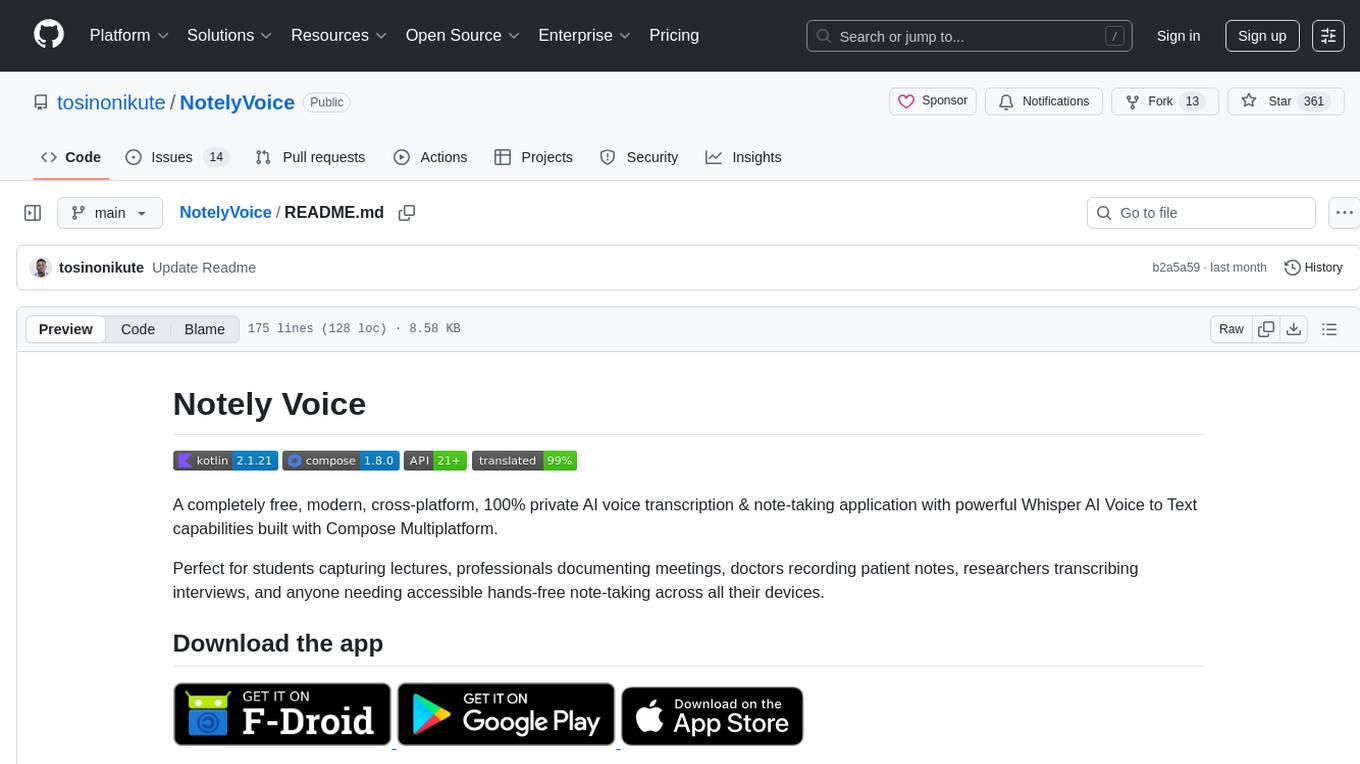
NotelyVoice
Notely Voice is a free, modern, cross-platform AI voice transcription and note-taking application. It offers powerful Whisper AI Voice to Text capabilities, making it ideal for students, professionals, doctors, researchers, and anyone in need of hands-free note-taking. The app features rich text editing, simple search, smart filtering, organization with folders and tags, advanced speech-to-text, offline capability, seamless integration, audio recording, theming, cross-platform support, and sharing functionality. It includes memory-efficient audio processing, chunking configuration, and utilizes OpenAI Whisper for speech recognition technology. Built with Kotlin, Compose Multiplatform, Coroutines, Android Architecture, ViewModel, Koin, Material 3, Whisper AI, and Native Compose Navigation, Notely follows Android Architecture principles with distinct layers for UI, presentation, domain, and data.
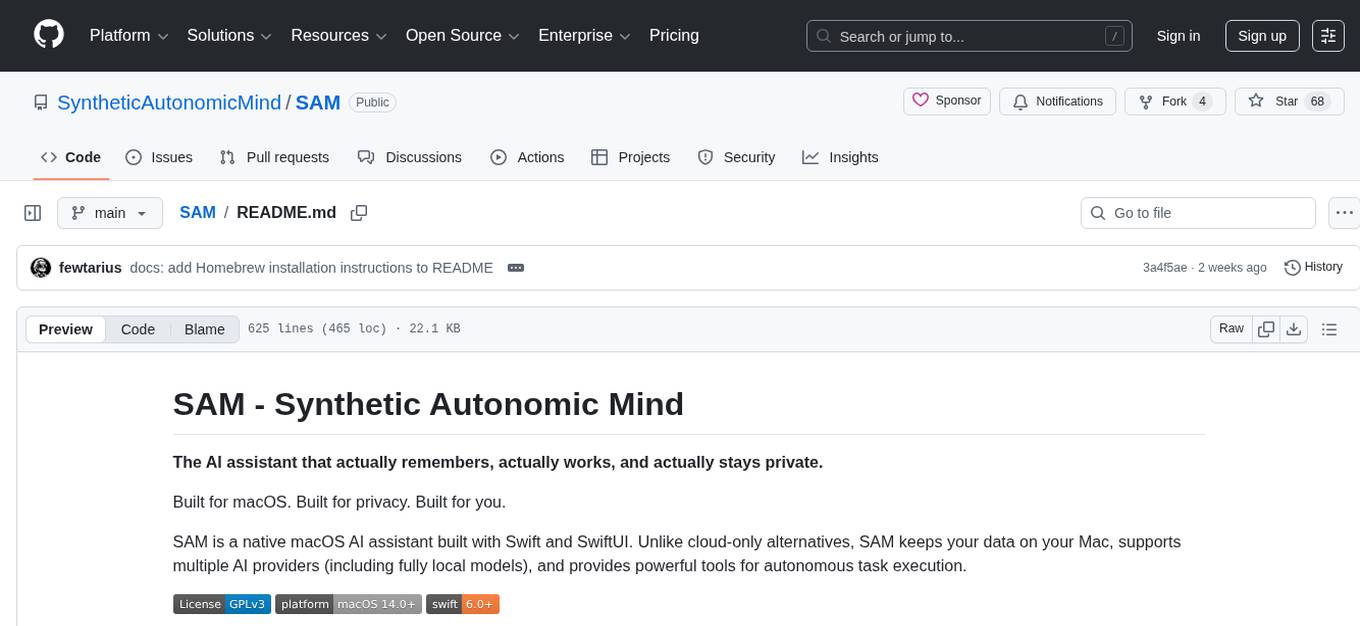
SAM
SAM is a native macOS AI assistant built with Swift and SwiftUI, designed for non-developers who want powerful tools in their everyday life. It provides real assistance, smart memory, voice control, image generation, and custom AI model training. SAM keeps your data on your Mac, supports multiple AI providers, and offers features for documents, creativity, writing, organization, learning, and more. It is privacy-focused, user-friendly, and accessible from various devices. SAM stands out with its privacy-first approach, intelligent memory, task execution capabilities, powerful tools, image generation features, custom AI model training, and flexible AI provider support.
agent-zero
Agent Zero is a personal, organic agentic framework designed to be dynamic, transparent, customizable, and interactive. It uses the computer as a tool to accomplish tasks, with features like general-purpose assistant, computer as a tool, multi-agent cooperation, customizable and extensible framework, and communication skills. The tool is fully Dockerized, with Speech-to-Text and TTS capabilities, and offers real-world use cases like financial analysis, Excel automation, API integration, server monitoring, and project isolation. Agent Zero can be dangerous if not used properly and is prompt-based, guided by the prompts folder. The tool is extensively documented and has a changelog highlighting various updates and improvements.
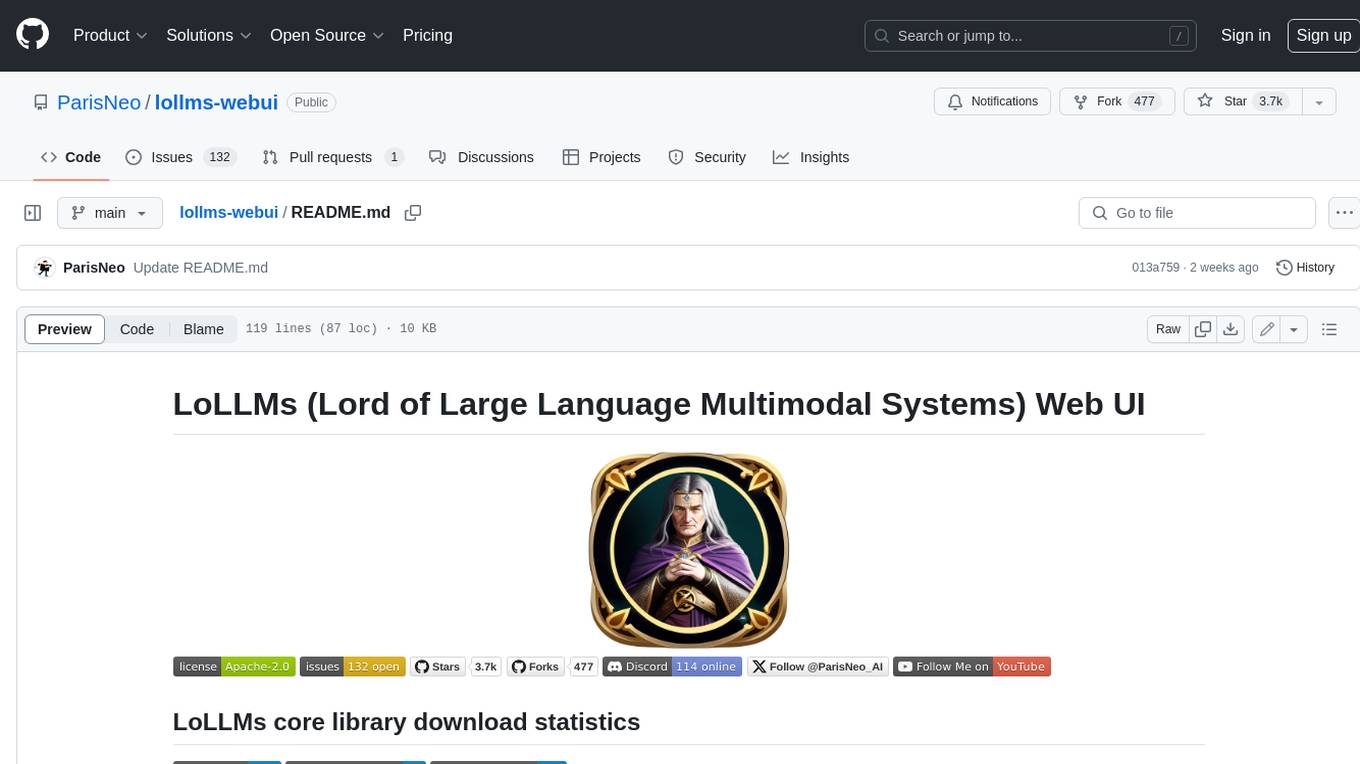
lollms-webui
LoLLMs WebUI (Lord of Large Language Multimodal Systems: One tool to rule them all) is a user-friendly interface to access and utilize various LLM (Large Language Models) and other AI models for a wide range of tasks. With over 500 AI expert conditionings across diverse domains and more than 2500 fine tuned models over multiple domains, LoLLMs WebUI provides an immediate resource for any problem, from car repair to coding assistance, legal matters, medical diagnosis, entertainment, and more. The easy-to-use UI with light and dark mode options, integration with GitHub repository, support for different personalities, and features like thumb up/down rating, copy, edit, and remove messages, local database storage, search, export, and delete multiple discussions, make LoLLMs WebUI a powerful and versatile tool.
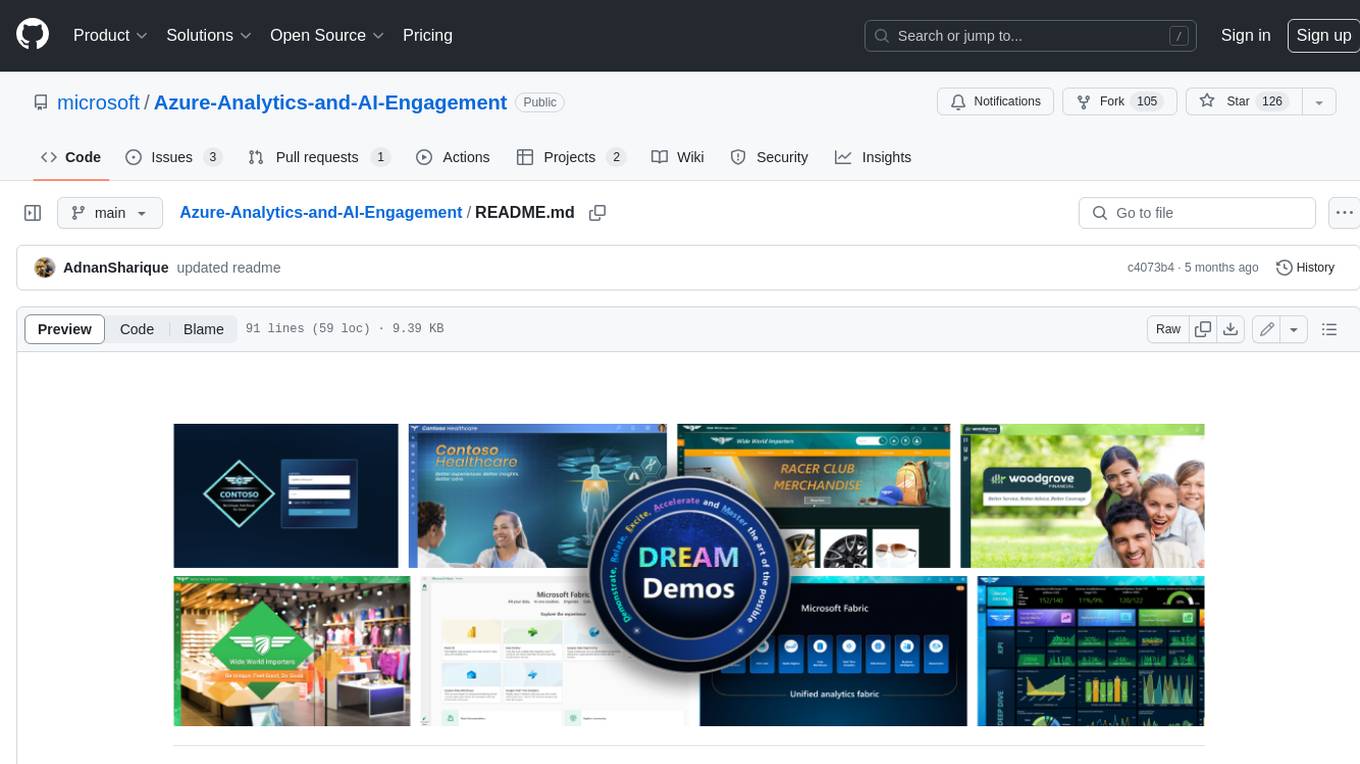
Azure-Analytics-and-AI-Engagement
The Azure-Analytics-and-AI-Engagement repository provides packaged Industry Scenario DREAM Demos with ARM templates (Containing a demo web application, Power BI reports, Synapse resources, AML Notebooks etc.) that can be deployed in a customer’s subscription using the CAPE tool within a matter of few hours. Partners can also deploy DREAM Demos in their own subscriptions using DPoC.
minio
MinIO is a High Performance Object Storage released under GNU Affero General Public License v3.0. It is API compatible with Amazon S3 cloud storage service. Use MinIO to build high performance infrastructure for machine learning, analytics and application data workloads.
mage-ai
Mage is an open-source data pipeline tool for transforming and integrating data. It offers an easy developer experience, engineering best practices built-in, and data as a first-class citizen. Mage makes it easy to build, preview, and launch data pipelines, and provides observability and scaling capabilities. It supports data integrations, streaming pipelines, and dbt integration.