


CameraChessWeb
Record a chess game live and upload the PGN to Lichess
Stars: 210
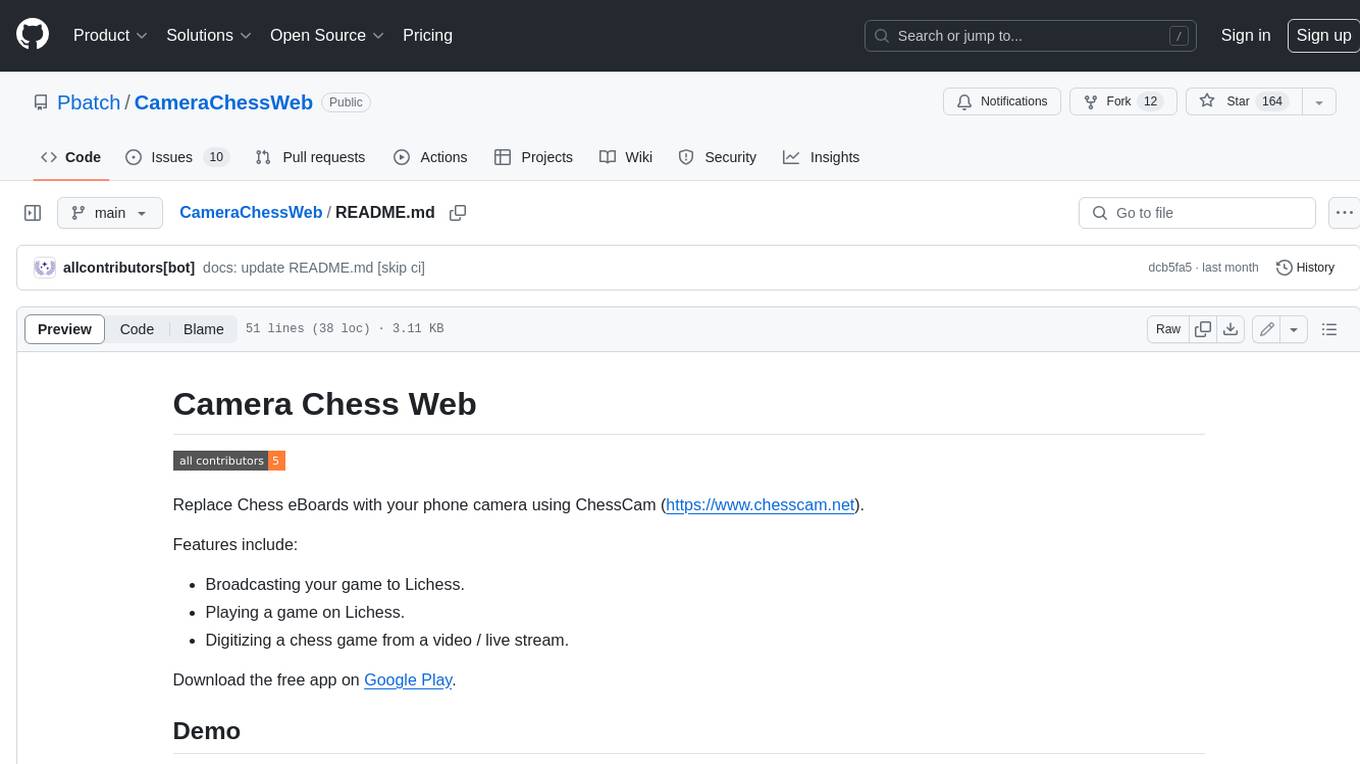
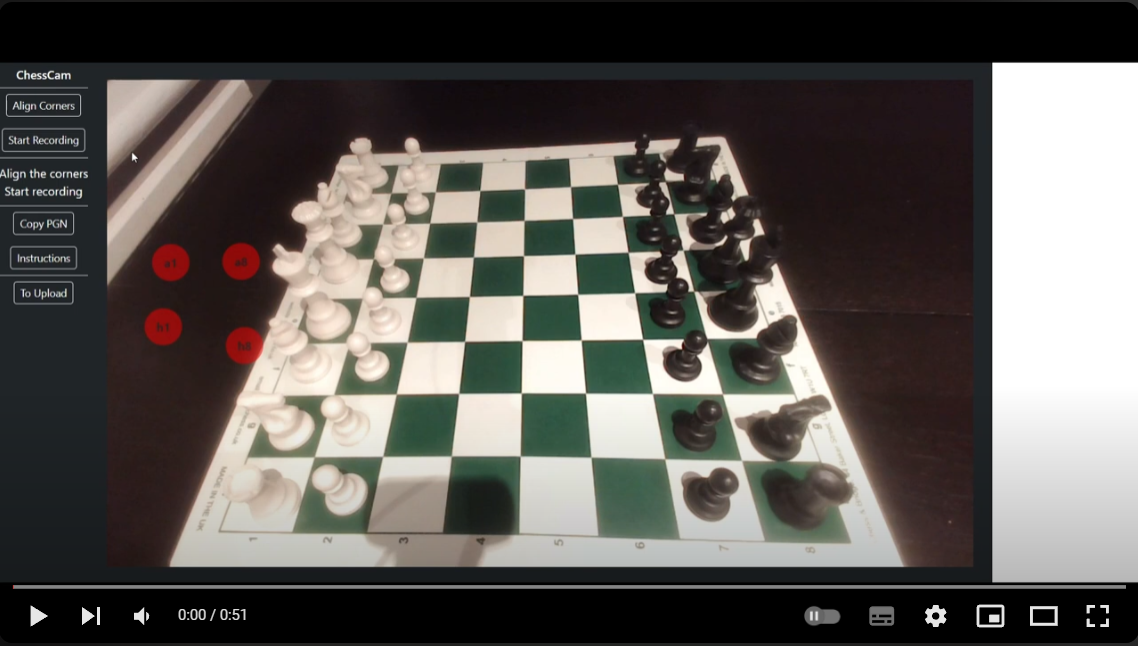
Camera Chess Web is a tool that allows you to use your phone camera to replace chess eBoards. With Camera Chess Web, you can broadcast your game to Lichess, play a game on Lichess, or digitize a chess game from a video or live stream. Camera Chess Web is free to download on Google Play.
README:
📌 This app is under active development and may experience minor issues.
Please report any bugs on Discord, and we will fix them promptly.
|
|


Replace Chess eBoards with your phone camera using ChessCam (https://www.chesscam.net).
Download the free app on Google Play.
Do you have ideas, bugs to report or training footage? Join our Discord Server.
- Raise an alert when an illegal move is played (currently they're just ignored)
- Add sounds for the opponents moves in "/play"
- Add support for variants
- Develop a testing framework for different board + piece sets
- ... Your next big idea?
Please post in the Issues tab if you need any help with:
- Running inference
- Exporting models to different formats
- Training on data of varying resolutions (I.e. 640x640)
- etc. etc.
| Name | Description | Link |
|---|---|---|
| 480M_leyolo_pieces.onnx | LeYOLO ONNX model | https://drive.google.com/file/d/1-80xp_nly9i6s3o0mF0mU9OZGEzUAlGj/view?usp=sharing |
| 480M_leyolo_pieces.pt | LeYOLO pt model | https://drive.google.com/file/d/1L6PZbSdT-peCmiJGNwmgHJN5MTpfAM-0/view?usp=sharing |
| pieces.tar.gz | Train/test data in YOLOv5 format | https://drive.google.com/file/d/1CrrINu11Wy8Cv1H4Q9DbcGqir3GPPO29/view?usp=sharing |
| Report | Weights & Biases report from the LeYOLO training run | https://api.wandb.ai/links/pbatch/g2rcvycv |
| Name | Description | Link |
|---|---|---|
| 480L_leyolo_xcorners.onnx | LeYOLO ONNX model | https://drive.google.com/file/d/1-2wodbiXag9UQ44e2AYAmoRN6jVpxy83/view?usp=sharing |
| 480L_leyolo_xcorners.pt | LeYOLO pt model | https://drive.google.com/file/d/173orSe8eaytN8nin_HOvd2sEfP_wtOUW/view?usp=sharing |
| xcorners.tar.gz | Train/test data in YOLOv5 format | https://drive.google.com/file/d/15Liy-vMcujSZak4YRPeC2TpVjIA3AwVM/view?usp=sharing |
| Report | Weights & Biases report from the LeYOLO training run | https://api.wandb.ai/links/pbatch/ziwur3gr |
- LeYOLO Training + ONNX export - https://gist.github.com/Pbatch/dccc680ac2f852d4f258e4b6f1997a7b
- TFJS export - https://gist.github.com/Pbatch/46d958df7e0363e42561bda50163a57a
Thanks goes to these wonderful people (emoji key):
 Conor Shepherd 🔬 |
 tdr24008 🔬 |
 DakshHandeCode 🎨 |
 ChessScholar 🐛 |
 JohnP-1 🐛 |
 Abdullah Khetran 🔬 |
 Tejas Raman 🛡️ |
This project follows the all-contributors specification. Contributions of any kind welcome!
For Tasks:
Click tags to check more tools for each tasksFor Jobs:
Alternative AI tools for CameraChessWeb
Similar Open Source Tools
CameraChessWeb
Camera Chess Web is a tool that allows you to use your phone camera to replace chess eBoards. With Camera Chess Web, you can broadcast your game to Lichess, play a game on Lichess, or digitize a chess game from a video or live stream. Camera Chess Web is free to download on Google Play.
generative-ai-for-beginners
This course has 18 lessons. Each lesson covers its own topic so start wherever you like! Lessons are labeled either "Learn" lessons explaining a Generative AI concept or "Build" lessons that explain a concept and code examples in both **Python** and **TypeScript** when possible. Each lesson also includes a "Keep Learning" section with additional learning tools. **What You Need** * Access to the Azure OpenAI Service **OR** OpenAI API - _Only required to complete coding lessons_ * Basic knowledge of Python or Typescript is helpful - *For absolute beginners check out these Python and TypeScript courses. * A Github account to fork this entire repo to your own GitHub account We have created a **Course Setup** lesson to help you with setting up your development environment. Don't forget to star (🌟) this repo to find it easier later. ## 🧠 Ready to Deploy? If you are looking for more advanced code samples, check out our collection of Generative AI Code Samples in both **Python** and **TypeScript**. ## 🗣️ Meet Other Learners, Get Support Join our official AI Discord server to meet and network with other learners taking this course and get support. ## 🚀 Building a Startup? Sign up for Microsoft for Startups Founders Hub to receive **free OpenAI credits** and up to **$150k towards Azure credits to access OpenAI models through Azure OpenAI Services**. ## 🙏 Want to help? Do you have suggestions or found spelling or code errors? Raise an issue or Create a pull request ## 📂 Each lesson includes: * A short video introduction to the topic * A written lesson located in the README * Python and TypeScript code samples supporting Azure OpenAI and OpenAI API * Links to extra resources to continue your learning ## 🗃️ Lessons | | Lesson Link | Description | Additional Learning | | :-: | :------------------------------------------------------------------------------------------------------------------------------------------: | :---------------------------------------------------------------------------------------------: | ------------------------------------------------------------------------------ | | 00 | Course Setup | **Learn:** How to Setup Your Development Environment | Learn More | | 01 | Introduction to Generative AI and LLMs | **Learn:** Understanding what Generative AI is and how Large Language Models (LLMs) work. | Learn More | | 02 | Exploring and comparing different LLMs | **Learn:** How to select the right model for your use case | Learn More | | 03 | Using Generative AI Responsibly | **Learn:** How to build Generative AI Applications responsibly | Learn More | | 04 | Understanding Prompt Engineering Fundamentals | **Learn:** Hands-on Prompt Engineering Best Practices | Learn More | | 05 | Creating Advanced Prompts | **Learn:** How to apply prompt engineering techniques that improve the outcome of your prompts. | Learn More | | 06 | Building Text Generation Applications | **Build:** A text generation app using Azure OpenAI | Learn More | | 07 | Building Chat Applications | **Build:** Techniques for efficiently building and integrating chat applications. | Learn More | | 08 | Building Search Apps Vector Databases | **Build:** A search application that uses Embeddings to search for data. | Learn More | | 09 | Building Image Generation Applications | **Build:** A image generation application | Learn More | | 10 | Building Low Code AI Applications | **Build:** A Generative AI application using Low Code tools | Learn More | | 11 | Integrating External Applications with Function Calling | **Build:** What is function calling and its use cases for applications | Learn More | | 12 | Designing UX for AI Applications | **Learn:** How to apply UX design principles when developing Generative AI Applications | Learn More | | 13 | Securing Your Generative AI Applications | **Learn:** The threats and risks to AI systems and methods to secure these systems. | Learn More | | 14 | The Generative AI Application Lifecycle | **Learn:** The tools and metrics to manage the LLM Lifecycle and LLMOps | Learn More | | 15 | Retrieval Augmented Generation (RAG) and Vector Databases | **Build:** An application using a RAG Framework to retrieve embeddings from a Vector Databases | Learn More | | 16 | Open Source Models and Hugging Face | **Build:** An application using open source models available on Hugging Face | Learn More | | 17 | AI Agents | **Build:** An application using an AI Agent Framework | Learn More | | 18 | Fine-Tuning LLMs | **Learn:** The what, why and how of fine-tuning LLMs | Learn More |
openkore
OpenKore is a custom client and intelligent automated assistant for Ragnarok Online. It is a free, open source, and cross-platform program (Linux, Windows, and MacOS are supported). To run OpenKore, you need to download and extract it or clone the repository using Git. Configure OpenKore according to the documentation and run openkore.pl to start. The tool provides a FAQ section for troubleshooting, guidelines for reporting issues, and information about botting status on official servers. OpenKore is developed by a global team, and contributions are welcome through pull requests. Various community resources are available for support and communication. Users are advised to comply with the GNU General Public License when using and distributing the software.
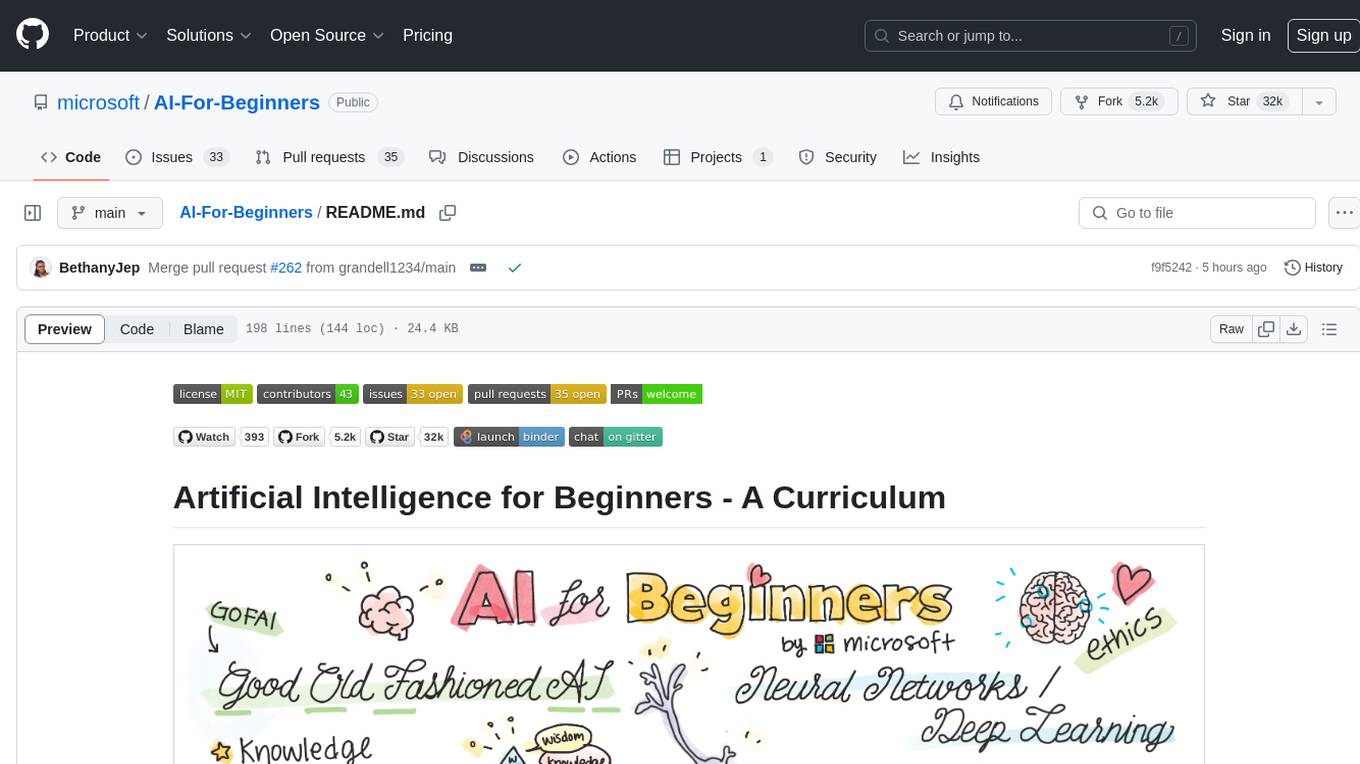
AI-For-Beginners
AI-For-Beginners is a comprehensive 12-week, 24-lesson curriculum designed by experts at Microsoft to introduce beginners to the world of Artificial Intelligence (AI). The curriculum covers various topics such as Symbolic AI, Neural Networks, Computer Vision, Natural Language Processing, Genetic Algorithms, and Multi-Agent Systems. It includes hands-on lessons, quizzes, and labs using popular frameworks like TensorFlow and PyTorch. The focus is on providing a foundational understanding of AI concepts and principles, making it an ideal starting point for individuals interested in AI.
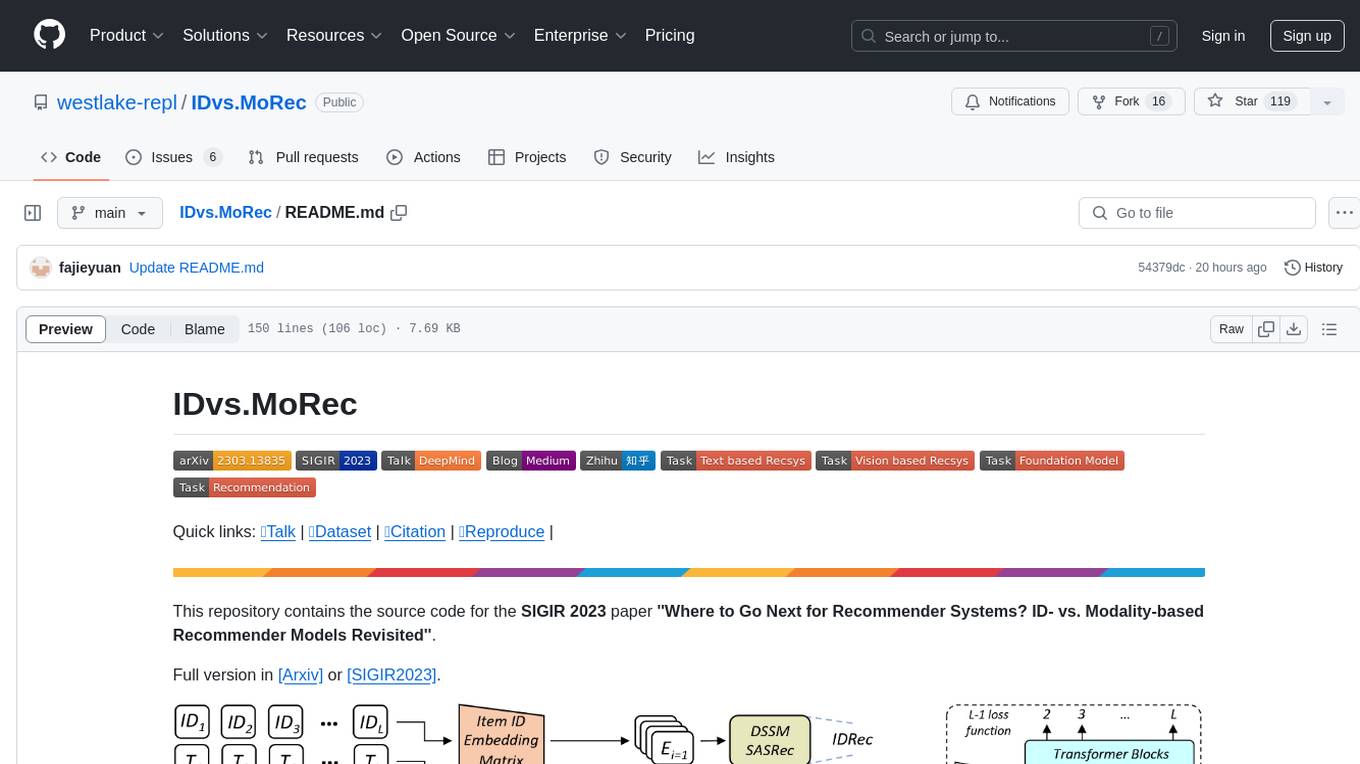
IDvs.MoRec
This repository contains the source code for the SIGIR 2023 paper 'Where to Go Next for Recommender Systems? ID- vs. Modality-based Recommender Models Revisited'. It provides resources for evaluating foundation, transferable, multi-modal, and LLM recommendation models, along with datasets, pre-trained models, and training strategies for IDRec and MoRec using in-batch debiased cross-entropy loss. The repository also offers large-scale datasets, code for SASRec with in-batch debias cross-entropy loss, and information on joining the lab for research opportunities.
Awesome-AI-GPTs
Awesome AI GPTs is an open repository that collects resources and fun ways to use OpenAI GPTs. It includes databases, search tools, open-source projects, articles, attack and defense strategies, installation of custom plugins, knowledge bases, and community interactions related to GPTs. Users can find curated lists, leaked prompts, and various GPT applications in this repository. The project aims to empower users with AI capabilities and foster collaboration in the AI community.
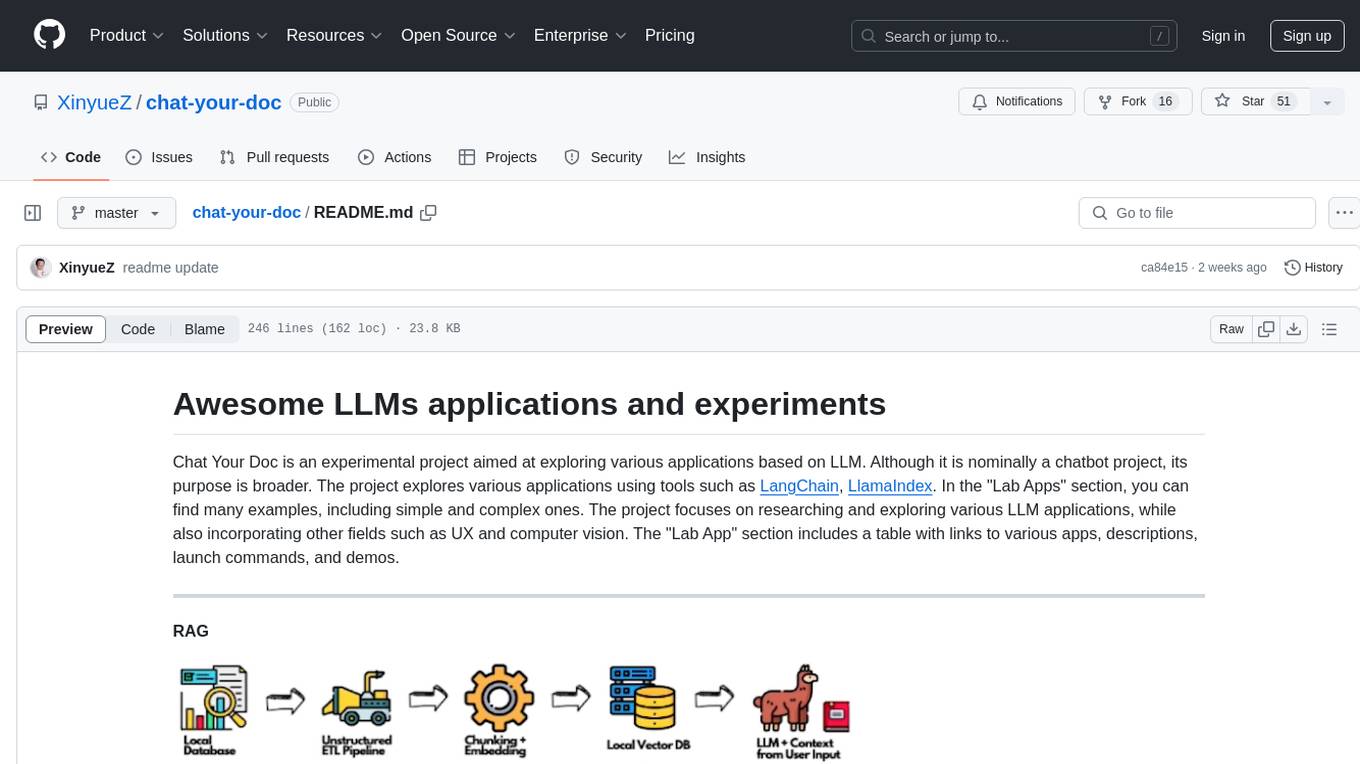
chat-your-doc
Chat Your Doc is an experimental project exploring various applications based on LLM technology. It goes beyond being just a chatbot project, focusing on researching LLM applications using tools like LangChain and LlamaIndex. The project delves into UX, computer vision, and offers a range of examples in the 'Lab Apps' section. It includes links to different apps, descriptions, launch commands, and demos, aiming to showcase the versatility and potential of LLM applications.
llm4ad
LLM4AD is an open-source Python-based platform leveraging Large Language Models (LLMs) for Automatic Algorithm Design (AD). It provides unified interfaces for methods, tasks, and LLMs, along with features like evaluation acceleration, secure evaluation, logs, GUI support, and more. The platform was originally developed for optimization tasks but is versatile enough to be used in other areas such as machine learning, science discovery, game theory, and engineering design. It offers various search methods and algorithm design tasks across different domains. LLM4AD supports remote LLM API, local HuggingFace LLM deployment, and custom LLM interfaces. The project is licensed under the MIT License and welcomes contributions, collaborations, and issue reports.
MaixPy
MaixPy is a Python SDK that enables users to easily create AI vision projects on edge devices. It provides a user-friendly API for accessing NPU, making it suitable for AI Algorithm Engineers, STEM teachers, Makers, Engineers, Students, Enterprises, and Contestants. The tool supports Python programming, MaixVision Workstation, AI vision, video streaming, voice recognition, and peripheral usage. It also offers an online AI training platform called MaixHub. MaixPy is designed for new hardware platforms like MaixCAM, offering improved performance and features compared to older versions. The ecosystem includes hardware, software, tools, documentation, and a cloud platform.
vlmrun-cookbook
VLM Run Cookbook is a repository containing practical examples and tutorials for extracting structured data from images, videos, and documents using Vision Language Models (VLMs). It offers comprehensive Colab notebooks demonstrating real-world applications of VLM Run, with complete code and documentation for easy adaptation. The examples cover various domains such as financial documents and TV news analysis.
EasyEdit
EasyEdit is a Python package for edit Large Language Models (LLM) like `GPT-J`, `Llama`, `GPT-NEO`, `GPT2`, `T5`(support models from **1B** to **65B**), the objective of which is to alter the behavior of LLMs efficiently within a specific domain without negatively impacting performance across other inputs. It is designed to be easy to use and easy to extend.
visionOS-examples
visionOS-examples is a repository containing accelerators for Spatial Computing. It includes examples such as Local Large Language Model, Chat Apple Vision Pro, WebSockets, Anchor To Head, Hand Tracking, Battery Life, Countdown, Plane Detection, Timer Vision, and PencilKit for visionOS. The repository showcases various functionalities and features for Apple Vision Pro, offering tools for developers to enhance their visionOS apps with capabilities like hand tracking, plane detection, and real-time cryptocurrency prices.
TrustLLM
TrustLLM is a comprehensive study of trustworthiness in LLMs, including principles for different dimensions of trustworthiness, established benchmark, evaluation, and analysis of trustworthiness for mainstream LLMs, and discussion of open challenges and future directions. Specifically, we first propose a set of principles for trustworthy LLMs that span eight different dimensions. Based on these principles, we further establish a benchmark across six dimensions including truthfulness, safety, fairness, robustness, privacy, and machine ethics. We then present a study evaluating 16 mainstream LLMs in TrustLLM, consisting of over 30 datasets. The document explains how to use the trustllm python package to help you assess the performance of your LLM in trustworthiness more quickly. For more details about TrustLLM, please refer to project website.
Q-Bench
Q-Bench is a benchmark for general-purpose foundation models on low-level vision, focusing on multi-modality LLMs performance. It includes three realms for low-level vision: perception, description, and assessment. The benchmark datasets LLVisionQA and LLDescribe are collected for perception and description tasks, with open submission-based evaluation. An abstract evaluation code is provided for assessment using public datasets. The tool can be used with the datasets API for single images and image pairs, allowing for automatic download and usage. Various tasks and evaluations are available for testing MLLMs on low-level vision tasks.
Botright
Botright is a tool designed for browser automation that focuses on stealth and captcha solving. It uses a real Chromium-based browser for enhanced stealth and offers features like browser fingerprinting and AI-powered captcha solving. The tool is suitable for developers looking to automate browser tasks while maintaining anonymity and bypassing captchas. Botright is available in async mode and can be easily integrated with existing Playwright code. It provides solutions for various captchas such as hCaptcha, reCaptcha, and GeeTest, with high success rates. Additionally, Botright offers browser stealth techniques and supports different browser functionalities for seamless automation.
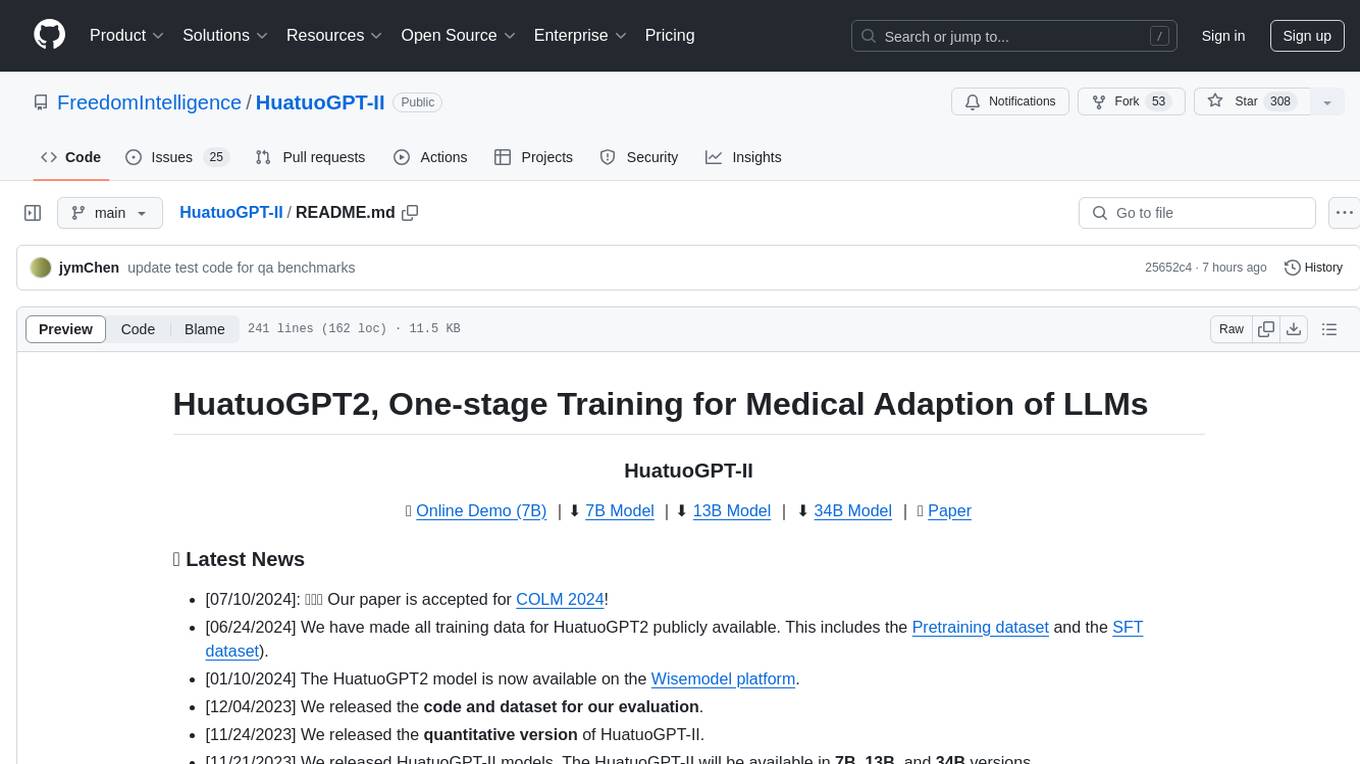
HuatuoGPT-II
HuatuoGPT2 is an innovative domain-adapted medical large language model that excels in medical knowledge and dialogue proficiency. It showcases state-of-the-art performance in various medical benchmarks, surpassing GPT-4 in expert evaluations and fresh medical licensing exams. The open-source release includes HuatuoGPT2 models in 7B, 13B, and 34B versions, training code for one-stage adaptation, partial pre-training and fine-tuning instructions, and evaluation methods for medical response capabilities and professional pharmacist exams. The tool aims to enhance LLM capabilities in the Chinese medical field through open-source principles.
For similar tasks
CameraChessWeb
Camera Chess Web is a tool that allows you to use your phone camera to replace chess eBoards. With Camera Chess Web, you can broadcast your game to Lichess, play a game on Lichess, or digitize a chess game from a video or live stream. Camera Chess Web is free to download on Google Play.
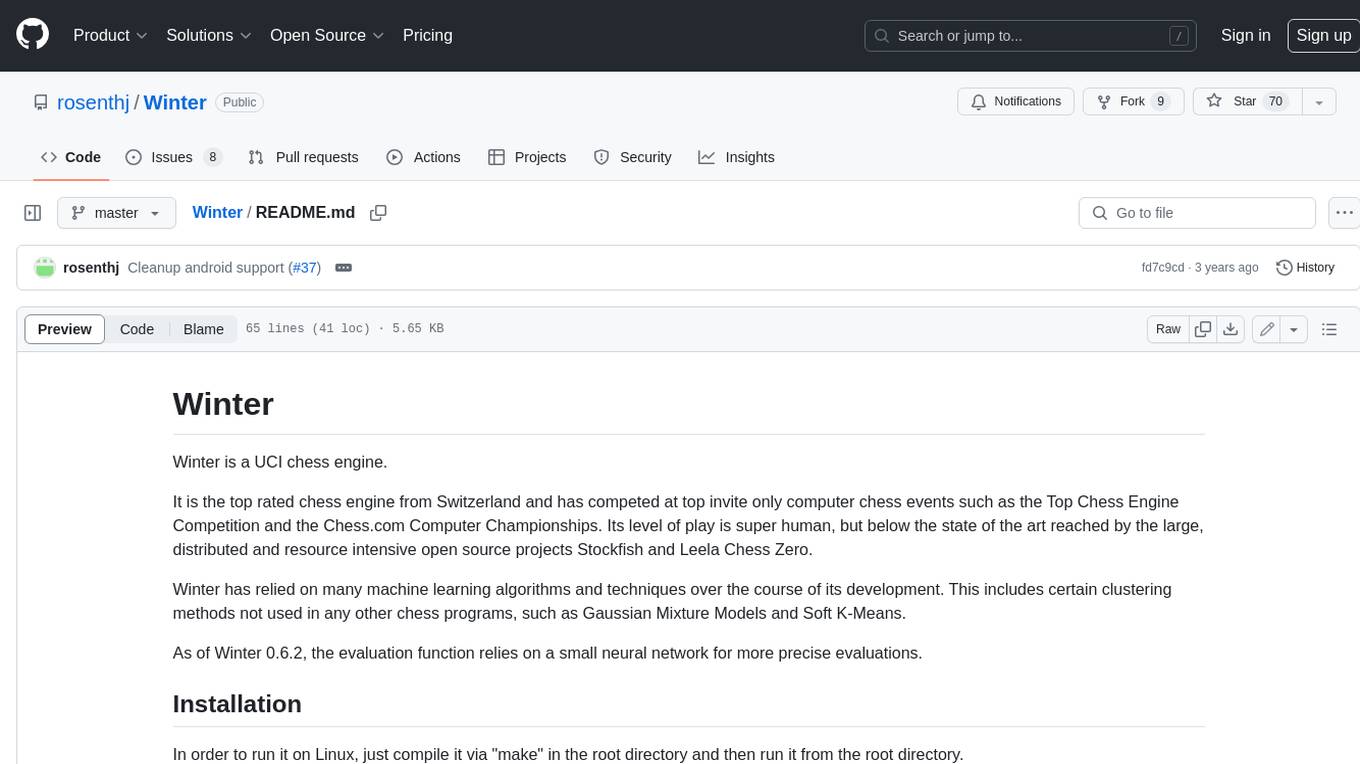
Winter
Winter is a UCI chess engine that has competed at top invite-only computer chess events. It is the top-rated chess engine from Switzerland and has a level of play that is super human but below the state of the art reached by large, distributed, and resource-intensive open-source projects like Stockfish and Leela Chess Zero. Winter has relied on many machine learning algorithms and techniques over the course of its development, including certain clustering methods not used in any other chess programs, such as Gaussian Mixture Models and Soft K-Means. As of Winter 0.6.2, the evaluation function relies on a small neural network for more precise evaluations.
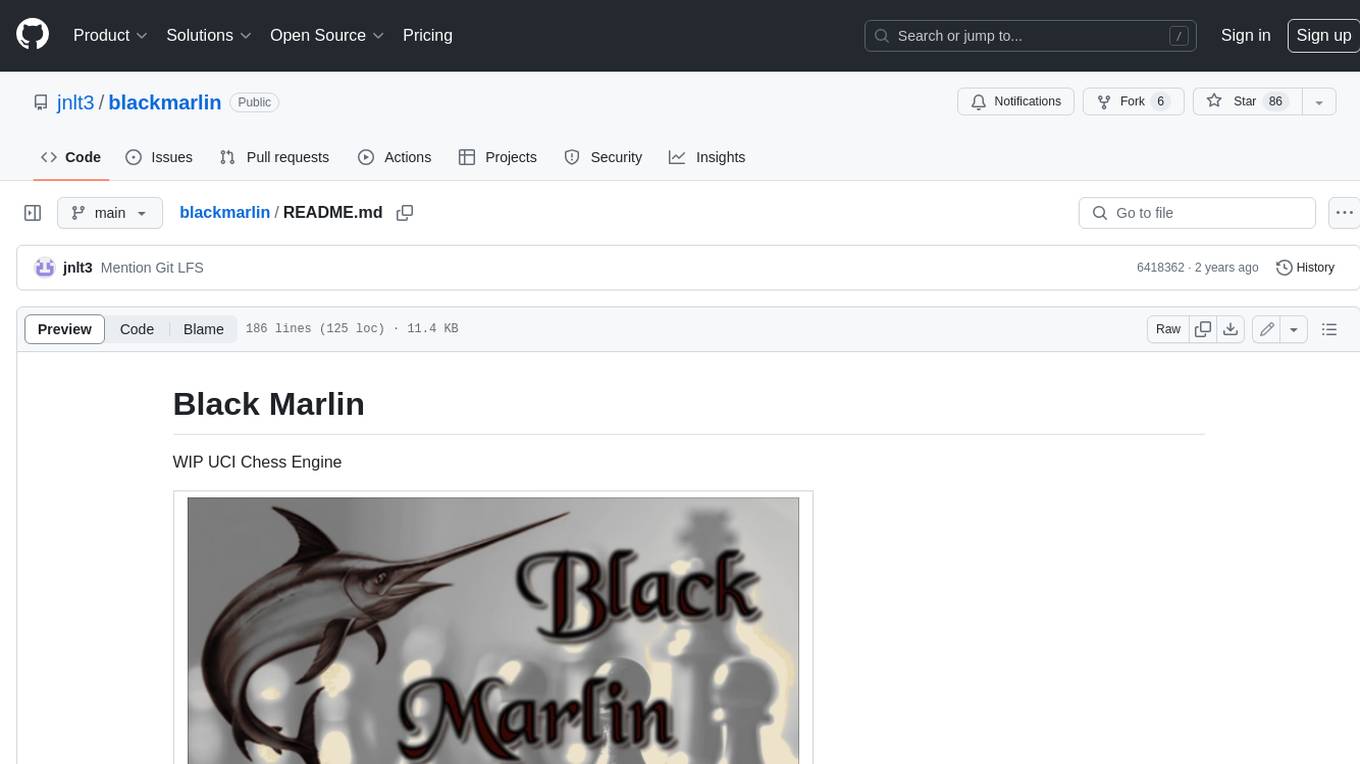
blackmarlin
Black Marlin is a UCI compliant chess engine fully written in Rust by Doruk Sekercioglu. It supports Chess960 and features a variety of search algorithms, pruning techniques, and evaluation methods. Black Marlin is designed to be efficient and accurate, and it has been shown to perform well against other top chess engines.
For similar jobs
CameraChessWeb
Camera Chess Web is a tool that allows you to use your phone camera to replace chess eBoards. With Camera Chess Web, you can broadcast your game to Lichess, play a game on Lichess, or digitize a chess game from a video or live stream. Camera Chess Web is free to download on Google Play.
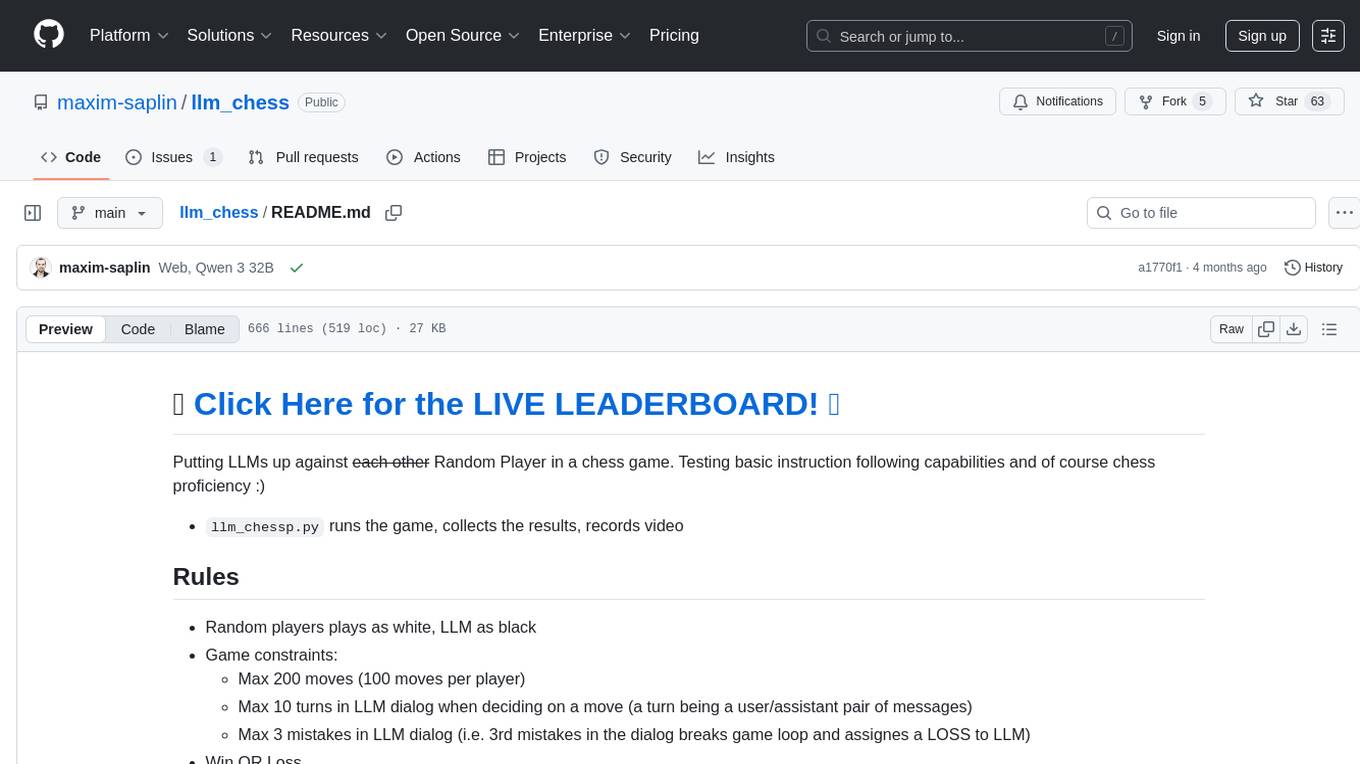
llm_chess
llm_chess is a tool designed to put Large Language Models (LLMs) against a Random Player in a chess game to test basic instruction following capabilities and chess proficiency. The tool sets constraints for the game, determines win/loss conditions, and handles exceptions/execution errors. Users can run games between LLMs and random players, configure player types, and analyze game results. The tool also supports running multiple games, processing logs, and preparing data for web visualization. It provides insights into player performance, model behavior, and future ideas for validation and benchmarking.