


giskard-oss
🐢 Open-Source Evaluation & Testing library for LLM Agents
Stars: 5117
Giskard-oss is an Evaluation & Testing framework for AI systems that aims to control risks of performance, bias, and security issues. It focuses on LLM systems, with plans for a new scan and a rewrite of RAGET for version 3. The repository is structured as a Python workspace with three packages: giskard-core, giskard-checks, and giskard-agents. Developers can use the Makefile for common tasks, and contributions from the AI community are welcome. The project encourages stars for visibility and offers sponsorship options for support.
README:







- This branch is Giskard v3 alpha. The API is unstable.
- Giskard v3 is a breaking change from legacy Giskard (
<2). - The codebase was fully rewritten to simplify the architecture.
- LLM systems are the primary focus.
- Traditional ML models are no longer a product focus, even if it is technically possible to use them.
- A new scan is planned for v3 (LLM-only).
- RAGET will be rewritten for v3 in a future release.
Giskard v3 is published as a pre-release.
pip install --pre giskardPython >= 3.12 is required.
This repo is a Python workspace with three packages:
giskard-coregiskard-checksgiskard-agents
Use the Makefile for common tasks.
make setup
make test
make ciWe welcome contributions from the AI community. Read the contributing guide to get started, and join the community on Discord.
🌟 Leave us a star to help the project get discovered and keep the momentum.
❤️ If you find our work useful, consider sponsoring us on GitHub. We also offer one-time sponsoring for consulting, workshops, or talks.
We thank the following companies which are sponsoring our project with monthly donations:


For Tasks:
Click tags to check more tools for each tasksFor Jobs:
Alternative AI tools for giskard-oss
Similar Open Source Tools
giskard-oss
Giskard-oss is an Evaluation & Testing framework for AI systems that aims to control risks of performance, bias, and security issues. It focuses on LLM systems, with plans for a new scan and a rewrite of RAGET for version 3. The repository is structured as a Python workspace with three packages: giskard-core, giskard-checks, and giskard-agents. Developers can use the Makefile for common tasks, and contributions from the AI community are welcome. The project encourages stars for visibility and offers sponsorship options for support.
lanarky
Lanarky is a Python web framework designed for building microservices using Large Language Models (LLMs). It is LLM-first, fast, modern, supports streaming over HTTP and WebSockets, and is open-source. The framework provides an abstraction layer for developers to easily create LLM microservices. Lanarky guarantees zero vendor lock-in and is free to use. It is built on top of FastAPI and offers features familiar to FastAPI users. The project is now in maintenance mode, with no active development planned, but community contributions are encouraged.
deepchecks
Deepchecks is a holistic open-source solution for AI & ML validation needs, enabling thorough testing of data and models from research to production. It includes components for testing, CI & testing management, and monitoring. Users can install and use Deepchecks for testing and monitoring their AI models, with customizable checks and suites for tabular, NLP, and computer vision data. The tool provides visual reports, pythonic/json output for processing, and a dynamic UI for collaboration and monitoring. Deepchecks is open source, with premium features available under a commercial license for monitoring components.
mlflow
MLflow is a platform to streamline machine learning development, including tracking experiments, packaging code into reproducible runs, and sharing and deploying models. MLflow offers a set of lightweight APIs that can be used with any existing machine learning application or library (TensorFlow, PyTorch, XGBoost, etc), wherever you currently run ML code (e.g. in notebooks, standalone applications or the cloud). MLflow's current components are:
* `MLflow Tracking
biochatter
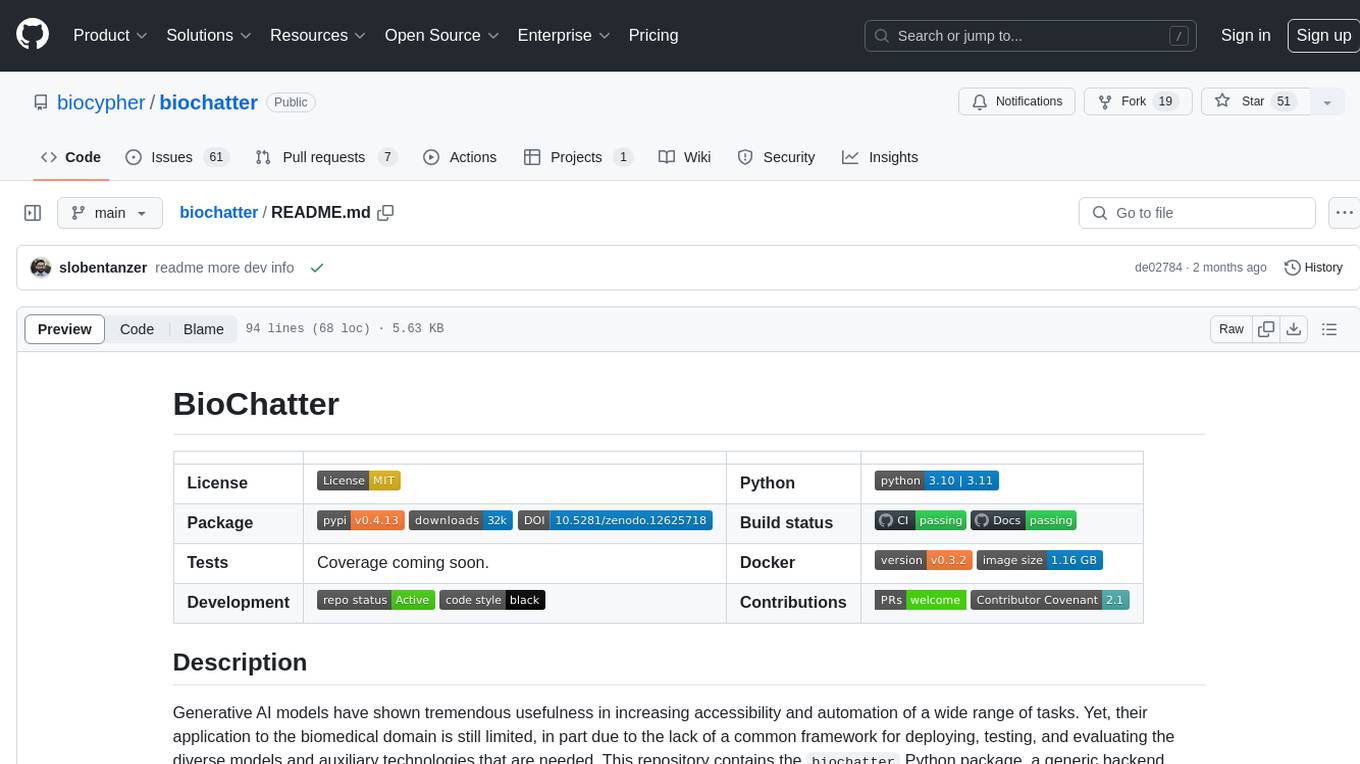
Generative AI models have shown tremendous usefulness in increasing accessibility and automation of a wide range of tasks. This repository contains the `biochatter` Python package, a generic backend library for the connection of biomedical applications to conversational AI. It aims to provide a common framework for deploying, testing, and evaluating diverse models and auxiliary technologies in the biomedical domain. BioChatter is part of the BioCypher ecosystem, connecting natively to BioCypher knowledge graphs.
MONAI
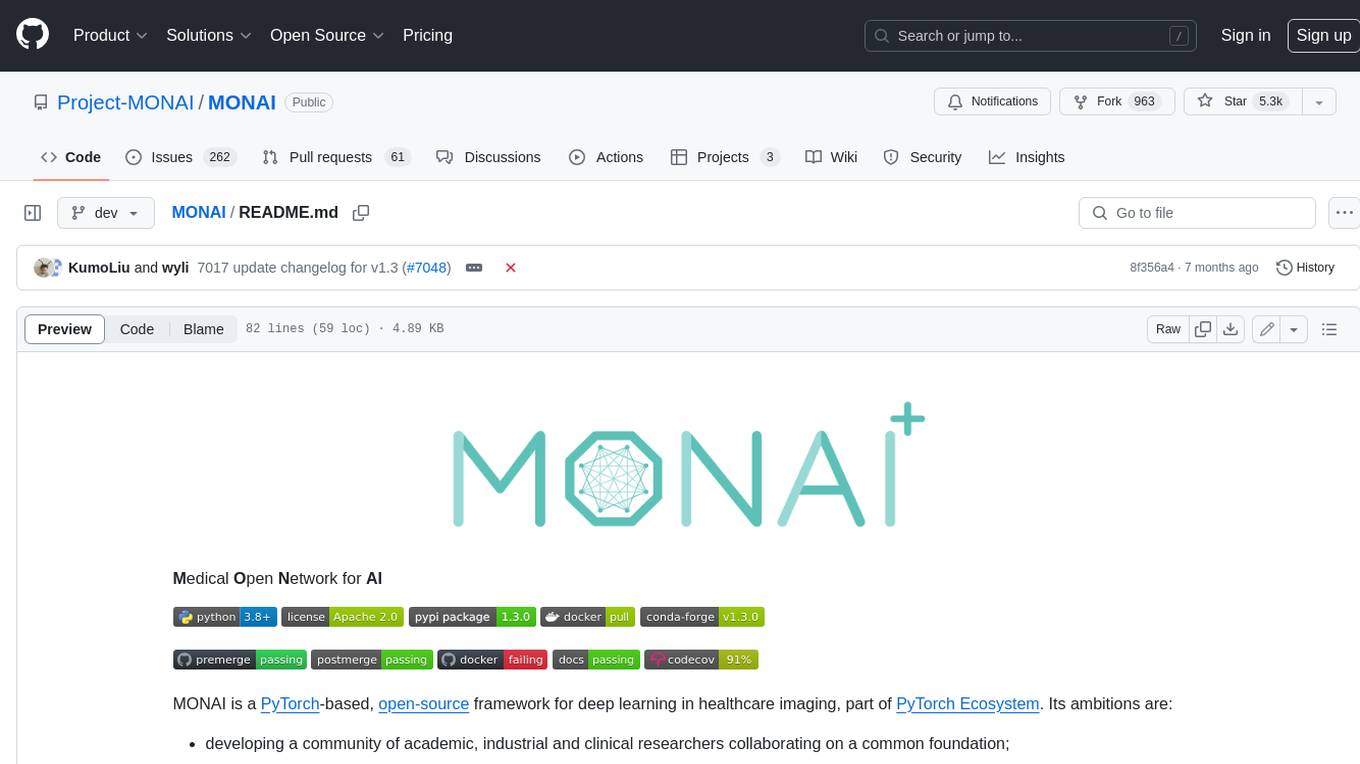
MONAI is a PyTorch-based, open-source framework for deep learning in healthcare imaging. It provides a comprehensive set of tools for medical image analysis, including data preprocessing, model training, and evaluation. MONAI is designed to be flexible and easy to use, making it a valuable resource for researchers and developers in the field of medical imaging.
agentgateway
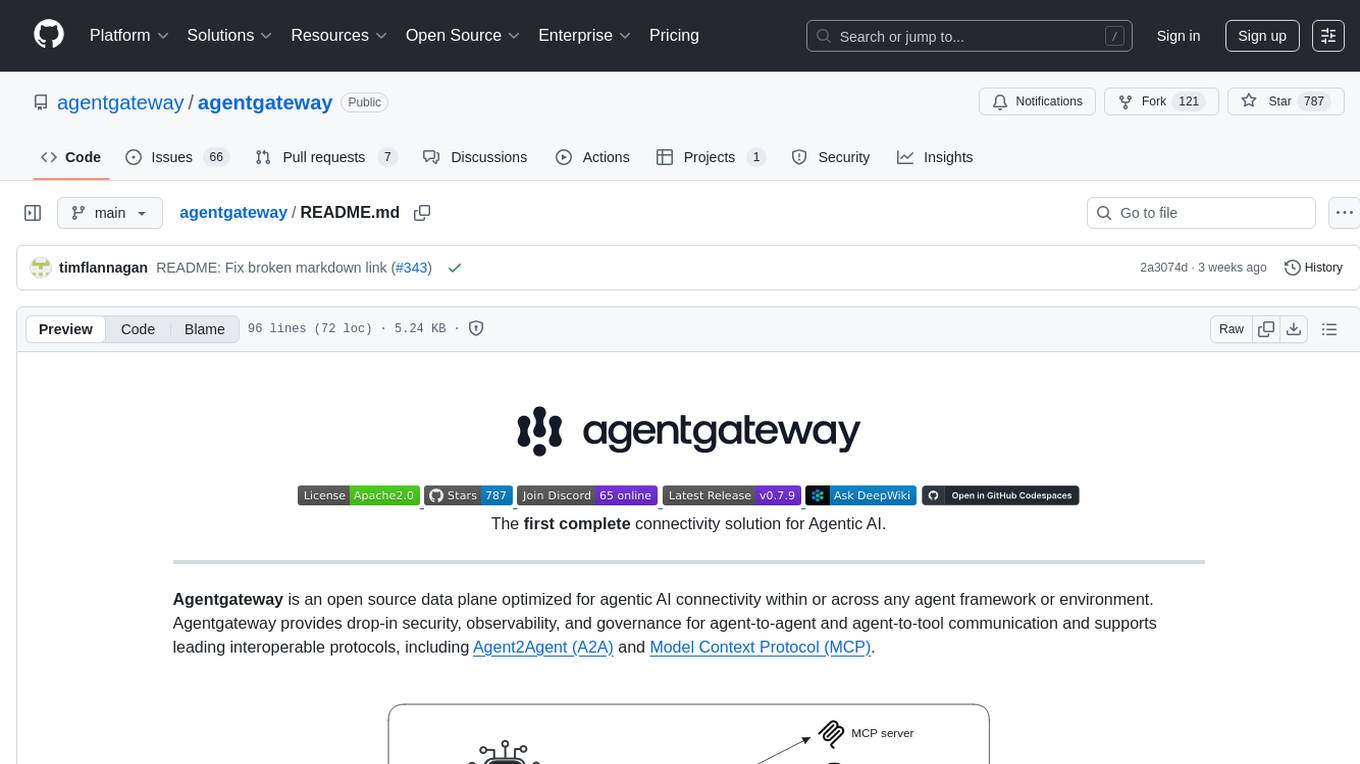
Agentgateway is an open source data plane optimized for agentic AI connectivity within or across any agent framework or environment. It provides drop-in security, observability, and governance for agent-to-agent and agent-to-tool communication, supporting leading interoperable protocols like Agent2Agent (A2A) and Model Context Protocol (MCP). Highly performant, security-first, multi-tenant, dynamic, and supporting legacy API transformation, agentgateway is designed to handle any scale and run anywhere with any agent framework.
giselle
Giselle is an open source AI tool designed for agentic workflows, facilitating seamless collaboration between humans and AI. It offers cloud hosting with free agent time, self-hosting options, and a Vibe Cording Guide for using AI coding assistants. Giselle is suitable for developers and non-engineers alike, empowering users to leverage AI capabilities without extensive coding knowledge. The tool is actively developed, with a roadmap in progress, and welcomes contributions from the community under the Apache License Version 2.0.
cognee
Cognee is an open-source framework designed for creating self-improving deterministic outputs for Large Language Models (LLMs) using graphs, LLMs, and vector retrieval. It provides a platform for AI engineers to enhance their models and generate more accurate results. Users can leverage Cognee to add new information, utilize LLMs for knowledge creation, and query the system for relevant knowledge. The tool supports various LLM providers and offers flexibility in adding different data types, such as text files or directories. Cognee aims to streamline the process of working with LLMs and improving AI models for better performance and efficiency.
open-autonomy
Open Autonomy is a framework for creating agent services that run as a multi-agent-system and offer enhanced functionalities on-chain. It enables executing complex operations like machine-learning algorithms in a decentralized, trust-minimized, transparent, and robust manner.
clearml
ClearML is an auto-magical suite of tools designed to streamline AI workflows. It includes modules for experiment management, MLOps/LLMOps, data management, model serving, and more. ClearML offers features like experiment tracking, model serving, orchestration, and automation. It supports various ML/DL frameworks and integrates with Jupyter Notebook and PyCharm for remote debugging. ClearML aims to simplify collaboration, automate processes, and enhance visibility in AI projects.
openlit
OpenLIT is an OpenTelemetry-native GenAI and LLM Application Observability tool. It's designed to make the integration process of observability into GenAI projects as easy as pie – literally, with just **a single line of code**. Whether you're working with popular LLM Libraries such as OpenAI and HuggingFace or leveraging vector databases like ChromaDB, OpenLIT ensures your applications are monitored seamlessly, providing critical insights to improve performance and reliability.
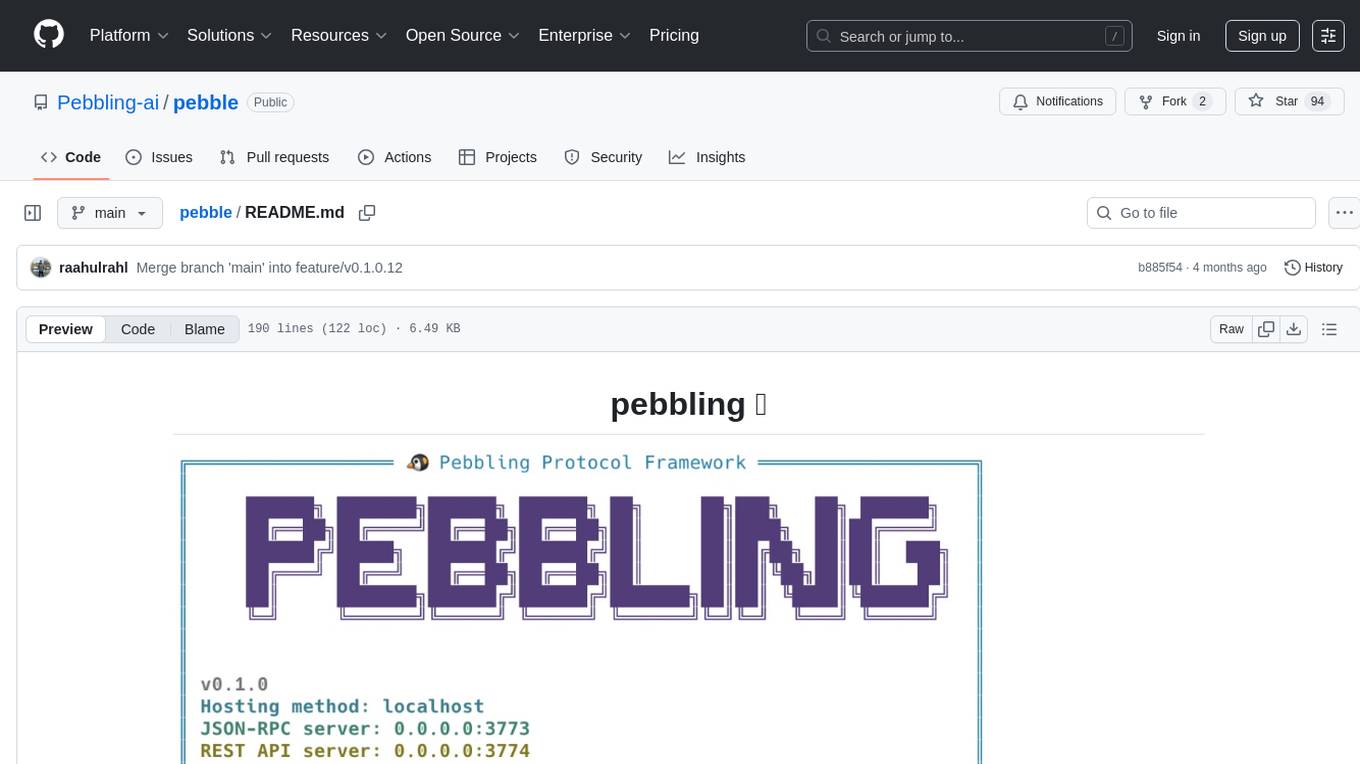
pebble
Pebbling is an open-source protocol for agent-to-agent communication, enabling AI agents to collaborate securely using Decentralised Identifiers (DIDs) and mutual TLS (mTLS). It provides a lightweight communication protocol built on JSON-RPC 2.0, ensuring reliable and secure conversations between agents. Pebbling allows agents to exchange messages safely, connect seamlessly regardless of programming language, and communicate quickly and efficiently. It is designed to pave the way for the next generation of collaborative AI systems, promoting secure and effortless communication between agents across different environments.
TaskingAI
TaskingAI brings Firebase's simplicity to **AI-native app development**. The platform enables the creation of GPTs-like multi-tenant applications using a wide range of LLMs from various providers. It features distinct, modular functions such as Inference, Retrieval, Assistant, and Tool, seamlessly integrated to enhance the development process. TaskingAI’s cohesive design ensures an efficient, intelligent, and user-friendly experience in AI application development.
SuperCoder
SuperCoder is an open-source autonomous software development system that leverages advanced AI tools and agents to streamline and automate coding, testing, and deployment tasks, enhancing efficiency and reliability. It supports a variety of languages and frameworks for diverse development needs. Users can set up the environment variables, build and run the Go server, Asynq worker, and Postgres using Docker and Docker Compose. The project is under active development and may still have issues, but users can seek help and support from the Discord community or by creating new issues on GitHub.
Learn_Prompting
Learn Prompting is a platform offering free resources, courses, and webinars to master prompt engineering and generative AI. It provides a Prompt Engineering Guide, courses on Generative AI, workshops, and the HackAPrompt competition. The platform also offers AI Red Teaming and AI Safety courses, research reports on prompting techniques, and welcomes contributions in various forms such as content suggestions, translations, artwork, and typo fixes. Users can locally develop the website using Visual Studio Code, Git, and Node.js, and run it in development mode to preview changes.
For similar tasks
giskard-oss
Giskard-oss is an Evaluation & Testing framework for AI systems that aims to control risks of performance, bias, and security issues. It focuses on LLM systems, with plans for a new scan and a rewrite of RAGET for version 3. The repository is structured as a Python workspace with three packages: giskard-core, giskard-checks, and giskard-agents. Developers can use the Makefile for common tasks, and contributions from the AI community are welcome. The project encourages stars for visibility and offers sponsorship options for support.
llm-app
Pathway's LLM (Large Language Model) Apps provide a platform to quickly deploy AI applications using the latest knowledge from data sources. The Python application examples in this repository are Docker-ready, exposing an HTTP API to the frontend. These apps utilize the Pathway framework for data synchronization, API serving, and low-latency data processing without the need for additional infrastructure dependencies. They connect to document data sources like S3, Google Drive, and Sharepoint, offering features like real-time data syncing, easy alert setup, scalability, monitoring, security, and unification of application logic.
kaytu
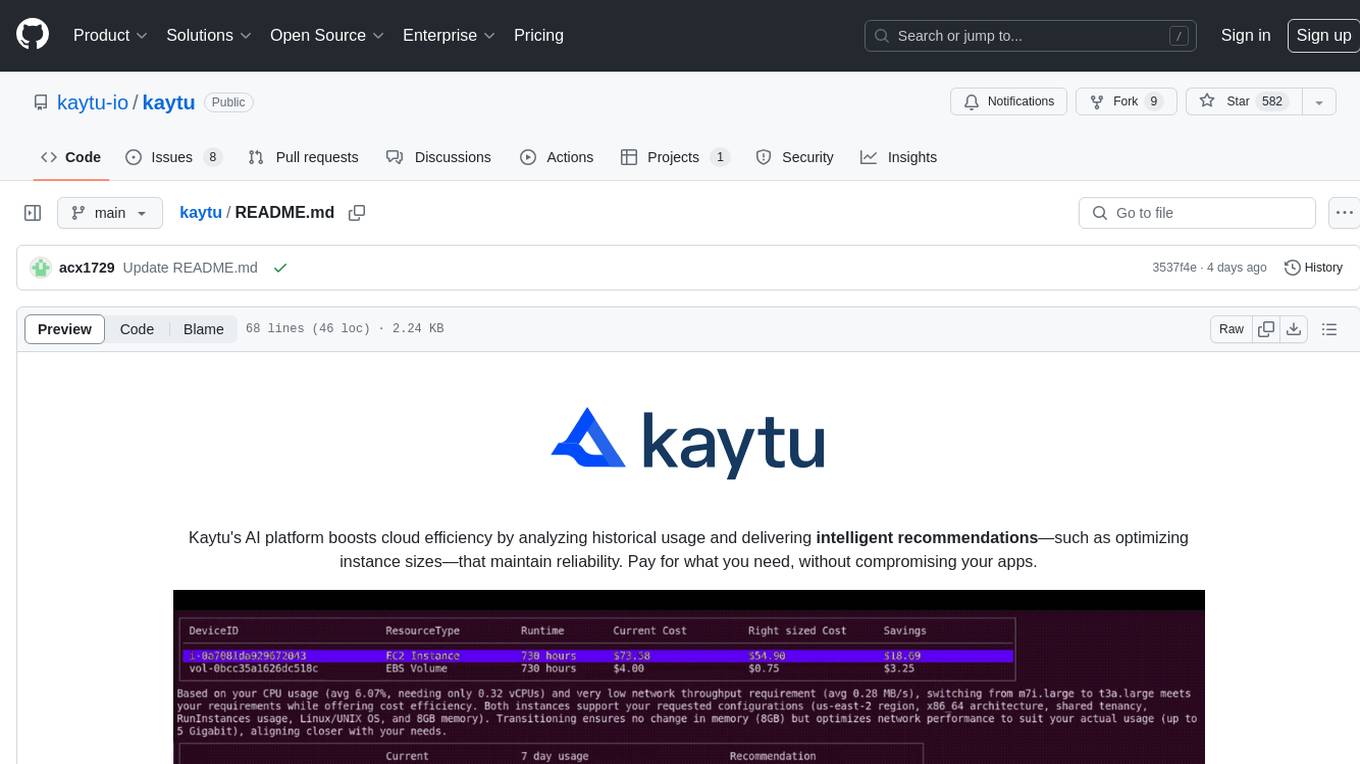
Kaytu is an AI platform that enhances cloud efficiency by analyzing historical usage data and providing intelligent recommendations for optimizing instance sizes. Users can pay for only what they need without compromising the performance of their applications. The platform is easy to use with a one-line command, allows customization for specific requirements, and ensures security by extracting metrics from the client side. Kaytu is open-source and supports AWS services, with plans to expand to GCP, Azure, GPU optimization, and observability data from Prometheus in the future.
awesome-production-llm
This repository is a curated list of open-source libraries for production large language models. It includes tools for data preprocessing, training/finetuning, evaluation/benchmarking, serving/inference, application/RAG, testing/monitoring, and guardrails/security. The repository also provides a new category called LLM Cookbook/Examples for showcasing examples and guides on using various LLM APIs.
holisticai
Holistic AI is an open-source library dedicated to assessing and improving the trustworthiness of AI systems. It focuses on measuring and mitigating bias, explainability, robustness, security, and efficacy in AI models. The tool provides comprehensive metrics, mitigation techniques, a user-friendly interface, and visualization tools to enhance AI system trustworthiness. It offers documentation, tutorials, and detailed installation instructions for easy integration into existing workflows.
langkit
LangKit is an open-source text metrics toolkit for monitoring language models. It offers methods for extracting signals from input/output text, compatible with whylogs. Features include text quality, relevance, security, sentiment, toxicity analysis. Installation via PyPI. Modules contain UDFs for whylogs. Benchmarks show throughput on AWS instances. FAQs available.
nesa
Nesa is a tool that allows users to run on-prem AI for a fraction of the cost through a blind API. It provides blind privacy, zero latency on protected inference, wide model coverage, cost savings compared to cloud and on-prem AI, RAG support, and ChatGPT compatibility. Nesa achieves blind AI through Equivariant Encryption (EE), a new security technology that provides complete inference encryption with no additional latency. EE allows users to perform inference on neural networks without exposing the underlying data, preserving data privacy and security.
eulers-shield
Euler's Shield is a decentralized, AI-powered financial system designed to stabilize the value of Pi Coin at $314.159. It combines blockchain, machine learning, and cybersecurity to ensure the security, scalability, and decentralization of the Pi Coin ecosystem.
For similar jobs
weave
Weave is a toolkit for developing Generative AI applications, built by Weights & Biases. With Weave, you can log and debug language model inputs, outputs, and traces; build rigorous, apples-to-apples evaluations for language model use cases; and organize all the information generated across the LLM workflow, from experimentation to evaluations to production. Weave aims to bring rigor, best-practices, and composability to the inherently experimental process of developing Generative AI software, without introducing cognitive overhead.
LLMStack
LLMStack is a no-code platform for building generative AI agents, workflows, and chatbots. It allows users to connect their own data, internal tools, and GPT-powered models without any coding experience. LLMStack can be deployed to the cloud or on-premise and can be accessed via HTTP API or triggered from Slack or Discord.
VisionCraft
The VisionCraft API is a free API for using over 100 different AI models. From images to sound.
kaito
Kaito is an operator that automates the AI/ML inference model deployment in a Kubernetes cluster. It manages large model files using container images, avoids tuning deployment parameters to fit GPU hardware by providing preset configurations, auto-provisions GPU nodes based on model requirements, and hosts large model images in the public Microsoft Container Registry (MCR) if the license allows. Using Kaito, the workflow of onboarding large AI inference models in Kubernetes is largely simplified.
PyRIT
PyRIT is an open access automation framework designed to empower security professionals and ML engineers to red team foundation models and their applications. It automates AI Red Teaming tasks to allow operators to focus on more complicated and time-consuming tasks and can also identify security harms such as misuse (e.g., malware generation, jailbreaking), and privacy harms (e.g., identity theft). The goal is to allow researchers to have a baseline of how well their model and entire inference pipeline is doing against different harm categories and to be able to compare that baseline to future iterations of their model. This allows them to have empirical data on how well their model is doing today, and detect any degradation of performance based on future improvements.
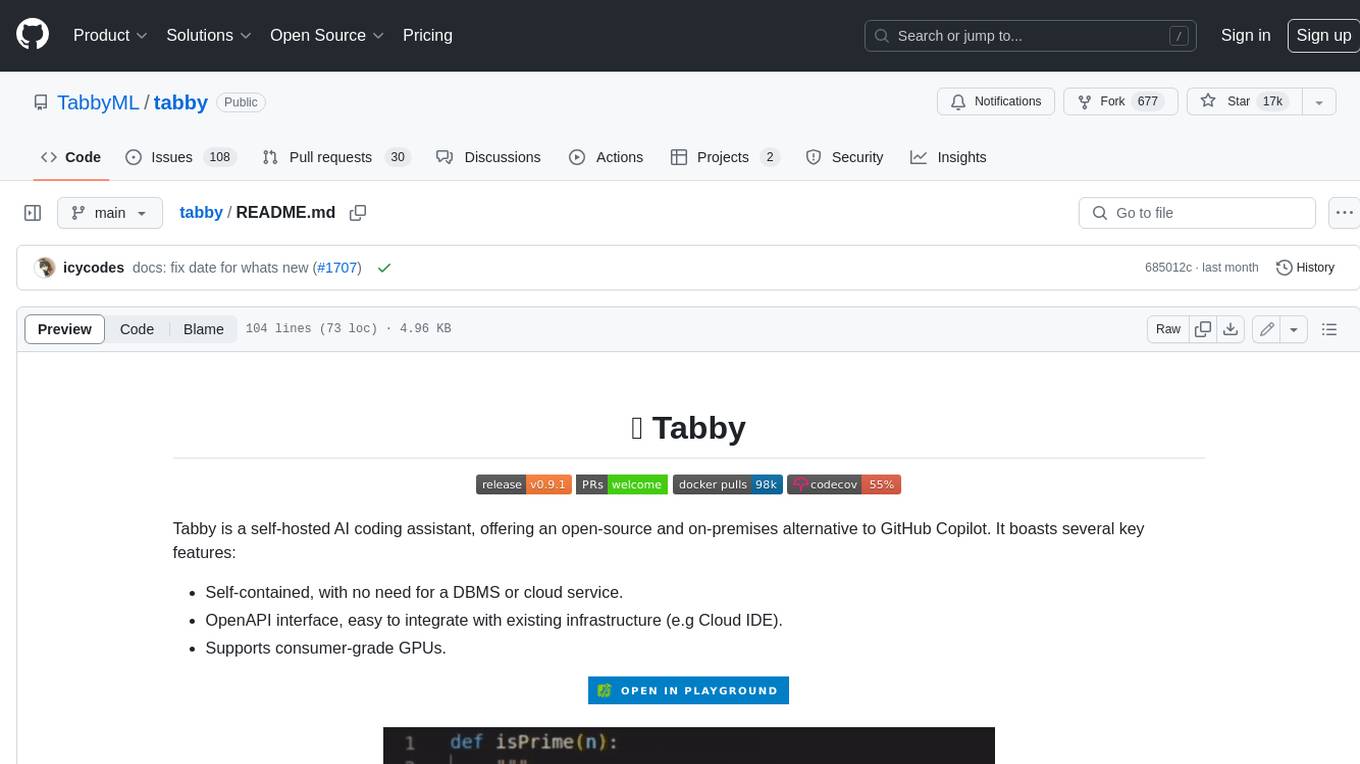
tabby
Tabby is a self-hosted AI coding assistant, offering an open-source and on-premises alternative to GitHub Copilot. It boasts several key features: * Self-contained, with no need for a DBMS or cloud service. * OpenAPI interface, easy to integrate with existing infrastructure (e.g Cloud IDE). * Supports consumer-grade GPUs.
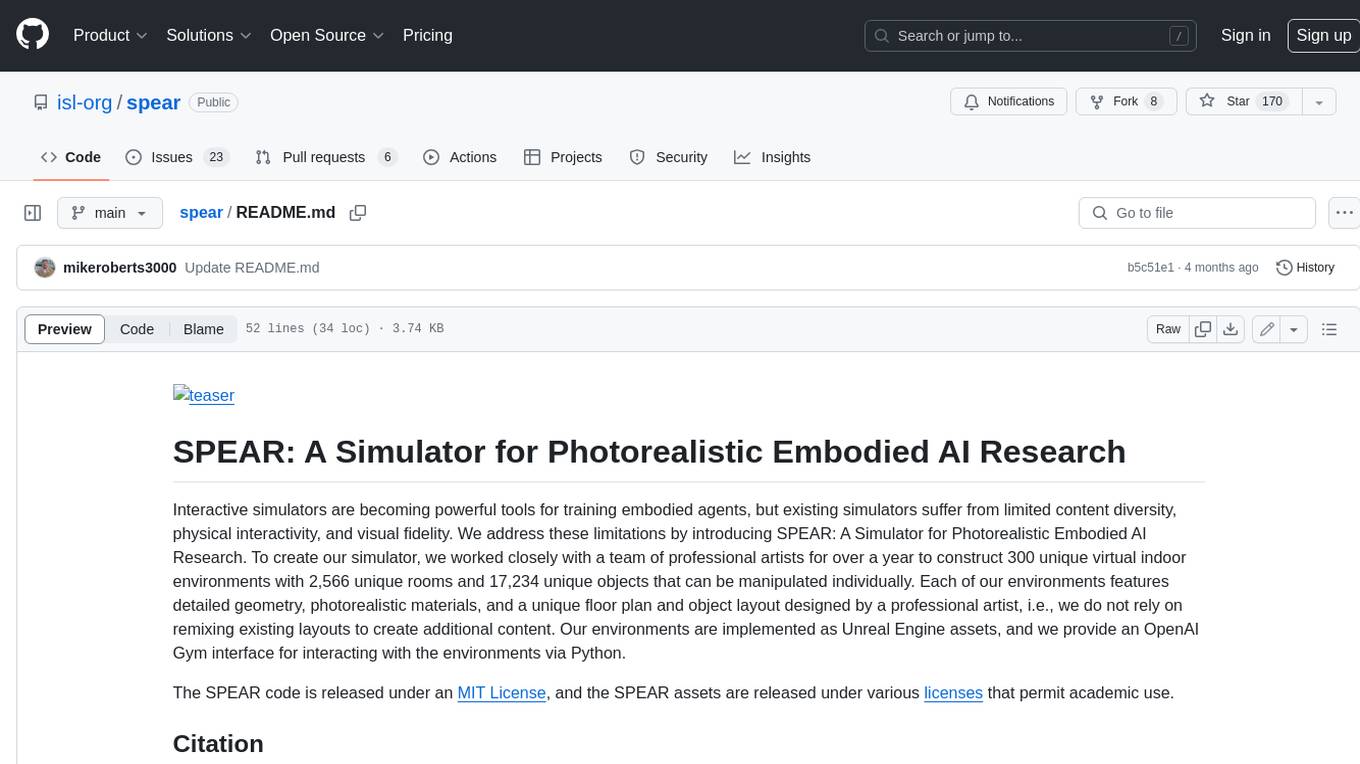
spear
SPEAR (Simulator for Photorealistic Embodied AI Research) is a powerful tool for training embodied agents. It features 300 unique virtual indoor environments with 2,566 unique rooms and 17,234 unique objects that can be manipulated individually. Each environment is designed by a professional artist and features detailed geometry, photorealistic materials, and a unique floor plan and object layout. SPEAR is implemented as Unreal Engine assets and provides an OpenAI Gym interface for interacting with the environments via Python.
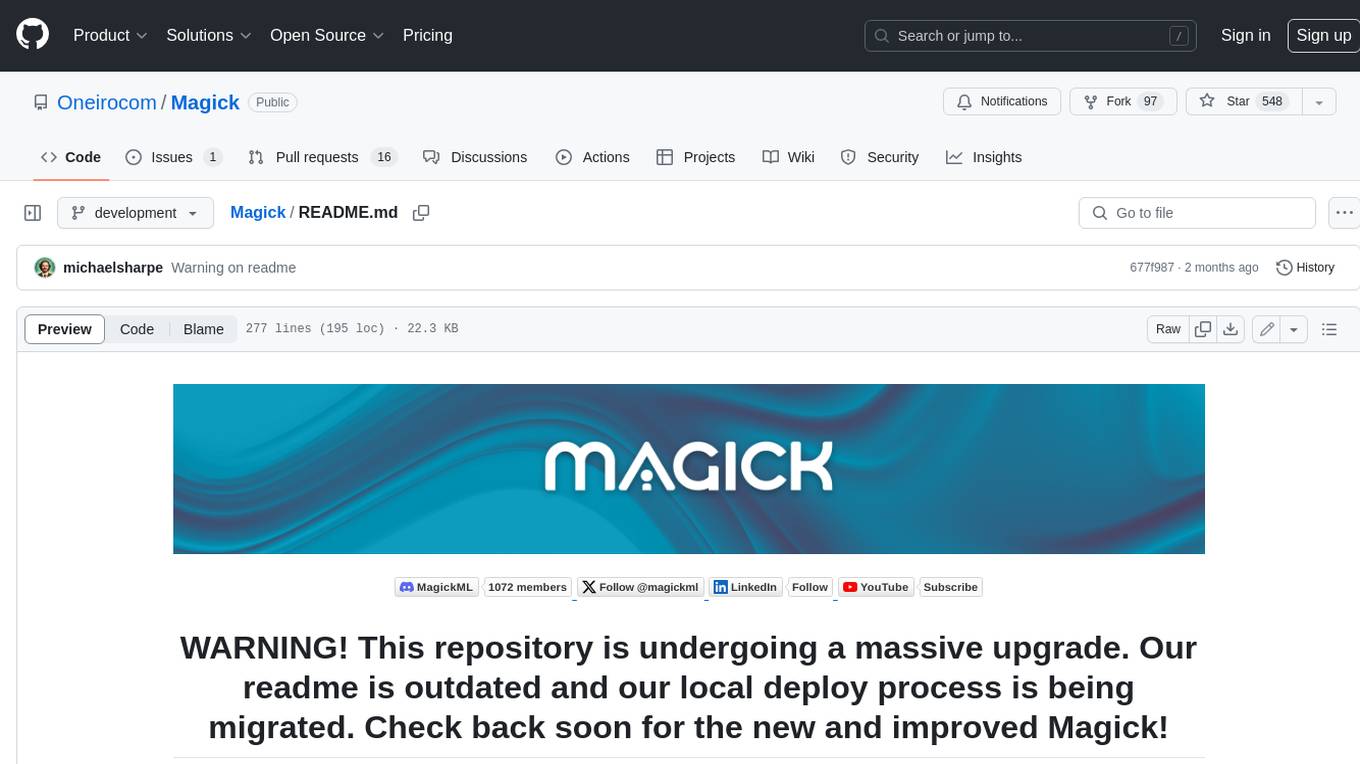
Magick
Magick is a groundbreaking visual AIDE (Artificial Intelligence Development Environment) for no-code data pipelines and multimodal agents. Magick can connect to other services and comes with nodes and templates well-suited for intelligent agents, chatbots, complex reasoning systems and realistic characters.