


screeps-starter-rust
Starter Rust AI for Screeps, the JavaScript-based MMO game
Stars: 121
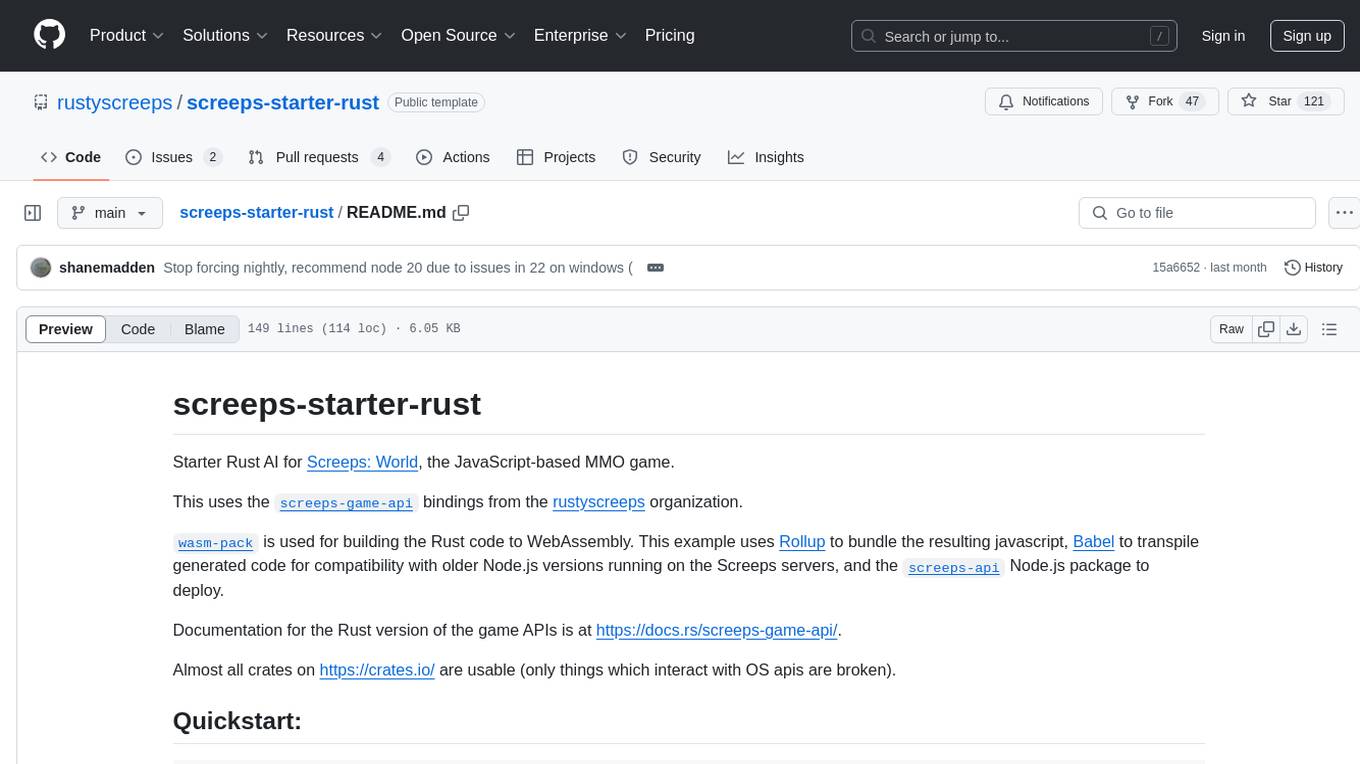
screeps-starter-rust is a Rust AI starter kit for Screeps: World, a JavaScript-based MMO game. It utilizes the screeps-game-api bindings from the rustyscreeps organization and wasm-pack for building Rust code to WebAssembly. The example includes Rollup for bundling javascript, Babel for transpiling code, and screeps-api Node.js package for deployment. Users can refer to the Rust version of game APIs documentation at https://docs.rs/screeps-game-api/. The tool supports most crates on crates.io, except those interacting with OS APIs.
README:
Starter Rust AI for Screeps: World, the JavaScript-based MMO game.
This uses the screeps-game-api bindings from the rustyscreeps organization.
wasm-pack is used for building the Rust code to WebAssembly. This example uses Rollup to
bundle the resulting javascript, Babel to transpile generated code for compatibility with older
Node.js versions running on the Screeps servers, and the screeps-api Node.js package to deploy.
Documentation for the Rust version of the game APIs is at https://docs.rs/screeps-game-api/.
Almost all crates on https://crates.io/ are usable (only things which interact with OS apis are broken).
# Install rustup: https://rustup.rs/

# Install wasm-pack
cargo install wasm-pack

# Install wasm-opt
cargo install wasm-opt

# Install Node.js for build steps - versions 16 through 22 have been tested, any should work
# nvm is recommended but not required to manage the install, follow instructions at:
# Mac/Linux: https://github.com/nvm-sh/nvm
# Windows: https://github.com/coreybutler/nvm-windows

# Installs Node.js at version 20
# (all versions within LTS support should work;
# 20 is recommended due to some observed problems on Windows systems using 22)
nvm install 20
nvm use 20

# Clone the starter
git clone https://github.com/rustyscreeps/screeps-starter-rust.git
cd screeps-starter-rust
# note: if you customize the name of the crate, you'll need to update the MODULE_NAME
# variable in the js_src/main.js file and the module import with the updated name, as well
# as the "name" in the package.json

# Install dependencies for JS build
npm install

# Copy the example config, and set up at least one deployment mode.
cp .example-screeps.yaml .screeps.yaml
nano .screeps.yaml

# compile for a configured server but don't upload
npm run deploy -- --server ptr --dryrun

# compile and upload to a configured server
npm run deploy -- --server mmoVersions of screeps-game-api at 0.22 or higher are no longer compatible with the
cargo-screeps tool for building and deployment; the transpile step being handled by Babel is
required to transform the generated JS into code that the game servers can load.
To migrate an existing bot to using the new JavaScript translation layer and deploy script:
- Create a
.screeps.yamlwith the relevant settings from yourscreeps.tomlfile applied to the new.example-screeps.yamlexample file in this repo. - Add to your
.gitignore:.screeps.yaml,node_modules, anddist - Create a
package.jsoncopied from the one in this repo and make appropriate customizations.- Importantly, if you've modified your module name from
screeps-starter-rustto something else, you need to update thenamefield inpackage.jsonto be your bot's name.
- Importantly, if you've modified your module name from
- Install Node.js (from the quickstart steps above), then run
npm installfrom within the bot directory to install the required packages. - Copy the
deploy.jsscript over to a newjs_toolsdirectory. - Add
main.jsto a newjs_srcdirectory, either moved from your existingjavascriptdir and updated, or freshly copied.- If updating, you'll need to change:
- Import formatting, particularly for the wasm module.
- wasm module initialization has changed, requiring two calls to first compile the module, then to initialize the instance of the module.
- Whether updating or copying fresh, if you've modified your bot name from
screeps-starter-rustyou'll need to update the bot package import andMODULE_NAMEat the beginning ofmain.jsto be your updated bot name.
- If updating, you'll need to change:
- Update your
Cargo.tomlwith version0.22forscreeps-game-api - Run
npm run deploy -- --server ptr --dryrunto compile for PTR, remove the--dryrunto deploy
If you encounter an error like the following:
Error: Not Authorized
    at ScreepsAPI.req (PATH_TO_YOUR_BOT/node_modules/screeps-api/dist/ScreepsAPI.js:1212:17)
    at process.processTicksAndRejections (node:internal/process/task_queues:105:5)
    at async ScreepsAPI.auth (PATH_TO_YOUR_BOT/node_modules/screeps-api/dist/ScreepsAPI.js:1162:17)
    at async ScreepsAPI.fromConfig (PATH_TO_YOUR_BOT/node_modules/screeps-api/dist/ScreepsAPI.js:1394:9)
    at async upload (PATH_TO_YOUR_BOT/js_tools/deploy.js:148:17)
    at async run (PATH_TO_YOUR_BOT/js_tools/deploy.js:163:3
Then the password in your .screeps.yaml file is getting picked up as something aside from a string. Passwords sent to the server must be a string. Wrap it in quotes: password: "12345"
If you encounter an error like the following:
Error: Unknown module 'bot-name-here'
    at Object.requireFn (<runtime>:20897:23)
    at Object.module.exports.loop (main:933:33)
    at __mainLoop:1:52
    at __mainLoop:2:3
    at Object.exports.evalCode (<runtime>:15381:76)
    at Object.exports.run (<runtime>:20865:24)
You need to make sure you update your package.json name field to be your bot name.
If you encounter an error like the following:
CompileError: WebAssembly.Module(): Compiling wasm function #327:core::unicode::printable::check::h9ddbb57eb721c858 failed: Invalid opcode (enable with --experimental-wasm-se) @+257876
    at Object.module.exports.loop (main:934:35)
    at __mainLoop:1:52
    at __mainLoop:2:3
    at Object.exports.evalCode (<runtime>:15381:76)
    at Object.exports.run (<runtime>:20865:24)
You need to update your Cargo.toml to include the --signext-lowering flag for wasm-opt. For example:
[package.metadata.wasm-pack.profile.release]
wasm-opt = ["-O4", "--signext-lowering"]
For Tasks:
Click tags to check more tools for each tasksFor Jobs:
Alternative AI tools for screeps-starter-rust
Similar Open Source Tools
screeps-starter-rust
screeps-starter-rust is a Rust AI starter kit for Screeps: World, a JavaScript-based MMO game. It utilizes the screeps-game-api bindings from the rustyscreeps organization and wasm-pack for building Rust code to WebAssembly. The example includes Rollup for bundling javascript, Babel for transpiling code, and screeps-api Node.js package for deployment. Users can refer to the Rust version of game APIs documentation at https://docs.rs/screeps-game-api/. The tool supports most crates on crates.io, except those interacting with OS APIs.
moly
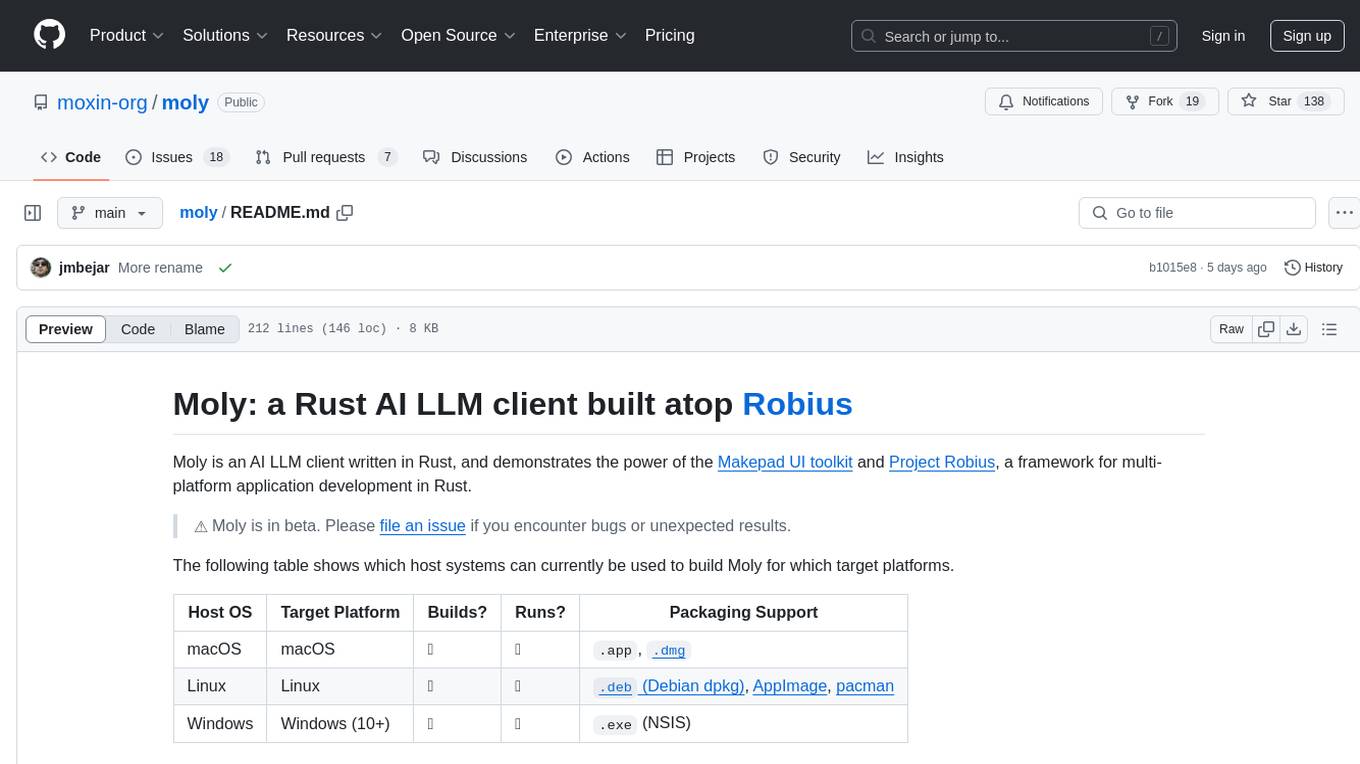
Moly is an AI LLM client written in Rust, showcasing the capabilities of the Makepad UI toolkit and Project Robius, a framework for multi-platform application development in Rust. It is currently in beta, allowing users to build and run Moly on macOS, Linux, and Windows. The tool provides packaging support for different platforms, such as `.app`, `.dmg`, `.deb`, AppImage, pacman, and `.exe` (NSIS). Users can easily set up WasmEdge using `moly-runner` and leverage `cargo` commands to build and run Moly. Additionally, Moly offers pre-built releases for download and supports packaging for distribution on Linux, Windows, and macOS.
moly-ai
Moly is an AI LLM client written in Rust that showcases the capabilities of the Makepad UI toolkit and Project Robius. It supports various AI providers, including OpenAI-compatible providers, Moly Server for local LLM exploration, and MoFa Servers for building AI agents. Users can download pre-built releases for different platforms and contribute to extending the list of supported providers. Moly can be used for tasks like chat completions, AI agent interactions, and custom client creation.
vim-ollama
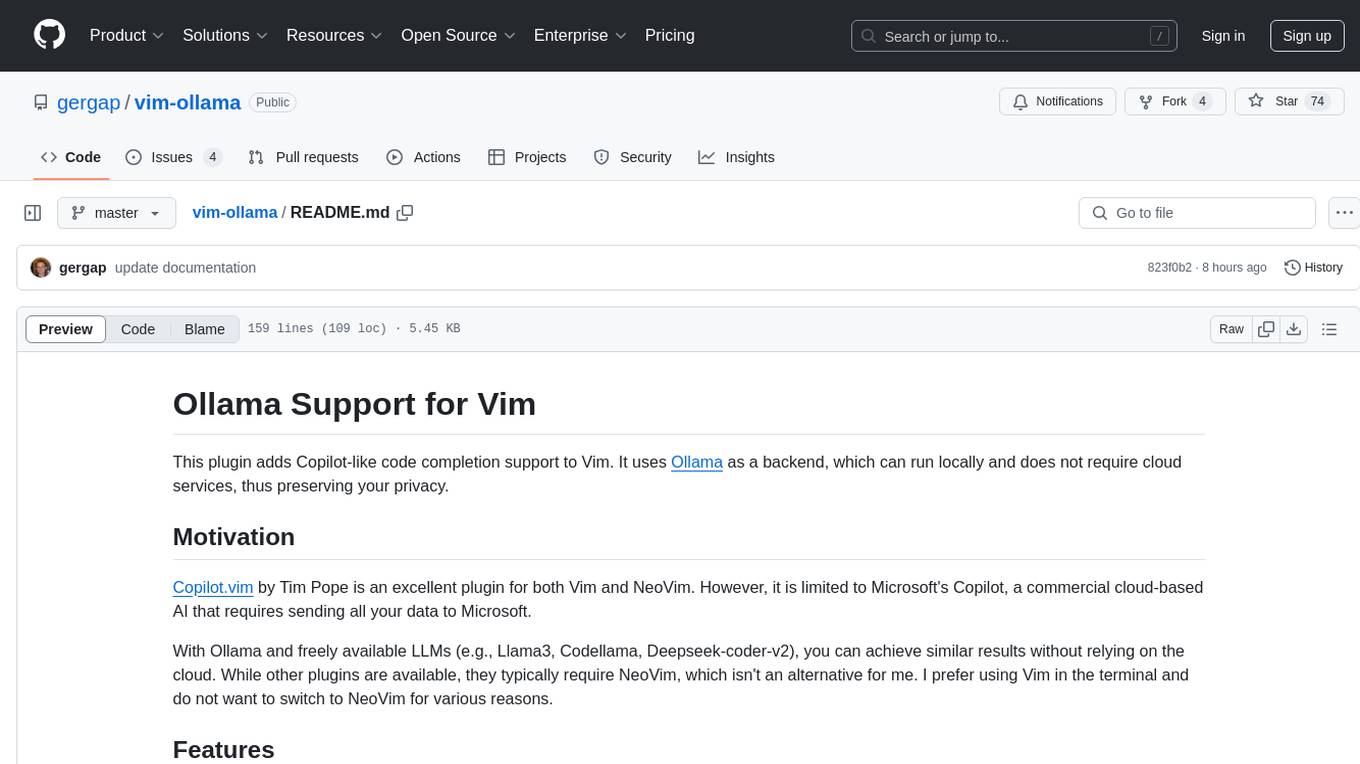
The 'vim-ollama' plugin for Vim adds Copilot-like code completion support using Ollama as a backend, enabling intelligent AI-based code completion and integrated chat support for code reviews. It does not rely on cloud services, preserving user privacy. The plugin communicates with Ollama via Python scripts for code completion and interactive chat, supporting Vim only. Users can configure LLM models for code completion tasks and interactive conversations, with detailed installation and usage instructions provided in the README.
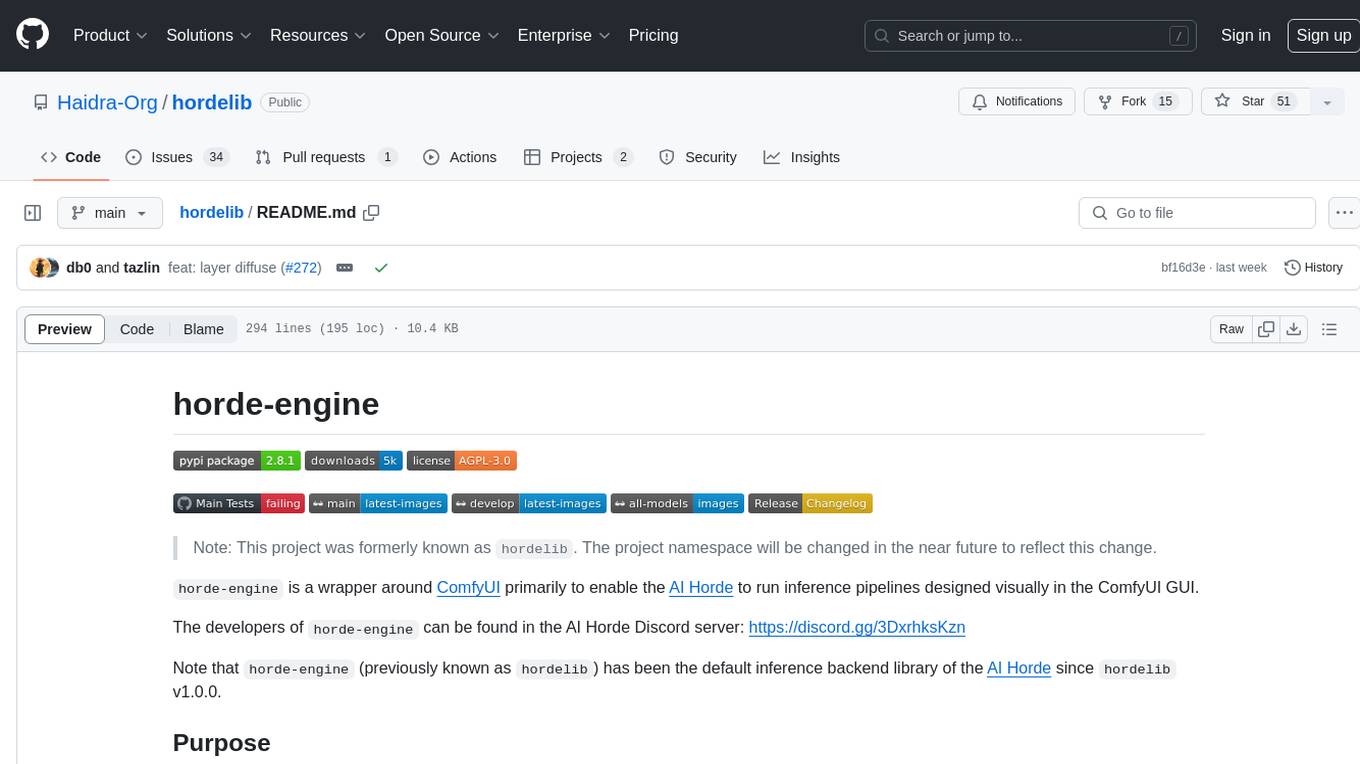
hordelib
horde-engine is a wrapper around ComfyUI designed to run inference pipelines visually designed in the ComfyUI GUI. It enables users to design inference pipelines in ComfyUI and then call them programmatically, maintaining compatibility with the existing horde implementation. The library provides features for processing Horde payloads, initializing the library, downloading and validating models, and generating images based on input data. It also includes custom nodes for preprocessing and tasks such as face restoration and QR code generation. The project depends on various open source projects and bundles some dependencies within the library itself. Users can design ComfyUI pipelines, convert them to the backend format, and run them using the run_image_pipeline() method in hordelib.comfy.Comfy(). The project is actively developed and tested using git, tox, and a specific model directory structure.
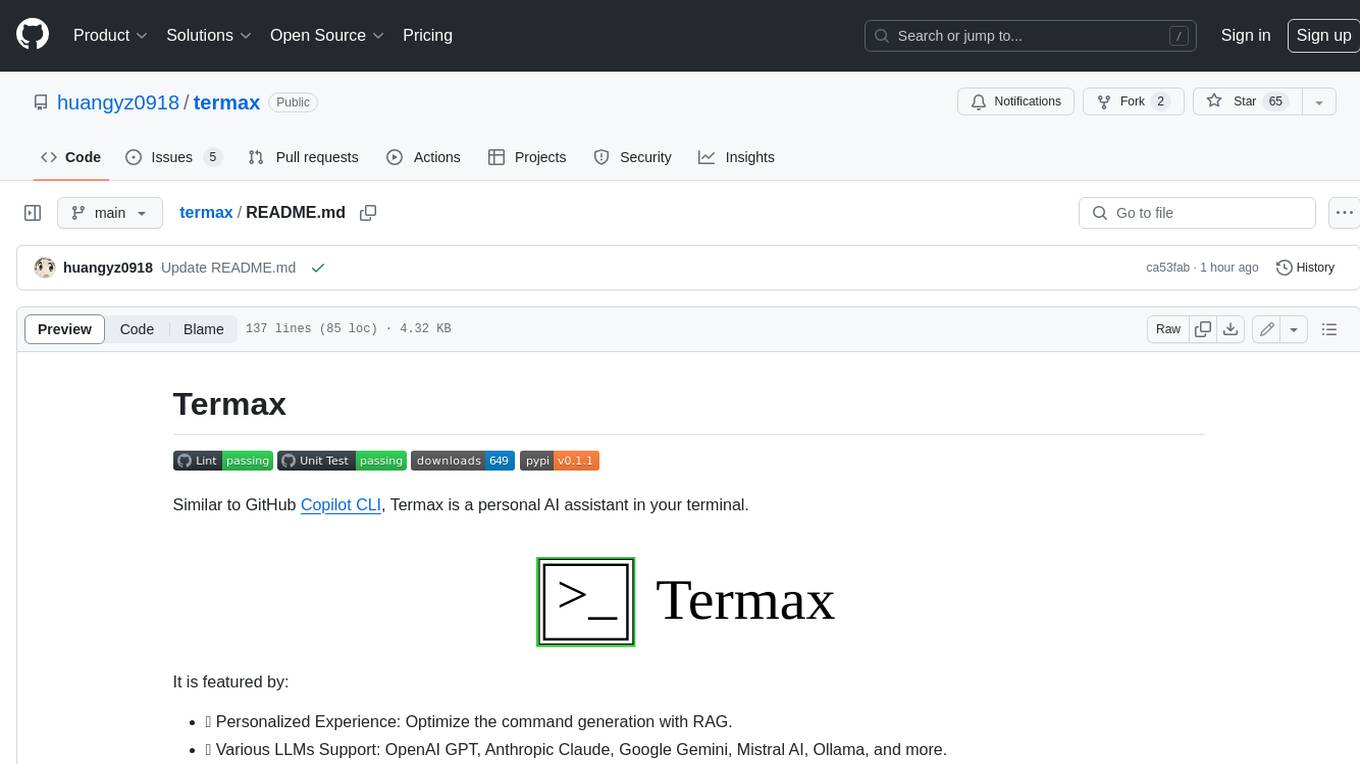
termax
Termax is an LLM agent in your terminal that converts natural language to commands. It is featured by: - Personalized Experience: Optimize the command generation with RAG. - Various LLMs Support: OpenAI GPT, Anthropic Claude, Google Gemini, Mistral AI, and more. - Shell Extensions: Plugin with popular shells like `zsh`, `bash` and `fish`. - Cross Platform: Able to run on Windows, macOS, and Linux.
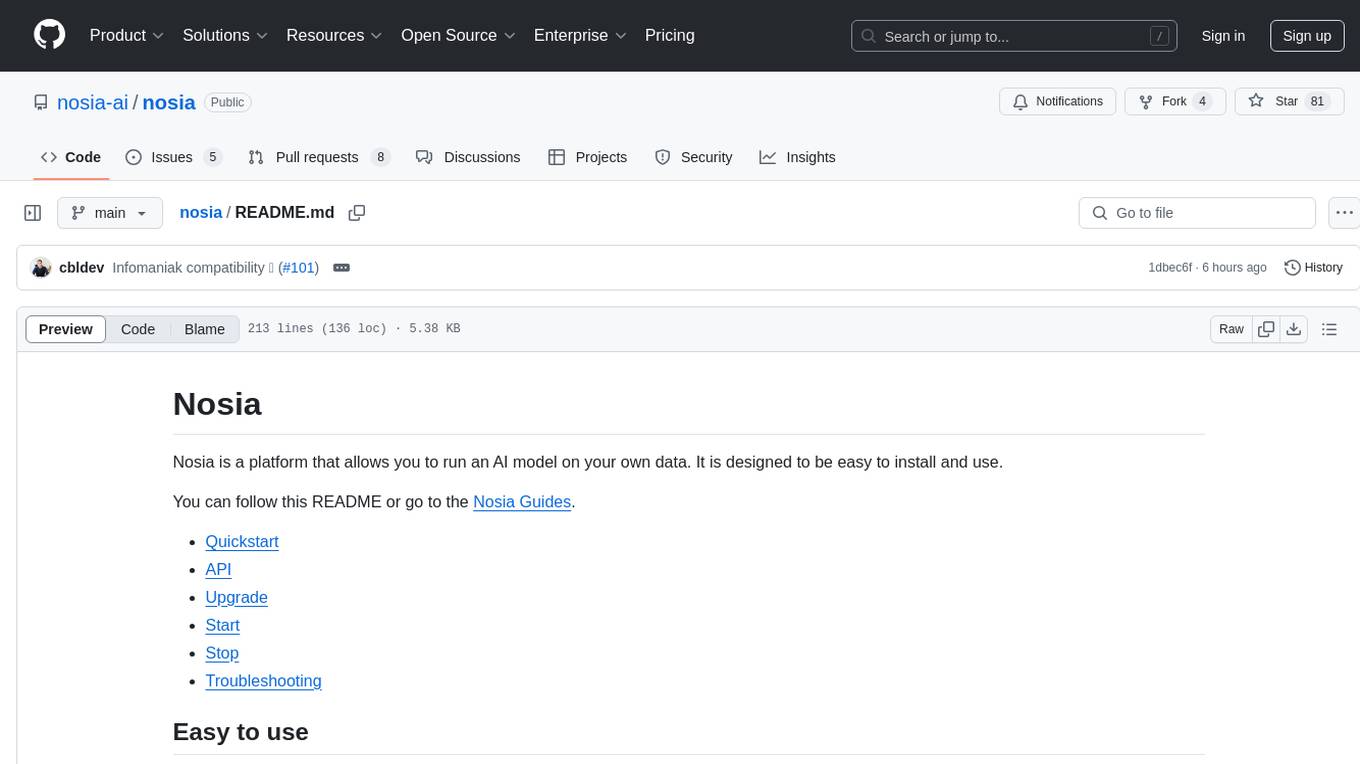
nosia
Nosia is a platform that allows users to run an AI model on their own data. It is designed to be easy to install and use. Users can follow the provided guides for quickstart, API usage, upgrading, starting, stopping, and troubleshooting. The platform supports custom installations with options for remote Ollama instances, custom completion models, and custom embeddings models. Advanced installation instructions are also available for macOS with a Debian or Ubuntu VM setup. Users can access the platform at 'https://nosia.localhost' and troubleshoot any issues by checking logs and job statuses.
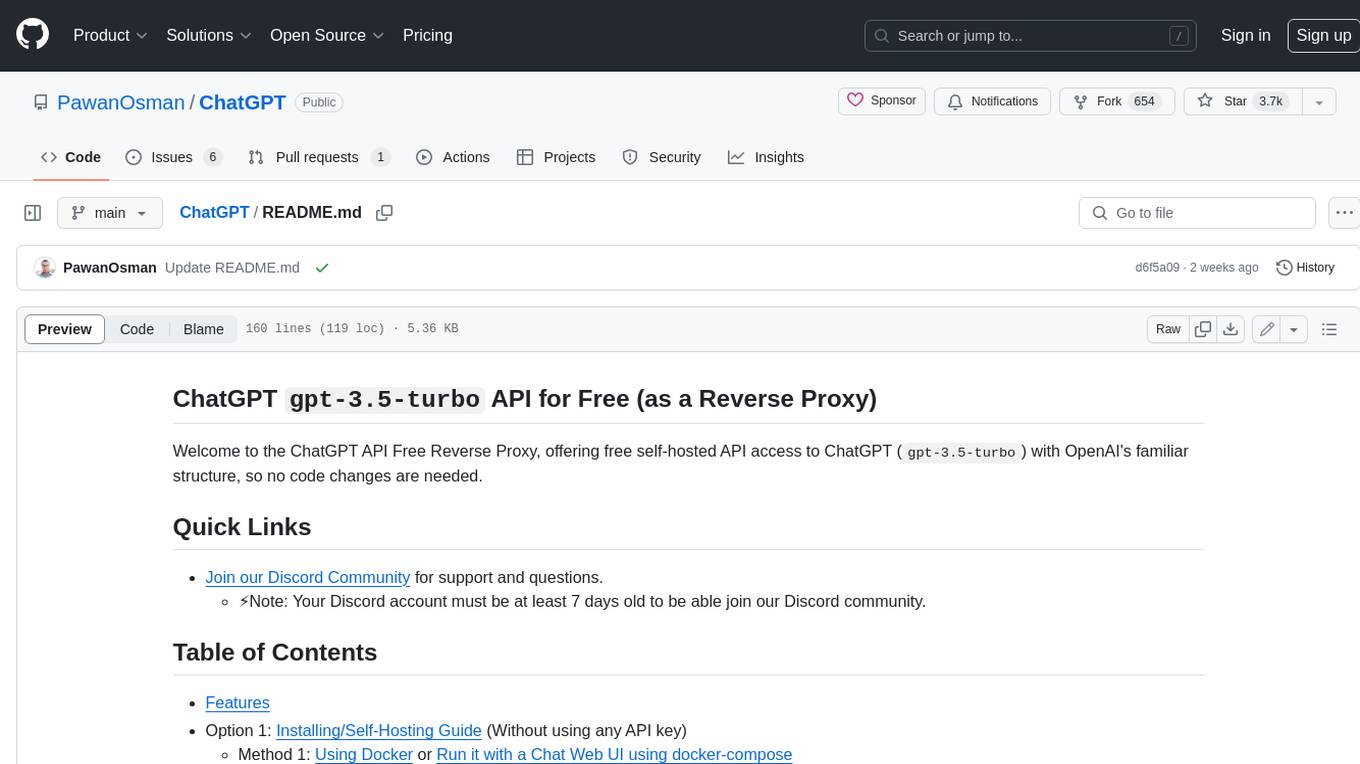
ChatGPT
The ChatGPT API Free Reverse Proxy provides free self-hosted API access to ChatGPT (`gpt-3.5-turbo`) with OpenAI's familiar structure, eliminating the need for code changes. It offers streaming response, API endpoint compatibility, and complimentary access without an API key. Installation options include Docker, PC/Server, and Termux on Android devices. The API can be accessed through a self-hosted local server or a pre-hosted API with an API key obtained from the Discord server. Usage examples are provided for Python and Node.js, and the project is licensed under AGPL-3.0.
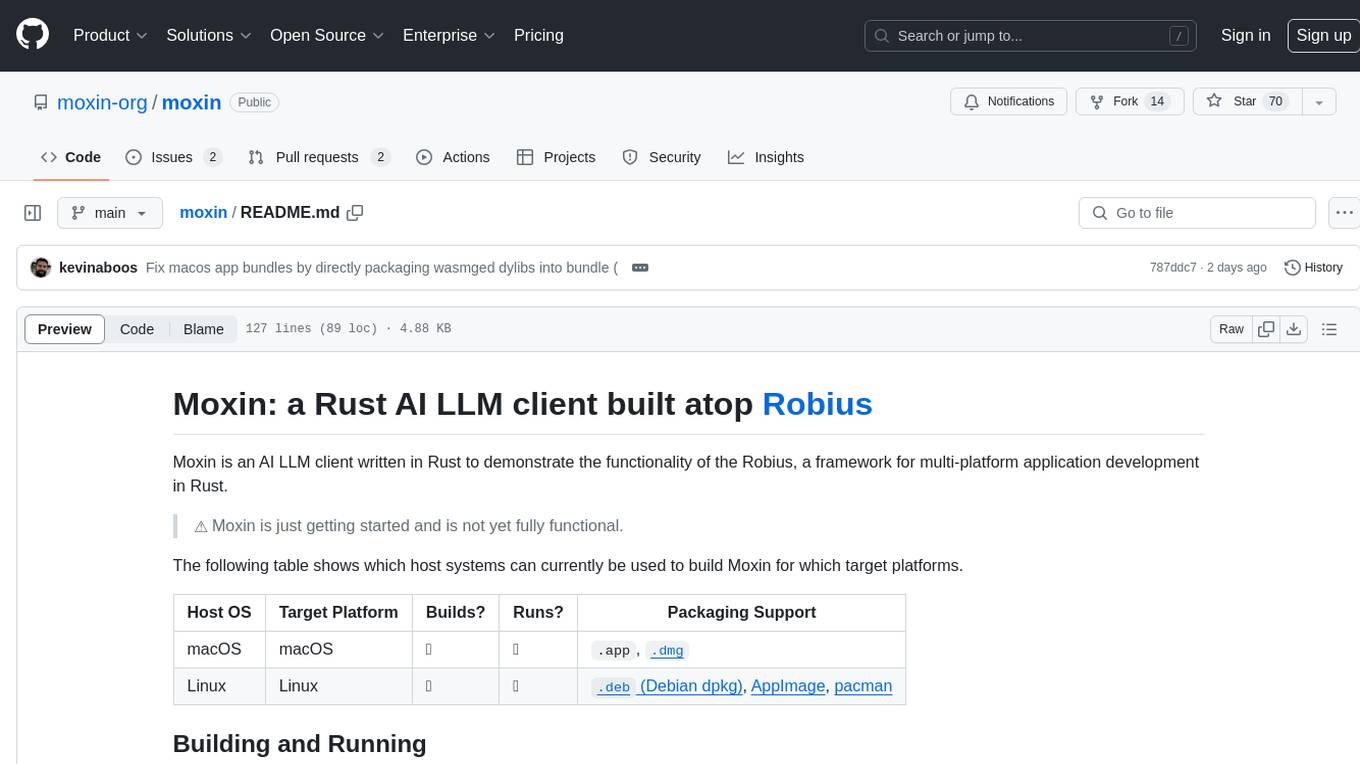
moxin
Moxin is an AI LLM client written in Rust to demonstrate the functionality of the Robius framework for multi-platform application development. It is currently in early stages of development and not fully functional. The tool supports building and running on macOS and Linux systems, with packaging options available for distribution. Users can install the required WasmEdge WASM runtime and dependencies to build and run Moxin. Packaging for distribution includes generating `.deb` Debian packages, AppImage, and pacman installation packages for Linux, as well as `.app` bundles and `.dmg` disk images for macOS. The macOS app is not signed, leading to a warning on installation, which can be resolved by removing the quarantine attribute from the installed app.
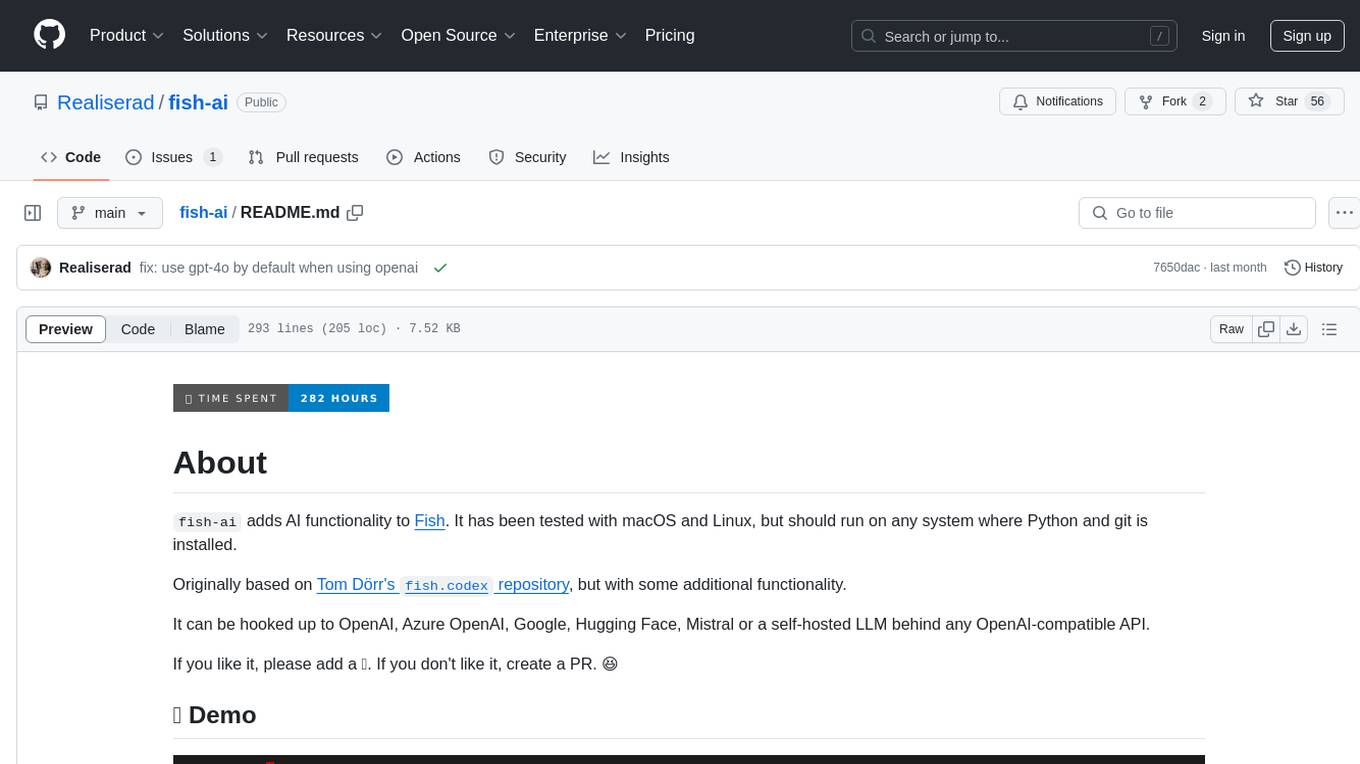
fish-ai
fish-ai is a tool that adds AI functionality to Fish shell. It can be integrated with various AI providers like OpenAI, Azure OpenAI, Google, Hugging Face, Mistral, or a self-hosted LLM. Users can transform comments into commands, autocomplete commands, and suggest fixes. The tool allows customization through configuration files and supports switching between contexts. Data privacy is maintained by redacting sensitive information before submission to the AI models. Development features include debug logging, testing, and creating releases.
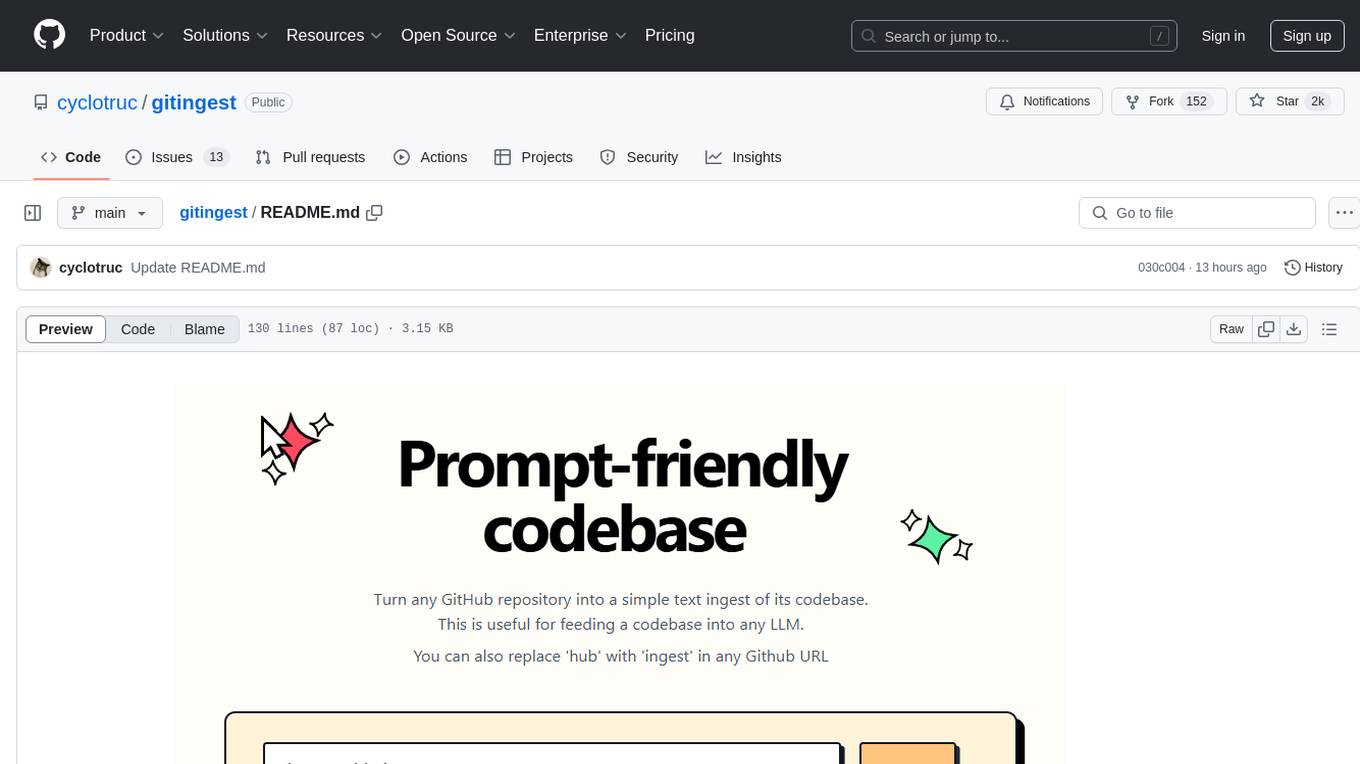
gitingest
GitIngest is a tool that allows users to turn any Git repository into a prompt-friendly text ingest for LLMs. It provides easy code context by generating a text digest from a git repository URL or directory. The tool offers smart formatting for optimized output format for LLM prompts and provides statistics about file and directory structure, size of the extract, and token count. GitIngest can be used as a CLI tool on Linux and as a Python package for code integration. The tool is built using Tailwind CSS for frontend, FastAPI for backend framework, tiktoken for token estimation, and apianalytics.dev for simple analytics. Users can self-host GitIngest by building the Docker image and running the container. Contributions to the project are welcome, and the tool aims to be beginner-friendly for first-time contributors with a simple Python and HTML codebase.
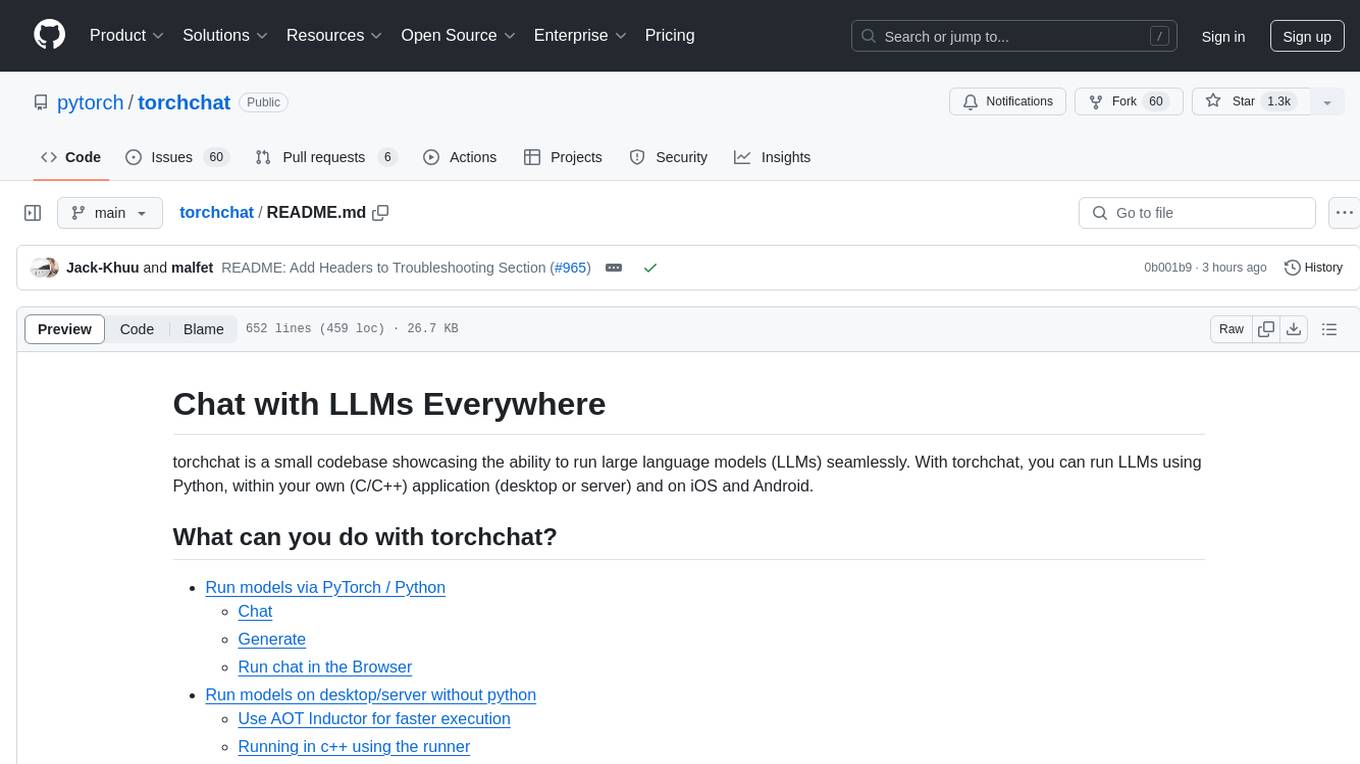
torchchat
torchchat is a codebase showcasing the ability to run large language models (LLMs) seamlessly. It allows running LLMs using Python in various environments such as desktop, server, iOS, and Android. The tool supports running models via PyTorch, chatting, generating text, running chat in the browser, and running models on desktop/server without Python. It also provides features like AOT Inductor for faster execution, running in C++ using the runner, and deploying and running on iOS and Android. The tool supports popular hardware and OS including Linux, Mac OS, Android, and iOS, with various data types and execution modes available.
lexido
Lexido is an innovative assistant for the Linux command line, designed to boost your productivity and efficiency. Powered by Gemini Pro 1.0 and utilizing the free API, Lexido offers smart suggestions for commands based on your prompts and importantly your current environment. Whether you're installing software, managing files, or configuring system settings, Lexido streamlines the process, making it faster and more intuitive.
mods
AI for the command line, built for pipelines. LLM based AI is really good at interpreting the output of commands and returning the results in CLI friendly text formats like Markdown. Mods is a simple tool that makes it super easy to use AI on the command line and in your pipelines. Mods works with OpenAI, Groq, Azure OpenAI, and LocalAI To get started, install Mods and check out some of the examples below. Since Mods has built-in Markdown formatting, you may also want to grab Glow to give the output some _pizzazz_.
ComfyUI
ComfyUI is a powerful and modular visual AI engine and application that allows users to design and execute advanced stable diffusion pipelines using a graph/nodes/flowchart based interface. It provides a user-friendly environment for creating complex Stable Diffusion workflows without the need for coding. ComfyUI supports various models for image, video, audio, and 3D processing, along with features like smart memory management, model loading, embeddings/textual inversion, and offline usage. Users can experiment with different models, create complex workflows, and optimize their processes efficiently.
ComfyUI
ComfyUI is a powerful and modular visual AI engine and application that allows users to design and execute advanced stable diffusion pipelines using a graph/nodes/flowchart based interface. It provides a user-friendly environment for creating complex Stable Diffusion workflows without the need for coding. ComfyUI supports various models for image editing, video processing, audio manipulation, 3D modeling, and more. It offers features like smart memory management, support for different GPU types, loading and saving workflows as JSON files, and offline functionality. Users can also use API nodes to access paid models from external providers through the online Comfy API.
For similar tasks
screeps-starter-rust
screeps-starter-rust is a Rust AI starter kit for Screeps: World, a JavaScript-based MMO game. It utilizes the screeps-game-api bindings from the rustyscreeps organization and wasm-pack for building Rust code to WebAssembly. The example includes Rollup for bundling javascript, Babel for transpiling code, and screeps-api Node.js package for deployment. Users can refer to the Rust version of game APIs documentation at https://docs.rs/screeps-game-api/. The tool supports most crates on crates.io, except those interacting with OS APIs.
For similar jobs
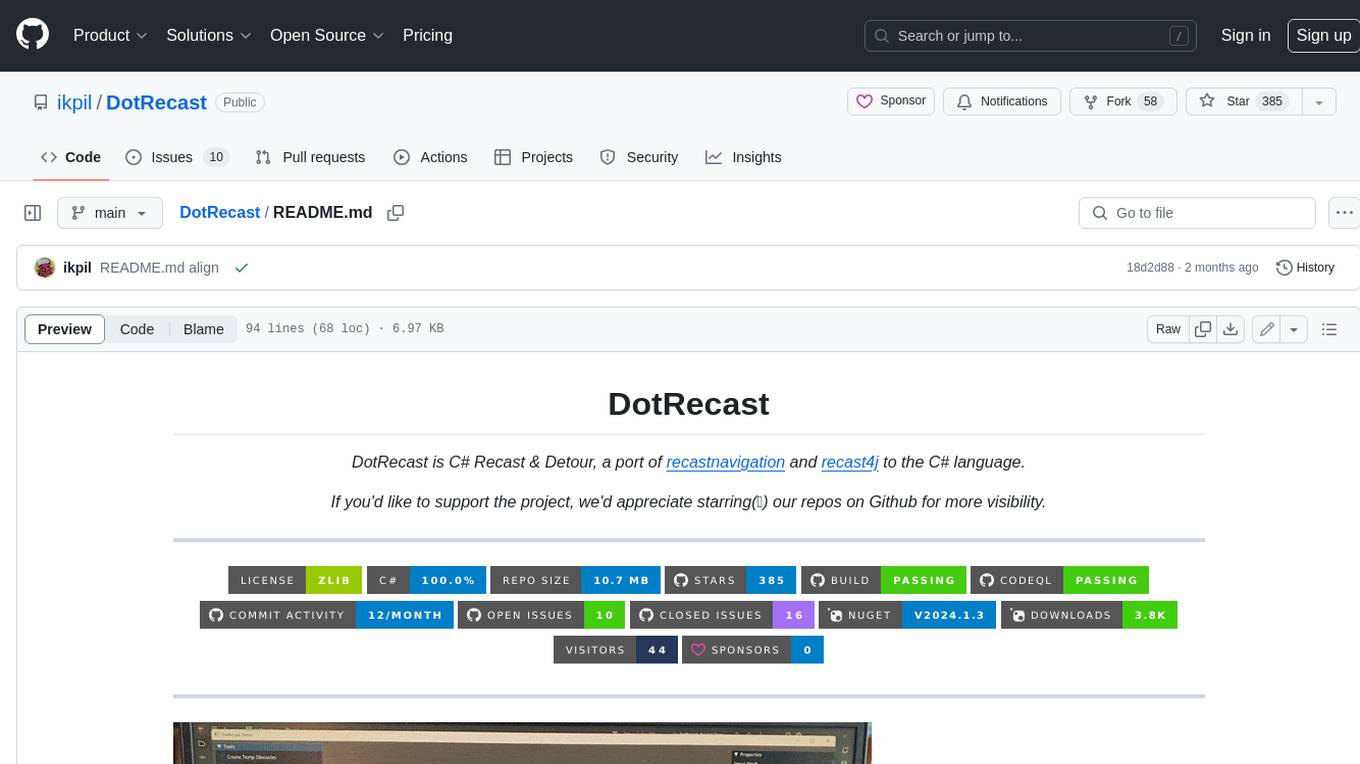
DotRecast
DotRecast is a C# port of Recast & Detour, a navigation library used in many AAA and indie games and engines. It provides automatic navmesh generation, fast turnaround times, detailed customization options, and is dependency-free. Recast Navigation is divided into multiple modules, each contained in its own folder: - DotRecast.Core: Core utils - DotRecast.Recast: Navmesh generation - DotRecast.Detour: Runtime loading of navmesh data, pathfinding, navmesh queries - DotRecast.Detour.TileCache: Navmesh streaming. Useful for large levels and open-world games - DotRecast.Detour.Crowd: Agent movement, collision avoidance, and crowd simulation - DotRecast.Detour.Dynamic: Robust support for dynamic nav meshes combining pre-built voxels with dynamic objects which can be freely added and removed - DotRecast.Detour.Extras: Simple tool to import navmeshes created with A* Pathfinding Project - DotRecast.Recast.Toolset: All modules - DotRecast.Recast.Demo: Standalone, comprehensive demo app showcasing all aspects of Recast & Detour's functionality - Tests: Unit tests Recast constructs a navmesh through a multi-step mesh rasterization process: 1. First Recast rasterizes the input triangle meshes into voxels. 2. Voxels in areas where agents would not be able to move are filtered and removed. 3. The walkable areas described by the voxel grid are then divided into sets of polygonal regions. 4. The navigation polygons are generated by re-triangulating the generated polygonal regions into a navmesh. You can use Recast to build a single navmesh, or a tiled navmesh. Single meshes are suitable for many simple, static cases and are easy to work with. Tiled navmeshes are more complex to work with but better support larger, more dynamic environments. Tiled meshes enable advanced Detour features like re-baking, hierarchical path-planning, and navmesh data-streaming.
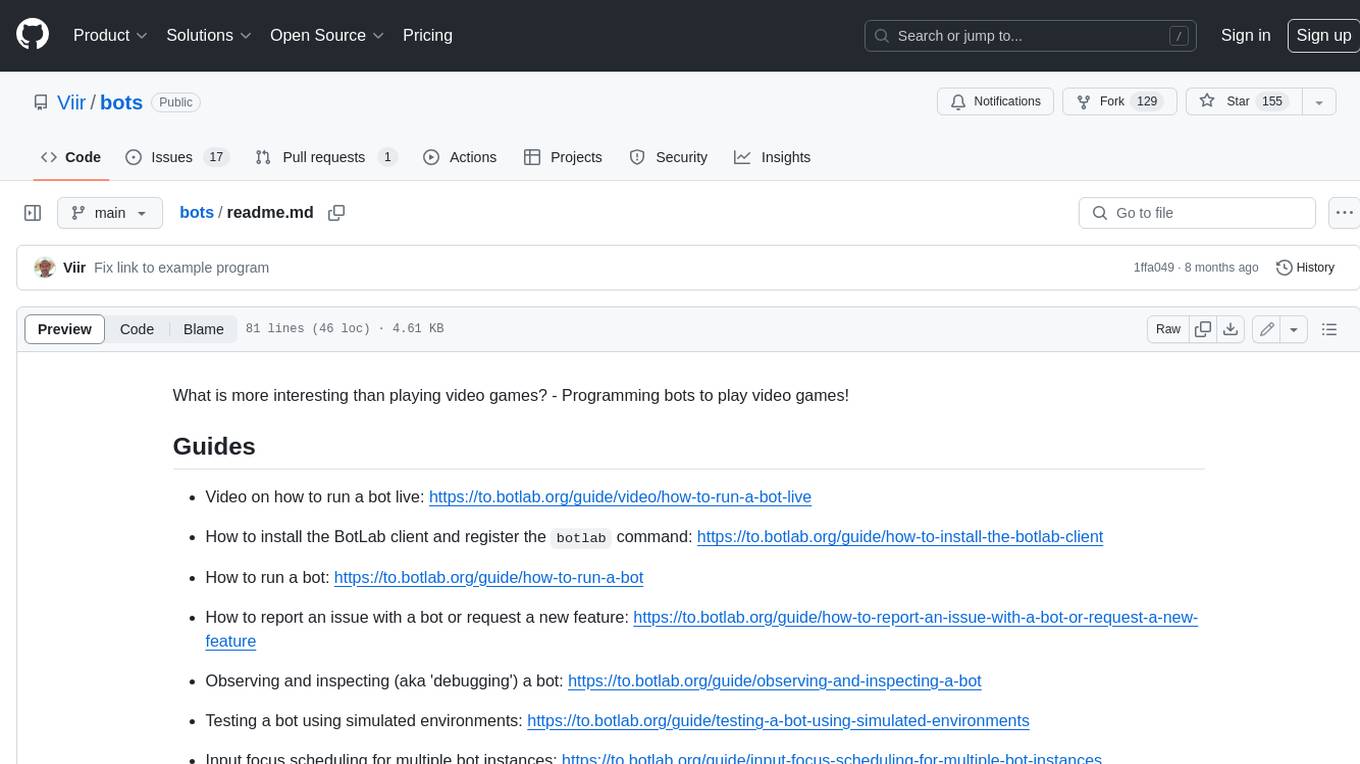
bots
The 'bots' repository is a collection of guides, tools, and example bots for programming bots to play video games. It provides resources on running bots live, installing the BotLab client, debugging bots, testing bots in simulated environments, and more. The repository also includes example bots for games like EVE Online, Tribal Wars 2, and Elvenar. Users can learn about developing bots for specific games, syntax of the Elm programming language, and tools for memory reading development. Additionally, there are guides on bot programming, contributing to BotLab, and exploring Elm syntax and core library.

Half-Life-Resurgence
Half-Life-Resurgence is a recreation and expansion project that brings NPCs, entities, and weapons from the Half-Life series into Garry's Mod. The goal is to faithfully recreate original content while also introducing new features and custom content envisioned by the community. Users can expect a wide range of NPCs with new abilities, AI behaviors, and weapons, as well as support for playing as any character and replacing NPCs in Half-Life 1 & 2 campaigns.
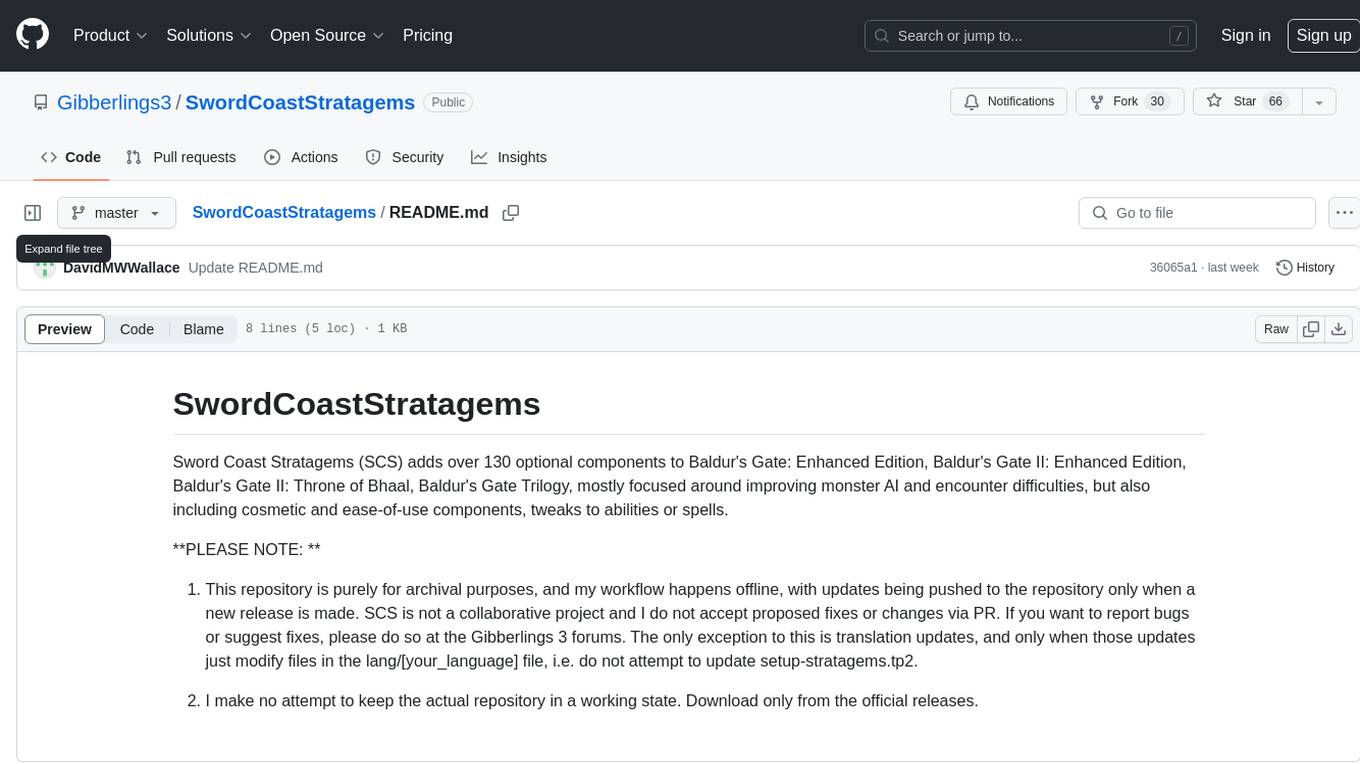
SwordCoastStratagems
Sword Coast Stratagems (SCS) is a mod that enhances Baldur's Gate games by adding over 130 optional components focused on improving monster AI, encounter difficulties, cosmetic enhancements, and ease-of-use tweaks. This repository serves as an archive for the project, with updates pushed only when new releases are made. It is not a collaborative project, and bug reports or suggestions should be made at the Gibberlings 3 forums. The mod is designed for offline workflow and should be downloaded from official releases.
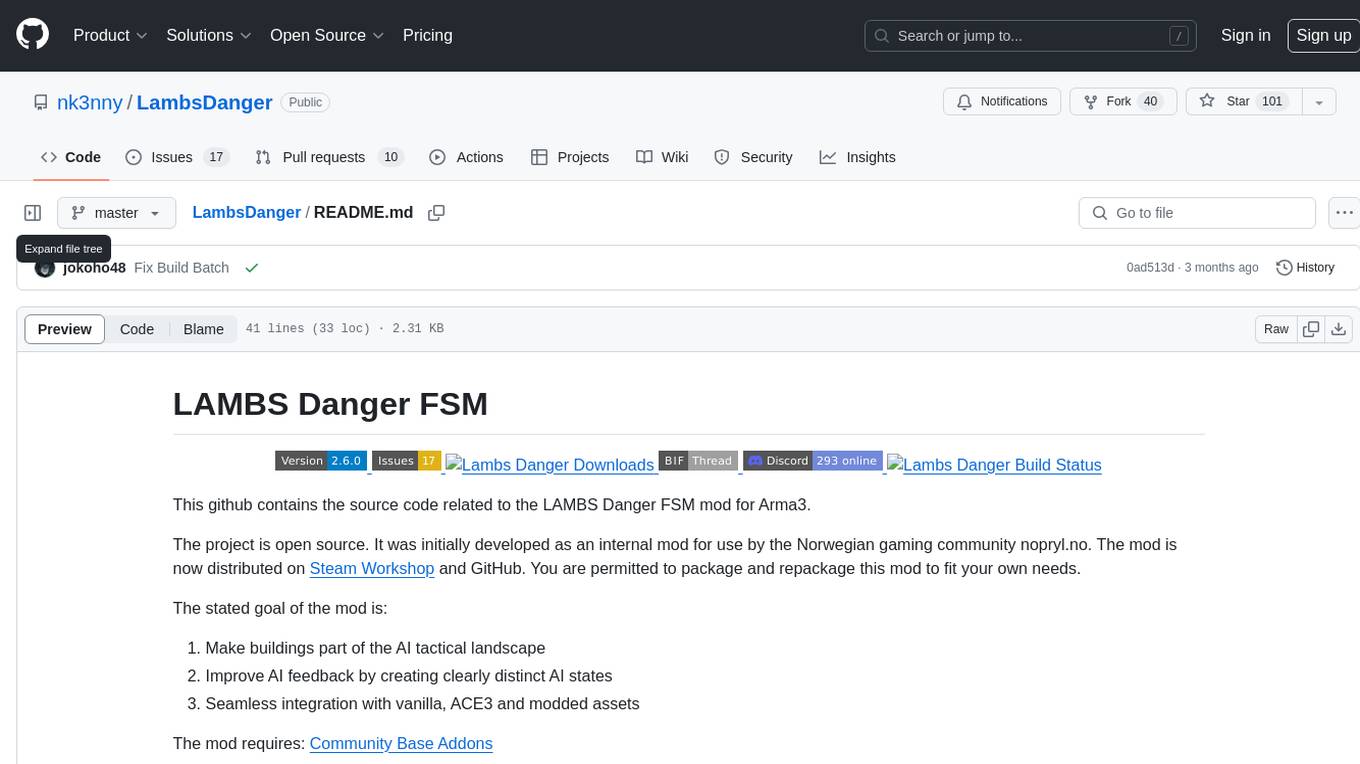
LambsDanger
LAMBS Danger FSM is an open-source mod developed for Arma3, aimed at enhancing the AI behavior by integrating buildings into the tactical landscape, creating distinct AI states, and ensuring seamless compatibility with vanilla, ACE3, and modded assets. Originally created for the Norwegian gaming community, it is now available on Steam Workshop and GitHub for wider use. Users are allowed to customize and redistribute the mod according to their requirements. The project is licensed under the GNU General Public License (GPLv2) with additional amendments.

beehave
Beehave is a powerful addon for Godot Engine that enables users to create robust AI systems using behavior trees. It simplifies the design of complex NPC behaviors, challenging boss battles, and other advanced setups. Beehave allows for the creation of highly adaptive AI that responds to changes in the game world and overcomes unexpected obstacles, catering to both beginners and experienced developers. The tool is currently in development for version 3.0.
thinker
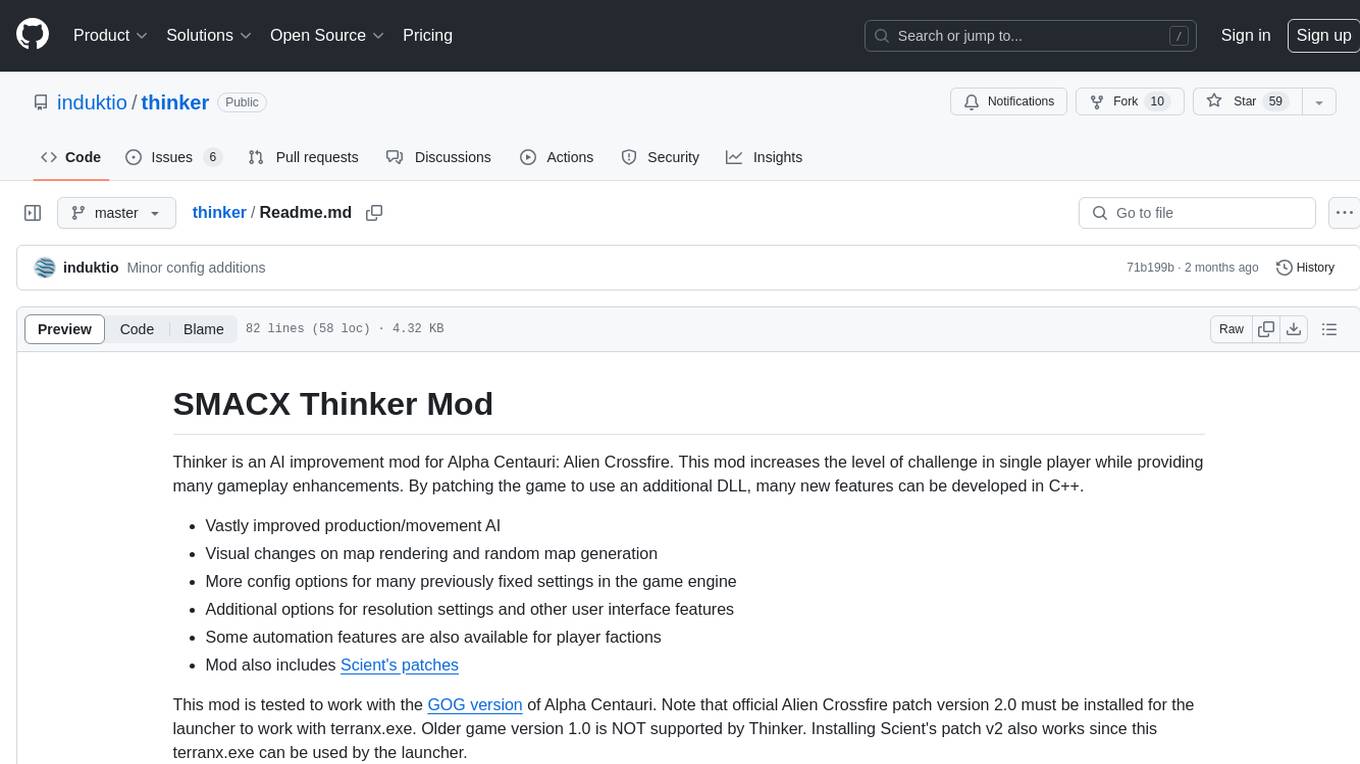
Thinker is an AI improvement mod for Alpha Centauri: Alien Crossfire that enhances single player challenge and gameplay with features like improved production/movement AI, visual changes on map rendering, more config options, resolution settings, and automation features. It includes Scient's patches and requires the GOG version of Alpha Centauri with the official Alien Crossfire patch version 2.0 installed. The mod provides additional DLL features developed in C++ for a richer gaming experience.
MobChip
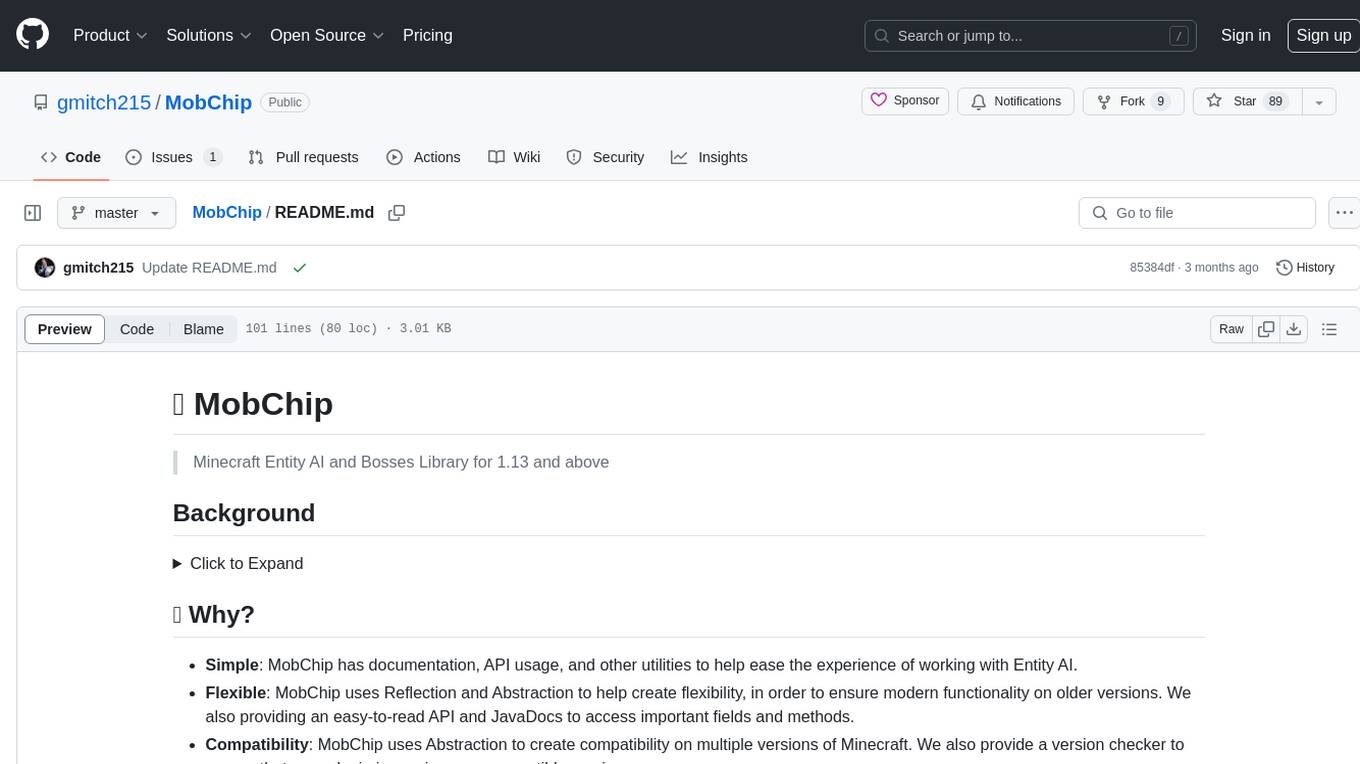
MobChip is an all-in-one Entity AI and Bosses Library for Minecraft 1.13 and above. It simplifies the implementation of Minecraft's native entity AI into plugins, offering documentation, API usage, and utilities for ease of use. The library is flexible, using Reflection and Abstraction for modern functionality on older versions, and ensuring compatibility across multiple Minecraft versions. MobChip is open source, providing features like Bosses Library, Pathfinder Goals, Behaviors, Villager Gossip, Ender Dragon Phases, and more.