


ai
The Laravel AI SDK provides a unified, expressive API for interacting with AI providers such as OpenAI, Anthropic, Gemini, and more.
Stars: 557
The Laravel AI SDK is a package that provides a unified API for interacting with various AI providers. It allows users to build intelligent agents, generate images, synthesize audio, create vector embeddings, and more using a Laravel-friendly interface. The SDK simplifies the integration of AI capabilities into Laravel applications, offering tools for structured output and seamless interaction with AI services.
README:




The Laravel AI SDK provides a unified, expressive API for interacting with AI providers such as OpenAI, Anthropic, Gemini, and more. With the AI SDK, you can build intelligent agents with tools and structured output, generate images, synthesize and transcribe audio, create vector embeddings, and much more — all using a consistent, Laravel-friendly interface.
Documentation for the Laravel AI SDK can be found on the Laravel website.
Thank you for considering contributing to Laravel! The contribution guide can be found in the Laravel documentation.
In order to ensure that the Laravel community is welcoming to all, please review and abide by the Code of Conduct.
Please review our security policy on how to report security vulnerabilities.
The Laravel AI SDK is open-sourced software licensed under the MIT license.
For Tasks:
Click tags to check more tools for each tasksFor Jobs:
Alternative AI tools for ai
Similar Open Source Tools
ai
The Laravel AI SDK is a package that provides a unified API for interacting with various AI providers. It allows users to build intelligent agents, generate images, synthesize audio, create vector embeddings, and more using a Laravel-friendly interface. The SDK simplifies the integration of AI capabilities into Laravel applications, offering tools for structured output and seamless interaction with AI services.
prism
Prism is a Laravel package for integrating Large Language Models (LLMs) into applications. It simplifies text generation, multi-step conversations, and AI tools integration. Focus on developing exceptional AI applications without technical complexities.
prism
Prism is a Laravel package that simplifies the integration of Large Language Models (LLMs) into applications. It offers a user-friendly interface for text generation, managing multi-step conversations, and leveraging AI tools from different providers. With Prism, developers can focus on creating exceptional AI applications without being bogged down by technical complexities.

spring-ai-alibaba
Spring AI Alibaba is an AI application framework for Java developers that seamlessly integrates with Alibaba Cloud QWen LLM services and cloud-native infrastructures. It provides features like support for various AI models, high-level AI agent abstraction, function calling, and RAG support. The framework aims to simplify the development, evaluation, deployment, and observability of AI native Java applications. It offers open-source framework and ecosystem integrations to support features like prompt template management, event-driven AI applications, and more.
Awesome-Vibe-Coding
Awesome-Vibe-Coding is a curated list of Vibe Coding open-source projects, tools, and learning resources. It includes a comprehensive collection of AI-powered development toolkits, IDEs, extensions, platforms, and cloud-based agents for modern software development. The repository also covers development standards, MCP servers, agent communication protocols, agent SDKs, supporting tools, vibe coding projects, and learning resources. The project aims to showcase the power of AI-assisted development and provide a resource hub for developers interested in Vibe Coding practices.
goose
Codename Goose is an open-source, extensible AI agent designed to provide functionalities beyond code suggestions. Users can install, execute, edit, and test with any LLM. The tool aims to enhance the coding experience by offering advanced features and capabilities. Stay updated for the upcoming 1.0 release scheduled by the end of January 2025. Explore the v0.X documentation available on the project's GitHub pages.
awesome-generative-ai
Awesome Generative AI is a curated list of modern Generative Artificial Intelligence projects and services. Generative AI technology creates original content like images, sounds, and texts using machine learning algorithms trained on large data sets. It can produce unique and realistic outputs such as photorealistic images, digital art, music, and writing. The repo covers a wide range of applications in art, entertainment, marketing, academia, and computer science.
alan-sdk-web
Alan AI is a comprehensive AI solution that acts as a 'unified brain' for enterprises, interconnecting applications, APIs, and data sources to streamline workflows. It offers tools like Alan AI Studio for designing dialog scenarios, lightweight SDKs for embedding AI Agents, and a backend powered by advanced AI technologies. With Alan AI, users can create conversational experiences with minimal UI changes, benefit from a serverless environment, receive on-the-fly updates, and access dialog testing and analytics tools. The platform supports various frameworks like JavaScript, React, Angular, Vue, Ember, and Electron, and provides example web apps for different platforms. Users can also explore Alan AI SDKs for iOS, Android, Flutter, Ionic, Apache Cordova, and React Native.
nocobase
NocoBase is an extensible AI-powered no-code platform that offers total control, infinite extensibility, and AI collaboration. It enables teams to adapt quickly and reduce costs without the need for years of development or wasted resources. With NocoBase, users can deploy the platform in minutes and have complete control over their projects. The platform is data model-driven, allowing for unlimited possibilities by decoupling UI and data structure. It integrates AI capabilities seamlessly into business systems, enabling roles such as translator, analyst, researcher, or assistant. NocoBase provides a simple and intuitive user experience with a 'what you see is what you get' approach. It is designed for extension through its plugin-based architecture, allowing users to customize and extend functionalities easily.
yao
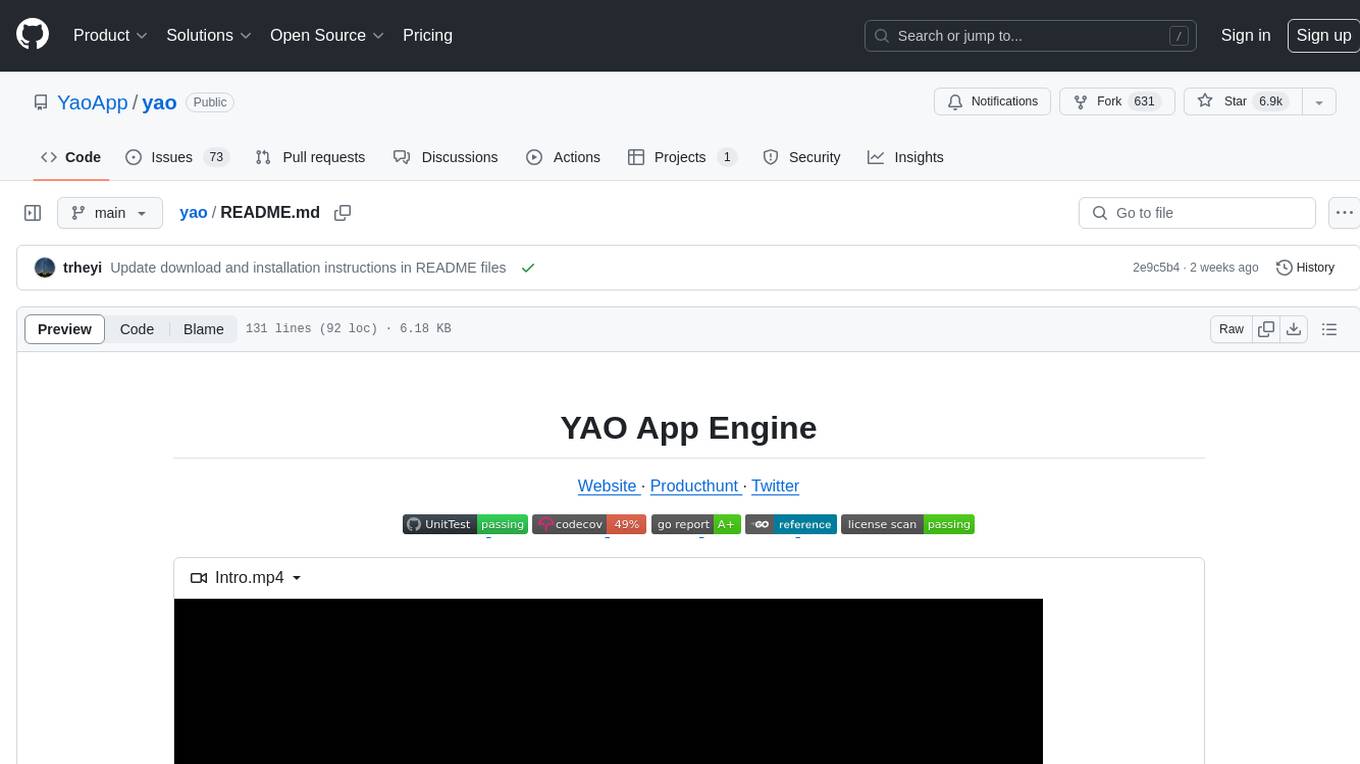
YAO is an open-source application engine written in Golang, suitable for developing business systems, website/APP API, admin panel, and self-built low-code platforms. It adopts a flow-based programming model to implement functions by writing YAO DSL or using JavaScript. Yao allows developers to create web services by processes, creating a database model, writing API services, and describing dashboard interfaces just by JSON for web & hardware, and 10x productivity. It is based on the flow-based programming idea, developed in Go language, and supports multiple ways to expand the data stream processor. Yao has a built-in data management system, making it suitable for quickly making various management backgrounds, CRM, ERP, and other internal enterprise systems. It is highly versatile, efficient, and performs better than PHP, JAVA, and other languages.
APIPark
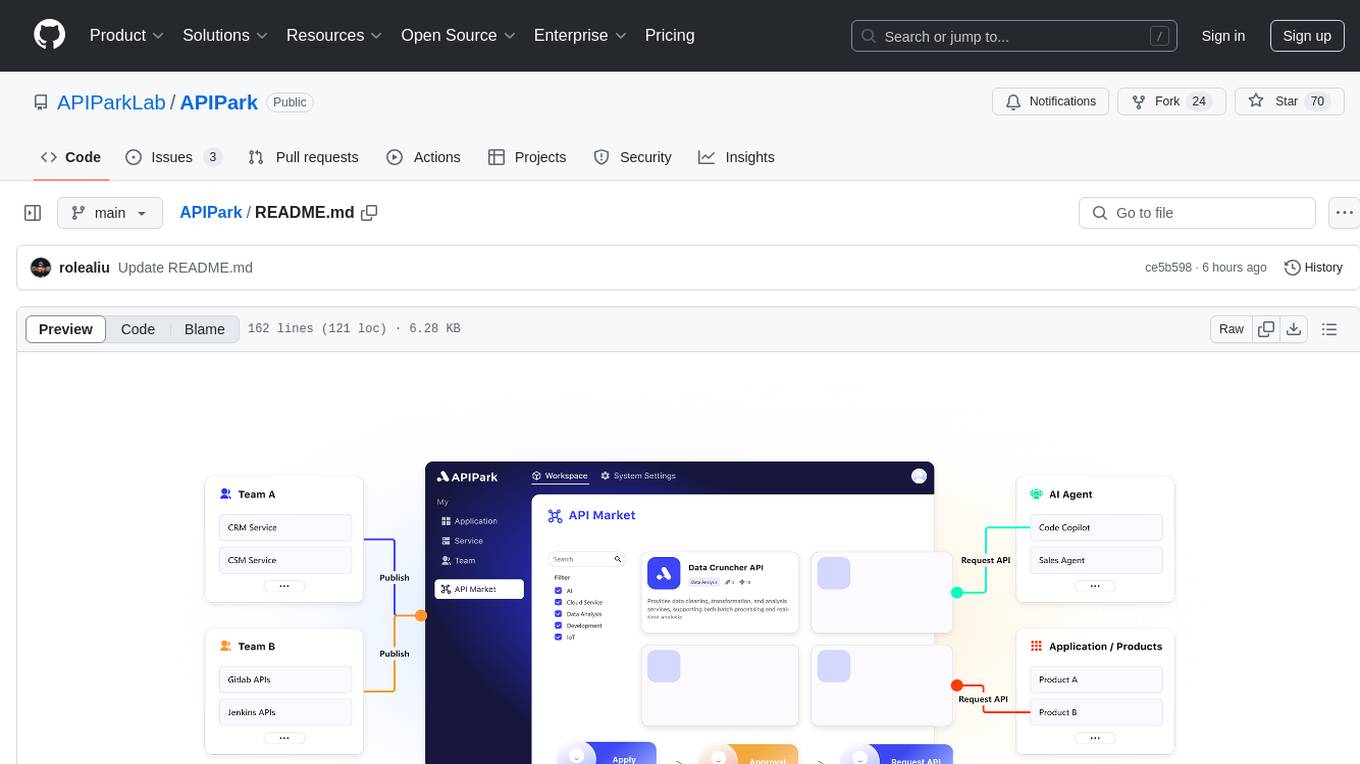
APIPark is an open-source AI Gateway and Developer Portal that enables users to easily manage, integrate, and deploy AI and API services. It provides robust API management features, including creation, monitoring, and access control, to help developers efficiently and securely develop and manage their APIs. The platform aims to solve challenges such as connecting to powerful AI models, managing complex AI & API call relationships, overseeing API creation and security, simplifying fault detection and troubleshooting, and enhancing the visibility and valuation of data assets.
budibase
Budibase is an open-source low-code platform that allows users to build web applications visually without writing code. It provides a drag-and-drop interface for designing user interfaces and workflows, as well as a visual editor for defining data models and business logic. With Budibase, users can quickly create custom web applications for various purposes, such as data management, project tracking, and internal tools. The platform supports integrations with popular services and databases, making it easy to extend the functionality of applications. Budibase is suitable for both experienced developers looking to speed up their workflow and non-technical users who want to create web applications without coding.
applied-ai-engineering-samples
The Google Cloud Applied AI Engineering repository provides reference guides, blueprints, code samples, and hands-on labs developed by the Google Cloud Applied AI Engineering team. It contains resources for Generative AI on Vertex AI, including code samples and hands-on labs demonstrating the use of Generative AI models and tools in Vertex AI. Additionally, it offers reference guides and blueprints that compile best practices and prescriptive guidance for running large-scale AI/ML workloads on Google Cloud AI/ML infrastructure.
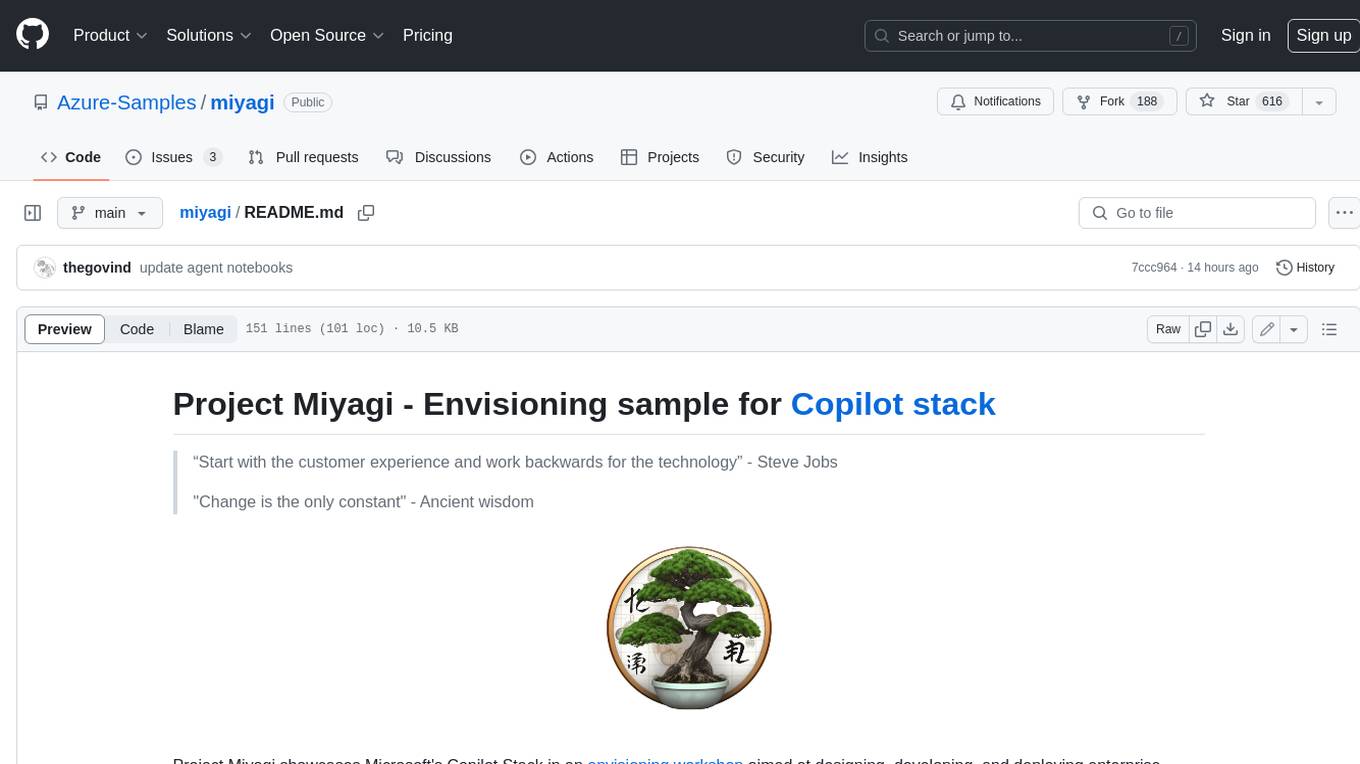
miyagi
Project Miyagi showcases Microsoft's Copilot Stack in an envisioning workshop aimed at designing, developing, and deploying enterprise-grade intelligent apps. By exploring both generative and traditional ML use cases, Miyagi offers an experiential approach to developing AI-infused product experiences that enhance productivity and enable hyper-personalization. Additionally, the workshop introduces traditional software engineers to emerging design patterns in prompt engineering, such as chain-of-thought and retrieval-augmentation, as well as to techniques like vectorization for long-term memory, fine-tuning of OSS models, agent-like orchestration, and plugins or tools for augmenting and grounding LLMs.
awesome-vibe-coding
Awesome Vibe Coding is a curated list of references for vibe coding, which involves collaborating with AI to write code. It includes browser-based tools, IDEs, code editors, desktop apps, plugins, command line tools, and documentation for AI coding. The concept of vibe coding is about fully embracing the vibes, exponentials, and forgetting that the code even exists while building projects or web apps. The repository provides a collection of tools and resources to facilitate the process of coding with a focus on creativity and efficiency.
coze-studio
Coze Studio is an all-in-one AI agent development tool that offers the most convenient AI agent development environment, from development to deployment. It provides core technologies for AI agent development, complete app templates, and build frameworks. Coze Studio aims to simplify creating, debugging, and deploying AI agents through visual design and build tools, enabling powerful AI app development and customized business logic. The tool is developed using Golang for the backend, React + TypeScript for the frontend, and follows microservices architecture based on domain-driven design principles.
For similar tasks
OpenAGI
OpenAGI is an AI agent creation package designed for researchers and developers to create intelligent agents using advanced machine learning techniques. The package provides tools and resources for building and training AI models, enabling users to develop sophisticated AI applications. With a focus on collaboration and community engagement, OpenAGI aims to facilitate the integration of AI technologies into various domains, fostering innovation and knowledge sharing among experts and enthusiasts.
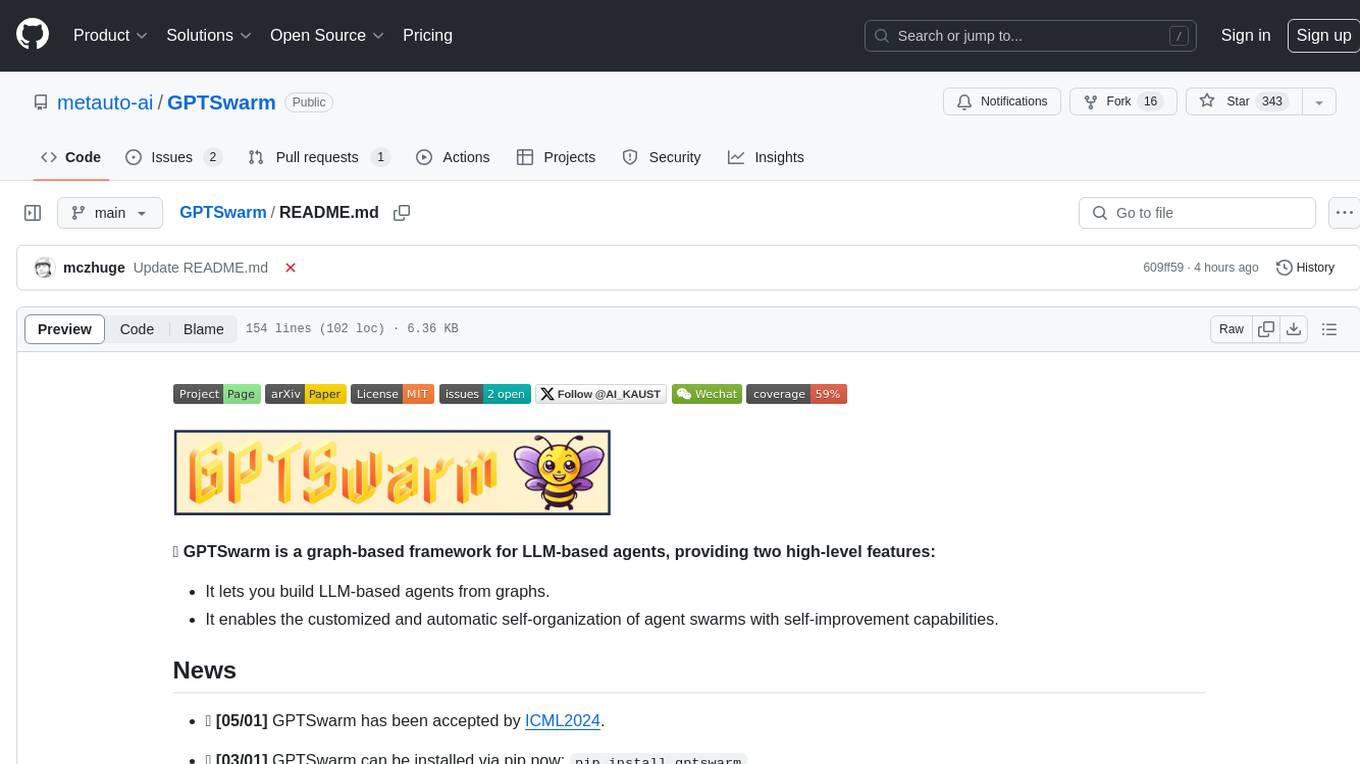
GPTSwarm
GPTSwarm is a graph-based framework for LLM-based agents that enables the creation of LLM-based agents from graphs and facilitates the customized and automatic self-organization of agent swarms with self-improvement capabilities. The library includes components for domain-specific operations, graph-related functions, LLM backend selection, memory management, and optimization algorithms to enhance agent performance and swarm efficiency. Users can quickly run predefined swarms or utilize tools like the file analyzer. GPTSwarm supports local LM inference via LM Studio, allowing users to run with a local LLM model. The framework has been accepted by ICML2024 and offers advanced features for experimentation and customization.
AgentForge
AgentForge is a low-code framework tailored for the rapid development, testing, and iteration of AI-powered autonomous agents and Cognitive Architectures. It is compatible with a range of LLM models and offers flexibility to run different models for different agents based on specific needs. The framework is designed for seamless extensibility and database-flexibility, making it an ideal playground for various AI projects. AgentForge is a beta-testing ground and future-proof hub for crafting intelligent, model-agnostic autonomous agents.
atomic_agents
Atomic Agents is a modular and extensible framework designed for creating powerful applications. It follows the principles of Atomic Design, emphasizing small and single-purpose components. Leveraging Pydantic for data validation and serialization, the framework offers a set of tools and agents that can be combined to build AI applications. It depends on the Instructor package and supports various APIs like OpenAI, Cohere, Anthropic, and Gemini. Atomic Agents is suitable for developers looking to create AI agents with a focus on modularity and flexibility.
LongRoPE
LongRoPE is a method to extend the context window of large language models (LLMs) beyond 2 million tokens. It identifies and exploits non-uniformities in positional embeddings to enable 8x context extension without fine-tuning. The method utilizes a progressive extension strategy with 256k fine-tuning to reach a 2048k context. It adjusts embeddings for shorter contexts to maintain performance within the original window size. LongRoPE has been shown to be effective in maintaining performance across various tasks from 4k to 2048k context lengths.
ax
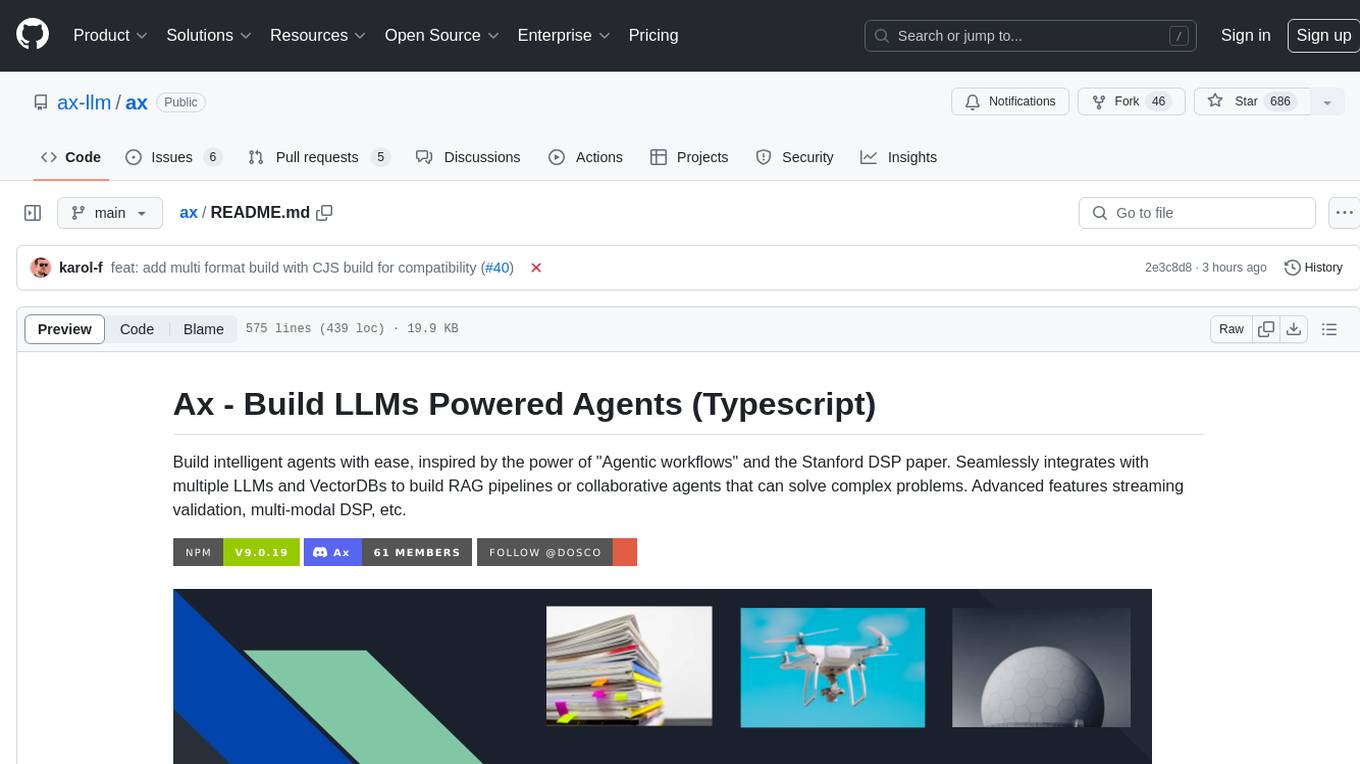
Ax is a Typescript library that allows users to build intelligent agents inspired by agentic workflows and the Stanford DSP paper. It seamlessly integrates with multiple Large Language Models (LLMs) and VectorDBs to create RAG pipelines or collaborative agents capable of solving complex problems. The library offers advanced features such as streaming validation, multi-modal DSP, and automatic prompt tuning using optimizers. Users can easily convert documents of any format to text, perform smart chunking, embedding, and querying, and ensure output validation while streaming. Ax is production-ready, written in Typescript, and has zero dependencies.
Awesome-AI-Agents
Awesome-AI-Agents is a curated list of projects, frameworks, benchmarks, platforms, and related resources focused on autonomous AI agents powered by Large Language Models (LLMs). The repository showcases a wide range of applications, multi-agent task solver projects, agent society simulations, and advanced components for building and customizing AI agents. It also includes frameworks for orchestrating role-playing, evaluating LLM-as-Agent performance, and connecting LLMs with real-world applications through platforms and APIs. Additionally, the repository features surveys, paper lists, and blogs related to LLM-based autonomous agents, making it a valuable resource for researchers, developers, and enthusiasts in the field of AI.
CodeFuse-muAgent
CodeFuse-muAgent is a Multi-Agent framework designed to streamline Standard Operating Procedure (SOP) orchestration for agents. It integrates toolkits, code libraries, knowledge bases, and sandbox environments for rapid construction of complex Multi-Agent interactive applications. The framework enables efficient execution and handling of multi-layered and multi-dimensional tasks.
For similar jobs
sweep
Sweep is an AI junior developer that turns bugs and feature requests into code changes. It automatically handles developer experience improvements like adding type hints and improving test coverage.
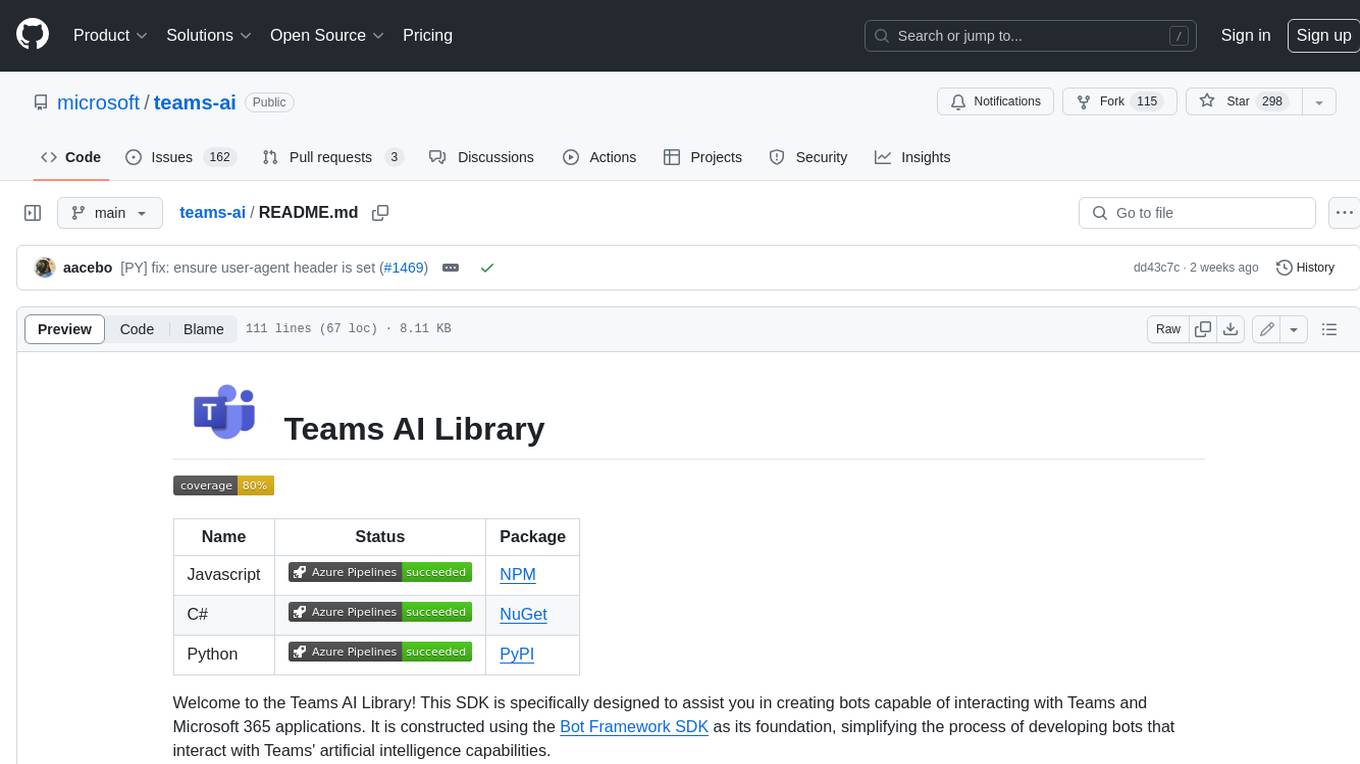
teams-ai
The Teams AI Library is a software development kit (SDK) that helps developers create bots that can interact with Teams and Microsoft 365 applications. It is built on top of the Bot Framework SDK and simplifies the process of developing bots that interact with Teams' artificial intelligence capabilities. The SDK is available for JavaScript/TypeScript, .NET, and Python.
ai-guide
This guide is dedicated to Large Language Models (LLMs) that you can run on your home computer. It assumes your PC is a lower-end, non-gaming setup.
classifai
Supercharge WordPress Content Workflows and Engagement with Artificial Intelligence. Tap into leading cloud-based services like OpenAI, Microsoft Azure AI, Google Gemini and IBM Watson to augment your WordPress-powered websites. Publish content faster while improving SEO performance and increasing audience engagement. ClassifAI integrates Artificial Intelligence and Machine Learning technologies to lighten your workload and eliminate tedious tasks, giving you more time to create original content that matters.
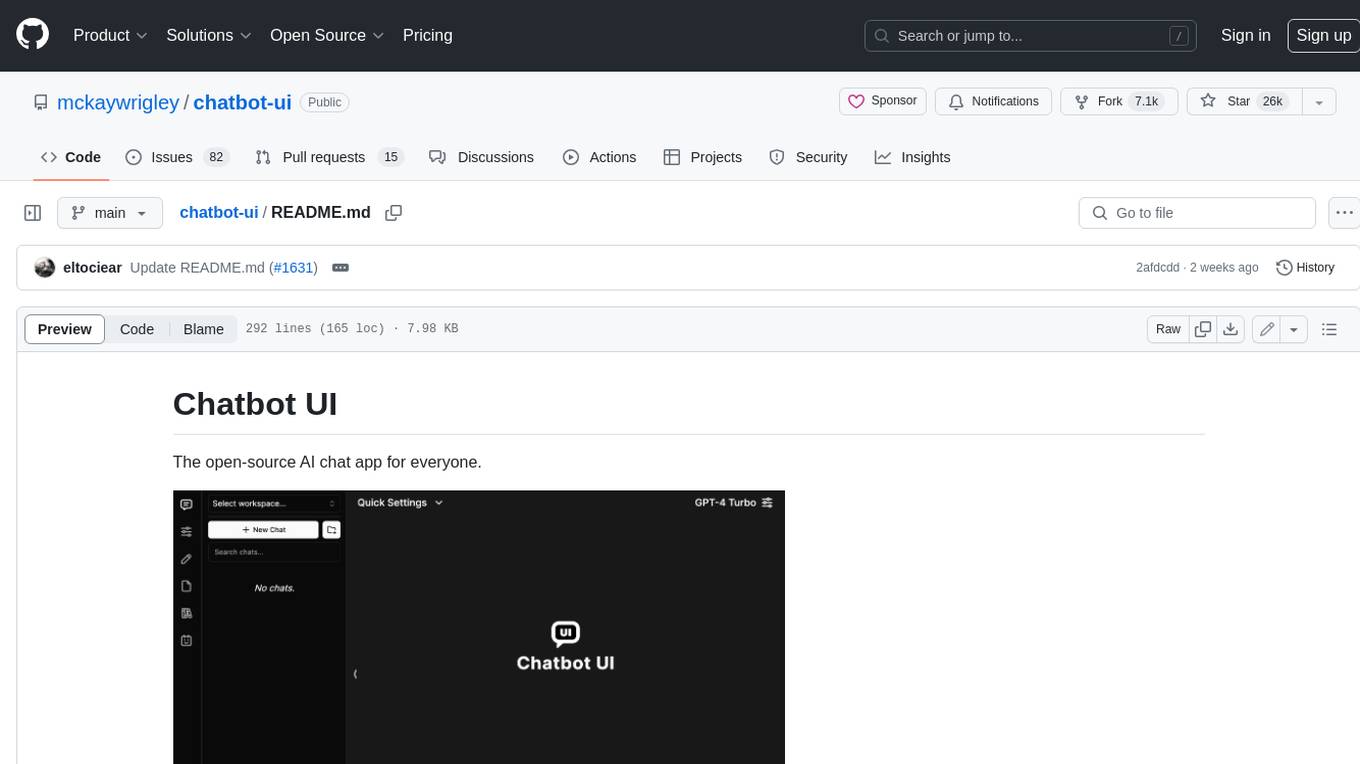
chatbot-ui
Chatbot UI is an open-source AI chat app that allows users to create and deploy their own AI chatbots. It is easy to use and can be customized to fit any need. Chatbot UI is perfect for businesses, developers, and anyone who wants to create a chatbot.
BricksLLM
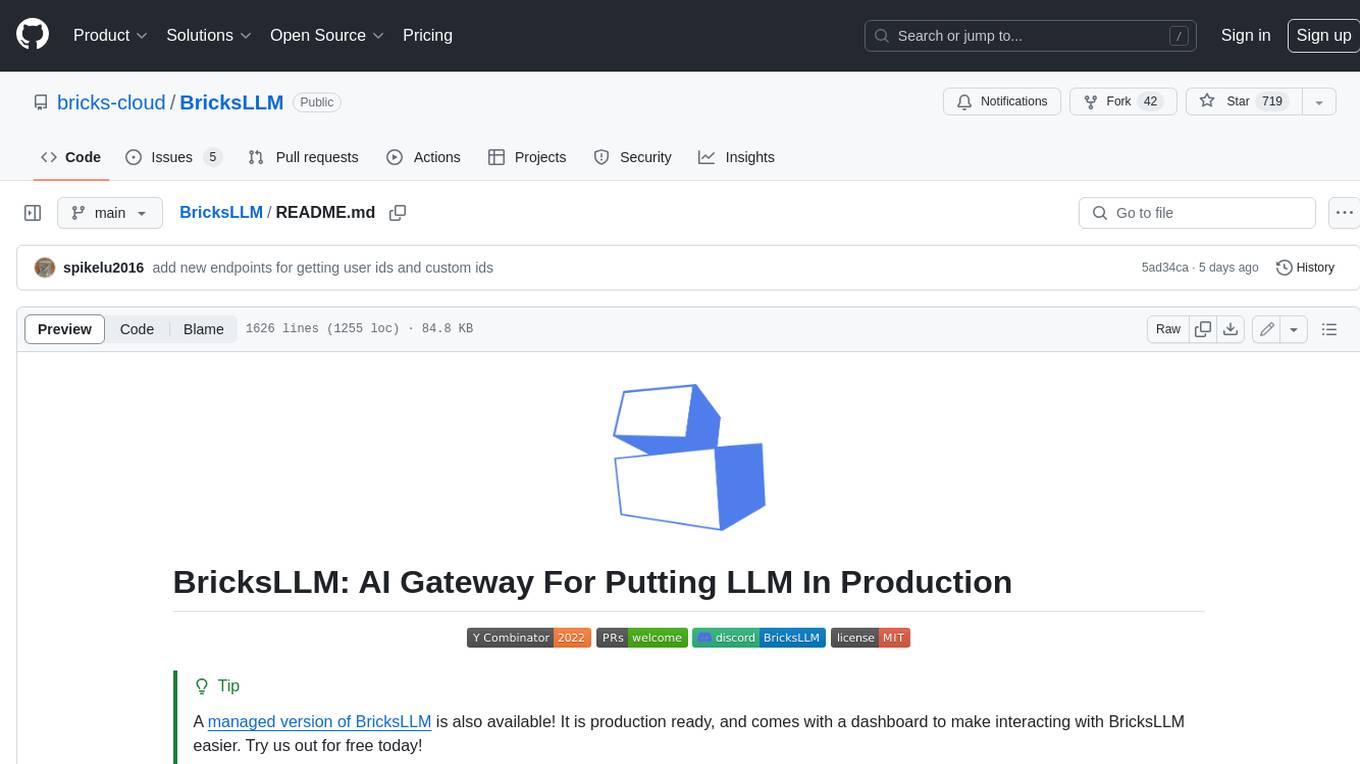
BricksLLM is a cloud native AI gateway written in Go. Currently, it provides native support for OpenAI, Anthropic, Azure OpenAI and vLLM. BricksLLM aims to provide enterprise level infrastructure that can power any LLM production use cases. Here are some use cases for BricksLLM: * Set LLM usage limits for users on different pricing tiers * Track LLM usage on a per user and per organization basis * Block or redact requests containing PIIs * Improve LLM reliability with failovers, retries and caching * Distribute API keys with rate limits and cost limits for internal development/production use cases * Distribute API keys with rate limits and cost limits for students
uAgents
uAgents is a Python library developed by Fetch.ai that allows for the creation of autonomous AI agents. These agents can perform various tasks on a schedule or take action on various events. uAgents are easy to create and manage, and they are connected to a fast-growing network of other uAgents. They are also secure, with cryptographically secured messages and wallets.
griptape
Griptape is a modular Python framework for building AI-powered applications that securely connect to your enterprise data and APIs. It offers developers the ability to maintain control and flexibility at every step. Griptape's core components include Structures (Agents, Pipelines, and Workflows), Tasks, Tools, Memory (Conversation Memory, Task Memory, and Meta Memory), Drivers (Prompt and Embedding Drivers, Vector Store Drivers, Image Generation Drivers, Image Query Drivers, SQL Drivers, Web Scraper Drivers, and Conversation Memory Drivers), Engines (Query Engines, Extraction Engines, Summary Engines, Image Generation Engines, and Image Query Engines), and additional components (Rulesets, Loaders, Artifacts, Chunkers, and Tokenizers). Griptape enables developers to create AI-powered applications with ease and efficiency.