


adk-go
An open-source, code-first Go toolkit for building, evaluating, and deploying sophisticated AI agents with flexibility and control.
Stars: 6879
An open-source, code-first Go toolkit for building, evaluating, and deploying sophisticated AI agents with flexibility and control. Agent Development Kit (ADK) is a flexible and modular framework that simplifies building, deploying, and orchestrating agent workflows, optimized for cloud-native agent applications. It offers idiomatic Go design, rich tool ecosystem, code-first development, modular multi-agent systems, and easy deployment in cloud-native environments like Google Cloud Run.
README:





An open-source, code-first Go toolkit for building, evaluating, and deploying sophisticated AI agents with flexibility and control.
Important Links: Docs & Samples & Python ADK & Java ADK & ADK Web.
Agent Development Kit (ADK) is a flexible and modular framework that applies software development principles to AI agent creation. It is designed to simplify building, deploying, and orchestrating agent workflows, from simple tasks to complex systems. While optimized for Gemini, ADK is model-agnostic, deployment-agnostic, and compatible with other frameworks.
This Go version of ADK is ideal for developers building cloud-native agent applications, leveraging Go's strengths in concurrency and performance.
- Idiomatic Go: Designed to feel natural and leverage the power of Go.
- Rich Tool Ecosystem: Utilize pre-built tools, custom functions, or integrate existing tools to give agents diverse capabilities.
- Code-First Development: Define agent logic, tools, and orchestration directly in Go for ultimate flexibility, testability, and versioning.
- Modular Multi-Agent Systems: Design scalable applications by composing multiple specialized agents.
- Deploy Anywhere: Easily containerize and deploy agents, with strong support for cloud-native environments like Google Cloud Run.
To add ADK Go to your project, run:
go get google.golang.org/adkThis project is licensed under the Apache 2.0 License - see the LICENSE file for details.
The exception is internal/httprr - see its LICENSE file.
For Tasks:
Click tags to check more tools for each tasksFor Jobs:
Alternative AI tools for adk-go
Similar Open Source Tools
adk-go
An open-source, code-first Go toolkit for building, evaluating, and deploying sophisticated AI agents with flexibility and control. Agent Development Kit (ADK) is a flexible and modular framework that simplifies building, deploying, and orchestrating agent workflows, optimized for cloud-native agent applications. It offers idiomatic Go design, rich tool ecosystem, code-first development, modular multi-agent systems, and easy deployment in cloud-native environments like Google Cloud Run.
adk-java
Agent Development Kit (ADK) for Java is an open-source toolkit designed for developers to build, evaluate, and deploy sophisticated AI agents with flexibility and control. It allows defining agent behavior, orchestration, and tool use directly in code, enabling robust debugging, versioning, and deployment anywhere. The toolkit offers a rich tool ecosystem, code-first development approach, and support for modular multi-agent systems, making it ideal for creating advanced AI agents integrated with Google Cloud services.
adk-docs
Agent Development Kit (ADK) is an open-source, code-first toolkit for building, evaluating, and deploying sophisticated AI agents with flexibility and control. It is a flexible and modular framework optimized for Gemini and the Google ecosystem, model-agnostic, deployment-agnostic, and compatible with other frameworks. ADK simplifies agent development by making it feel more like software development, enabling developers to create, deploy, and orchestrate agentic architectures from simple tasks to complex workflows.
langchain
LangChain is a framework for building LLM-powered applications that simplifies AI application development by chaining together interoperable components and third-party integrations. It helps developers connect LLMs to diverse data sources, swap models easily, and future-proof decisions as technology evolves. LangChain's ecosystem includes tools like LangSmith for agent evals, LangGraph for complex task handling, and LangGraph Platform for deployment and scaling. Additional resources include tutorials, how-to guides, conceptual guides, a forum, API reference, and chat support.
genkit
Firebase Genkit (beta) is a framework with powerful tooling to help app developers build, test, deploy, and monitor AI-powered features with confidence. Genkit is cloud optimized and code-centric, integrating with many services that have free tiers to get started. It provides unified API for generation, context-aware AI features, evaluation of AI workflow, extensibility with plugins, easy deployment to Firebase or Google Cloud, observability and monitoring with OpenTelemetry, and a developer UI for prototyping and testing AI features locally. Genkit works seamlessly with Firebase or Google Cloud projects through official plugins and templates.
langgraph
LangGraph is a low-level orchestration framework for building, managing, and deploying long-running, stateful agents. It provides durable execution, human-in-the-loop capabilities, comprehensive memory management, debugging tools, and production-ready deployment infrastructure. LangGraph can be used standalone or integrated with other LangChain products to streamline LLM application development.
Genkit
Genkit is an open-source framework for building full-stack AI-powered applications, used in production by Google's Firebase. It provides SDKs for JavaScript/TypeScript (Stable), Go (Beta), and Python (Alpha) with unified interface for integrating AI models from providers like Google, OpenAI, Anthropic, Ollama. Rapidly build chatbots, automations, and recommendation systems using streamlined APIs for multimodal content, structured outputs, tool calling, and agentic workflows. Genkit simplifies AI integration with open-source SDK, unified APIs, and offers text and image generation, structured data generation, tool calling, prompt templating, persisted chat interfaces, AI workflows, and AI-powered data retrieval (RAG).
dapr-agents
Dapr Agents is a developer framework for building production-grade resilient AI agent systems that operate at scale. It enables software developers to create AI agents that reason, act, and collaborate using Large Language Models (LLMs), while providing built-in observability and stateful workflow execution to ensure agentic workflows complete successfully. The framework is scalable, efficient, Kubernetes-native, data-driven, secure, observable, vendor-neutral, and open source. It offers features like scalable workflows, cost-effective AI adoption, data-centric AI agents, accelerated development, integrated security and reliability, built-in messaging and state infrastructure, and vendor-neutral and open source support. Dapr Agents is designed to simplify the development of AI applications and workflows by providing a comprehensive API surface and seamless integration with various data sources and services.
goose
Codename Goose is an open-source, extensible AI agent designed to provide functionalities beyond code suggestions. Users can install, execute, edit, and test with any LLM. The tool aims to enhance the coding experience by offering advanced features and capabilities. Stay updated for the upcoming 1.0 release scheduled by the end of January 2025. Explore the v0.X documentation available on the project's GitHub pages.
agents
Inkeep Agents is a platform for building AI agents using a No-Code Visual Builder or TypeScript SDK. It allows technical and non-technical teams to create and manage agents collaboratively. The platform supports real-time AI chat assistants and AI workflow automation, with features like multi-agent architecture, MCP tools, UI component library, and observability via Traces UI & OpenTelemetry. Inkeep Agents is interoperable, allowing seamless editing and management of agents in both visual and code formats.
suna
Kortix is an open-source platform designed to build, manage, and train AI agents for various tasks. It allows users to create autonomous agents, from general-purpose assistants to specialized automation tools. The platform offers capabilities such as browser automation, file management, web intelligence, system operations, API integrations, and agent building tools. Users can create custom agents tailored to specific domains, workflows, or business needs, enabling tasks like research & analysis, browser automation, file & document management, data processing & analysis, and system administration.
baserow
Baserow is a secure, open-source platform that allows users to build databases, applications, automations, and AI agents without writing any code. With enterprise-grade security compliance and both cloud and self-hosted deployment options, Baserow empowers teams to structure data, automate processes, create internal tools, and build custom dashboards. It features a spreadsheet database hybrid, AI Assistant for natural language database creation, GDPR, HIPAA, and SOC 2 Type II compliance, and seamless integration with existing tools. Baserow is API-first, extensible, and uses frameworks like Django, Vue.js, and PostgreSQL.
bedrock-agentcore-starter-toolkit
Amazon Bedrock AgentCore Starter Toolkit enables developers to deploy and operate highly effective AI agents securely at scale using any framework and model. It provides tools and capabilities to make agents more effective and capable, purpose-built infrastructure to securely scale agents, and controls to operate trustworthy agents. The toolkit includes modular services like Runtime, Memory, Gateway, Code Interpreter, Browser, Observability, Identity, and Import Agent for seamless migration of existing agents. It is currently in public preview and offers enterprise-grade security and reliability for accelerating AI agent development.
llmariner
LLMariner is an extensible open source platform built on Kubernetes to simplify the management of generative AI workloads. It enables efficient handling of training and inference data within clusters, with OpenAI-compatible APIs for seamless integration with a wide range of AI-driven applications.
synthora
Synthora is a lightweight and extensible framework for LLM-driven Agents and ALM research. It aims to simplify the process of building, testing, and evaluating agents by providing essential components. The framework allows for easy agent assembly with a single config, reducing the effort required for tuning and sharing agents. Although in early development stages with unstable APIs, Synthora welcomes feedback and contributions to enhance its stability and functionality.
ai-platform-engineering
The AI Platform Engineering repository provides a collection of tools and resources for building and deploying AI models. It includes libraries for data preprocessing, model training, and model serving. The repository also contains example code and tutorials to help users get started with AI development. Whether you are a beginner or an experienced AI engineer, this repository offers valuable insights and best practices to streamline your AI projects.
For similar tasks
OpenAGI
OpenAGI is an AI agent creation package designed for researchers and developers to create intelligent agents using advanced machine learning techniques. The package provides tools and resources for building and training AI models, enabling users to develop sophisticated AI applications. With a focus on collaboration and community engagement, OpenAGI aims to facilitate the integration of AI technologies into various domains, fostering innovation and knowledge sharing among experts and enthusiasts.
GPTSwarm
GPTSwarm is a graph-based framework for LLM-based agents that enables the creation of LLM-based agents from graphs and facilitates the customized and automatic self-organization of agent swarms with self-improvement capabilities. The library includes components for domain-specific operations, graph-related functions, LLM backend selection, memory management, and optimization algorithms to enhance agent performance and swarm efficiency. Users can quickly run predefined swarms or utilize tools like the file analyzer. GPTSwarm supports local LM inference via LM Studio, allowing users to run with a local LLM model. The framework has been accepted by ICML2024 and offers advanced features for experimentation and customization.
AgentForge
AgentForge is a low-code framework tailored for the rapid development, testing, and iteration of AI-powered autonomous agents and Cognitive Architectures. It is compatible with a range of LLM models and offers flexibility to run different models for different agents based on specific needs. The framework is designed for seamless extensibility and database-flexibility, making it an ideal playground for various AI projects. AgentForge is a beta-testing ground and future-proof hub for crafting intelligent, model-agnostic autonomous agents.
atomic_agents
Atomic Agents is a modular and extensible framework designed for creating powerful applications. It follows the principles of Atomic Design, emphasizing small and single-purpose components. Leveraging Pydantic for data validation and serialization, the framework offers a set of tools and agents that can be combined to build AI applications. It depends on the Instructor package and supports various APIs like OpenAI, Cohere, Anthropic, and Gemini. Atomic Agents is suitable for developers looking to create AI agents with a focus on modularity and flexibility.
LongRoPE
LongRoPE is a method to extend the context window of large language models (LLMs) beyond 2 million tokens. It identifies and exploits non-uniformities in positional embeddings to enable 8x context extension without fine-tuning. The method utilizes a progressive extension strategy with 256k fine-tuning to reach a 2048k context. It adjusts embeddings for shorter contexts to maintain performance within the original window size. LongRoPE has been shown to be effective in maintaining performance across various tasks from 4k to 2048k context lengths.
ax
Ax is a Typescript library that allows users to build intelligent agents inspired by agentic workflows and the Stanford DSP paper. It seamlessly integrates with multiple Large Language Models (LLMs) and VectorDBs to create RAG pipelines or collaborative agents capable of solving complex problems. The library offers advanced features such as streaming validation, multi-modal DSP, and automatic prompt tuning using optimizers. Users can easily convert documents of any format to text, perform smart chunking, embedding, and querying, and ensure output validation while streaming. Ax is production-ready, written in Typescript, and has zero dependencies.
Awesome-AI-Agents
Awesome-AI-Agents is a curated list of projects, frameworks, benchmarks, platforms, and related resources focused on autonomous AI agents powered by Large Language Models (LLMs). The repository showcases a wide range of applications, multi-agent task solver projects, agent society simulations, and advanced components for building and customizing AI agents. It also includes frameworks for orchestrating role-playing, evaluating LLM-as-Agent performance, and connecting LLMs with real-world applications through platforms and APIs. Additionally, the repository features surveys, paper lists, and blogs related to LLM-based autonomous agents, making it a valuable resource for researchers, developers, and enthusiasts in the field of AI.
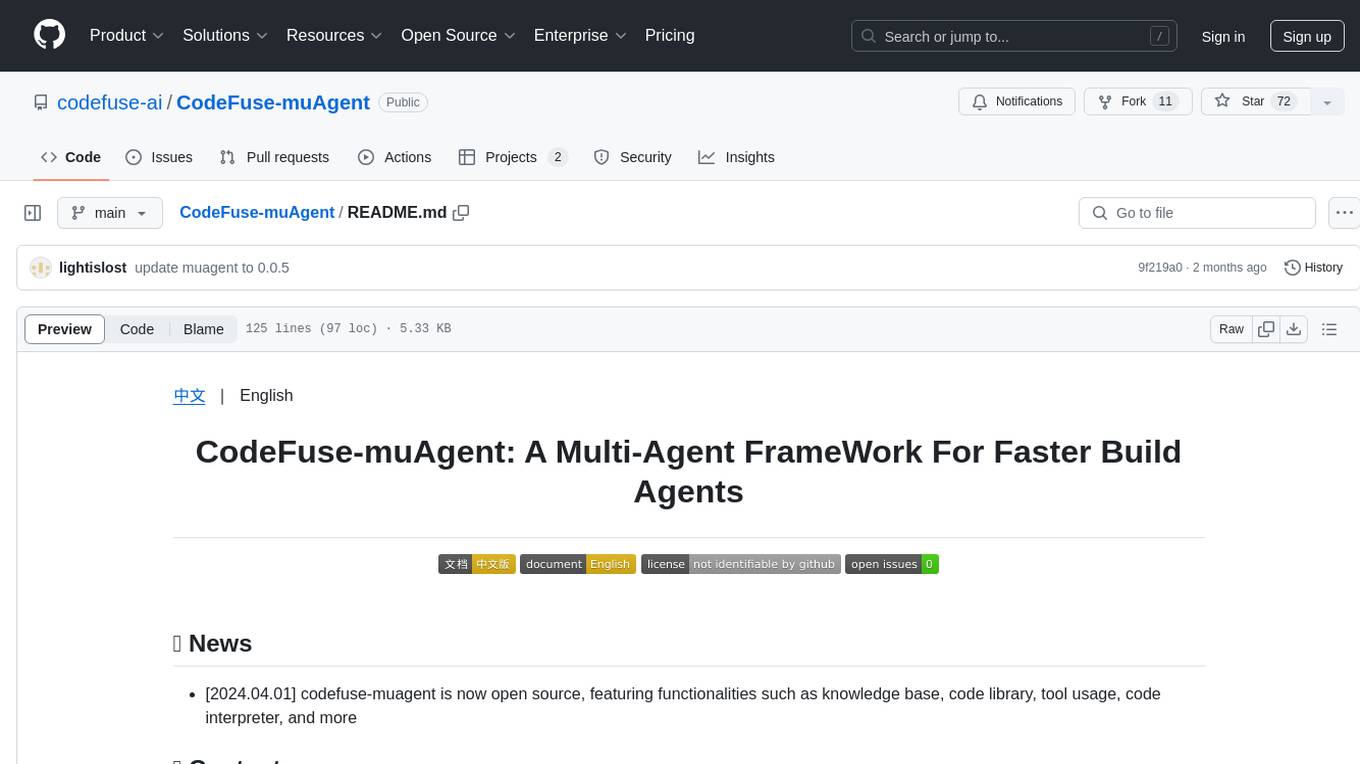
CodeFuse-muAgent
CodeFuse-muAgent is a Multi-Agent framework designed to streamline Standard Operating Procedure (SOP) orchestration for agents. It integrates toolkits, code libraries, knowledge bases, and sandbox environments for rapid construction of complex Multi-Agent interactive applications. The framework enables efficient execution and handling of multi-layered and multi-dimensional tasks.
For similar jobs
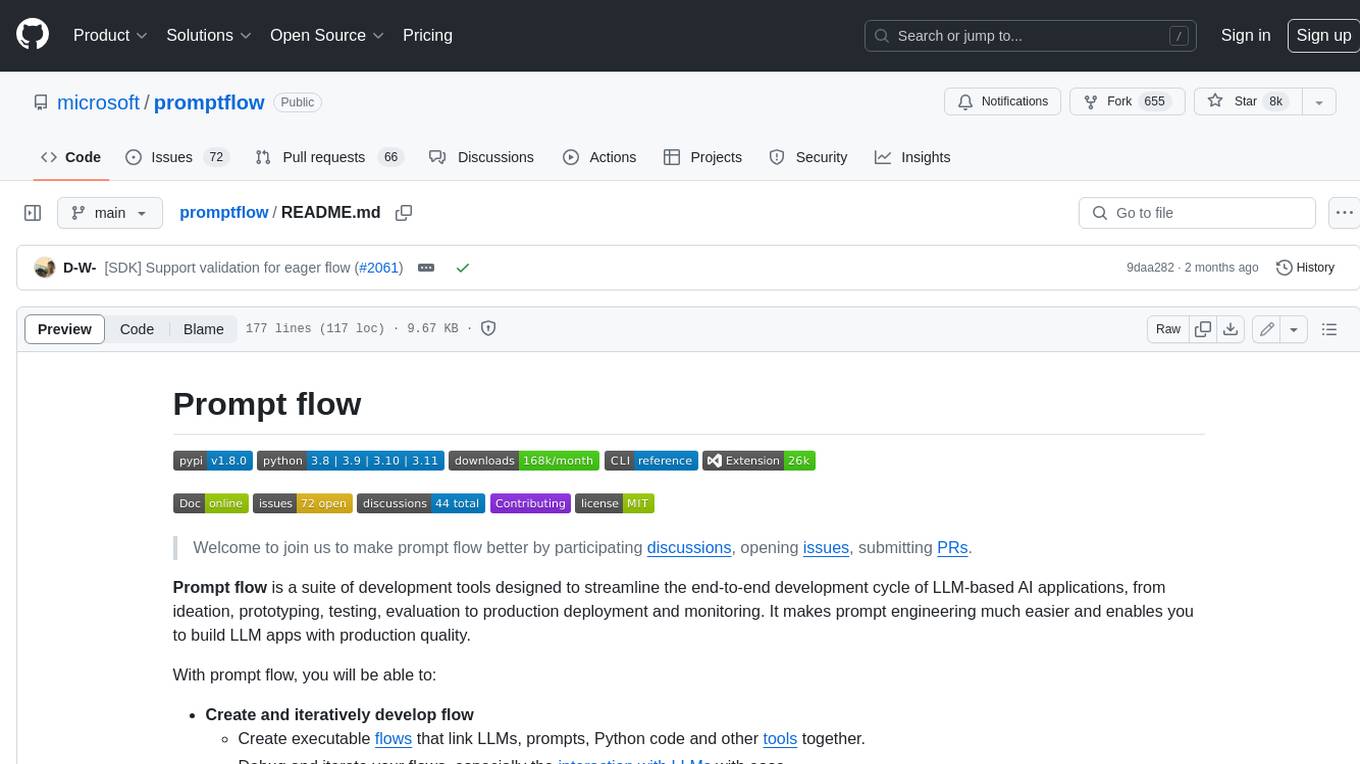
promptflow
**Prompt flow** is a suite of development tools designed to streamline the end-to-end development cycle of LLM-based AI applications, from ideation, prototyping, testing, evaluation to production deployment and monitoring. It makes prompt engineering much easier and enables you to build LLM apps with production quality.
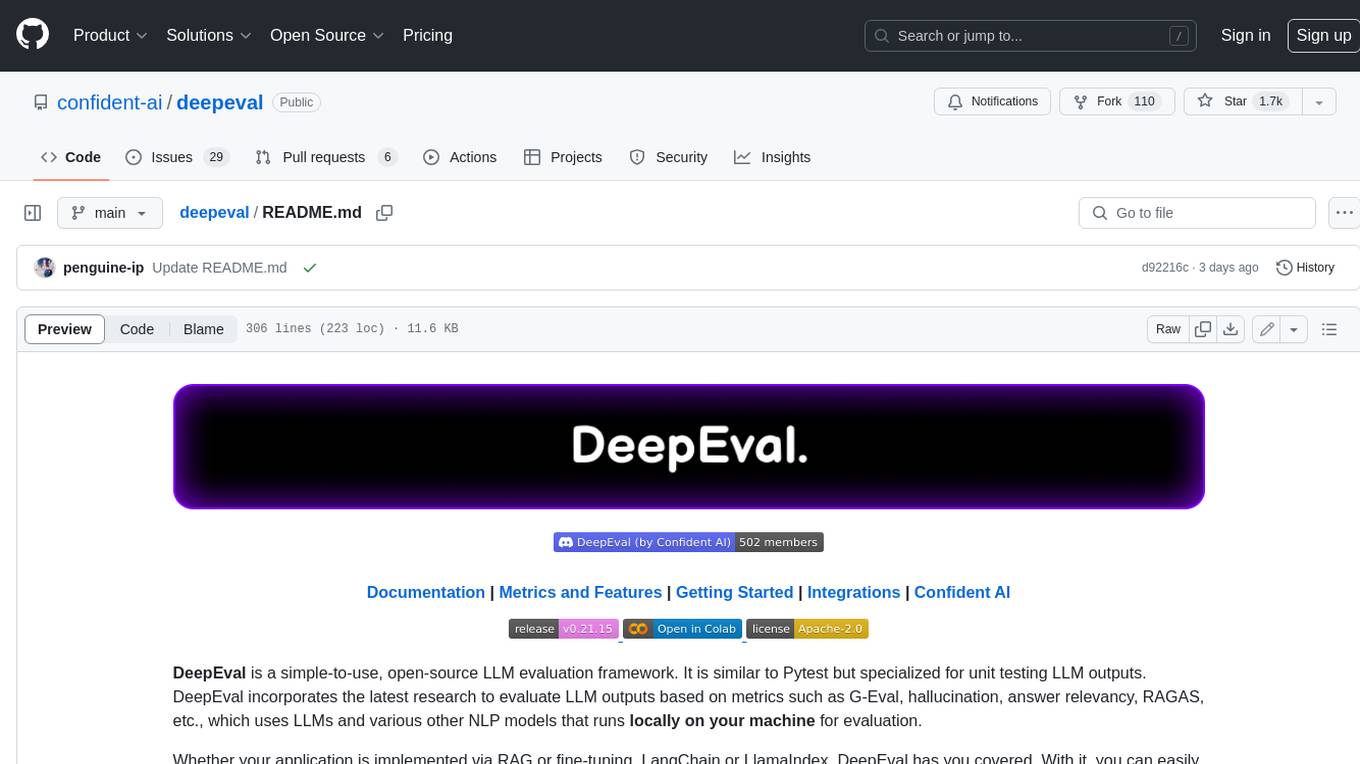
deepeval
DeepEval is a simple-to-use, open-source LLM evaluation framework specialized for unit testing LLM outputs. It incorporates various metrics such as G-Eval, hallucination, answer relevancy, RAGAS, etc., and runs locally on your machine for evaluation. It provides a wide range of ready-to-use evaluation metrics, allows for creating custom metrics, integrates with any CI/CD environment, and enables benchmarking LLMs on popular benchmarks. DeepEval is designed for evaluating RAG and fine-tuning applications, helping users optimize hyperparameters, prevent prompt drifting, and transition from OpenAI to hosting their own Llama2 with confidence.
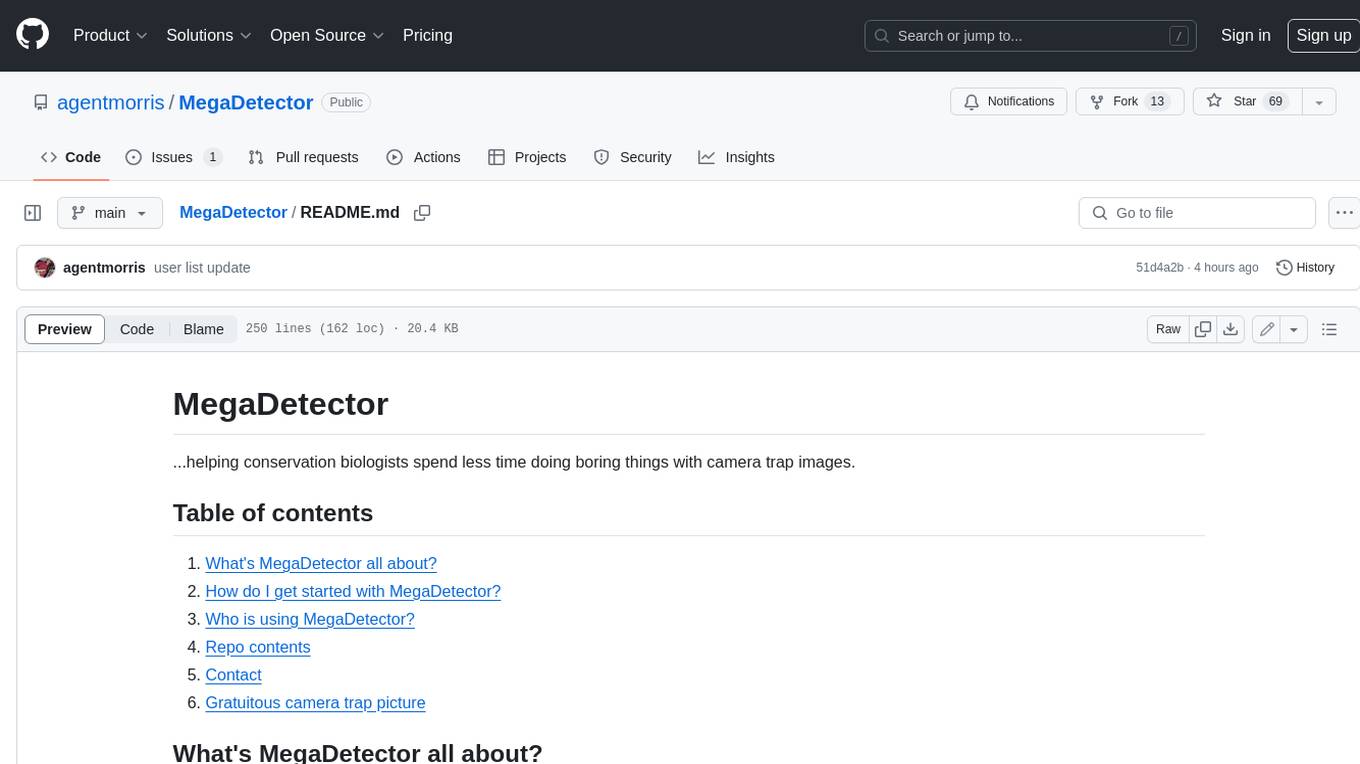
MegaDetector
MegaDetector is an AI model that identifies animals, people, and vehicles in camera trap images (which also makes it useful for eliminating blank images). This model is trained on several million images from a variety of ecosystems. MegaDetector is just one of many tools that aims to make conservation biologists more efficient with AI. If you want to learn about other ways to use AI to accelerate camera trap workflows, check out our of the field, affectionately titled "Everything I know about machine learning and camera traps".
leapfrogai
LeapfrogAI is a self-hosted AI platform designed to be deployed in air-gapped resource-constrained environments. It brings sophisticated AI solutions to these environments by hosting all the necessary components of an AI stack, including vector databases, model backends, API, and UI. LeapfrogAI's API closely matches that of OpenAI, allowing tools built for OpenAI/ChatGPT to function seamlessly with a LeapfrogAI backend. It provides several backends for various use cases, including llama-cpp-python, whisper, text-embeddings, and vllm. LeapfrogAI leverages Chainguard's apko to harden base python images, ensuring the latest supported Python versions are used by the other components of the stack. The LeapfrogAI SDK provides a standard set of protobuffs and python utilities for implementing backends and gRPC. LeapfrogAI offers UI options for common use-cases like chat, summarization, and transcription. It can be deployed and run locally via UDS and Kubernetes, built out using Zarf packages. LeapfrogAI is supported by a community of users and contributors, including Defense Unicorns, Beast Code, Chainguard, Exovera, Hypergiant, Pulze, SOSi, United States Navy, United States Air Force, and United States Space Force.
llava-docker
This Docker image for LLaVA (Large Language and Vision Assistant) provides a convenient way to run LLaVA locally or on RunPod. LLaVA is a powerful AI tool that combines natural language processing and computer vision capabilities. With this Docker image, you can easily access LLaVA's functionalities for various tasks, including image captioning, visual question answering, text summarization, and more. The image comes pre-installed with LLaVA v1.2.0, Torch 2.1.2, xformers 0.0.23.post1, and other necessary dependencies. You can customize the model used by setting the MODEL environment variable. The image also includes a Jupyter Lab environment for interactive development and exploration. Overall, this Docker image offers a comprehensive and user-friendly platform for leveraging LLaVA's capabilities.

carrot
The 'carrot' repository on GitHub provides a list of free and user-friendly ChatGPT mirror sites for easy access. The repository includes sponsored sites offering various GPT models and services. Users can find and share sites, report errors, and access stable and recommended sites for ChatGPT usage. The repository also includes a detailed list of ChatGPT sites, their features, and accessibility options, making it a valuable resource for ChatGPT users seeking free and unlimited GPT services.
TrustLLM
TrustLLM is a comprehensive study of trustworthiness in LLMs, including principles for different dimensions of trustworthiness, established benchmark, evaluation, and analysis of trustworthiness for mainstream LLMs, and discussion of open challenges and future directions. Specifically, we first propose a set of principles for trustworthy LLMs that span eight different dimensions. Based on these principles, we further establish a benchmark across six dimensions including truthfulness, safety, fairness, robustness, privacy, and machine ethics. We then present a study evaluating 16 mainstream LLMs in TrustLLM, consisting of over 30 datasets. The document explains how to use the trustllm python package to help you assess the performance of your LLM in trustworthiness more quickly. For more details about TrustLLM, please refer to project website.
AI-YinMei
AI-YinMei is an AI virtual anchor Vtuber development tool (N card version). It supports fastgpt knowledge base chat dialogue, a complete set of solutions for LLM large language models: [fastgpt] + [one-api] + [Xinference], supports docking bilibili live broadcast barrage reply and entering live broadcast welcome speech, supports Microsoft edge-tts speech synthesis, supports Bert-VITS2 speech synthesis, supports GPT-SoVITS speech synthesis, supports expression control Vtuber Studio, supports painting stable-diffusion-webui output OBS live broadcast room, supports painting picture pornography public-NSFW-y-distinguish, supports search and image search service duckduckgo (requires magic Internet access), supports image search service Baidu image search (no magic Internet access), supports AI reply chat box [html plug-in], supports AI singing Auto-Convert-Music, supports playlist [html plug-in], supports dancing function, supports expression video playback, supports head touching action, supports gift smashing action, supports singing automatic start dancing function, chat and singing automatic cycle swing action, supports multi scene switching, background music switching, day and night automatic switching scene, supports open singing and painting, let AI automatically judge the content.