


claude-code-ultimate-guide
Claude Code from beginner to power user. Exhaustive documentation, production-ready templates, agentic workflow guides, quiz, and cheatsheet.
Stars: 106
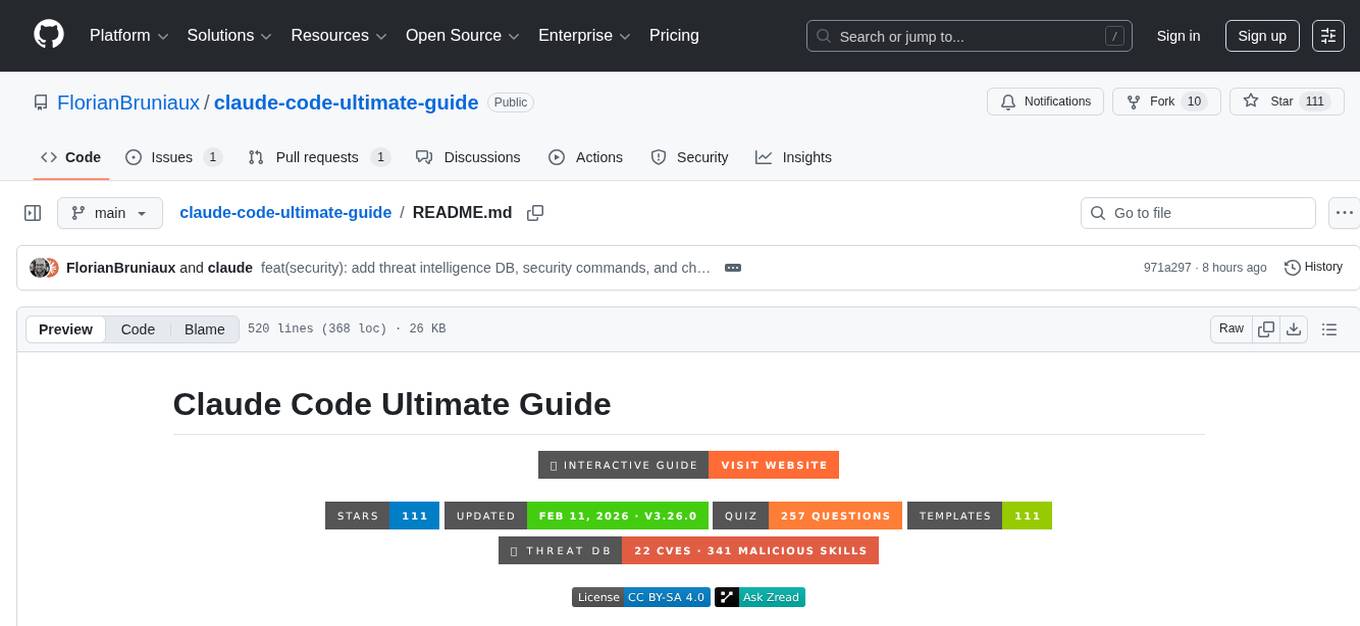
The Claude Code Ultimate Guide is an exhaustive documentation resource that takes users from beginner to power user in using Claude Code. It includes production-ready templates, workflow guides, a quiz, and a cheatsheet for daily use. The guide covers educational depth, methodologies, and practical examples to help users understand concepts and workflows. It also provides interactive onboarding, a repository structure overview, and learning paths for different user levels. The guide is regularly updated and offers a unique 257-question quiz for comprehensive assessment. Users can also find information on agent teams coverage, methodologies, annotated templates, resource evaluations, and learning paths for different roles like junior developer, senior developer, power user, and product manager/devops/designer.
README:








Claude Code from beginner to power user. Exhaustive documentation, production-ready templates, agentic workflow guides, quiz, and a cheatsheet for daily use.
Quickest path: Cheat Sheet — 1 printable page with daily essentials
Interactive onboarding (no clone needed):
claude "Fetch and follow the onboarding instructions from: https://raw.githubusercontent.com/FlorianBruniaux/claude-code-ultimate-guide/main/tools/onboarding-prompt.md"Browse directly: Full Guide | Examples | Quiz
Prerequisites & Minimal CLAUDE.md Template
Prerequisites: Node.js 18+ | Anthropic API key
# Project: [NAME]

## Tech Stack
- Language: [e.g., TypeScript]
- Framework: [e.g., Next.js 14]
- Testing: [e.g., Vitest]

## Commands
- Build: `npm run build`
- Test: `npm test`
- Lint: `npm run lint`

## Rules
- Run tests before marking tasks complete
- Follow existing code patterns
- Keep commits atomic and conventional
Save as CLAUDE.md in your project root. Claude reads it automatically.
graph LR
    root[📦 Repository<br/>Root]

    root --> guide[📖 guide/<br/>19K lines]
    root --> examples[📋 examples/<br/>111 templates]
    root --> quiz[🧠 quiz/<br/>257 questions]
    root --> tools[🔧 tools/<br/>utils]
    root --> machine[🤖 machine-readable/<br/>AI index]
    root --> docs[📚 docs/<br/>56 evaluations]

    style root fill:#d35400,stroke:#e67e22,stroke-width:3px,color:#fff
    style guide fill:#2980b9,stroke:#3498db,stroke-width:2px,color:#fff
    style examples fill:#8e44ad,stroke:#9b59b6,stroke-width:2px,color:#fff
    style quiz fill:#d68910,stroke:#f39c12,stroke-width:2px,color:#fff
    style tools fill:#5d6d7e,stroke:#7f8c8d,stroke-width:2px,color:#fff
    style machine fill:#138d75,stroke:#16a085,stroke-width:2px,color:#fff
    style docs fill:#c0392b,stroke:#e74c3c,stroke-width:2px,color:#fff
Detailed Structure (Text View)
📦 claude-code-ultimate-guide/
│
├─ 📖 guide/              Core Documentation (~19K lines)
│  ├─ ultimate-guide.md   Complete reference, 10 sections
│  ├─ cheatsheet.md       1-page printable
│  ├─ architecture.md     How Claude Code works internally
│  ├─ methodologies.md    TDD, SDD, BDD workflows
│  ├─ mcp-servers-ecosystem.md  Official & community MCP servers
│  └─ workflows/          Step-by-step guides
│
├─ 📋 examples/           111 Production Templates
│  ├─ agents/             6 custom AI personas
│  ├─ commands/           22 slash commands
│  ├─ hooks/              18 security hooks (bash + PowerShell)
│  ├─ skills/             1 meta-skill (Claudeception)
│  └─ scripts/            Utility scripts (audit, search)
│
├─ 🧠 quiz/               257 Questions
│  ├─ 9 categories        Setup, Agents, MCP, Trust, Advanced...
│  ├─ 4 profiles          Junior, Senior, Power User, PM
│  └─ Instant feedback    Doc links + score tracking
│
├─ 🔧 tools/              Interactive Utilities
│  ├─ onboarding-prompt   Personalized guided tour
│  └─ audit-prompt        Setup audit & recommendations
│
├─ 🤖 machine-readable/   AI-Optimized Index
│  ├─ reference.yaml      Structured index (~2K tokens)
│  └─ llms.txt            Standard LLM context file
│
└─ 📚 docs/               55 Resource Evaluations
   └─ resource-evaluations/  5-point scoring, source attribution
We explain concepts first, not just configs:
- Architecture — How Claude Code works internally
- Trade-offs — When to use agents vs skills vs commands
- Pitfalls — Common mistakes and solutions
Only comprehensive assessment available — test your understanding across 9 categories:
- Setup & Configuration
- Agents & Sub-Agents
- MCP Servers & Integration
- Trust & Verification
- Advanced Patterns
Try the Quiz Online → | Run Locally
Only comprehensive guide to Anthropic's experimental multi-agent coordination:
- Production metrics (Fountain 50% faster, CRED 2x speed, autonomous C compiler)
- 5 validated workflows (multi-layer review, parallel debugging, large-scale refactoring)
- Git-based coordination architecture (team lead + teammates)
- Decision framework: Teams vs Multi-Instance vs Dual-Instance vs Beads
- Setup, limitations, best practices, troubleshooting
Agent Teams Workflow → | Section 9.20 →
Complete guides with rationale and examples:
- TDD — Test-Driven Development
- SDD — Specification-Driven Development
- BDD — Behavior-Driven Development
- GSD — Get Shit Done pattern
Educational templates with explanations:
- Agents (6), Commands (22), Hooks (18), Skills
- Comments explaining why each pattern works
- Gradual complexity progression
Systematic assessment of external resources (5-point scoring):
- Articles, videos, tools, frameworks
- Honest assessments with source attribution
- Integration recommendations
Junior Developer — Foundation path (7 steps)
- Quick Start — Install & first workflow
- Essential Commands — The 7 commands
- Context Management — Critical concept
- Memory Files — Your first CLAUDE.md
- Learning with AI — Use AI without becoming dependent ⭐
- TDD Workflow — Test-first development
- Cheat Sheet — Print this
Senior Developer — Intermediate path (6 steps)
- Core Concepts — Mental model
- Plan Mode — Safe exploration
- Methodologies — TDD, SDD, BDD reference
- Agents — Custom AI personas
- Hooks — Event automation
- CI/CD Integration — Pipelines
Power User — Comprehensive path (8 steps)
- Complete Guide — End-to-end
- Architecture — How Claude Code works
- Security Hardening — MCP vetting, injection defense
- MCP Servers — Extended capabilities
- Trinity Pattern — Advanced workflows
- Observability — Monitor costs & sessions
- Agent Teams — Multi-agent coordination (Opus 4.6 experimental)
- Examples — Production templates
Product Manager / DevOps / Designer
Product Manager (5 steps):
- What's Inside — Scope overview
- Golden Rules — Key principles
- Data Privacy — Retention & compliance
- Adoption Approaches — Team strategies
- PM FAQ — Code-adjacent vs non-coding PMs
Note: Non-coding PMs should consider Claude Cowork Guide instead.
DevOps / SRE (5 steps):
- DevOps & SRE Guide — FIRE framework
- K8s Troubleshooting — Symptom-based prompts
- Incident Response — Workflows
- IaC Patterns — Terraform, Ansible
- Guardrails — Security boundaries
Product Designer (5 steps):
- Working with Images — Image analysis
- Wireframing Tools — ASCII/Excalidraw
- Figma MCP — Design file access
- Design-to-Code Workflow — Figma → Claude
- Cheat Sheet — Print this
- Week 1: Foundations (install, CLAUDE.md, first agent)
- Week 2: Core Features (skills, hooks, trust calibration)
- Week 3: Advanced (MCP servers, methodologies)
- Month 2+: Production mastery (CI/CD, observability)
cc-copilot-bridge routes Claude Code through GitHub Copilot Pro+ for flat-rate access ($10/month instead of per-token billing).
# Install
git clone https://github.com/FlorianBruniaux/cc-copilot-bridge.git && cd cc-copilot-bridge && ./install.sh

# Use
ccc   # Copilot mode (flat $10/month)
ccd   # Direct Anthropic mode (per-token)
cco # Offline mode (Ollama, 100% local)Benefits: Multi-provider switching, rate limit bypass, 99%+ cost savings on heavy usage.
- Start small — First project: 10-15 lines CLAUDE.md max
- Read before edit — Always Read → Understand → Edit (never blind Write)
- Test-first — Write test → Watch fail → Implement → Pass
-
Use
/compactbefore context hits 70% — prevention beats recovery - Review everything — AI code has 1.75× more logic errors (source)
- Context = Gold — Clear CLAUDE.md > clever prompts
Context management is critical. See the Cheat Sheet for thresholds and actions.
| Resource | Purpose | Tokens |
|---|---|---|
| llms.txt | Standard context file | ~1K |
| reference.yaml | Structured index with line numbers | ~2K |
Quick load: curl -sL https://raw.githubusercontent.com/FlorianBruniaux/claude-code-ultimate-guide/main/machine-readable/reference.yaml
Claude Code has two major community resources:
| Resource | Focus | Best For |
|---|---|---|
| This Guide | 🎓 Educational depth, methodologies | Deep understanding, learning WHY |
| everything-claude-code | ⚙️ Production configs, plugin install | Quick setup, battle-tested patterns |
Recommended workflow: Learn concepts here → Leverage production configs there → Return for deep dives
Both resources serve different needs. Use what fits your learning style and project requirements.
Claude Cowork is the companion guide for non-technical users (knowledge workers, assistants, managers).
Same agentic capabilities as Claude Code, but through a visual interface with no coding required.
→ Claude Cowork Guide — File organization, document generation, automated workflows
Status: Research preview (Pro $20/mo or Max $100-200/mo, macOS only, VPN incompatible)
| Project | Focus | Best For |
|---|---|---|
| claude-code-templates | Distribution (200+ templates) | CLI installation (17k⭐) |
| anthropics/skills | Official Anthropic skills (60K+⭐) | Documents, design, dev templates |
| anthropics/claude-plugins-official | Plugin dev tools (3.1K installs) | CLAUDE.md audit, automation discovery |
| skills.sh | Skills marketplace | One-command install (Vercel Labs) |
| awesome-claude-code | Curation | Resource discovery |
| awesome-claude-skills | Skills taxonomy | 62 skills across 12 categories |
| AI Coding Agents Matrix | Technical comparison | Comparing 23+ alternatives |
Community: 🇫🇷 Dev With AI — 1500+ devs on Slack, meetups in Paris, Bordeaux, Lyon
→ AI Ecosystem Guide — Complete integration patterns with complementary AI tools
Origins & Philosophy
This guide is the result of several months of daily practice with Claude Code. I don't claim expertise—I'm sharing what I've learned to help peers and evangelize AI-assisted development best practices.
Philosophy: Learning journey over reference manual. Understanding why before how. Progressive complexity — start simple, master advanced at your pace.
Created with Claude Code. Community-validated through contributions and feedback.
Key Inspirations:
- Claudelog.com — Excellent patterns & tutorials
- zebbern/claude-code-guide — Comprehensive reference with security focus
- ykdojo/claude-code-tips — Practical productivity techniques
Privacy & Data
Claude Code sends your prompts, file contents, and MCP results to Anthropic servers.
- Default: 5 years retention (training enabled) | Opt-out: 30 days | Enterprise: 0
- Action: Disable training | Full privacy guide
| File | Purpose | Time |
|---|---|---|
| Ultimate Guide | Complete reference (~19K lines), 10 sections | 30-40h (full) • Most consult sections |
| Cheat Sheet | 1-page printable reference | 5 min |
| Visual Reference | 20 ASCII diagrams for key concepts | 5 min |
| Architecture | How Claude Code works internally | 25 min |
| Methodologies | TDD, SDD, BDD reference | 20 min |
| Workflows | Practical guides (TDD, Plan-Driven, Task Management) | 30 min |
| Data Privacy | Retention & compliance | 10 min |
| Security Hardening | MCP vetting, injection defense | 25 min |
| Sandbox Isolation | Docker Sandboxes, cloud alternatives, safe autonomy | 10 min |
| Production Safety | Port stability, DB safety, infrastructure lock | 20 min |
| DevOps & SRE | FIRE framework, K8s troubleshooting, incident response | 30 min |
| AI Ecosystem | Complementary AI tools & integration patterns | 20 min |
| AI Traceability | Code attribution & provenance tracking | 15 min |
| Search Tools Cheatsheet | Grep, Serena, ast-grep, grepai comparison | 5 min |
| Learning with AI | Use AI without becoming dependent | 15 min |
| Claude Code Releases | Official release history | 10 min |
Examples Library (111 templates)
Agents (6): code-reviewer, test-writer, security-auditor, refactoring-specialist, output-evaluator, devops-sre ⭐
Slash Commands (22): /pr, /commit, /release-notes, /diagnose, /security, /security-check **, /security-audit **, /update-threat-db **, /refactor, /explain, /optimize, /ship...
Security Hooks (18): dangerous-actions-blocker, prompt-injection-detector, unicode-injection-scanner, output-secrets-scanner...
Skills (1): Claudeception — Meta-skill that auto-generates skills from session discoveries ⭐
Plugins (1): SE-CoVe — Chain-of-Verification for independent code review (Meta AI, ACL 2024)
Utility Scripts: session-search.sh, audit-scan.sh
GitHub Actions: claude-pr-auto-review.yml, claude-security-review.yml, claude-issue-triage.yml
Integrations (1): Agent Vibes TTS - Text-to-speech narration for Claude Code responses
Knowledge Quiz (257 questions)
Test your Claude Code knowledge with an interactive CLI quiz covering all guide sections.
cd quiz && npm install && npm startFeatures: 4 profiles (Junior/Senior/Power User/PM), 10 topic categories, immediate feedback with doc links, score tracking with weak area identification.
Resource Evaluations (55 assessments)
Systematic evaluation of external resources (tools, methodologies, articles) before integration into the guide.
Methodology: 5-point scoring system (Critical → Low) with technical review and challenge phase for objectivity.
Evaluations: GSD methodology, Worktrunk, Boris Cowork video, AST-grep, ClawdBot analysis, and more.
We welcome:
- ✅ Corrections and clarifications
- ✅ New quiz questions
- ✅ Methodologies and workflows
- ✅ Resource evaluations (see process)
- ✅ Educational content improvements
See CONTRIBUTING.md for guidelines.
Ways to Help: Star the repo • Report issues • Submit PRs • Share workflows in Discussions
Guide: CC BY-SA 4.0 — Educational content is open for reuse with attribution.
Templates: CC0 1.0 — Copy-paste freely, no attribution needed.
Author: Florian BRUNIAUX | Founding Engineer @Méthode Aristote
Stay Updated: Watch releases | Discussions | Connect on LinkedIn
- Claude Code CLI — Official website
- Documentation — Official docs
- CHANGELOG — Official changelog
- GitHub Issues — Bug reports & feature requests
-
2026 Agentic Coding Trends Report (Anthropic, Feb 2026)
- 8 trends prospectifs (foundation/capability/impact)
- Case studies: Fountain (50% faster), Rakuten (7h autonomous), CRED (2x speed), TELUS (500K hours saved)
- Research data: 60% AI usage, 0-20% full delegation, 67% more PRs merged/day
-
Evaluation:
docs/resource-evaluations/anthropic-2026-agentic-coding-trends.md(score 4/5) - Integration: Diffused across sections 9.17 (Multi-Instance ROI), 9.20 (Agent Teams adoption), 9.11 (Enterprise Anti-Patterns), Section 9 intro
- everything-claude-code — Production configs (31.9k⭐)
- awesome-claude-code — Curated links
- SuperClaude Framework — Behavioral modes
- Ask Zread — Ask questions about this guide
- Interactive Quiz — 257 questions
- Landing Site — Visual navigation
Version 3.26.0 | Updated daily · Feb 11, 2026 | Crafted with Claude
For Tasks:
Click tags to check more tools for each tasksFor Jobs:
Alternative AI tools for claude-code-ultimate-guide
Similar Open Source Tools
claude-code-ultimate-guide
The Claude Code Ultimate Guide is an exhaustive documentation resource that takes users from beginner to power user in using Claude Code. It includes production-ready templates, workflow guides, a quiz, and a cheatsheet for daily use. The guide covers educational depth, methodologies, and practical examples to help users understand concepts and workflows. It also provides interactive onboarding, a repository structure overview, and learning paths for different user levels. The guide is regularly updated and offers a unique 257-question quiz for comprehensive assessment. Users can also find information on agent teams coverage, methodologies, annotated templates, resource evaluations, and learning paths for different roles like junior developer, senior developer, power user, and product manager/devops/designer.
cia
CIA is a powerful open-source tool designed for data analysis and visualization. It provides a user-friendly interface for processing large datasets and generating insightful reports. With CIA, users can easily explore data, perform statistical analysis, and create interactive visualizations to communicate findings effectively. Whether you are a data scientist, analyst, or researcher, CIA offers a comprehensive set of features to streamline your data analysis workflow and uncover valuable insights.
Awesome-Lists
Awesome-Lists is a curated list of awesome lists across various domains of computer science and beyond, including programming languages, web development, data science, and more. It provides a comprehensive index of articles, books, courses, open source projects, and other resources. The lists are organized by topic and subtopic, making it easy to find the information you need. Awesome-Lists is a valuable resource for anyone looking to learn more about a particular topic or to stay up-to-date on the latest developments in the field.
Awesome-Lists-and-CheatSheets
Awesome-Lists is a curated index of selected resources spanning various fields including programming languages and theories, web and frontend development, server-side development and infrastructure, cloud computing and big data, data science and artificial intelligence, product design, etc. It includes articles, books, courses, examples, open-source projects, and more. The repository categorizes resources according to the knowledge system of different domains, aiming to provide valuable and concise material indexes for readers. Users can explore and learn from a wide range of high-quality resources in a systematic way.
azure-agentic-infraops
Agentic InfraOps is a multi-agent orchestration system for Azure infrastructure development that transforms how you build Azure infrastructure with AI agents. It provides a structured 7-step workflow that coordinates specialized AI agents through a complete infrastructure development cycle: Requirements → Architecture → Design → Plan → Code → Deploy → Documentation. The system enforces Azure Well-Architected Framework (WAF) alignment and Azure Verified Modules (AVM) at every phase, combining the speed of AI coding with best practices in cloud engineering.
monoscope
Monoscope is an open-source monitoring and observability platform that uses artificial intelligence to understand and monitor systems automatically. It allows users to ingest and explore logs, traces, and metrics in S3 buckets, query in natural language via LLMs, and create AI agents to detect anomalies. Key capabilities include universal data ingestion, AI-powered understanding, natural language interface, cost-effective storage, and zero configuration. Monoscope is designed to reduce alert fatigue, catch issues before they impact users, and provide visibility across complex systems.
prism-insight
PRISM-INSIGHT is a comprehensive stock analysis and trading simulation system based on AI agents. It automatically captures daily surging stocks via Telegram channel, generates expert-level analyst reports, and performs trading simulations. The system utilizes OpenAI GPT-4.1 for in-depth stock analysis and GPT-5 for investment strategy simulation. It also interacts with users via Anthropic Claude for Telegram conversations. The system architecture includes AI analysis agents, stock tracking, PDF conversion, and Telegram bot functionalities. Users can customize criteria for identifying surging stocks, modify AI prompts, and adjust chart styles. The project is open-source under the MIT license, and all investment decisions based on the analysis are the responsibility of the user.
EverMemOS
EverMemOS is an AI memory system that enables AI to not only remember past events but also understand the meaning behind memories and use them to guide decisions. It achieves 93% reasoning accuracy on the LoCoMo benchmark by providing long-term memory capabilities for conversational AI agents through structured extraction, intelligent retrieval, and progressive profile building. The tool is production-ready with support for Milvus vector DB, Elasticsearch, MongoDB, and Redis, and offers easy integration via a simple REST API. Users can store and retrieve memories using Python code and benefit from features like multi-modal memory storage, smart retrieval mechanisms, and advanced techniques for memory management.
anylabeling
AnyLabeling is a tool for effortless data labeling with AI support from YOLO and Segment Anything. It combines features from LabelImg and Labelme with an improved UI and auto-labeling capabilities. Users can annotate images with polygons, rectangles, circles, lines, and points, as well as perform auto-labeling using YOLOv5 and Segment Anything. The tool also supports text detection, recognition, and Key Information Extraction (KIE) labeling, with multiple language options available such as English, Vietnamese, and Chinese.
AI-LLM-ML-CS-Quant-Overview
AI-LLM-ML-CS-Quant-Overview is a repository providing overview notes on AI, Large Language Models (LLM), Machine Learning (ML), Computer Science (CS), and Quantitative Finance. It covers various topics such as LangGraph & Cursor AI, DeepSeek, MoE (Mixture of Experts), NVIDIA GTC, LLM Essentials, System Design, Computer Systems, Big Data and AI in Finance, Econometrics and Statistics Conference, C++ Design Patterns and Derivatives Pricing, High-Frequency Finance, Machine Learning for Algorithmic Trading, Stochastic Volatility Modeling, Quant Job Interview Questions, Distributed Systems, Language Models, Designing Machine Learning Systems, Designing Data-Intensive Applications (DDIA), Distributed Machine Learning, and The Elements of Quantitative Investing.
bitcart
Bitcart is a platform designed for merchants, users, and developers, providing easy setup and usage. It includes various linked repositories for core daemons, admin panel, ready store, Docker packaging, Python library for coins connection, BitCCL scripting language, documentation, and official site. The platform aims to simplify the process for merchants and developers to interact and transact with cryptocurrencies, offering a comprehensive ecosystem for managing transactions and payments.
Wegent
Wegent is an open-source AI-native operating system designed to define, organize, and run intelligent agent teams. It offers various core features such as a chat agent with multi-model support, conversation history, group chat, attachment parsing, follow-up mode, error correction mode, long-term memory, sandbox execution, and extensions. Additionally, Wegent includes a code agent for cloud-based code execution, AI feed for task triggers, AI knowledge for document management, and AI device for running tasks locally. The platform is highly extensible, allowing for custom agents, agent creation wizard, organization management, collaboration modes, skill support, MCP tools, execution engines, YAML config, and an API for easy integration with other systems.
AI-LLM-ML-CS-Quant-Review
This repository provides an in-depth review of industry trends in AI, Large Language Models (LLMs), Machine Learning, Computer Science, and Quantitative Finance. It covers various topics such as NVIDIA GTC conferences, DeepSeek theory and applications, LangGraph & Cursor AI, LLM essentials, system design, computer systems, big data and AI in finance, C++ design patterns, high-frequency finance, machine learning for algorithmic trading, stochastic volatility modeling, and quant job interview questions.

AI-LLM-ML-CS-Quant-Readings
AI-LLM-ML-CS-Quant-Readings is a repository dedicated to taking notes on Artificial Intelligence, Large Language Models, Machine Learning, Computer Science, and Quantitative Finance. It contains a wide range of resources, including theory, applications, conferences, essentials, foundations, system design, computer systems, finance, and job interview questions. The repository covers topics such as AI systems, multi-agent systems, deep learning theory and applications, system design interviews, C++ design patterns, high-frequency finance, algorithmic trading, stochastic volatility modeling, and quantitative investing. It is a comprehensive collection of materials for individuals interested in these fields.
GraphGen
GraphGen is a framework for synthetic data generation guided by knowledge graphs. It enhances supervised fine-tuning for large language models (LLMs) by generating synthetic data based on a fine-grained knowledge graph. The tool identifies knowledge gaps in LLMs, prioritizes generating QA pairs targeting high-value knowledge, incorporates multi-hop neighborhood sampling, and employs style-controlled generation to diversify QA data. Users can use LLaMA-Factory and xtuner for fine-tuning LLMs after data generation.
Automodel
Automodel is a Python library for automating the process of building and evaluating machine learning models. It provides a set of tools and utilities to streamline the model development workflow, from data preprocessing to model selection and evaluation. With Automodel, users can easily experiment with different algorithms, hyperparameters, and feature engineering techniques to find the best model for their dataset. The library is designed to be user-friendly and customizable, allowing users to define their own pipelines and workflows. Automodel is suitable for data scientists, machine learning engineers, and anyone looking to quickly build and test machine learning models without the need for manual intervention.
For similar tasks
claude-code-ultimate-guide
The Claude Code Ultimate Guide is an exhaustive documentation resource that takes users from beginner to power user in using Claude Code. It includes production-ready templates, workflow guides, a quiz, and a cheatsheet for daily use. The guide covers educational depth, methodologies, and practical examples to help users understand concepts and workflows. It also provides interactive onboarding, a repository structure overview, and learning paths for different user levels. The guide is regularly updated and offers a unique 257-question quiz for comprehensive assessment. Users can also find information on agent teams coverage, methodologies, annotated templates, resource evaluations, and learning paths for different roles like junior developer, senior developer, power user, and product manager/devops/designer.
mflux
MFLUX is a line-by-line port of the FLUX implementation in the Huggingface Diffusers library to Apple MLX. It aims to run powerful FLUX models from Black Forest Labs locally on Mac machines. The codebase is minimal and explicit, prioritizing readability over generality and performance. Models are implemented from scratch in MLX, with tokenizers from the Huggingface Transformers library. Dependencies include Numpy and Pillow for image post-processing. Installation can be done using `uv tool` or classic virtual environment setup. Command-line arguments allow for image generation with specified models, prompts, and optional parameters. Quantization options for speed and memory reduction are available. LoRA adapters can be loaded for fine-tuning image generation. Controlnet support provides more control over image generation with reference images. Current limitations include generating images one by one, lack of support for negative prompts, and some LoRA adapters not working.
awesome-mcp-servers-devops
This repository, 'awesome-mcp-servers-devops', is a curated list of Model Context Protocol servers for DevOps workflows. It includes servers for various aspects of DevOps such as infrastructure, CI/CD, monitoring, security, and cloud operations. The repository provides information on different MCP servers available for tools like GitHub, GitLab, Azure DevOps, Gitea, Terraform, Vault, Pulumi, Kubernetes, Docker Hub, Portainer, Qovery, various command line and local operation tools, browser automation tools, code execution tools, coding agents, aggregators, CI/CD tools like Argo CD, Jenkins, GitHub Actions, Codemagic, DevOps visibility tools, build tools, cloud platforms like AWS, Azure, Cloudflare, Alibaba Cloud, observability tools like Grafana, Datadog, Prometheus, VictoriaMetrics, Alertmanager, APM & monitoring tools, security tools like Snyk, Semgrep, and community security servers, collaboration tools like Atlassian, Jira, project management tools, service desks, Notion, and more.
For similar jobs
sweep
Sweep is an AI junior developer that turns bugs and feature requests into code changes. It automatically handles developer experience improvements like adding type hints and improving test coverage.
teams-ai
The Teams AI Library is a software development kit (SDK) that helps developers create bots that can interact with Teams and Microsoft 365 applications. It is built on top of the Bot Framework SDK and simplifies the process of developing bots that interact with Teams' artificial intelligence capabilities. The SDK is available for JavaScript/TypeScript, .NET, and Python.
ai-guide
This guide is dedicated to Large Language Models (LLMs) that you can run on your home computer. It assumes your PC is a lower-end, non-gaming setup.
classifai
Supercharge WordPress Content Workflows and Engagement with Artificial Intelligence. Tap into leading cloud-based services like OpenAI, Microsoft Azure AI, Google Gemini and IBM Watson to augment your WordPress-powered websites. Publish content faster while improving SEO performance and increasing audience engagement. ClassifAI integrates Artificial Intelligence and Machine Learning technologies to lighten your workload and eliminate tedious tasks, giving you more time to create original content that matters.
chatbot-ui
Chatbot UI is an open-source AI chat app that allows users to create and deploy their own AI chatbots. It is easy to use and can be customized to fit any need. Chatbot UI is perfect for businesses, developers, and anyone who wants to create a chatbot.
BricksLLM
BricksLLM is a cloud native AI gateway written in Go. Currently, it provides native support for OpenAI, Anthropic, Azure OpenAI and vLLM. BricksLLM aims to provide enterprise level infrastructure that can power any LLM production use cases. Here are some use cases for BricksLLM: * Set LLM usage limits for users on different pricing tiers * Track LLM usage on a per user and per organization basis * Block or redact requests containing PIIs * Improve LLM reliability with failovers, retries and caching * Distribute API keys with rate limits and cost limits for internal development/production use cases * Distribute API keys with rate limits and cost limits for students
uAgents
uAgents is a Python library developed by Fetch.ai that allows for the creation of autonomous AI agents. These agents can perform various tasks on a schedule or take action on various events. uAgents are easy to create and manage, and they are connected to a fast-growing network of other uAgents. They are also secure, with cryptographically secured messages and wallets.
griptape
Griptape is a modular Python framework for building AI-powered applications that securely connect to your enterprise data and APIs. It offers developers the ability to maintain control and flexibility at every step. Griptape's core components include Structures (Agents, Pipelines, and Workflows), Tasks, Tools, Memory (Conversation Memory, Task Memory, and Meta Memory), Drivers (Prompt and Embedding Drivers, Vector Store Drivers, Image Generation Drivers, Image Query Drivers, SQL Drivers, Web Scraper Drivers, and Conversation Memory Drivers), Engines (Query Engines, Extraction Engines, Summary Engines, Image Generation Engines, and Image Query Engines), and additional components (Rulesets, Loaders, Artifacts, Chunkers, and Tokenizers). Griptape enables developers to create AI-powered applications with ease and efficiency.