


lmms-lab-writer
Agentic LaTeX Writer - Local-first editor for AI-assisted academic writing
Stars: 77
LMMs-Lab Writer is an AI-native LaTeX editor designed for researchers who prioritize ideas over syntax. It offers a local-first approach with AI agents for editing assistance, one-click LaTeX setup with automatic package installation, support for multiple languages, AI-powered workflows with OpenCode integration, Git integration for modern collaboration, fully open-source with MIT license, cross-platform compatibility, and a comparison with Overleaf highlighting its advantages. The tool aims to streamline the writing and publishing process for researchers while ensuring data security and control.
README:





As a researcher, your time belongs to breakthroughs—not wrestling with LaTeX boilerplate, resolving package conflicts, or the endless copy-paste loop between Overleaf and ChatGPT.
LMMs-Lab Writer is a local-first, AI-native LaTeX editor. Your files remain secure on your machine. AI agents assist with editing directly. Compile, review, and publish—all within a single, unified environment.
Say goodbye to hour-long TeX Live installations. LMMs-Lab Writer automatically detects and installs a lightweight LaTeX distribution. If a package is missing, it’s installed on the fly during compilation. Zero manual configuration required—just open the app and start writing.
Supports TinyTeX, MiKTeX, MacTeX, and TeX Live—with streamlined, one-click management.

Write effortlessly in English, Chinese, Japanese, Korean, Arabic, or any other language. XeLaTeX and LuaLaTeX are supported out of the box with full Unicode and system font compatibility. CJK documents work instantly with ctex, xeCJK, and other multilingual packages—no extra setup needed.

The built-in OpenCode panel brings AI directly into your editing experience:
You: "Add a related work section comparing our method to LoRA and QLoRA"
Agent: *writes directly to main.tex in real-time*
You: *hit compile* Done.
- Chat with AI, attach files, and manage context seamlessly
- AI analyzes your entire project for deep context awareness
- Edits are reflected in the editor in real-time
- Compatible with any model—Claude, GPT, Gemini, DeepSeek, or local LLMs
It also pairs perfectly with Claude Code, Cursor, Codex CLI, Aider, and other tools. The editor monitors your project directory, syncing external changes instantly.

Git isn't just an add-on; it's deeply integrated into the sidebar:
- Stage, commit, diff, push, pull—entirely via the UI
- AI-generated commit messages based on your staged changes
- Side-by-side diff viewer for reviewing AI suggestions before committing
- One-click GitHub publishing—create and push repositories without touching the terminal
- Seamless GitHub CLI integration for effortless authentication
Stop paying premium prices for basic Git sync. Here, version control is free, powerful, and built-in.

MIT licensed. Every line of code is open on GitHub. No vendor lock-in, no telemetry, no hidden costs.
- Your files never leave your local machine
- AI tools utilize your own API keys
- Fully functional offline (editing, compilation, Git)
- Fork it, modify it, self-host it—it's yours to control
Native performance on macOS (Apple Silicon & Intel) and Windows (64-bit). Built with Tauri for a lightweight, responsive experience—not just another heavy Electron wrapper.
| Light Mode | Dark Mode |
 |
 |
# macOS (Homebrew)
brew tap EvolvingLMMs-Lab/tap && brew install --cask lmms-lab-writer
Or download for macOS / Windows from the website.
| Overleaf | LMMs-Lab Writer | |
|---|---|---|
| File storage | Cloud only | Local (your machine) |
| AI editing | Basic grammar | OpenCode + any AI agent |
| Non-English | Limited CJK support | Full Unicode, XeLaTeX, system fonts |
| LaTeX setup | Pre-configured | One-click install, agent-managed |
| Git | Paid plans only | Free, built into sidebar |
| Offline | No | Full support |
| Compilation | Cloud queue | Local, instant |
| Open source | No | MIT license |
| Price | $21-42/month | Free |
1. Download & Install
Get the latest version from writer.lmms-lab.com/download, or install via Homebrew on macOS.
2. Open Your Project
Launch the app, click Open Folder, and select your LaTeX project. The main file is detected automatically.
3. Write with AI
Leverage the integrated OpenCode panel, or execute any AI tool via the terminal:
claude "Write the abstract summarizing our three key contributions"4. Compile & Publish
One click to compile and preview your PDF. Stage changes, commit, and push to GitHub—all from the sidebar.
Do I need to install LaTeX separately? Not necessarily. The app automates the installation of a minimal LaTeX distribution. Missing packages are handled automatically during compilation.
Does it work with non-English documents? Absolutely. Full Unicode support is provided via XeLaTeX and LuaLaTeX. CJK, Arabic, Cyrillic—all work out of the box.
Is my data sent anywhere? No. All files remain locally on your device. AI tools operate locally or via your personal API keys.
Can I use this with Overleaf projects? Yes. Simply clone your Overleaf Git repository locally and open it in Writer.
Does it work offline? Yes. Editing, compilation, and Git operations are fully functional without an internet connection.
git clone https://github.com/EvolvingLMMs-Lab/lmms-lab-writer.git
cd lmms-lab-writer
pnpm install
pnpm tauri:dev
See the Developer Guide for full architecture, tech stack, Rust commands, debugging, and contribution conventions.
MIT
Built by LMMs-Lab
Every legendary paper started somewhere. Yours starts here.
For Tasks:
Click tags to check more tools for each tasksFor Jobs:
Alternative AI tools for lmms-lab-writer
Similar Open Source Tools
lmms-lab-writer
LMMs-Lab Writer is an AI-native LaTeX editor designed for researchers who prioritize ideas over syntax. It offers a local-first approach with AI agents for editing assistance, one-click LaTeX setup with automatic package installation, support for multiple languages, AI-powered workflows with OpenCode integration, Git integration for modern collaboration, fully open-source with MIT license, cross-platform compatibility, and a comparison with Overleaf highlighting its advantages. The tool aims to streamline the writing and publishing process for researchers while ensuring data security and control.
AionUi
AionUi is a user interface library for building modern and responsive web applications. It provides a set of customizable components and styles to create visually appealing user interfaces. With AionUi, developers can easily design and implement interactive web interfaces that are both functional and aesthetically pleasing. The library is built using the latest web technologies and follows best practices for performance and accessibility. Whether you are working on a personal project or a professional application, AionUi can help you streamline the UI development process and deliver a seamless user experience.
LynxHub
LynxHub is a platform that allows users to seamlessly install, configure, launch, and manage all their AI interfaces from a single, intuitive dashboard. It offers features like AI interface management, arguments manager, custom run commands, pre-launch actions, extension management, in-app tools like terminal and web browser, AI information dashboard, Discord integration, and additional features like theme options and favorite interface pinning. The platform supports modular design for custom AI modules and upcoming extensions system for complete customization. LynxHub aims to streamline AI workflow and enhance user experience with a user-friendly interface and comprehensive functionalities.
Everywhere
Everywhere is an interactive AI assistant with context-aware capabilities, featuring a sleek, modern UI and powerful integrated functionality. It instantly perceives and understands anything on your screen, providing seamless AI assistant support without the need for screenshots or app switching. The tool offers troubleshooting expertise, quick web summarization, instant translation, and email draft assistance. It supports LLM from various providers, integrates with web browsers, file systems, terminals, and more, and provides an interactive experience with a modern UI, context-aware invocation, keyboard shortcuts, and markdown rendering. Everywhere is available on Windows and macOS, with Linux support coming soon. Language support includes Simplified Chinese, English, German, Spanish, French, Italian, Japanese, Korean, Russian, Turkish, Traditional Chinese, and Traditional Chinese (Hong Kong).
chatbox
Chatbox is a desktop client for ChatGPT, Claude, and other LLMs, providing a user-friendly interface for AI copilot assistance on Windows, Mac, and Linux. It offers features like local data storage, multiple LLM provider support, image generation with Dall-E-3, enhanced prompting, keyboard shortcuts, and more. Users can collaborate, access the tool on various platforms, and enjoy multilingual support. Chatbox is constantly evolving with new features to enhance the user experience.
chatbox
Chatbox is a desktop client for ChatGPT, Claude, and other LLMs, providing features like local data storage, multiple LLM provider support, image generation, enhanced prompting, keyboard shortcuts, and more. It offers a user-friendly interface with dark theme, team collaboration, cross-platform availability, web version access, iOS & Android apps, multilingual support, and ongoing feature enhancements. Developed for prompt and API debugging, it has gained popularity for daily chatting and professional role-playing with AI assistance.
lancedb
LanceDB is an open-source database for vector-search built with persistent storage, which greatly simplifies retrieval, filtering, and management of embeddings. The key features of LanceDB include: Production-scale vector search with no servers to manage. Store, query, and filter vectors, metadata, and multi-modal data (text, images, videos, point clouds, and more). Support for vector similarity search, full-text search, and SQL. Native Python and Javascript/Typescript support. Zero-copy, automatic versioning, manage versions of your data without needing extra infrastructure. GPU support in building vector index(*). Ecosystem integrations with LangChain 🦜️🔗, LlamaIndex 🦙, Apache-Arrow, Pandas, Polars, DuckDB, and more on the way. LanceDB's core is written in Rust 🦀 and is built using Lance, an open-source columnar format designed for performant ML workloads.
RWKV_APP
RWKV App is an experimental application that enables users to run Large Language Models (LLMs) offline on their edge devices. It offers a privacy-first, on-device LLM experience for everyday devices. Users can engage in multi-turn conversations, text-to-speech, visual understanding, and more, all without requiring an internet connection. The app supports switching between different models, running locally without internet, and exploring various AI tasks such as chat, speech generation, and visual understanding. It is built using Flutter and Dart FFI for cross-platform compatibility and efficient communication with the C++ inference engine. The roadmap includes integrating features into the RWKV Chat app, supporting more model weights, hardware, operating systems, and devices.
sandboxed.sh
sandboxed.sh is a self-hosted cloud orchestrator for AI coding agents that provides isolated Linux workspaces with Claude Code, OpenCode & Amp runtimes. It allows users to hand off entire development cycles, run multi-day operations unattended, and keep sensitive data local by analyzing data against scientific literature. The tool features dual runtime support, mission control for remote agent management, isolated workspaces, a git-backed library, MCP registry, and multi-platform support with a web dashboard and iOS app.
jan
Jan is an open-source ChatGPT alternative that runs 100% offline on your computer. It supports universal architectures, including Nvidia GPUs, Apple M-series, Apple Intel, Linux Debian, and Windows x64. Jan is currently in development, so expect breaking changes and bugs. It is lightweight and embeddable, and can be used on its own within your own projects.
RisuAI
RisuAI, or Risu for short, is a cross-platform AI chatting software/web application with powerful features such as multiple API support, assets in the chat, regex functions, and much more.
shots-studio
Shots Studio is a screenshot manager that uses on-device AI to intelligently organize and declutter your gallery. It offers AI-driven search, smart tagging, and custom collections for efficient screenshot management. Users can choose between cloud-powered AI or offline Gemma On-Device AI for privacy and speed. The tool allows users to search by content, automatically generate tags, group related screenshots, and process images without an internet connection. Shots Studio is open source, community-driven, and offers customizable AI options for personalized usage.
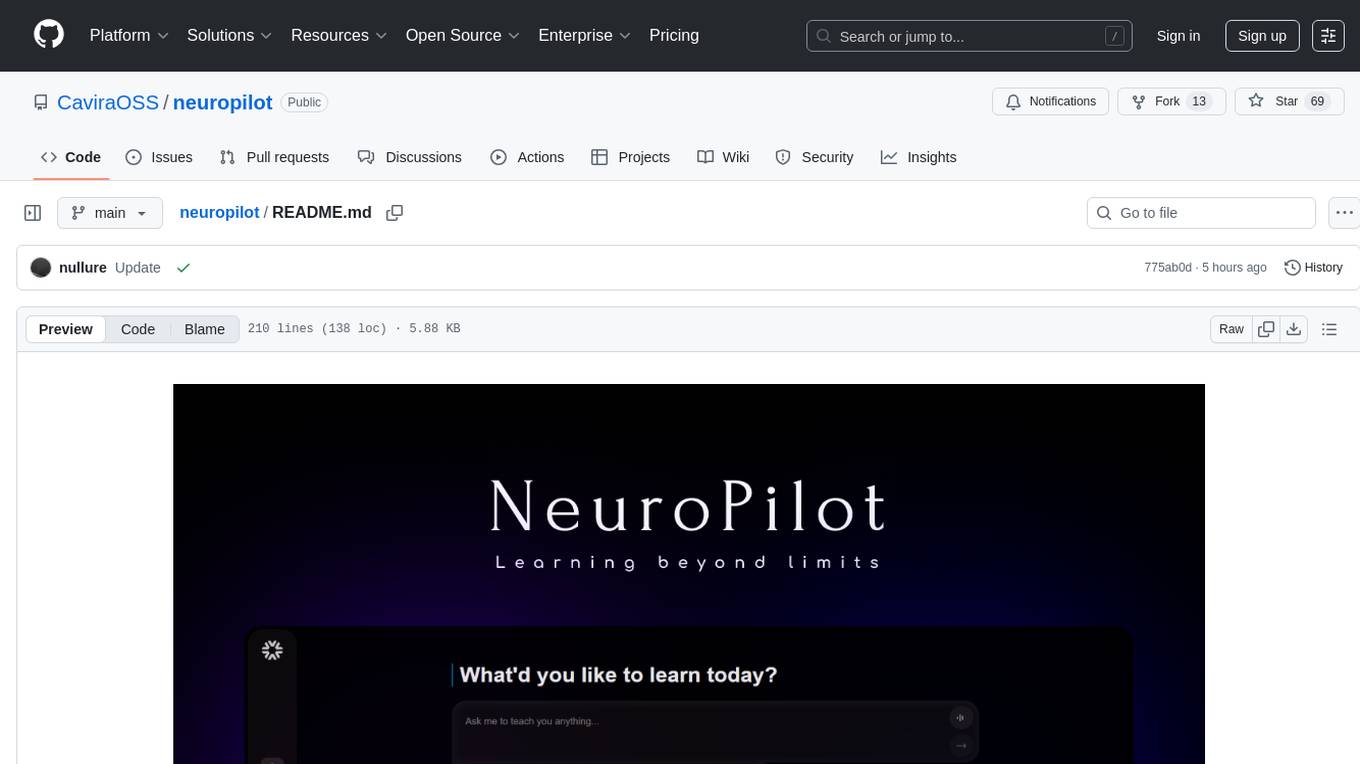
neuropilot
NeuroPilot is an open-source AI-powered education platform that transforms study materials into interactive learning resources. It provides tools like contextual chat, smart notes, flashcards, quizzes, and AI podcasts. Supported by various AI models and embedding providers, it offers features like WebSocket streaming, JSON or vector database support, file-based storage, and configurable multi-provider setup for LLMs and TTS engines. The technology stack includes Node.js, TypeScript, Vite, React, TailwindCSS, JSON database, multiple LLM providers, and Docker for deployment. Users can contribute to the project by integrating AI models, adding mobile app support, improving performance, enhancing accessibility features, and creating documentation and tutorials.
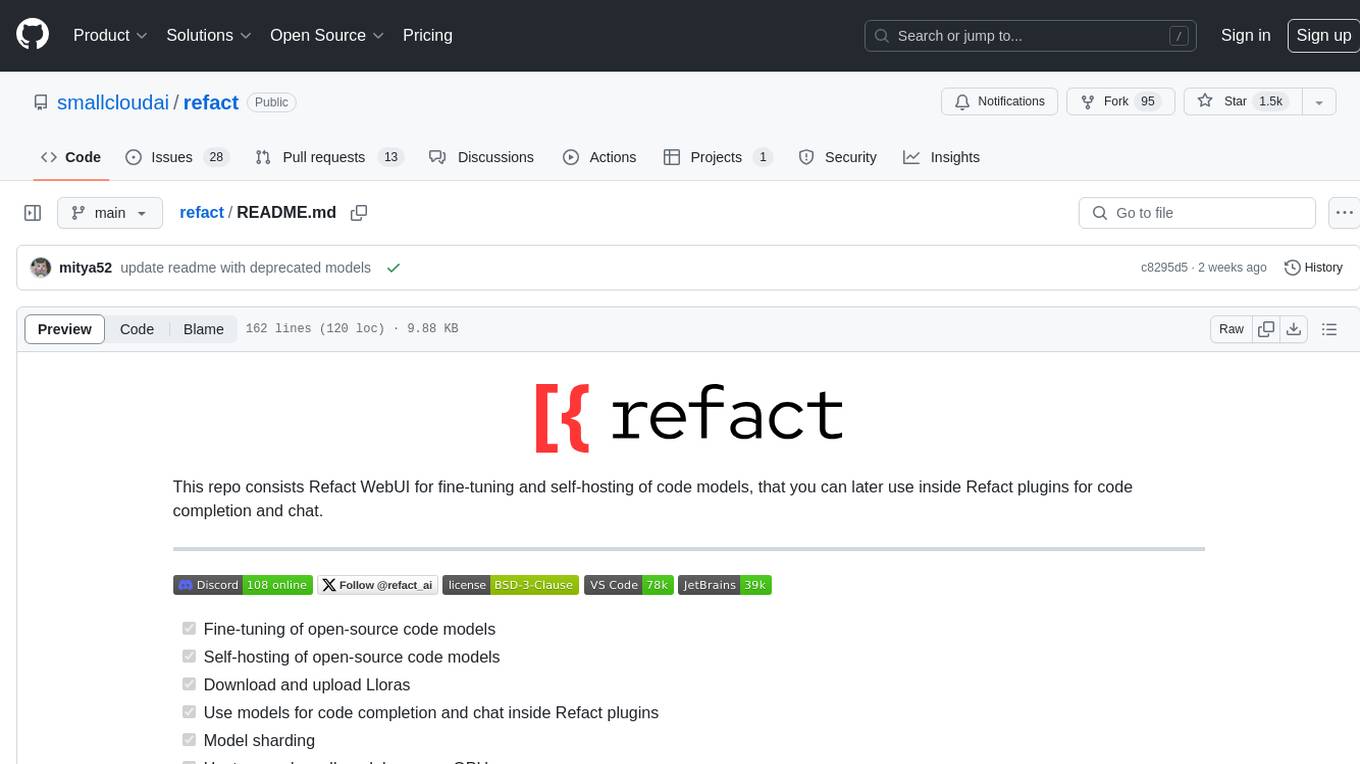
refact
This repository contains Refact WebUI for fine-tuning and self-hosting of code models, which can be used inside Refact plugins for code completion and chat. Users can fine-tune open-source code models, self-host them, download and upload Lloras, use models for code completion and chat inside Refact plugins, shard models, host multiple small models on one GPU, and connect GPT-models for chat using OpenAI and Anthropic keys. The repository provides a Docker container for running the self-hosted server and supports various models for completion, chat, and fine-tuning. Refact is free for individuals and small teams under the BSD-3-Clause license, with custom installation options available for GPU support. The community and support include contributing guidelines, GitHub issues for bugs, a community forum, Discord for chatting, and Twitter for product news and updates.
MemMachine
MemMachine is an open-source long-term memory layer designed for AI agents and LLM-powered applications. It enables AI to learn, store, and recall information from past sessions, transforming stateless chatbots into personalized, context-aware assistants. With capabilities like episodic memory, profile memory, working memory, and agent memory persistence, MemMachine offers a developer-friendly API, flexible storage options, and seamless integration with various AI frameworks. It is suitable for developers, researchers, and teams needing persistent, cross-session memory for their LLM applications.

hugo-blox-builder
Hugo Blox Builder is an open-source toolkit designed for building world-class technical and academic websites quickly and efficiently. Users can create blazing-fast, SEO-optimized sites in minutes by customizing templates with drag-and-drop blocks. The tool is built for a technical workflow, allowing users to own their content and brand without any vendor lock-in. With a modern stack featuring Hugo and Tailwind CSS, users can write in Markdown, Jupyter, or BibTeX and auto-sync publications. Hugo Blox is open and extendable, offering a generous MIT-licensed core that can be upgraded with premium templates and blocks or extended with React 'islands' for custom interactivity.
For similar tasks
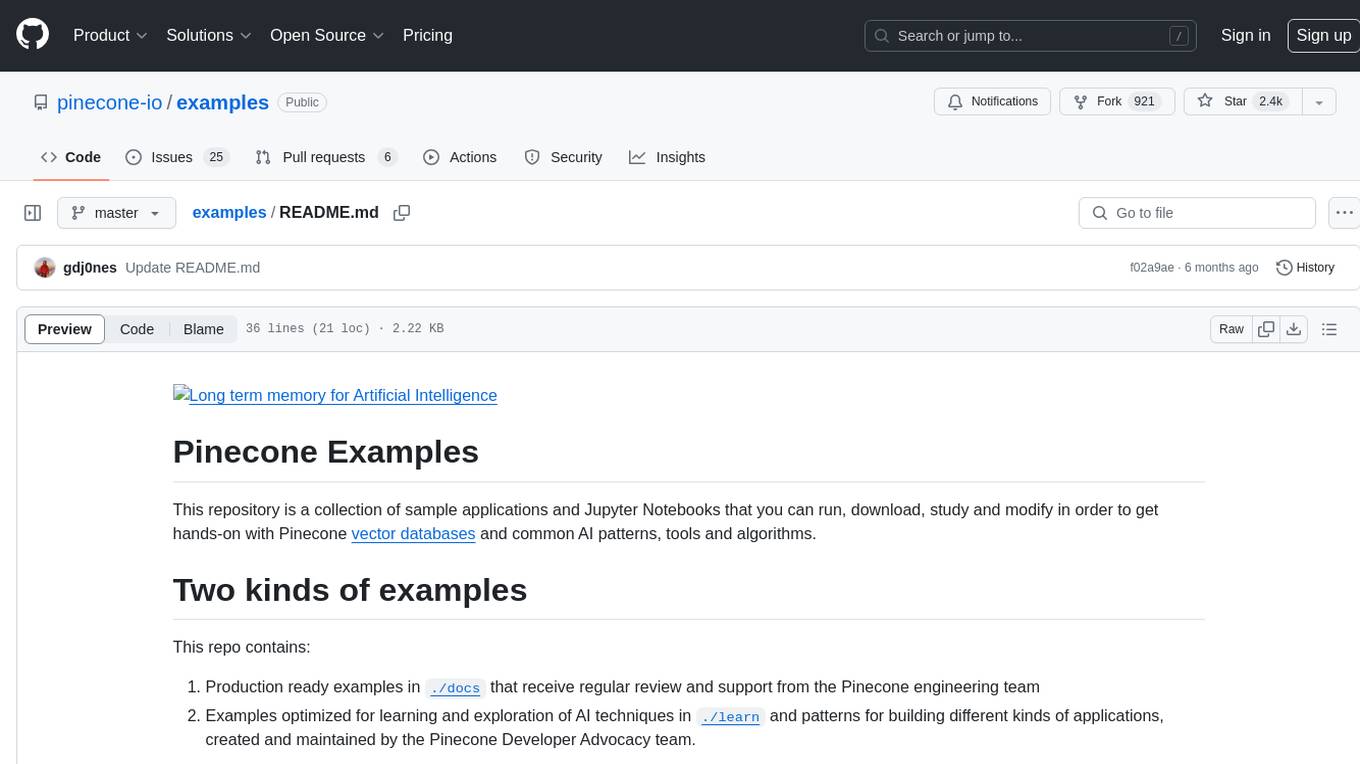
examples
This repository contains a collection of sample applications and Jupyter Notebooks for hands-on experience with Pinecone vector databases and common AI patterns, tools, and algorithms. It includes production-ready examples for review and support, as well as learning-optimized examples for exploring AI techniques and building applications. Users can contribute, provide feedback, and collaborate to improve the resource.
OpenAGI
OpenAGI is an AI agent creation package designed for researchers and developers to create intelligent agents using advanced machine learning techniques. The package provides tools and resources for building and training AI models, enabling users to develop sophisticated AI applications. With a focus on collaboration and community engagement, OpenAGI aims to facilitate the integration of AI technologies into various domains, fostering innovation and knowledge sharing among experts and enthusiasts.
sirji
Sirji is an agentic AI framework for software development where various AI agents collaborate via a messaging protocol to solve software problems. It uses standard or user-generated recipes to list tasks and tips for problem-solving. Agents in Sirji are modular AI components that perform specific tasks based on custom pseudo code. The framework is currently implemented as a Visual Studio Code extension, providing an interactive chat interface for problem submission and feedback. Sirji sets up local or remote development environments by installing dependencies and executing generated code.
dewhale
Dewhale is a GitHub-Powered AI tool designed for effortless development. It utilizes prompt engineering techniques under the GPT-4 model to issue commands, allowing users to generate code with lower usage costs and easy customization. The tool seamlessly integrates with GitHub, providing version control, code review, and collaborative features. Users can join discussions on the design philosophy of Dewhale and explore detailed instructions and examples for setting up and using the tool.
max
The Modular Accelerated Xecution (MAX) platform is an integrated suite of AI libraries, tools, and technologies that unifies commonly fragmented AI deployment workflows. MAX accelerates time to market for the latest innovations by giving AI developers a single toolchain that unlocks full programmability, unparalleled performance, and seamless hardware portability.
Awesome-CVPR2024-ECCV2024-AIGC
A Collection of Papers and Codes for CVPR 2024 AIGC. This repository compiles and organizes research papers and code related to CVPR 2024 and ECCV 2024 AIGC (Artificial Intelligence and Graphics Computing). It serves as a valuable resource for individuals interested in the latest advancements in the field of computer vision and artificial intelligence. Users can find a curated list of papers and accompanying code repositories for further exploration and research. The repository encourages collaboration and contributions from the community through stars, forks, and pull requests.
ZetaForge
ZetaForge is an open-source AI platform designed for rapid development of advanced AI and AGI pipelines. It allows users to assemble reusable, customizable, and containerized Blocks into highly visual AI Pipelines, enabling rapid experimentation and collaboration. With ZetaForge, users can work with AI technologies in any programming language, easily modify and update AI pipelines, dive into the code whenever needed, utilize community-driven blocks and pipelines, and share their own creations. The platform aims to accelerate the development and deployment of advanced AI solutions through its user-friendly interface and community support.
NeoHaskell
NeoHaskell is a newcomer-friendly and productive dialect of Haskell. It aims to be easy to learn and use, while also powerful enough for app development with minimal effort and maximum confidence. The project prioritizes design and documentation before implementation, with ongoing work on design documents for community sharing.
For similar jobs
SLR-FC
This repository provides a comprehensive collection of AI tools and resources to enhance literature reviews. It includes a curated list of AI tools for various tasks, such as identifying research gaps, discovering relevant papers, visualizing paper content, and summarizing text. Additionally, the repository offers materials on generative AI, effective prompts, copywriting, image creation, and showcases of AI capabilities. By leveraging these tools and resources, researchers can streamline their literature review process, gain deeper insights from scholarly literature, and improve the quality of their research outputs.
paper-ai
Paper-ai is a tool that helps you write papers using artificial intelligence. It provides features such as AI writing assistance, reference searching, and editing and formatting tools. With Paper-ai, you can quickly and easily create high-quality papers.
paper-qa
PaperQA is a minimal package for question and answering from PDFs or text files, providing very good answers with in-text citations. It uses OpenAI Embeddings to embed and search documents, and follows a process of embedding docs and queries, searching for top passages, creating summaries, scoring and selecting relevant summaries, putting summaries into prompt, and generating answers. Users can customize prompts and use various models for embeddings and LLMs. The tool can be used asynchronously and supports adding documents from paths, files, or URLs.
ChatData
ChatData is a robust chat-with-documents application designed to extract information and provide answers by querying the MyScale free knowledge base or uploaded documents. It leverages the Retrieval Augmented Generation (RAG) framework, millions of Wikipedia pages, and arXiv papers. Features include self-querying retriever, VectorSQL, session management, and building a personalized knowledge base. Users can effortlessly navigate vast data, explore academic papers, and research documents. ChatData empowers researchers, students, and knowledge enthusiasts to unlock the true potential of information retrieval.
noScribe
noScribe is an AI-based software designed for automated audio transcription, specifically tailored for transcribing interviews for qualitative social research or journalistic purposes. It is a free and open-source tool that runs locally on the user's computer, ensuring data privacy. The software can differentiate between speakers and supports transcription in 99 languages. It includes a user-friendly editor for reviewing and correcting transcripts. Developed by Kai Dröge, a PhD in sociology with a background in computer science, noScribe aims to streamline the transcription process and enhance the efficiency of qualitative analysis.
AIStudyAssistant
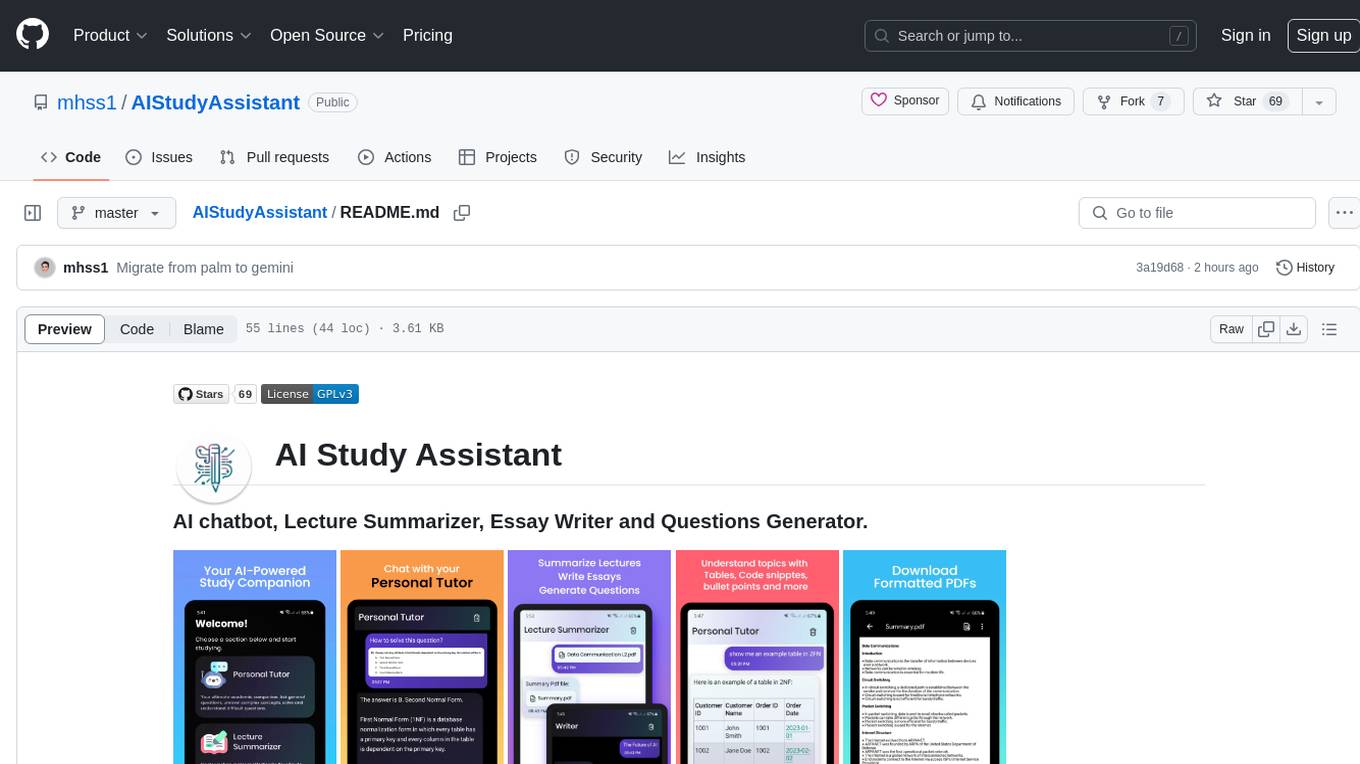
AI Study Assistant is an app designed to enhance learning experience and boost academic performance. It serves as a personal tutor, lecture summarizer, writer, and question generator powered by Google PaLM 2. Features include interacting with an AI chatbot, summarizing lectures, generating essays, and creating practice questions. The app is built using 100% Kotlin, Jetpack Compose, Clean Architecture, and MVVM design pattern, with technologies like Ktor, Room DB, Hilt, and Kotlin coroutines. AI Study Assistant aims to provide comprehensive AI-powered assistance for students in various academic tasks.
data-to-paper
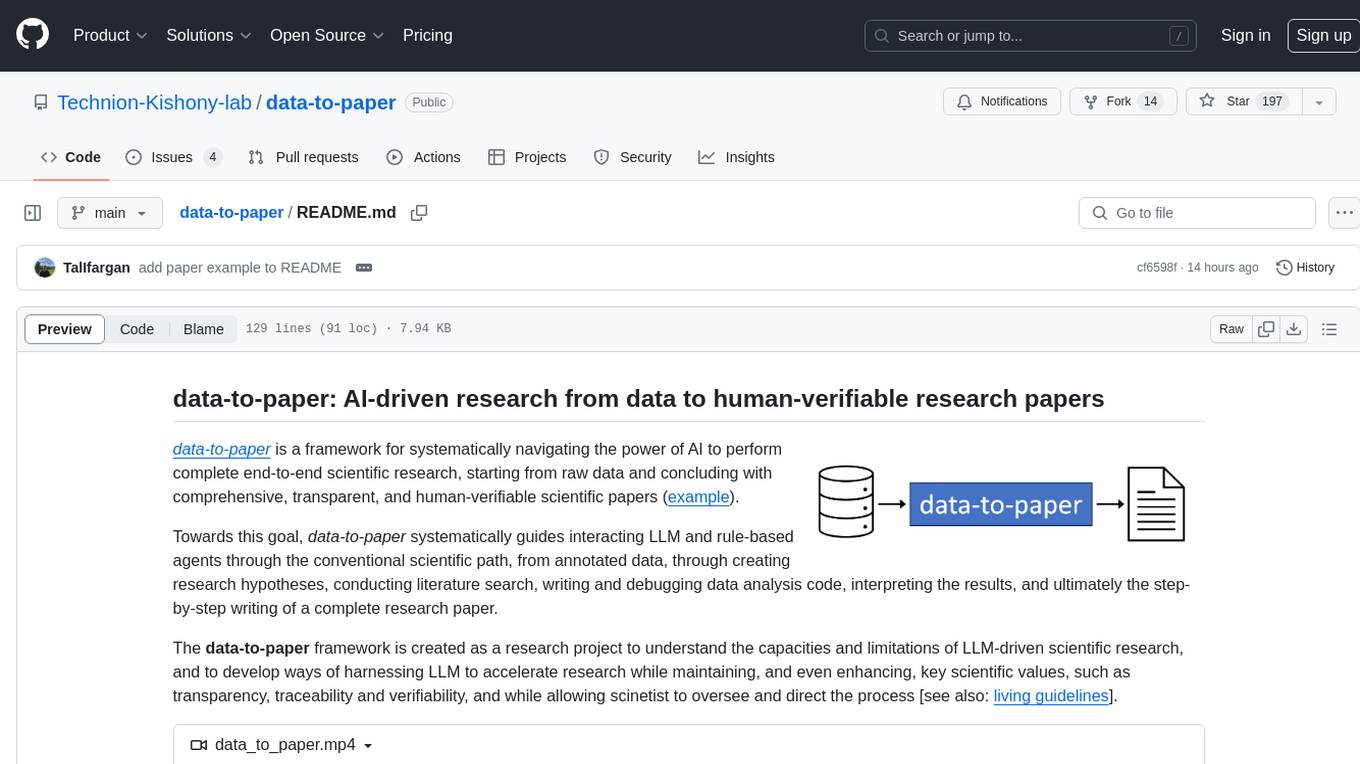
Data-to-paper is an AI-driven framework designed to guide users through the process of conducting end-to-end scientific research, starting from raw data to the creation of comprehensive and human-verifiable research papers. The framework leverages a combination of LLM and rule-based agents to assist in tasks such as hypothesis generation, literature search, data analysis, result interpretation, and paper writing. It aims to accelerate research while maintaining key scientific values like transparency, traceability, and verifiability. The framework is field-agnostic, supports both open-goal and fixed-goal research, creates data-chained manuscripts, involves human-in-the-loop interaction, and allows for transparent replay of the research process.
k2
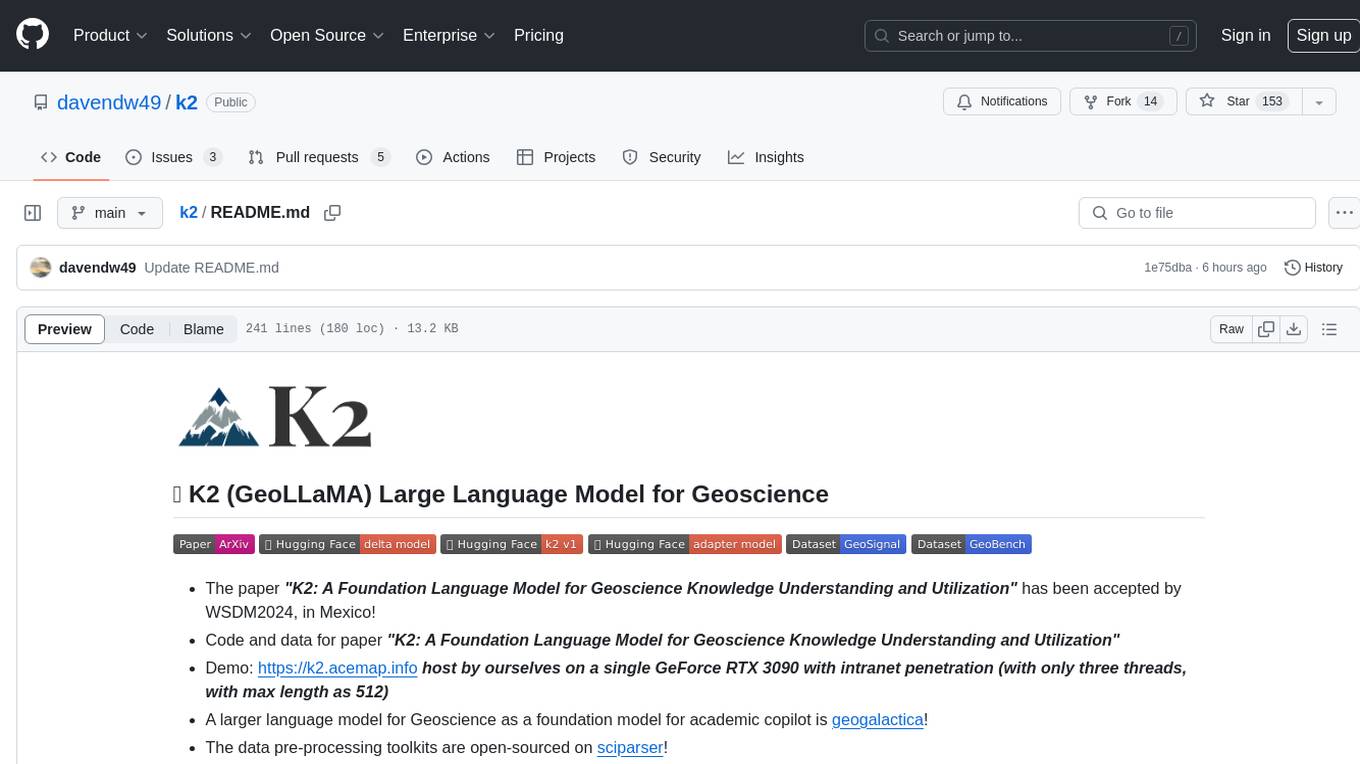
K2 (GeoLLaMA) is a large language model for geoscience, trained on geoscience literature and fine-tuned with knowledge-intensive instruction data. It outperforms baseline models on objective and subjective tasks. The repository provides K2 weights, core data of GeoSignal, GeoBench benchmark, and code for further pretraining and instruction tuning. The model is available on Hugging Face for use. The project aims to create larger and more powerful geoscience language models in the future.