


Home-AssistantConfig
:house: Home Assistant configuration & Documentation for my Smart House. Write-ups, videos, part lists, and links throughout. Be sure to :star: it. Updated FREQUENTLY!
Stars: 5169
Bear Stone Smart Home Documentation is a live, personal Home Assistant configuration shared for browsing and inspiration. It provides real-world automations, scripts, and scenes for users to reverse-engineer patterns and adapt to their own setups. The repository layout includes reusable config under `config/`, with runtime artifacts hidden by `.gitignore`. The platform runs on Docker/compose, and featured examples cover various smart home scenarios like alarm monitoring, lighting control, and presence awareness. The repository also includes a network diagram and lists Docker add-ons & utilities, gear tied to real automations, and affiliate links for supported hardware.
README:







Live, personal Home Assistant configuration shared for browsing and inspiration. This is not a turnkey clone-and-run setup; borrow ideas, adapt entity IDs/secrets, and test in your own environment.
- You are here:
/(root repo guide) - Blog | Issues | Diagram | YouTube
- Config readmes: Config index | Packages | Automations | Scripts | Scenes | Sounds | Package triggers
- Codex skills (optional): codex_skills

- A live record of how my smart home runs, with real-world automations, scripts, and scenes.
- A place to reverse-engineer patterns, not a deployment guide. If you reuse snippets, adjust entities, secrets, and services to fit your setup.
- Issues double as a changelog and design history; browse them for rationale behind changes.
- Reusable config lives under
config/(see the quick navigation paths above). - Runtime artifacts are hidden by
.gitignoreand won't show up on GitHub (e.g.,home-assistant_v2.db*, logs,deps/,.venv/, backups). Look at the YAML and scripts for the actual logic and regenerate your ownsecrets.yaml.
- Runs on Docker/compose today; this README is a browsing guide, not a how-to-install. Current HA version is tracked in
config/.HA_VERSION(see the badge above).
- Alarm and perimeter monitoring: config/packages/alarm.yaml
- Garage routines and entry lighting: config/packages/garadget.yaml, config/automation/garage_entry_light.yaml
- Holiday/front-of-house color scenes: config/scene/monthly_colors.yaml, config/script/monthly_color_scene.yaml
- Dash-button triggers for quick actions: config/automation/dash_buttons.yaml
- PC lock/unlock-driven lighting via HASS.Agent: config/packages/hass_agent_homepc.yaml
- Seasonal cuckoo clock with October and Christmas sound packs: config/automation/System/CucKoo_Clock.yaml
- Garage arrival and entry helpers: config/packages/garadget.yaml
- Battery and solar awareness: config/packages/powerwall.yaml
- Presence-aware office comfort: config/packages/office_motion.yaml
- Weather-aware lighting: config/automation/dark_rainy_day.yaml

Docker add-ons & utilities
| Container | Repo/Docs | Purpose |
|---|---|---|
| Home Assistant Time Machine | saihgupr/HomeAssistantTimeMachine | Browse/diff/restore HA YAML (Lovelace, automations, scripts, ESPHome, packages) against existing backups. Blog walkthrough: Time Machine for dashboards. |
| Duplicati | duplicati/duplicati | Off-box, versioned backups for HA config and media; docker config backups land in OneDrive. |
| Dozzle | amir20/dozzle | Lightweight Docker log viewer (useful for quick tailing across the homelab stacks). |
| Cloudflared | cloudflare/cloudflared | Secure tunnel/edge access to Home Assistant without opening inbound ports. |
| WordPress | wordpress | Hosts vCloudInfo.com for docs, how-tos, videos, and long-form writeups that accompany this config. |
Only listing hardware that appears in active packages/automations here. https://amzn.to/48jVzZ3
| Device | What it drives (friendly name -> file) | Buy |
|---|---|---|
| Garadget garage door controller | Garage doors: open/close, reflection alerts - garadget package |  |
| August smart lock | Front-door lock control + status - august package |  |
| Phyn Plus water shutoff | Leak detection + auto shutoff - phynplus package |  |
| Rachio sprinkler controller | Rain-skips and seasonal watering - rachio package |  |
| Tesla Powerwall 2 | Grid-outage alerts + load-shed automations - powerwall package |  |
| NodeMCU motion sensor | Office motion lighting - office_motion package |  |
| Raspberry Pi 3 + Aeon Z-Wave stick | Z-Wave backbone for door/hall sensors - garage entry helper |
 
|
| Roku streaming device | TV presence -> scenes/lighting - roku package |  |
| Amazon Dash Button | Quick actions (office lamp toggle) - dash buttons automation |  |
| Amazon Echo Show | Front door camera pop-up when the August lock unlocks - august package |  |
| Dreame/Neato vacuum | Cleaning schedules + notifications - vacuum package |  |
| Flux/LED strip controller | Monthly color scenes for exterior - monthly color scene |  |
| Etekcity/433MHz outlet | Accent lighting relays - garage entry helper |  |
- Browsing or purchasing through the affiliate links above helps support this project; thanks!
- Full gear list: https://www.vcloudinfo.com/gear-list
All of my configuration files are tested against the most stable version of home-assistant.

Still have questions on my Config?
Message me on X :



For Tasks:
Click tags to check more tools for each tasksFor Jobs:
Alternative AI tools for Home-AssistantConfig
Similar Open Source Tools
Home-AssistantConfig
Bear Stone Smart Home Documentation is a live, personal Home Assistant configuration shared for browsing and inspiration. It provides real-world automations, scripts, and scenes for users to reverse-engineer patterns and adapt to their own setups. The repository layout includes reusable config under `config/`, with runtime artifacts hidden by `.gitignore`. The platform runs on Docker/compose, and featured examples cover various smart home scenarios like alarm monitoring, lighting control, and presence awareness. The repository also includes a network diagram and lists Docker add-ons & utilities, gear tied to real automations, and affiliate links for supported hardware.
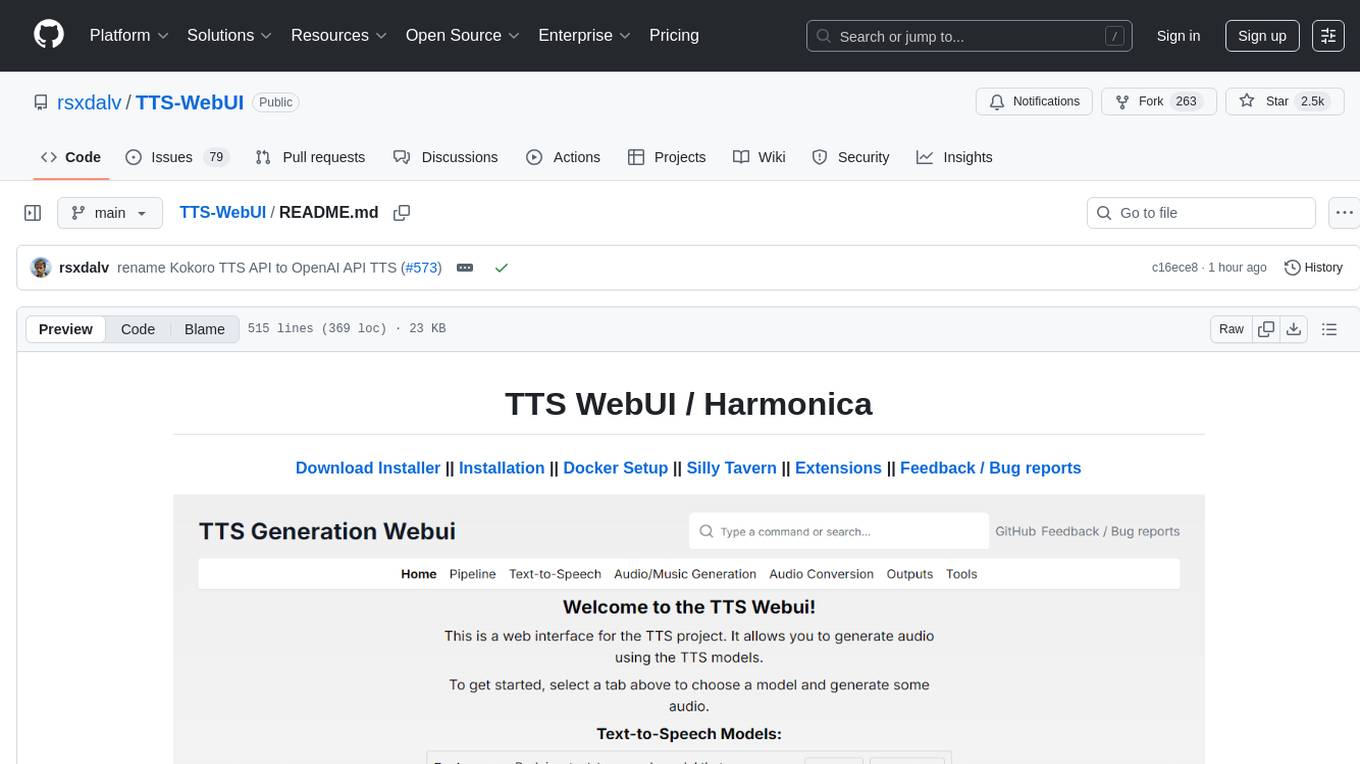
TTS-WebUI
TTS WebUI is a comprehensive tool for text-to-speech synthesis, audio/music generation, and audio conversion. It offers a user-friendly interface for various AI projects related to voice and audio processing. The tool provides a range of models and extensions for different tasks, along with integrations like Silly Tavern and OpenWebUI. With support for Docker setup and compatibility with Linux and Windows, TTS WebUI aims to facilitate creative and responsible use of AI technologies in a user-friendly manner.
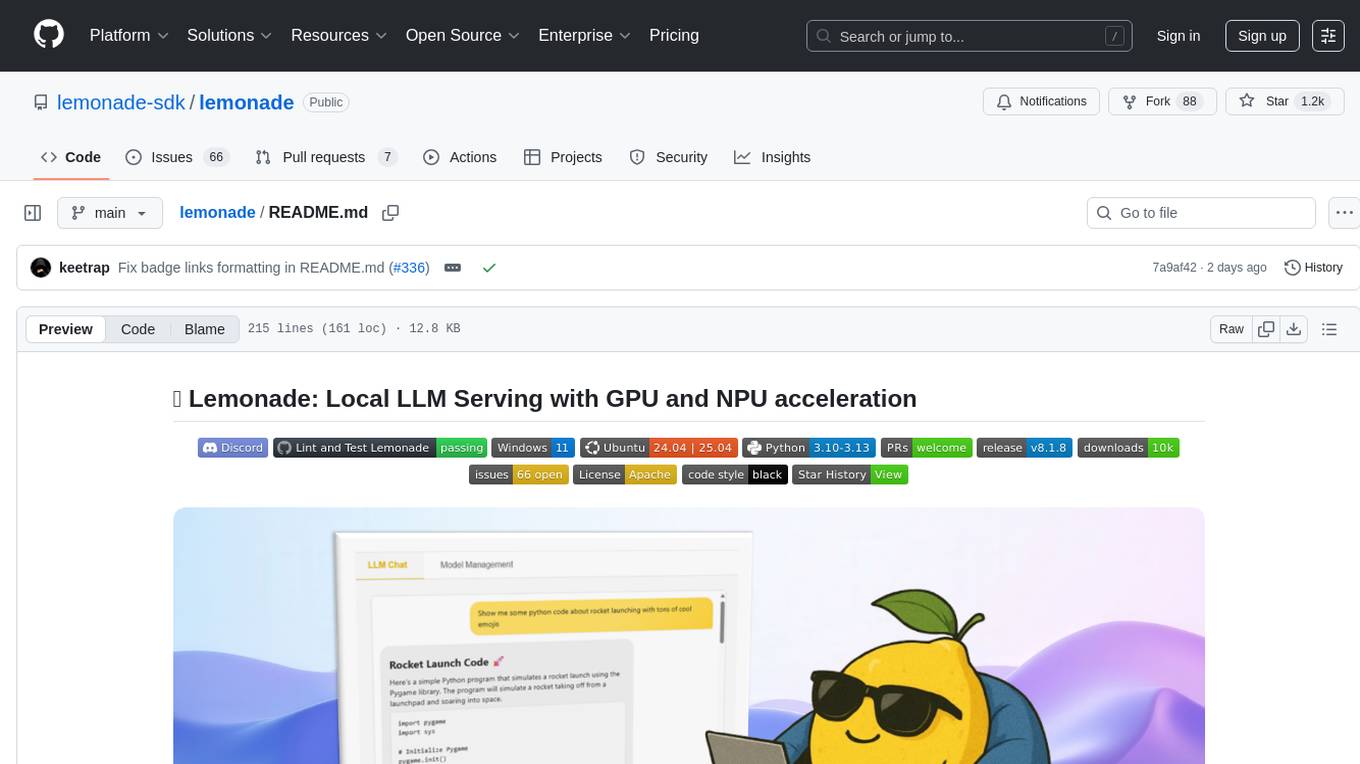
lemonade
Lemonade is a tool that helps users run local Large Language Models (LLMs) with high performance by configuring state-of-the-art inference engines for their Neural Processing Units (NPUs) and Graphics Processing Units (GPUs). It is used by startups, research teams, and large companies to run LLMs efficiently. Lemonade provides a high-level Python API for direct integration of LLMs into Python applications and a CLI for mixing and matching LLMs with various features like prompting templates, accuracy testing, performance benchmarking, and memory profiling. The tool supports both GGUF and ONNX models and allows importing custom models from Hugging Face using the Model Manager. Lemonade is designed to be easy to use and switch between different configurations at runtime, making it a versatile tool for running LLMs locally.
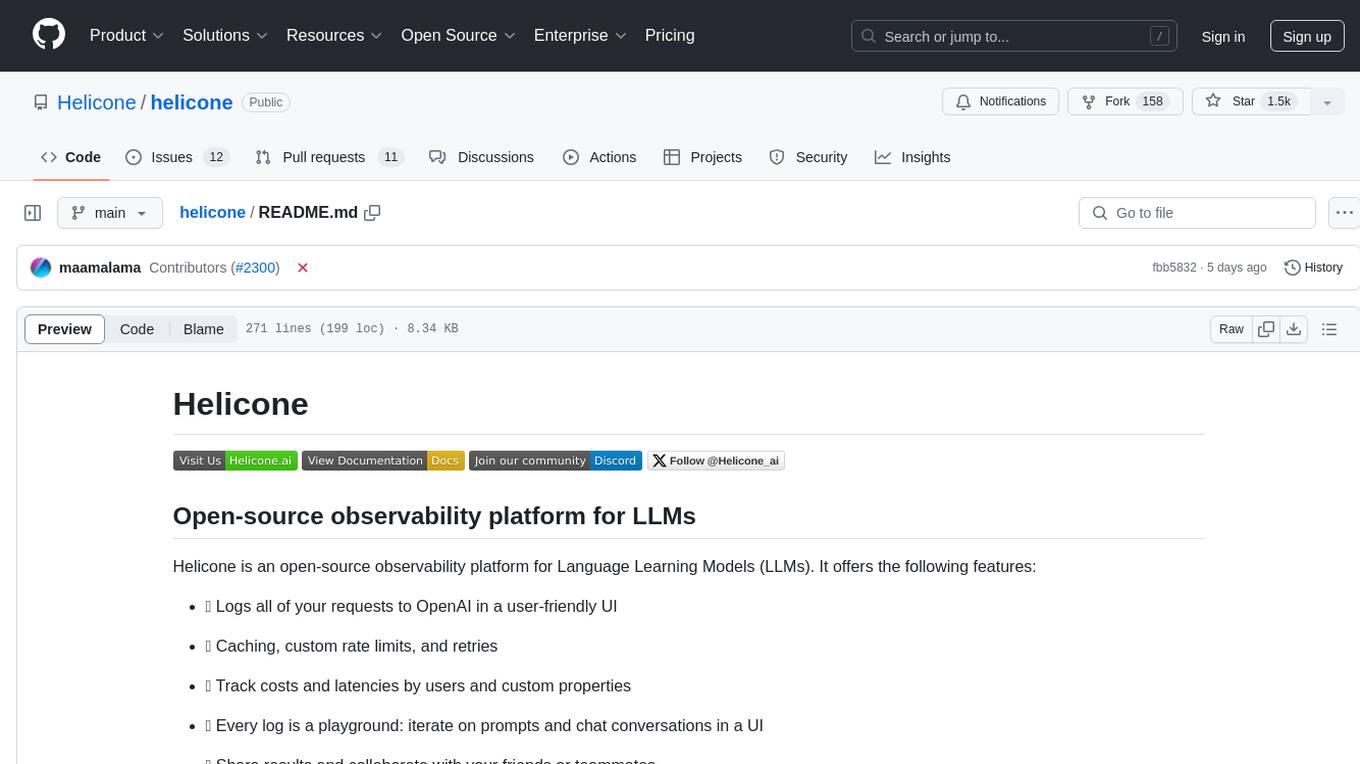
helicone
Helicone is an open-source observability platform designed for Language Learning Models (LLMs). It logs requests to OpenAI in a user-friendly UI, offers caching, rate limits, and retries, tracks costs and latencies, provides a playground for iterating on prompts and chat conversations, supports collaboration, and will soon have APIs for feedback and evaluation. The platform is deployed on Cloudflare and consists of services like Web (NextJs), Worker (Cloudflare Workers), Jawn (Express), Supabase, and ClickHouse. Users can interact with Helicone locally by setting up the required services and environment variables. The platform encourages contributions and provides resources for learning, documentation, and integrations.
ASTRA.ai
ASTRA is an open-source platform designed for developing applications utilizing large language models. It merges the ideas of Backend-as-a-Service and LLM operations, allowing developers to swiftly create production-ready generative AI applications. Additionally, it empowers non-technical users to engage in defining and managing data operations for AI applications. With ASTRA, you can easily create real-time, multi-modal AI applications with low latency, even without any coding knowledge.
nacos
Nacos is an easy-to-use platform designed for dynamic service discovery and configuration and service management. It helps build cloud native applications and microservices platform easily. Nacos provides functions like service discovery, health check, dynamic configuration management, dynamic DNS service, and service metadata management.
stm32ai-modelzoo
The STM32 AI model zoo is a collection of reference machine learning models optimized to run on STM32 microcontrollers. It provides a large collection of application-oriented models ready for re-training, scripts for easy retraining from user datasets, pre-trained models on reference datasets, and application code examples generated from user AI models. The project offers training scripts for transfer learning or training custom models from scratch. It includes performances on reference STM32 MCU and MPU for float and quantized models. The project is organized by application, providing step-by-step guides for training and deploying models.
ASTRA.ai
Astra.ai is a multimodal agent powered by TEN, showcasing its capabilities in speech, vision, and reasoning through RAG from local documentation. It provides a platform for developing AI agents with features like RTC transportation, extension store, workflow builder, and local deployment. Users can build and test agents locally using Docker and Node.js, with prerequisites including Agora App ID, Azure's speech-to-text and text-to-speech API keys, and OpenAI API key. The platform offers advanced customization options through config files and API keys setup, enabling users to create and deploy their AI agents for various tasks.
retinify
Retinify is an advanced AI-powered stereo vision library designed for robotics, enabling real-time, high-precision 3D perception by leveraging GPU and NPU acceleration. It is open source under Apache-2.0 license, offers high precision 3D mapping and object recognition, runs computations on GPU for fast performance, accepts stereo images from any rectified camera setup, is cost-efficient using minimal hardware, and has minimal dependencies on CUDA Toolkit, cuDNN, and TensorRT. The tool provides a pipeline for stereo matching and supports various image data types independently of OpenCV.
PocketFlow
Pocket Flow is a 100-line minimalist LLM framework designed for (Multi-)Agents, Workflow, RAG, etc. It provides a core abstraction for LLM projects by focusing on computation and communication through a graph structure and shared store. The framework aims to support the development of LLM Agents, such as Cursor AI, by offering a minimal and low-level approach that is well-suited for understanding and usage. Users can install Pocket Flow via pip or by copying the source code, and detailed documentation is available on the project website.
supabase
Supabase is an open source Firebase alternative that provides a wide range of features including a hosted Postgres database, authentication and authorization, auto-generated APIs, REST and GraphQL support, realtime subscriptions, functions, file storage, AI and vector/embeddings toolkit, and a dashboard. It aims to offer developers a Firebase-like experience using enterprise-grade open source tools.
awesome-saas
The Alchemyst Platform Cookbook is a comprehensive guide for developers and builders to bring their AI ideas to life. It provides cutting-edge AI tools and templates to empower users in creating innovative projects. The platform offers API documentation, quick start guides, official and community templates for various projects. Users can contribute to the platform by forking the repository, adding the topic 'alchemyst-awesome-saas', making their repository public, and submitting a pull request. Troubleshooting guidelines are provided for contributors. The platform is actively maintained by the Alchemyst AI Team.
ai-dev-kit
The AI Dev Kit is a comprehensive toolkit designed to enhance AI-driven development on Databricks. It provides trusted sources for AI coding assistants like Claude Code and Cursor to build faster and smarter on Databricks. The kit includes features such as Spark Declarative Pipelines, Databricks Jobs, AI/BI Dashboards, Unity Catalog, Genie Spaces, Knowledge Assistants, MLflow Experiments, Model Serving, Databricks Apps, and more. Users can choose from different adventures like installing the kit, using the visual builder app, teaching AI assistants Databricks patterns, executing Databricks actions, or building custom integrations with the core library. The kit also includes components like databricks-tools-core, databricks-mcp-server, databricks-skills, databricks-builder-app, and ai-dev-project.
monoscope
Monoscope is an open-source monitoring and observability platform that uses artificial intelligence to understand and monitor systems automatically. It allows users to ingest and explore logs, traces, and metrics in S3 buckets, query in natural language via LLMs, and create AI agents to detect anomalies. Key capabilities include universal data ingestion, AI-powered understanding, natural language interface, cost-effective storage, and zero configuration. Monoscope is designed to reduce alert fatigue, catch issues before they impact users, and provide visibility across complex systems.
omi
Omi is an open-source AI wearable that provides automatic, high-quality transcriptions of meetings, chats, and voice memos. It revolutionizes how conversations are captured and managed by connecting to mobile devices. The tool offers features for seamless documentation and integration with third-party services.
openkore
OpenKore is a custom client and intelligent automated assistant for Ragnarok Online. It is a free, open source, and cross-platform program (Linux, Windows, and MacOS are supported). To run OpenKore, you need to download and extract it or clone the repository using Git. Configure OpenKore according to the documentation and run openkore.pl to start. The tool provides a FAQ section for troubleshooting, guidelines for reporting issues, and information about botting status on official servers. OpenKore is developed by a global team, and contributions are welcome through pull requests. Various community resources are available for support and communication. Users are advised to comply with the GNU General Public License when using and distributing the software.
For similar tasks
Home-AssistantConfig
Bear Stone Smart Home Documentation is a live, personal Home Assistant configuration shared for browsing and inspiration. It provides real-world automations, scripts, and scenes for users to reverse-engineer patterns and adapt to their own setups. The repository layout includes reusable config under `config/`, with runtime artifacts hidden by `.gitignore`. The platform runs on Docker/compose, and featured examples cover various smart home scenarios like alarm monitoring, lighting control, and presence awareness. The repository also includes a network diagram and lists Docker add-ons & utilities, gear tied to real automations, and affiliate links for supported hardware.
AIOsense
AIOsense is an all-in-one sensor that is modular, affordable, and easy to solder. It is designed to be an alternative to commercially available sensors and focuses on upgradeability. AIOsense is cheaper and better than most commercial sensors and supports a variety of sensors and modules, including: - (RGB)-LED - Barometer - Breath VOC equivalent - Buzzer / Beeper - CO² equivalent - Humidity sensor - Light / Illumination sensor - PIR motion sensor - Temperature sensor - mmWave / Radar sensor Upcoming features include full voice assistant support, microphone, and speaker. All supported sensors & modules are listed in the documentation. AIOsense has a low power consumption, with an idle power consumption of 0.45W / 0.09A on a fully equipped board. Without a mmWave sensor, the idle power consumption is around 0.11W / 0.02A. To get started with AIOsense, you can refer to the documentation. If you have any questions, you can open an issue.
For similar jobs
hass-ollama-conversation
The Ollama Conversation integration adds a conversation agent powered by Ollama in Home Assistant. This agent can be used in automations to query information provided by Home Assistant about your house, including areas, devices, and their states. Users can install the integration via HACS and configure settings such as API timeout, model selection, context size, maximum tokens, and other parameters to fine-tune the responses generated by the AI language model. Contributions to the project are welcome, and discussions can be held on the Home Assistant Community platform.
addon-aircast
AirCast is a Home Assistant Community Add-on that provides AirPlay capabilities for Chromecast players. It bridges the compatibility gap between Apple's AirPlay and Google's Chromecast by creating virtual AirPlay devices for Chromecast players on the network. The add-on is based on the AirConnect project and allows users to stream audio from Apple devices to Chromecast players.
ai_automation_suggester
An integration for Home Assistant that leverages AI models to understand your unique home environment and propose intelligent automations. By analyzing your entities, devices, areas, and existing automations, the AI Automation Suggester helps you discover new, context-aware use cases you might not have considered, ultimately streamlining your home management and improving efficiency, comfort, and convenience. The tool acts as a personal automation consultant, providing actionable YAML-based automations that can save energy, improve security, enhance comfort, and reduce manual intervention. It turns the complexity of a large Home Assistant environment into actionable insights and tangible benefits.
Home-AssistantConfig
Bear Stone Smart Home Documentation is a live, personal Home Assistant configuration shared for browsing and inspiration. It provides real-world automations, scripts, and scenes for users to reverse-engineer patterns and adapt to their own setups. The repository layout includes reusable config under `config/`, with runtime artifacts hidden by `.gitignore`. The platform runs on Docker/compose, and featured examples cover various smart home scenarios like alarm monitoring, lighting control, and presence awareness. The repository also includes a network diagram and lists Docker add-ons & utilities, gear tied to real automations, and affiliate links for supported hardware.
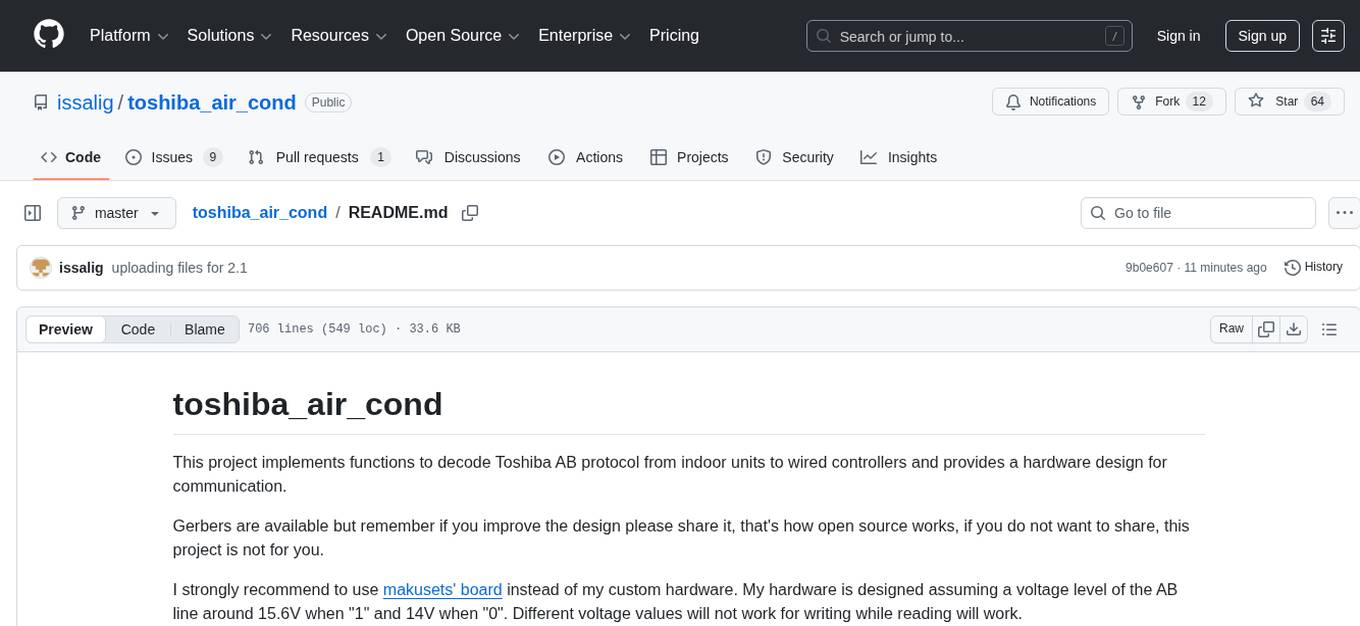
toshiba_air_cond
The toshiba_air_cond project implements functions to decode Toshiba AB protocol from indoor units to wired controllers and provides a hardware design for communication. It is developed for ESP8266 using PlatformIO and Wemos D1 mini board. The project offers features such as WebServer, WebSockets communication, Home Assistant integration, OTA updates, file uploading, and WiFiManager. It has been tested with specific Toshiba units and provides a web interface for controlling functions like power ON/OFF, setting target temperature, changing modes, adjusting fan speed, setting timers, and displaying current temperature and system information.
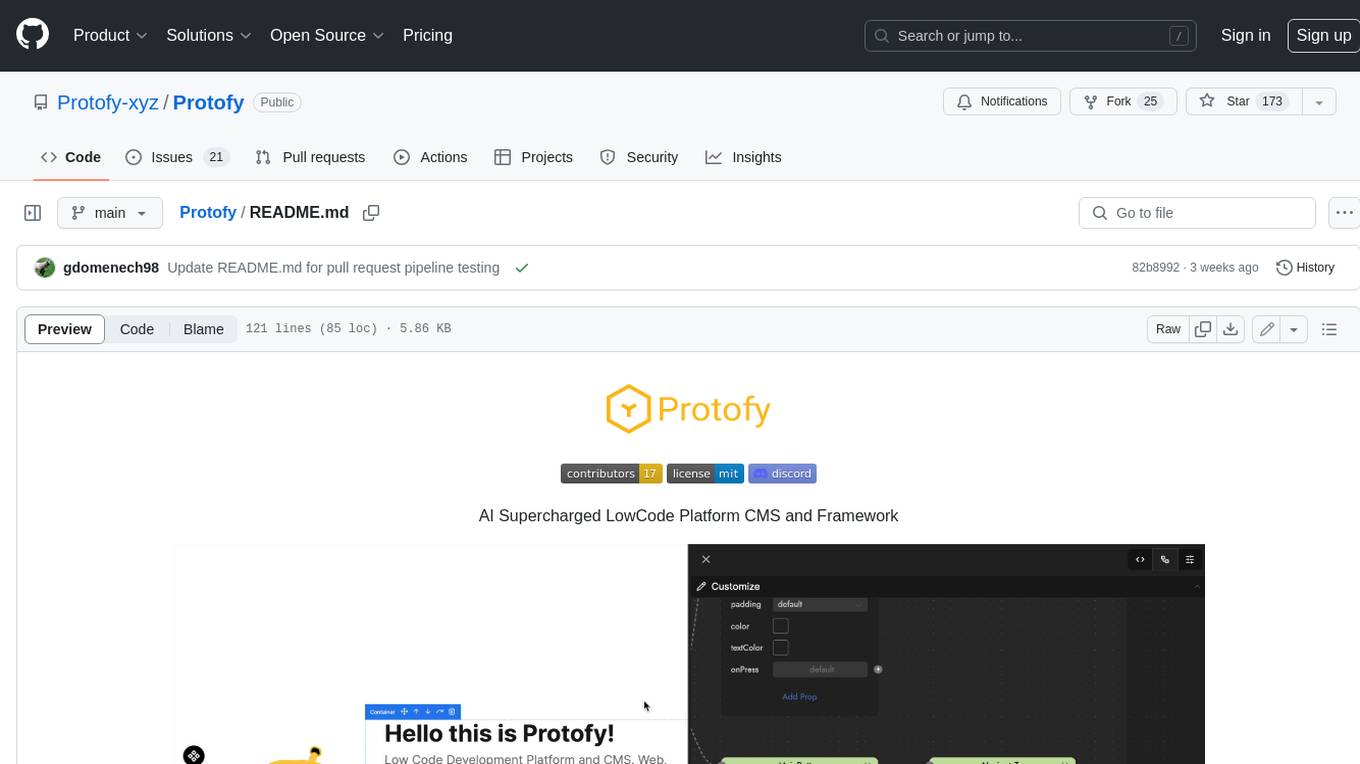
Protofy
Protofy is a full-stack, batteries-included low-code enabled web/app and IoT system with an API system and real-time messaging. It is based on Protofy (protoflow + visualui + protolib + protodevices) + Expo + Next.js + Tamagui + Solito + Express + Aedes + Redbird + Many other amazing packages. Protofy can be used to fast prototype Apps, webs, IoT systems, automations, or APIs. It is a ultra-extensible CMS with supercharged capabilities, mobile support, and IoT support (esp32 thanks to esphome).
openmeter
OpenMeter is a real-time and scalable usage metering tool for AI, usage-based billing, infrastructure, and IoT use cases. It provides a REST API for integrations and offers client SDKs in Node.js, Python, Go, and Web. OpenMeter is licensed under the Apache 2.0 License.
AIOsense
AIOsense is an all-in-one sensor that is modular, affordable, and easy to solder. It is designed to be an alternative to commercially available sensors and focuses on upgradeability. AIOsense is cheaper and better than most commercial sensors and supports a variety of sensors and modules, including: - (RGB)-LED - Barometer - Breath VOC equivalent - Buzzer / Beeper - CO² equivalent - Humidity sensor - Light / Illumination sensor - PIR motion sensor - Temperature sensor - mmWave / Radar sensor Upcoming features include full voice assistant support, microphone, and speaker. All supported sensors & modules are listed in the documentation. AIOsense has a low power consumption, with an idle power consumption of 0.45W / 0.09A on a fully equipped board. Without a mmWave sensor, the idle power consumption is around 0.11W / 0.02A. To get started with AIOsense, you can refer to the documentation. If you have any questions, you can open an issue.