


deep-research-web-ui
(Supports DeepSeek R1) An AI-powered research assistant that performs iterative, deep research on any topic by combining search engines, web scraping, and large language models.
Stars: 1387
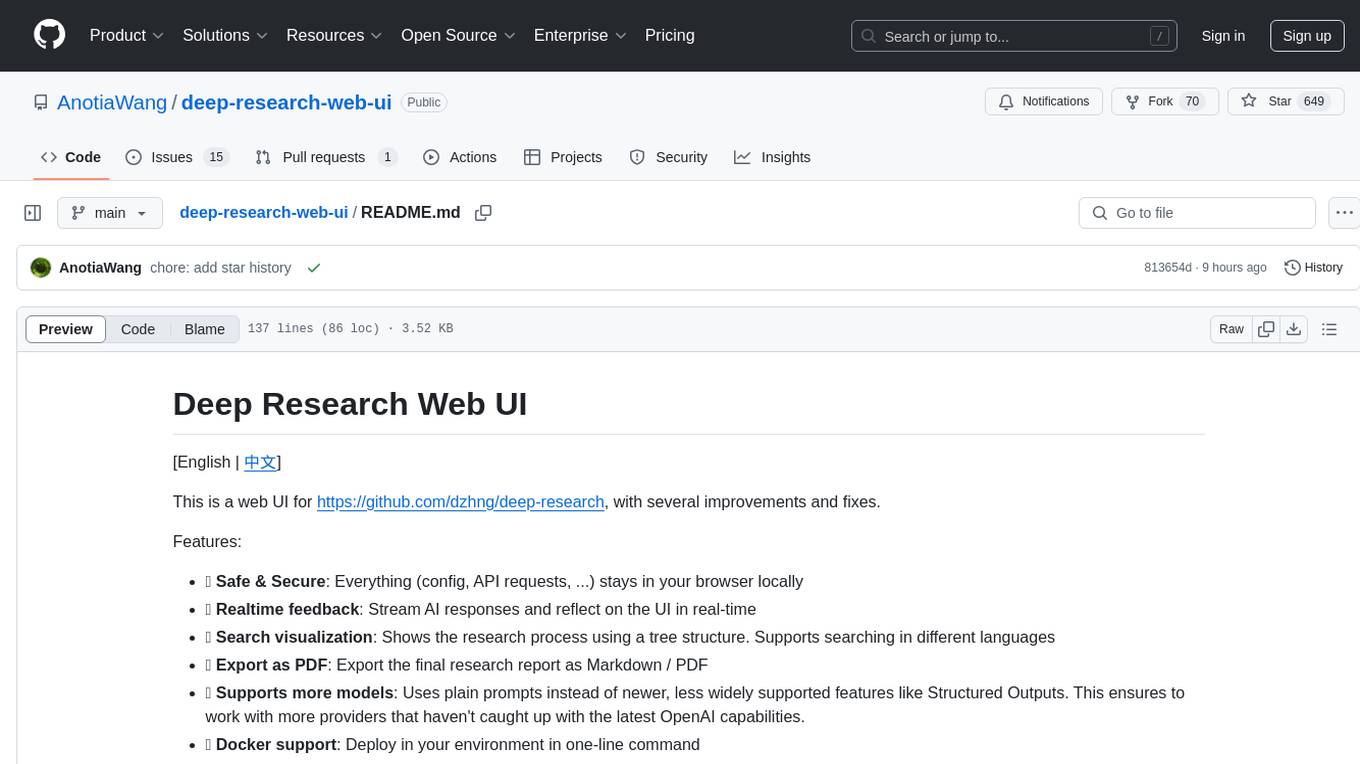
This web UI tool is designed to enhance the user experience of the deep-research repository by providing a safe and secure environment for conducting AI research. It offers features such as real-time feedback, search visualization, export as PDF, support for various AI models, and Docker deployment. Users can interact with multiple AI providers and web search services, making research processes more efficient and accessible. The tool also includes recent updates that improve functionality and fix bugs, ensuring a seamless experience for users.
README:
[English | 中文]
This is a web UI for https://github.com/dzhng/deep-research, with several improvements and fixes.
Features:
- 🚀 Safe & Secure: Everything (config, API requests, ...) stays in your browser locally
- 🕙 Realtime feedback: Stream AI responses and reflect on the UI in real-time
- 🌳 Search visualization: Shows the research process using a tree structure. Supports searching in different languages
- 📄 Export as PDF: Export the final research report as Markdown / PDF
- 🤖 Supports more models: Uses plain prompts instead of newer, less widely supported features like Structured Outputs. This ensures to work with more providers that haven't caught up with the latest OpenAI capabilities.
- 🐳 Docker support: Deploy in your environment in one-line command
Currently available providers:
- AI: OpenAI compatible, SiliconFlow, Infiniai, DeepSeek, OpenRouter, Ollama and more
- Web Search: Tavily (1000 free credits / month), Firecrawl (cloud / self-hosted)
Please give a 🌟 Star if you like this project!
25/03/09
- Added: InifiniAI support
- Improved LLM prompts
- Improved error handling
- Improved: Try to fetch model list even when no API key is provided
25/02/27
- Added: Citations in research report
- Improved: Chinese output layout
- Improved: Increased max width and breadth in the form
- Fixed: Text overflow issues for web search node details
- Fixed: general UI style issues
25/02/24
- Added: Fullscreen mode for the search flow. This helps you to focus on the search process better.
- Changed: "Export PDF" now uses the browser's native print ability. This fixes layout issues and emilinates font problems.
- Fixed: "Context Size" setting are not correctly applied
25/02/22
- Added: NL/Dutch translation
- Added: Retry failed nodes in web search
- Fixed: Web search node sometimes shows empty label and duplicated learnings
- Fixed: Firecrawl now limits scrape content format to
Markdown
25/02/18 - 25/02/20
- Added: "advanced search" and "search topic" support for Tavily
- Added: custom endpoint support for Firecrawl
- Fixed: overall bug fixes, less "invalid JSON structure" errors
25/02/17
- Added: set rate limits for web search
- Added: set context length for AI model
25/02/16
- Refactored the search visualization using VueFlow
- Style & bug fixes
Older updates
25/02/15
- Added AI providers DeepSeek, OpenRouter and Ollama; Added web search provider Firecrawl
- Supported checking project updates
- Supported regenerating reports
- General fixes
25/02/14
- Supported reasoning models like DeepSeek R1
- Improved compatibility with more models & error handling
25/02/13
- Significantly reduced bundle size
- Supported searching in different languages
- Added Docker support
- Fixed "export as PDF" issues
Live demo: https://deep-research.ataw.top
One-click deploy with EdgeOne Pages:

Use pre-built Docker image:
docker run -p 3000:3000 --name deep-research-web -d anotia/deep-research-web:latestUse self-built Docker image:
git clone https://github.com/AnotiaWang/deep-research-web-ui
cd deep-research-web-ui
docker build -t deep-research-web .
docker run -p 3000:3000 --name deep-research-web -d deep-research-web
Make sure to install dependencies:
pnpm installStart the development server on http://localhost:3000:
pnpm devBuild the application for production:
If you want to deploy a SSR application:
pnpm buildIf you want to deploy a static, SSG application:
pnpm generateLocally preview production build:
pnpm previewCheck out the deployment documentation for more information.
MIT
For Tasks:
Click tags to check more tools for each tasksFor Jobs:
Alternative AI tools for deep-research-web-ui
Similar Open Source Tools
deep-research-web-ui
This web UI tool is designed to enhance the user experience of the deep-research repository by providing a safe and secure environment for conducting AI research. It offers features such as real-time feedback, search visualization, export as PDF, support for various AI models, and Docker deployment. Users can interact with multiple AI providers and web search services, making research processes more efficient and accessible. The tool also includes recent updates that improve functionality and fix bugs, ensuring a seamless experience for users.
UltraRAG
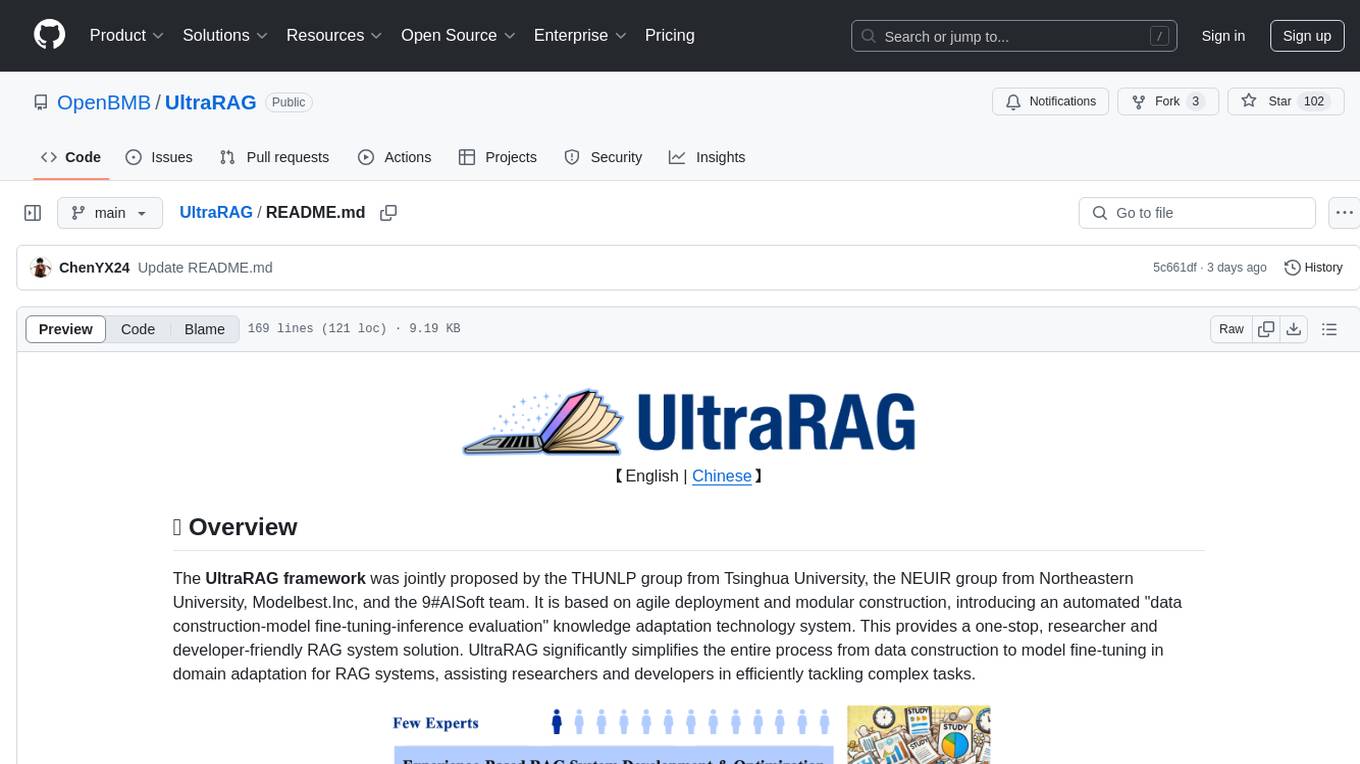
The UltraRAG framework is a researcher and developer-friendly RAG system solution that simplifies the process from data construction to model fine-tuning in domain adaptation. It introduces an automated knowledge adaptation technology system, supporting no-code programming, one-click synthesis and fine-tuning, multidimensional evaluation, and research-friendly exploration work integration. The architecture consists of Frontend, Service, and Backend components, offering flexibility in customization and optimization. Performance evaluation in the legal field shows improved results compared to VanillaRAG, with specific metrics provided. The repository is licensed under Apache-2.0 and encourages citation for support.
deep-research
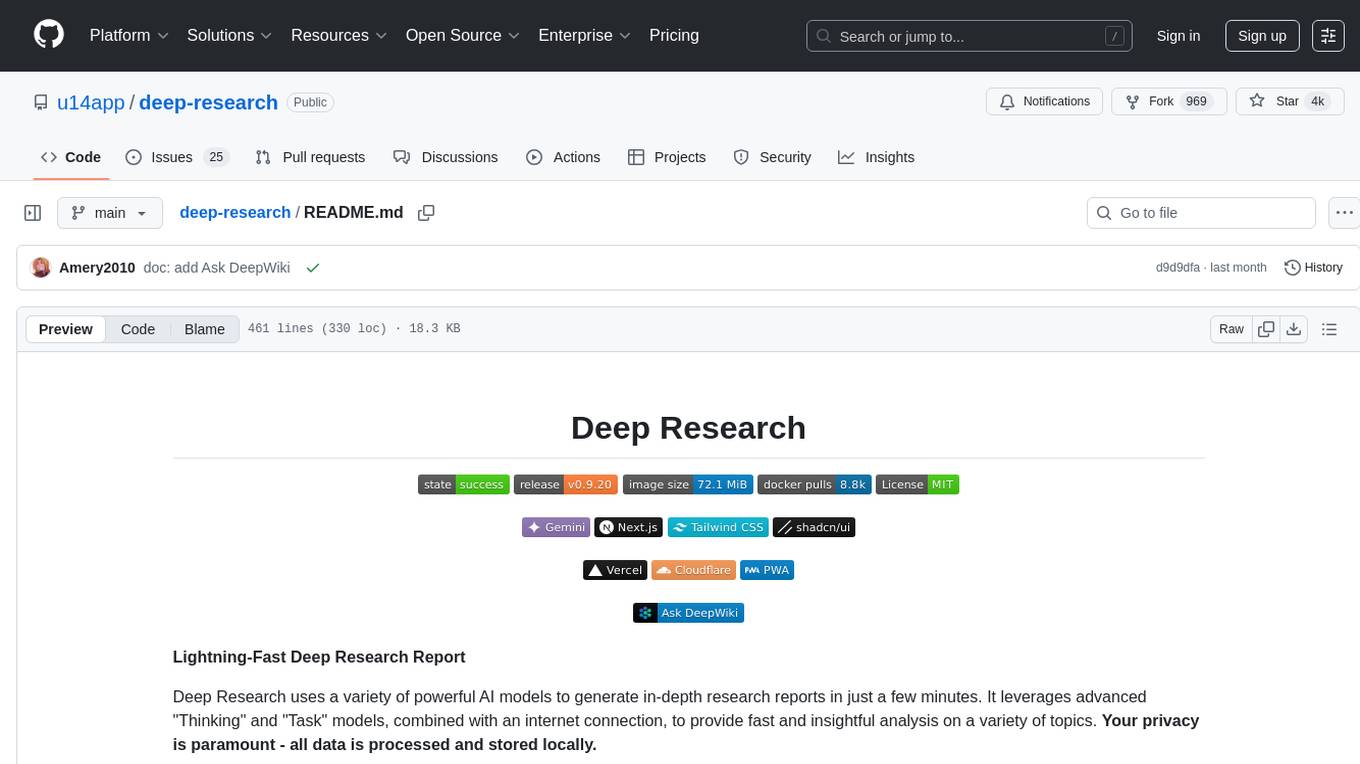
Deep Research is a lightning-fast tool that uses powerful AI models to generate comprehensive research reports in just a few minutes. It leverages advanced 'Thinking' and 'Task' models, combined with an internet connection, to provide fast and insightful analysis on various topics. The tool ensures privacy by processing and storing all data locally. It supports multi-platform deployment, offers support for various large language models, web search functionality, knowledge graph generation, research history preservation, local and server API support, PWA technology, multi-key payload support, multi-language support, and is built with modern technologies like Next.js and Shadcn UI. Deep Research is open-source under the MIT License.

DevDocs
DevDocs is a platform designed to simplify the process of digesting technical documentation for software engineers and developers. It automates the extraction and conversion of web content into markdown format, making it easier for users to access and understand the information. By crawling through child pages of a given URL, DevDocs provides a streamlined approach to gathering relevant data and integrating it into various tools for software development. The tool aims to save time and effort by eliminating the need for manual research and content extraction, ultimately enhancing productivity and efficiency in the development process.
MyDeviceAI
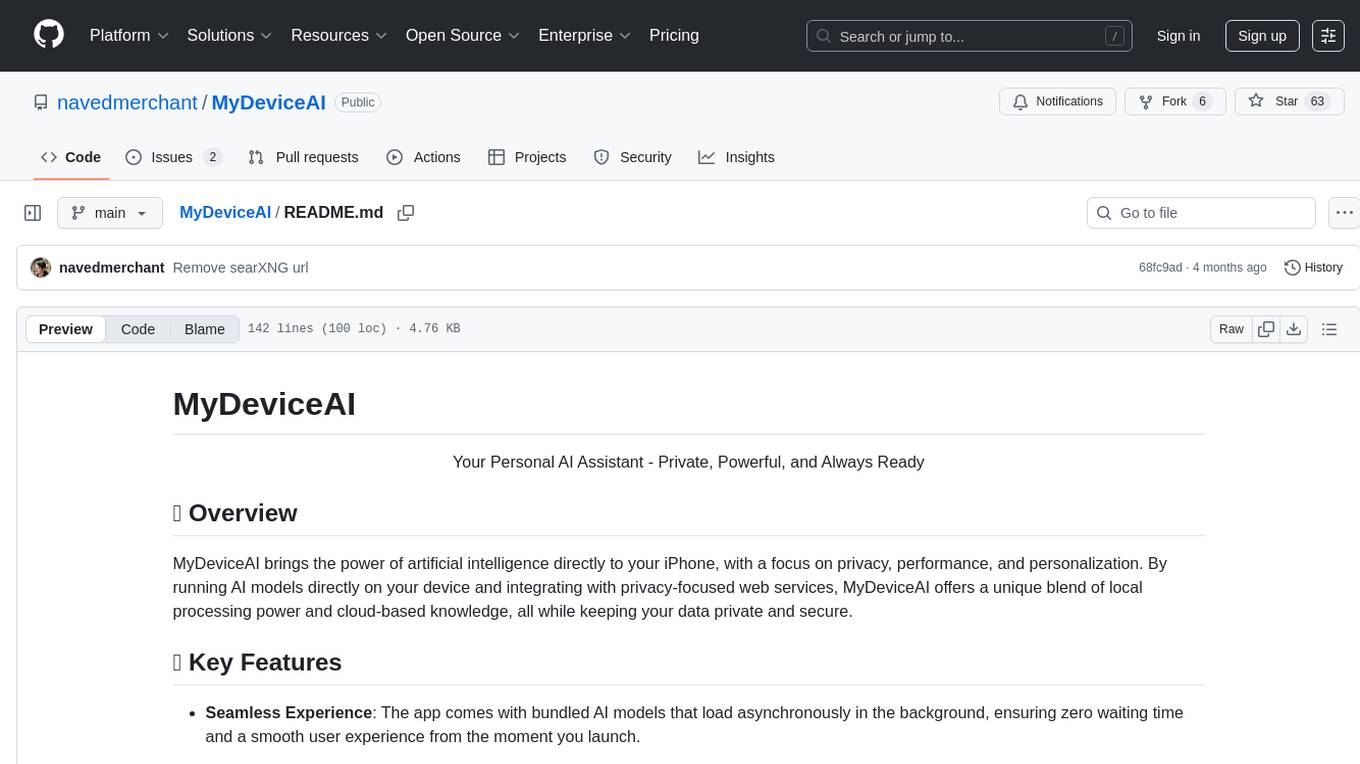
MyDeviceAI is a personal AI assistant app for iPhone that brings the power of artificial intelligence directly to the device. It focuses on privacy, performance, and personalization by running AI models locally and integrating with privacy-focused web services. The app offers seamless user experience, web search integration, advanced reasoning capabilities, personalization features, chat history access, and broad device support. It requires macOS, Xcode, CocoaPods, Node.js, and a React Native development environment for installation. The technical stack includes React Native framework, AI models like Qwen 3 and BGE Small, SearXNG integration, Redux for state management, AsyncStorage for storage, Lucide for UI components, and tools like ESLint and Prettier for code quality.
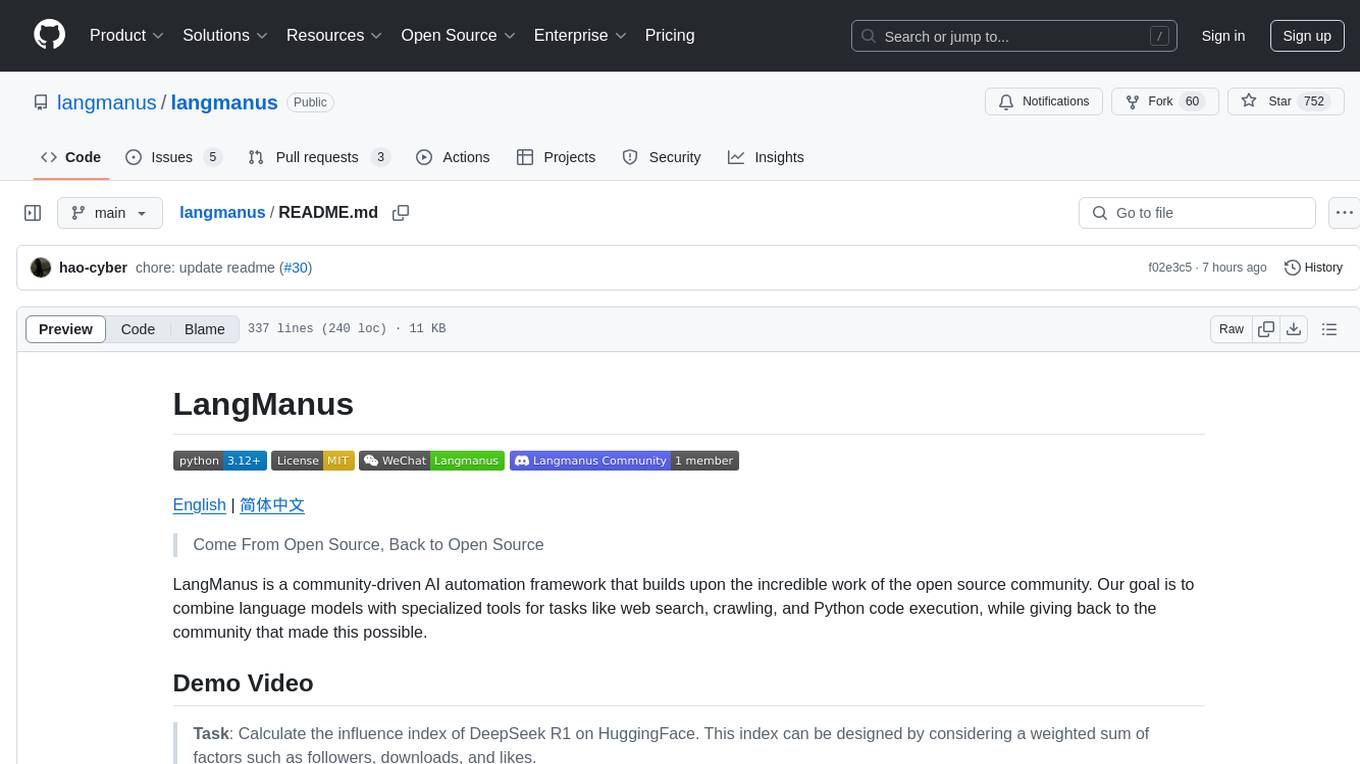
langmanus
LangManus is a community-driven AI automation framework that combines language models with specialized tools for tasks like web search, crawling, and Python code execution. It implements a hierarchical multi-agent system with agents like Coordinator, Planner, Supervisor, Researcher, Coder, Browser, and Reporter. The framework supports LLM integration, search and retrieval tools, Python integration, workflow management, and visualization. LangManus aims to give back to the open-source community and welcomes contributions in various forms.
Revornix
Revornix is an information management tool designed for the AI era. It allows users to conveniently integrate all visible information and generates comprehensive reports at specific times. The tool offers cross-platform availability, all-in-one content aggregation, document transformation & vectorized storage, native multi-tenancy, localization & open-source features, smart assistant & built-in MCP, seamless LLM integration, and multilingual & responsive experience for users.
BentoML
BentoML is an open-source model serving library for building performant and scalable AI applications with Python. It comes with everything you need for serving optimization, model packaging, and production deployment.
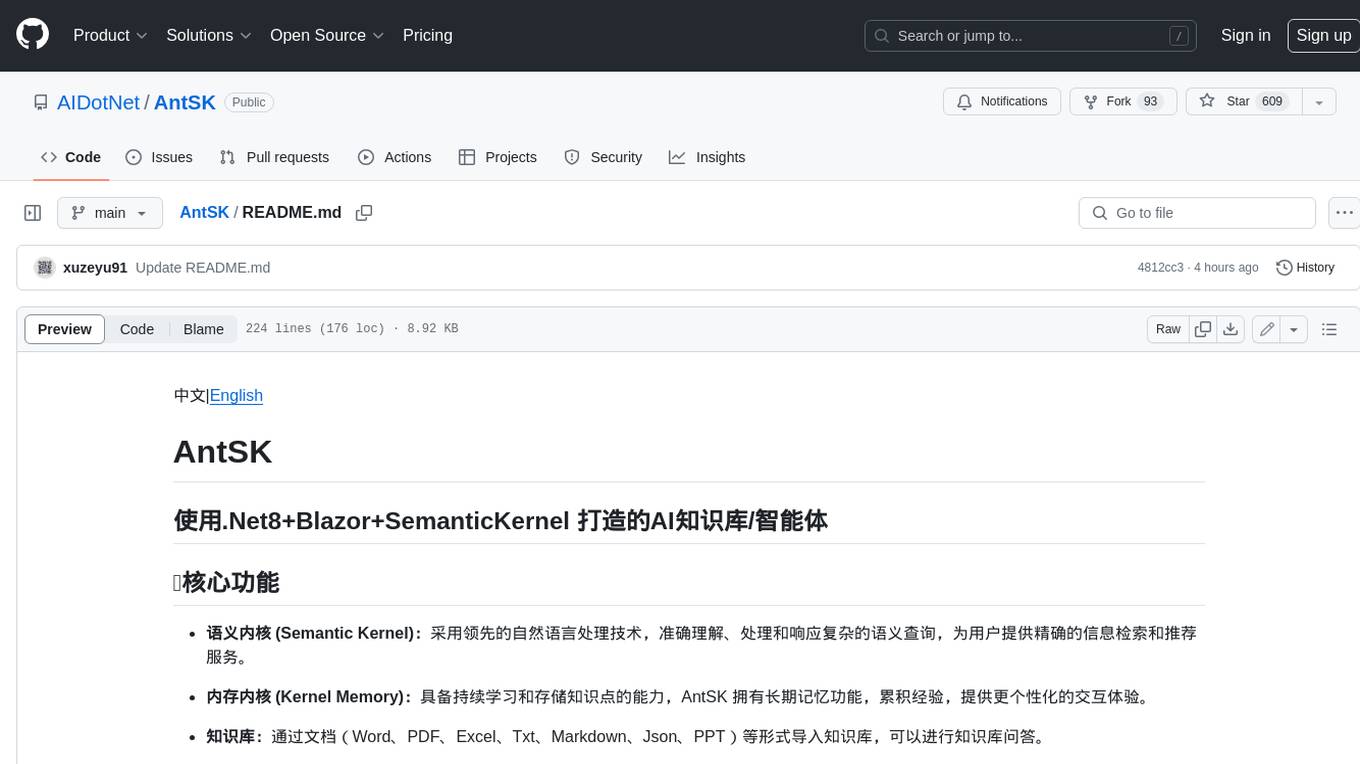
AntSK
AntSK is an AI knowledge base/agent built with .Net8+Blazor+SemanticKernel. It features a semantic kernel for accurate natural language processing, a memory kernel for continuous learning and knowledge storage, a knowledge base for importing and querying knowledge from various document formats, a text-to-image generator integrated with StableDiffusion, GPTs generation for creating personalized GPT models, API interfaces for integrating AntSK into other applications, an open API plugin system for extending functionality, a .Net plugin system for integrating business functions, real-time information retrieval from the internet, model management for adapting and managing different models from different vendors, support for domestic models and databases for operation in a trusted environment, and planned model fine-tuning based on llamafactory.
qdrant
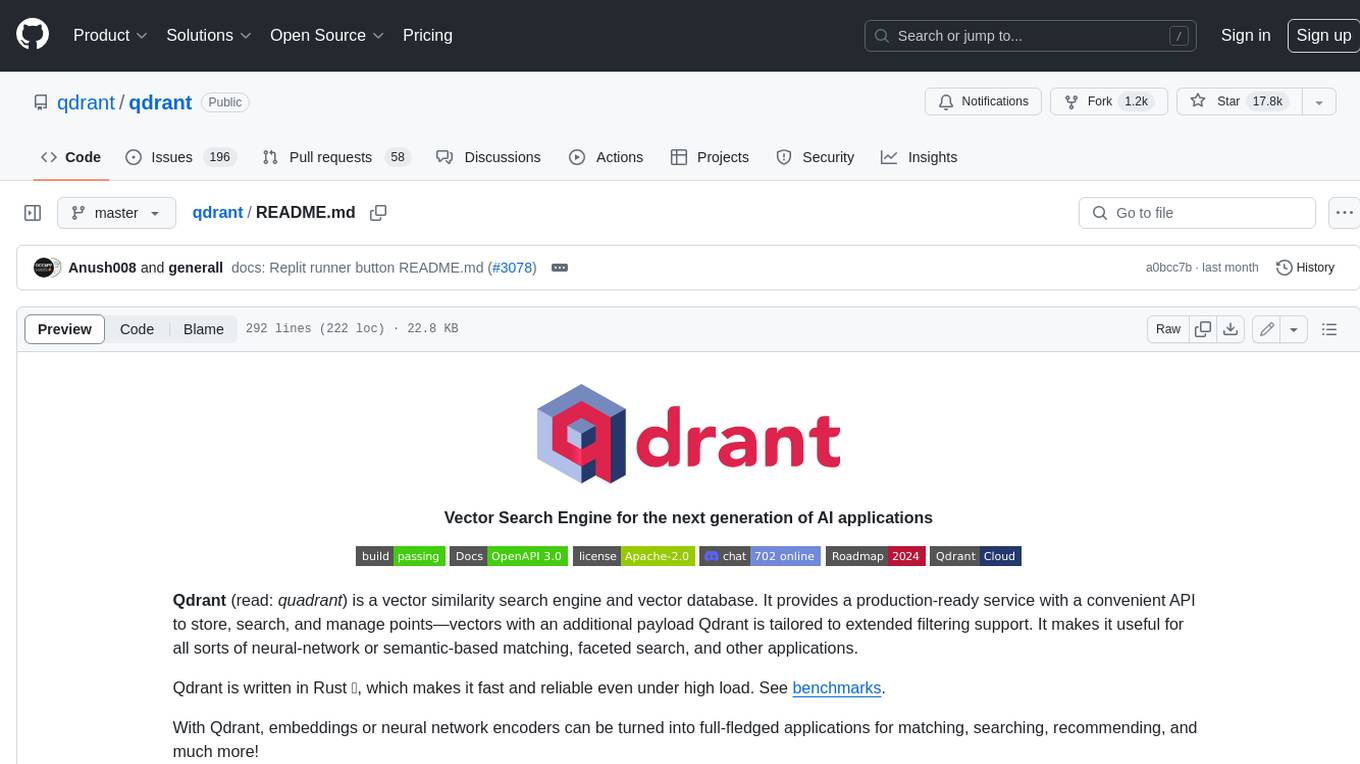
Qdrant is a vector similarity search engine and vector database. It is written in Rust, which makes it fast and reliable even under high load. Qdrant can be used for a variety of applications, including: * Semantic search * Image search * Product recommendations * Chatbots * Anomaly detection Qdrant offers a variety of features, including: * Payload storage and filtering * Hybrid search with sparse vectors * Vector quantization and on-disk storage * Distributed deployment * Highlighted features such as query planning, payload indexes, SIMD hardware acceleration, async I/O, and write-ahead logging Qdrant is available as a fully managed cloud service or as an open-source software that can be deployed on-premises.
kodit
Kodit is a Code Indexing MCP Server that connects AI coding assistants to external codebases, providing accurate and up-to-date code snippets. It improves AI-assisted coding by offering canonical examples, indexing local and public codebases, integrating with AI coding assistants, enabling keyword and semantic search, and supporting OpenAI-compatible or custom APIs/models. Kodit helps engineers working with AI-powered coding assistants by providing relevant examples to reduce errors and hallucinations.

open-deep-research
Open Deep Research is an open-source tool designed to generate AI-powered reports from web search results efficiently. It combines Bing Search API for search results retrieval, JinaAI for content extraction, and customizable report generation. Users can customize settings, export reports in multiple formats, and benefit from rate limiting for stability. The tool aims to streamline research and report creation in a user-friendly platform.
saga-reader
Saga Reader is an AI-driven think tank-style reader that automatically retrieves information from the internet based on user-specified topics and preferences. It uses cloud or local large models to summarize and provide guidance, and it includes an AI-driven interactive companion reading function, allowing you to discuss and exchange ideas with AI about the content you've read. Saga Reader is completely free and open-source, meaning all data is securely stored on your own computer and is not controlled by third-party service providers. Additionally, you can manage your subscription keywords based on your interests and preferences without being disturbed by advertisements and commercialized content.

Instrukt
Instrukt is a terminal-based AI integrated environment that allows users to create and instruct modular AI agents, generate document indexes for question-answering, and attach tools to any agent. It provides a platform for users to interact with AI agents in natural language and run them inside secure containers for performing tasks. The tool supports custom AI agents, chat with code and documents, tools customization, prompt console for quick interaction, LangChain ecosystem integration, secure containers for agent execution, and developer console for debugging and introspection. Instrukt aims to make AI accessible to everyone by providing tools that empower users without relying on external APIs and services.
autobe
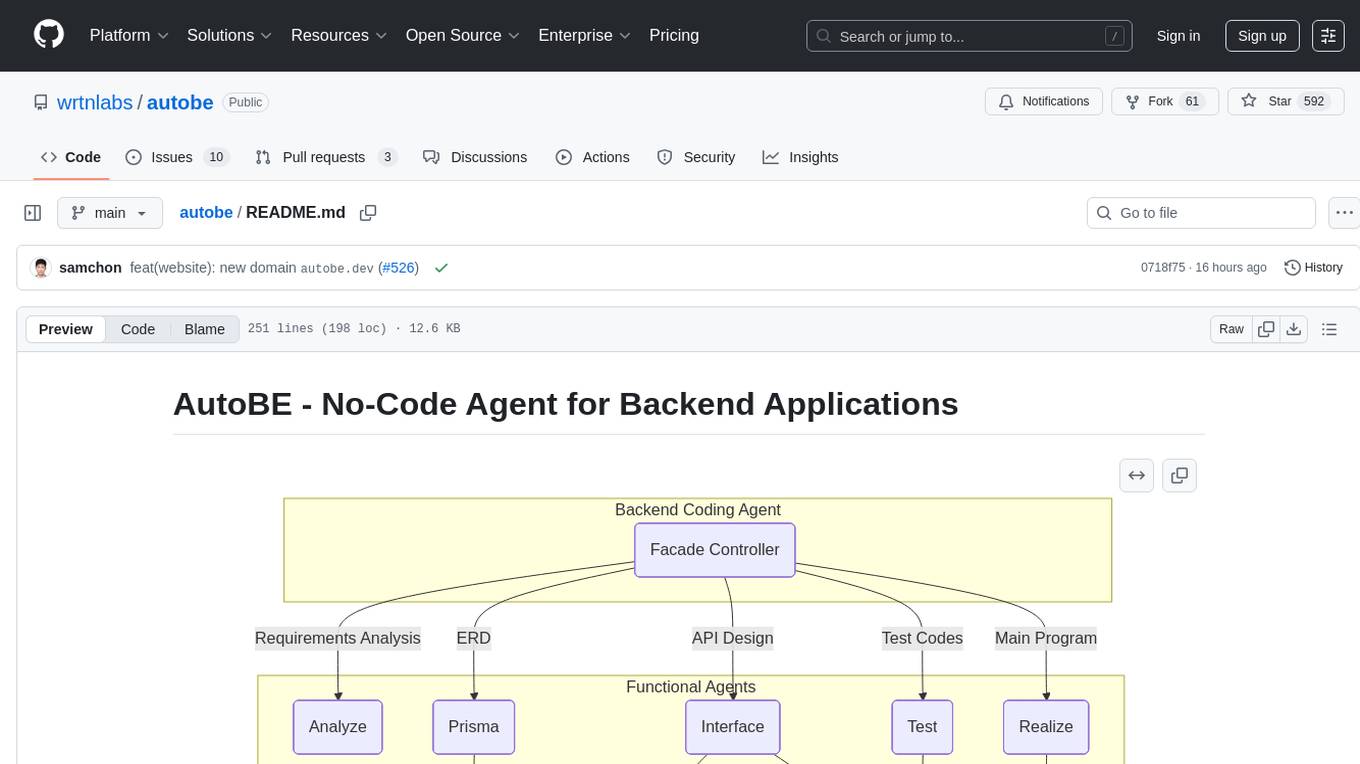
AutoBE is an AI-powered no-code agent that builds backend applications, enhanced by compiler feedback. It automatically generates backend applications using TypeScript, NestJS, and Prisma following a waterfall development model. The generated code is validated by review agents and OpenAPI/TypeScript/Prisma compilers, ensuring 100% working code. The tool aims to enable anyone to build backend servers, AI chatbots, and frontend applications without coding knowledge by conversing with AI.
bionic-gpt
BionicGPT is an on-premise replacement for ChatGPT, offering the advantages of Generative AI while maintaining strict data confidentiality. BionicGPT can run on your laptop or scale into the data center.
For similar tasks
Azure-Analytics-and-AI-Engagement
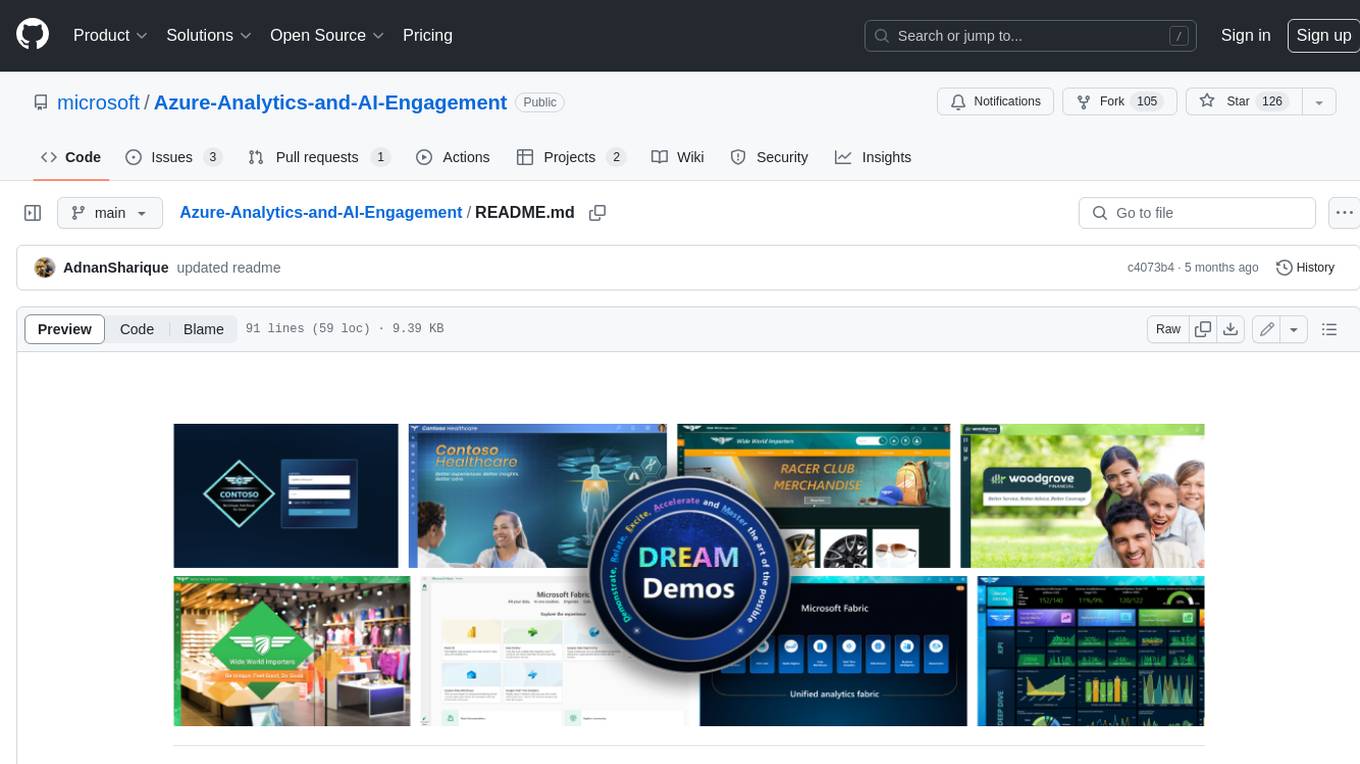
The Azure-Analytics-and-AI-Engagement repository provides packaged Industry Scenario DREAM Demos with ARM templates (Containing a demo web application, Power BI reports, Synapse resources, AML Notebooks etc.) that can be deployed in a customer’s subscription using the CAPE tool within a matter of few hours. Partners can also deploy DREAM Demos in their own subscriptions using DPoC.
sorrentum
Sorrentum is an open-source project that aims to combine open-source development, startups, and brilliant students to build machine learning, AI, and Web3 / DeFi protocols geared towards finance and economics. The project provides opportunities for internships, research assistantships, and development grants, as well as the chance to work on cutting-edge problems, learn about startups, write academic papers, and get internships and full-time positions at companies working on Sorrentum applications.
tidb
TiDB is an open-source distributed SQL database that supports Hybrid Transactional and Analytical Processing (HTAP) workloads. It is MySQL compatible and features horizontal scalability, strong consistency, and high availability.

zep-python
Zep is an open-source platform for building and deploying large language model (LLM) applications. It provides a suite of tools and services that make it easy to integrate LLMs into your applications, including chat history memory, embedding, vector search, and data enrichment. Zep is designed to be scalable, reliable, and easy to use, making it a great choice for developers who want to build LLM-powered applications quickly and easily.
telemetry-airflow
This repository codifies the Airflow cluster that is deployed at workflow.telemetry.mozilla.org (behind SSO) and commonly referred to as "WTMO" or simply "Airflow". Some links relevant to users and developers of WTMO: * The `dags` directory in this repository contains some custom DAG definitions * Many of the DAGs registered with WTMO don't live in this repository, but are instead generated from ETL task definitions in bigquery-etl * The Data SRE team maintains a WTMO Developer Guide (behind SSO)
mojo
Mojo is a new programming language that bridges the gap between research and production by combining Python syntax and ecosystem with systems programming and metaprogramming features. Mojo is still young, but it is designed to become a superset of Python over time.
pandas-ai
PandasAI is a Python library that makes it easy to ask questions to your data in natural language. It helps you to explore, clean, and analyze your data using generative AI.
databend
Databend is an open-source cloud data warehouse that serves as a cost-effective alternative to Snowflake. With its focus on fast query execution and data ingestion, it's designed for complex analysis of the world's largest datasets.
For similar jobs
weave
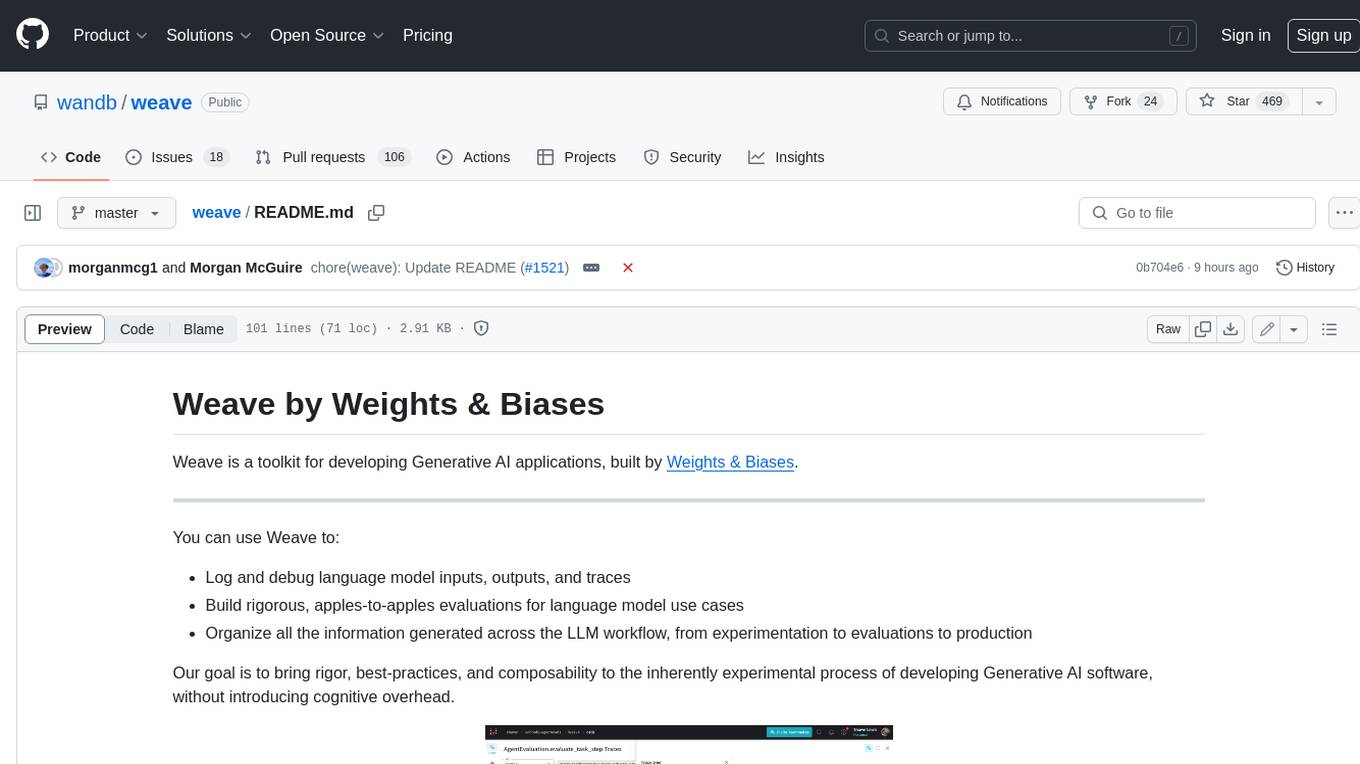
Weave is a toolkit for developing Generative AI applications, built by Weights & Biases. With Weave, you can log and debug language model inputs, outputs, and traces; build rigorous, apples-to-apples evaluations for language model use cases; and organize all the information generated across the LLM workflow, from experimentation to evaluations to production. Weave aims to bring rigor, best-practices, and composability to the inherently experimental process of developing Generative AI software, without introducing cognitive overhead.
LLMStack
LLMStack is a no-code platform for building generative AI agents, workflows, and chatbots. It allows users to connect their own data, internal tools, and GPT-powered models without any coding experience. LLMStack can be deployed to the cloud or on-premise and can be accessed via HTTP API or triggered from Slack or Discord.
VisionCraft
The VisionCraft API is a free API for using over 100 different AI models. From images to sound.
kaito
Kaito is an operator that automates the AI/ML inference model deployment in a Kubernetes cluster. It manages large model files using container images, avoids tuning deployment parameters to fit GPU hardware by providing preset configurations, auto-provisions GPU nodes based on model requirements, and hosts large model images in the public Microsoft Container Registry (MCR) if the license allows. Using Kaito, the workflow of onboarding large AI inference models in Kubernetes is largely simplified.
PyRIT
PyRIT is an open access automation framework designed to empower security professionals and ML engineers to red team foundation models and their applications. It automates AI Red Teaming tasks to allow operators to focus on more complicated and time-consuming tasks and can also identify security harms such as misuse (e.g., malware generation, jailbreaking), and privacy harms (e.g., identity theft). The goal is to allow researchers to have a baseline of how well their model and entire inference pipeline is doing against different harm categories and to be able to compare that baseline to future iterations of their model. This allows them to have empirical data on how well their model is doing today, and detect any degradation of performance based on future improvements.
tabby
Tabby is a self-hosted AI coding assistant, offering an open-source and on-premises alternative to GitHub Copilot. It boasts several key features: * Self-contained, with no need for a DBMS or cloud service. * OpenAPI interface, easy to integrate with existing infrastructure (e.g Cloud IDE). * Supports consumer-grade GPUs.
spear
SPEAR (Simulator for Photorealistic Embodied AI Research) is a powerful tool for training embodied agents. It features 300 unique virtual indoor environments with 2,566 unique rooms and 17,234 unique objects that can be manipulated individually. Each environment is designed by a professional artist and features detailed geometry, photorealistic materials, and a unique floor plan and object layout. SPEAR is implemented as Unreal Engine assets and provides an OpenAI Gym interface for interacting with the environments via Python.
Magick
Magick is a groundbreaking visual AIDE (Artificial Intelligence Development Environment) for no-code data pipelines and multimodal agents. Magick can connect to other services and comes with nodes and templates well-suited for intelligent agents, chatbots, complex reasoning systems and realistic characters.