


rill
Rill is a tool for effortlessly transforming data sets into powerful, opinionated dashboards using SQL. BI-as-code.
Stars: 2483
Rill delivers rapid, self-service dashboards for data engineers and analysts directly on raw data lakes, ensuring reliable, fast-loading dashboards with accurate, real-time metrics. It comes with an embedded in-memory database for lightning-fast performance and supports bringing your own OLAP engine. Rill implements BI-as-code through SQL-based definitions, YAML configuration, Git integration, and CLI tools. Its metrics layer provides a unified way to define, compute, and serve business metrics, while AI agents can access fresh metrics instantly for precise decision-making and intelligent automation.
README:







Docs • Install • Quickstart • Tutorials • Reference
Rill delivers the fastest path from data lake to dashboard. For data engineers and analysts, it provides rapid, self-service dashboards built directly on raw data lakes, eliminating traditional BI complexity. For data consumers, it ensures reliable, fast-loading dashboards with accurate, real-time metrics.
Download Rill to start modeling data and create fast, exploratory dashboards in minutes:
curl https://rill.sh | sh
rill start my-rill-project
Unlike most BI tools, Rill comes with its own embedded in-memory database powered by DuckDB or ClickHouse. Data and compute are co-located, and queries return in milliseconds, so you can pivot, slice, and drill-down into your data instantly.
We also support bringing your own OLAP engine as a live connector with pushdown compute capabilities.

- Table of Contents
- Rill's design principles:
- Core Concepts
- Learn More
- Production Examples
- Get in touch!
- Company
- License
- Lightning Fast - Powered by SvelteKit & DuckDB for conversationally fast performance
- Universal Data Support - Works with local and remote datasets (Parquet, CSV, S3, GCS, HTTPS, local)
- Automatic Profiling - Build intuition about your dataset through automatic profiling
- Real-time Response - Responds to each keystroke by re-profiling the resulting dataset
- Interactive Dashboards - Thoughtful, opinionated defaults for quick insights
- Dashboards as Code - Version control, Git sharing, and easy project rehydration
Rill implements BI-as-code through a combination of:
- SQL-based Definitions: Define your models via SQL to connect to your various sources
- YAML Configuration: Configure your metrics views, dashboards, and project settings via YAML
- Git Integration: Version control your analytics assets
- CLI Tools: Deploy and manage your analytics stack from the command line
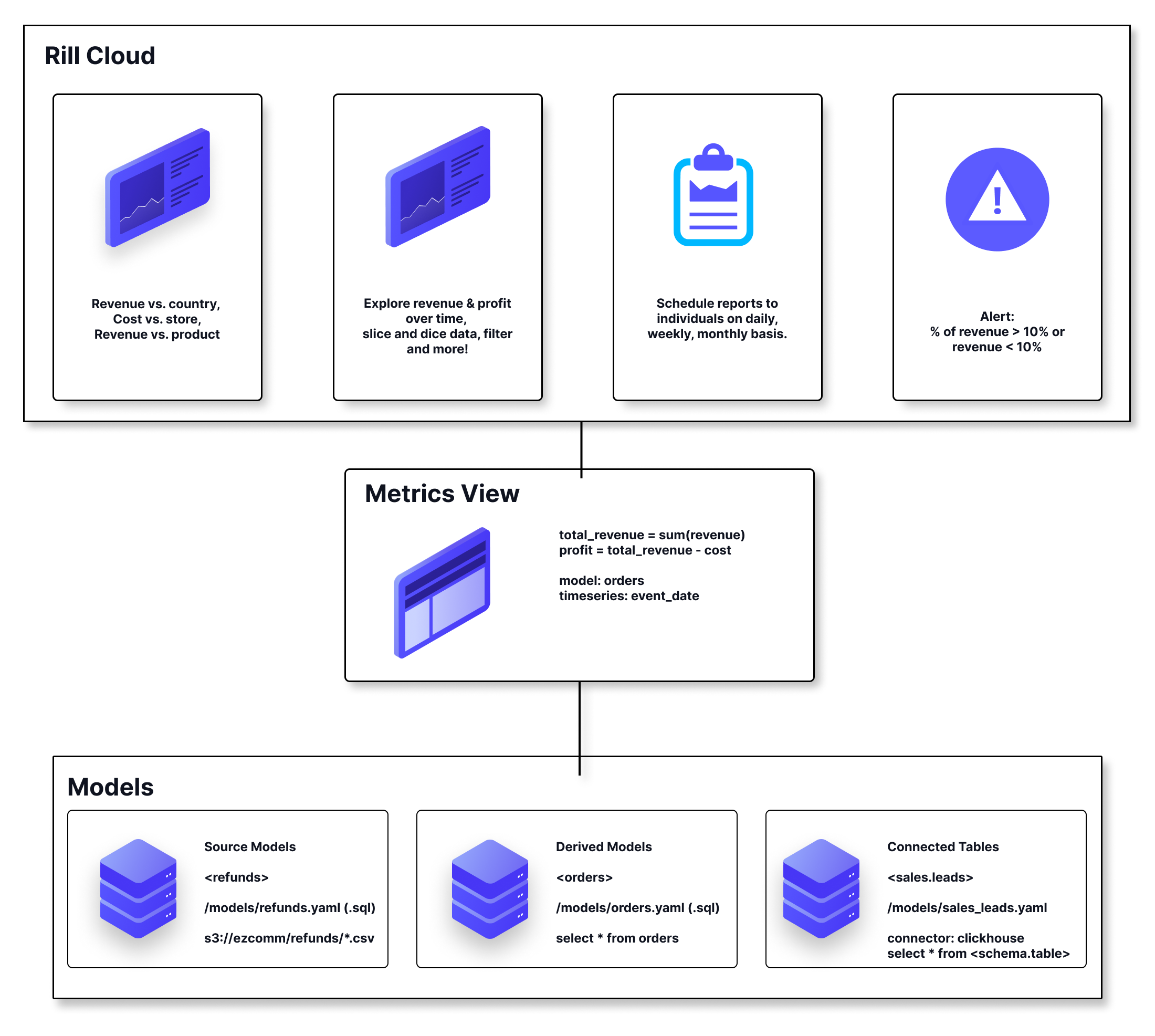
Rill's metrics layer provides a unified way to define, compute, and serve business metrics. Metrics views combine SQL models with YAML configuration to create standardized, reusable business metrics that can be consumed by dashboards, APIs, and AI systems.
Example Metrics View:
# metrics/revenue_metrics.yaml
name: revenue_metrics
description: Key revenue metrics by country and product
model: revenue_model
timeseries: date
dimensions:
  - name: country
    column: country
  - name: product_category
    column:product_category
measures:
  - name: total_revenue
    expression: sum(amount)
    description: Total revenue amount
  - name: order_count
    expression: count(*)
    description: Number of orders
  - name: avg_order_value
    expression: sum(amount) / count(*)
description: Average order valueWe understand the critical importance of AI and data in modern business intelligence. Our metrics layer is designed to provide AI systems with the structured, real-time data they need to deliver quick and accurate responses. By co-locating data and compute with embedded databases like DuckDB and ClickHouse, Rill eliminates the latency that traditional BI tools introduce, ensuring AI agents can access fresh metrics instantly for precise decision-making and intelligent automation.
For visual learners, take a look at our various playlists that explains what Rill is and how to get the most out of it!
Bidstream data for programmatic advertisers to optimize pricing strategies, look for inventory opportunities, and improve campaign performance.
Based on Rill's own internal dashboards, cloud infrastructure data (compute, storage, pipeline statistics, etc.) merged with customer data to analyze bottlenecks and look for efficiencies.
Analyze GitHub activity to understand what parts of your codebase are most active, analyze contributor productivity, and evaluate the intersections between commits and files.
A conversion dataset used by marketers, mobile developers, or product teams to analyze funnel steps.
A compilation of projects with deep dives into Rill's features using ClickHouse's GitHub commit information.
- Discord Community - Join discussions and get help
- GitHub Issues - Report bugs and request features
- Rill Guru - Ask questions and get expert answers
Rill is developed and maintained by Rill Data, Inc..
This project is licensed under the Apache License 2.0 - see the LICENSE file for details.
For Tasks:
Click tags to check more tools for each tasksFor Jobs:
Alternative AI tools for rill
Similar Open Source Tools
For similar tasks
langtrace
Langtrace is an open source observability software that lets you capture, debug, and analyze traces and metrics from all your applications that leverage LLM APIs, Vector Databases, and LLM-based Frameworks. It supports Open Telemetry Standards (OTEL), and the traces generated adhere to these standards. Langtrace offers both a managed SaaS version (Langtrace Cloud) and a self-hosted option. The SDKs for both Typescript/Javascript and Python are available, making it easy to integrate Langtrace into your applications. Langtrace automatically captures traces from various vendors, including OpenAI, Anthropic, Azure OpenAI, Langchain, LlamaIndex, Pinecone, and ChromaDB.
mlcraft
Synmetrix (prev. MLCraft) is an open source data engineering platform and semantic layer for centralized metrics management. It provides a complete framework for modeling, integrating, transforming, aggregating, and distributing metrics data at scale. Key features include data modeling and transformations, semantic layer for unified data model, scheduled reports and alerts, versioning, role-based access control, data exploration, caching, and collaboration on metrics modeling. Synmetrix leverages Cube (Cube.js) for flexible data models that consolidate metrics from various sources, enabling downstream distribution via a SQL API for integration into BI tools, reporting, dashboards, and data science. Use cases include data democratization, business intelligence, embedded analytics, and enhancing accuracy in data handling and queries. The tool speeds up data-driven workflows from metrics definition to consumption by combining data engineering best practices with self-service analytics capabilities.
synmetrix
Synmetrix is an open source data engineering platform and semantic layer for centralized metrics management. It provides a complete framework for modeling, integrating, transforming, aggregating, and distributing metrics data at scale. Key features include data modeling and transformations, semantic layer for unified data model, scheduled reports and alerts, versioning, role-based access control, data exploration, caching, and collaboration on metrics modeling. Synmetrix leverages Cube.js to consolidate metrics from various sources and distribute them downstream via a SQL API. Use cases include data democratization, business intelligence and reporting, embedded analytics, and enhancing accuracy in data handling and queries. The tool speeds up data-driven workflows from metrics definition to consumption by combining data engineering best practices with self-service analytics capabilities.
rtdl-num-embeddings
This repository provides the official implementation of the paper 'On Embeddings for Numerical Features in Tabular Deep Learning'. It focuses on transforming scalar continuous features into vectors before integrating them into the main backbone of tabular neural networks, showcasing improved performance. The embeddings for continuous features are shown to enhance the performance of tabular DL models and are applicable to various conventional backbones, offering efficiency comparable to Transformer-based models. The repository includes Python packages for practical usage, exploration of metrics and hyperparameters, and reproducing reported results for different algorithms and datasets.
VulBench
This repository contains materials for the paper 'How Far Have We Gone in Vulnerability Detection Using Large Language Model'. It provides a tool for evaluating vulnerability detection models using datasets such as d2a, ctf, magma, big-vul, and devign. Users can query the model 'Llama-2-7b-chat-hf' and store results in a SQLite database for analysis. The tool supports binary and multiple classification tasks with concurrency settings. Additionally, users can evaluate the results and generate a CSV file with metrics for each dataset and prompt type.
agentneo
AgentNeo is a Python package that provides functionalities for project, trace, dataset, experiment management. It allows users to authenticate, create projects, trace agents and LangGraph graphs, manage datasets, and run experiments with metrics. The tool aims to streamline AI project management and analysis by offering a comprehensive set of features.
hyperfy
Hyperfy is a powerful tool for automating social media marketing tasks. It provides a user-friendly interface to schedule posts, analyze performance metrics, and engage with followers across multiple platforms. With Hyperfy, users can save time and effort by streamlining their social media management processes in one centralized platform.
rill
Rill delivers rapid, self-service dashboards for data engineers and analysts directly on raw data lakes, ensuring reliable, fast-loading dashboards with accurate, real-time metrics. It comes with an embedded in-memory database for lightning-fast performance and supports bringing your own OLAP engine. Rill implements BI-as-code through SQL-based definitions, YAML configuration, Git integration, and CLI tools. Its metrics layer provides a unified way to define, compute, and serve business metrics, while AI agents can access fresh metrics instantly for precise decision-making and intelligent automation.
For similar jobs
sweep
Sweep is an AI junior developer that turns bugs and feature requests into code changes. It automatically handles developer experience improvements like adding type hints and improving test coverage.
teams-ai
The Teams AI Library is a software development kit (SDK) that helps developers create bots that can interact with Teams and Microsoft 365 applications. It is built on top of the Bot Framework SDK and simplifies the process of developing bots that interact with Teams' artificial intelligence capabilities. The SDK is available for JavaScript/TypeScript, .NET, and Python.
ai-guide
This guide is dedicated to Large Language Models (LLMs) that you can run on your home computer. It assumes your PC is a lower-end, non-gaming setup.
classifai
Supercharge WordPress Content Workflows and Engagement with Artificial Intelligence. Tap into leading cloud-based services like OpenAI, Microsoft Azure AI, Google Gemini and IBM Watson to augment your WordPress-powered websites. Publish content faster while improving SEO performance and increasing audience engagement. ClassifAI integrates Artificial Intelligence and Machine Learning technologies to lighten your workload and eliminate tedious tasks, giving you more time to create original content that matters.
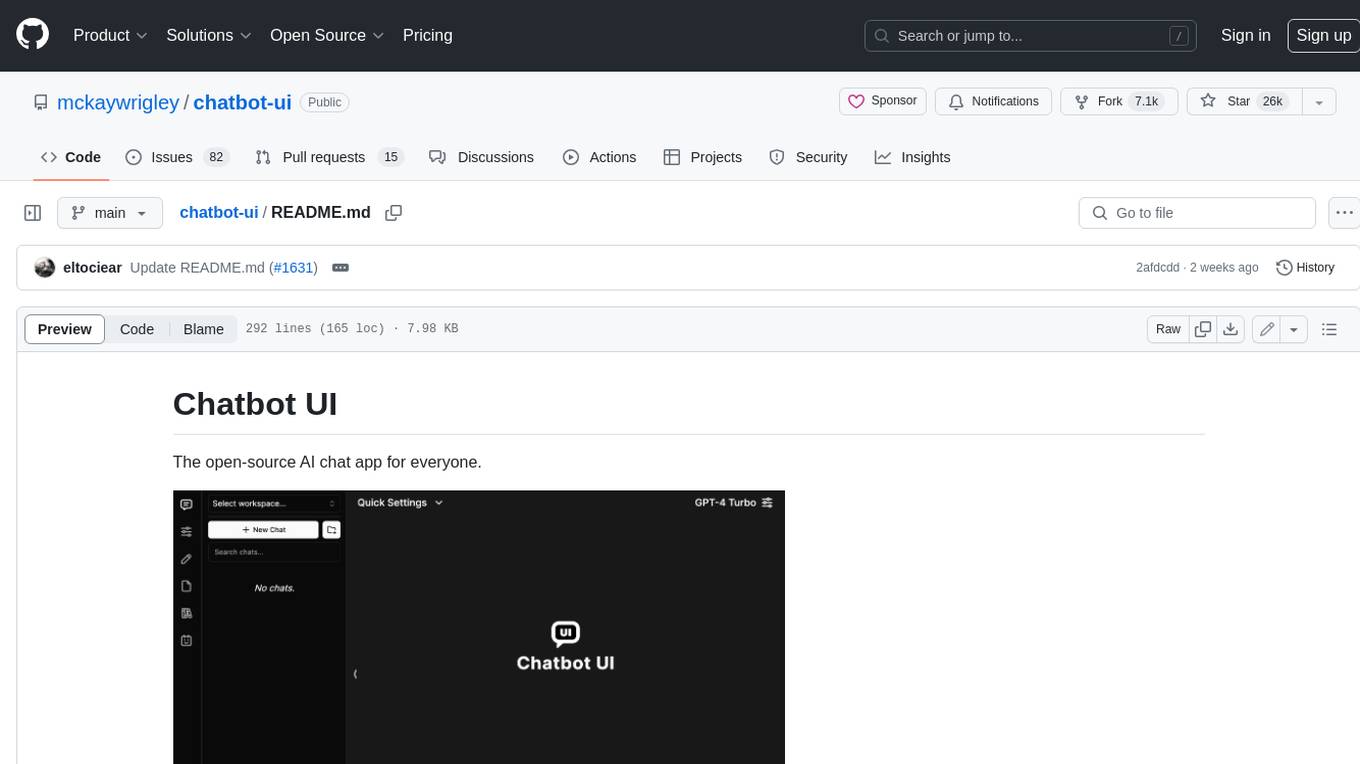
chatbot-ui
Chatbot UI is an open-source AI chat app that allows users to create and deploy their own AI chatbots. It is easy to use and can be customized to fit any need. Chatbot UI is perfect for businesses, developers, and anyone who wants to create a chatbot.
BricksLLM
BricksLLM is a cloud native AI gateway written in Go. Currently, it provides native support for OpenAI, Anthropic, Azure OpenAI and vLLM. BricksLLM aims to provide enterprise level infrastructure that can power any LLM production use cases. Here are some use cases for BricksLLM: * Set LLM usage limits for users on different pricing tiers * Track LLM usage on a per user and per organization basis * Block or redact requests containing PIIs * Improve LLM reliability with failovers, retries and caching * Distribute API keys with rate limits and cost limits for internal development/production use cases * Distribute API keys with rate limits and cost limits for students
uAgents
uAgents is a Python library developed by Fetch.ai that allows for the creation of autonomous AI agents. These agents can perform various tasks on a schedule or take action on various events. uAgents are easy to create and manage, and they are connected to a fast-growing network of other uAgents. They are also secure, with cryptographically secured messages and wallets.
griptape
Griptape is a modular Python framework for building AI-powered applications that securely connect to your enterprise data and APIs. It offers developers the ability to maintain control and flexibility at every step. Griptape's core components include Structures (Agents, Pipelines, and Workflows), Tasks, Tools, Memory (Conversation Memory, Task Memory, and Meta Memory), Drivers (Prompt and Embedding Drivers, Vector Store Drivers, Image Generation Drivers, Image Query Drivers, SQL Drivers, Web Scraper Drivers, and Conversation Memory Drivers), Engines (Query Engines, Extraction Engines, Summary Engines, Image Generation Engines, and Image Query Engines), and additional components (Rulesets, Loaders, Artifacts, Chunkers, and Tokenizers). Griptape enables developers to create AI-powered applications with ease and efficiency.