


hyperfy
World building for everyone
Stars: 131
Hyperfy is a powerful tool for automating social media marketing tasks. It provides a user-friendly interface to schedule posts, analyze performance metrics, and engage with followers across multiple platforms. With Hyperfy, users can save time and effort by streamlining their social media management processes in one centralized platform.
README:

- Standalone persistent world
- Host them on your own domain
- Connect via Hyperfy for portable avatars
- Realtime content creation in-world
- Realtime coding in-world (for devs)
- Fully interactive and interoperable app format
- Highly extensible
- Live events
- Storefronts
- Podcasts
- Gaming
- Social
- Node 22.11.0+ (eg via nvm)
git clone https://github.com/hyperfy-xyz/hyperfy.git my-world
cd my-world
cp .env.example .env
npm install
npm run devThis project is still in alpha as we transition all of our reference platform code into fully self hostable worlds. Most features are already here in this repo but still need to be connected up to work with self hosting in mind. Note that APIs are highly likely to change during this time.
For Tasks:
Click tags to check more tools for each tasksFor Jobs:
Alternative AI tools for hyperfy
Similar Open Source Tools
hyperfy
Hyperfy is a powerful tool for automating social media marketing tasks. It provides a user-friendly interface to schedule posts, analyze performance metrics, and engage with followers across multiple platforms. With Hyperfy, users can save time and effort by streamlining their social media management processes in one centralized platform.
supervisely
Supervisely is a computer vision platform that provides a range of tools and services for developing and deploying computer vision solutions. It includes a data labeling platform, a model training platform, and a marketplace for computer vision apps. Supervisely is used by a variety of organizations, including Fortune 500 companies, research institutions, and government agencies.
buildel
Buildel is an AI automation platform that empowers users to create versatile workflows without writing code. It supports multiple providers and interfaces, offers pre-built use cases, and allows users to bring their own API keys. Ideal for AI-powered document retrieval, conversational interfaces, and data integration. Users can get started at app.buildel.ai or run Buildel locally with Node.js, Elixir/Erlang, Docker, Git, and JQ installed. Join the community on Discord for support and discussions.
naas
Naas (Notebooks as a service) is an open source platform that enables users to create powerful data engines combining automation, analytics, and AI from Jupyter notebooks. It offers features like templates for automated data jobs and reports, drivers for data connectivity, and production-ready environment with scheduling and notifications. Naas aims to provide an alternative to Google Colab with enhanced low-code layers.
countly-server
Countly is a privacy-first, AI-ready analytics and customer engagement platform built for organizations that require full data ownership and deployment flexibility. It can be deployed on-premises or in a private cloud, giving complete control over data, infrastructure, compliance, and security. Teams use Countly to understand user behavior across mobile, web, desktop, and connected devices, optimize product and customer experiences in real time, and automate and personalize customer engagement across channels. With flexible data tracking, customizable dashboards, and a modular plugin-based architecture, Countly scales with the product while ensuring long-term autonomy and zero vendor lock-in. Built for privacy, designed for flexibility, and ready for AI-driven innovation.
mindsdb
MindsDB is a platform for customizing AI from enterprise data. You can create, serve, and fine-tune models in real-time from your database, vector store, and application data. MindsDB "enhances" SQL syntax with AI capabilities to make it accessible for developers worldwide. With MindsDB’s nearly 200 integrations, any developer can create AI customized for their purpose, faster and more securely. Their AI systems will constantly improve themselves — using companies’ own data, in real-time.
nocobase
NocoBase is an extensible AI-powered no-code platform that offers total control, infinite extensibility, and AI collaboration. It enables teams to adapt quickly and reduce costs without the need for years of development or wasted resources. With NocoBase, users can deploy the platform in minutes and have complete control over their projects. The platform is data model-driven, allowing for unlimited possibilities by decoupling UI and data structure. It integrates AI capabilities seamlessly into business systems, enabling roles such as translator, analyst, researcher, or assistant. NocoBase provides a simple and intuitive user experience with a 'what you see is what you get' approach. It is designed for extension through its plugin-based architecture, allowing users to customize and extend functionalities easily.
InvokeAI
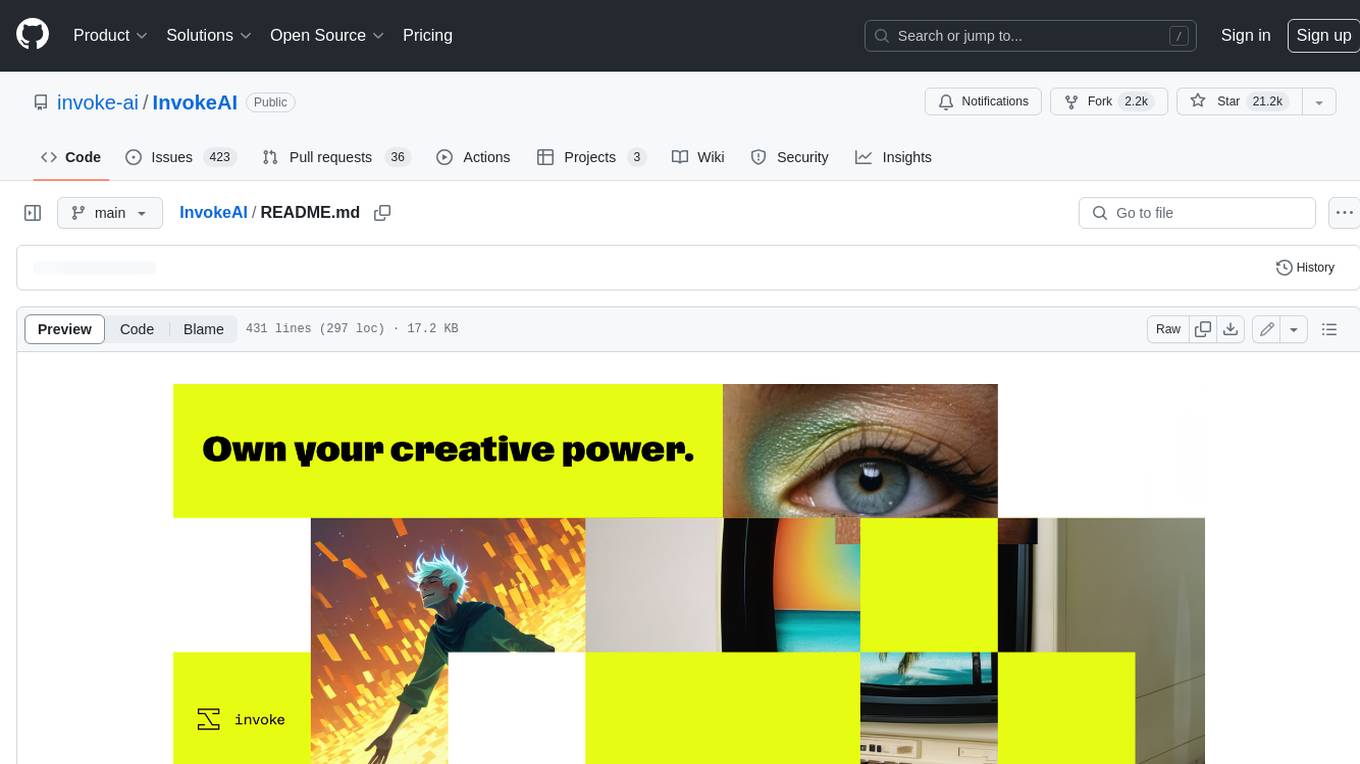
InvokeAI is a leading creative engine built to empower professionals and enthusiasts alike. Generate and create stunning visual media using the latest AI-driven technologies. InvokeAI offers an industry leading Web Interface, interactive Command Line Interface, and also serves as the foundation for multiple commercial products.
web-llm-chat
WebLLM Chat is a private AI chat interface that combines WebLLM with a user-friendly design, leveraging WebGPU to run large language models natively in your browser. It offers browser-native AI experience with WebGPU acceleration, guaranteed privacy as all data processing happens locally, offline accessibility, user-friendly interface with markdown support, and open-source customization. The project aims to democratize AI technology by making powerful tools accessible directly to end-users, enhancing the chatting experience and broadening the scope for deployment of self-hosted and customizable language models.
singulatron
Singulatron is an AI Superplatform that runs on your computer(s) and server(s) without using third party APIs, providing complete control over data and privacy. It offers AI functionality, user management, supports different database backends, collaboration, and mini-apps. It aims to be a desktop app for local usage and a distributed daemon for servers, with a web app frontend client. The tool is stack-based on Electron, Angular, and Go, and currently dual-licensed under AGPL-3.0-or-later and a commercial license.
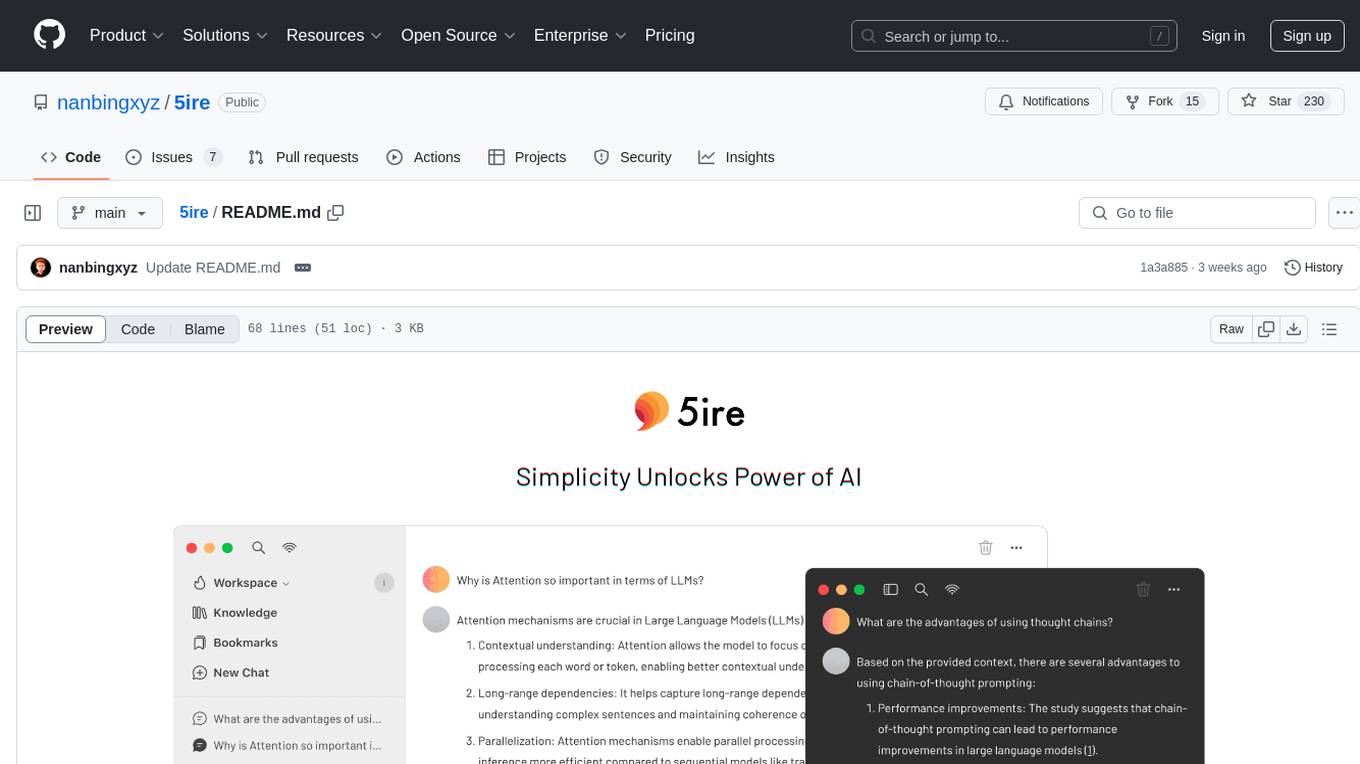
5ire
5ire is a cross-platform desktop client that integrates a local knowledge base for multilingual vectorization, supports parsing and vectorization of various document formats, offers usage analytics to track API spending, provides a prompts library for creating and organizing prompts with variable support, allows bookmarking of conversations, and enables quick keyword searches across conversations. It is licensed under the GNU General Public License version 3.
posthog
PostHog is an all-in-one, open source platform for building successful products. It provides tools for product analytics, web analytics, session replays, feature flags, experiments, error tracking, surveys, data warehouse, data pipelines, LLM analytics, and workflows. Users can get started with a generous free tier, self-host the platform, or use PostHog Cloud. The platform supports various SDKs and libraries for popular languages and frameworks, making it versatile and easy to integrate. PostHog is suitable for teams looking to understand user behavior, improve product performance, and automate actions or messages to users.
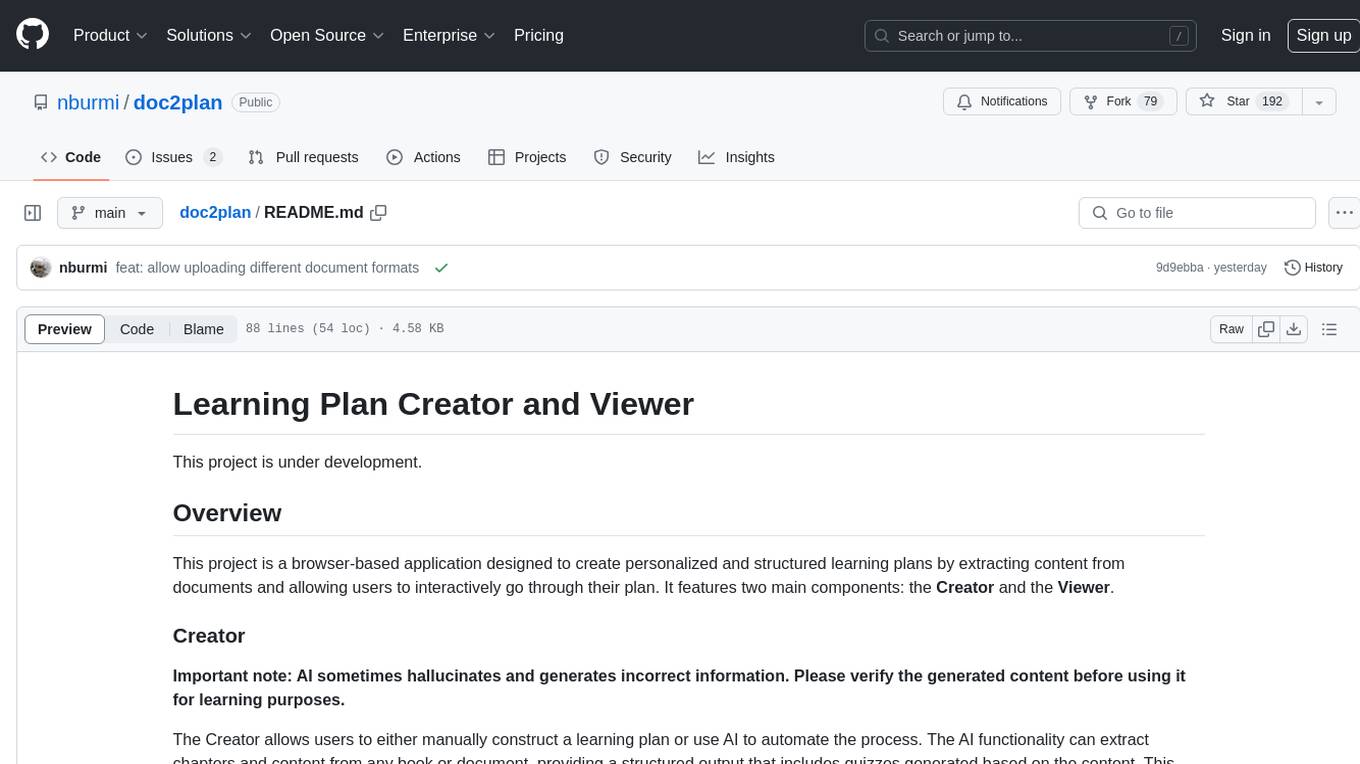
doc2plan
doc2plan is a browser-based application that helps users create personalized learning plans by extracting content from documents. It features a Creator for manual or AI-assisted plan construction and a Viewer for interactive plan navigation. Users can extract chapters, key topics, generate quizzes, and track progress. The application includes AI-driven content extraction, quiz generation, progress tracking, plan import/export, assistant management, customizable settings, viewer chat with text-to-speech and speech-to-text support, and integration with various Retrieval-Augmented Generation (RAG) models. It aims to simplify the creation of comprehensive learning modules tailored to individual needs.
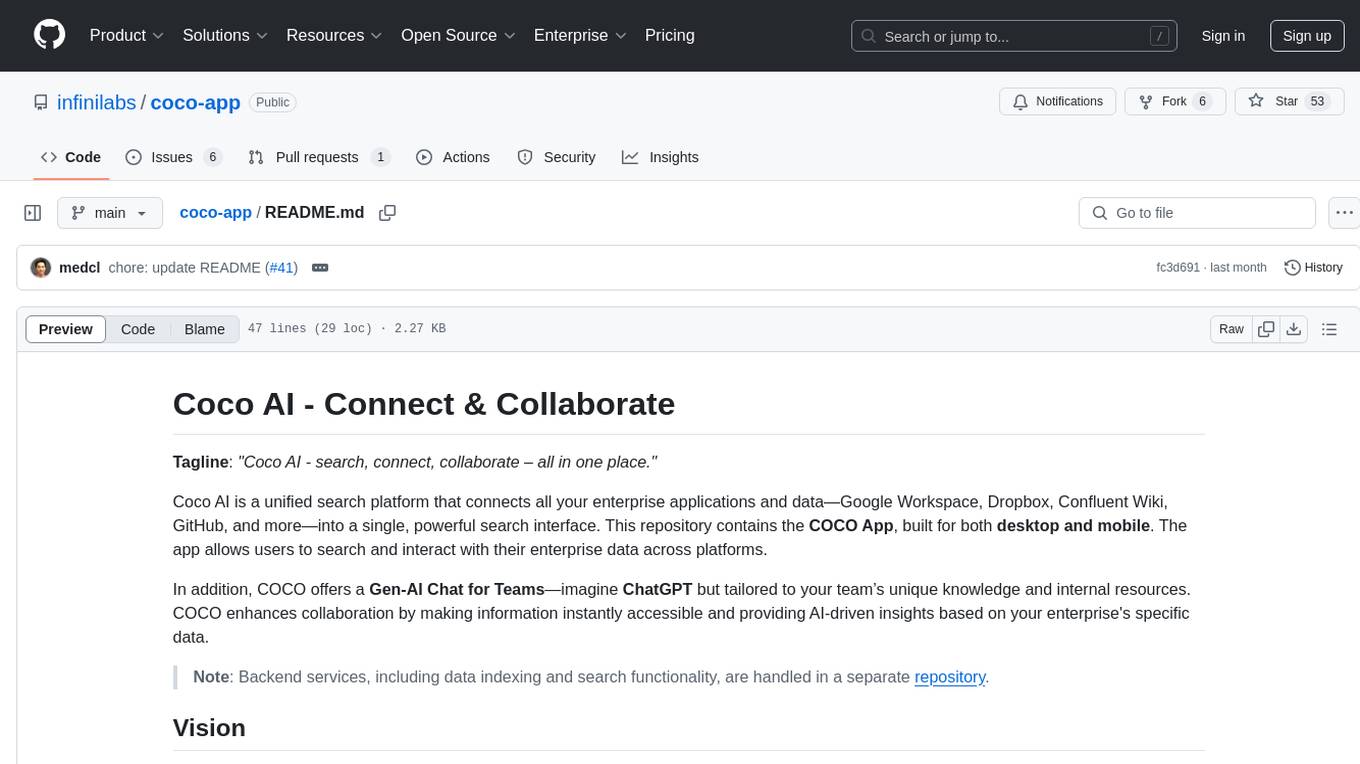
coco-app
Coco AI is a unified search platform that connects enterprise applications and data into a single, powerful search interface. The COCO App allows users to search and interact with their enterprise data across platforms. It also offers a Gen-AI Chat for Teams tailored to team's unique knowledge and internal resources, enhancing collaboration by making information instantly accessible and providing AI-driven insights based on enterprise's specific data.
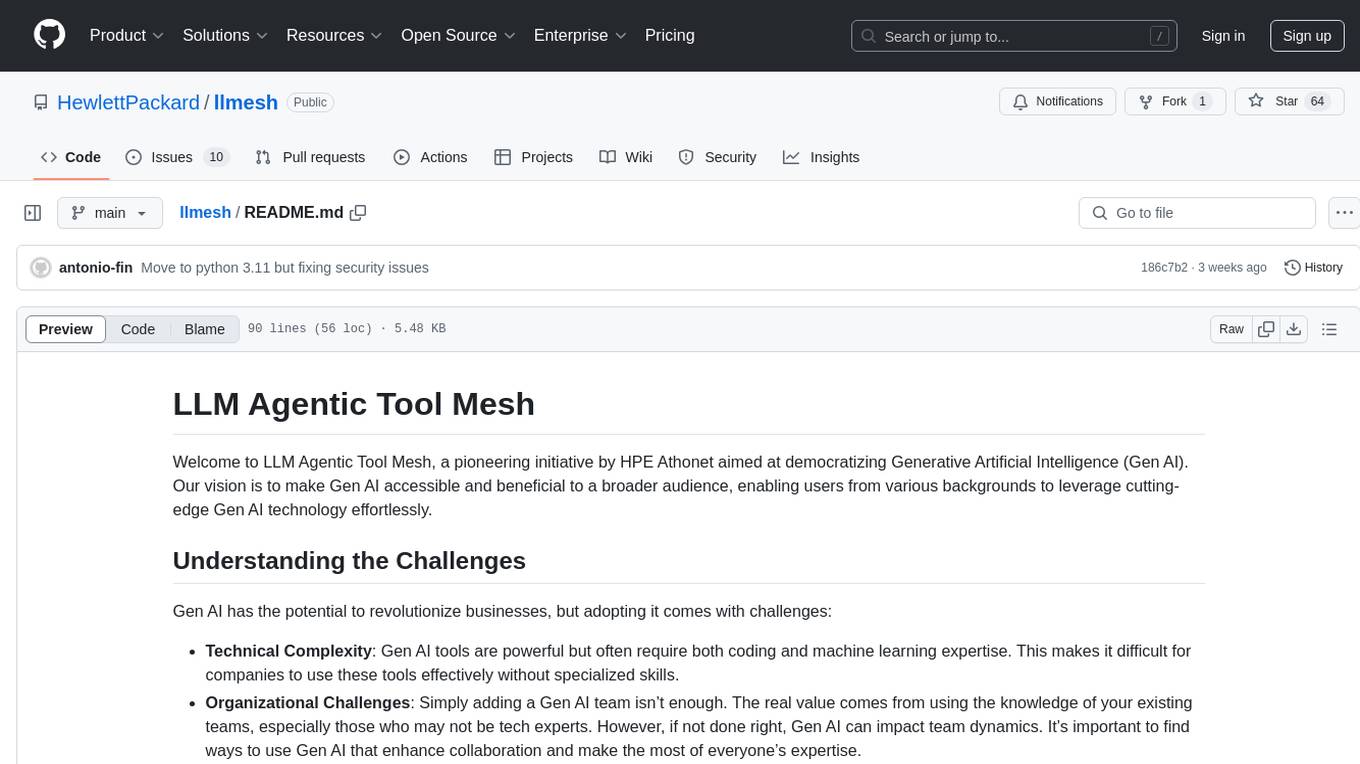
llmesh
LLM Agentic Tool Mesh is a platform by HPE Athonet that democratizes Generative Artificial Intelligence (Gen AI) by enabling users to create tools and web applications using Gen AI with Low or No Coding. The platform simplifies the integration process, focuses on key user needs, and abstracts complex libraries into easy-to-understand services. It empowers both technical and non-technical teams to develop tools related to their expertise and provides orchestration capabilities through an agentic Reasoning Engine based on Large Language Models (LLMs) to ensure seamless tool integration and enhance organizational functionality and efficiency.
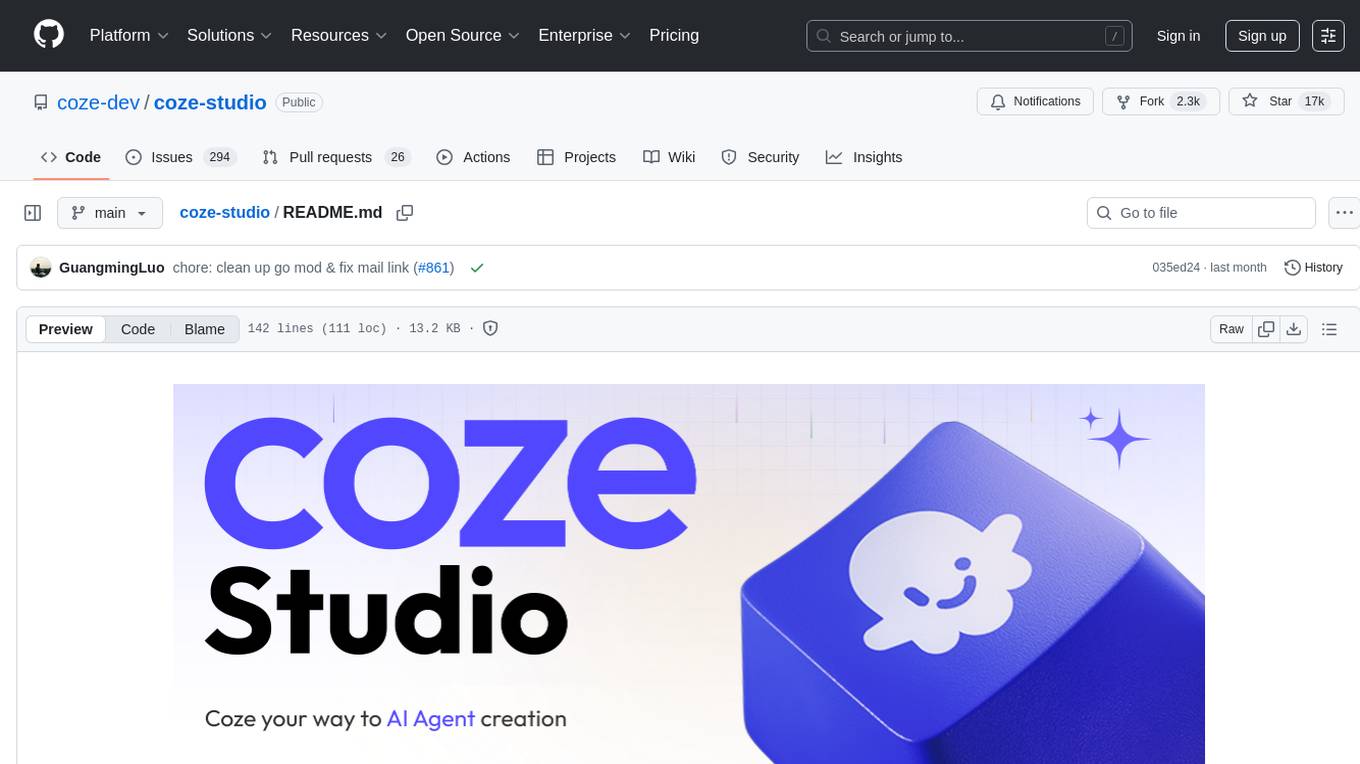
coze-studio
Coze Studio is an all-in-one AI agent development tool that offers the most convenient AI agent development environment, from development to deployment. It provides core technologies for AI agent development, complete app templates, and build frameworks. Coze Studio aims to simplify creating, debugging, and deploying AI agents through visual design and build tools, enabling powerful AI app development and customized business logic. The tool is developed using Golang for the backend, React + TypeScript for the frontend, and follows microservices architecture based on domain-driven design principles.
For similar tasks
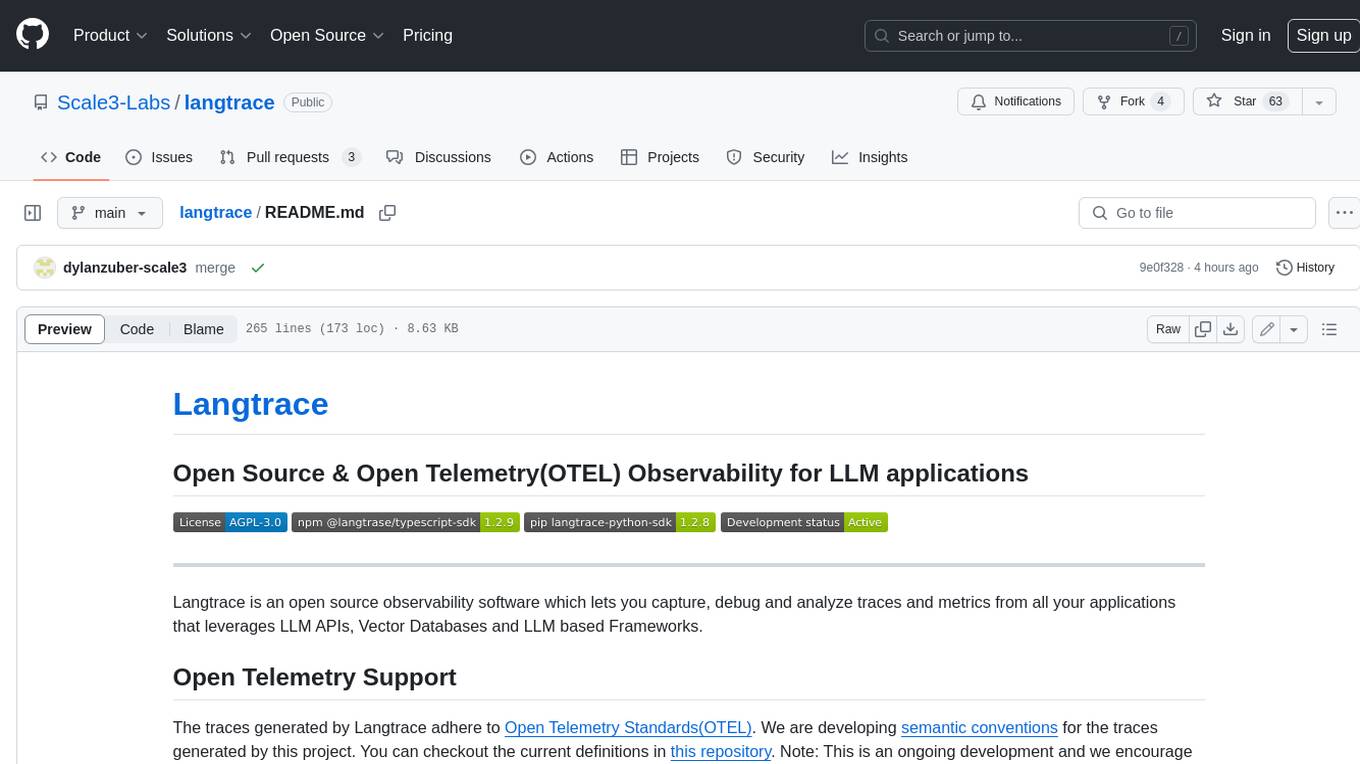
langtrace
Langtrace is an open source observability software that lets you capture, debug, and analyze traces and metrics from all your applications that leverage LLM APIs, Vector Databases, and LLM-based Frameworks. It supports Open Telemetry Standards (OTEL), and the traces generated adhere to these standards. Langtrace offers both a managed SaaS version (Langtrace Cloud) and a self-hosted option. The SDKs for both Typescript/Javascript and Python are available, making it easy to integrate Langtrace into your applications. Langtrace automatically captures traces from various vendors, including OpenAI, Anthropic, Azure OpenAI, Langchain, LlamaIndex, Pinecone, and ChromaDB.
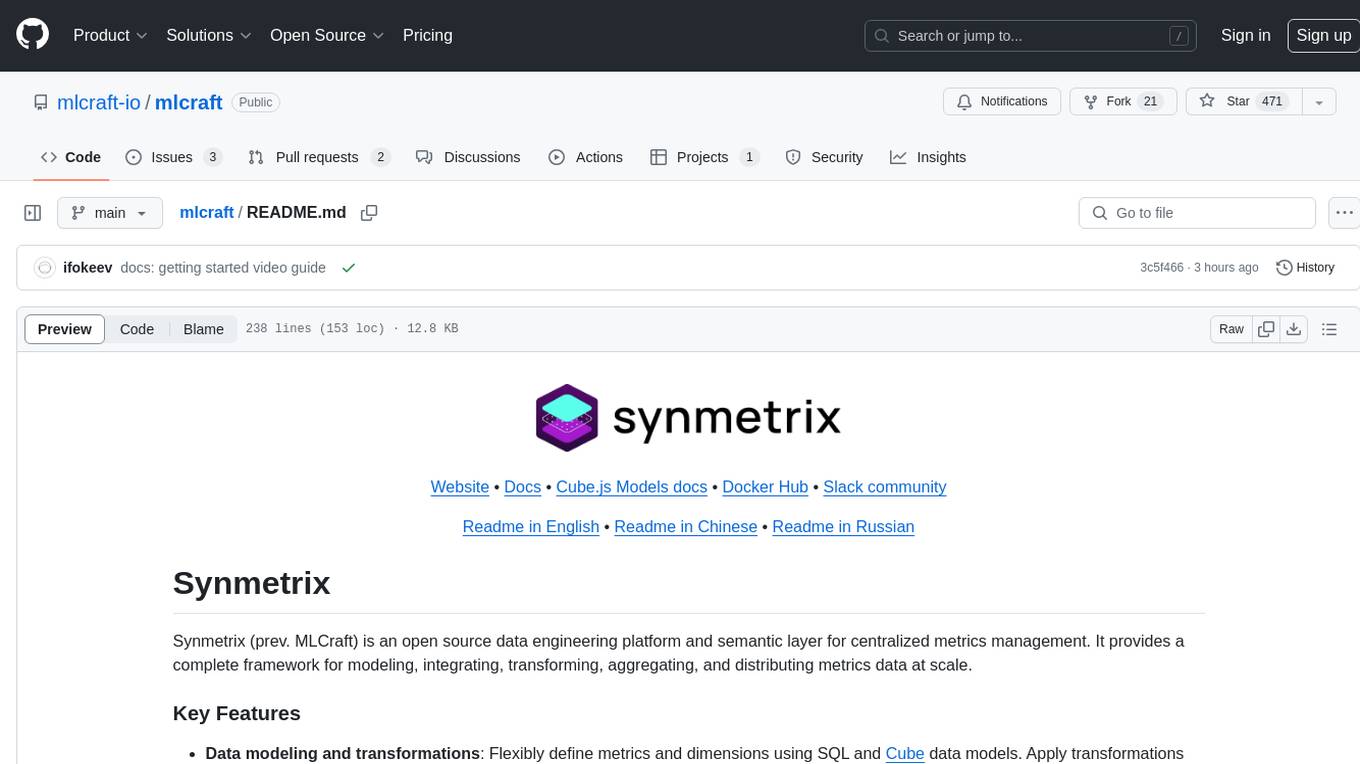
mlcraft
Synmetrix (prev. MLCraft) is an open source data engineering platform and semantic layer for centralized metrics management. It provides a complete framework for modeling, integrating, transforming, aggregating, and distributing metrics data at scale. Key features include data modeling and transformations, semantic layer for unified data model, scheduled reports and alerts, versioning, role-based access control, data exploration, caching, and collaboration on metrics modeling. Synmetrix leverages Cube (Cube.js) for flexible data models that consolidate metrics from various sources, enabling downstream distribution via a SQL API for integration into BI tools, reporting, dashboards, and data science. Use cases include data democratization, business intelligence, embedded analytics, and enhancing accuracy in data handling and queries. The tool speeds up data-driven workflows from metrics definition to consumption by combining data engineering best practices with self-service analytics capabilities.
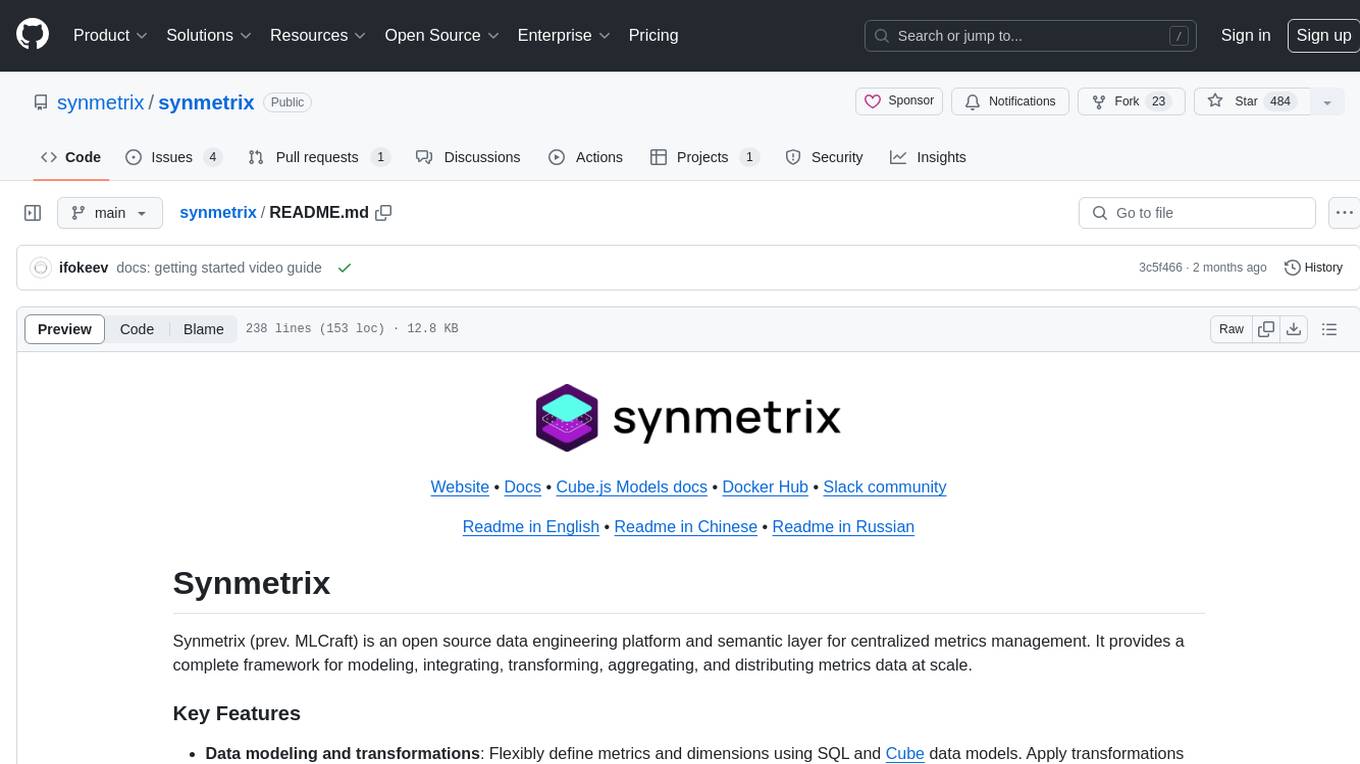
synmetrix
Synmetrix is an open source data engineering platform and semantic layer for centralized metrics management. It provides a complete framework for modeling, integrating, transforming, aggregating, and distributing metrics data at scale. Key features include data modeling and transformations, semantic layer for unified data model, scheduled reports and alerts, versioning, role-based access control, data exploration, caching, and collaboration on metrics modeling. Synmetrix leverages Cube.js to consolidate metrics from various sources and distribute them downstream via a SQL API. Use cases include data democratization, business intelligence and reporting, embedded analytics, and enhancing accuracy in data handling and queries. The tool speeds up data-driven workflows from metrics definition to consumption by combining data engineering best practices with self-service analytics capabilities.
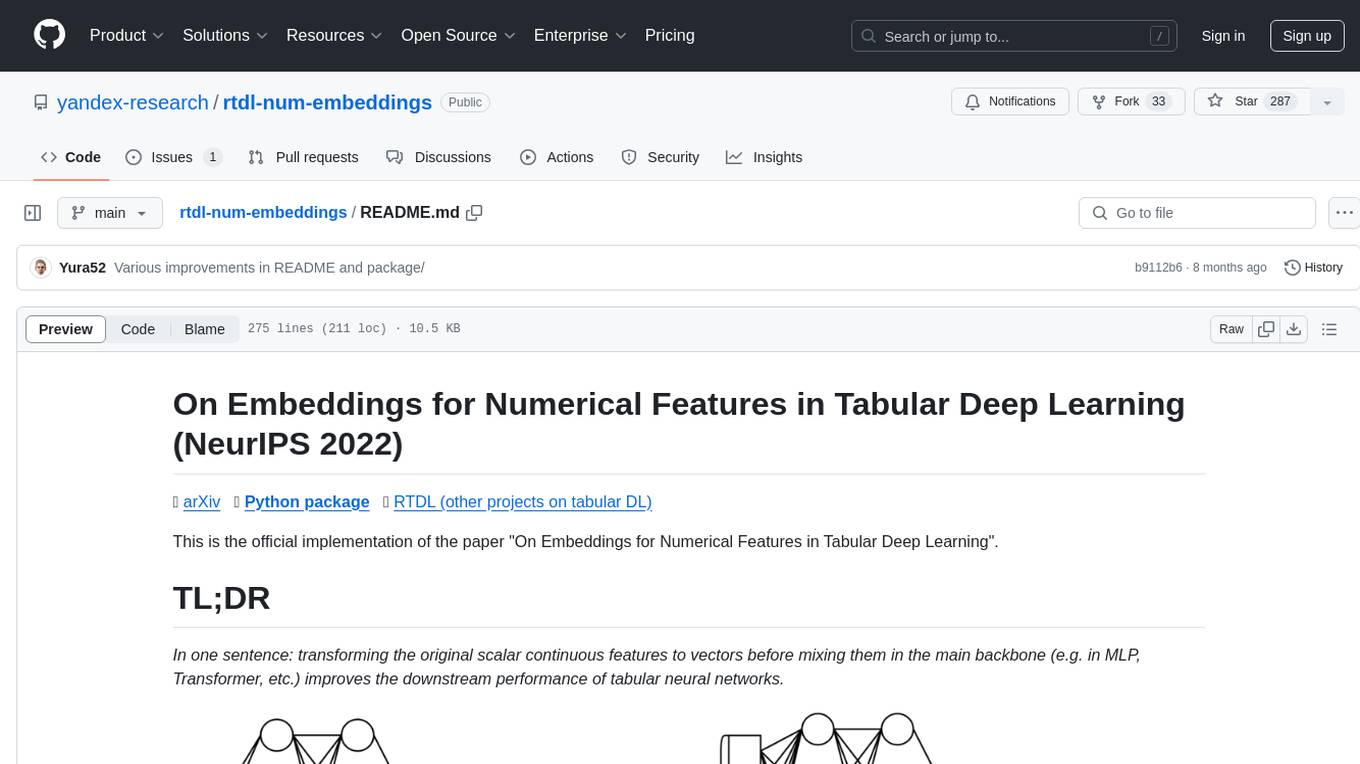
rtdl-num-embeddings
This repository provides the official implementation of the paper 'On Embeddings for Numerical Features in Tabular Deep Learning'. It focuses on transforming scalar continuous features into vectors before integrating them into the main backbone of tabular neural networks, showcasing improved performance. The embeddings for continuous features are shown to enhance the performance of tabular DL models and are applicable to various conventional backbones, offering efficiency comparable to Transformer-based models. The repository includes Python packages for practical usage, exploration of metrics and hyperparameters, and reproducing reported results for different algorithms and datasets.
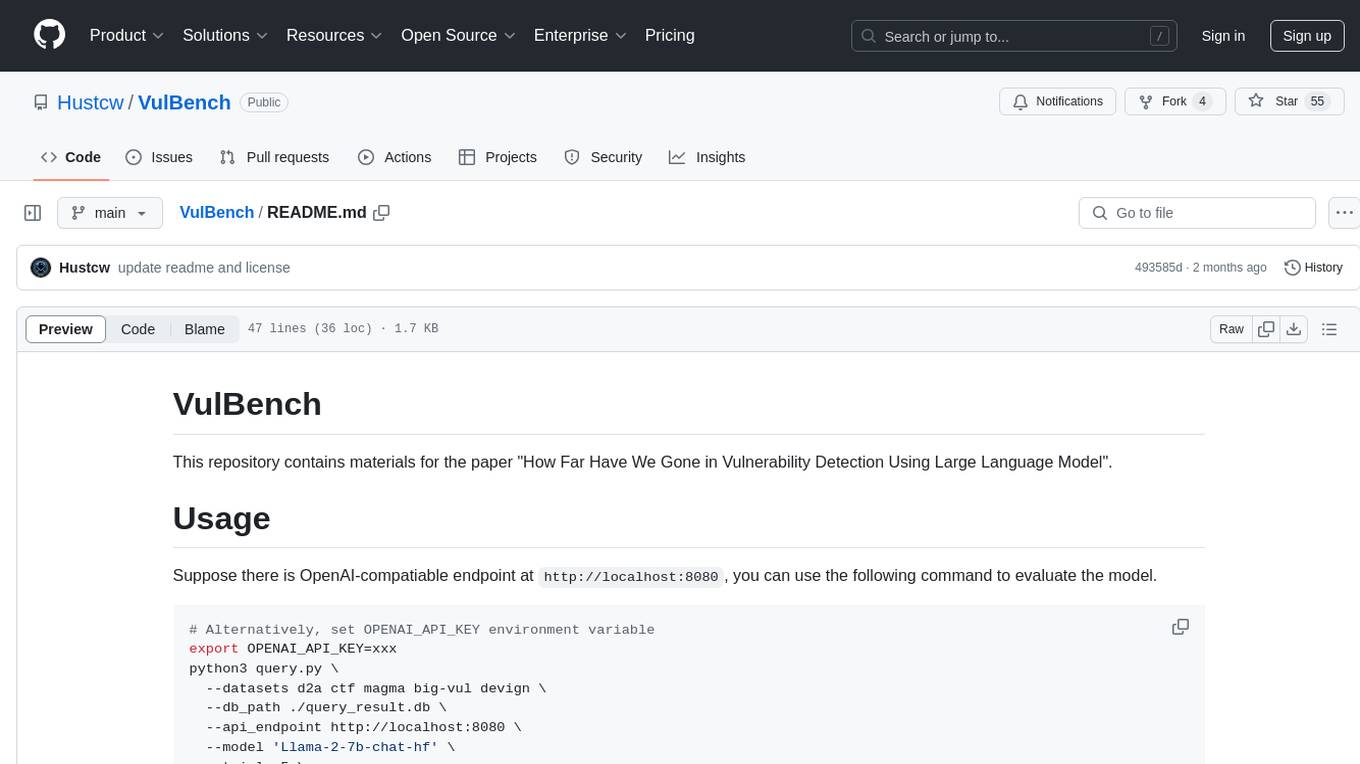
VulBench
This repository contains materials for the paper 'How Far Have We Gone in Vulnerability Detection Using Large Language Model'. It provides a tool for evaluating vulnerability detection models using datasets such as d2a, ctf, magma, big-vul, and devign. Users can query the model 'Llama-2-7b-chat-hf' and store results in a SQLite database for analysis. The tool supports binary and multiple classification tasks with concurrency settings. Additionally, users can evaluate the results and generate a CSV file with metrics for each dataset and prompt type.
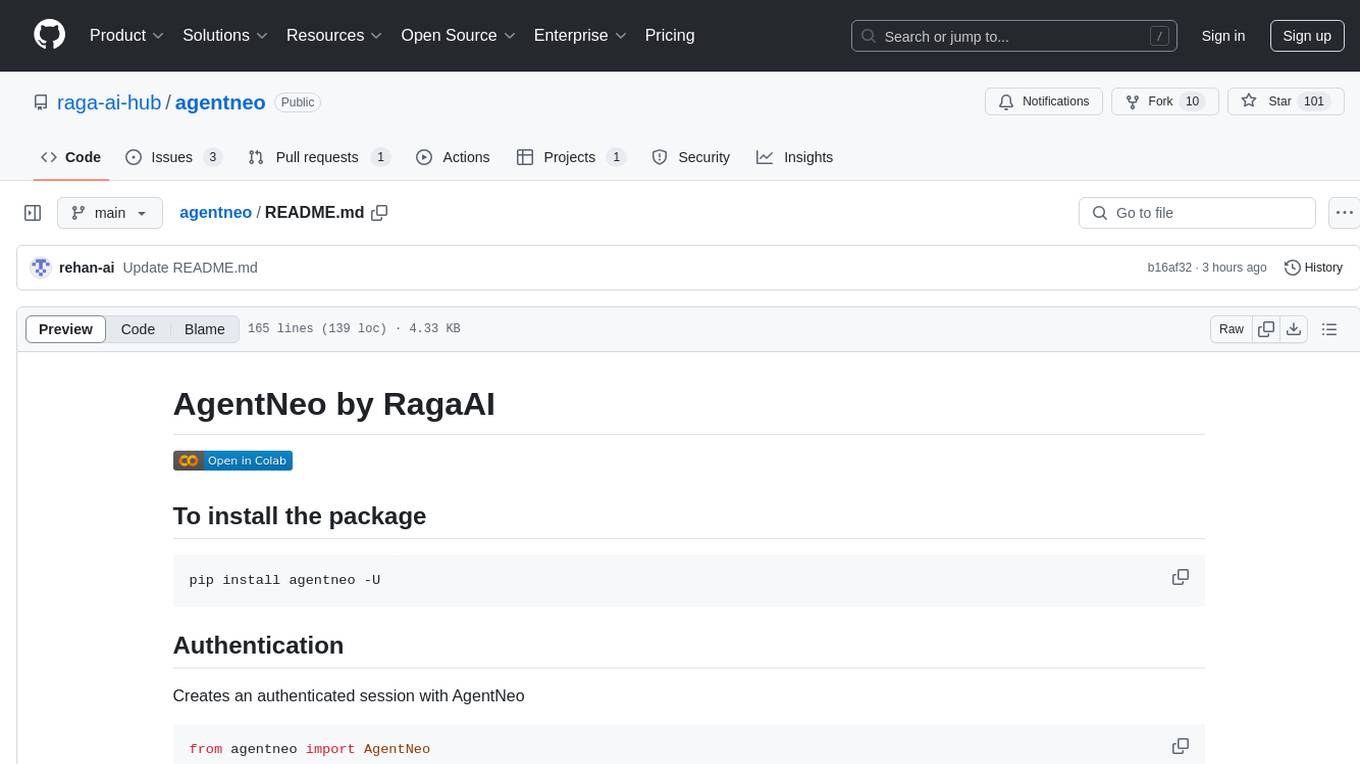
agentneo
AgentNeo is a Python package that provides functionalities for project, trace, dataset, experiment management. It allows users to authenticate, create projects, trace agents and LangGraph graphs, manage datasets, and run experiments with metrics. The tool aims to streamline AI project management and analysis by offering a comprehensive set of features.
hyperfy
Hyperfy is a powerful tool for automating social media marketing tasks. It provides a user-friendly interface to schedule posts, analyze performance metrics, and engage with followers across multiple platforms. With Hyperfy, users can save time and effort by streamlining their social media management processes in one centralized platform.
rill
Rill delivers rapid, self-service dashboards for data engineers and analysts directly on raw data lakes, ensuring reliable, fast-loading dashboards with accurate, real-time metrics. It comes with an embedded in-memory database for lightning-fast performance and supports bringing your own OLAP engine. Rill implements BI-as-code through SQL-based definitions, YAML configuration, Git integration, and CLI tools. Its metrics layer provides a unified way to define, compute, and serve business metrics, while AI agents can access fresh metrics instantly for precise decision-making and intelligent automation.
For similar jobs
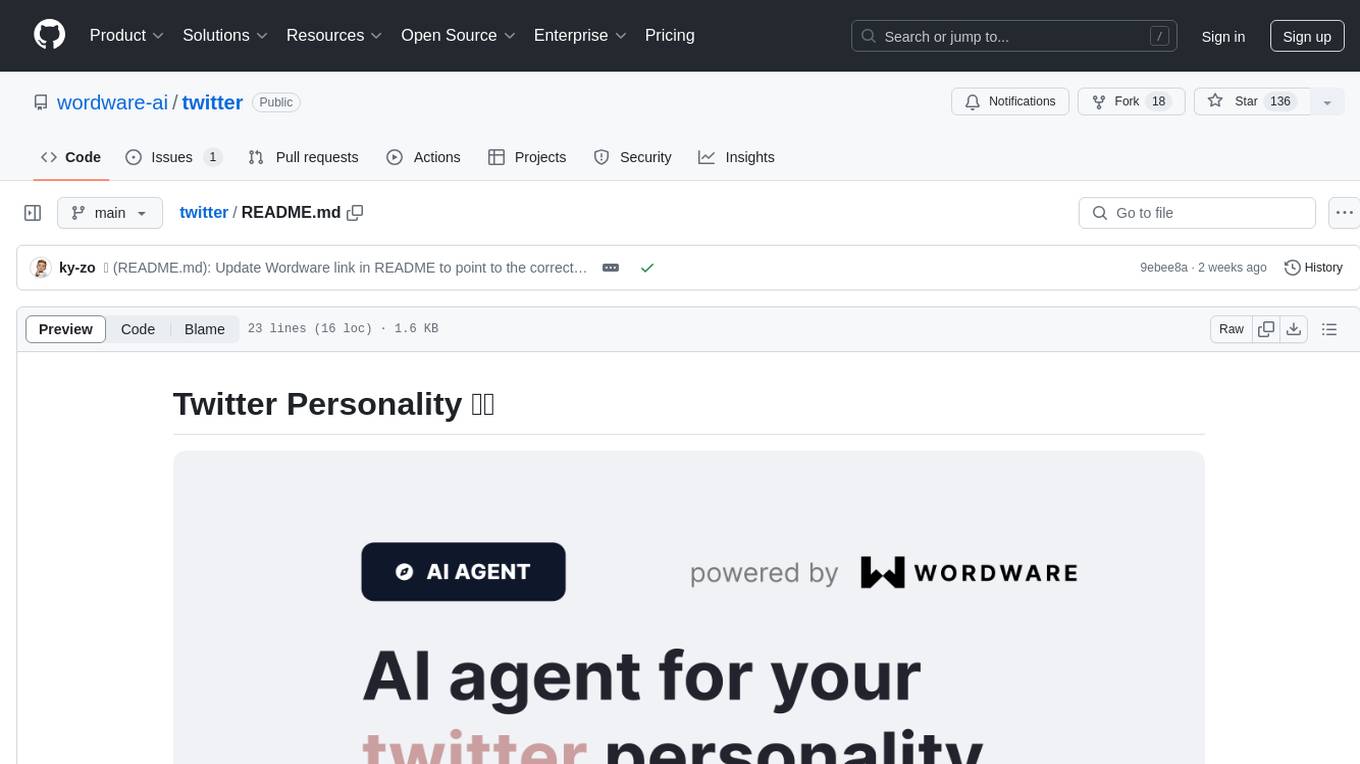
Twitter Personality is a web application that analyzes Twitter handles to create personalized personality profiles using Wordware AI Agent. It leverages cutting-edge AI technologies to provide unique insights into Twitter personas. The project allows users to explore the AI agent and prompts through a web interface.
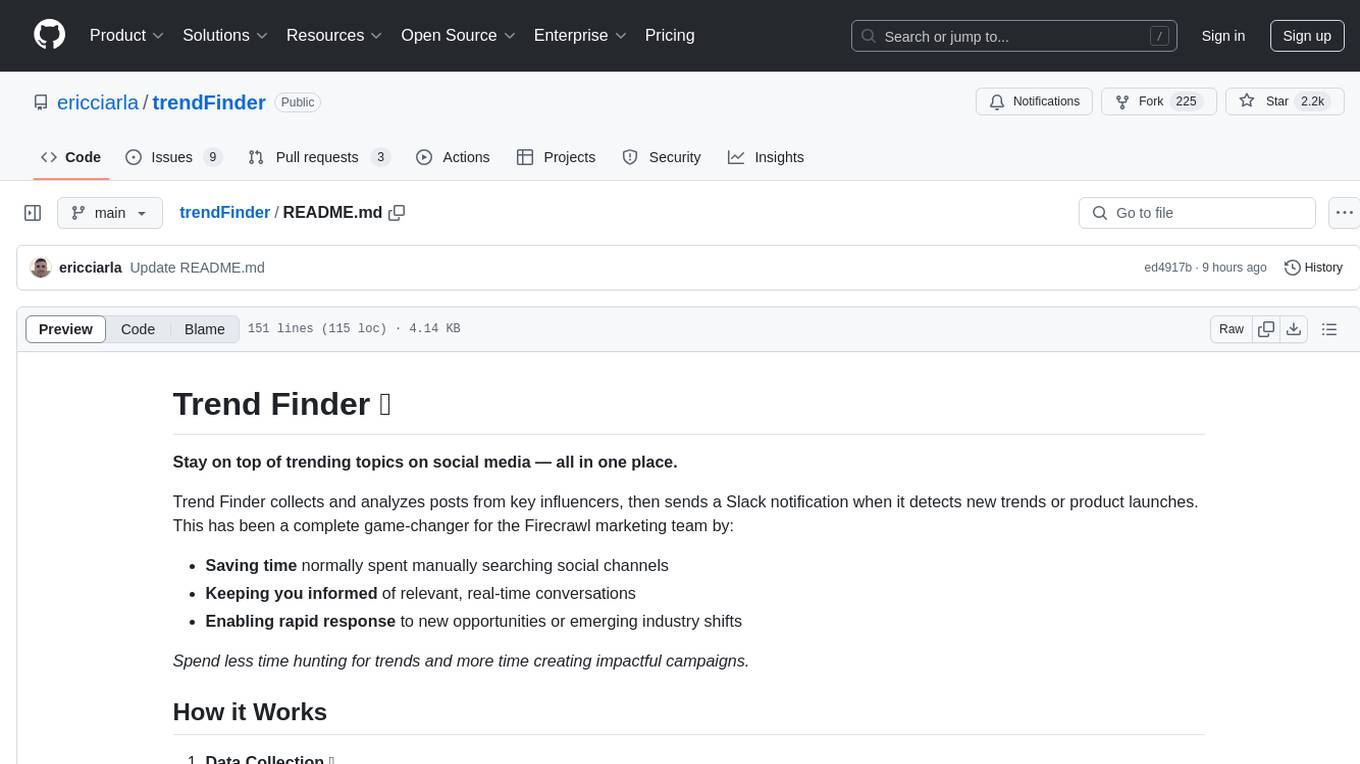
trendFinder
Trend Finder is a tool designed to help users stay updated on trending topics on social media by collecting and analyzing posts from key influencers. It sends Slack notifications when new trends or product launches are detected, saving time, keeping users informed, and enabling quick responses to emerging opportunities. The tool features AI-powered trend analysis, social media and website monitoring, instant Slack notifications, and scheduled monitoring using cron jobs. Built with Node.js and Express.js, Trend Finder integrates with Together AI, Twitter/X API, Firecrawl, and Slack Webhooks for notifications.
hyperfy
Hyperfy is a powerful tool for automating social media marketing tasks. It provides a user-friendly interface to schedule posts, analyze performance metrics, and engage with followers across multiple platforms. With Hyperfy, users can save time and effort by streamlining their social media management processes in one centralized platform.
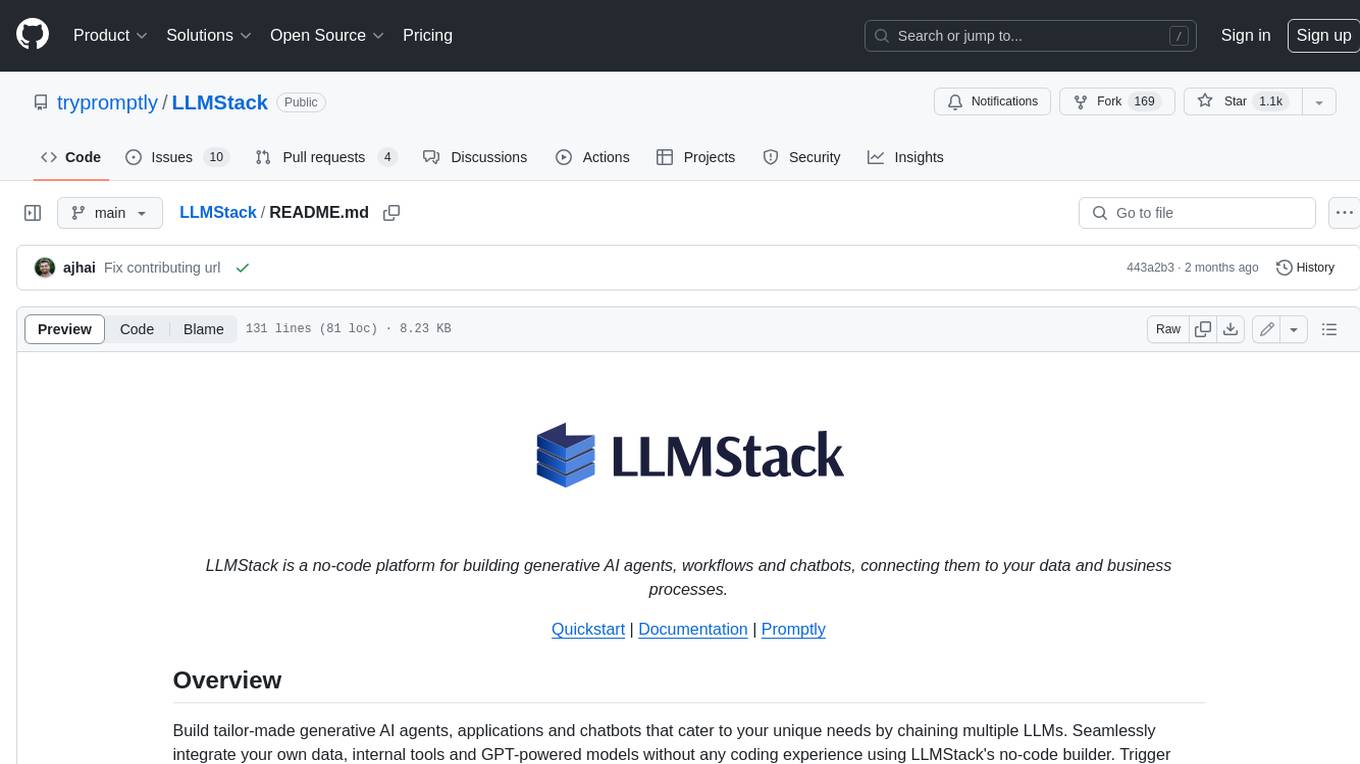
LLMStack
LLMStack is a no-code platform for building generative AI agents, workflows, and chatbots. It allows users to connect their own data, internal tools, and GPT-powered models without any coding experience. LLMStack can be deployed to the cloud or on-premise and can be accessed via HTTP API or triggered from Slack or Discord.
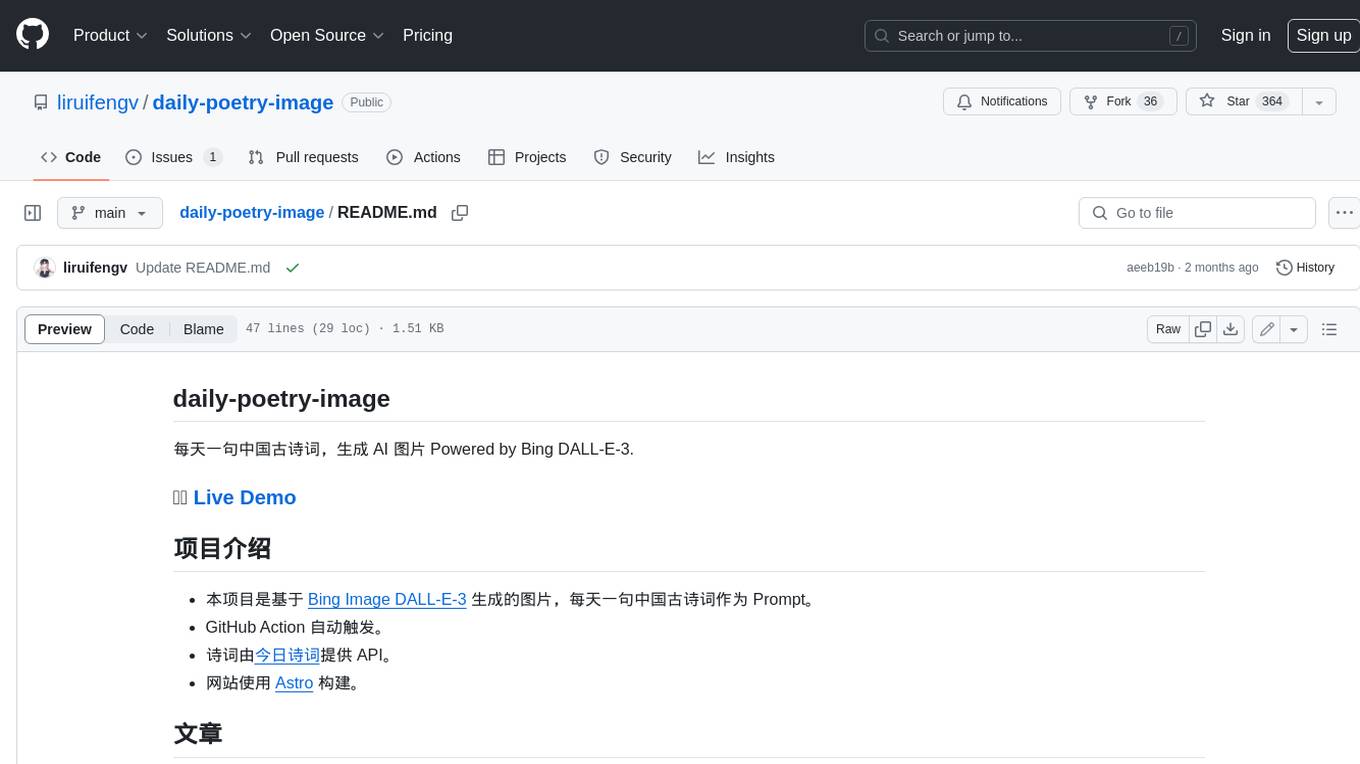
daily-poetry-image
Daily Chinese ancient poetry and AI-generated images powered by Bing DALL-E-3. GitHub Action triggers the process automatically. Poetry is provided by Today's Poem API. The website is built with Astro.
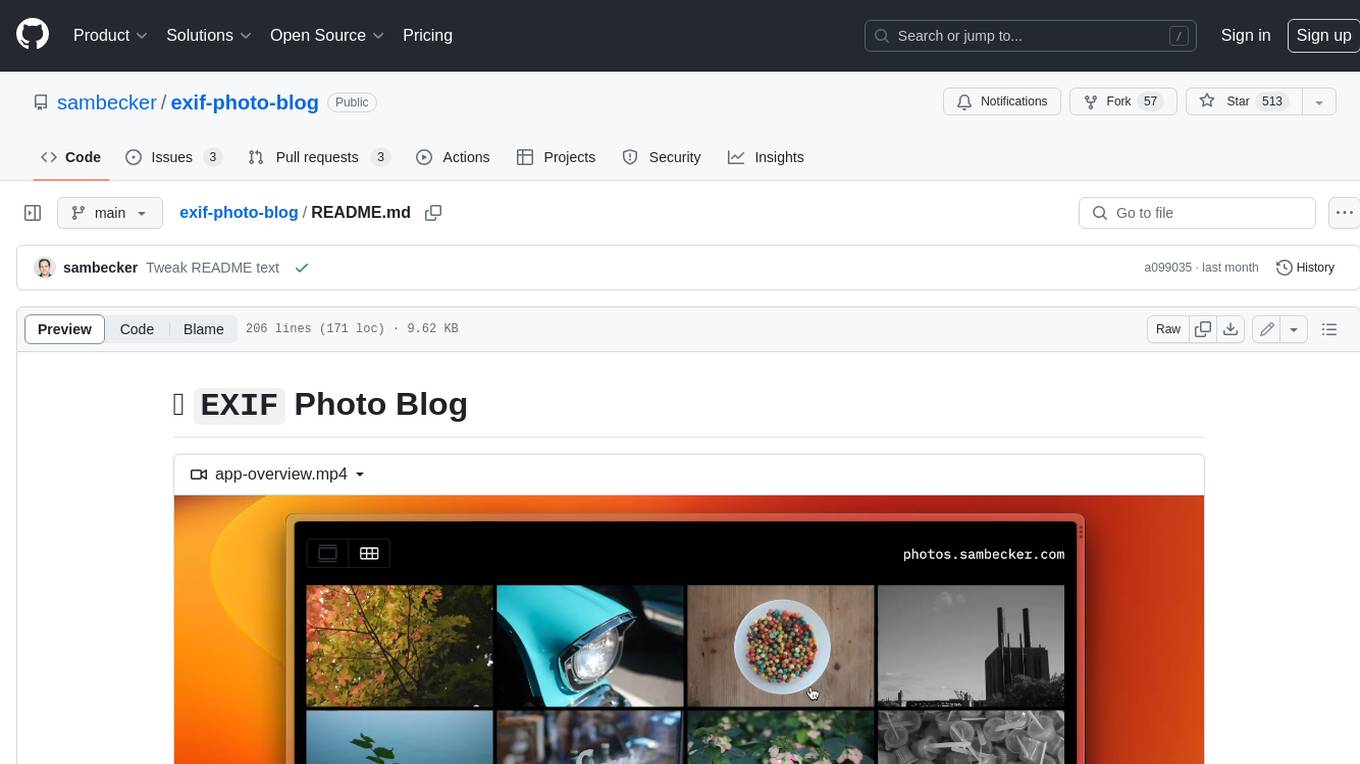
exif-photo-blog
EXIF Photo Blog is a full-stack photo blog application built with Next.js, Vercel, and Postgres. It features built-in authentication, photo upload with EXIF extraction, photo organization by tag, infinite scroll, light/dark mode, automatic OG image generation, a CMD-K menu with photo search, experimental support for AI-generated descriptions, and support for Fujifilm simulations. The application is easy to deploy to Vercel with just a few clicks and can be customized with a variety of environment variables.
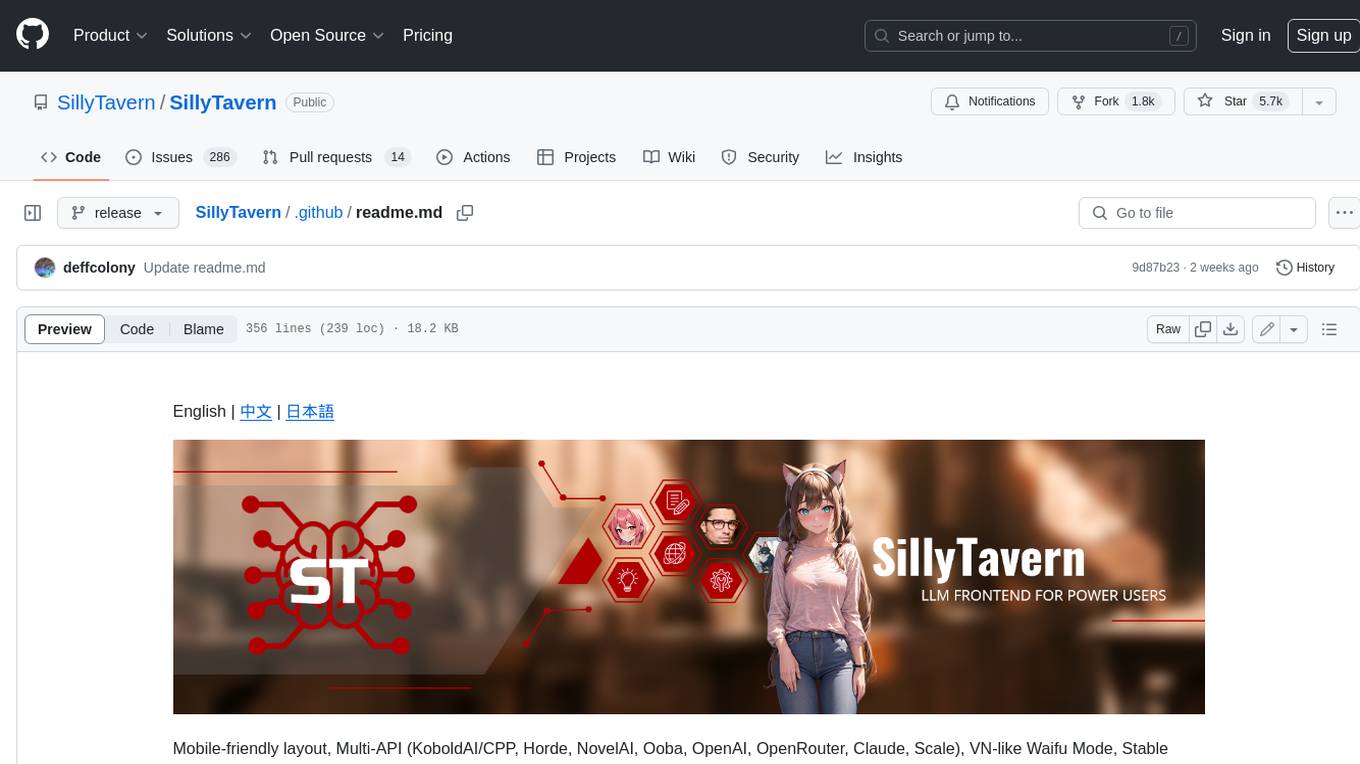
SillyTavern
SillyTavern is a user interface you can install on your computer (and Android phones) that allows you to interact with text generation AIs and chat/roleplay with characters you or the community create. SillyTavern is a fork of TavernAI 1.2.8 which is under more active development and has added many major features. At this point, they can be thought of as completely independent programs.
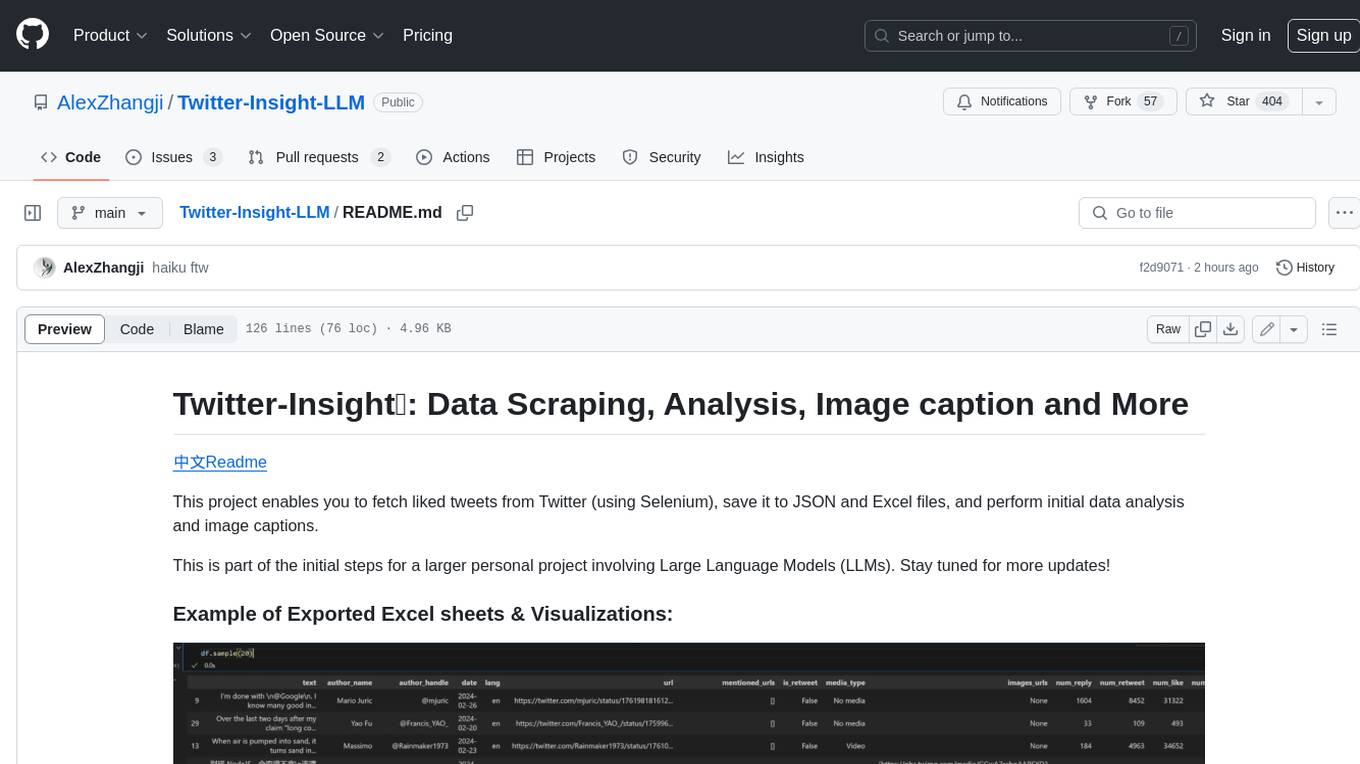
Twitter-Insight-LLM
This project enables you to fetch liked tweets from Twitter (using Selenium), save it to JSON and Excel files, and perform initial data analysis and image captions. This is part of the initial steps for a larger personal project involving Large Language Models (LLMs).