


lobehub
The ultimate space for work and life — to find, build, and collaborate with agent teammates that grow with you. We are taking agent harness to the next level — enabling multi-agent collaboration, effortless agent team design, and introducing agents as the unit of work interaction.
Stars: 72212
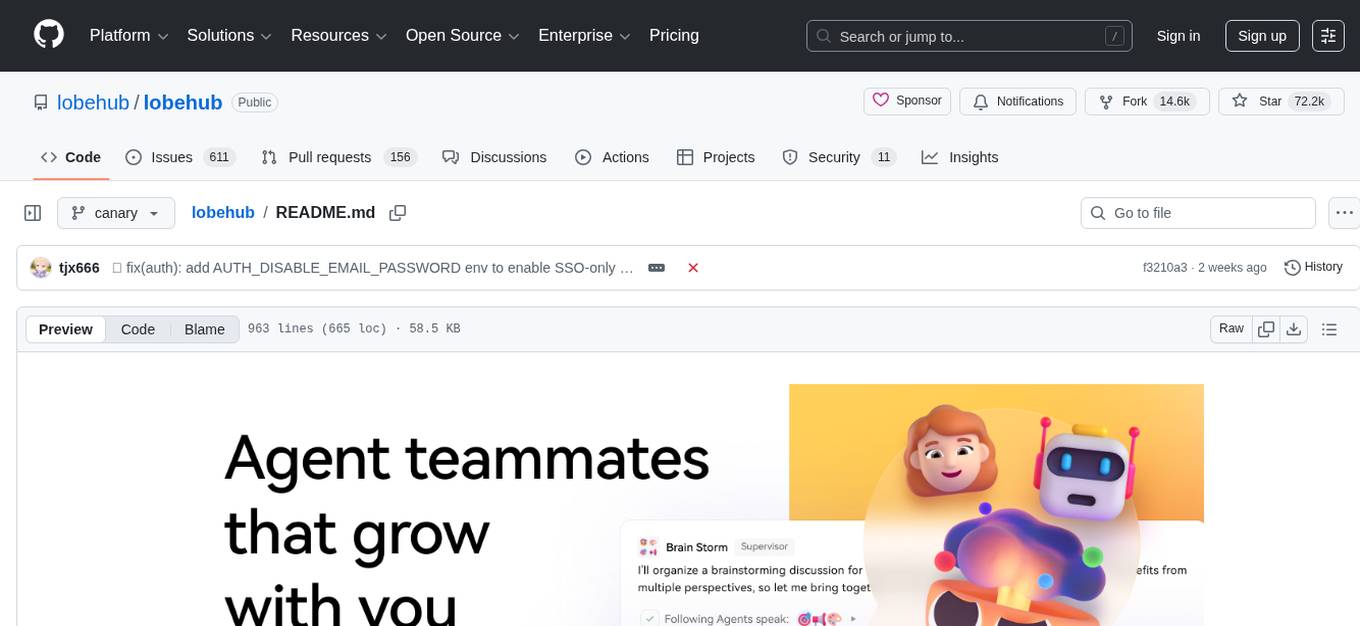
LobeHub is the ultimate space for work and life, where users can find, build, and collaborate with agent teammates that grow with them. It aims to create the world's largest human-agent co-evolving network. LobeHub treats agents as the unit of work, providing an infrastructure for humans and agents to co-evolve. Users can create personalized AI teams, collaborate with agent groups, and experience the co-evolution of humans and agents. The platform supports various features like model visual recognition, TTS & STT voice conversation, text to image generation, plugin system for function calling, and an agent market for GPTs. LobeHub also offers self-hosting options with Vercel, Alibaba Cloud, and Docker Image, along with an ecosystem of UI components, icons, TTS libraries, and lint configurations.
README:
LobeHub is the ultimate space for work and life:
to find, build, and collaborate with agent teammates that grow with you.
We’re building the world’s largest human–agent co-evolving network.
English · 简体中文 · Official Site · Changelog · Documents · Blog · Feedback














Share LobeHub Repository







Agent teammates that grow with you

Table of contents
- 👋🏻 Getting Started & Join Our Community
-
✨ Features
- Create: Agents as the Unit of Work
- Collaborate: Scale New Forms of Collaboration Networks
- Evolve: Co-evolution of Humans and Agents
- MCP Plugin One-Click Installation
- MCP Marketplace
- Desktop App
- Smart Internet Search
- Chain of Thought
- Branching Conversations
- Artifacts Support
- File Upload /Knowledge Base
- Multi-Model Service Provider Support
- Local Large Language Model (LLM) Support
- Model Visual Recognition
- TTS & STT Voice Conversation
- Text to Image Generation
- Plugin System (Function Calling)
- Agent Market (GPTs)
- Support Local / Remote Database
- Support Multi-User Management
- Progressive Web App (PWA)
- Mobile Device Adaptation
- Custom Themes
*What's more
- 🛳 Self Hosting
- 📦 Ecosystem
- 🧩 Plugins
- ⌨️ Local Development
- 🤝 Contributing
- ❤️ Sponsor
- 🔗 More Products
https://github.com/user-attachments/assets/6710ad97-03d0-4175-bd75-adff9b55eca2
We are a group of e/acc design-engineers, hoping to provide modern design components and tools for AIGC. By adopting the Bootstrapping approach, we aim to provide developers and users with a more open, transparent, and user-friendly product ecosystem.
Whether for users or professional developers, LobeHub will be your AI Agent playground. Please be aware that LobeHub is currently under active development, and feedback is welcome for any issues encountered.
 |
We are live on Product Hunt! We are thrilled to bring LobeHub to the world. If you believe in a future where humans and agents co-evolve, please support our journey. |
|---|---|
 |
Join our Discord community! This is where you can connect with developers and other enthusiastic users of LobeHub. |
[!IMPORTANT]
Star Us, You will receive all release notifications from GitHub without any delay ~ ⭐️
Star History
Today’s agents are one-off, task-driven tools. They lack context, live in isolation, and require manual hand-offs between different windows and models. While some maintain memory, it is often global, shallow, and impersonal. In this mode, users are forced to toggle between fragmented conversations, making it difficult to form structured productivity.
LobeHub changes everything.
LobeHub is a work-and-lifestyle space to find, build, and collaborate with agent teammates that grow with you. In LobeHub, we treat Agents as the unit of work, providing an infrastructure where humans and agents co-evolve.
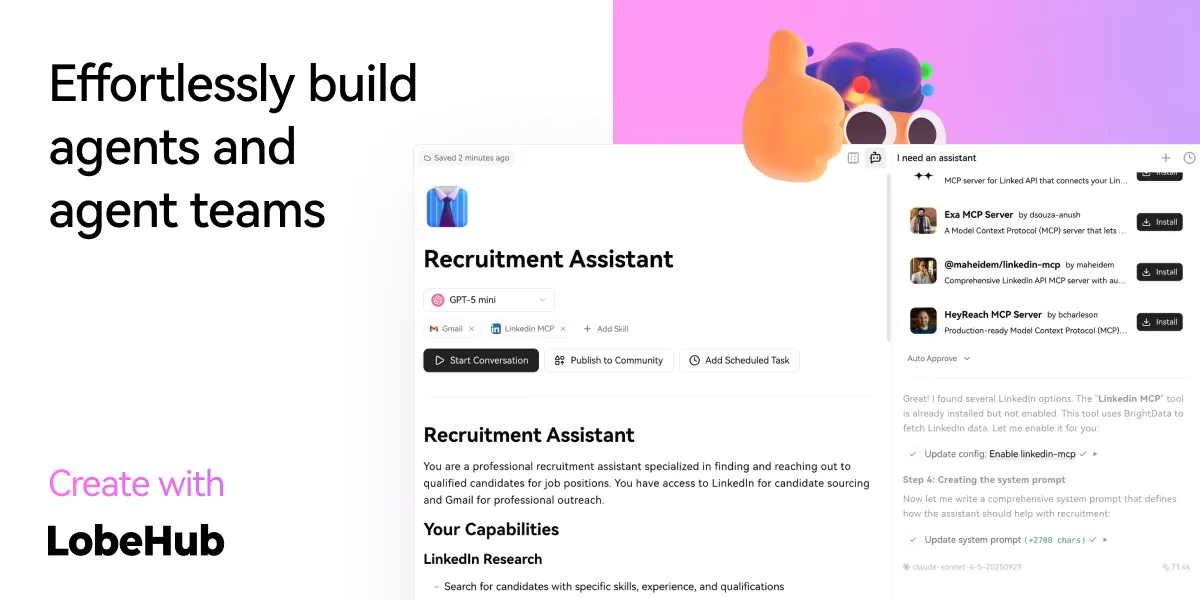
Building a personalized AI team starts with the Agent Builder. You can describe what you need once, and the agent setup starts right away, applying auto-configurations so you can use it instantly.
- Unified Intelligence: Seamlessly access any model and any modality—all under your control.
- 10,000+ Skills: Connect your agents to the skills you use every day with a library of over 10,000 tools and MCP-compatible plugins.

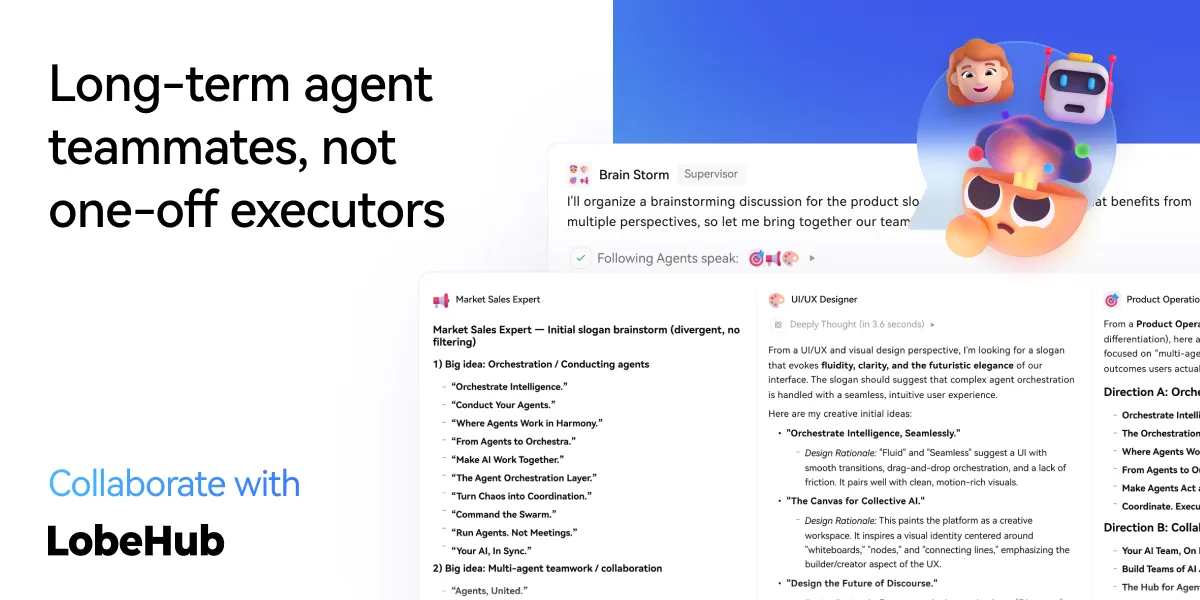
LobeHub introduces Agent Groups, allowing you to work with agents like real teammates. The system assembles the right agents for the task, enabling parallel collaboration and iterative improvement.
- Pages: Write and refine content with multiple agents in one place with a shared context.
- Schedule: Schedule runs and let agents do the work at the right time, even while you are away.
- Project: Organize work by project to keep everything structured and easy to track.
- Workspace: A shared space for teams to collaborate with agents, ensuring clear ownership and visibility across the organization.
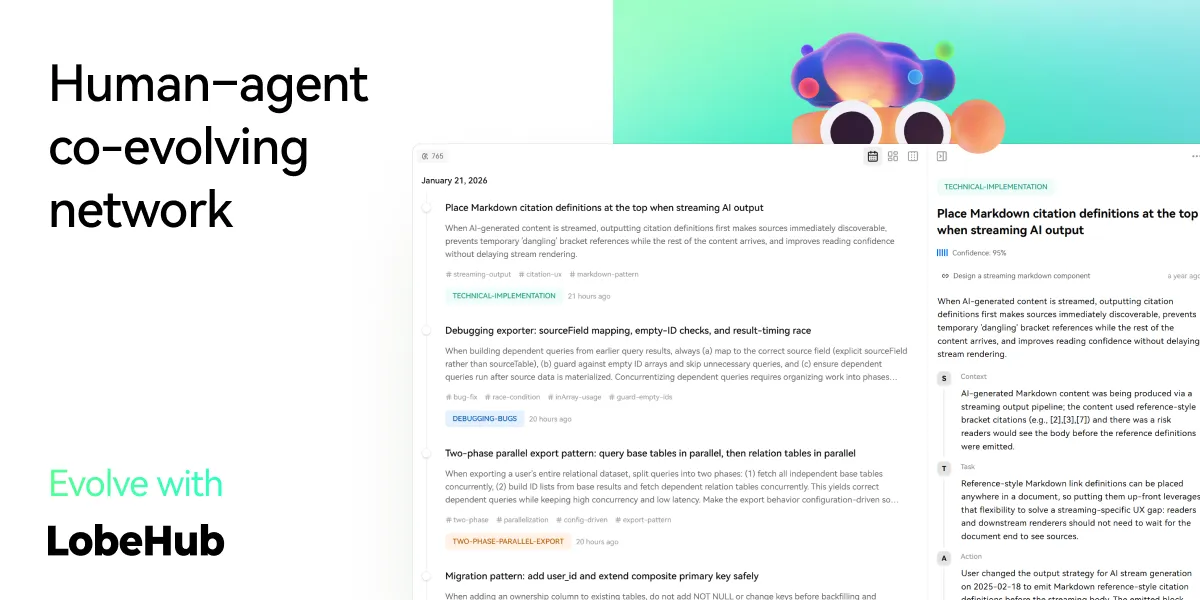
The best AI is one that understands you deeply. LobeHub features Personal Memory that builds a clear understanding of your needs.
- Continual Learning: Your agents learn from how you work, adapting their behavior to act at the right moment.
- White-Box Memory: We believe in transparency. Your agents use structured, editable memory, giving you full control over what they remember.
More Features
Seamlessly Connect Your AI to the World
Unlock the full potential of your AI by enabling smooth, secure, and dynamic interactions with external tools, data sources, and services. LobeHub's MCP (Model Context Protocol) plugin system breaks down the barriers between your AI and the digital ecosystem, allowing for unprecedented connectivity and functionality.
Transform your conversations into powerful workflows by connecting to databases, APIs, file systems, and more. Experience the freedom of AI that truly understands and interacts with your world.
Discover, Connect, Extend
Browse a growing library of MCP plugins to expand your AI's capabilities and streamline your workflows effortlessly. Visit lobehub.com/mcp to explore the MCP Marketplace, which offers a curated collection of integrations that enhance your AI's ability to work with various tools and services.
From productivity tools to development environments, discover new ways to extend your AI's reach and effectiveness. Connect with the community and find the perfect plugins for your specific needs.
Peak Performance, Zero Distractions
Get the full LobeHub experience without browser limitations—comprehensive, focused, and always ready to go. Our desktop application provides a dedicated environment for your AI interactions, ensuring optimal performance and minimal distractions.
Experience faster response times, better resource management, and a more stable connection to your AI assistant. The desktop app is designed for users who demand the best performance from their AI tools.
Online Knowledge On Demand
With real-time internet access, your AI keeps up with the world—news, data, trends, and more. Stay informed and get the most current information available, enabling your AI to provide accurate and up-to-date responses.
Access live information, verify facts, and explore current events without leaving your conversation. Your AI becomes a gateway to the world's knowledge, always current and comprehensive.
Experience AI reasoning like never before. Watch as complex problems unfold step by step through our innovative Chain of Thought (CoT) visualization. This breakthrough feature provides unprecedented transparency into AI's decision-making process, allowing you to observe how conclusions are reached in real-time.
By breaking down complex reasoning into clear, logical steps, you can better understand and validate the AI's problem-solving approach. Whether you're debugging, learning, or simply curious about AI reasoning, CoT visualization transforms abstract thinking into an engaging, interactive experience.
Introducing a more natural and flexible way to chat with AI. With Branch Conversations, your discussions can flow in multiple directions, just like human conversations do. Create new conversation branches from any message, giving you the freedom to explore different paths while preserving the original context.
Choose between two powerful modes:
- Continuation Mode: Seamlessly extend your current discussion while maintaining valuable context
- Standalone Mode: Start fresh with a new topic based on any previous message
This groundbreaking feature transforms linear conversations into dynamic, tree-like structures, enabling deeper exploration of ideas and more productive interactions.
Experience the power of Claude Artifacts, now integrated into LobeHub. This revolutionary feature expands the boundaries of AI-human interaction, enabling real-time creation and visualization of diverse content formats.
Create and visualize with unprecedented flexibility:
- Generate and display dynamic SVG graphics
- Build and render interactive HTML pages in real-time
- Produce professional documents in multiple formats
LobeHub supports file upload and knowledge base functionality. You can upload various types of files including documents, images, audio, and video, as well as create knowledge bases, making it convenient for users to manage and search for files. Additionally, you can utilize files and knowledge base features during conversations, enabling a richer dialogue experience.
https://github.com/user-attachments/assets/faa8cf67-e743-4590-8bf6-ebf6ccc34175
[!TIP]
Learn more on 📘 LobeHub Knowledge Base Launch — From Now On, Every Step Counts
In the continuous development of LobeHub, we deeply understand the importance of diversity in model service providers for meeting the needs of the community when providing AI conversation services. Therefore, we have expanded our support to multiple model service providers, rather than being limited to a single one, in order to offer users a more diverse and rich selection of conversations.
In this way, LobeHub can more flexibly adapt to the needs of different users, while also providing developers with a wider range of choices.
We have implemented support for the following model service providers:
See more providers (+-10)
📊 Total providers: 0
At the same time, we are also planning to support more model service providers. If you would like LobeHub to support your favorite service provider, feel free to join our 💬 community discussion.
To meet the specific needs of users, LobeHub also supports the use of local models based on Ollama, allowing users to flexibly use their own or third-party models.
[!TIP]
Learn more about 📘 Using Ollama in LobeHub by checking it out.
LobeHub now supports OpenAI's latest gpt-4-vision model with visual recognition capabilities,
a multimodal intelligence that can perceive visuals. Users can easily upload or drag and drop images into the dialogue box,
and the agent will be able to recognize the content of the images and engage in intelligent conversation based on this,
creating smarter and more diversified chat scenarios.
This feature opens up new interactive methods, allowing communication to transcend text and include a wealth of visual elements. Whether it's sharing images in daily use or interpreting images within specific industries, the agent provides an outstanding conversational experience.
LobeHub supports Text-to-Speech (TTS) and Speech-to-Text (STT) technologies, enabling our application to convert text messages into clear voice outputs, allowing users to interact with our conversational agent as if they were talking to a real person. Users can choose from a variety of voices to pair with the agent.
Moreover, TTS offers an excellent solution for those who prefer auditory learning or desire to receive information while busy. In LobeHub, we have meticulously selected a range of high-quality voice options (OpenAI Audio, Microsoft Edge Speech) to meet the needs of users from different regions and cultural backgrounds. Users can choose the voice that suits their personal preferences or specific scenarios, resulting in a personalized communication experience.
With support for the latest text-to-image generation technology, LobeHub now allows users to invoke image creation tools directly within conversations with the agent. By leveraging the capabilities of AI tools such as DALL-E 3, MidJourney, and Pollinations, the agents are now equipped to transform your ideas into images.
This enables a more private and immersive creative process, allowing for the seamless integration of visual storytelling into your personal dialogue with the agent.
The plugin ecosystem of LobeHub is an important extension of its core functionality, greatly enhancing the practicality and flexibility of the LobeHub assistant.
By utilizing plugins, LobeHub assistants can obtain and process real-time information, such as searching for web information and providing users with instant and relevant news.
In addition, these plugins are not limited to news aggregation, but can also extend to other practical functions, such as quickly searching documents, generating images, obtaining data from various platforms like Bilibili, Steam, and interacting with various third-party services.
[!TIP]
Learn more about 📘 Plugin Usage by checking it out.
| Recent Submits | Description |
|---|---|
|
Shopping tools By shoppingtools on 2026-01-12 |
Search for products on eBay & AliExpress, find eBay events & coupons. Get prompt examples.shopping e-bay ali-express coupons
|
|
SEO Assistant By webfx on 2026-01-12 |
The SEO Assistant can generate search engine keyword information in order to aid the creation of content.seo keyword
|
|
Video Captions By maila on 2025-12-13 |
Convert Youtube links into transcribed text, enable asking questions, create chapters, and summarize its content.video-to-text youtube
|
|
WeatherGPT By steven-tey on 2025-12-13 |
Get current weather information for a specific location.weather
|
📊 Total plugins: 40
In LobeHub Agent Marketplace, creators can discover a vibrant and innovative community that brings together a multitude of well-designed agents, which not only play an important role in work scenarios but also offer great convenience in learning processes. Our marketplace is not just a showcase platform but also a collaborative space. Here, everyone can contribute their wisdom and share the agents they have developed.
[!TIP]
By 🤖/🏪 Submit Agents, you can easily submit your agent creations to our platform. Importantly, LobeHub has established a sophisticated automated internationalization (i18n) workflow, capable of seamlessly translating your agent into multiple language versions. This means that no matter what language your users speak, they can experience your agent without barriers.
[!IMPORTANT]
We welcome all users to join this growing ecosystem and participate in the iteration and optimization of agents. Together, we can create more interesting, practical, and innovative agents, further enriching the diversity and practicality of the agent offerings.
| Recent Submits | Description |
|---|---|
|
Turtle Soup Host By CSY2022 on 2025-06-19 |
A turtle soup host needs to provide the scenario, the complete story (truth of the event), and the key point (the condition for guessing correctly).turtle-soup reasoning interaction puzzle role-playing
|
|
Academic Writing Assistant By swarfte on 2025-06-17 |
Expert in academic research paper writing and formal documentationacademic-writing research formal-style
|
|
Gourmet Reviewer🍟 By renhai-lab on 2025-06-17 |
Food critique expertgourmet review writing
|
|
Minecraft Senior Developer By iamyuuk on 2025-06-17 |
Expert in advanced Java development and Minecraft mod and server plugin developmentdevelopment programming minecraft java
|
📊 Total agents: 505
LobeHub supports the use of both server-side and local databases. Depending on your needs, you can choose the appropriate deployment solution:
- Local database: suitable for users who want more control over their data and privacy protection. LobeHub uses CRDT (Conflict-Free Replicated Data Type) technology to achieve multi-device synchronization. This is an experimental feature aimed at providing a seamless data synchronization experience.
- Server-side database: suitable for users who want a more convenient user experience. LobeHub supports PostgreSQL as a server-side database. For detailed documentation on how to configure the server-side database, please visit Configure Server-side Database.
Regardless of which database you choose, LobeHub can provide you with an excellent user experience.
LobeHub supports multi-user management and provides flexible user authentication solutions:
-
Better Auth: LobeHub integrates
Better Auth, a modern and flexible authentication library that supports multiple authentication methods, including OAuth, email login, credential login, magic links, and more. WithBetter Auth, you can easily implement user registration, login, session management, social login, multi-factor authentication (MFA), and other functions to ensure the security and privacy of user data.
We deeply understand the importance of providing a seamless experience for users in today's multi-device environment. Therefore, we have adopted Progressive Web Application (PWA) technology, a modern web technology that elevates web applications to an experience close to that of native apps.
Through PWA, LobeHub can offer a highly optimized user experience on both desktop and mobile devices while maintaining high-performance characteristics. Visually and in terms of feel, we have also meticulously designed the interface to ensure it is indistinguishable from native apps, providing smooth animations, responsive layouts, and adapting to different device screen resolutions.
[!NOTE]
If you are unfamiliar with the installation process of PWA, you can add LobeHub as your desktop application (also applicable to mobile devices) by following these steps:
- Launch the Chrome or Edge browser on your computer.
- Visit the LobeHub webpage.
- In the upper right corner of the address bar, click on the Install icon.
- Follow the instructions on the screen to complete the PWA Installation.
We have carried out a series of optimization designs for mobile devices to enhance the user's mobile experience. Currently, we are iterating on the mobile user experience to achieve smoother and more intuitive interactions. If you have any suggestions or ideas, we welcome you to provide feedback through GitHub Issues or Pull Requests.
As a design-engineering-oriented application, LobeHub places great emphasis on users' personalized experiences, hence introducing flexible and diverse theme modes, including a light mode for daytime and a dark mode for nighttime. Beyond switching theme modes, a range of color customization options allow users to adjust the application's theme colors according to their preferences. Whether it's a desire for a sober dark blue, a lively peach pink, or a professional gray-white, users can find their style of color choices in LobeHub.
[!TIP]
The default configuration can intelligently recognize the user's system color mode and automatically switch themes to ensure a consistent visual experience with the operating system. For users who like to manually control details, LobeHub also offers intuitive setting options and a choice between chat bubble mode and document mode for conversation scenarios.
Beside these features, LobeHub also have much better basic technique underground:
- [x] 💨 Quick Deployment: Using the Vercel platform or docker image, you can deploy with just one click and complete the process within 1 minute without any complex configuration.
- [x] 🌐 Custom Domain: If users have their own domain, they can bind it to the platform for quick access to the dialogue agent from anywhere.
- [x] 🔒 Privacy Protection: All data is stored locally in the user's browser, ensuring user privacy.
- [x] 💎 Exquisite UI Design: With a carefully designed interface, it offers an elegant appearance and smooth interaction. It supports light and dark themes and is mobile-friendly. PWA support provides a more native-like experience.
- [x] 🗣️ Smooth Conversation Experience: Fluid responses ensure a smooth conversation experience. It fully supports Markdown rendering, including code highlighting, LaTex formulas, Mermaid flowcharts, and more.
✨ more features will be added when LobeHub evolve.
LobeHub provides Self-Hosted Version with Vercel, Alibaba Cloud, and Docker Image. This allows you to deploy your own chatbot within a few minutes without any prior knowledge.
[!TIP]
Learn more about 📘 Build your own LobeHub by checking it out.
"If you want to deploy this service yourself on Vercel, Zeabur or Alibaba Cloud, you can follow these steps:
- Prepare your OpenAI API Key.
- Click the button below to start deployment: Log in directly with your GitHub account, and remember to fill in the
OPENAI_API_KEY(required) on the environment variable section. - After deployment, you can start using it.
- Bind a custom domain (optional): The DNS of the domain assigned by Vercel is polluted in some areas; binding a custom domain can connect directly.
| Deploy with Vercel | Deploy with Zeabur | Deploy with Sealos | Deploy with RepoCloud | Deploy with Alibaba Cloud |
|---|---|---|---|---|
 |
 |
 |
 |
After fork, only retain the upstream sync action and disable other actions in your repository on GitHub.
If you have deployed your own project following the one-click deployment steps in the README, you might encounter constant prompts indicating "updates available." This is because Vercel defaults to creating a new project instead of forking this one, resulting in an inability to detect updates accurately.
[!TIP]
We suggest you redeploy using the following steps, 📘 Auto Sync With Latest


We provide a Docker image for deploying the LobeHub service on your own private device. Use the following command to start the LobeHub service:
- create a folder to for storage files
$ mkdir lobe-chat-db && cd lobe-chat-db- init the LobeHub infrastructure
bash <(curl -fsSL https://lobe.li/setup.sh)- Start the LobeHub service
docker compose up -d[!NOTE]
For detailed instructions on deploying with Docker, please refer to the 📘 Docker Deployment Guide
This project provides some additional configuration items set with environment variables:
| Environment Variable | Required | Description | Example |
|---|---|---|---|
OPENAI_API_KEY |
Yes | This is the API key you apply on the OpenAI account page | sk-xxxxxx...xxxxxx |
OPENAI_PROXY_URL |
No | If you manually configure the OpenAI interface proxy, you can use this configuration item to override the default OpenAI API request base URL |
https://api.chatanywhere.cn or https://aihubmix.com/v1 The default value is https://api.openai.com/v1
|
OPENAI_MODEL_LIST |
No | Used to control the model list. Use + to add a model, - to hide a model, and model_name=display_name to customize the display name of a model, separated by commas. |
qwen-7b-chat,+glm-6b,-gpt-3.5-turbo |
[!NOTE]
The complete list of environment variables can be found in the 📘 Environment Variables
| NPM | Repository | Description | Version |
|---|---|---|---|
| @lobehub/ui | lobehub/lobe-ui | Open-source UI component library dedicated to building AIGC web applications. |  |
| @lobehub/icons | lobehub/lobe-icons | Popular AI / LLM Model Brand SVG Logo and Icon Collection. |  |
| @lobehub/tts | lobehub/lobe-tts | High-quality & reliable TTS/STT React Hooks library |  |
| @lobehub/lint | lobehub/lobe-lint | Configurations for ESlint, Stylelint, Commitlint, Prettier, Remark, and Semantic Release for LobeHub. |  |
Plugins provide a means to extend the Function Calling capabilities of LobeHub. They can be used to introduce new function calls and even new ways to render message results. If you are interested in plugin development, please refer to our 📘 Plugin Development Guide in the Wiki.
- lobe-chat-plugins: This is the plugin index for LobeHub. It accesses index.json from this repository to display a list of available plugins for LobeHub to the user.
- chat-plugin-template: This is the plugin template for LobeHub plugin development.
- @lobehub/chat-plugin-sdk: The LobeHub Plugin SDK assists you in creating exceptional chat plugins for LobeHub.
- @lobehub/chat-plugins-gateway: The LobeHub Plugins Gateway is a backend service that provides a gateway for LobeHub plugins. We deploy this service using Vercel. The primary API POST /api/v1/runner is deployed as an Edge Function.
[!NOTE]
The plugin system is currently undergoing major development. You can learn more in the following issues:
- [x] Plugin Phase 1: Implement separation of the plugin from the main body, split the plugin into an independent repository for maintenance, and realize dynamic loading of the plugin.
- [x] Plugin Phase 2: The security and stability of the plugin's use, more accurately presenting abnormal states, the maintainability of the plugin architecture, and developer-friendly.
- [x] Plugin Phase 3: Higher-level and more comprehensive customization capabilities, support for plugin authentication, and examples.
You can use GitHub Codespaces for online development:

Or clone it for local development:
$ git clone https://github.com/lobehub/lobe-chat.git
$ cd lobe-chat
$ pnpm install
$ pnpm dev
If you would like to learn more details, please feel free to look at our 📘 Development Guide.
Contributions of all types are more than welcome; if you are interested in contributing code, feel free to check out our GitHub Issues and Projects to get stuck in to show us what you're made of.
[!TIP]
We are creating a technology-driven forum, fostering knowledge interaction and the exchange of ideas that may culminate in mutual inspiration and collaborative innovation.
Help us make LobeHub better. Welcome to provide product design feedback, user experience discussions directly to us.
Principal Maintainers: @arvinxx @canisminor1990



|
|
|
|---|---|
|
|
|
|
Every bit counts and your one-time donation sparkles in our galaxy of support! You're a shooting star, making a swift and bright impact on our journey. Thank you for believing in us – your generosity guides us toward our mission, one brilliant flash at a time.

-
🅰️ Lobe SD Theme: Modern theme for Stable Diffusion WebUI, exquisite interface design, highly customizable UI, and efficiency-boosting features. - ⛵️ Lobe Midjourney WebUI: WebUI for Midjourney, leverages AI to quickly generate a wide array of rich and diverse images from text prompts, sparking creativity and enhancing conversations.
- 🌏 Lobe i18n : Lobe i18n is an automation tool for the i18n (internationalization) translation process, powered by ChatGPT. It supports features such as automatic splitting of large files, incremental updates, and customization options for the OpenAI model, API proxy, and temperature.
- 💌 Lobe Commit: Lobe Commit is a CLI tool that leverages Langchain/ChatGPT to generate Gitmoji-based commit messages.

Copyright © 2026 LobeHub.
This project is LobeHub Community License licensed.
For Tasks:
Click tags to check more tools for each tasksFor Jobs:
Alternative AI tools for lobehub
Similar Open Source Tools
lobehub
LobeHub is the ultimate space for work and life, where users can find, build, and collaborate with agent teammates that grow with them. It aims to create the world's largest human-agent co-evolving network. LobeHub treats agents as the unit of work, providing an infrastructure for humans and agents to co-evolve. Users can create personalized AI teams, collaborate with agent groups, and experience the co-evolution of humans and agents. The platform supports various features like model visual recognition, TTS & STT voice conversation, text to image generation, plugin system for function calling, and an agent market for GPTs. LobeHub also offers self-hosting options with Vercel, Alibaba Cloud, and Docker Image, along with an ecosystem of UI components, icons, TTS libraries, and lint configurations.
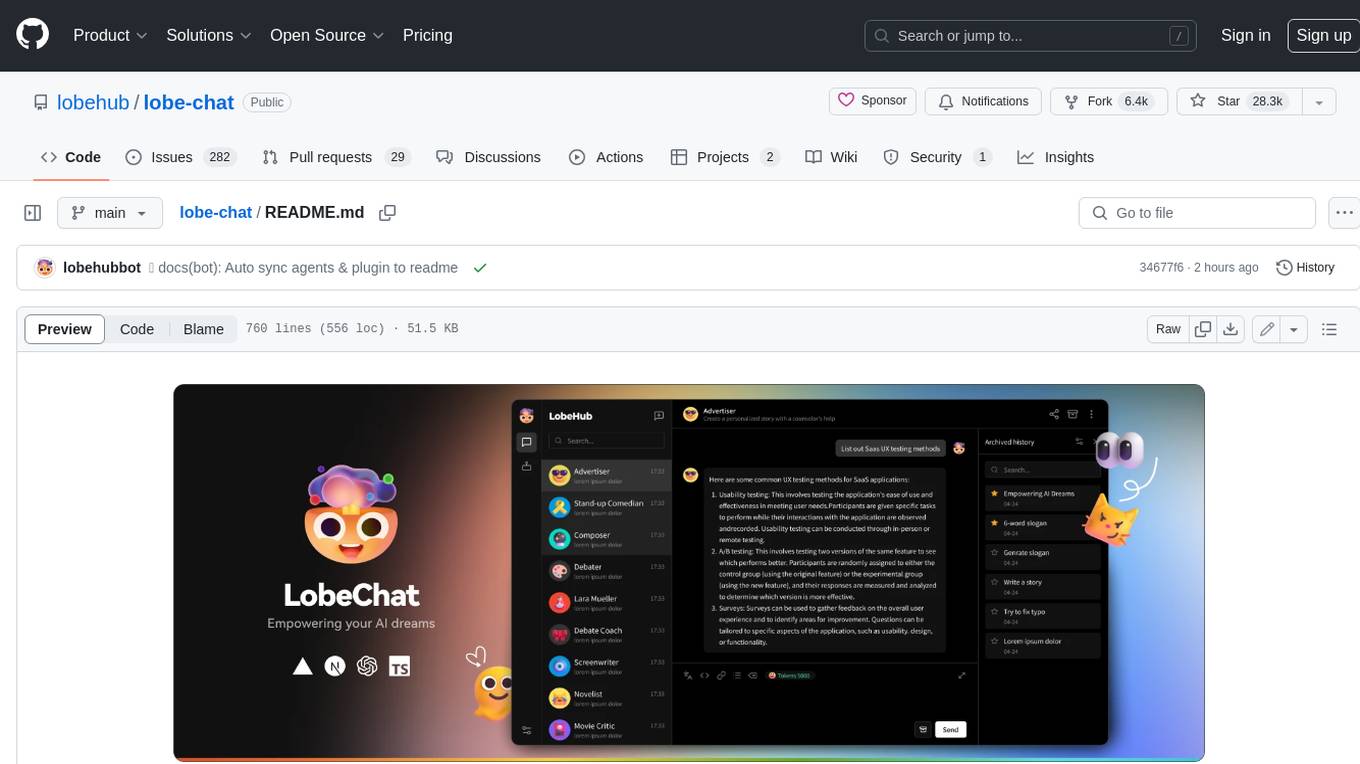
lobe-chat
Lobe Chat is an open-source, modern-design ChatGPT/LLMs UI/Framework. Supports speech-synthesis, multi-modal, and extensible ([function call][docs-functionc-call]) plugin system. One-click **FREE** deployment of your private OpenAI ChatGPT/Claude/Gemini/Groq/Ollama chat application.
read-frog
Read-frog is a powerful text analysis tool designed to help users extract valuable insights from text data. It offers a wide range of features including sentiment analysis, keyword extraction, entity recognition, and text summarization. With its user-friendly interface and robust algorithms, Read-frog is suitable for both beginners and advanced users looking to analyze text data for various purposes such as market research, social media monitoring, and content optimization. Whether you are a data scientist, marketer, researcher, or student, Read-frog can streamline your text analysis workflow and provide actionable insights to drive decision-making and enhance productivity.
ten-framework
TEN is an open-source ecosystem for creating, customizing, and deploying real-time conversational AI agents with multimodal capabilities including voice, vision, and avatar interactions. It includes various components like TEN Framework, TEN Turn Detection, TEN VAD, TEN Agent, TMAN Designer, and TEN Portal. Users can follow the provided guidelines to set up and customize their agents using TMAN Designer, run them locally or in Codespace, and deploy them with Docker or other cloud services. The ecosystem also offers community channels for developers to connect, contribute, and get support.
gorilla
Gorilla is a tool that enables LLMs to use tools by invoking APIs. Given a natural language query, Gorilla comes up with the semantically- and syntactically- correct API to invoke. With Gorilla, you can use LLMs to invoke 1,600+ (and growing) API calls accurately while reducing hallucination. Gorilla also releases APIBench, the largest collection of APIs, curated and easy to be trained on!
superduperdb
SuperDuperDB is a Python framework for integrating AI models, APIs, and vector search engines directly with your existing databases, including hosting of your own models, streaming inference and scalable model training/fine-tuning. Build, deploy and manage any AI application without the need for complex pipelines, infrastructure as well as specialized vector databases, and moving our data there, by integrating AI at your data's source: - Generative AI, LLMs, RAG, vector search - Standard machine learning use-cases (classification, segmentation, regression, forecasting recommendation etc.) - Custom AI use-cases involving specialized models - Even the most complex applications/workflows in which different models work together SuperDuperDB is **not** a database. Think `db = superduper(db)`: SuperDuperDB transforms your databases into an intelligent platform that allows you to leverage the full AI and Python ecosystem. A single development and deployment environment for all your AI applications in one place, fully scalable and easy to manage.
AI-Studio
MindWork AI Studio is a desktop application that provides a unified chat interface for Large Language Models (LLMs). It is free to use for personal and commercial purposes, offers independence in choosing LLM providers, provides unrestricted usage through the providers API, and is cost-effective with pay-as-you-go pricing. The app prioritizes privacy, flexibility, minimal storage and memory usage, and low impact on system resources. Users can support the project through monthly contributions or one-time donations, with opportunities for companies to sponsor the project for public relations and marketing benefits. Planned features include support for more LLM providers, system prompts integration, text replacement for privacy, and advanced interactions tailored for various use cases.
Awesome-local-LLM
Awesome-local-LLM is a curated list of platforms, tools, practices, and resources that help run Large Language Models (LLMs) locally. It includes sections on inference platforms, engines, user interfaces, specific models for general purpose, coding, vision, audio, and miscellaneous tasks. The repository also covers tools for coding agents, agent frameworks, retrieval-augmented generation, computer use, browser automation, memory management, testing, evaluation, research, training, and fine-tuning. Additionally, there are tutorials on models, prompt engineering, context engineering, inference, agents, retrieval-augmented generation, and miscellaneous topics, along with a section on communities for LLM enthusiasts.
CuMo
CuMo is a project focused on scaling multimodal Large Language Models (LLMs) with Co-Upcycled Mixture-of-Experts. It introduces CuMo, which incorporates Co-upcycled Top-K sparsely-gated Mixture-of-experts blocks into the vision encoder and the MLP connector, enhancing the capabilities of multimodal LLMs. The project adopts a three-stage training approach with auxiliary losses to stabilize the training process and maintain a balanced loading of experts. CuMo achieves comparable performance to other state-of-the-art multimodal LLMs on various Visual Question Answering (VQA) and visual-instruction-following benchmarks.
MarkFlowy
MarkFlowy is a lightweight and feature-rich Markdown editor with built-in AI capabilities. It supports one-click export of conversations, translation of articles, and obtaining article abstracts. Users can leverage large AI models like DeepSeek and Chatgpt as intelligent assistants. The editor provides high availability with multiple editing modes and custom themes. Available for Linux, macOS, and Windows, MarkFlowy aims to offer an efficient, beautiful, and data-safe Markdown editing experience for users.
core
OpenSumi is a framework designed to help users quickly build AI Native IDE products. It provides a set of tools and templates for creating Cloud IDEs, Desktop IDEs based on Electron, CodeBlitz web IDE Framework, Lite Web IDE on the Browser, and Mini-App liked IDE. The framework also offers documentation for users to refer to and a detailed guide on contributing to the project. OpenSumi encourages contributions from the community and provides a platform for users to report bugs, contribute code, or improve documentation. The project is licensed under the MIT license and contains third-party code under other open source licenses.
cherry-studio
Cherry Studio is a desktop client that supports multiple LLM providers on Windows, Mac, and Linux. It offers diverse LLM provider support, AI assistants & conversations, document & data processing, practical tools integration, and enhanced user experience. The tool includes features like support for major LLM cloud services, AI web service integration, local model support, pre-configured AI assistants, document processing for text, images, and more, global search functionality, topic management system, AI-powered translation, and cross-platform support with ready-to-use features and themes for a better user experience.
note-gen
Note-gen is a simple tool for generating notes automatically based on user input. It uses natural language processing techniques to analyze text and extract key information to create structured notes. The tool is designed to save time and effort for users who need to summarize large amounts of text or generate notes quickly. With note-gen, users can easily create organized and concise notes for study, research, or any other purpose.
openrl
OpenRL is an open-source general reinforcement learning research framework that supports training for various tasks such as single-agent, multi-agent, offline RL, self-play, and natural language. Developed based on PyTorch, the goal of OpenRL is to provide a simple-to-use, flexible, efficient and sustainable platform for the reinforcement learning research community. It supports a universal interface for all tasks/environments, single-agent and multi-agent tasks, offline RL training with expert dataset, self-play training, reinforcement learning training for natural language tasks, DeepSpeed, Arena for evaluation, importing models and datasets from Hugging Face, user-defined environments, models, and datasets, gymnasium environments, callbacks, visualization tools, unit testing, and code coverage testing. It also supports various algorithms like PPO, DQN, SAC, and environments like Gymnasium, MuJoCo, Atari, and more.
WrenAI
WrenAI is a data assistant tool that helps users get results and insights faster by asking questions in natural language, without writing SQL. It leverages Large Language Models (LLM) with Retrieval-Augmented Generation (RAG) technology to enhance comprehension of internal data. Key benefits include fast onboarding, secure design, and open-source availability. WrenAI consists of three core services: Wren UI (intuitive user interface), Wren AI Service (processes queries using a vector database), and Wren Engine (platform backbone). It is currently in alpha version, with new releases planned biweekly.
sealos
Sealos is a cloud operating system distribution based on the Kubernetes kernel, designed for a seamless development lifecycle. It allows users to spin up full-stack environments in seconds, effortlessly push releases, and scale production seamlessly. With core features like easy application management, quick database creation, and cloud universality, Sealos offers efficient and economical cloud management with high universality and ease of use. The platform also emphasizes agility and security through its multi-tenancy sharing model. Sealos is supported by a community offering full documentation, Discord support, and active development roadmap.
For similar tasks
lobehub
LobeHub is the ultimate space for work and life, where users can find, build, and collaborate with agent teammates that grow with them. It aims to create the world's largest human-agent co-evolving network. LobeHub treats agents as the unit of work, providing an infrastructure for humans and agents to co-evolve. Users can create personalized AI teams, collaborate with agent groups, and experience the co-evolution of humans and agents. The platform supports various features like model visual recognition, TTS & STT voice conversation, text to image generation, plugin system for function calling, and an agent market for GPTs. LobeHub also offers self-hosting options with Vercel, Alibaba Cloud, and Docker Image, along with an ecosystem of UI components, icons, TTS libraries, and lint configurations.
For similar jobs
sweep
Sweep is an AI junior developer that turns bugs and feature requests into code changes. It automatically handles developer experience improvements like adding type hints and improving test coverage.
teams-ai
The Teams AI Library is a software development kit (SDK) that helps developers create bots that can interact with Teams and Microsoft 365 applications. It is built on top of the Bot Framework SDK and simplifies the process of developing bots that interact with Teams' artificial intelligence capabilities. The SDK is available for JavaScript/TypeScript, .NET, and Python.
ai-guide
This guide is dedicated to Large Language Models (LLMs) that you can run on your home computer. It assumes your PC is a lower-end, non-gaming setup.
classifai
Supercharge WordPress Content Workflows and Engagement with Artificial Intelligence. Tap into leading cloud-based services like OpenAI, Microsoft Azure AI, Google Gemini and IBM Watson to augment your WordPress-powered websites. Publish content faster while improving SEO performance and increasing audience engagement. ClassifAI integrates Artificial Intelligence and Machine Learning technologies to lighten your workload and eliminate tedious tasks, giving you more time to create original content that matters.
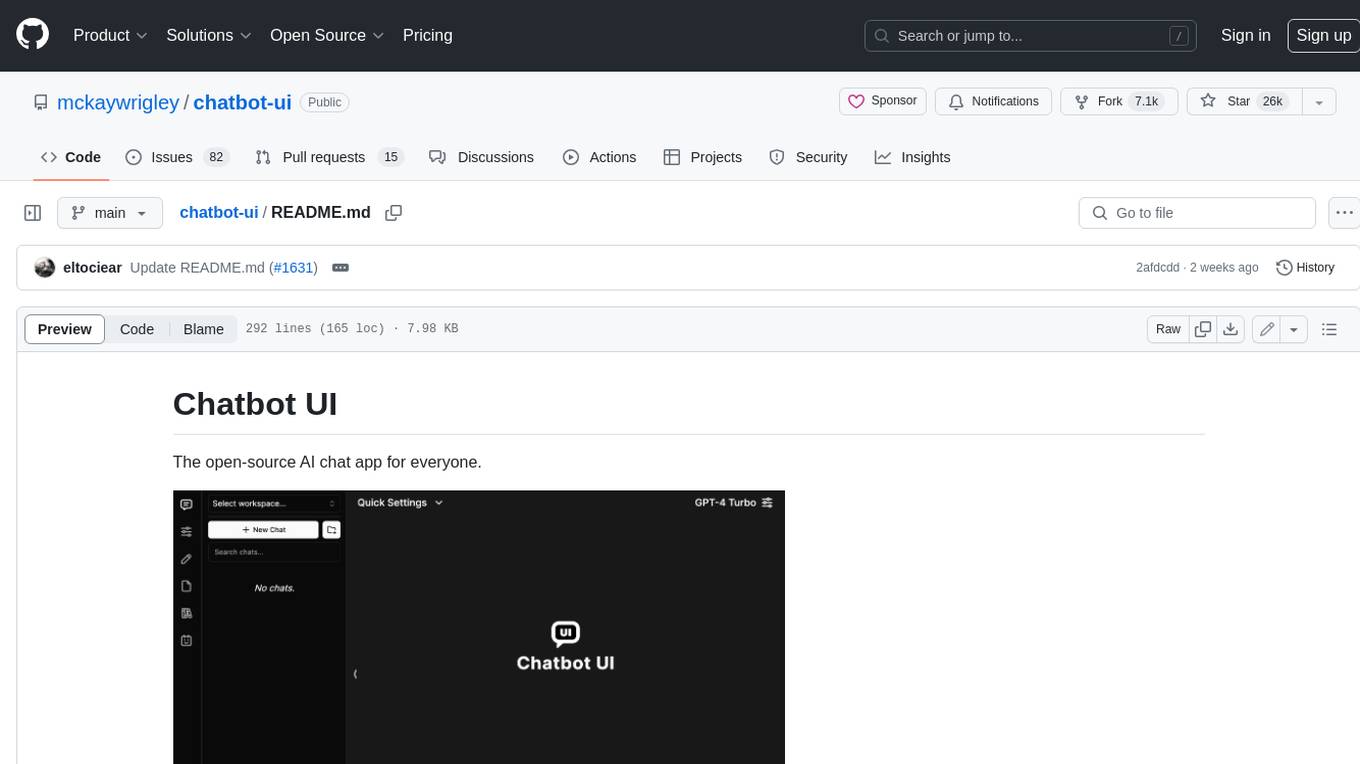
chatbot-ui
Chatbot UI is an open-source AI chat app that allows users to create and deploy their own AI chatbots. It is easy to use and can be customized to fit any need. Chatbot UI is perfect for businesses, developers, and anyone who wants to create a chatbot.
BricksLLM
BricksLLM is a cloud native AI gateway written in Go. Currently, it provides native support for OpenAI, Anthropic, Azure OpenAI and vLLM. BricksLLM aims to provide enterprise level infrastructure that can power any LLM production use cases. Here are some use cases for BricksLLM: * Set LLM usage limits for users on different pricing tiers * Track LLM usage on a per user and per organization basis * Block or redact requests containing PIIs * Improve LLM reliability with failovers, retries and caching * Distribute API keys with rate limits and cost limits for internal development/production use cases * Distribute API keys with rate limits and cost limits for students
uAgents
uAgents is a Python library developed by Fetch.ai that allows for the creation of autonomous AI agents. These agents can perform various tasks on a schedule or take action on various events. uAgents are easy to create and manage, and they are connected to a fast-growing network of other uAgents. They are also secure, with cryptographically secured messages and wallets.
griptape
Griptape is a modular Python framework for building AI-powered applications that securely connect to your enterprise data and APIs. It offers developers the ability to maintain control and flexibility at every step. Griptape's core components include Structures (Agents, Pipelines, and Workflows), Tasks, Tools, Memory (Conversation Memory, Task Memory, and Meta Memory), Drivers (Prompt and Embedding Drivers, Vector Store Drivers, Image Generation Drivers, Image Query Drivers, SQL Drivers, Web Scraper Drivers, and Conversation Memory Drivers), Engines (Query Engines, Extraction Engines, Summary Engines, Image Generation Engines, and Image Query Engines), and additional components (Rulesets, Loaders, Artifacts, Chunkers, and Tokenizers). Griptape enables developers to create AI-powered applications with ease and efficiency.