


BubbleLab
Open source workflow automation platform built for developers - full observability and code exportability!
Stars: 1045
Bubble Lab is an open-source agentic workflow automation builder designed for developers seeking full control, transparency, and type safety. It compiles workflows into clean, production-ready TypeScript code that can be debugged and deployed anywhere. With features like natural language prompt to workflow generation, full observability, seamless migration from other platforms, and instant export as TypeScript/API, Bubble Lab offers a flexible and code-centric approach to workflow automation.
README:







Bubble Lab is a Typescript-native workflow automation platform built for developers who need full control, transparency, and type safety. Unlike traditional workflow builders that lock you into proprietary JSON nodes, Bubble Lab compiles everything into clean, production-ready TypeScript that you can own, debug, and deploy anywhere.
Key Features:
- Prompt to Workflow: Describe what you want in natural language, and Pearl (our AI Assistant) instantly generate and amend working typescript workflows using our composable bubble system (integrations, tools) with branching and transformations. You get the visual, speed, and full flexibility of code.
- Full Observability: Built-in execution tracing with detailed logs, token usage and cost usage tracking for each supported services, and performance metrics. Debug with complete visibility into every step.
- Import from n8n/other workflow platform: Migrate existing workflows seamlessly such as n8n. Any human-readable workflow can be converted bubble lab workflow with a good enough model.
- Export as TypeScript/API Instantly: Own your workflows completely. Export clean, production-ready code that runs anywhere—integrate with your codebase, CI/CD pipelines.
No setup required, start building immediately with managed integrations 👉 Try Now
Run Bubble Studio locally in 2 commands:
# 1. Install dependencies
pnpm install

# 2. Start everything
pnpm run dev
Open http://localhost:3000 and start building workflows!
Get started with BubbleLab in seconds using our CLI tool:
npx create-bubblelab-appThis will scaffold a new BubbleLab project with:
- Pre-configured TypeScript setup with core packages and run time installed
- Sample templates (basic, reddit-scraper, etc.) you can choose
- All necessary dependencies
- Ready-to-run example workflows you fully control, customize
Next steps after creation:
cd my-agent
npm install
npm run devLet's look at what BubbleFlow code actually looks like using the reddit-scraper template:
The Flow (reddit-news-flow.ts) - Just ~50 lines of clean TypeScript:
export class RedditNewsFlow extends BubbleFlow<'webhook/http'> {
  async handle(payload: RedditNewsPayload) {
    const subreddit = payload.subreddit || 'worldnews';
    const limit = payload.limit || 10;

    // Step 1: Scrape Reddit for posts
    const scrapeResult = await new RedditScrapeTool({
      subreddit: subreddit,
      sort: 'hot',
      limit: limit,
    }).action();

    const posts = scrapeResult.data.posts;

    // Step 2: AI analyzes and summarizes the posts
    const summaryResult = await new AIAgentBubble({
      message: `Analyze these top ${posts.length} posts from r/${subreddit}:
        ${postsText}

        Provide: 1) Summary of top news, 2) Key themes, 3) Executive summary`,
      model: { model: 'google/gemini-2.5-flash' },
    }).action();

    return {
      subreddit,
      postsScraped: posts.length,
      summary: summaryResult.data?.response,
      status: 'success',
    };
  }
}
What happens when you run it:
$ npm run dev

✅ Reddit scraper executed successfully
{
  "subreddit": "worldnews",
  "postsScraped": 10,
  "summary": "### Top 5 News Items:\n1. China Halts US Soybean Imports...\n2. Zelensky Firm on Ukraine's EU Membership...\n3. Hamas Demands Release of Oct 7 Attackers...\n[full AI-generated summary]",
  "timestamp": "2025-10-07T21:35:19.882Z",
  "status": "success"
}

Execution Summary:
  Total Duration: 13.8s
  Bubbles Executed: 3 (RedditScrapeTool → AIAgentBubble → Return)
  Token Usage: 1,524 tokens (835 input, 689 output)
  Memory Peak: 139.8 MB
What's happening under the hood:
- RedditScrapeTool scrapes 10 hot posts from r/worldnews
- AIAgentBubble (using Google Gemini) analyzes the posts
- Returns structured JSON with summary, themes, and metadata
- Detailed execution stats show performance and token usage
Key Features:
- Type-safe - Full TypeScript support with proper interfaces
-
Simple - Just chain "Bubbles" (tools/nodes) together with
.action() - Observable - Built-in logging shows exactly what's executing
- Production-ready - Error handling, metrics, and performance tracking included
Learn how to use each bubble node and build powerful workflows:
👉 Visit BubbleLab Documentation
The documentation includes:
- Detailed guides for each node type
- Workflow building tutorials
- API references
- Best practices and examples
⚠️ UPDATE (January 20, 2026): We are no longer accepting code contributions or pull requests at this time. However, we still welcome and encourage:
- 🐛 Bug reports - Help us identify issues
- 💬 Feature requests - Share your ideas for improvements
- 🗨️ Community discussions - Join conversations in Discord
- 📖 Documentation feedback - Suggest improvements to our docs
Thank you to everyone who has contributed and shown interest in Bubble Lab!
Get involved:
- Join our Discord community for discussions and support
- Open issues for bugs or feature requests
- Check out CONTRIBUTING.md for project setup and architecture details
Apache 2.0
For Tasks:
Click tags to check more tools for each tasksFor Jobs:
Alternative AI tools for BubbleLab
Similar Open Source Tools
BubbleLab
Bubble Lab is an open-source agentic workflow automation builder designed for developers seeking full control, transparency, and type safety. It compiles workflows into clean, production-ready TypeScript code that can be debugged and deployed anywhere. With features like natural language prompt to workflow generation, full observability, seamless migration from other platforms, and instant export as TypeScript/API, Bubble Lab offers a flexible and code-centric approach to workflow automation.
pyspur
PySpur is a graph-based editor designed for LLM (Large Language Models) workflows. It offers modular building blocks, node-level debugging, and performance evaluation. The tool is easy to hack, supports JSON configs for workflow graphs, and is lightweight with minimal dependencies. Users can quickly set up PySpur by cloning the repository, creating a .env file, starting docker services, and accessing the portal. PySpur can also work with local models served using Ollama, with steps provided for configuration. The roadmap includes features like canvas, async/batch execution, support for Ollama, new nodes, pipeline optimization, templates, code compilation, multimodal support, and more.
Roo-Code
Roo Code is an AI-powered development tool that integrates with your code editor to help you generate code from natural language descriptions and specifications, refactor and debug existing code, write and update documentation, answer questions about your codebase, automate repetitive tasks, and utilize MCP servers. It offers different modes such as Code, Architect, Ask, Debug, and Custom Modes to adapt to various tasks and workflows. Roo Code provides tutorial and feature videos, documentation, a YouTube channel, a Discord server, a Reddit community, GitHub issues tracking, and a feature request platform. Users can set up and develop Roo Code locally by cloning the repository, installing dependencies, and running the extension in development mode or by automated/manual VSIX installation. The tool uses changesets for versioning and publishing. Please note that Roo Code, Inc. does not make any representations or warranties regarding the tools provided, and users assume all risks associated with their use.
mlflow
MLflow is a platform to streamline machine learning development, including tracking experiments, packaging code into reproducible runs, and sharing and deploying models. MLflow offers a set of lightweight APIs that can be used with any existing machine learning application or library (TensorFlow, PyTorch, XGBoost, etc), wherever you currently run ML code (e.g. in notebooks, standalone applications or the cloud). MLflow's current components are:
* `MLflow Tracking
payload-ai
The Payload AI Plugin is an advanced extension that integrates modern AI capabilities into your Payload CMS, streamlining content creation and management. It offers features like text generation, voice and image generation, field-level prompt customization, prompt editor, document analyzer, fact checking, automated content workflows, internationalization support, editor AI suggestions, and AI chat support. Users can personalize and configure the plugin by setting environment variables. The plugin is actively developed and tested with Payload version v3.2.1, with regular updates expected.
ChatDev
ChatDev is a virtual software company powered by intelligent agents like CEO, CPO, CTO, programmer, reviewer, tester, and art designer. These agents collaborate to revolutionize the digital world through programming. The platform offers an easy-to-use, highly customizable, and extendable framework based on large language models, ideal for studying collective intelligence. ChatDev introduces innovative methods like Iterative Experience Refinement and Experiential Co-Learning to enhance software development efficiency. It supports features like incremental development, Docker integration, Git mode, and Human-Agent-Interaction mode. Users can customize ChatChain, Phase, and Role settings, and share their software creations easily. The project is open-source under the Apache 2.0 License and utilizes data licensed under CC BY-NC 4.0.
tracecat
Tracecat is an open-source automation platform for security teams. It's designed to be simple but powerful, with a focus on AI features and a practitioner-obsessed UI/UX. Tracecat can be used to automate a variety of tasks, including phishing email investigation, evidence collection, and remediation plan generation.
ai
Jetify's AI SDK for Go is a unified interface for interacting with multiple AI providers including OpenAI, Anthropic, and more. It addresses the challenges of fragmented ecosystems, vendor lock-in, poor Go developer experience, and complex multi-modal handling by providing a unified interface, Go-first design, production-ready features, multi-modal support, and extensible architecture. The SDK supports language models, embeddings, image generation, multi-provider support, multi-modal inputs, tool calling, and structured outputs.
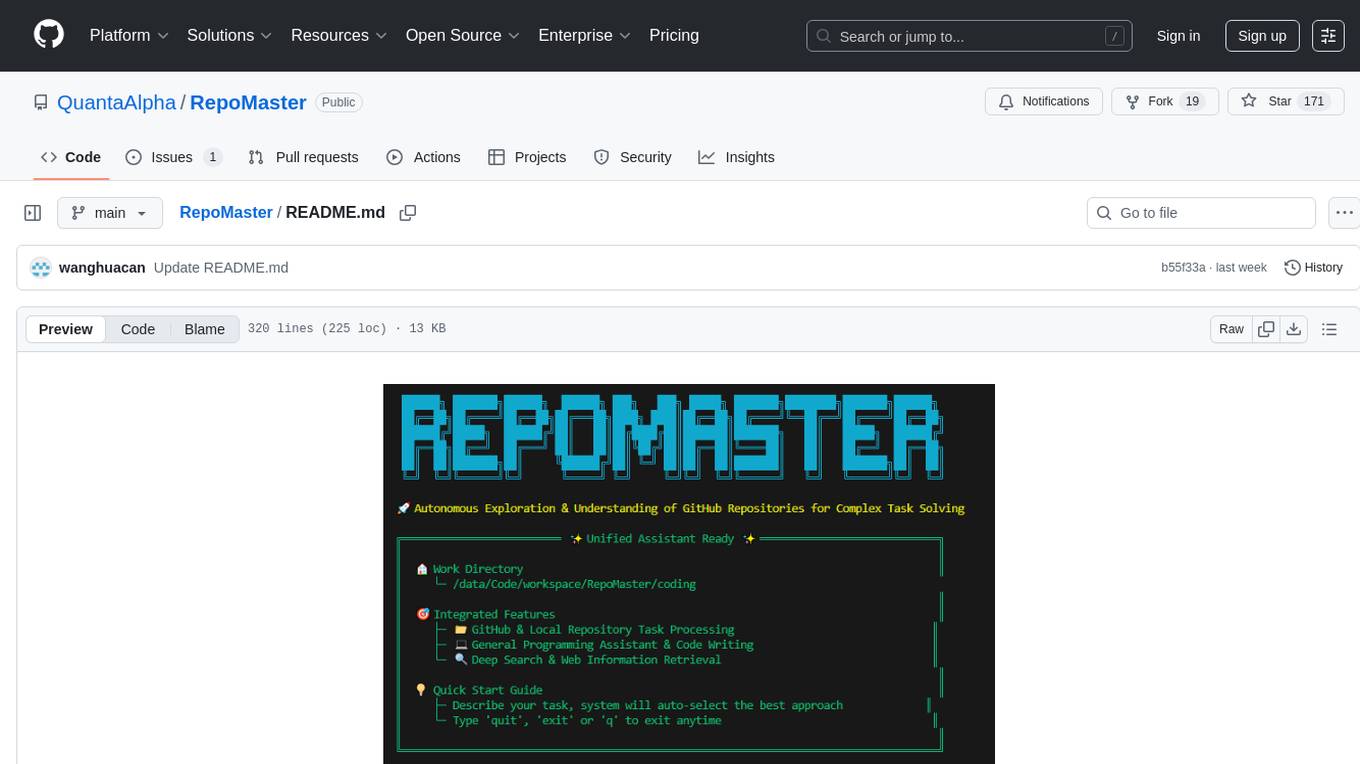
RepoMaster
RepoMaster is an AI agent that leverages GitHub repositories to solve complex real-world tasks. It transforms how coding tasks are solved by automatically finding the right GitHub tools and making them work together seamlessly. Users can describe their tasks, and RepoMaster's AI analysis leads to auto discovery and smart execution, resulting in perfect outcomes. The tool provides a web interface for beginners and a command-line interface for advanced users, along with specialized agents for deep search, general assistance, and repository tasks.
tingly-box
Tingly Box is a tool that helps in deciding which model to call, compressing context, and routing requests efficiently. It offers secure, reliable, and customizable functional extensions. With features like unified API, smart routing, context compression, auto API translation, blazing fast performance, flexible authentication, visual control panel, and client-side usage stats, Tingly Box provides a comprehensive solution for managing AI models and tokens. It supports integration with various IDEs, CLI tools, SDKs, and AI applications, making it versatile and easy to use. The tool also allows seamless integration with OAuth providers like Claude Code, enabling users to utilize existing quotas in OpenAI-compatible tools. Tingly Box aims to simplify AI model management and usage by providing a single endpoint for multiple providers with minimal configuration, promoting seamless integration with SDKs and CLI tools.
gaia-ui
A collection of production-ready UI components designed specifically for building AI assistants and chatbots. These components are battle-tested in production at GAIA, designed to handle edge cases and real-world scenarios, accessible, responsive, and performant. The library focuses on quality over quantity, offering components that solve real problems better than existing alternatives. Users can easily add components to their projects using the provided commands, and the library is actively being developed and refined for better compatibility and smaller bundle sizes.
sre
SmythOS is an operating system designed for building, deploying, and managing intelligent AI agents at scale. It provides a unified SDK and resource abstraction layer for various AI services, making it easy to scale and flexible. With an agent-first design, developer-friendly SDK, modular architecture, and enterprise security features, SmythOS offers a robust foundation for AI workloads. The system is built with a philosophy inspired by traditional operating system kernels, ensuring autonomy, control, and security for AI agents. SmythOS aims to make shipping production-ready AI agents accessible and open for everyone in the coming Internet of Agents era.
bytebot
Bytebot is an open-source AI desktop agent that provides a virtual employee with its own computer to complete tasks for users. It can use various applications, download and organize files, log into websites, process documents, and perform complex multi-step workflows. By giving AI access to a complete desktop environment, Bytebot unlocks capabilities not possible with browser-only agents or API integrations, enabling complete task autonomy, document processing, and usage of real applications.

Mira
Mira is an agentic AI library designed for automating company research by gathering information from various sources like company websites, LinkedIn profiles, and Google Search. It utilizes a multi-agent architecture to collect and merge data points into a structured profile with confidence scores and clear source attribution. The core library is framework-agnostic and can be integrated into applications, pipelines, or custom workflows. Mira offers features such as real-time progress events, confidence scoring, company criteria matching, and built-in services for data gathering. The tool is suitable for users looking to streamline company research processes and enhance data collection efficiency.
hayhooks
Hayhooks is a tool that simplifies the deployment and serving of Haystack pipelines as REST APIs. It allows users to wrap their pipelines with custom logic and expose them via HTTP endpoints, including OpenAI-compatible chat completion endpoints. With Hayhooks, users can easily convert their Haystack pipelines into API services with minimal boilerplate code.
inferable
Inferable is an open source platform that helps users build reliable LLM-powered agentic automations at scale. It offers a managed agent runtime, durable tool calling, zero network configuration, multiple language support, and is fully open source under the MIT license. Users can define functions, register them with Inferable, and create runs that utilize these functions to automate tasks. The platform supports Node.js/TypeScript, Go, .NET, and React, and provides SDKs, core services, and bootstrap templates for various languages.
For similar tasks
Azure-Analytics-and-AI-Engagement
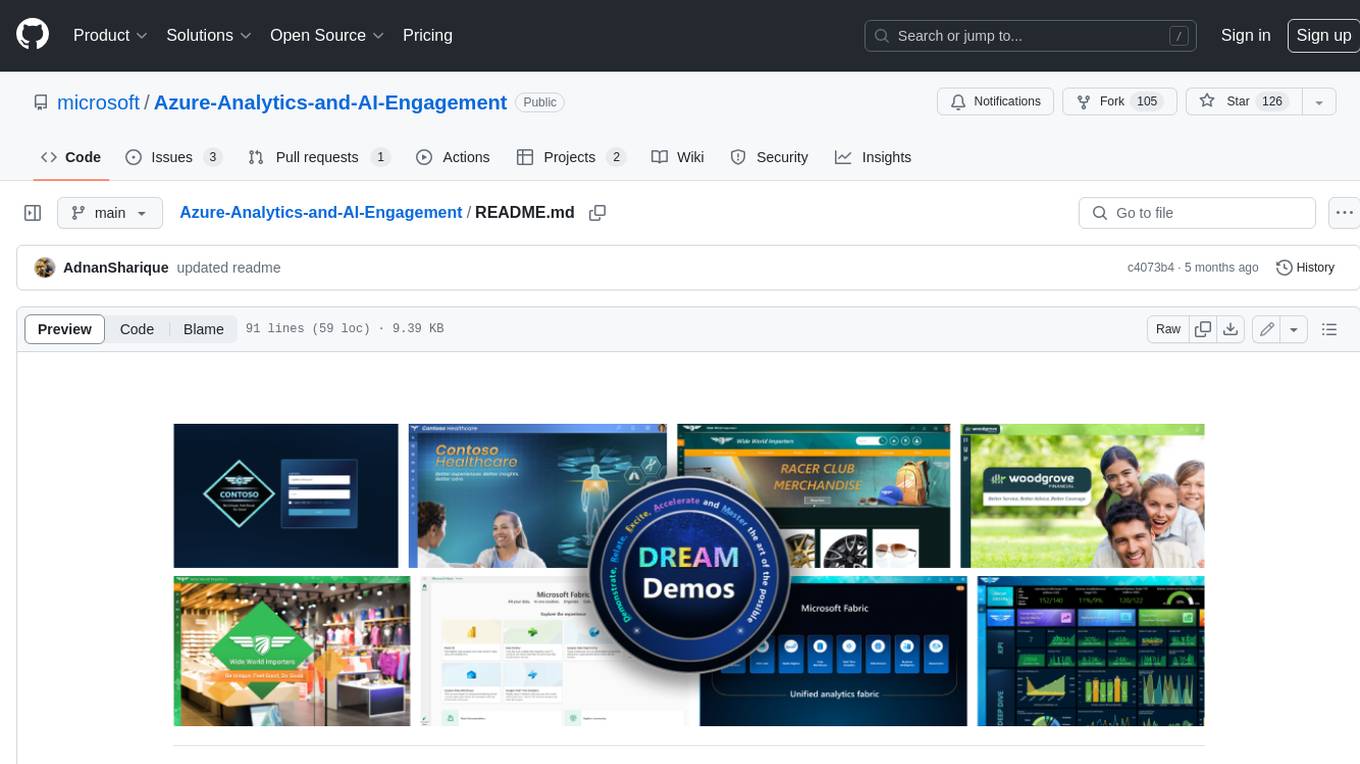
The Azure-Analytics-and-AI-Engagement repository provides packaged Industry Scenario DREAM Demos with ARM templates (Containing a demo web application, Power BI reports, Synapse resources, AML Notebooks etc.) that can be deployed in a customer’s subscription using the CAPE tool within a matter of few hours. Partners can also deploy DREAM Demos in their own subscriptions using DPoC.
sorrentum
Sorrentum is an open-source project that aims to combine open-source development, startups, and brilliant students to build machine learning, AI, and Web3 / DeFi protocols geared towards finance and economics. The project provides opportunities for internships, research assistantships, and development grants, as well as the chance to work on cutting-edge problems, learn about startups, write academic papers, and get internships and full-time positions at companies working on Sorrentum applications.
tidb
TiDB is an open-source distributed SQL database that supports Hybrid Transactional and Analytical Processing (HTAP) workloads. It is MySQL compatible and features horizontal scalability, strong consistency, and high availability.

zep-python
Zep is an open-source platform for building and deploying large language model (LLM) applications. It provides a suite of tools and services that make it easy to integrate LLMs into your applications, including chat history memory, embedding, vector search, and data enrichment. Zep is designed to be scalable, reliable, and easy to use, making it a great choice for developers who want to build LLM-powered applications quickly and easily.
telemetry-airflow
This repository codifies the Airflow cluster that is deployed at workflow.telemetry.mozilla.org (behind SSO) and commonly referred to as "WTMO" or simply "Airflow". Some links relevant to users and developers of WTMO: * The `dags` directory in this repository contains some custom DAG definitions * Many of the DAGs registered with WTMO don't live in this repository, but are instead generated from ETL task definitions in bigquery-etl * The Data SRE team maintains a WTMO Developer Guide (behind SSO)
mojo
Mojo is a new programming language that bridges the gap between research and production by combining Python syntax and ecosystem with systems programming and metaprogramming features. Mojo is still young, but it is designed to become a superset of Python over time.
pandas-ai
PandasAI is a Python library that makes it easy to ask questions to your data in natural language. It helps you to explore, clean, and analyze your data using generative AI.
databend
Databend is an open-source cloud data warehouse that serves as a cost-effective alternative to Snowflake. With its focus on fast query execution and data ingestion, it's designed for complex analysis of the world's largest datasets.
For similar jobs
aiscript
AiScript is a lightweight scripting language that runs on JavaScript. It supports arrays, objects, and functions as first-class citizens, and is easy to write without the need for semicolons or commas. AiScript runs in a secure sandbox environment, preventing infinite loops from freezing the host. It also allows for easy provision of variables and functions from the host.
askui
AskUI is a reliable, automated end-to-end automation tool that only depends on what is shown on your screen instead of the technology or platform you are running on.
bots
The 'bots' repository is a collection of guides, tools, and example bots for programming bots to play video games. It provides resources on running bots live, installing the BotLab client, debugging bots, testing bots in simulated environments, and more. The repository also includes example bots for games like EVE Online, Tribal Wars 2, and Elvenar. Users can learn about developing bots for specific games, syntax of the Elm programming language, and tools for memory reading development. Additionally, there are guides on bot programming, contributing to BotLab, and exploring Elm syntax and core library.
ain
Ain is a terminal HTTP API client designed for scripting input and processing output via pipes. It allows flexible organization of APIs using files and folders, supports shell-scripts and executables for common tasks, handles url-encoding, and enables sharing the resulting curl, wget, or httpie command-line. Users can put things that change in environment variables or .env-files, and pipe the API output for further processing. Ain targets users who work with many APIs using a simple file format and uses curl, wget, or httpie to make the actual calls.
LaVague
LaVague is an open-source Large Action Model framework that uses advanced AI techniques to compile natural language instructions into browser automation code. It leverages Selenium or Playwright for browser actions. Users can interact with LaVague through an interactive Gradio interface to automate web interactions. The tool requires an OpenAI API key for default examples and offers a Playwright integration guide. Contributors can help by working on outlined tasks, submitting PRs, and engaging with the community on Discord. The project roadmap is available to track progress, but users should exercise caution when executing LLM-generated code using 'exec'.
robocorp
Robocorp is a platform that allows users to create, deploy, and operate Python automations and AI actions. It provides an easy way to extend the capabilities of AI agents, assistants, and copilots with custom actions written in Python. Users can create and deploy tools, skills, loaders, and plugins that securely connect any AI Assistant platform to their data and applications. The Robocorp Action Server makes Python scripts compatible with ChatGPT and LangChain by automatically creating and exposing an API based on function declaration, type hints, and docstrings. It simplifies the process of developing and deploying AI actions, enabling users to interact with AI frameworks effortlessly.
Open-Interface
Open Interface is a self-driving software that automates computer tasks by sending user requests to a language model backend (e.g., GPT-4V) and simulating keyboard and mouse inputs to execute the steps. It course-corrects by sending current screenshots to the language models. The tool supports MacOS, Linux, and Windows, and requires setting up the OpenAI API key for access to GPT-4V. It can automate tasks like creating meal plans, setting up custom language model backends, and more. Open Interface is currently not efficient in accurate spatial reasoning, tracking itself in tabular contexts, and navigating complex GUI-rich applications. Future improvements aim to enhance the tool's capabilities with better models trained on video walkthroughs. The tool is cost-effective, with user requests priced between $0.05 - $0.20, and offers features like interrupting the app and primary display visibility in multi-monitor setups.
AI-Case-Sorter-CS7.1
AI-Case-Sorter-CS7.1 is a project focused on building a case sorter using machine vision and machine learning AI to sort cases by headstamp. The repository includes Arduino code and 3D models necessary for the project.