


AgentConnect
Our vision is to provide communication capabilities for intelligent agents, allowing them to connect with each other to form a collaborative network of intelligent agents.
Stars: 66
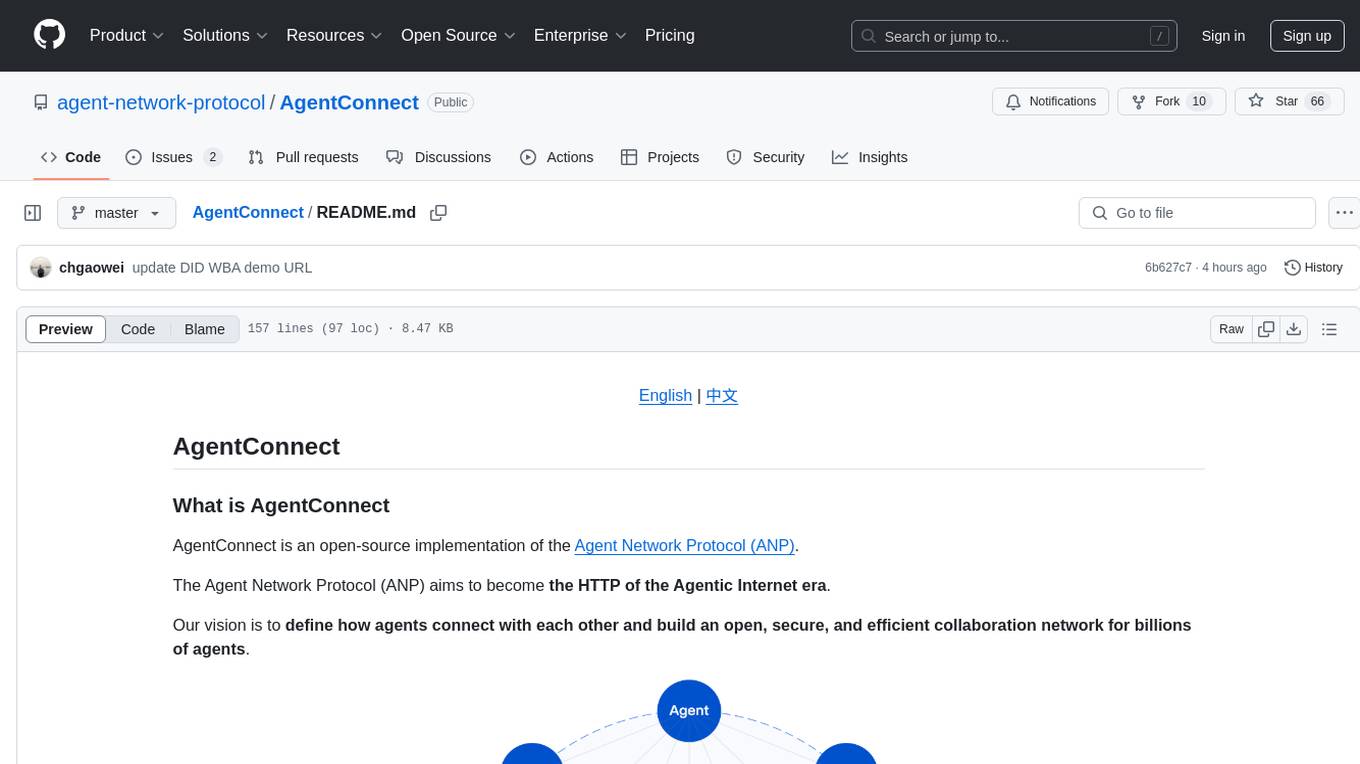
AgentConnect is an open-source implementation of the Agent Network Protocol (ANP) aiming to define how agents connect with each other and build an open, secure, and efficient collaboration network for billions of agents. It addresses challenges like interconnectivity, native interfaces, and efficient collaboration by providing authentication, end-to-end encryption, meta-protocol handling, and application layer protocol integration. The project focuses on performance and multi-platform support, with plans to rewrite core components in Rust and support Mac, Linux, Windows, mobile platforms, and browsers. AgentConnect aims to establish ANP as an industry standard through protocol development and forming a standardization committee.
README:
AgentConnect is an open-source implementation of the Agent Network Protocol (ANP).
The Agent Network Protocol (ANP) aims to become the HTTP of the Agentic Internet era.
Our vision is to define how agents connect with each other and build an open, secure, and efficient collaboration network for billions of agents.

While current internet infrastructure is well-established, there's still a lack of optimal communication and connection solutions for the specific needs of agent networks. We are committed to addressing three major challenges faced by agent networks:
- 🌐 Interconnectivity: Enable communication between all agents, break down data silos, and allow AI to access complete contextual information.
- 🖥️ Native Interfaces: AI shouldn't have to mimic human internet interactions; it should interact with the digital world through its most proficient methods (APIs or communication protocols).
- 🤝 Efficient Collaboration: Leverage AI for self-organizing and self-negotiating agents to build a more cost-effective and efficient collaboration network than the existing internet.
The technical architecture of AgentConnect is illustrated below:

Corresponding to the three-layer architecture of the Agent Network Protocol, AgentConnect primarily includes:
-
🔒 Authentication and End-to-End Encryption Modules Implements W3C DID-based authentication and end-to-end encrypted communication, including DID document generation, verification, retrieval, and end-to-end encryption based on DID and ECDHE (Elliptic Curve Diffie-Hellman Ephemeral). Currently supports HTTP-based DID authentication.
-
🌍 Meta-Protocol Module Built on LLM (Large Language Models) and meta-protocols, this module handles application protocol negotiation, protocol code implementation, protocol debugging, and protocol processing.
-
📡 Application Layer Protocol Integration Framework Manages protocol specifications and code for communication with other agents, including protocol loading, unloading, configuration, and processing. This framework enables agents to easily load and run required protocols on demand, accelerating protocol negotiation.
Beyond these features, AgentConnect will focus on performance and multi-platform support:
- Performance: As a fundamental codebase, we aim to provide optimal performance and plan to rewrite core components in Rust.
- Multi-Platform: Currently supports Mac, Linux, and Windows, with future support for mobile platforms and browsers.
- Learn more about AgentNetworkProtocol: Agent Network Protocol (ANP)
- For our overall design philosophy, check our technical whitepaper: AgentNetworkProtocol Technical White Paper
Here are some of our blogs:
-
This is our understanding of the agent network: What's Different About the Agentic Web
-
A brief introduction to did:wba: did:wba - Web-Based Decentralized Identifiers
-
We compared the differences between did:wba and technologies like OpenID Connect and API keys: Comparison of did:wba with OpenID Connect and API keys
-
We analyzed the security principles of did:wba: Security Principles of did:wba
-
Three Technical Approaches to AI-Internet Interaction: Three Technical Approaches to AI-Internet Interaction
Both protocol and implementation development follow this progression:
- [x] Build authentication and end-to-end encrypted communication protocol and implementation. This foundational core is essentially complete.
- [x] Meta-protocol design and implementation. Protocol design and code development are basically complete.
- [ ] Application layer protocol design and development. Currently in progress.
To establish ANP as an industry standard, we plan to form an ANP Standardization Committee at an appropriate time, working towards recognition by international standardization organizations like W3C.
pip install agent-connectAfter installing the agent-connect library, you can run our demos to experience its capabilities.
Clone the repository:
git clone https://github.com/agent-network-protocol/AgentConnect.gitdid:wba is a Web-based Decentralized Identifier. More information: did:wba, a Web-based Decentralized Identifier.
Our latest version supports decentralized authentication based on did:wba and HTTP. We provide a did:wba server for testing. Server API documentation: did:wba Server Test API Documentation.
Example code path: examples/did_wba_examples. Including:
- basic.py: A basic example of DID WBA authentication. Creates a DID document and private key, uploads the DID document to the server, and tests DID authentication.
- full.py: Builds on basic.py, adding token verification and DID document validation.
- client.py: A client example for testing if your server supports DID WBA authentication, using pre-created DID documents and private keys.
Run these files directly to experience DID WBA authentication:
python basic.py
python full.py
python client.py
You can also experience DID WBA authentication through our demo page: DID WBA Authentication Page. This page demonstrates the process of creating a DID identity on one platform (pi-unlimited.com) and then verifying the identity on another platform (service.agent-network-protocol.com).
We support meta-protocol negotiation where Alice and Bob first negotiate a protocol, generate processing code, and then communicate using the protocol code.
Run the demo code in examples/negotiation_mode directory. Start Bob's node first, then Alice's node.
- Start Bob's node
python negotiation_bob.py- Start Alice's node
python negotiation_alice.pyThe logs will show successful connection, protocol negotiation, code generation, and data communication between Alice and Bob.
Note: Meta-protocol negotiation requires Azure OpenAI API configuration (currently only supports Azure OpenAI). Configure these environment variables in the ".env" file in the project root: AZURE_OPENAI_API_KEY, AZURE_OPENAI_ENDPOINT, AZURE_OPENAI_DEPLOYMENT, AZURE_OPENAI_MODEL_NAME
Author: Gaowei Chang
Email: [email protected]
- Discord: https://discord.gg/sFjBKTY7sB
- Website: https://agent-network-protocol.com/
- GitHub: https://github.com/agent-network-protocol/AgentNetworkProtocol
- WeChat: flow10240
Contributions are welcome! Please see CONTRIBUTING.md for details.
This project is open-sourced under the MIT License. See the LICENSE file for details.
Copyright (c) 2024 GaoWei Chang
This file is released under the MIT License. You are free to use and modify it, but you must retain this copyright notice.
For Tasks:
Click tags to check more tools for each tasksFor Jobs:
Alternative AI tools for AgentConnect
Similar Open Source Tools
AgentConnect
AgentConnect is an open-source implementation of the Agent Network Protocol (ANP) aiming to define how agents connect with each other and build an open, secure, and efficient collaboration network for billions of agents. It addresses challenges like interconnectivity, native interfaces, and efficient collaboration by providing authentication, end-to-end encryption, meta-protocol handling, and application layer protocol integration. The project focuses on performance and multi-platform support, with plans to rewrite core components in Rust and support Mac, Linux, Windows, mobile platforms, and browsers. AgentConnect aims to establish ANP as an industry standard through protocol development and forming a standardization committee.
AgentConnect
AgentConnect is an open-source implementation of the Agent Network Protocol (ANP) aiming to define how agents connect with each other and build an open, secure, and efficient collaboration network for billions of agents. It addresses challenges like interconnectivity, native interfaces, and efficient collaboration. The architecture includes authentication, end-to-end encryption modules, meta-protocol module, and application layer protocol integration framework. AgentConnect focuses on performance and multi-platform support, with plans to rewrite core components in Rust and support mobile platforms and browsers. The project aims to establish ANP as an industry standard and form an ANP Standardization Committee. Installation is done via 'pip install agent-connect' and demos can be run after cloning the repository. Features include decentralized authentication based on did:wba and HTTP, and meta-protocol negotiation examples.
AgentNetworkProtocol
AgentNetworkProtocol (ANP) aims to define how agents connect with each other, building an open, secure, and efficient collaboration network for billions of intelligent agents. It addresses challenges in interconnectivity, native interfaces, and efficient collaboration by providing protocol layers for identity and encrypted communication, meta-protocol negotiation, and application protocol management. The project is developing an open-source implementation available on GitHub, with a vision to become the HTTP of the Intelligent Agent Internet era and establish ANP as an industry standard through a standardization committee. Contact the author Gaowei Chang via email, Discord, website, or GitHub for contributions or inquiries.
AgentUp
AgentUp is an active development tool that provides a developer-first agent framework for creating AI agents with enterprise-grade infrastructure. It allows developers to define agents with configuration, ensuring consistent behavior across environments. The tool offers secure design, configuration-driven architecture, extensible ecosystem for customizations, agent-to-agent discovery, asynchronous task architecture, deterministic routing, and MCP support. It supports multiple agent types like reactive agents and iterative agents, making it suitable for chatbots, interactive applications, research tasks, and more. AgentUp is built by experienced engineers from top tech companies and is designed to make AI agents production-ready, secure, and reliable.
k8sgateway
K8sGateway is a feature-rich, fast, and flexible Kubernetes-native API gateway built on Envoy proxy and Kubernetes Gateway API. It excels in function-level routing, supports legacy apps, microservices, and serverless. It offers robust discovery capabilities, seamless integration with open-source projects, and supports hybrid applications with various technologies, architectures, protocols, and clouds.
coze-studio
Coze Studio is an all-in-one AI agent development tool that offers the most convenient AI agent development environment, from development to deployment. It provides core technologies for AI agent development, complete app templates, and build frameworks. Coze Studio aims to simplify creating, debugging, and deploying AI agents through visual design and build tools, enabling powerful AI app development and customized business logic. The tool is developed using Golang for the backend, React + TypeScript for the frontend, and follows microservices architecture based on domain-driven design principles.
CSGHub
CSGHub is an open source, trustworthy large model asset management platform that can assist users in governing the assets involved in the lifecycle of LLM and LLM applications (datasets, model files, codes, etc). With CSGHub, users can perform operations on LLM assets, including uploading, downloading, storing, verifying, and distributing, through Web interface, Git command line, or natural language Chatbot. Meanwhile, the platform provides microservice submodules and standardized OpenAPIs, which could be easily integrated with users' own systems. CSGHub is committed to bringing users an asset management platform that is natively designed for large models and can be deployed On-Premise for fully offline operation. CSGHub offers functionalities similar to a privatized Huggingface(on-premise Huggingface), managing LLM assets in a manner akin to how OpenStack Glance manages virtual machine images, Harbor manages container images, and Sonatype Nexus manages artifacts.
kgateway
Kgateway is a feature-rich, fast, and flexible Kubernetes-native API gateway built on top of Envoy proxy and the Kubernetes Gateway API. It excels in function-level routing, supports legacy apps, microservices, and serverless, offers robust discovery capabilities, integrates seamlessly with open-source projects, and is designed to support hybrid applications with various technologies, architectures, protocols, and clouds.
dapr-agents
Dapr Agents is a developer framework for building production-grade resilient AI agent systems that operate at scale. It enables software developers to create AI agents that reason, act, and collaborate using Large Language Models (LLMs), while providing built-in observability and stateful workflow execution to ensure agentic workflows complete successfully. The framework is scalable, efficient, Kubernetes-native, data-driven, secure, observable, vendor-neutral, and open source. It offers features like scalable workflows, cost-effective AI adoption, data-centric AI agents, accelerated development, integrated security and reliability, built-in messaging and state infrastructure, and vendor-neutral and open source support. Dapr Agents is designed to simplify the development of AI applications and workflows by providing a comprehensive API surface and seamless integration with various data sources and services.
nuwa
Nuwa is an AI platform where users pay directly to developers for AI models and agents. Payments are made using cryptocurrencies secured by blockchain. User data and authentications are based on Decentralized Identity (DID). Nuwa aims to reduce friction for users, enhance their daily AI experience, and provide direct monetization for developers. The platform offers an agent-first approach, protocol-powered solutions, and user-aligned services. It includes a Nuwa Client for AI chat with DID-based authentication and cryptocurrency payments, and Nuwa Kit for developers to build and launch AI models and agents into Caps (capabilities). The repository contains various components of the Nuwa Protocol, including Nuwa Improvement Proposals, smart contracts, client agent implementation, development kits, reference implementations of key services, and websites for documentation and landing pages.
agentUniverse
agentUniverse is a framework for developing applications powered by multi-agent based on large language model. It provides essential components for building single agent and multi-agent collaboration mechanism for customizing collaboration patterns. Developers can easily construct multi-agent applications and share pattern practices from different fields. The framework includes pre-installed collaboration patterns like PEER and DOE for complex task breakdown and data-intensive tasks.
CodeFuse-muAgent
CodeFuse-muAgent is a Multi-Agent framework designed to streamline Standard Operating Procedure (SOP) orchestration for agents. It integrates toolkits, code libraries, knowledge bases, and sandbox environments for rapid construction of complex Multi-Agent interactive applications. The framework enables efficient execution and handling of multi-layered and multi-dimensional tasks.
synthora
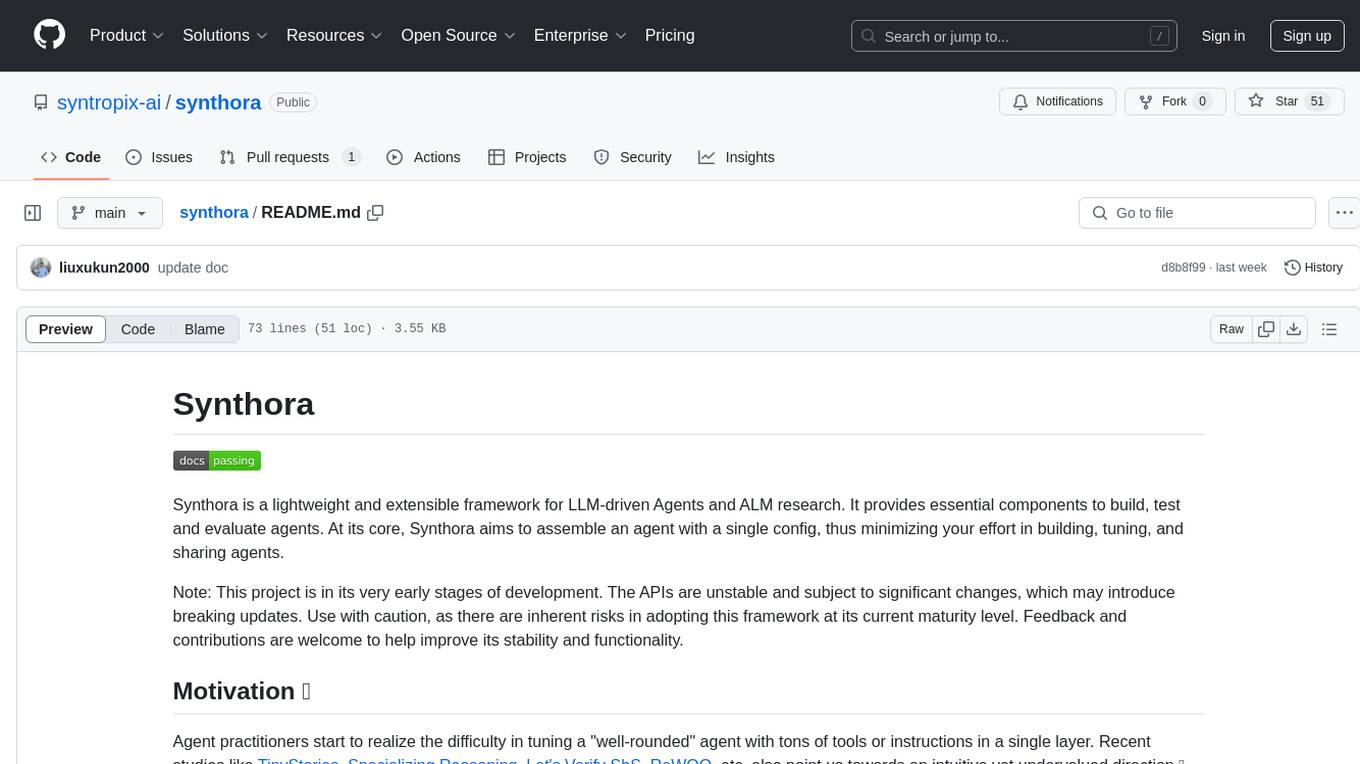
Synthora is a lightweight and extensible framework for LLM-driven Agents and ALM research. It aims to simplify the process of building, testing, and evaluating agents by providing essential components. The framework allows for easy agent assembly with a single config, reducing the effort required for tuning and sharing agents. Although in early development stages with unstable APIs, Synthora welcomes feedback and contributions to enhance its stability and functionality.
agentUniverse
agentUniverse is a multi-agent framework based on large language models, providing flexible capabilities for building individual agents. It focuses on collaborative pattern components to solve problems in various fields and integrates domain experience. The framework supports LLM model integration and offers various pattern components like PEER and DOE. Users can easily configure models and set up agents for tasks. agentUniverse aims to assist developers and enterprises in constructing domain-expert-level intelligent agents for seamless collaboration.
awesome-algorand
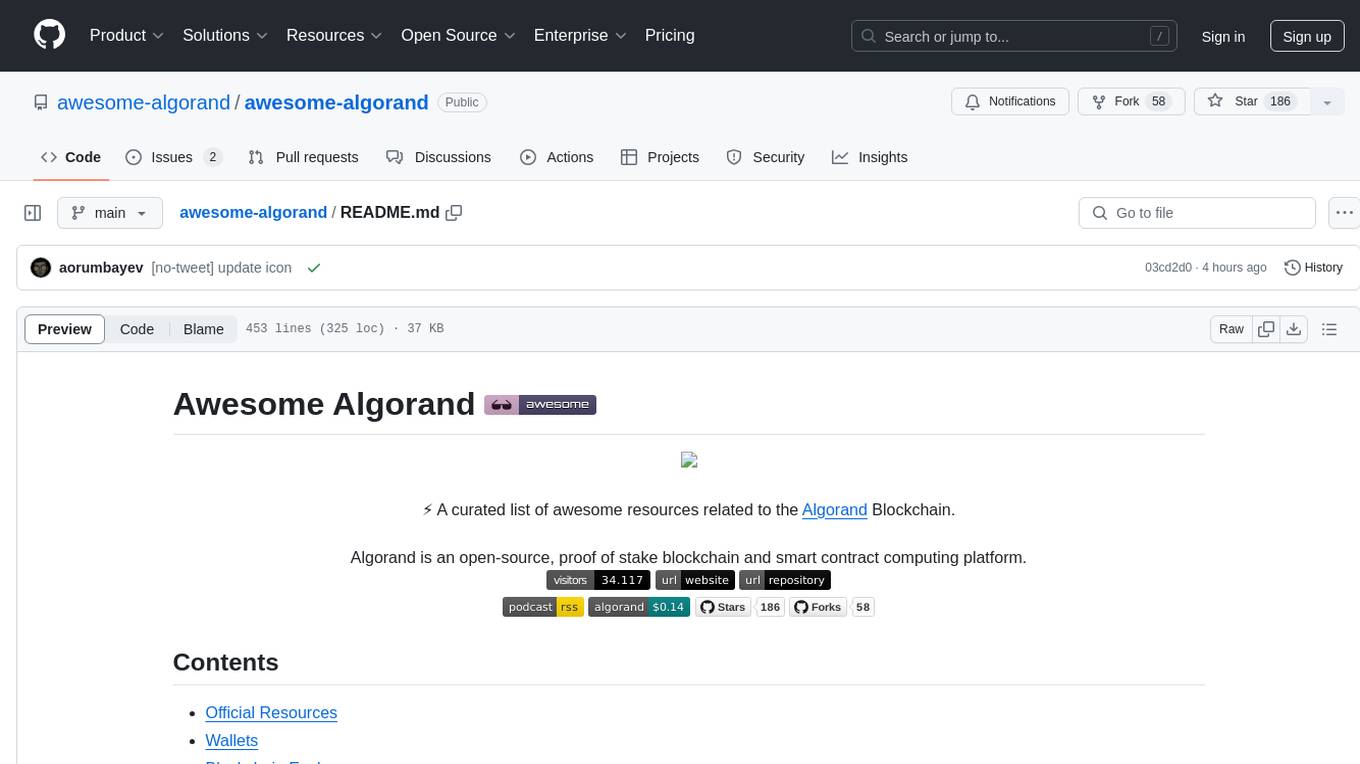
Awesome Algorand is a curated list of resources related to the Algorand Blockchain, including official resources, wallets, blockchain explorers, portfolio trackers, learning resources, development tools, DeFi platforms, nodes & consensus participation, subscription management, security auditing services, blockchain bridges, oracles, name services, community resources, Algorand Request for Comments, metrics and analytics services, decentralized voting tools, and NFT marketplaces. The repository provides a comprehensive collection of tools, tutorials, protocols, and platforms for developers, users, and enthusiasts interested in the Algorand ecosystem.
uusec-waf
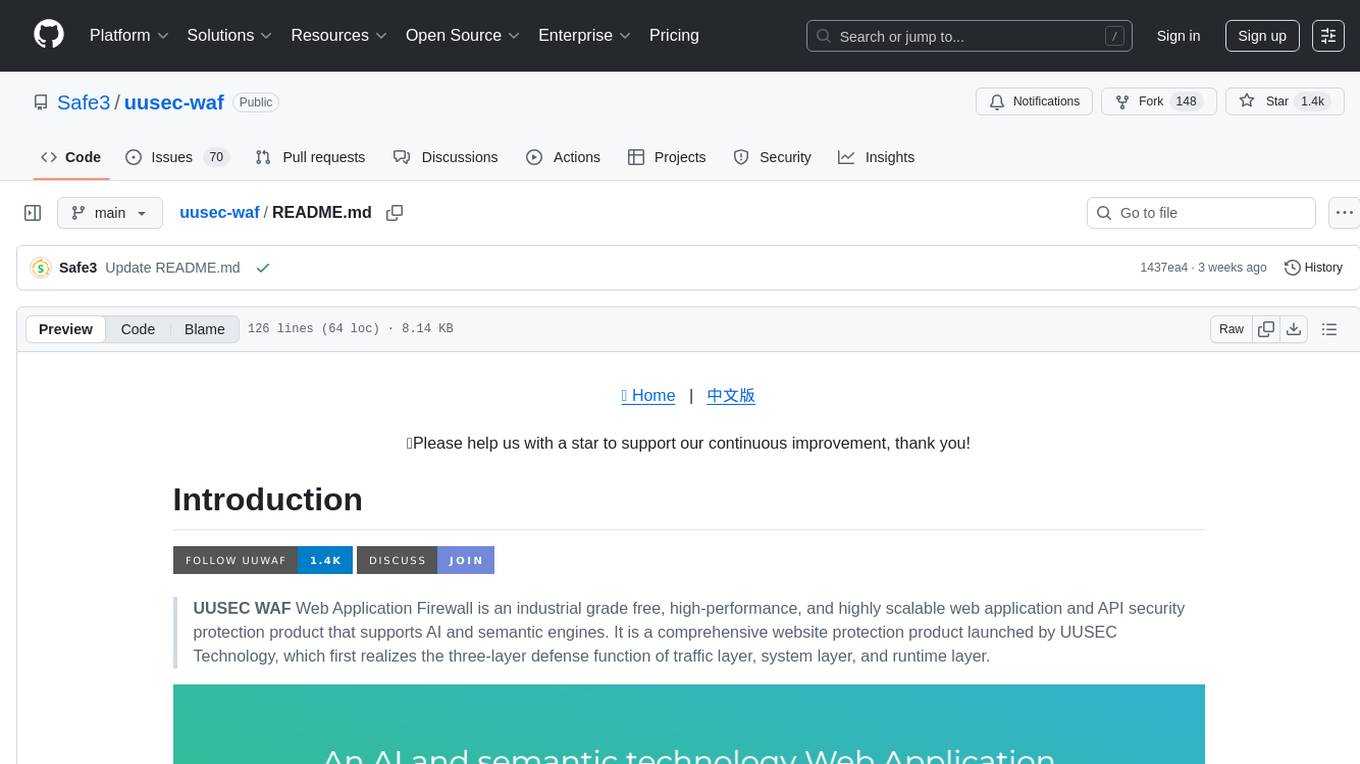
UUSEC WAF is an industrial grade free, high-performance, and highly scalable web application and API security protection product that supports AI and semantic engines. It provides intelligent 0-day defense, ultimate CDN acceleration, powerful proactive defense, advanced semantic engine, and advanced rule engine. With features like machine learning technology, cache cleaning, dual layer defense, semantic analysis, and Lua script rule writing, UUSEC WAF offers comprehensive website protection with three-layer defense functions at traffic, system, and runtime layers.
For similar tasks
AgentConnect
AgentConnect is an open-source implementation of the Agent Network Protocol (ANP) aiming to define how agents connect with each other and build an open, secure, and efficient collaboration network for billions of agents. It addresses challenges like interconnectivity, native interfaces, and efficient collaboration by providing authentication, end-to-end encryption, meta-protocol handling, and application layer protocol integration. The project focuses on performance and multi-platform support, with plans to rewrite core components in Rust and support Mac, Linux, Windows, mobile platforms, and browsers. AgentConnect aims to establish ANP as an industry standard through protocol development and forming a standardization committee.
AgentConnect
AgentConnect is an open-source implementation of the Agent Network Protocol (ANP) aiming to define how agents connect with each other and build an open, secure, and efficient collaboration network for billions of agents. It addresses challenges like interconnectivity, native interfaces, and efficient collaboration. The architecture includes authentication, end-to-end encryption modules, meta-protocol module, and application layer protocol integration framework. AgentConnect focuses on performance and multi-platform support, with plans to rewrite core components in Rust and support mobile platforms and browsers. The project aims to establish ANP as an industry standard and form an ANP Standardization Committee. Installation is done via 'pip install agent-connect' and demos can be run after cloning the repository. Features include decentralized authentication based on did:wba and HTTP, and meta-protocol negotiation examples.
authed
Authed is an identity and authentication system designed for AI agents, providing unique identities, secure agent-to-agent authentication, and dynamic access policies. It eliminates the need for static credentials and human intervention in authentication workflows. The protocol is developer-first, open-source, and scalable, enabling AI agents to interact securely across different ecosystems and organizations.
we0
We0 is a web project generation tool that offers browser-based debugging, high-fidelity design restoration, importing historical projects, integration with WeChat Mini Program Developer Tools, and multi-platform support. It supports code generation, design-to-code conversion, open-source projects, WeChat Mini Program Tools preview, existing projects, and Deepseek. The tool uses pnpm as the package management tool and requires Node.js version 18.20. Users can install and configure the tool for web development and utilize quick start methods for building the web editor. Additionally, instructions are provided for installing and using the client version on Mac, along with troubleshooting tips. For any questions or support, users can contact [email protected] or join the WeChat group chat.
For similar jobs
sweep
Sweep is an AI junior developer that turns bugs and feature requests into code changes. It automatically handles developer experience improvements like adding type hints and improving test coverage.
teams-ai
The Teams AI Library is a software development kit (SDK) that helps developers create bots that can interact with Teams and Microsoft 365 applications. It is built on top of the Bot Framework SDK and simplifies the process of developing bots that interact with Teams' artificial intelligence capabilities. The SDK is available for JavaScript/TypeScript, .NET, and Python.
ai-guide
This guide is dedicated to Large Language Models (LLMs) that you can run on your home computer. It assumes your PC is a lower-end, non-gaming setup.
classifai
Supercharge WordPress Content Workflows and Engagement with Artificial Intelligence. Tap into leading cloud-based services like OpenAI, Microsoft Azure AI, Google Gemini and IBM Watson to augment your WordPress-powered websites. Publish content faster while improving SEO performance and increasing audience engagement. ClassifAI integrates Artificial Intelligence and Machine Learning technologies to lighten your workload and eliminate tedious tasks, giving you more time to create original content that matters.
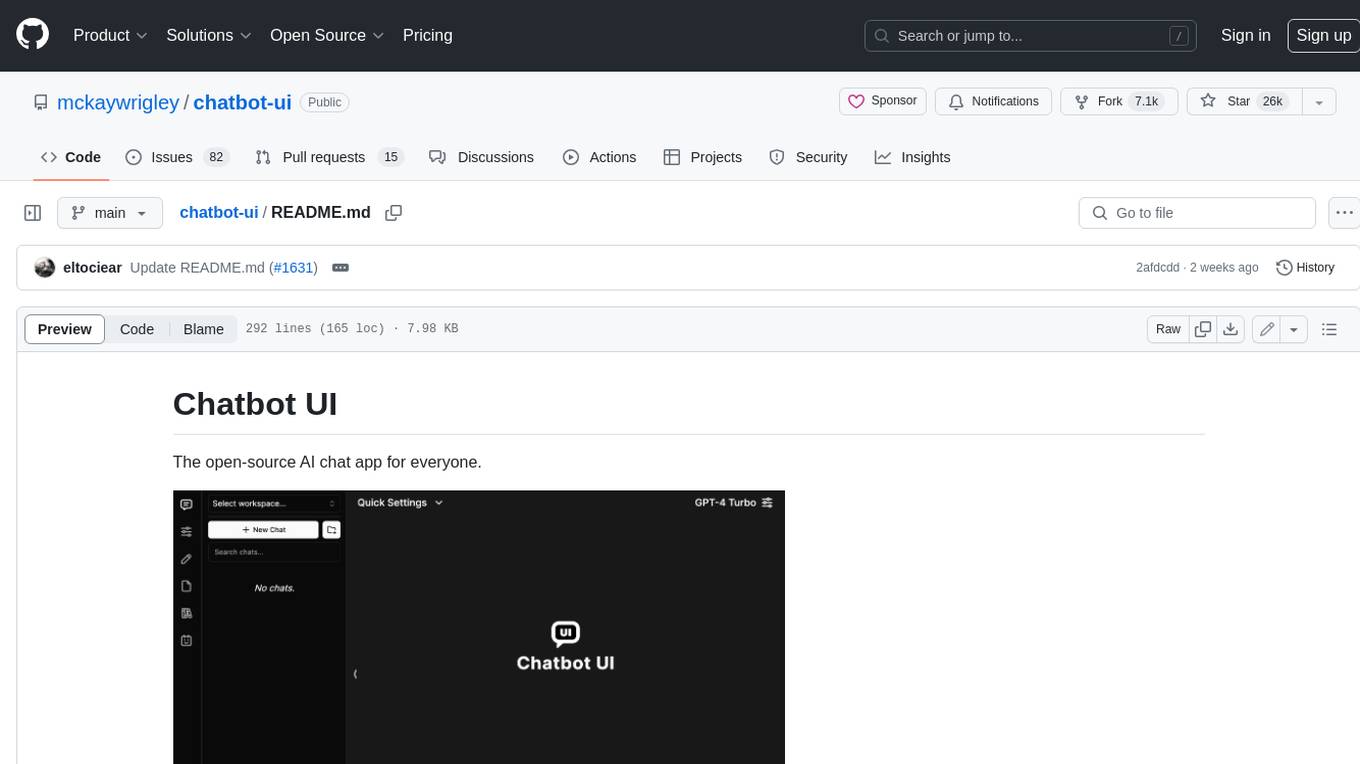
chatbot-ui
Chatbot UI is an open-source AI chat app that allows users to create and deploy their own AI chatbots. It is easy to use and can be customized to fit any need. Chatbot UI is perfect for businesses, developers, and anyone who wants to create a chatbot.
BricksLLM
BricksLLM is a cloud native AI gateway written in Go. Currently, it provides native support for OpenAI, Anthropic, Azure OpenAI and vLLM. BricksLLM aims to provide enterprise level infrastructure that can power any LLM production use cases. Here are some use cases for BricksLLM: * Set LLM usage limits for users on different pricing tiers * Track LLM usage on a per user and per organization basis * Block or redact requests containing PIIs * Improve LLM reliability with failovers, retries and caching * Distribute API keys with rate limits and cost limits for internal development/production use cases * Distribute API keys with rate limits and cost limits for students
uAgents
uAgents is a Python library developed by Fetch.ai that allows for the creation of autonomous AI agents. These agents can perform various tasks on a schedule or take action on various events. uAgents are easy to create and manage, and they are connected to a fast-growing network of other uAgents. They are also secure, with cryptographically secured messages and wallets.
griptape
Griptape is a modular Python framework for building AI-powered applications that securely connect to your enterprise data and APIs. It offers developers the ability to maintain control and flexibility at every step. Griptape's core components include Structures (Agents, Pipelines, and Workflows), Tasks, Tools, Memory (Conversation Memory, Task Memory, and Meta Memory), Drivers (Prompt and Embedding Drivers, Vector Store Drivers, Image Generation Drivers, Image Query Drivers, SQL Drivers, Web Scraper Drivers, and Conversation Memory Drivers), Engines (Query Engines, Extraction Engines, Summary Engines, Image Generation Engines, and Image Query Engines), and additional components (Rulesets, Loaders, Artifacts, Chunkers, and Tokenizers). Griptape enables developers to create AI-powered applications with ease and efficiency.