


AgentNetworkProtocol
AgentNetworkProtocol (ANP) is an open protocol framework designed for agentic web. Our vision is to define how agents connect with each other, building an open, secure, and efficient collaboration network for billions of intelligent agents.
Stars: 62
AgentNetworkProtocol (ANP) aims to define how agents connect with each other, building an open, secure, and efficient collaboration network for billions of intelligent agents. It addresses challenges in interconnectivity, native interfaces, and efficient collaboration by providing protocol layers for identity and encrypted communication, meta-protocol negotiation, and application protocol management. The project is developing an open-source implementation available on GitHub, with a vision to become the HTTP of the Intelligent Agent Internet era and establish ANP as an industry standard through a standardization committee. Contact the author Gaowei Chang via email, Discord, website, or GitHub for contributions or inquiries.
README:
AgentNetworkProtocol(ANP) aims to become the HTTP of the Intelligent Agent Internet era.
Our vision is to define how agents connect with each other, building an open, secure, and efficient collaboration network for billions of intelligent agents.

While current internet infrastructure is well-established, there's still a lack of optimal communication and connection solutions for the specific needs of agent networks. We are committed to addressing three major challenges faced by agent networks:
- 🌐 Interconnectivity: Enable communication between all agents, break down data silos, and ensure AI has access to complete contextual information.
- 🖥️ Native Interfaces: AI shouldn't need to mimic human internet interaction; instead, it should interact with the digital world through its most proficient means (APIs or communication protocols).
- 🤝 Efficient Collaboration: Leverage AI for self-organization and self-negotiation among agents, creating a more cost-effective and efficient collaboration network than the existing internet.

- 🔒 Identity and Encrypted Communication Layer: Based on W3C DID (Decentralized Identifiers) specification, we build a decentralized authentication scheme and end-to-end encrypted communication solution on existing mature web infrastructure. This enables agents across any platforms to authenticate each other without relying on centralized systems.
- 🌍 Meta-Protocol Layer: The meta-protocol is a protocol for negotiating communication protocols between agents. It is key to evolving agent networks into self-organizing, self-negotiating efficient collaboration networks.
- 📡 Application Protocol Layer: Based on semantic web specifications, this layer enables agents to describe their capabilities and supported application protocols, and efficiently manage these protocols.
We are developing an open-source implementation of AgentNetworkProtocol at: https://github.com/chgaowei/AgentConnect
For further understanding, you can refer to these documents:
- For our overall design philosophy and concepts, see our technical white paper: AgentNetworkProtocol Technical White Paper
- We've designed a decentralized authentication scheme that leverages existing web infrastructure while maintaining decentralization. We believe this is currently the optimal solution for agent authentication: did:wba Method Specification
- This is our did:wba service side interface, which can be used to test your own did:wba client and service side: did:wba service side interface
- Based on DID, we've designed an end-to-end encrypted communication protocol for agents, distinct from TLS as intermediate relay nodes cannot decrypt the content: DID-based End-to-End Encrypted Communication
- We've designed a meta-protocol for negotiating communication protocols between agents, enabling them to autonomously negotiate their communication protocols: Meta-Protocol Design Specification
- We have designed a protocol for describing agents that enables data exchange between agents: Agent Description Protocol Specification
- Additional specifications are currently under development.
Here are some of our blogs:
-
This is our understanding of the agent network: What's Different About the Agentic Web
-
A brief introduction to did:wba: did:wba - Web-Based Decentralized Identifiers
-
We compared the differences between did:wba and technologies like OpenID Connect and API keys: Comparison of did:wba with OpenID Connect and API keys
-
We analyzed the security principles of did:wba: Security Principles of did:wba
-
Three Technical Approaches to AI-Internet Interaction: Three Technical Approaches to AI-Internet Interaction
Both protocol development and open-source implementation are progressing in the following order:
- [x] Build identity authentication and end-to-end encrypted communication protocol and implementation. This foundational core is essentially complete in both protocol design and code.
- [x] Meta-protocol design and implementation. Protocol design and code development are basically complete.
- [x] Application layer protocol design and development.
- [x] Support for agent description.
- [ ] Support for agent discovery.
To establish Agent Network Protocol(ANP) as an industry standard, we plan to form an ANP Standardization Committee at an appropriate time, working towards recognition by international standardization organizations like W3C.
Author: Gaowei Chang
Email: [email protected]
- Discord: https://discord.gg/SuXb2pzqGy
- Website: https://agent-network-protocol.com/
- GitHub: https://github.com/chgaowei/AgentNetworkProtocol
- WeChat: flow10240
We welcome contributions of any form. Please refer to CONTRIBUTING.md for details.
This project is open-sourced under the MIT License. See LICENSE file for details.
For Tasks:
Click tags to check more tools for each tasksFor Jobs:
Alternative AI tools for AgentNetworkProtocol
Similar Open Source Tools
AgentNetworkProtocol
AgentNetworkProtocol (ANP) aims to define how agents connect with each other, building an open, secure, and efficient collaboration network for billions of intelligent agents. It addresses challenges in interconnectivity, native interfaces, and efficient collaboration by providing protocol layers for identity and encrypted communication, meta-protocol negotiation, and application protocol management. The project is developing an open-source implementation available on GitHub, with a vision to become the HTTP of the Intelligent Agent Internet era and establish ANP as an industry standard through a standardization committee. Contact the author Gaowei Chang via email, Discord, website, or GitHub for contributions or inquiries.
AgentConnect
AgentConnect is an open-source implementation of the Agent Network Protocol (ANP) aiming to define how agents connect with each other and build an open, secure, and efficient collaboration network for billions of agents. It addresses challenges like interconnectivity, native interfaces, and efficient collaboration by providing authentication, end-to-end encryption, meta-protocol handling, and application layer protocol integration. The project focuses on performance and multi-platform support, with plans to rewrite core components in Rust and support Mac, Linux, Windows, mobile platforms, and browsers. AgentConnect aims to establish ANP as an industry standard through protocol development and forming a standardization committee.
AgentConnect
AgentConnect is an open-source implementation of the Agent Network Protocol (ANP) aiming to define how agents connect with each other and build an open, secure, and efficient collaboration network for billions of agents. It addresses challenges like interconnectivity, native interfaces, and efficient collaboration. The architecture includes authentication, end-to-end encryption modules, meta-protocol module, and application layer protocol integration framework. AgentConnect focuses on performance and multi-platform support, with plans to rewrite core components in Rust and support mobile platforms and browsers. The project aims to establish ANP as an industry standard and form an ANP Standardization Committee. Installation is done via 'pip install agent-connect' and demos can be run after cloning the repository. Features include decentralized authentication based on did:wba and HTTP, and meta-protocol negotiation examples.
agentUniverse
agentUniverse is a framework for developing applications powered by multi-agent based on large language model. It provides essential components for building single agent and multi-agent collaboration mechanism for customizing collaboration patterns. Developers can easily construct multi-agent applications and share pattern practices from different fields. The framework includes pre-installed collaboration patterns like PEER and DOE for complex task breakdown and data-intensive tasks.
dapr-agents
Dapr Agents is a developer framework for building production-grade resilient AI agent systems that operate at scale. It enables software developers to create AI agents that reason, act, and collaborate using Large Language Models (LLMs), while providing built-in observability and stateful workflow execution to ensure agentic workflows complete successfully. The framework is scalable, efficient, Kubernetes-native, data-driven, secure, observable, vendor-neutral, and open source. It offers features like scalable workflows, cost-effective AI adoption, data-centric AI agents, accelerated development, integrated security and reliability, built-in messaging and state infrastructure, and vendor-neutral and open source support. Dapr Agents is designed to simplify the development of AI applications and workflows by providing a comprehensive API surface and seamless integration with various data sources and services.
agentUniverse
agentUniverse is a multi-agent framework based on large language models, providing flexible capabilities for building individual agents. It focuses on collaborative pattern components to solve problems in various fields and integrates domain experience. The framework supports LLM model integration and offers various pattern components like PEER and DOE. Users can easily configure models and set up agents for tasks. agentUniverse aims to assist developers and enterprises in constructing domain-expert-level intelligent agents for seamless collaboration.
agentUniverse
agentUniverse is a multi-agent framework based on large language models, providing flexible capabilities for building individual agents. It focuses on multi-agent collaborative patterns, integrating domain experience to help agents solve problems in various fields. The framework includes pattern components like PEER and DOE for event interpretation, industry analysis, and financial report generation. It offers features for agent construction, multi-agent collaboration, and domain expertise integration, aiming to create intelligent applications with professional know-how.
nuwa
Nuwa is an AI platform where users pay directly to developers for AI models and agents. Payments are made using cryptocurrencies secured by blockchain. User data and authentications are based on Decentralized Identity (DID). Nuwa aims to reduce friction for users, enhance their daily AI experience, and provide direct monetization for developers. The platform offers an agent-first approach, protocol-powered solutions, and user-aligned services. It includes a Nuwa Client for AI chat with DID-based authentication and cryptocurrency payments, and Nuwa Kit for developers to build and launch AI models and agents into Caps (capabilities). The repository contains various components of the Nuwa Protocol, including Nuwa Improvement Proposals, smart contracts, client agent implementation, development kits, reference implementations of key services, and websites for documentation and landing pages.
AIXP
The AI-Exchange Protocol (AIXP) is a communication standard designed to facilitate information and result exchange between artificial intelligence agents. It aims to enhance interoperability and collaboration among various AI systems by establishing a common framework for communication. AIXP includes components for communication, loop prevention, and task finalization, ensuring secure and efficient collaboration while avoiding infinite communication loops. The protocol defines access points, data formats, authentication, authorization, versioning, loop detection, status codes, error messages, and task completion verification. AIXP enables AI agents to collaborate seamlessly and complete tasks effectively, contributing to the overall efficiency and reliability of AI systems.
CodeFuse-muAgent
CodeFuse-muAgent is a Multi-Agent framework designed to streamline Standard Operating Procedure (SOP) orchestration for agents. It integrates toolkits, code libraries, knowledge bases, and sandbox environments for rapid construction of complex Multi-Agent interactive applications. The framework enables efficient execution and handling of multi-layered and multi-dimensional tasks.
agentsociety
AgentSociety is an advanced framework designed for building agents in urban simulation environments. It integrates LLMs' planning, memory, and reasoning capabilities to generate realistic behaviors. The framework supports dataset-based, text-based, and rule-based environments with interactive visualization. It includes tools for interviews, surveys, interventions, and metric recording tailored for social experimentation.
akeru
Akeru.ai is an open-source AI platform leveraging the power of decentralization. It offers transparent, safe, and highly available AI capabilities. The platform aims to give developers access to open-source and transparent AI resources through its decentralized nature hosted on an edge network. Akeru API introduces features like retrieval, function calling, conversation management, custom instructions, data input optimization, user privacy, testing and iteration, and comprehensive documentation. It is ideal for creating AI agents and enhancing web and mobile applications with advanced AI capabilities. The platform runs on a Bittensor Subnet design that aims to democratize AI technology and promote an equitable AI future. Akeru.ai embraces decentralization challenges to ensure a decentralized and equitable AI ecosystem with security features like watermarking and network pings. The API architecture integrates with technologies like Bun, Redis, and Elysia for a robust, scalable solution.
CSGHub
CSGHub is an open source, trustworthy large model asset management platform that can assist users in governing the assets involved in the lifecycle of LLM and LLM applications (datasets, model files, codes, etc). With CSGHub, users can perform operations on LLM assets, including uploading, downloading, storing, verifying, and distributing, through Web interface, Git command line, or natural language Chatbot. Meanwhile, the platform provides microservice submodules and standardized OpenAPIs, which could be easily integrated with users' own systems. CSGHub is committed to bringing users an asset management platform that is natively designed for large models and can be deployed On-Premise for fully offline operation. CSGHub offers functionalities similar to a privatized Huggingface(on-premise Huggingface), managing LLM assets in a manner akin to how OpenStack Glance manages virtual machine images, Harbor manages container images, and Sonatype Nexus manages artifacts.
k8sgateway
K8sGateway is a feature-rich, fast, and flexible Kubernetes-native API gateway built on Envoy proxy and Kubernetes Gateway API. It excels in function-level routing, supports legacy apps, microservices, and serverless. It offers robust discovery capabilities, seamless integration with open-source projects, and supports hybrid applications with various technologies, architectures, protocols, and clouds.
kgateway
Kgateway is a feature-rich, fast, and flexible Kubernetes-native API gateway built on top of Envoy proxy and the Kubernetes Gateway API. It excels in function-level routing, supports legacy apps, microservices, and serverless, offers robust discovery capabilities, integrates seamlessly with open-source projects, and is designed to support hybrid applications with various technologies, architectures, protocols, and clouds.
wren-engine
Wren Engine is a semantic engine designed to serve as the backbone of the semantic layer for LLMs. It simplifies the user experience by translating complex data structures into a business-friendly format, enabling end-users to interact with data using familiar terminology. The engine powers the semantic layer with advanced capabilities to define and manage modeling definitions, metadata, schema, data relationships, and logic behind calculations and aggregations through an analytics-as-code design approach. By leveraging Wren Engine, organizations can ensure a developer-friendly semantic layer that reflects nuanced data relationships and dynamics, facilitating more informed decision-making and strategic insights.
For similar tasks
AgentNetworkProtocol
AgentNetworkProtocol (ANP) aims to define how agents connect with each other, building an open, secure, and efficient collaboration network for billions of intelligent agents. It addresses challenges in interconnectivity, native interfaces, and efficient collaboration by providing protocol layers for identity and encrypted communication, meta-protocol negotiation, and application protocol management. The project is developing an open-source implementation available on GitHub, with a vision to become the HTTP of the Intelligent Agent Internet era and establish ANP as an industry standard through a standardization committee. Contact the author Gaowei Chang via email, Discord, website, or GitHub for contributions or inquiries.
pebble
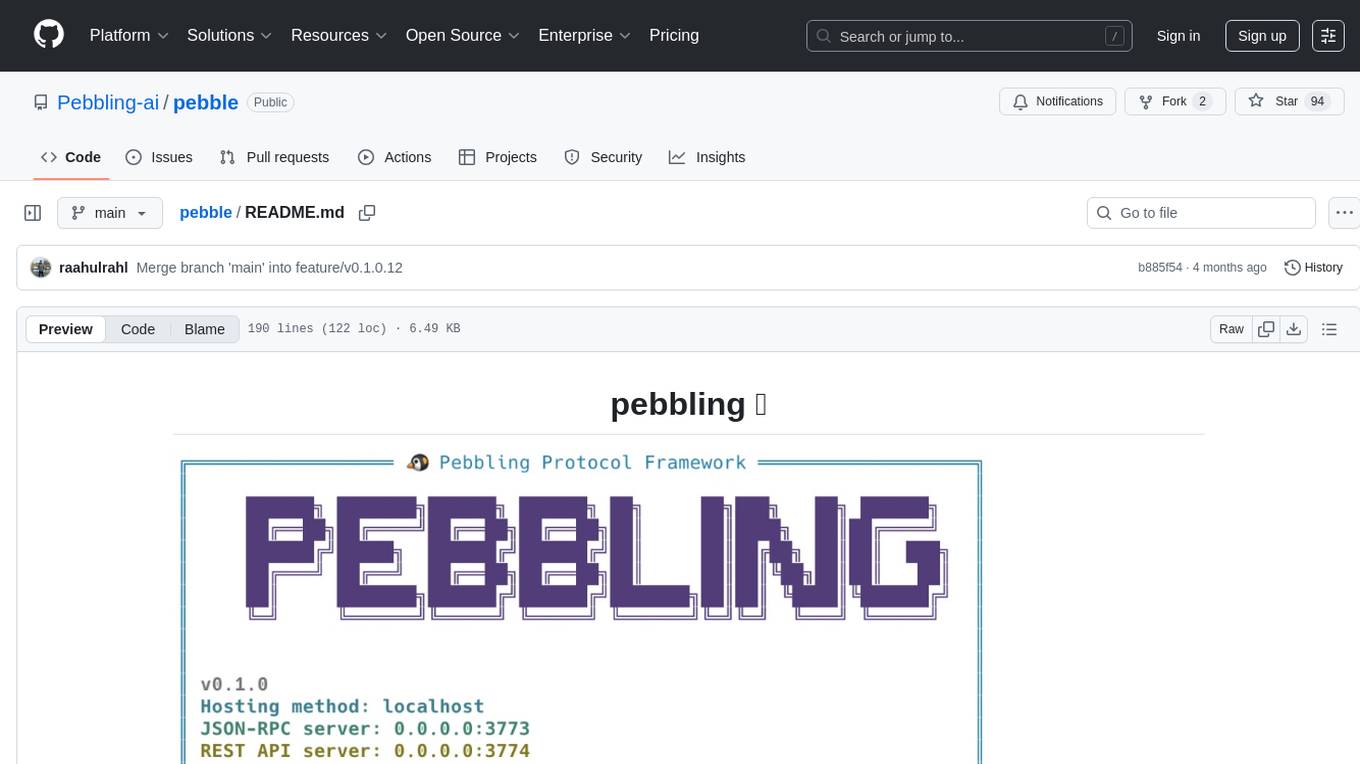
Pebbling is an open-source protocol for agent-to-agent communication, enabling AI agents to collaborate securely using Decentralised Identifiers (DIDs) and mutual TLS (mTLS). It provides a lightweight communication protocol built on JSON-RPC 2.0, ensuring reliable and secure conversations between agents. Pebbling allows agents to exchange messages safely, connect seamlessly regardless of programming language, and communicate quickly and efficiently. It is designed to pave the way for the next generation of collaborative AI systems, promoting secure and effortless communication between agents across different environments.
agentgateway
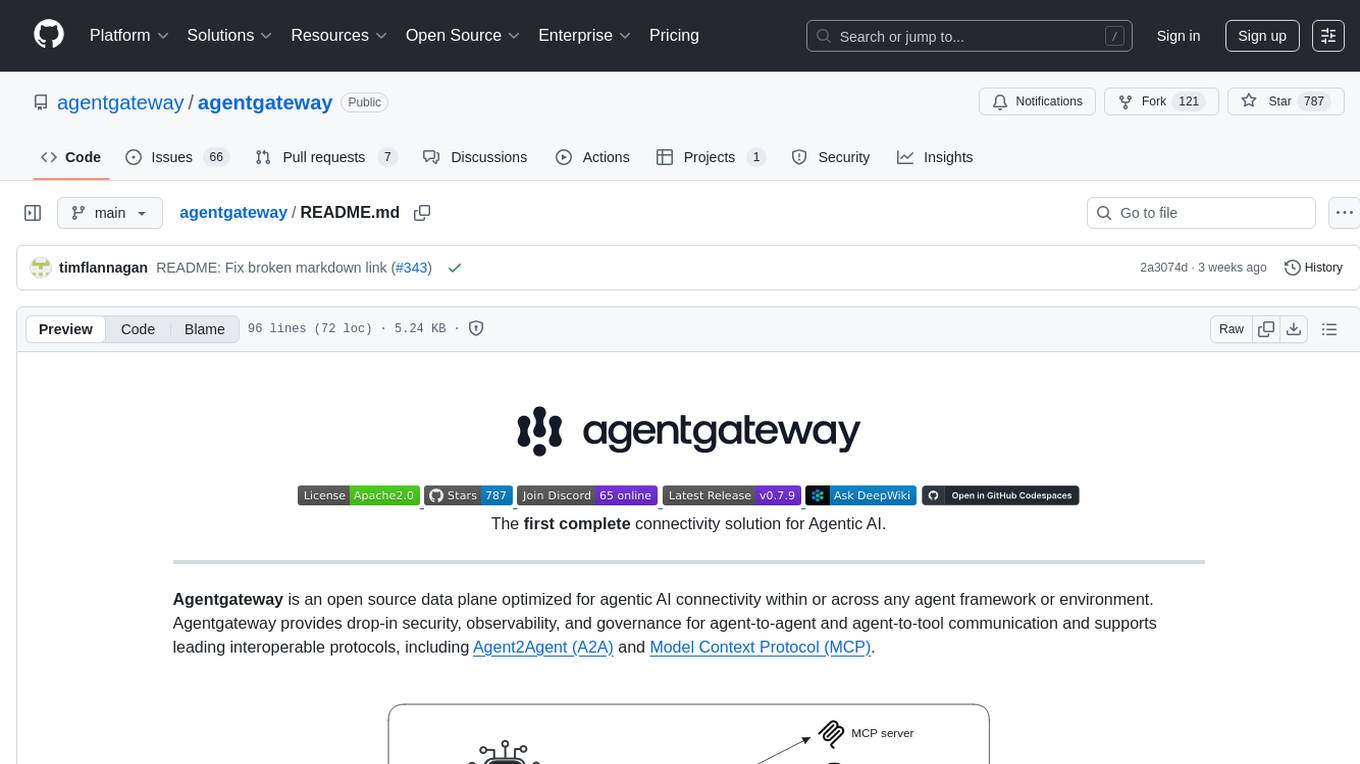
Agentgateway is an open source data plane optimized for agentic AI connectivity within or across any agent framework or environment. It provides drop-in security, observability, and governance for agent-to-agent and agent-to-tool communication, supporting leading interoperable protocols like Agent2Agent (A2A) and Model Context Protocol (MCP). Highly performant, security-first, multi-tenant, dynamic, and supporting legacy API transformation, agentgateway is designed to handle any scale and run anywhere with any agent framework.
beeai
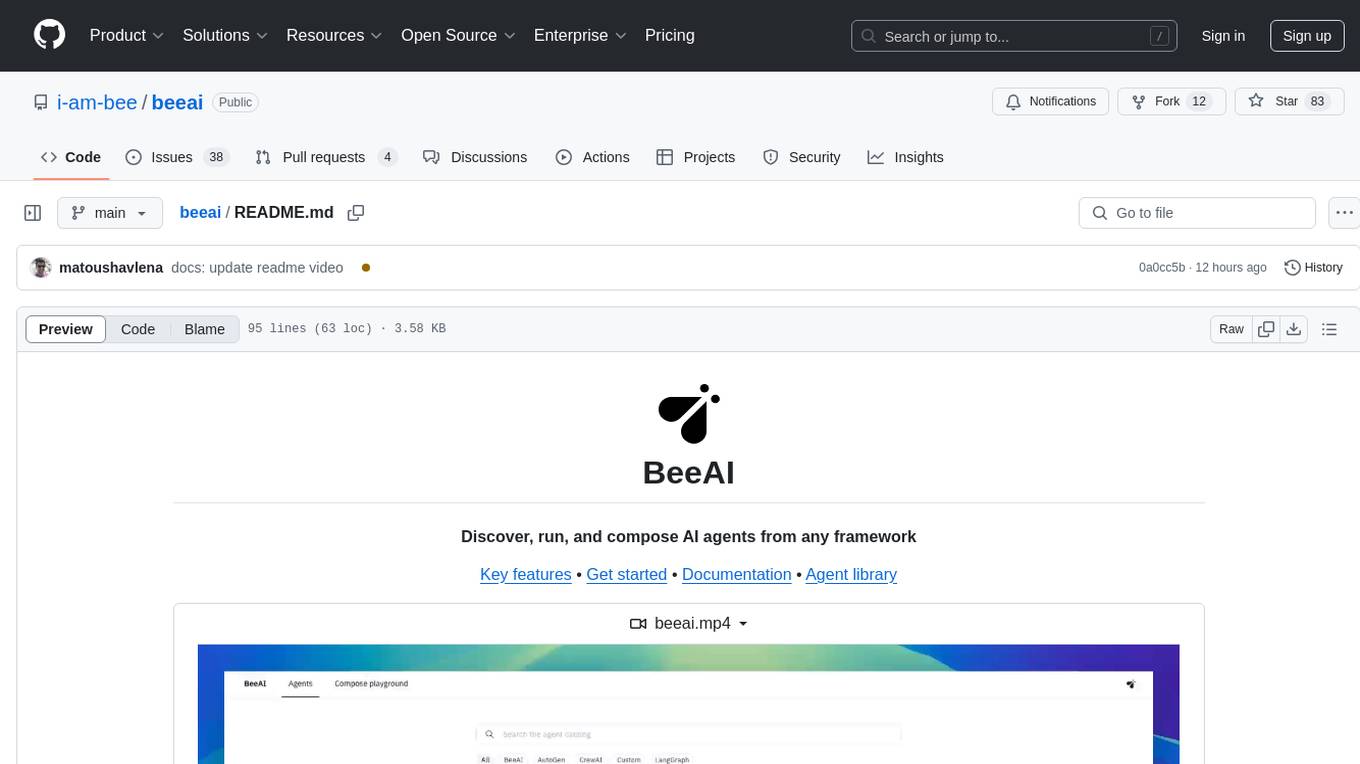
BeeAI is an open platform that helps users discover, run, and compose AI agents from any framework and language. It offers a framework-agnostic approach, allowing seamless integration of AI agents regardless of the language or platform. Users can build complex workflows using simple building blocks, explore a catalog of powerful agents with integrated search, and benefit from the BeeAI ecosystem with first-class support for Python and TypeScript agent developers.
beeai-platform
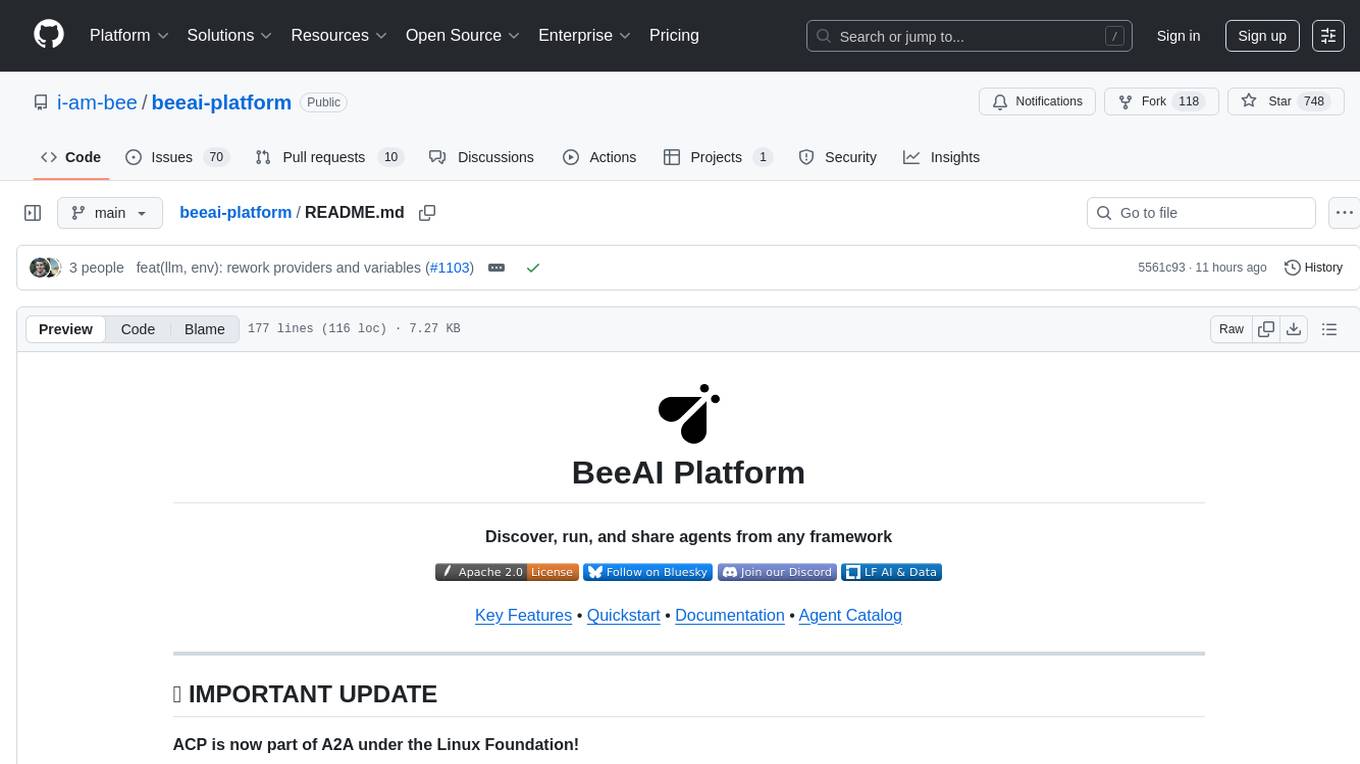
BeeAI is an open-source platform that simplifies the discovery, running, and sharing of AI agents across different frameworks. It addresses challenges such as framework fragmentation, deployment complexity, and discovery issues by providing a standardized platform for individuals and teams to access agents easily. With features like a centralized agent catalog, framework-agnostic interfaces, containerized agents, and consistent user experiences, BeeAI aims to streamline the process of working with AI agents for both developers and teams.
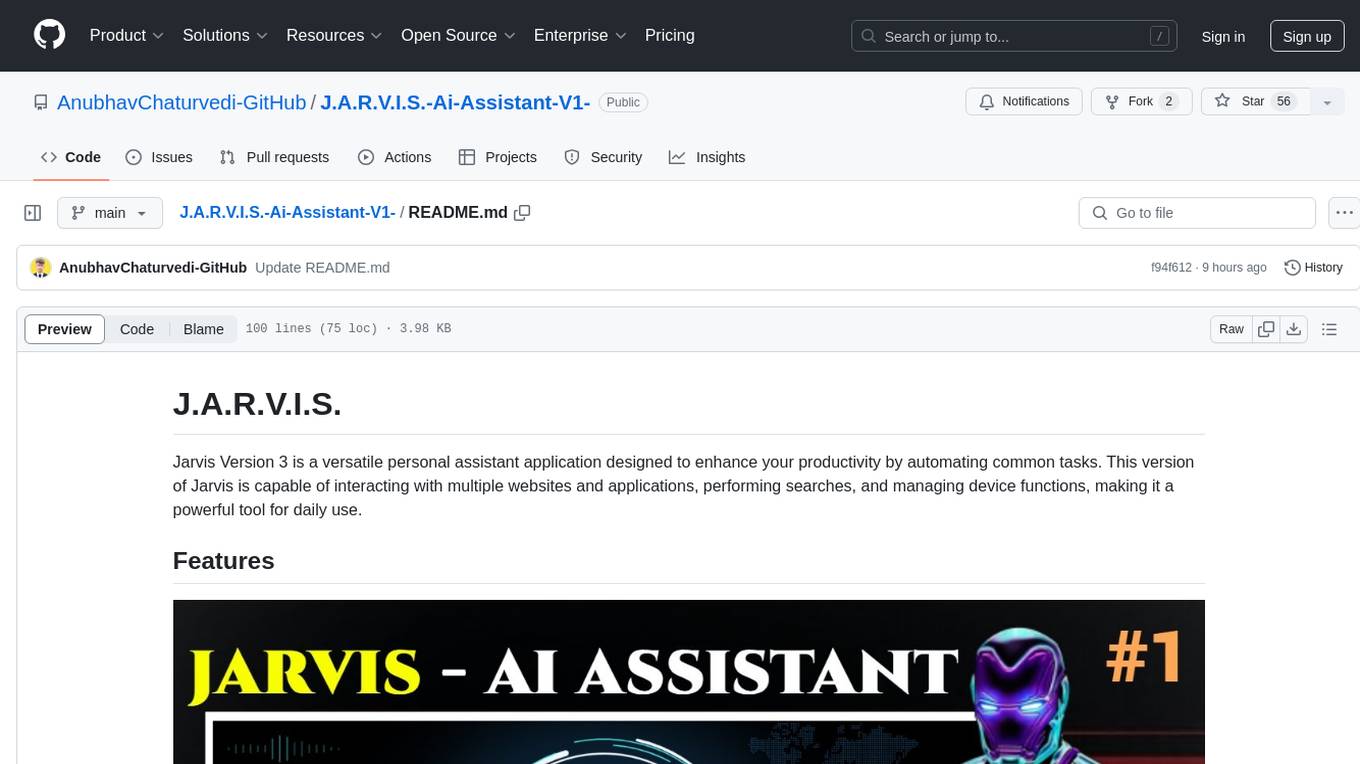
J.A.R.V.I.S.-Ai-Assistant-V1-
Jarvis Version 3 is a versatile personal assistant application designed to enhance productivity by automating common tasks. It can interact with websites and applications, perform searches, manage device functions, and control music. Users can give commands to open websites, search on Google or YouTube, scroll pages, manage applications, check time, internet speed, battery percentage, battery alerts, charging status, play music, and synchronize clapping with music. The tool offers features for web navigation, search functionality, scrolling, application management, device management, and music control.
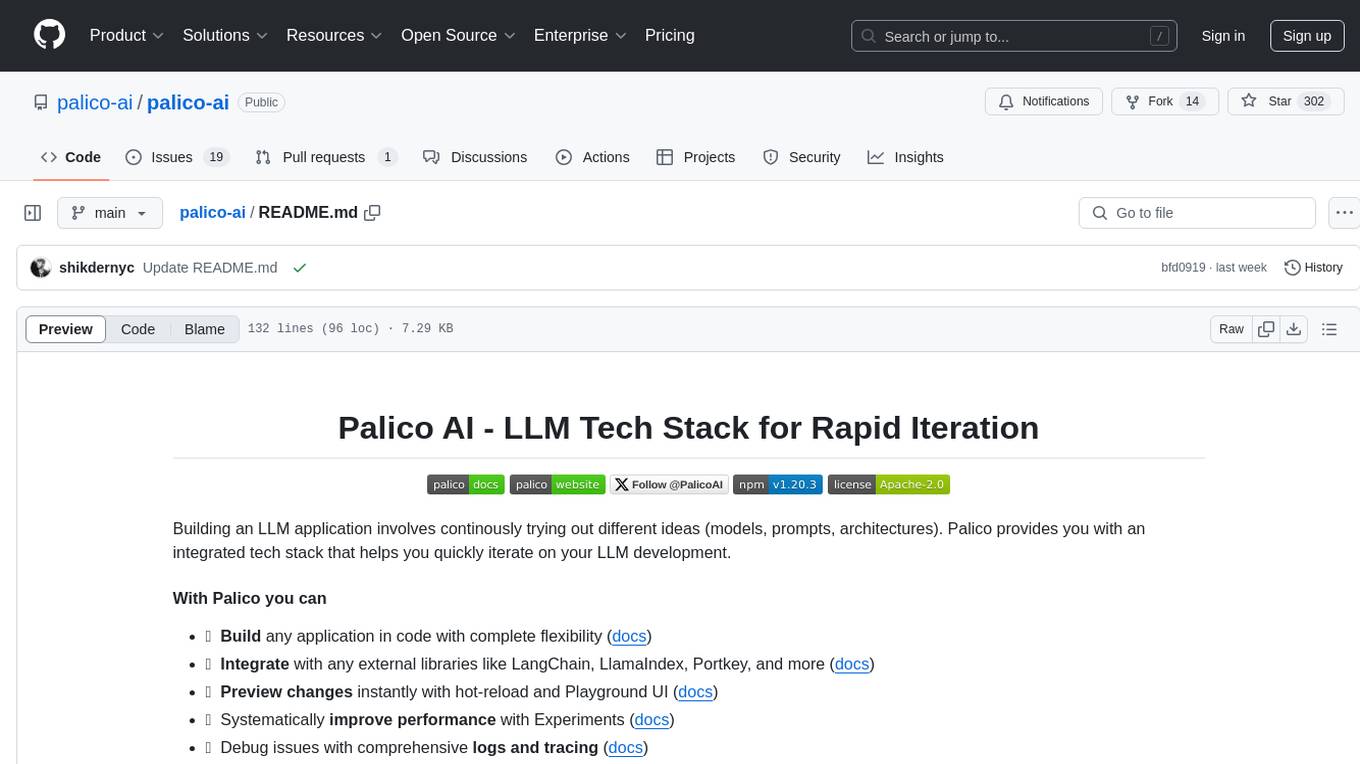
palico-ai
Palico AI is a tech stack designed for rapid iteration of LLM applications. It allows users to preview changes instantly, improve performance through experiments, debug issues with logs and tracing, deploy applications behind a REST API, and manage applications with a UI control panel. Users have complete flexibility in building their applications with Palico, integrating with various tools and libraries. The tool enables users to swap models, prompts, and logic easily using AppConfig. It also facilitates performance improvement through experiments and provides options for deploying applications to cloud providers or using managed hosting. Contributions to the project are welcomed, with easy ways to get involved by picking issues labeled as 'good first issue'.
sealos
Sealos is a cloud operating system distribution based on the Kubernetes kernel, designed for a seamless development lifecycle. It allows users to spin up full-stack environments in seconds, effortlessly push releases, and scale production seamlessly. With core features like easy application management, quick database creation, and cloud universality, Sealos offers efficient and economical cloud management with high universality and ease of use. The platform also emphasizes agility and security through its multi-tenancy sharing model. Sealos is supported by a community offering full documentation, Discord support, and active development roadmap.
For similar jobs
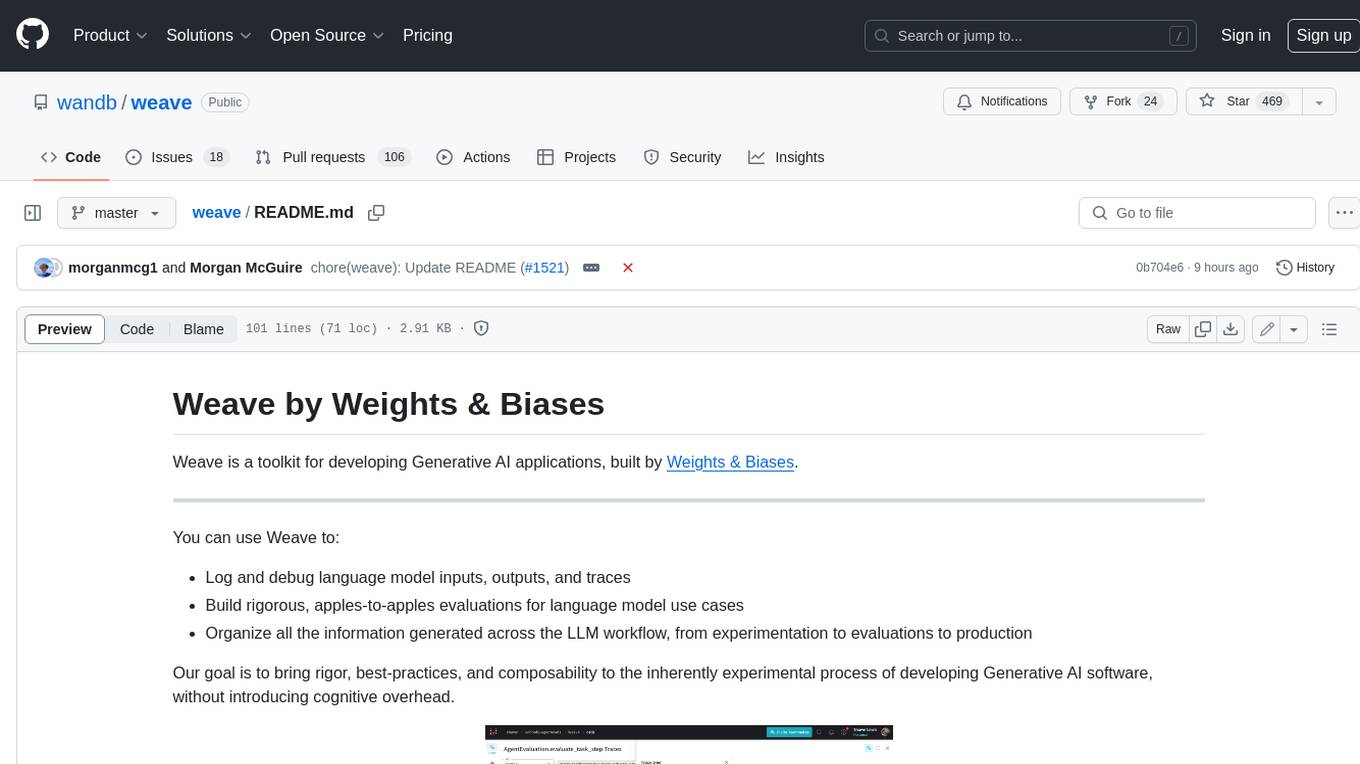
weave
Weave is a toolkit for developing Generative AI applications, built by Weights & Biases. With Weave, you can log and debug language model inputs, outputs, and traces; build rigorous, apples-to-apples evaluations for language model use cases; and organize all the information generated across the LLM workflow, from experimentation to evaluations to production. Weave aims to bring rigor, best-practices, and composability to the inherently experimental process of developing Generative AI software, without introducing cognitive overhead.
LLMStack
LLMStack is a no-code platform for building generative AI agents, workflows, and chatbots. It allows users to connect their own data, internal tools, and GPT-powered models without any coding experience. LLMStack can be deployed to the cloud or on-premise and can be accessed via HTTP API or triggered from Slack or Discord.
VisionCraft
The VisionCraft API is a free API for using over 100 different AI models. From images to sound.
kaito
Kaito is an operator that automates the AI/ML inference model deployment in a Kubernetes cluster. It manages large model files using container images, avoids tuning deployment parameters to fit GPU hardware by providing preset configurations, auto-provisions GPU nodes based on model requirements, and hosts large model images in the public Microsoft Container Registry (MCR) if the license allows. Using Kaito, the workflow of onboarding large AI inference models in Kubernetes is largely simplified.
PyRIT
PyRIT is an open access automation framework designed to empower security professionals and ML engineers to red team foundation models and their applications. It automates AI Red Teaming tasks to allow operators to focus on more complicated and time-consuming tasks and can also identify security harms such as misuse (e.g., malware generation, jailbreaking), and privacy harms (e.g., identity theft). The goal is to allow researchers to have a baseline of how well their model and entire inference pipeline is doing against different harm categories and to be able to compare that baseline to future iterations of their model. This allows them to have empirical data on how well their model is doing today, and detect any degradation of performance based on future improvements.
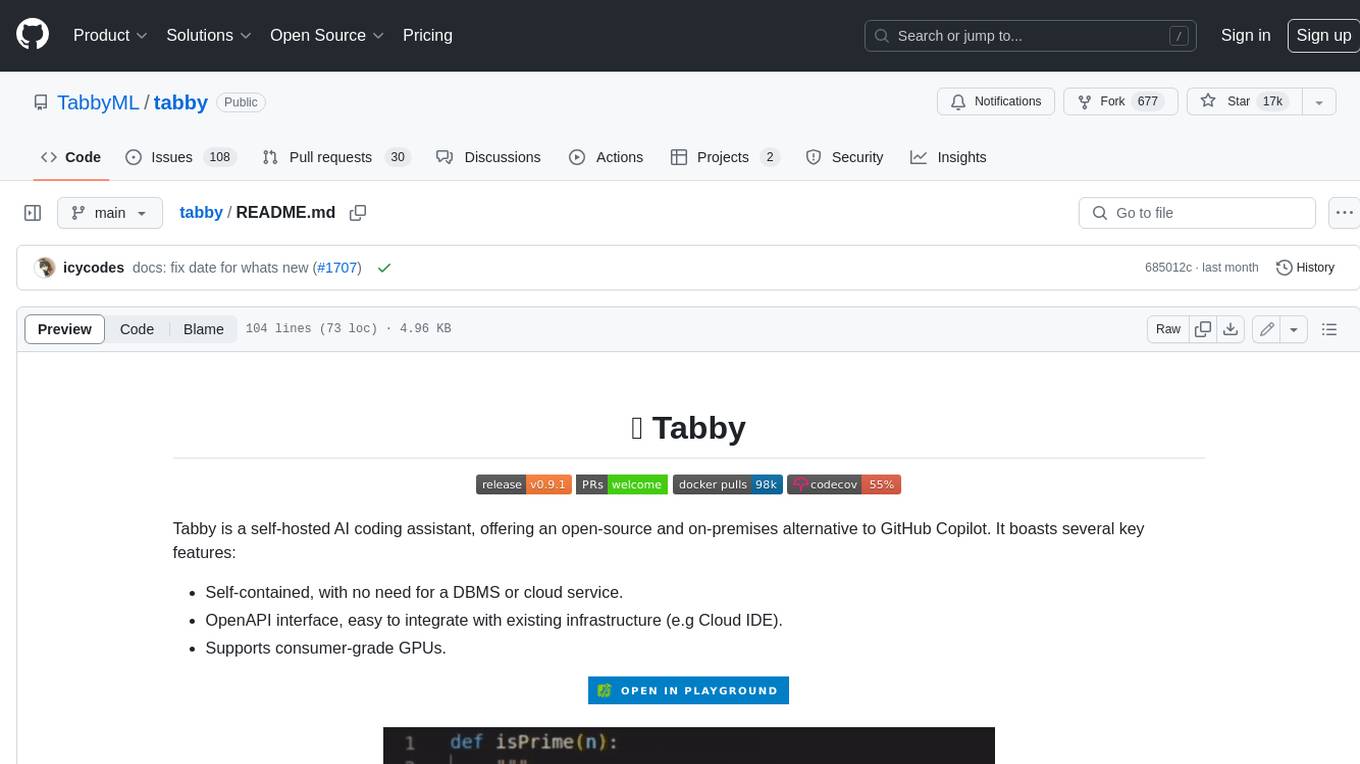
tabby
Tabby is a self-hosted AI coding assistant, offering an open-source and on-premises alternative to GitHub Copilot. It boasts several key features: * Self-contained, with no need for a DBMS or cloud service. * OpenAPI interface, easy to integrate with existing infrastructure (e.g Cloud IDE). * Supports consumer-grade GPUs.
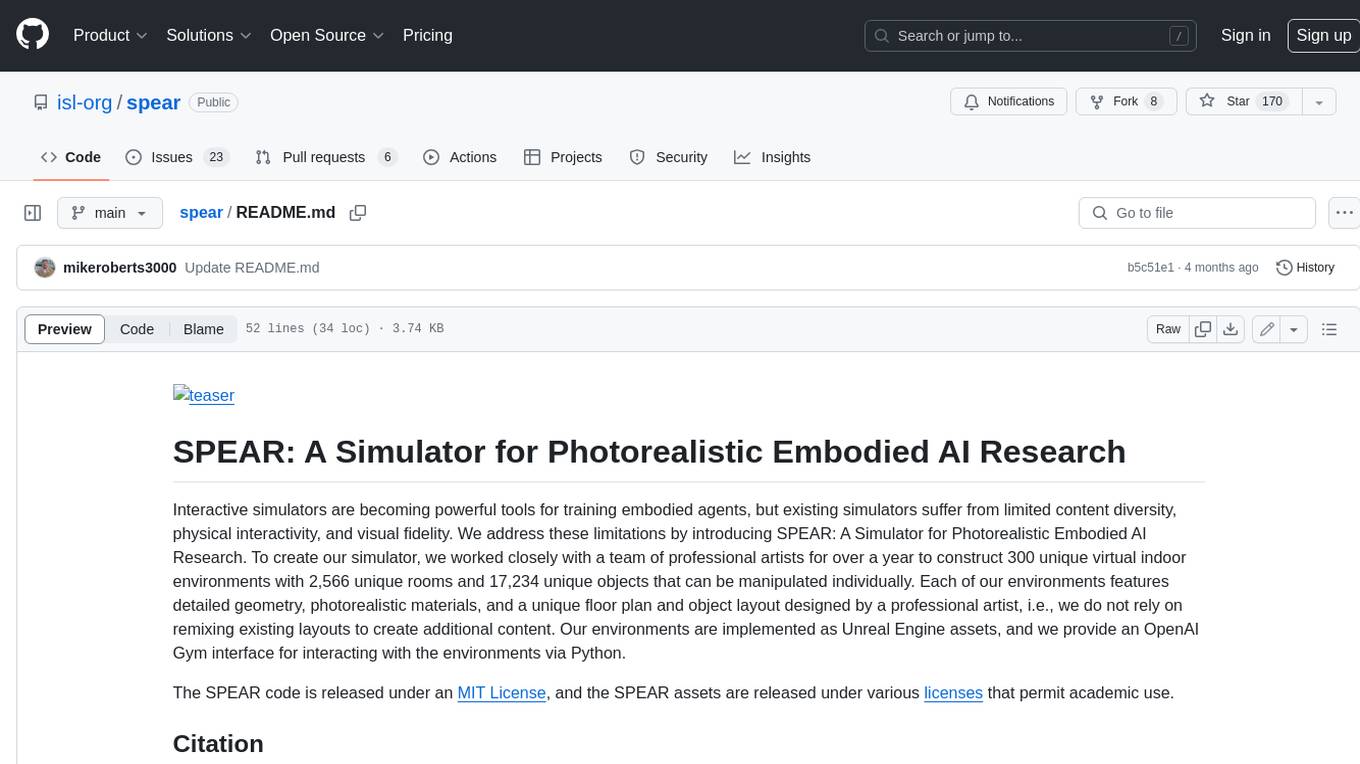
spear
SPEAR (Simulator for Photorealistic Embodied AI Research) is a powerful tool for training embodied agents. It features 300 unique virtual indoor environments with 2,566 unique rooms and 17,234 unique objects that can be manipulated individually. Each environment is designed by a professional artist and features detailed geometry, photorealistic materials, and a unique floor plan and object layout. SPEAR is implemented as Unreal Engine assets and provides an OpenAI Gym interface for interacting with the environments via Python.
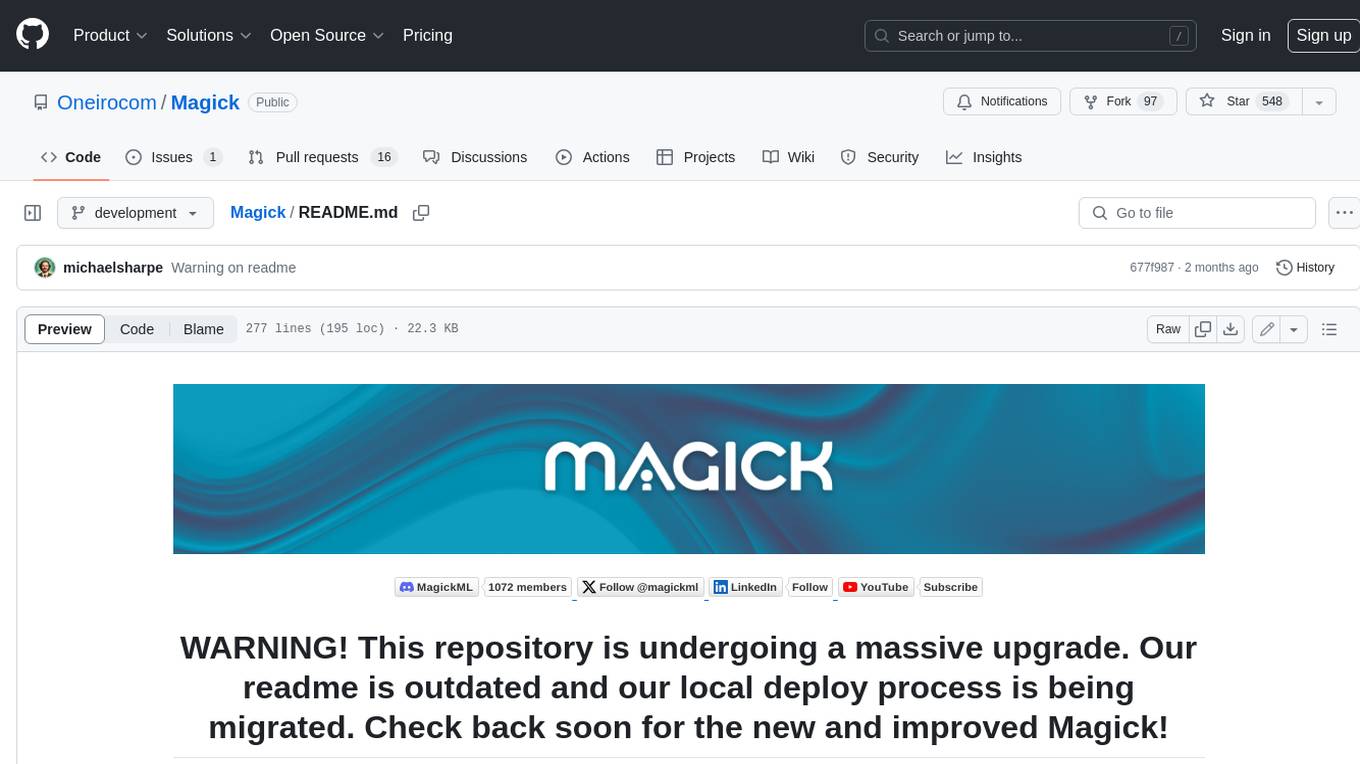
Magick
Magick is a groundbreaking visual AIDE (Artificial Intelligence Development Environment) for no-code data pipelines and multimodal agents. Magick can connect to other services and comes with nodes and templates well-suited for intelligent agents, chatbots, complex reasoning systems and realistic characters.