


ag2
AG2 (formerly AutoGen): The Open-Source AgentOS. Join us at: https://discord.gg/sNGSwQME3x
Stars: 4123
Ag2 is a lightweight and efficient tool for generating automated reports from data sources. It simplifies the process of creating reports by allowing users to define templates and automate the data extraction and formatting. With Ag2, users can easily generate reports in various formats such as PDF, Excel, and CSV, saving time and effort in manual report generation tasks.
README:






📚 Documentation | 💡 Examples | 🤝 Contributing | 📝 Cite paper | 💬 Join Discord
AG2 was evolved from AutoGen. Fully open-sourced. We invite collaborators from all organizations to contribute.
AG2 (formerly AutoGen) is an open-source programming framework for building AI agents and facilitating cooperation among multiple agents to solve tasks. AG2 aims to streamline the development and research of agentic AI. It offers features such as agents capable of interacting with each other, facilitates the use of various large language models (LLMs) and tool use support, autonomous and human-in-the-loop workflows, and multi-agent conversation patterns.
The project is currently maintained by a dynamic group of volunteers from several organizations. Contact project administrators Chi Wang and Qingyun Wu via [email protected] if you are interested in becoming a maintainer.
- AG2: Open-Source AgentOS for AI Agents
For a step-by-step walk through of AG2 concepts and code, see Basic Concepts in our documentation.
AG2 requires Python version >= 3.10, < 3.14. AG2 is available via ag2 (or its alias autogen) on PyPI.
Windows/Linux:
pip install ag2[openai]Mac:
pip install 'ag2[openai]'Minimal dependencies are installed by default. You can install extra options based on the features you need.
To keep your LLM dependencies neat and avoid accidentally checking in code with your API key, we recommend storing your keys in a configuration file.
In our examples, we use a file named OAI_CONFIG_LIST to store API keys. You can choose any filename, but make sure to add it to .gitignore so it will not be committed to source control.
You can use the following content as a template:
[
  {
    "model": "gpt-5",
    "api_key": "<your OpenAI API key here>"
  }
]Create a script or a Jupyter Notebook and run your first agent.
from autogen import AssistantAgent, UserProxyAgent, LLMConfig

llm_config = LLMConfig.from_json(path="OAI_CONFIG_LIST")

assistant = AssistantAgent("assistant", llm_config=llm_config)

user_proxy = UserProxyAgent("user_proxy", code_execution_config={"work_dir": "coding", "use_docker": False})

user_proxy.run(assistant, message="Summarize the main differences between Python lists and tuples.").process()We maintain a dedicated repository with a wide range of applications to help you get started with various use cases or check out our collection of jupyter notebooks as a starting point.
We have several agent concepts in AG2 to help you build your AI agents. We introduce the most common ones here.
- Conversable Agent: Agents that are able to send messages, receive messages and generate replies using GenAI models, non-GenAI tools, or human inputs.
- Human in the loop: Add human input to the conversation
- Orchestrating multiple agents: Users can orchestrate multiple agents with built-in conversation patterns such as swarms, group chats, nested chats, sequential chats or customize the orchestration by registering custom reply methods.
- Tools: Programs that can be registered, invoked and executed by agents
- Advanced Concepts: AG2 supports more concepts such as structured outputs, rag, code execution, etc.
The ConversableAgent is the fundamental building block of AG2, designed to enable seamless communication between AI entities. This core agent type handles message exchange and response generation, serving as the base class for all agents in the framework.
Let's begin with a simple example where two agents collaborate:
- A coder agent that writes Python code.
- A reviewer agent that critiques the code without rewriting it.
import logging
from autogen import ConversableAgent, LLMConfig

# Configure logging
logging.basicConfig(level=logging.INFO)
logger = logging.getLogger(__name__)

# Load LLM configuration
llm_config = LLMConfig.from_json(path="OAI_CONFIG_LIST")

# Define agents
coder = ConversableAgent(
    name="coder",
    system_message="You are a Python developer. Write short Python scripts.",
    llm_config=llm_config,
)

reviewer = ConversableAgent(
    name="reviewer",
    system_message="You are a code reviewer. Analyze provided code and suggest improvements. "
                   "Do not generate code, only suggest improvements.",
    llm_config=llm_config,
)

# Start a conversation
response = reviewer.run(
            recipient=coder,
            message="Write a Python function that computes Fibonacci numbers.",
            max_turns=10
        )

response.process()

logger.info("Final output:\n%s", response.summary)AG2 enables sophisticated multi-agent collaboration through flexible orchestration patterns, allowing you to create dynamic systems where specialized agents work together to solve complex problems.
Here’s how to build a team of teacher, lesson planner, and reviewer agents working together to design a lesson plan:
import logging
from autogen import ConversableAgent, LLMConfig
from autogen.agentchat import run_group_chat
from autogen.agentchat.group.patterns import AutoPattern

logging.basicConfig(level=logging.INFO)
logger = logging.getLogger(__name__)

llm_config = LLMConfig.from_json(path="OAI_CONFIG_LIST")

# Define lesson planner and reviewer
planner_message = "You are a classroom lesson planner. Given a topic, write a lesson plan for a fourth grade class."
reviewer_message = "You are a classroom lesson reviewer. Compare the plan to the curriculum and suggest up to 3 improvements."

lesson_planner = ConversableAgent(
    name="planner_agent",
    system_message=planner_message,
    description="Creates or revises lesson plans.",
    llm_config=llm_config,
)

lesson_reviewer = ConversableAgent(
    name="reviewer_agent",
    system_message=reviewer_message,
    description="Provides one round of feedback to lesson plans.",
    llm_config=llm_config,
)

teacher_message = "You are a classroom teacher. You decide topics and collaborate with planner and reviewer to finalize lesson plans. When satisfied, output DONE!"

teacher = ConversableAgent(
    name="teacher_agent",
    system_message=teacher_message,
    is_termination_msg=lambda x: "DONE!" in (x.get("content", "") or "").upper(),
    llm_config=llm_config,
)

auto_selection = AutoPattern(
    agents=[teacher, lesson_planner, lesson_reviewer],
    initial_agent=lesson_planner,
    group_manager_args={"name": "group_manager", "llm_config": llm_config},
)

response = run_group_chat(
    pattern=auto_selection,
    messages="Let's introduce our kids to the solar system.",
    max_rounds=20,
)

response.process()

logger.info("Final output:\n%s", response.summary)
Human oversight is often essential for validating or guiding AI outputs.
AG2 provides the UserProxyAgent for seamless integration of human feedback.
Here we extend the teacher–planner–reviewer example by introducing a human agent who validates the final lesson:
import logging
from autogen import ConversableAgent, LLMConfig, UserProxyAgent
from autogen.agentchat import run_group_chat
from autogen.agentchat.group.patterns import AutoPattern

logging.basicConfig(level=logging.INFO)
logger = logging.getLogger(__name__)

llm_config = LLMConfig.from_json(path="OAI_CONFIG_LIST")

# Same agents as before, but now the human validator will pass to the planner who will check for "APPROVED" and terminate
planner_message = "You are a classroom lesson planner. Given a topic, write a lesson plan for a fourth grade class."
reviewer_message = "You are a classroom lesson reviewer. Compare the plan to the curriculum and suggest up to 3 improvements."
teacher_message = "You are an experienced classroom teacher. You don't prepare plans, you provide simple guidance to the planner to prepare a lesson plan on the key topic."

lesson_planner = ConversableAgent(
    name="planner_agent",
    system_message=planner_message,
    description="Creates or revises lesson plans before having them reviewed.",
    is_termination_msg=lambda x: "APPROVED" in (x.get("content", "") or "").upper(),
    human_input_mode="NEVER",
    llm_config=llm_config,
)

lesson_reviewer = ConversableAgent(
    name="reviewer_agent",
    system_message=reviewer_message,
    description="Provides one round of feedback to lesson plans back to the lesson planner before requiring the human validator.",
    llm_config=llm_config,
)

teacher = ConversableAgent(
    name="teacher_agent",
    system_message=teacher_message,
    description="Provides guidance on the topic and content, if required.",
    llm_config=llm_config,
)

human_validator = UserProxyAgent(
    name="human_validator",
    system_message="You are a human educator who provides final approval for lesson plans.",
    description="Evaluates the proposed lesson plan and either approves it or requests revisions, before returning to the planner.",
)

auto_selection = AutoPattern(
    agents=[teacher, lesson_planner, lesson_reviewer],
    initial_agent=teacher,
    user_agent=human_validator,
    group_manager_args={"name": "group_manager", "llm_config": llm_config},
)

response = run_group_chat(
    pattern=auto_selection,
    messages="Let's introduce our kids to the solar system.",
    max_rounds=20,
)

response.process()

logger.info("Final output:\n%s", response.summary)Agents gain significant utility through tools, which extend their capabilities with external data, APIs, or functions.
import logging
from datetime import datetime
from typing import Annotated
from autogen import ConversableAgent, register_function, LLMConfig

logging.basicConfig(level=logging.INFO)
logger = logging.getLogger(__name__)

llm_config = LLMConfig.from_json(path="OAI_CONFIG_LIST")

# Tool: returns weekday for a given date
def get_weekday(date_string: Annotated[str, "Format: YYYY-MM-DD"]) -> str:
    date = datetime.strptime(date_string, "%Y-%m-%d")
    return date.strftime("%A")

date_agent = ConversableAgent(
    name="date_agent",
    system_message="You find the day of the week for a given date.",
    llm_config=llm_config,
)

executor_agent = ConversableAgent(
    name="executor_agent",
    human_input_mode="NEVER",
    llm_config=llm_config,
)

# Register tool
register_function(
    get_weekday,
    caller=date_agent,
    executor=executor_agent,
    description="Get the day of the week for a given date",
)

# Use tool in chat
chat_result = executor_agent.initiate_chat(
    recipient=date_agent,
    message="I was born on 1995-03-25, what day was it?",
    max_turns=2,
)

logger.info("Final output:\n%s", chat_result.chat_history[-1]["content"])AG2 supports more advanced concepts to help you build your AI agent workflows. You can find more information in the documentation.
- Structured Output
- Ending a conversation
- Retrieval Augmented Generation (RAG)
- Code Execution
- Tools with Secrets
- Pattern Cookbook (9 group orchestrations)
🔥 🎉 Nov 11, 2024: We are evolving AutoGen into AG2! A new organization AG2AI is created to host the development of AG2 and related projects with open governance. Check AG2's new look.
📄 License: We adopt the Apache 2.0 license from v0.3. This enhances our commitment to open-source collaboration while providing additional protections for contributors and users alike.
🎉 May 29, 2024: DeepLearning.ai launched a new short course AI Agentic Design Patterns with AutoGen, made in collaboration with Microsoft and Penn State University, and taught by AutoGen creators Chi Wang and Qingyun Wu.
🎉 May 24, 2024: Foundation Capital published an article on Forbes: The Promise of Multi-Agent AI and a video AI in the Real World Episode 2: Exploring Multi-Agent AI and AutoGen with Chi Wang.
🎉 Apr 17, 2024: Andrew Ng cited AutoGen in The Batch newsletter and What's next for AI agentic workflows at Sequoia Capital's AI Ascent (Mar 26).
This project uses pre-commit hooks to maintain code quality. Before contributing:
- Install pre-commit:
pip install pre-commit
pre-commit install- The hooks will run automatically on commit, or you can run them manually:
pre-commit run --all-files-
AutoGen: Enabling Next-Gen LLM Applications via Multi-Agent Conversation
-
EcoOptiGen: Hyperparameter Optimization for Large Language Model Generation Inference
-
MathChat: Converse to Tackle Challenging Math Problems with LLM Agents
-
AgentOptimizer: Offline Training of Language Model Agents with Functions as Learnable Weights
-
StateFlow: Enhancing LLM Task-Solving through State-Driven Workflows
@software{AG2_2024,
author = {Chi Wang and Qingyun Wu and the AG2 Community},
title = {AG2: Open-Source AgentOS for AI Agents},
year = {2024},
url = {https://github.com/ag2ai/ag2},
note = {Available at https://docs.ag2.ai/},
version = {latest}
}
This project is licensed under the Apache License, Version 2.0 (Apache-2.0).
This project is a spin-off of AutoGen and contains code under two licenses:
-
The original code from https://github.com/microsoft/autogen is licensed under the MIT License. See the LICENSE_original_MIT file for details.
-
Modifications and additions made in this fork are licensed under the Apache License, Version 2.0. See the LICENSE file for the full license text.
We have documented these changes for clarity and to ensure transparency with our user and contributor community. For more details, please see the NOTICE file.
For Tasks:
Click tags to check more tools for each tasksFor Jobs:
Alternative AI tools for ag2
Similar Open Source Tools
ag2
Ag2 is a lightweight and efficient tool for generating automated reports from data sources. It simplifies the process of creating reports by allowing users to define templates and automate the data extraction and formatting. With Ag2, users can easily generate reports in various formats such as PDF, Excel, and CSV, saving time and effort in manual report generation tasks.
HyperAgent
HyperAgent is a powerful tool for automating repetitive tasks in web scraping and data extraction. It provides a user-friendly interface to create custom web scraping scripts without the need for extensive coding knowledge. With HyperAgent, users can easily extract data from websites, transform it into structured formats, and save it for further analysis. The tool supports various data formats and offers scheduling options for automated data extraction at regular intervals. HyperAgent is suitable for individuals and businesses looking to streamline their data collection processes and improve efficiency in extracting information from the web.
context7
Context7 is a powerful tool for analyzing and visualizing data in various formats. It provides a user-friendly interface for exploring datasets, generating insights, and creating interactive visualizations. With advanced features such as data filtering, aggregation, and customization, Context7 is suitable for both beginners and experienced data analysts. The tool supports a wide range of data sources and formats, making it versatile for different use cases. Whether you are working on exploratory data analysis, data visualization, or data storytelling, Context7 can help you uncover valuable insights and communicate your findings effectively.
axolotl
Axolotl is a lightweight and efficient tool for managing and analyzing large datasets. It provides a user-friendly interface for data manipulation, visualization, and statistical analysis. With Axolotl, users can easily import, clean, and explore data to gain valuable insights and make informed decisions. The tool supports various data formats and offers a wide range of functions for data processing and modeling. Whether you are a data scientist, researcher, or business analyst, Axolotl can help streamline your data workflows and enhance your data analysis capabilities.
ROGRAG
ROGRAG is a powerful open-source tool designed for data analysis and visualization. It provides a user-friendly interface for exploring and manipulating datasets, making it ideal for researchers, data scientists, and analysts. With ROGRAG, users can easily import, clean, analyze, and visualize data to gain valuable insights and make informed decisions. The tool supports a wide range of data formats and offers a variety of statistical and visualization tools to help users uncover patterns, trends, and relationships in their data. Whether you are working on exploratory data analysis, statistical modeling, or data visualization, ROGRAG is a versatile tool that can streamline your workflow and enhance your data analysis capabilities.
datatune
Datatune is a data analysis tool designed to help users explore and analyze datasets efficiently. It provides a user-friendly interface for importing, cleaning, visualizing, and modeling data. With Datatune, users can easily perform tasks such as data preprocessing, feature engineering, model selection, and evaluation. The tool offers a variety of statistical and machine learning algorithms to support data analysis tasks. Whether you are a data scientist, analyst, or researcher, Datatune can streamline your data analysis workflow and help you derive valuable insights from your data.
xorq
Xorq (formerly LETSQL) is a data processing library built on top of Ibis and DataFusion to write multi-engine data workflows. It provides a flexible and powerful tool for processing and analyzing data from various sources, enabling users to create complex data pipelines and perform advanced data transformations.
cellm
Cellm is an Excel extension that allows users to leverage Large Language Models (LLMs) like ChatGPT within cell formulas. It enables users to extract AI responses to text ranges, making it useful for automating repetitive tasks that involve data processing and analysis. Cellm supports various models from Anthropic, Mistral, OpenAI, and Google, as well as locally hosted models via Llamafiles, Ollama, or vLLM. The tool is designed to simplify the integration of AI capabilities into Excel for tasks such as text classification, data cleaning, content summarization, entity extraction, and more.
arconia
Arconia is a powerful open-source tool for managing and visualizing data in a user-friendly way. It provides a seamless experience for data analysts and scientists to explore, clean, and analyze datasets efficiently. With its intuitive interface and robust features, Arconia simplifies the process of data manipulation and visualization, making it an essential tool for anyone working with data.
simple-data-analysis
Simple data analysis (SDA) is an easy-to-use and high-performance TypeScript library for data analysis. It can be used with tabular and geospatial data. The library is maintained by Nael Shiab, a computational journalist and senior data producer for CBC News. SDA is based on DuckDB, a fast in-process analytical database, and it sends SQL queries to be executed by DuckDB. The library provides methods inspired by Pandas (Python) and the Tidyverse (R), and it also supports writing custom SQL queries and processing data with JavaScript. Additionally, SDA offers methods for leveraging large language models (LLMs) for data cleaning, extraction, categorization, and natural language interaction, as well as for embeddings and semantic search.
CrossIntelligence
CrossIntelligence is a powerful tool for data analysis and visualization. It allows users to easily connect and analyze data from multiple sources, providing valuable insights and trends. With a user-friendly interface and customizable features, CrossIntelligence is suitable for both beginners and advanced users in various industries such as marketing, finance, and research.
waidrin
Waidrin is a powerful web scraping tool that allows users to easily extract data from websites. It provides a user-friendly interface for creating custom web scraping scripts and supports various data formats for exporting the extracted data. With Waidrin, users can automate the process of collecting information from multiple websites, saving time and effort. The tool is designed to be flexible and scalable, making it suitable for both beginners and advanced users in the field of web scraping.
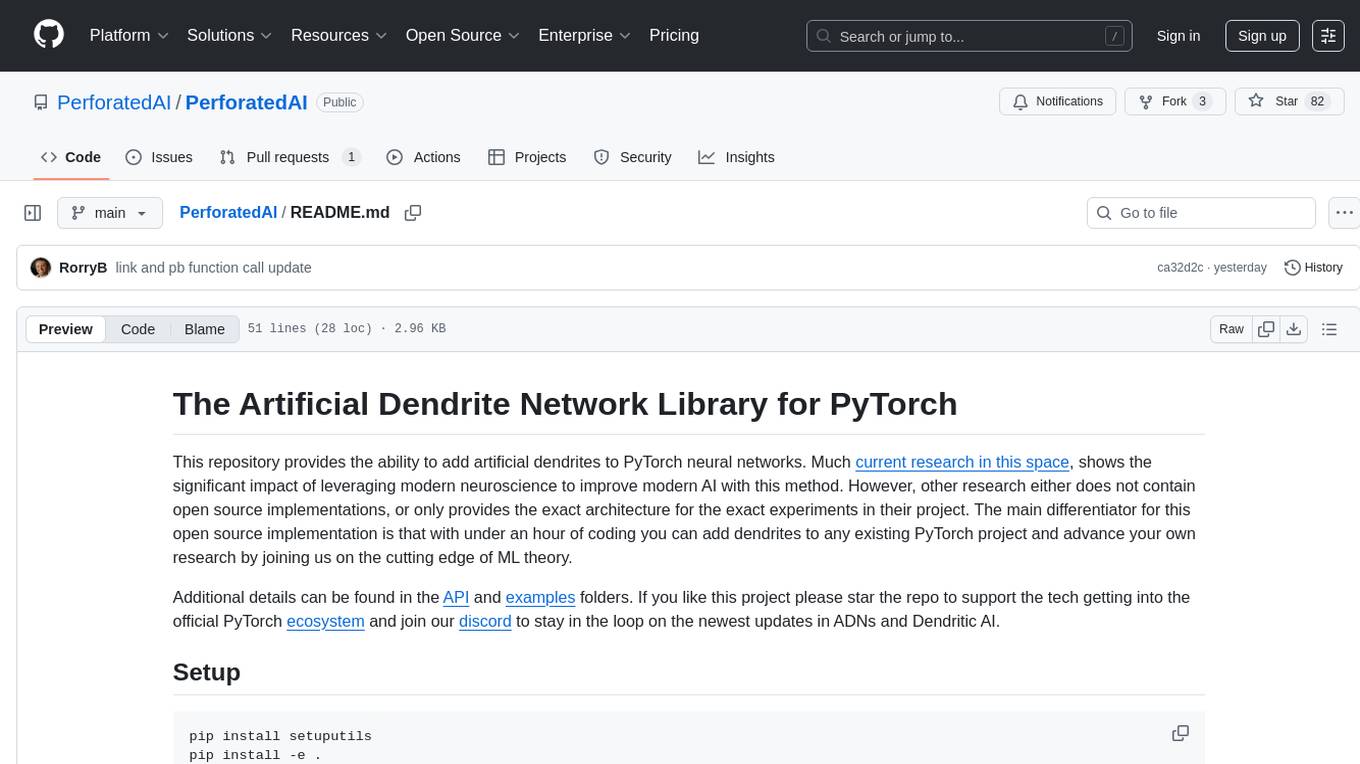
PerforatedAI
PerforatedAI is a machine learning tool designed to automate the process of analyzing and extracting information from perforated documents. It uses advanced OCR technology to accurately identify and extract data from documents with perforations, such as surveys, questionnaires, and forms. The tool can handle various types of perforations and is capable of processing large volumes of documents quickly and efficiently. PerforatedAI streamlines the data extraction process, saving time and reducing errors associated with manual data entry. It is a valuable tool for businesses and organizations that deal with large amounts of perforated documents on a regular basis.
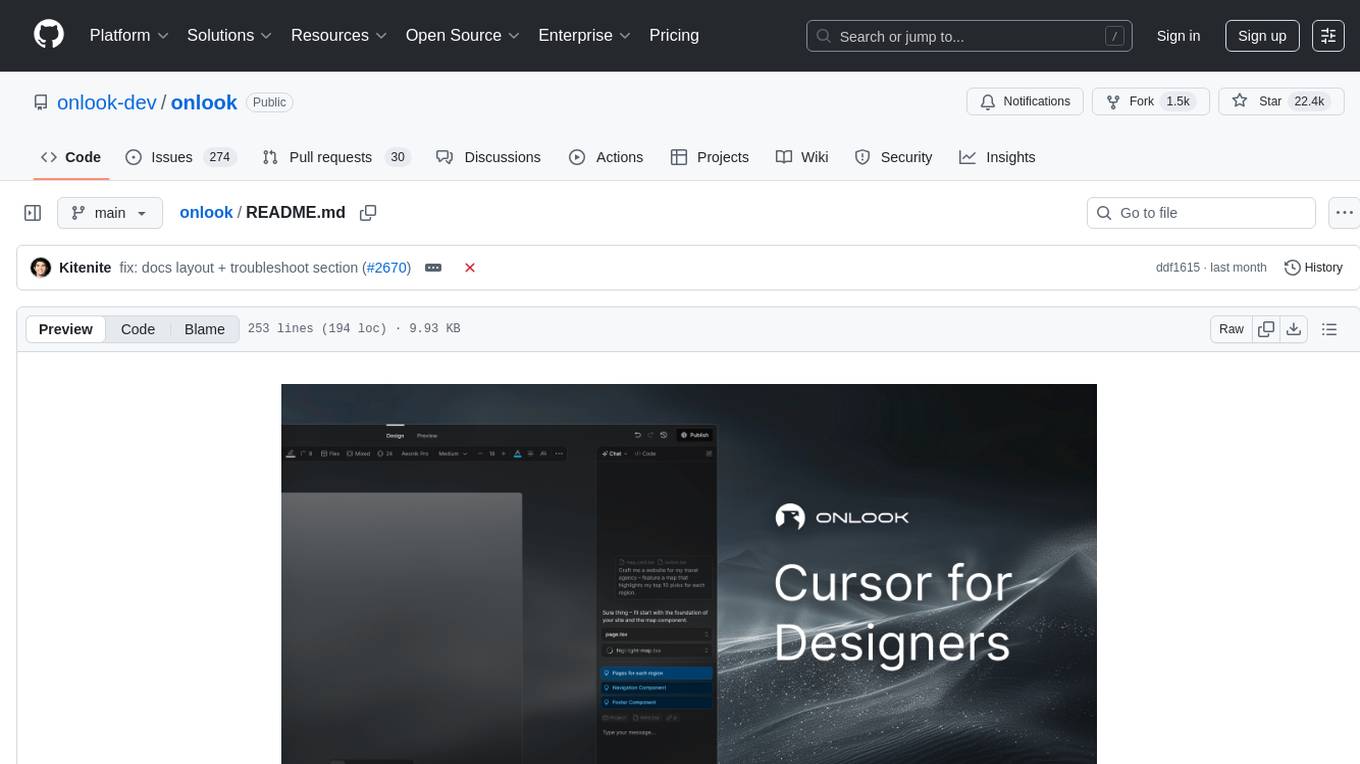
onlook
Onlook is a web scraping tool that allows users to extract data from websites easily and efficiently. It provides a user-friendly interface for creating web scraping scripts and supports various data formats for exporting the extracted data. With Onlook, users can automate the process of collecting information from multiple websites, saving time and effort. The tool is designed to be flexible and customizable, making it suitable for a wide range of web scraping tasks.
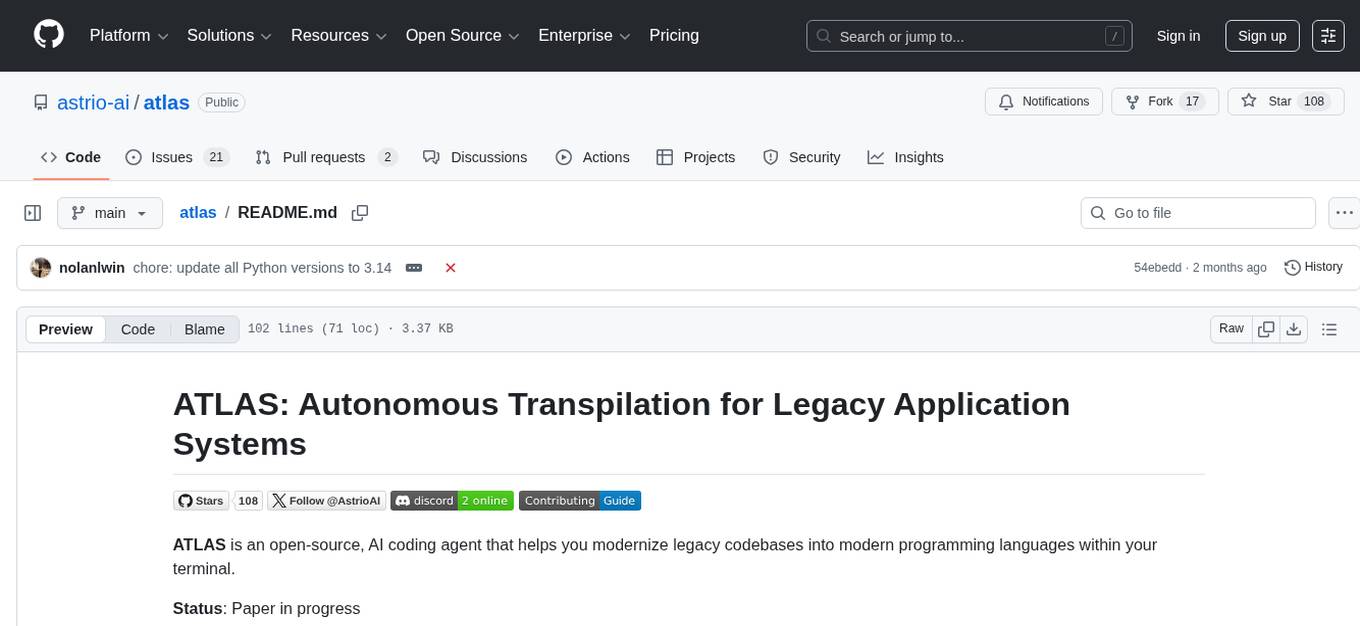
atlas
Atlas is a powerful data visualization tool that allows users to create interactive charts and graphs from their datasets. It provides a user-friendly interface for exploring and analyzing data, making it ideal for both beginners and experienced data analysts. With Atlas, users can easily customize the appearance of their visualizations, add filters and drill-down capabilities, and share their insights with others. The tool supports a wide range of data formats and offers various chart types to suit different data visualization needs. Whether you are looking to create simple bar charts or complex interactive dashboards, Atlas has you covered.
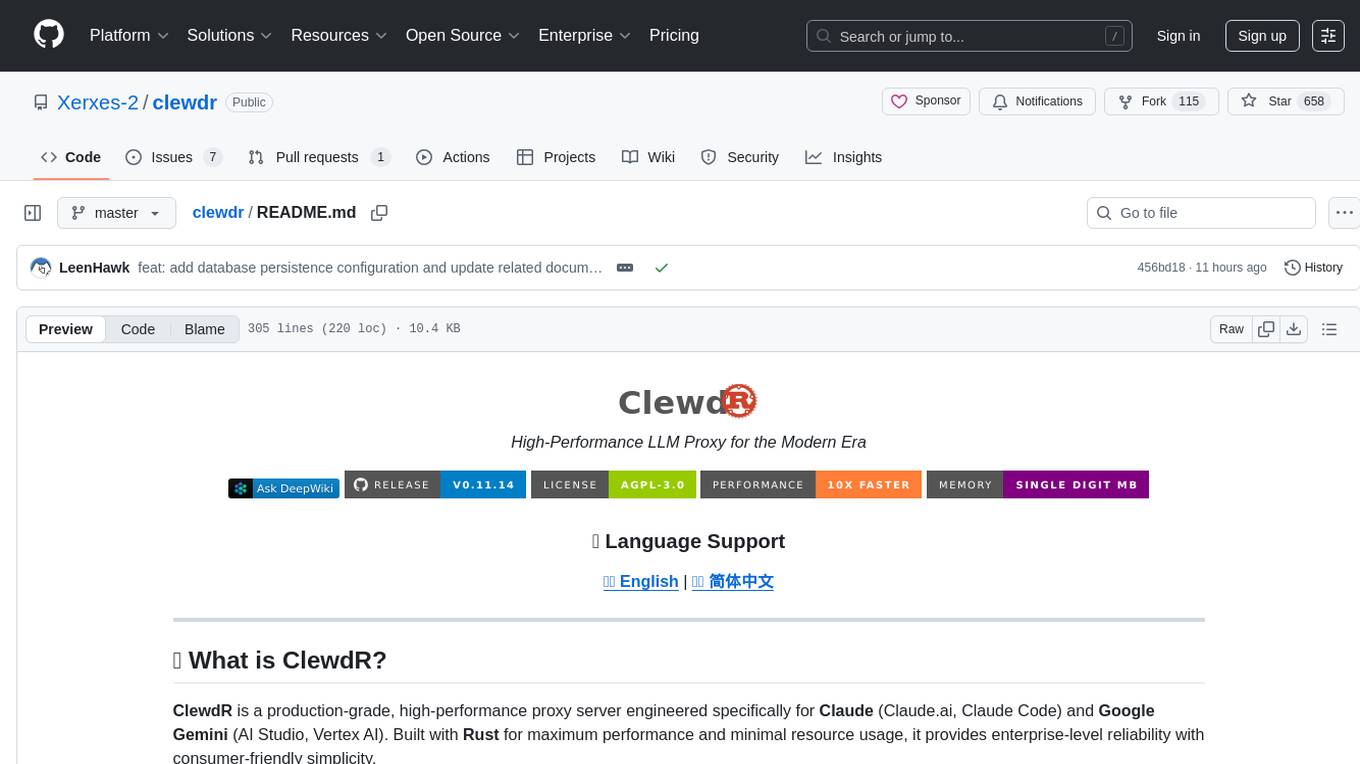
clewdr
Clewdr is a collaborative platform for data analysis and visualization. It allows users to upload datasets, perform various data analysis tasks, and create interactive visualizations. The platform supports multiple users working on the same project simultaneously, enabling real-time collaboration and sharing of insights. Clewdr is designed to streamline the data analysis process and facilitate communication among team members. With its user-friendly interface and powerful features, Clewdr is suitable for data scientists, analysts, researchers, and anyone working with data to gain valuable insights and make informed decisions.
For similar tasks
generative_ai_with_langchain
Generative AI with LangChain is a code repository for building large language model (LLM) apps with Python, ChatGPT, and other LLMs. The repository provides code examples, instructions, and configurations for creating generative AI applications using the LangChain framework. It covers topics such as setting up the development environment, installing dependencies with Conda or Pip, using Docker for environment setup, and setting API keys securely. The repository also emphasizes stability, code updates, and user engagement through issue reporting and feedback. It aims to empower users to leverage generative AI technologies for tasks like building chatbots, question-answering systems, software development aids, and data analysis applications.
suna
Kortix is an open-source platform designed to build, manage, and train AI agents for various tasks. It allows users to create autonomous agents, from general-purpose assistants to specialized automation tools. The platform offers capabilities such as browser automation, file management, web intelligence, system operations, API integrations, and agent building tools. Users can create custom agents tailored to specific domains, workflows, or business needs, enabling tasks like research & analysis, browser automation, file & document management, data processing & analysis, and system administration.
ag2
Ag2 is a lightweight and efficient tool for generating automated reports from data sources. It simplifies the process of creating reports by allowing users to define templates and automate the data extraction and formatting. With Ag2, users can easily generate reports in various formats such as PDF, Excel, and CSV, saving time and effort in manual report generation tasks.
hof
Hof is a CLI tool that unifies data models, schemas, code generation, and a task engine. It allows users to augment data, config, and schemas with CUE to improve consistency, generate multiple Yaml and JSON files, explore data or config with a TUI, and run workflows with automatic task dependency inference. The tool uses CUE to power the DX and implementation, providing a language for specifying schemas, configuration, and writing declarative code. Hof offers core features like code generation, data model management, task engine, CUE cmds, creators, modules, TUI, and chat for better, scalable results.
vast-python
This repository contains the open source python command line interface for vast.ai. The CLI has all the main functionality of the vast.ai website GUI and uses the same underlying REST API. The main functionality is self-contained in the script file vast.py, with additional invoice generating commands in vast_pdf.py. Users can interact with the vast.ai platform through the CLI to manage instances, create templates, manage teams, and perform various cloud-related tasks.
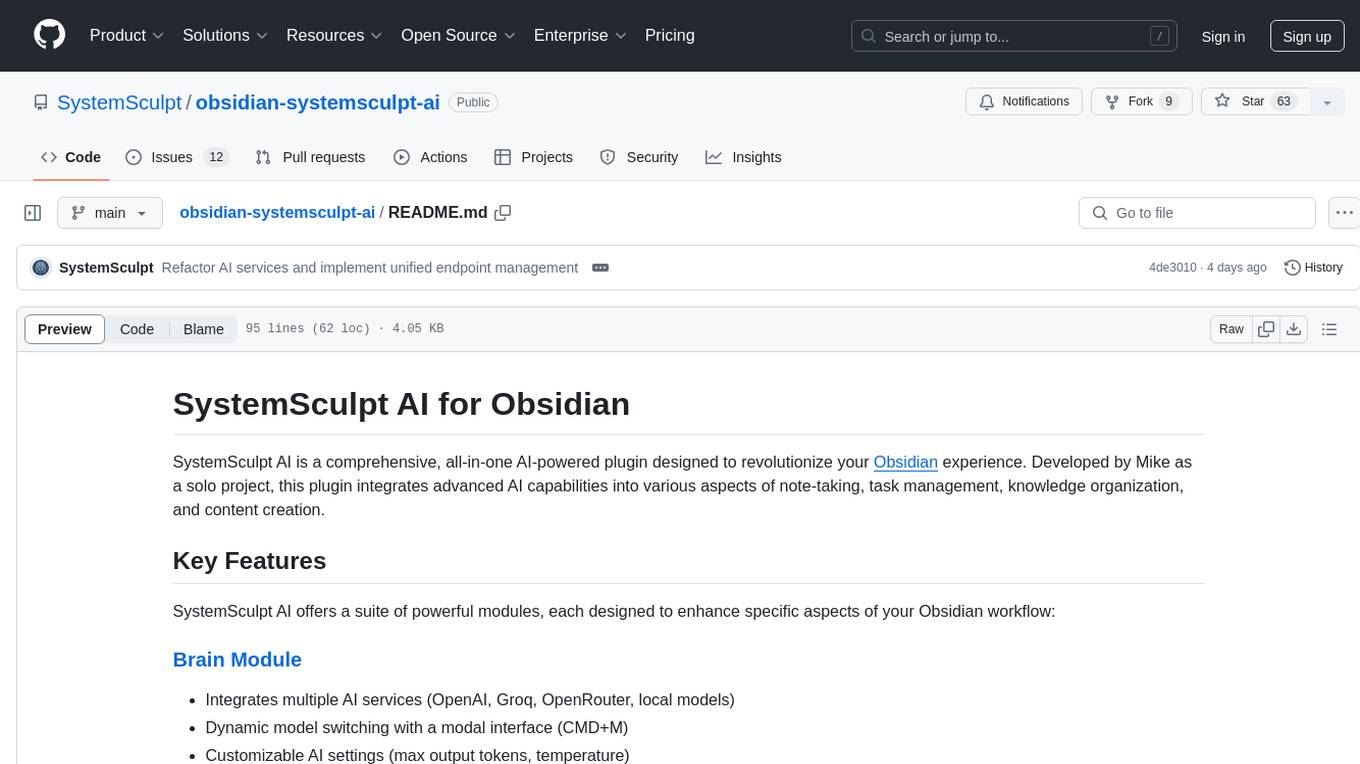
obsidian-systemsculpt-ai
SystemSculpt AI is a comprehensive AI-powered plugin for Obsidian, integrating advanced AI capabilities into note-taking, task management, knowledge organization, and content creation. It offers modules for brain integration, chat conversations, audio recording and transcription, note templates, and task generation and management. Users can customize settings, utilize AI services like OpenAI and Groq, and access documentation for detailed guidance. The plugin prioritizes data privacy by storing sensitive information locally and offering the option to use local AI models for enhanced privacy.
sdk
Smithery SDK is a tool that provides utilities to simplify the development and deployment of Model Context Protocols (MCPs) with Smithery. It offers functionalities for finding and connecting to MCP servers in the registry, building and deploying MCP servers, and creating fast MCP servers with Smithery session configuration support. Additionally, it includes a ready-to-use MCP server template. For more information and access to the MCP registry, visit https://smithery.ai/.
mushroom
MRCMS is a Java-based content management system that uses data model + template + plugin implementation, providing built-in article model publishing functionality. The goal is to quickly build small to medium websites.
For similar jobs
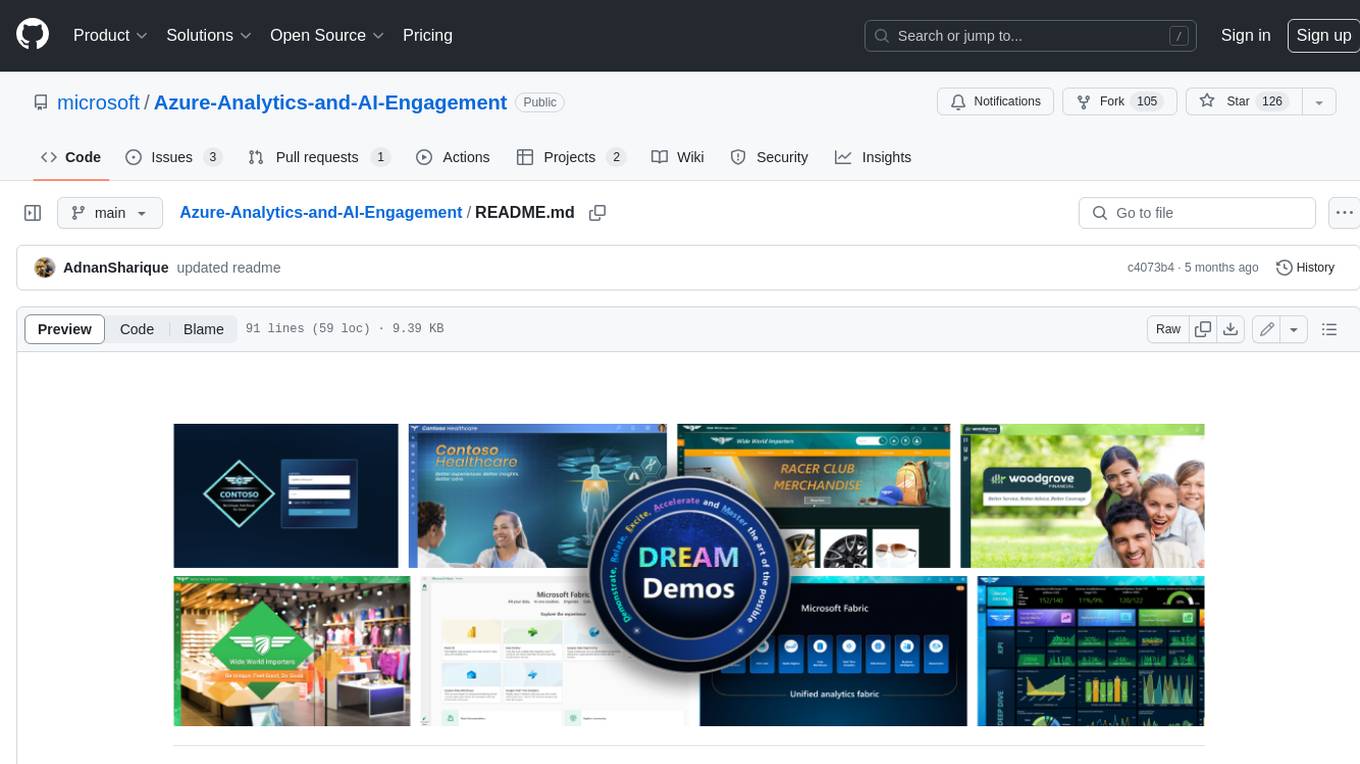
Azure-Analytics-and-AI-Engagement
The Azure-Analytics-and-AI-Engagement repository provides packaged Industry Scenario DREAM Demos with ARM templates (Containing a demo web application, Power BI reports, Synapse resources, AML Notebooks etc.) that can be deployed in a customer’s subscription using the CAPE tool within a matter of few hours. Partners can also deploy DREAM Demos in their own subscriptions using DPoC.
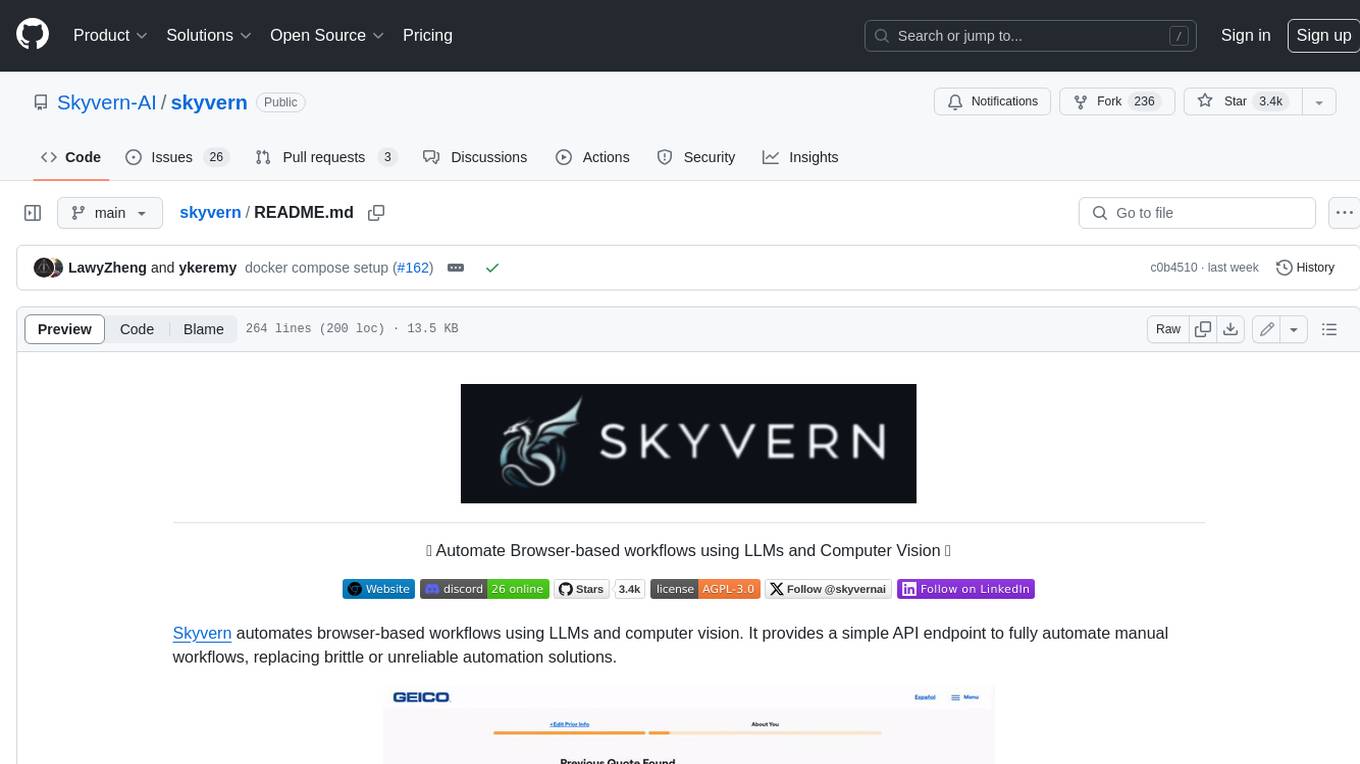
skyvern
Skyvern automates browser-based workflows using LLMs and computer vision. It provides a simple API endpoint to fully automate manual workflows, replacing brittle or unreliable automation solutions. Traditional approaches to browser automations required writing custom scripts for websites, often relying on DOM parsing and XPath-based interactions which would break whenever the website layouts changed. Instead of only relying on code-defined XPath interactions, Skyvern adds computer vision and LLMs to the mix to parse items in the viewport in real-time, create a plan for interaction and interact with them. This approach gives us a few advantages: 1. Skyvern can operate on websites it’s never seen before, as it’s able to map visual elements to actions necessary to complete a workflow, without any customized code 2. Skyvern is resistant to website layout changes, as there are no pre-determined XPaths or other selectors our system is looking for while trying to navigate 3. Skyvern leverages LLMs to reason through interactions to ensure we can cover complex situations. Examples include: 1. If you wanted to get an auto insurance quote from Geico, the answer to a common question “Were you eligible to drive at 18?” could be inferred from the driver receiving their license at age 16 2. If you were doing competitor analysis, it’s understanding that an Arnold Palmer 22 oz can at 7/11 is almost definitely the same product as a 23 oz can at Gopuff (even though the sizes are slightly different, which could be a rounding error!) Want to see examples of Skyvern in action? Jump to #real-world-examples-of- skyvern
pandas-ai
PandasAI is a Python library that makes it easy to ask questions to your data in natural language. It helps you to explore, clean, and analyze your data using generative AI.
vanna
Vanna is an open-source Python framework for SQL generation and related functionality. It uses Retrieval-Augmented Generation (RAG) to train a model on your data, which can then be used to ask questions and get back SQL queries. Vanna is designed to be portable across different LLMs and vector databases, and it supports any SQL database. It is also secure and private, as your database contents are never sent to the LLM or the vector database.
databend
Databend is an open-source cloud data warehouse that serves as a cost-effective alternative to Snowflake. With its focus on fast query execution and data ingestion, it's designed for complex analysis of the world's largest datasets.
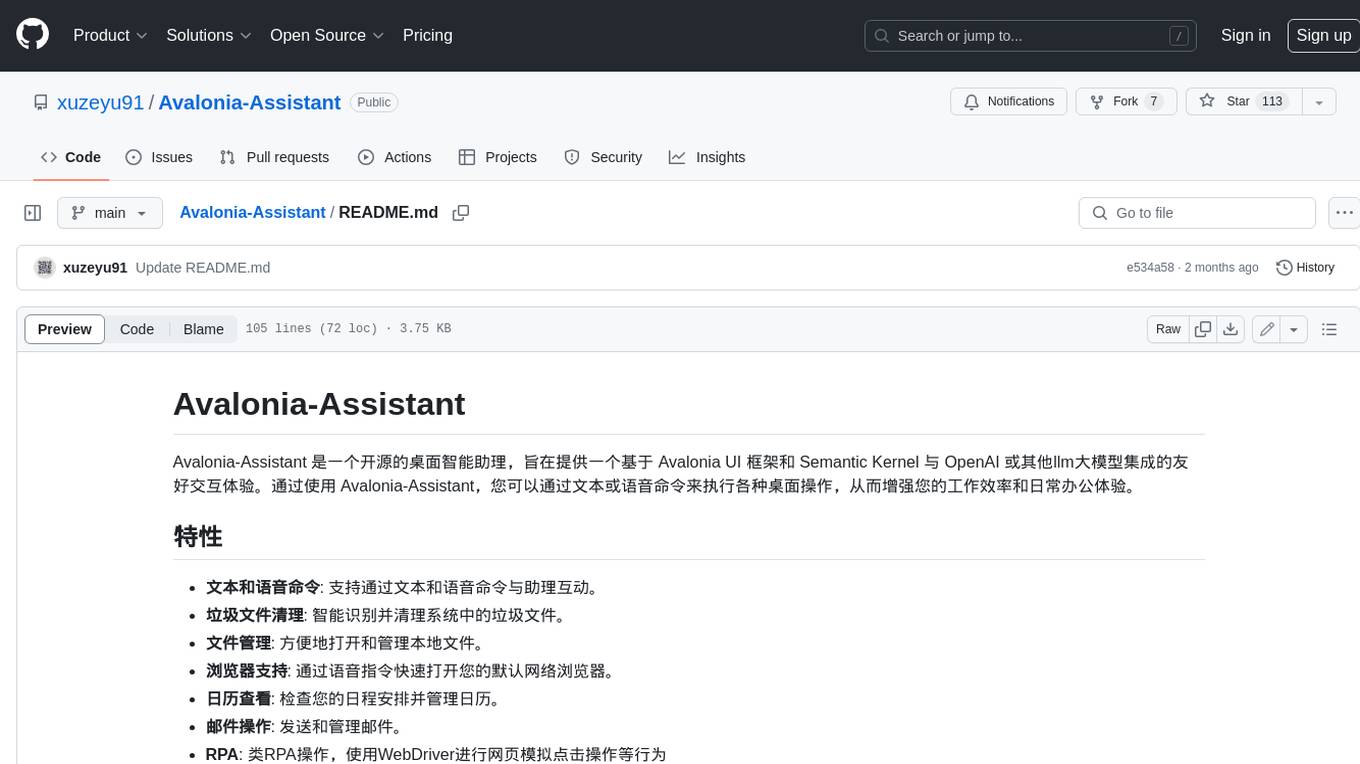
Avalonia-Assistant
Avalonia-Assistant is an open-source desktop intelligent assistant that aims to provide a user-friendly interactive experience based on the Avalonia UI framework and the integration of Semantic Kernel with OpenAI or other large LLM models. By utilizing Avalonia-Assistant, you can perform various desktop operations through text or voice commands, enhancing your productivity and daily office experience.
marvin
Marvin is a lightweight AI toolkit for building natural language interfaces that are reliable, scalable, and easy to trust. Each of Marvin's tools is simple and self-documenting, using AI to solve common but complex challenges like entity extraction, classification, and generating synthetic data. Each tool is independent and incrementally adoptable, so you can use them on their own or in combination with any other library. Marvin is also multi-modal, supporting both image and audio generation as well using images as inputs for extraction and classification. Marvin is for developers who care more about _using_ AI than _building_ AI, and we are focused on creating an exceptional developer experience. Marvin users should feel empowered to bring tightly-scoped "AI magic" into any traditional software project with just a few extra lines of code. Marvin aims to merge the best practices for building dependable, observable software with the best practices for building with generative AI into a single, easy-to-use library. It's a serious tool, but we hope you have fun with it. Marvin is open-source, free to use, and made with 💙 by the team at Prefect.
activepieces
Activepieces is an open source replacement for Zapier, designed to be extensible through a type-safe pieces framework written in Typescript. It features a user-friendly Workflow Builder with support for Branches, Loops, and Drag and Drop. Activepieces integrates with Google Sheets, OpenAI, Discord, and RSS, along with 80+ other integrations. The list of supported integrations continues to grow rapidly, thanks to valuable contributions from the community. Activepieces is an open ecosystem; all piece source code is available in the repository, and they are versioned and published directly to npmjs.com upon contributions. If you cannot find a specific piece on the pieces roadmap, please submit a request by visiting the following link: Request Piece Alternatively, if you are a developer, you can quickly build your own piece using our TypeScript framework. For guidance, please refer to the following guide: Contributor's Guide