


ring
Mandatory workflow system enforcing software engineering best practices and quality gates for AI agents.
Stars: 100
Ring is a comprehensive skills library and workflow system for AI agents that transforms how AI assistants approach software development. It provides battle-tested patterns, mandatory workflows, and systematic approaches across the entire software delivery value chain. With 74 specialized skills and 33 specialized agents, Ring enforces proven workflows, automates skill discovery, and prevents common failures. The repository includes multiple plugins for different team specializations, each offering a set of skills, agents, and commands to streamline various aspects of software development.
README:

Proven engineering practices, enforced through skills.
Ring is a comprehensive skills library and workflow system for AI agents that transforms how AI assistants approach software development. Currently implemented as a Claude Code plugin marketplace with 6 active plugins (see .claude-plugin/marketplace.json for current versions), the skills themselves are agent-agnostic and can be used with any AI agent system. Ring provides battle-tested patterns, mandatory workflows, and systematic approaches across the entire software delivery value chain.
Without Ring, AI assistants often:
- Skip tests and jump straight to implementation
- Make changes without understanding root causes
- Claim tasks are complete without verification
- Forget to check for existing solutions
- Repeat known mistakes
Ring solves this by:
- Enforcing proven workflows - Test-driven development, systematic debugging, proper planning
- Providing 74 specialized skills (25 core + 13 dev-team + 13 product planning + 7 FinOps regulatory + 7 technical writing + 9 PMO)
- 33 specialized agents - 7 review/planning + 10 developer + 4 product research + 3 FinOps regulatory + 3 technical writing + 6 PMO
- Automating skill discovery - Skills load automatically at session start
- Preventing common failures - Built-in anti-patterns and mandatory checklists
Review & Planning Agents (default plugin):
-
ring:code-reviewer- Foundation review (architecture, code quality, design patterns) -
ring:business-logic-reviewer- Correctness review (domain logic, requirements, edge cases) -
ring:security-reviewer- Safety review (vulnerabilities, OWASP, authentication) -
ring:test-reviewer- Test quality review (coverage, edge cases, assertions, test anti-patterns) -
ring:nil-safety-reviewer- Nil/null safety review (traces pointer risks, missing guards, panic paths) -
ring:write-plan- Implementation planning agent -
ring:codebase-explorer- Deep architecture analysis (Opus-powered, complements built-in Explore) - Use
/ring:codereviewcommand to orchestrate parallel review workflow
Developer Agents (dev-team plugin):
-
ring:backend-engineer-golang- Go backend specialist for financial systems -
ring:backend-engineer-typescript- TypeScript/Node.js backend specialist (Express, NestJS, Fastify) -
ring:devops-engineer- DevOps infrastructure specialist -
ring:frontend-bff-engineer-typescript- BFF & React/Next.js frontend with Clean Architecture -
ring:frontend-designer- Visual design specialist -
ring:frontend-engineer- Senior Frontend Engineer (React/Next.js) -
ring:prompt-quality-reviewer- Agent Quality Analyst -
ring:qa-analyst- Quality assurance specialist -
ring:sre- Site reliability engineer -
ring:ui-engineer- UI component specialist (design systems, accessibility)
Standards Compliance: All dev-team agents include a
## Standards Complianceoutput section with conditional requirement:
- Optional when invoked directly or via
ring:dev-cycle- MANDATORY when invoked from
ring:dev-refactor(triggered by**MODE: ANALYSIS ONLY**in prompt)When mandatory, agents load Ring standards via WebFetch and produce comparison tables with:
- Current Pattern vs Expected Pattern
- Severity classification (Critical/High/Medium/Low)
- File locations and migration recommendations
See
dev-team/docs/standards/*.mdfor standards source. Cross-references: CLAUDE.md (Standards Compliance section),dev-team/skills/dev-refactor/SKILL.md
Product Research Agents (ring-pm-team plugin):
-
ring:repo-research-analyst- Repository structure and codebase analysis -
ring:best-practices-researcher- Industry best practices research -
ring:framework-docs-researcher- Framework documentation research -
ring:product-designer- Product design and UX research
Technical Writing Agents (ring-tw-team plugin):
-
ring:functional-writer- Functional documentation (guides, tutorials, conceptual docs) -
ring:api-writer- API reference documentation (endpoints, schemas, examples) -
ring:docs-reviewer- Documentation quality review (voice, tone, structure, completeness)
FinOps Agents (ring-finops-team plugin):
-
ring:finops-analyzer- Financial operations analysis -
ring:finops-automation- FinOps template creation and automation -
ring:infrastructure-cost-estimator- Infrastructure cost estimation and analysis
PMO Agents (ring-pmo-team plugin):
-
ring:portfolio-manager- Portfolio-level planning and multi-project coordination -
ring:resource-planner- Capacity planning and resource allocation optimization -
ring:risk-analyst- Portfolio risk identification and mitigation planning -
ring:governance-specialist- Gate reviews and process compliance -
ring:executive-reporter- Executive dashboards and stakeholder communications -
ring:delivery-reporter- Delivery status reporting and tracking
Plugin versions are managed in .claude-plugin/marketplace.json
The following plugins have been archived and are not actively maintained. They remain available in .archive/ for reference:
| Plugin | Description | Status |
|---|---|---|
pmm-team |
Product Marketing (GTM, positioning, competitive intel) | Archived - functionality may be restored based on demand |
finance-team |
Financial planning and analysis | Archived - under evaluation |
ops-team |
Operations management | Archived - under evaluation |
To restore an archived plugin, move its folder from .archive/ to the root directory and register it in marketplace.json.
Ring works across multiple AI development platforms:
| Platform | Format | Status | Features |
|---|---|---|---|
| Claude Code | Native | ✅ Source of truth | Skills, agents, commands, hooks |
| Factory AI | Transformed | ✅ Supported | Droids, commands, skills |
| Cursor | Transformed | ✅ Supported | Rules, workflows |
| Cline | Transformed | ✅ Supported | Prompts |
Transformation Notes:
- Claude Code receives Ring content in its native format
- Factory AI:
agents→droidsterminology - Cursor: Skills/agents →
.cursorrulesand workflows - Cline: All content → structured prompts
Platform-Specific Guides:
- Claude Code Installation Guide - Native format setup and usage
- Factory AI Installation Guide - Droids transformation and configuration
- Cursor Installation Guide - Rules and workflow setup
- Cline Installation Guide - Prompt-based configuration
- Migration Guide - Moving between platforms or upgrading
The Ring installer automatically detects installed platforms and transforms content appropriately.
Linux/macOS/Git Bash:
# Interactive installer (auto-detects platforms)
curl -fsSL https://raw.githubusercontent.com/lerianstudio/ring/main/install-ring.sh | bash

# Or clone and run locally
git clone https://github.com/lerianstudio/ring.git ~/ring
cd ~/ring
./installer/install-ring.sh
Windows PowerShell:
# Interactive installer (auto-detects platforms)
irm https://raw.githubusercontent.com/lerianstudio/ring/main/install-ring.ps1 | iex

# Or clone and run locally
git clone https://github.com/lerianstudio/ring.git $HOME\ring
cd $HOME\ring
.\installer\install-ring.ps1Install to specific platforms without the interactive menu:
# Install to Claude Code only (native format)
./installer/install-ring.sh install --platforms claude

# Install to Factory AI only (droids format)
./installer/install-ring.sh install --platforms factory

# Install to multiple platforms
./installer/install-ring.sh install --platforms claude,cursor,cline

# Install to all detected platforms
./installer/install-ring.sh install --platforms auto

# Dry run (preview changes without installing)
./installer/install-ring.sh install --platforms auto --dry-run# List installed platforms and versions
./installer/install-ring.sh list
# Update existing installation
./installer/install-ring.sh update
# Check for available updates
./installer/install-ring.sh check
# Sync (update only changed files)
./installer/install-ring.sh sync
# Uninstall from specific platform
./installer/install-ring.sh uninstall --platforms cursor
# Detect available platforms
./installer/install-ring.sh detectFor Claude Code users, you can also install from the marketplace:
- Open Claude Code
- Go to Settings → Plugins
- Search for "ring"
- Click Install
# Clone the marketplace repository
git clone https://github.com/lerianstudio/ring.git ~/ring

# Skills auto-load at session start via hooks
# No additional configuration needed for Claude CodeThe codereview pipeline includes pre-built binaries with SHA256 checksum verification. Binaries are verified before execution; if verification fails, they are automatically rebuilt from source.
See Binary Security Model for details on checksum verification and the RING_ALLOW_UNVERIFIED environment variable.
When you start a new Claude Code session with Ring installed, you'll see:
## Available Skills:
- ring:using-ring (Check for skills BEFORE any task)
- ring:test-driven-development (RED-GREEN-REFACTOR cycle)
- ring:systematic-debugging (4-phase root cause analysis)
- ring:verification-before-completion (Evidence before claims)
... and 70 more skills
Before ANY action → Check skills
Before ANY tool → Check skills
Before ANY code → Check skills
RED → Write failing test → Watch it fail
GREEN → Minimal code → Watch it pass
REFACTOR → Clean up → Stay green
Phase 1: Investigate (gather ALL evidence)
Phase 2: Analyze patterns
Phase 3: Test hypothesis (one at a time)
Phase 4: Implement fix (with test)
Run command → Paste output → Then claim
No "should work" → Only "does work" with proof
Testing & Debugging (7):
-
ring:test-driven-development- Write test first, watch fail, minimal code -
ring:systematic-debugging- 4-phase root cause investigation -
ring:verification-before-completion- Evidence before claims -
ring:testing-anti-patterns- Common test pitfalls to avoid -
ring:condition-based-waiting- Replace timeouts with conditions -
ring:defense-in-depth- Multi-layer validation -
ring:linting-codebase- Parallel lint fixing with agent dispatch
Collaboration & Planning (11):
-
ring:brainstorming- Structured design refinement -
ring:interviewing-user- Proactive requirements gathering through structured interview -
ring:writing-plans- Zero-context implementation plans -
ring:executing-plans- Batch execution with checkpoints -
ring:requesting-code-review- Parallel 5-reviewer dispatch with severity-based handling -
ring:receiving-code-review- Responding to feedback -
ring:dispatching-parallel-agents- Concurrent workflows -
ring:subagent-driven-development- Fast iteration with parallel reviews -
ring:using-git-worktrees- Isolated development -
ring:finishing-a-development-branch- Merge/PR decisions -
ring:root-cause-tracing- Backward bug tracking
Meta Skills (4):
-
ring:using-ring- Mandatory skill discovery -
ring:writing-skills- TDD for documentation -
ring:testing-skills-with-subagents- Skill validation -
ring:testing-agents-with-subagents- Subagent-specific testing
Session & Learning (2):
-
ring:exploring-codebase- Two-phase codebase exploration -
ring:release-guide-info- Generate Ops Update Guide from git diff analysis
Audit & Readiness (1):
-
ring:production-readiness-audit- 27-dimension production readiness audit; runs 10 explorers per batch, appends incrementally to a single report; output: scored report (0–270) with severity ratings. See default/skills/production-readiness-audit/SKILL.md for invocation and implementation details.
Code Development:
-
ring:using-dev-team- Introduction to developer specialist agents -
ring:dev-refactor- Codebase analysis against standards -
ring:dev-cycle- 10-gate development workflow orchestrator
10-Gate Workflow Skills:
-
ring:dev-implementation- Gate 0: TDD implementation -
ring:dev-devops- Gate 1: DevOps setup (Docker, compose) -
ring:dev-sre- Gate 2: Observability validation
Advanced Testing Gates (5):
-
ring:dev-unit-testing- Gate 3: Unit test coverage (85%+ threshold) -
ring:dev-fuzz-testing- Gate 4: Fuzz testing with seed corpus for edge case discovery -
ring:dev-property-testing- Gate 5: Property-based tests for domain invariants -
ring:dev-integration-testing- Gate 6: Integration tests with real containers via testcontainers -
ring:dev-chaos-testing- Gate 7: Chaos tests using Toxiproxy for graceful degradation
Review & Validation:
-
ring:requesting-code-review- Gate 8: Parallel code review (5 reviewers) -
ring:dev-validation- Gate 9: User approval -
ring:dev-feedback-loop- Assertiveness scoring and metrics
Pre-Development Workflow (includes ring:using-pm-team + 9 gates):
-
ring:using-pm-team- Introduction to product planning workflow
-
ring:pre-dev-research- Research phase (parallel agents) -
ring:pre-dev-prd-creation- Business requirements (WHAT/WHY) -
ring:pre-dev-feature-map- Feature relationships -
ring:pre-dev-trd-creation- Technical architecture (HOW) -
ring:pre-dev-api-design- Component contracts -
ring:pre-dev-data-model- Entity relationships -
ring:pre-dev-dependency-map- Technology selection -
ring:pre-dev-task-breakdown- Work increments -
ring:pre-dev-subtask-creation- Atomic units
Additional Planning Skills:
-
ring:pre-dev-design-validation- Gate 1.5/2.5: Design validation for UI features -
ring:pre-dev-delivery-planning- Gate 4 (Small) / Gate 9 (Large): Delivery roadmap and timeline -
ring:delivery-status-tracking- Delivery progress tracking against roadmap
Documentation Creation:
-
ring:using-tw-team- Introduction to technical writing specialists -
ring:writing-functional-docs- Patterns for guides, tutorials, conceptual docs -
ring:writing-api-docs- API reference documentation patterns -
ring:documentation-structure- Document hierarchy and organization -
ring:voice-and-tone- Voice and tone guidelines (assertive, encouraging, human) -
ring:documentation-review- Quality checklist and review process -
ring:api-field-descriptions- Field description patterns by type
Regulatory Templates (6):
-
ring:using-finops-team- Introduction to FinOps team workflow -
ring:regulatory-templates- Brazilian regulatory orchestration (BACEN, RFB) -
ring:regulatory-templates-setup- Template selection initialization -
ring:regulatory-templates-gate1- Compliance analysis and field mapping -
ring:regulatory-templates-gate2- Field mapping validation -
ring:regulatory-templates-gate3- Template file generation
Cost Estimation (1):
-
ring:infrastructure-cost-estimation- Infrastructure cost estimation and analysis
Portfolio Management:
-
ring:using-pmo-team- Introduction to PMO specialist agents -
ring:portfolio-planning- Multi-project coordination and portfolio optimization -
ring:resource-allocation- Capacity planning and conflict resolution -
ring:risk-management- Portfolio-level risk identification and mitigation -
ring:dependency-mapping- Cross-project dependency analysis -
ring:project-health-check- Individual project health assessment -
ring:pmo-retrospective- Portfolio lessons learned and process improvements -
ring:executive-reporting- Executive dashboards and board packages -
ring:delivery-reporting- Delivery status reports and executive communications
Ring provides 27 slash commands across 6 plugins for common workflows.
-
/ring:codereview [files-or-paths]- Dispatch 5 parallel code reviewers for comprehensive review -
/ring:commit [message]- Create git commit with AI identification via Git trailers -
/ring:worktree [branch-name]- Create isolated git workspace for parallel development -
/ring:brainstorm [topic]- Interactive design refinement using Socratic method -
/ring:write-plan [feature]- Create detailed implementation plan with bite-sized tasks -
/ring:execute-plan [path]- Execute plan in batches with review checkpoints -
/ring:lint [path]- Run lint checks and dispatch parallel agents to fix all issues -
/ring:explore-codebase [path]- Deep codebase exploration using Opus-powered agent -
/ring:interview-me [topic]- Proactive requirements gathering through structured user interview -
/ring:release-guide- Generate Ops Update Guide from git diff between two refs -
/ring:create-handoff [name]- Create handoff document for session continuity -
/ring:resume-handoff [path]- Resume work from a previous handoff
-
/ring:pre-dev-feature [feature-name]- 5-gate pre-dev workflow for small features (<2 days) -
/ring:pre-dev-full [feature-name]- 10-gate pre-dev workflow for large features (>=2 days) -
/ring:delivery-status [scope]- Track delivery progress against roadmap
-
/ring:dev-cycle [task]- Start 10-gate development workflow (implementation→devops→SRE→unit-testing→fuzz-testing→property-testing→integration-testing→chaos-testing→review→validation) -
/ring:dev-refactor [path]- Analyze codebase against standards -
/ring:dev-status- Show current gate progress -
/ring:dev-report- Generate development cycle report -
/ring:dev-cancel- Cancel active development cycle
-
/ring:write-guide [topic]- Start writing a functional guide with voice/tone guidance -
/ring:write-api [endpoint]- Start writing API reference documentation -
/ring:review-docs [file]- Review existing documentation for quality
-
/ring:portfolio-review [scope]- Conduct comprehensive portfolio review across projects -
/ring:dependency-analysis [scope]- Analyze cross-project dependencies -
/ring:executive-summary [scope]- Generate executive summary for leadership -
/ring:delivery-report [scope]- Generate delivery status report
User: "Add user authentication to the app"
Claude: I'm using the ring:brainstorming skill to design this feature...
        [Structured exploration of requirements]
Claude: I'm using ring:test-driven-development to implement...
        [RED-GREEN-REFACTOR cycle for each component]
Claude: I'm using ring:verification-before-completion to confirm...
        [Runs tests, shows actual output]
User: "The app crashes when clicking submit"
Claude: I'm using systematic-debugging to investigate...
        Phase 1: [Gathering evidence]
        Phase 2: [Pattern analysis]
        Phase 3: [Hypothesis testing]
        Phase 4: [Implementing fix with test]
User: "Plan an e-commerce platform"
Claude: I'll use the pre-dev workflow to plan this systematically...
        Gate 1: PRD Creation [Business requirements]
        Gate 2: Feature Map [Domain groupings]
        Gate 3: TRD Creation [Architecture patterns]
        ... [Through all 8 gates]
User: "Review my authentication implementation"
Claude: Dispatching all 5 reviewers in parallel...
        [Launches ring:code-reviewer, ring:business-logic-reviewer, ring:security-reviewer,
         ring:test-reviewer, ring:nil-safety-reviewer simultaneously]

        Code reviewer: PASS. Clean architecture, good tests.
        Business reviewer: FAIL. Missing password reset flow (HIGH severity).
        Security reviewer: FAIL. JWT secret hardcoded (CRITICAL severity).
        Test reviewer: PASS. Good coverage, assertions well-structured.
        Nil-safety reviewer: PASS. No unguarded nil dereferences found.

        Aggregating issues by severity:
        - CRITICAL: JWT secret hardcoded in auth.ts:42
        - HIGH: Password reset flow missing from requirements

        Dispatching fix subagent to address Critical/High issues...
        [Fixes applied]

        Re-running all 5 reviewers in parallel...
        All reviewers: PASS. Ready for production.
Key benefits:
- All reviewers run simultaneously (not sequential)
- Comprehensive - Get all feedback at once, easier to prioritize
- Tech debt tracking - Low/Cosmetic issues tracked with TODO/FIXME comments in code
- Model-specific - All reviewers run on Opus for deep analysis
Monorepo Marketplace - Multiple specialized plugin collections:
ring/                                  # Monorepo root
├── .claude-plugin/
│   └── marketplace.json              # Multi-plugin marketplace config (6 active plugins)
├── default/                          # Core Ring plugin (ring-default)
│   ├── skills/                       # 25 core skills
│   │   ├── skill-name/
│   │   │   └── SKILL.md             # Skill definition with frontmatter
│   │   └── shared-patterns/         # Universal patterns (6 patterns)
│   ├── commands/                    # 12 slash command definitions
│   ├── hooks/                       # Session initialization
│   │   ├── hooks.json              # Hook configuration
│   │   ├── session-start.sh        # Loads skills at startup
│   │   └── generate-skills-ref.py  # Auto-generates quick reference
│   ├── agents/                      # 7 specialized agents
│   │   ├── ring:code-reviewer.md        # Foundation review (parallel)
│   │   ├── ring:business-logic-reviewer.md  # Correctness review (parallel)
│   │   ├── ring:security-reviewer.md    # Safety review (parallel)
│   │   ├── ring:test-reviewer.md        # Test quality review (parallel)
│   │   ├── ring:nil-safety-reviewer.md  # Nil/null safety review (parallel)
│   │   ├── ring:write-plan.md           # Implementation planning
│   │   └── ring:codebase-explorer.md    # Deep architecture analysis (Opus)
│   └── docs/                       # Documentation
├── dev-team/                      # Developer Agents plugin (ring-dev-team) - 13 skills, 10 agents, 5 commands
│   └── agents/                      # 10 specialized developer agents
│       ├── ring:backend-engineer-golang.md  # Go backend specialist
│       ├── ring:backend-engineer-typescript.md # TypeScript/Node.js backend specialist
│       ├── ring:devops-engineer.md          # DevOps infrastructure
│       ├── frontend-bff-engineer-typescript.md # BFF & React/Next.js frontend specialist
│       ├── ring:frontend-designer.md        # Visual design specialist
│       ├── ring:frontend-engineer.md        # Senior Frontend Engineer (React/Next.js)
│       ├── prompt-quality-reviewer.md       # Agent Quality Analyst
│       ├── qa-analyst.md                    # Quality assurance
│       ├── sre.md                           # Site reliability engineer
│       └── ui-engineer.md                   # UI component specialist
├── pm-team/                    # Product Planning plugin (ring-pm-team)
│   └── skills/                      # 13 pre-dev workflow skills
│       └── pre-dev-*/              # PRD, TRD, API, Data, Tasks
├── finops-team/                     # FinOps Regulatory plugin (ring-finops-team)
│   ├── skills/                      # 7 regulatory skills
│   ├── agents/                      # 3 FinOps agents
│   ├── docs/regulatory/             # Regulatory templates and dictionaries
│   └── hooks/                       # SessionStart hook
├── pmo-team/                         # PMO Specialists plugin (ring-pmo-team)
│   ├── agents/                       # 6 PMO specialist agents
│   │   ├── portfolio-manager.md
│   │   ├── resource-planner.md
│   │   ├── risk-analyst.md
│   │   ├── governance-specialist.md
│   │   ├── executive-reporter.md
│   │   └── delivery-reporter.md
│   ├── skills/                       # 9 PMO skills
│   ├── commands/                     # 4 PMO commands
│   └── hooks/                        # SessionStart hook
└── tw-team/                         # Technical Writing plugin (ring-tw-team)
    ├── skills/                      # 7 documentation skills
    ├── agents/                      # 3 technical writing agents
    ├── commands/                    # 3 slash commands
    └── hooks/                       # SessionStart hook
For core Ring skills:
-
Create the skill directory
mkdir default/skills/your-skill-name
-
Write SKILL.md with frontmatter
---
name: your-skill-name
description: |
  Brief description of WHAT this skill does (the method/technique).
  1-2 sentences maximum.

trigger: |
  - Specific condition that mandates using this skill
  - Another trigger condition
  - Use quantifiable criteria when possible

skip_when: |
  - When NOT to use this skill → alternative
  - Another exclusion condition

sequence:
  after: [prerequisite-skill] # Skills that should come before
  before: [following-skill] # Skills that typically follow

related:
  similar: [skill-that-seems-similar] # Differentiate from these
  complementary: [skill-that-pairs-well] # Use together with these
---
# Skill content here...
Schema fields explained:
-
name: Skill identifier (matches directory name) -
description: WHAT the skill does (method/technique) -
trigger: WHEN to use - specific, quantifiable conditions -
skip_when: WHEN NOT to use - differentiates from similar skills -
sequence: Workflow ordering (optional) -
related: Similar/complementary skills for disambiguation (optional)
-
-
Update documentation
- Skills auto-load via
default/hooks/generate-skills-ref.py - Test with session start hook
- Skills auto-load via
-
Submit PR
git checkout -b feat/your-skill-name
git add default/skills/your-skill-name
git commit -m "feat(skills): add your-skill-name for X"
gh pr create
For product/team-specific skills:
-
Create plugin structure
mkdir -p product-xyz/{skills,agents,commands,hooks,lib} -
Register in marketplace Edit
.claude-plugin/marketplace.json:{ "name": "ring-product-xyz", "description": "Product XYZ specific skills", "version": "0.1.0", "source": "./product-xyz", "homepage": "https://github.com/lerianstudio/ring/tree/product-xyz" } -
Follow core plugin structure
- Use same layout as
default/ - Create
product-xyz/hooks/hooks.jsonfor initialization - Add skills to
product-xyz/skills/
- Use same layout as
- Mandatory sections: When to use, How to use, Anti-patterns
- Include checklists: TodoWrite-compatible task lists
- Evidence-based: Require verification before claims
- Battle-tested: Based on real-world experience
- Clear triggers: Unambiguous "when to use" conditions
- Skills Quick Reference - Auto-generated at session start from skill frontmatter
- CLAUDE.md - Repository guide for Claude Code
- MANUAL.md - Quick reference for all commands, agents, and workflows
- ARCHITECTURE.md - Architecture diagrams and component relationships
- Design Documents - Implementation plans and architecture decisions
-
Platform Guides:
- Claude Code - Native format setup
- Factory AI - Droids transformation
- Cursor - Rules and workflows
- Cline - Prompt-based setup
- Migration - Platform switching and upgrades
Ring embodies these principles:
- Skills are mandatory, not optional - If a skill applies, it MUST be used
- Evidence over assumptions - Prove it works, don't assume
- Process prevents problems - Following workflows prevents known failures
- Small steps, verified often - Incremental progress with continuous validation
- Learn from failure - Anti-patterns document what doesn't work
Teams using Ring report:
- 90% reduction in "works on my machine" issues
- 75% fewer bugs reaching production
- 60% faster debugging cycles
- 100% of code covered by tests (enforced by TDD)
Ring is built on decades of collective software engineering wisdom, incorporating patterns from:
- Extreme Programming (XP)
- Test-Driven Development (TDD)
- Domain-Driven Design (DDD)
- Agile methodologies
- DevOps practices
Special thanks to the Lerian Team for battle-testing these skills in production.
MIT - See LICENSE file
Remember: If a skill applies to your task, you MUST use it. This is not optional.
For Tasks:
Click tags to check more tools for each tasksFor Jobs:
Alternative AI tools for ring
Similar Open Source Tools
ring
Ring is a comprehensive skills library and workflow system for AI agents that transforms how AI assistants approach software development. It provides battle-tested patterns, mandatory workflows, and systematic approaches across the entire software delivery value chain. With 74 specialized skills and 33 specialized agents, Ring enforces proven workflows, automates skill discovery, and prevents common failures. The repository includes multiple plugins for different team specializations, each offering a set of skills, agents, and commands to streamline various aspects of software development.
dotclaude
A sophisticated multi-agent configuration system for Claude Code that provides specialized agents and command templates to accelerate code review, refactoring, security audits, tech-lead-guidance, and UX evaluations. It offers essential commands, directory structure details, agent system overview, command templates, usage patterns, collaboration philosophy, sync management, advanced usage guidelines, and FAQ. The tool aims to streamline development workflows, enhance code quality, and facilitate collaboration between developers and AI agents.
PAI
PAI is an open-source personal AI infrastructure designed to orchestrate personal and professional lives. It provides a scaffolding framework with real-world examples for life management, professional tasks, and personal goals. The core mission is to augment humans with AI capabilities to thrive in a world full of AI. PAI features UFC Context Architecture for persistent memory, specialized digital assistants for various tasks, an integrated tool ecosystem with MCP Servers, voice system, browser automation, and API integrations. The philosophy of PAI focuses on augmenting human capability rather than replacing it. The tool is MIT licensed and encourages contributions from the open-source community.
MassGen
MassGen is a cutting-edge multi-agent system that leverages the power of collaborative AI to solve complex tasks. It assigns a task to multiple AI agents who work in parallel, observe each other's progress, and refine their approaches to converge on the best solution to deliver a comprehensive and high-quality result. The system operates through an architecture designed for seamless multi-agent collaboration, with key features including cross-model/agent synergy, parallel processing, intelligence sharing, consensus building, and live visualization. Users can install the system, configure API settings, and run MassGen for various tasks such as question answering, creative writing, research, development & coding tasks, and web automation & browser tasks. The roadmap includes plans for advanced agent collaboration, expanded model, tool & agent integration, improved performance & scalability, enhanced developer experience, and a web interface.
claude-code-settings
A repository collecting best practices for Claude Code settings and customization. It provides configuration files for customizing Claude Code's behavior and building an efficient development environment. The repository includes custom agents and skills for specific domains, interactive development workflow features, efficient development rules, and team workflow with Codex MCP. Users can leverage the provided configuration files and tools to enhance their development process and improve code quality.
auto-engineer
Auto Engineer is a tool designed to automate the Software Development Life Cycle (SDLC) by building production-grade applications with a combination of human and AI agents. It offers a plugin-based architecture that allows users to install only the necessary functionality for their projects. The tool guides users through key stages including Flow Modeling, IA Generation, Deterministic Scaffolding, AI Coding & Testing Loop, and Comprehensive Quality Checks. Auto Engineer follows a command/event-driven architecture and provides a modular plugin system for specific functionalities. It supports TypeScript with strict typing throughout and includes a built-in message bus server with a web dashboard for monitoring commands and events.
paelladoc
PAELLADOC is an intelligent documentation system that uses AI to analyze code repositories and generate comprehensive technical documentation. It offers a modular architecture with MECE principles, interactive documentation process, key features like Orchestrator and Commands, and a focus on context for successful AI programming. The tool aims to streamline documentation creation, code generation, and product management tasks for software development teams, providing a definitive standard for AI-assisted development documentation.
llm-context.py
LLM Context is a tool designed to assist developers in quickly injecting relevant content from code/text projects into Large Language Model chat interfaces. It leverages `.gitignore` patterns for smart file selection and offers a streamlined clipboard workflow using the command line. The tool also provides direct integration with Large Language Models through the Model Context Protocol (MCP). LLM Context is optimized for code repositories and collections of text/markdown/html documents, making it suitable for developers working on projects that fit within an LLM's context window. The tool is under active development and aims to enhance AI-assisted development workflows by harnessing the power of Large Language Models.
kiss_ai
KISS AI is a lightweight and powerful multi-agent evolutionary framework that simplifies building AI agents. It uses native function calling for efficiency and accuracy, making building AI agents as straightforward as possible. The framework includes features like multi-agent orchestration, agent evolution and optimization, relentless coding agent for long-running tasks, output formatting, trajectory saving and visualization, GEPA for prompt optimization, KISSEvolve for algorithm discovery, self-evolving multi-agent, Docker integration, multiprocessing support, and support for various models from OpenAI, Anthropic, Gemini, Together AI, and OpenRouter.
zcf
ZCF (Zero-Config Claude-Code Flow) is a tool that provides zero-configuration, one-click setup for Claude Code with bilingual support, intelligent agent system, and personalized AI assistant. It offers an interactive menu for easy operations and direct commands for quick execution. The tool supports bilingual operation with automatic language switching and customizable AI output styles. ZCF also includes features like BMad Workflow for enterprise-grade workflow system, Spec Workflow for structured feature development, CCR (Claude Code Router) support for proxy routing, and CCometixLine for real-time usage tracking. It provides smart installation, complete configuration management, and core features like professional agents, command system, and smart configuration. ZCF is cross-platform compatible, supports Windows and Termux environments, and includes security features like dangerous operation confirmation mechanism.
claude-007-agents
Claude Code Agents is an open-source AI agent system designed to enhance development workflows by providing specialized AI agents for orchestration, resilience engineering, and organizational memory. These agents offer specialized expertise across technologies, AI system with organizational memory, and an agent orchestration system. The system includes features such as engineering excellence by design, advanced orchestration system, Task Master integration, live MCP integrations, professional-grade workflows, and organizational intelligence. It is suitable for solo developers, small teams, enterprise teams, and open-source projects. The system requires a one-time bootstrap setup for each project to analyze the tech stack, select optimal agents, create configuration files, set up Task Master integration, and validate system readiness.

roo-code-memory-bank
Roo Code Memory Bank is a tool designed for AI-assisted development to maintain project context across sessions. It provides a structured memory system integrated with VS Code, ensuring deep understanding of the project for the AI assistant. The tool includes key components such as Memory Bank for persistent storage, Mode Rules for behavior configuration, VS Code Integration for seamless development experience, and Real-time Updates for continuous context synchronization. Users can configure custom instructions, initialize the Memory Bank, and organize files within the project root directory. The Memory Bank structure includes files for tracking session state, technical decisions, project overview, progress tracking, and optional project brief and system patterns documentation. Features include persistent context, smart workflows for specialized tasks, knowledge management with structured documentation, and cross-referenced project knowledge. Pro tips include handling multiple projects, utilizing Debug mode for troubleshooting, and managing session updates for synchronization. The tool aims to enhance AI-assisted development by providing a comprehensive solution for maintaining project context and facilitating efficient workflows.
routilux
Routilux is a powerful event-driven workflow orchestration framework designed for building complex data pipelines and workflows effortlessly. It offers features like event queue architecture, flexible connections, built-in state management, robust error handling, concurrent execution, persistence & recovery, and simplified API. Perfect for tasks such as data pipelines, API orchestration, event processing, workflow automation, microservices coordination, and LLM agent workflows.
oreilly_live_training_agents
This repository provides resources and notebooks for O'Reilly Live Training on getting started with LLM Agents using LangChain & LangGraph. It includes setup instructions, core learning paths, additional topics, repository structure, and additional resources for learning and deploying LangGraph agents.
claude-code-plugins-plus-skills
Claude Code Skills & Plugins Hub is a comprehensive marketplace for agent skills and plugins, offering 1537 production-ready agent skills and 270 total plugins. It provides a learning lab with guides, diagrams, and examples for building production agent workflows. The package manager CLI allows users to discover, install, and manage plugins from their terminal, with features like searching, listing, installing, updating, and validating plugins. The marketplace is not on GitHub Marketplace and does not support built-in monetization. It is community-driven, actively maintained, and focuses on quality over quantity, aiming to be the definitive resource for Claude Code plugins.
For similar tasks
ring
Ring is a comprehensive skills library and workflow system for AI agents that transforms how AI assistants approach software development. It provides battle-tested patterns, mandatory workflows, and systematic approaches across the entire software delivery value chain. With 74 specialized skills and 33 specialized agents, Ring enforces proven workflows, automates skill discovery, and prevents common failures. The repository includes multiple plugins for different team specializations, each offering a set of skills, agents, and commands to streamline various aspects of software development.
agentica
Agentica is a human-centric framework for building large language model agents. It provides functionalities for planning, memory management, tool usage, and supports features like reflection, planning and execution, RAG, multi-agent, multi-role, and workflow. The tool allows users to quickly code and orchestrate agents, customize prompts, and make API calls to various services. It supports API calls to OpenAI, Azure, Deepseek, Moonshot, Claude, Ollama, and Together. Agentica aims to simplify the process of building AI agents by providing a user-friendly interface and a range of functionalities for agent development.
For similar jobs
Azure-Analytics-and-AI-Engagement
The Azure-Analytics-and-AI-Engagement repository provides packaged Industry Scenario DREAM Demos with ARM templates (Containing a demo web application, Power BI reports, Synapse resources, AML Notebooks etc.) that can be deployed in a customer’s subscription using the CAPE tool within a matter of few hours. Partners can also deploy DREAM Demos in their own subscriptions using DPoC.
quivr
Quivr is a personal assistant powered by Generative AI, designed to be a second brain for users. It offers fast and efficient access to data, ensuring security and compatibility with various file formats. Quivr is open source and free to use, allowing users to share their brains publicly or keep them private. The marketplace feature enables users to share and utilize brains created by others, boosting productivity. Quivr's offline mode provides anytime, anywhere access to data. Key features include speed, security, OS compatibility, file compatibility, open source nature, public/private sharing options, a marketplace, and offline mode.
Avalonia-Assistant
Avalonia-Assistant is an open-source desktop intelligent assistant that aims to provide a user-friendly interactive experience based on the Avalonia UI framework and the integration of Semantic Kernel with OpenAI or other large LLM models. By utilizing Avalonia-Assistant, you can perform various desktop operations through text or voice commands, enhancing your productivity and daily office experience.
MetaGPT
MetaGPT is a multi-agent framework that enables GPT to work in a software company, collaborating to tackle more complex tasks. It assigns different roles to GPTs to form a collaborative entity for complex tasks. MetaGPT takes a one-line requirement as input and outputs user stories, competitive analysis, requirements, data structures, APIs, documents, etc. Internally, MetaGPT includes product managers, architects, project managers, and engineers. It provides the entire process of a software company along with carefully orchestrated SOPs. MetaGPT's core philosophy is "Code = SOP(Team)", materializing SOP and applying it to teams composed of LLMs.
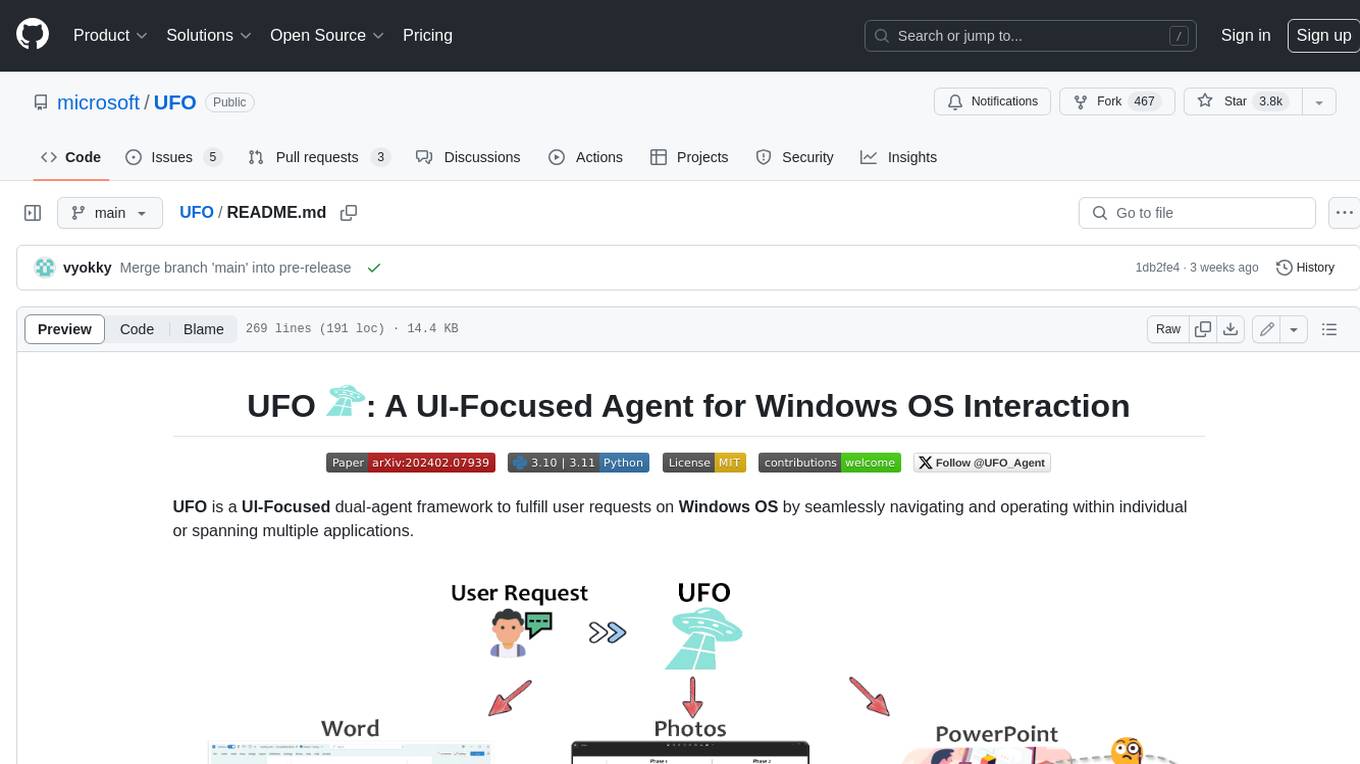
UFO
UFO is a UI-focused dual-agent framework to fulfill user requests on Windows OS by seamlessly navigating and operating within individual or spanning multiple applications.
timefold-solver
Timefold Solver is an optimization engine evolved from OptaPlanner. Developed by the original OptaPlanner team, our aim is to free the world of wasteful planning.
MateCat
Matecat is an enterprise-level, web-based CAT tool designed to make post-editing and outsourcing easy and to provide a complete set of features to manage and monitor translation projects.
crewAI
crewAI is a cutting-edge framework for orchestrating role-playing, autonomous AI agents. By fostering collaborative intelligence, CrewAI empowers agents to work together seamlessly, tackling complex tasks. It provides a flexible and structured approach to AI collaboration, enabling users to define agents with specific roles, goals, and tools, and assign them tasks within a customizable process. crewAI supports integration with various LLMs, including OpenAI, and offers features such as autonomous task delegation, flexible task management, and output parsing. It is open-source and welcomes contributions, with a focus on improving the library based on usage data collected through anonymous telemetry.