


open-wearables
Self-hosted platform to unify wearable health data through one AI-ready API.
Stars: 487
Open Wearables is an open-source platform that unifies wearable device data from multiple providers and enables AI-powered health insights through natural language automations. It provides a single API for building health applications faster, with embeddable widgets and webhook notifications. Developers can integrate multiple wearable providers, access normalized health data, and build AI-powered insights. The platform simplifies the process of supporting multiple wearables, handling OAuth flows, data mapping, and sync logic, allowing users to focus on product development. Use cases include fitness coaching apps, healthcare platforms, wellness applications, research projects, and personal use.
README:




Documentation: https://docs.openwearables.io
Open-source platform that unifies wearable device data from multiple providers and enables AI-powered health insights through natural language automations. Build health applications faster with a single API, embeddable widgets, and intelligent webhook notifications.
Open Wearables provides a unified API and developer portal to connect and sync data from multiple wearable devices and fitness platforms. Instead of implementing separate integrations for each provider (e.g., Garmin, Whoop, Apple Health), you can use a single platform to access normalized health data and build intelligent health insights through AI-powered automations.
[!IMPORTANT] For Individuals: This platform isn't just for developers - individuals can self-host it to take control of their own wearable data. Connect your devices, explore your health metrics through the unified API, and stay tuned for upcoming features like the AI Health Assistant and personal health insights automations. Best of all, your data stays on your own infrastructure, giving you complete privacy and control.
For Developers building health apps:
- 🔌 Integrate multiple wearable providers through one API instead of maintaining separate implementations
- 📊 Access normalized health data across different devices (heart rate, sleep, activity, steps, etc.)
- 🏠 Self-hosted solution - deploy on your own infrastructure with full data control
- 🚀 No third-party dependencies for core functionality - run it locally with
docker compose up - 🤖 Build AI-powered health insights and automations using natural language (coming soon)
- 🧩 Embeddable widgets for easy integration into your applications (coming soon)
The Problem It Solves:
Building a health app that supports multiple wearables typically requires:
- Significant development effort per provider (Garmin, Whoop, Apple Health, etc.) to implement OAuth flows, data mapping, and sync logic
- Managing different OAuth flows and APIs for each service
- Handling various data formats and units
- Maintaining multiple SDKs and dealing with API changes
Open Wearables handles this complexity so you can focus on building your product 🚀
- 🏃 Fitness Coaching Apps: Connect user wearables to provide personalized training recommendations. Running coaches can create users, share connection links via WhatsApp, and test AI insights capabilities
- 🏥 Healthcare Platforms: Aggregate patient health data from various devices and set up automations for health alerts
- 💪 Wellness Applications: Track and analyze user activity across different wearables with AI-powered insights
- 🔬 Research Projects: Collect standardized health data from multiple sources
- 🧪 Product Pilots: Non-technical product owners can test platform functionality by sharing connection links with users without needing their own app
- 👤 Personal Use: Individuals can self-host the platform to connect their own wearables, chat with their health data using the AI Health Assistant, and set up personal health insights - all with complete data privacy and control
Get Open Wearables up and running in minutes.
-
Clone the repository:
git clone https://github.com/the-momentum/open-wearables.git cd open-wearables -
Configure environment variables:
Backend configuration:
cp ./backend/config/.env.example ./backend/config/.env
Frontend configuration:
cp ./frontend/.env.example ./frontend/.env
-
Start the application
Using Docker (Recommended):
The easiest way to get started is with Docker Compose:
docker compose up -d
For local development setup without Docker take a look at docs
-
Seed sample data (optional but recommended): If you're using Docker, seed the database with sample data including an admin account:
make init
This will create:
- An admin user account (
[email protected]/secret123) - 10 test users
- Sample activity data for test users
- An admin user account (
-
Access the developer portal:
Open http://localhost:3000 to access the developer portal and create API keys.
-
View API documentation:
Open http://localhost:8000/docs in your browser to explore the interactive Swagger UI.
Web-based dashboard for managing your integration:
- 📈 General Statistics: View number of users and data points at a glance
- 👥 User Management: Add users via the portal or through the API
- 📋 User Details: View connected data sources, integration status, and user metrics with visualizations
- 🔑 API Key Management: Generate and manage credentials in the Credentials tab
The platform's most powerful feature - define intelligent health insights using natural language:
- 💬 Natural Language Conditions: Describe when notifications should be triggered in plain English
- 🔔 Webhook Notifications: Configure your backend endpoint to receive real-time health insights
- 🧪 Test Automation: Run dry runs on historical data to see how automations work in practice
- 👤 Human-in-the-Loop: Mark incorrect AI interpretations during testing to continuously improve the system
- ✨ Improve Description: AI-powered suggestions to refine your automation descriptions
- 📜 Automation Logs: Review past automation triggers and provide feedback
- 💬 Interactive chat interface for debugging and exploring user data
- 🧩 Embeddable widget that can be integrated into any app with just a few lines of code
- 🔄 Customizable AI models (swap models to match your needs)
- 🔍 Natural language queries about user health metrics
Access health data through a consistent REST API regardless of the source device.
- ☁️ Cloud-based: Garmin, Suunto, Polar (more comming soon!)
- 📱 SDK-based: Apple Health (via XML export and webhooks)
Simplified connection process for end users:
- Generate a connection link for your user (or use the SDK widget)
- User authenticates with their wearable provider
- Data automatically syncs to your platform
- Access via unified API
- 🔌 Connection Widget: Allow users to connect their wearables directly from your app
- 🤖 AI Health Assistant Widget: Embed the AI chat interface for user health queries
- 🍏 Flutter SDK: Handles HealthKit permissions, background sync, and data normalization
Built with:
- 🐍 Backend: FastAPI (Python)
- ⚛️ Frontend: React + TanStack Router + TypeScript (Vite)
- 🗄️ Database: PostgreSQL + Redis
- ⚙️ Task Queue: Celery (background jobs for data syncing and processing)
- 🔐 Authentication: Self-contained (no external auth services required)
- 📡 API Style: RESTful with OpenAPI/Swagger documentation
The platform is designed for self-hosting, meaning each deployment serves a single organization. No multi-tenancy complexity.
Available:
- Developer portal
- User management (via API and developer portal)
- OAuth flow for Garmin, Polar, and Suunto
- Workout data sync and API access for Garmin, Polar, and Suunto
In Development:
- Core health data endpoints
- Health Insights automations
- AI Health Assistant
- Mobile SDK (Flutter)
- Enhanced widget integration
Join our Discord community to connect with other developers, get help, share ideas, and stay updated on the latest developments:
Contributions are welcome! This project aims to be a community-driven solution for wearable data integration.
See CONTRIBUTING.md for details on:
- 🛠️ Setting up the development environment
- 📝 Code style and testing requirements
- 🔀 Pull request process
MIT License - Use it freely in commercial and open-source projects.
- 💬 GitHub Discussions - Questions and ideas
Note: This is an early-stage project under active development. APIs may change before version 1.0. We recommend pinning to specific versions in production and following the changelog for updates.
The backend part of this project was generated from the Python AI Kit.
For Tasks:
Click tags to check more tools for each tasksFor Jobs:
Alternative AI tools for open-wearables
Similar Open Source Tools
open-wearables
Open Wearables is an open-source platform that unifies wearable device data from multiple providers and enables AI-powered health insights through natural language automations. It provides a single API for building health applications faster, with embeddable widgets and webhook notifications. Developers can integrate multiple wearable providers, access normalized health data, and build AI-powered insights. The platform simplifies the process of supporting multiple wearables, handling OAuth flows, data mapping, and sync logic, allowing users to focus on product development. Use cases include fitness coaching apps, healthcare platforms, wellness applications, research projects, and personal use.
weam
Weam is an open source platform designed to help teams systematically adopt AI. It provides a production-ready stack with Next.js frontend and Node.js/Python backend, allowing for immediate deployment and use. Weam connects to major LLM providers, enabling easy access to the latest AI models. The platform organizes AI interactions into 'Brains' for different departments, offering customization and expansion options. Features include chat system, productivity tools, sharing & access controls, prompt library, AI agents, RAG, MCP, enterprise features, pre-built automations, and upcoming AI app solutions. Weam is free, open source, and scalable to meet growing needs.
vulcan-sql
VulcanSQL is an Analytical Data API Framework for AI agents and data apps. It aims to help data professionals deliver RESTful APIs from databases, data warehouses or data lakes much easier and secure. It turns your SQL into APIs in no time!
fridon-ai
FridonAI is an open-source project offering AI-powered tools for cryptocurrency analysis and blockchain operations. It includes modules like FridonAnalytics for price analysis, FridonSearch for technical indicators, FridonNotifier for custom alerts, FridonBlockchain for blockchain operations, and FridonChat as a unified chat interface. The platform empowers users to create custom AI chatbots, access crypto tools, and interact effortlessly through chat. The core functionality is modular, with plugins, tools, and utilities for easy extension and development. FridonAI implements a scoring system to assess user interactions and incentivize engagement. The application uses Redis extensively for communication and includes a Nest.js backend for system operations.
JamAIBase
JamAI Base is an open-source platform integrating SQLite and LanceDB databases with managed memory and RAG capabilities. It offers built-in LLM, vector embeddings, and reranker orchestration accessible through a spreadsheet-like UI and REST API. Users can transform static tables into dynamic entities, facilitate real-time interactions, manage structured data, and simplify chatbot development. The tool focuses on ease of use, scalability, flexibility, declarative paradigm, and innovative RAG techniques, making complex data operations accessible to users with varying technical expertise.
kodit
Kodit is a Code Indexing MCP Server that connects AI coding assistants to external codebases, providing accurate and up-to-date code snippets. It improves AI-assisted coding by offering canonical examples, indexing local and public codebases, integrating with AI coding assistants, enabling keyword and semantic search, and supporting OpenAI-compatible or custom APIs/models. Kodit helps engineers working with AI-powered coding assistants by providing relevant examples to reduce errors and hallucinations.
ChatFAQ
ChatFAQ is an open-source comprehensive platform for creating a wide variety of chatbots: generic ones, business-trained, or even capable of redirecting requests to human operators. It includes a specialized NLP/NLG engine based on a RAG architecture and customized chat widgets, ensuring a tailored experience for users and avoiding vendor lock-in.
codegate
CodeGate is a local gateway that enhances the safety of AI coding assistants by ensuring AI-generated recommendations adhere to best practices, safeguarding code integrity, and protecting individual privacy. Developed by Stacklok, CodeGate allows users to confidently leverage AI in their development workflow without compromising security or productivity. It works seamlessly with coding assistants, providing real-time security analysis of AI suggestions. CodeGate is designed with privacy at its core, keeping all data on the user's machine and offering complete control over data.
LLMstudio
LLMstudio by TensorOps is a platform that offers prompt engineering tools for accessing models from providers like OpenAI, VertexAI, and Bedrock. It provides features such as Python Client Gateway, Prompt Editing UI, History Management, and Context Limit Adaptability. Users can track past runs, log costs and latency, and export history to CSV. The tool also supports automatic switching to larger-context models when needed. Coming soon features include side-by-side comparison of LLMs, automated testing, API key administration, project organization, and resilience against rate limits. LLMstudio aims to streamline prompt engineering, provide execution history tracking, and enable effortless data export, offering an evolving environment for teams to experiment with advanced language models.
magic
Magic is an open-source all-in-one AI productivity platform designed to help enterprises quickly build and deploy AI applications, aiming for a 100x increase in productivity. It consists of various AI products and infrastructure tools, such as Super Magic, Magic IM, Magic Flow, and more. Super Magic is a general-purpose AI Agent for complex task scenarios, while Magic Flow is a visual AI workflow orchestration system. Magic IM is an enterprise-grade AI Agent conversation system for internal knowledge management. Teamshare OS is a collaborative office platform integrating AI capabilities. The platform provides cloud services, enterprise solutions, and a self-hosted community edition for users to leverage its features.
deepflow
DeepFlow is an open-source project that provides deep observability for complex cloud-native and AI applications. It offers Zero Code data collection with eBPF for metrics, distributed tracing, request logs, and function profiling. DeepFlow is integrated with SmartEncoding to achieve Full Stack correlation and efficient access to all observability data. With DeepFlow, cloud-native and AI applications automatically gain deep observability, removing the burden of developers continually instrumenting code and providing monitoring and diagnostic capabilities covering everything from code to infrastructure for DevOps/SRE teams.
genkit
Firebase Genkit (beta) is a framework with powerful tooling to help app developers build, test, deploy, and monitor AI-powered features with confidence. Genkit is cloud optimized and code-centric, integrating with many services that have free tiers to get started. It provides unified API for generation, context-aware AI features, evaluation of AI workflow, extensibility with plugins, easy deployment to Firebase or Google Cloud, observability and monitoring with OpenTelemetry, and a developer UI for prototyping and testing AI features locally. Genkit works seamlessly with Firebase or Google Cloud projects through official plugins and templates.
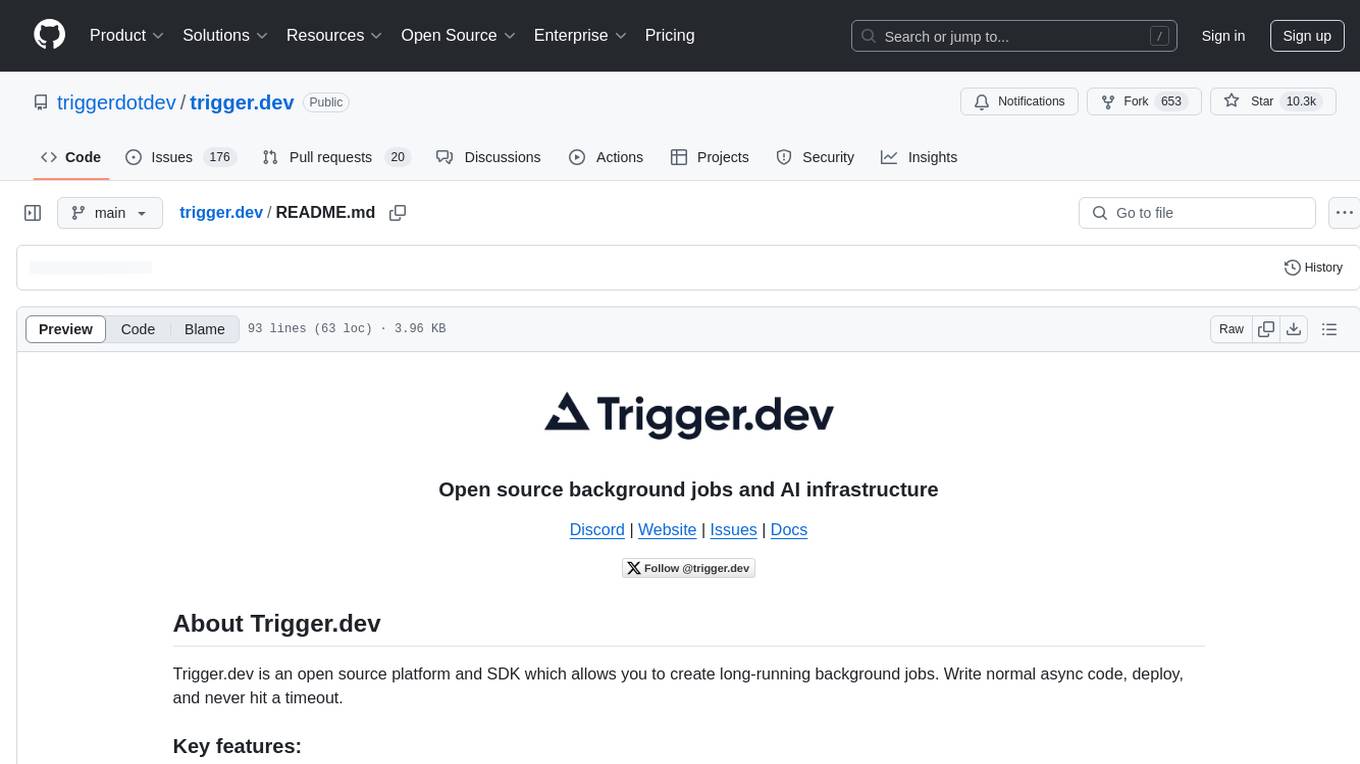
trigger.dev
Trigger.dev is an open source platform and SDK for creating long-running background jobs. It provides features like JavaScript and TypeScript SDK, no timeouts, retries, queues, schedules, observability, React hooks, Realtime API, custom alerts, elastic scaling, and works with existing tech stack. Users can create tasks in their codebase, deploy tasks using the SDK, manage tasks in different environments, and have full visibility of job runs. The platform offers a trace view of every task run for detailed monitoring. Getting started is easy with account creation, project setup, and onboarding instructions. Self-hosting and development guides are available for users interested in contributing or hosting Trigger.dev.
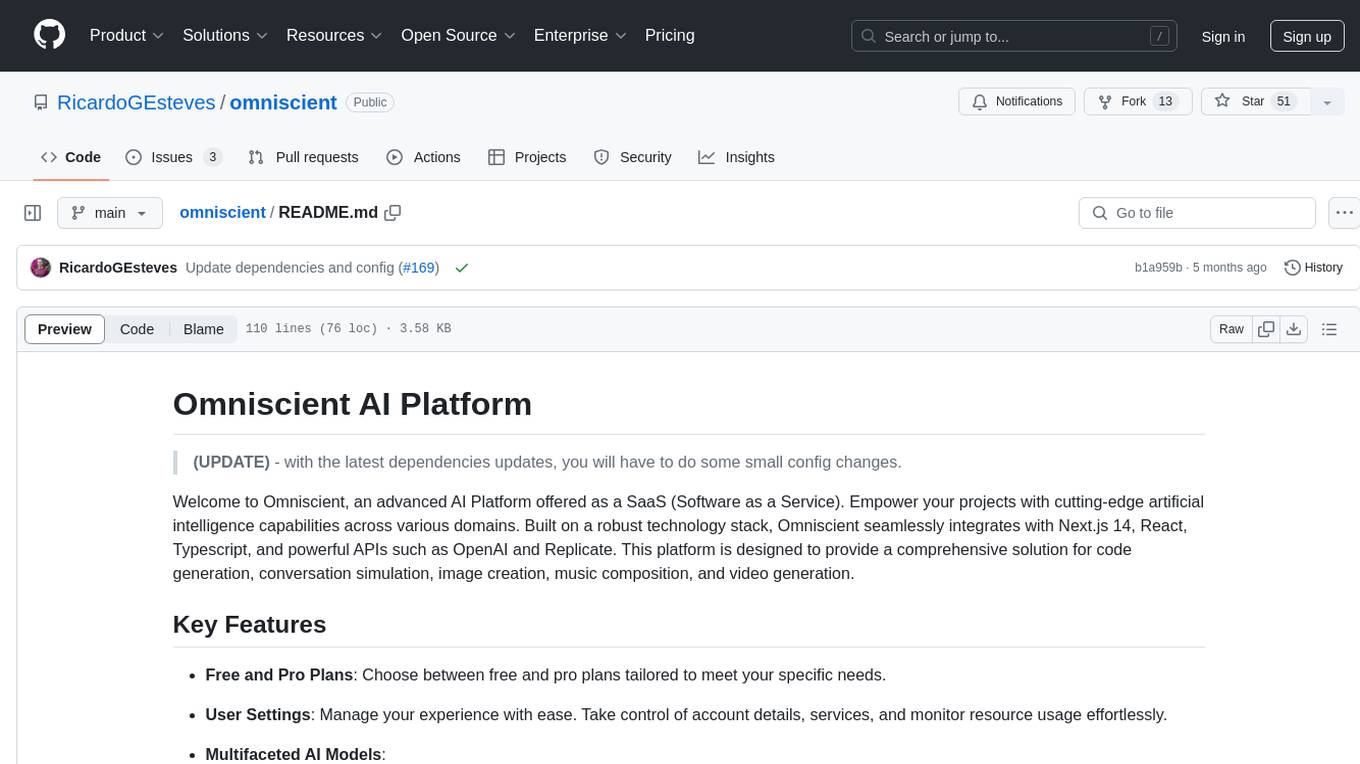
omniscient
Omniscient is an advanced AI Platform offered as a SaaS, empowering projects with cutting-edge artificial intelligence capabilities. Seamlessly integrating with Next.js 14, React, Typescript, and APIs like OpenAI and Replicate, it provides solutions for code generation, conversation simulation, image creation, music composition, and video generation.
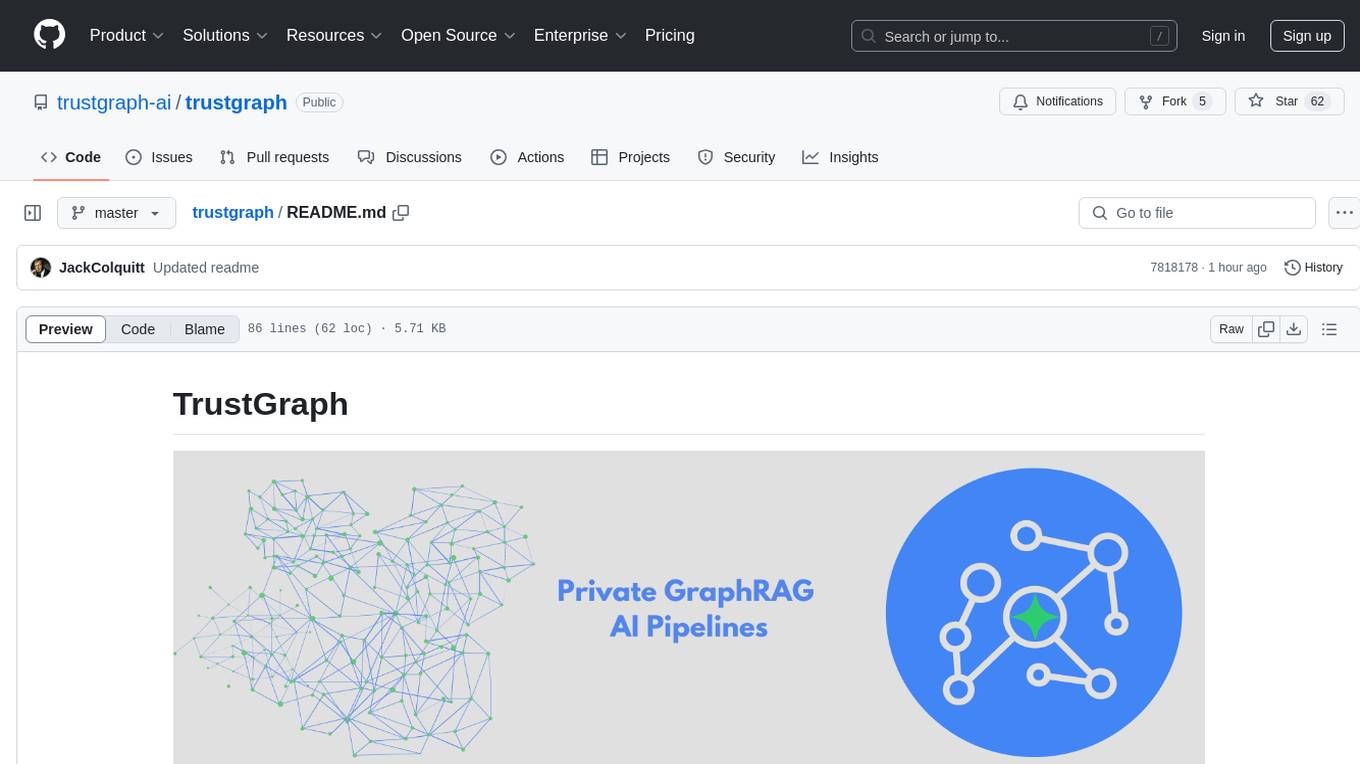
trustgraph
TrustGraph is a tool that deploys private GraphRAG pipelines to build a RDF style knowledge graph from data, enabling accurate and secure `RAG` requests compatible with cloud LLMs and open-source SLMs. It showcases the reliability and efficiencies of GraphRAG algorithms, capturing contextual language flags missed in conventional RAG approaches. The tool offers features like PDF decoding, text chunking, inference of various LMs, RDF-aligned Knowledge Graph extraction, and more. TrustGraph is designed to be modular, supporting multiple Language Models and environments, with a plug'n'play architecture for easy customization.
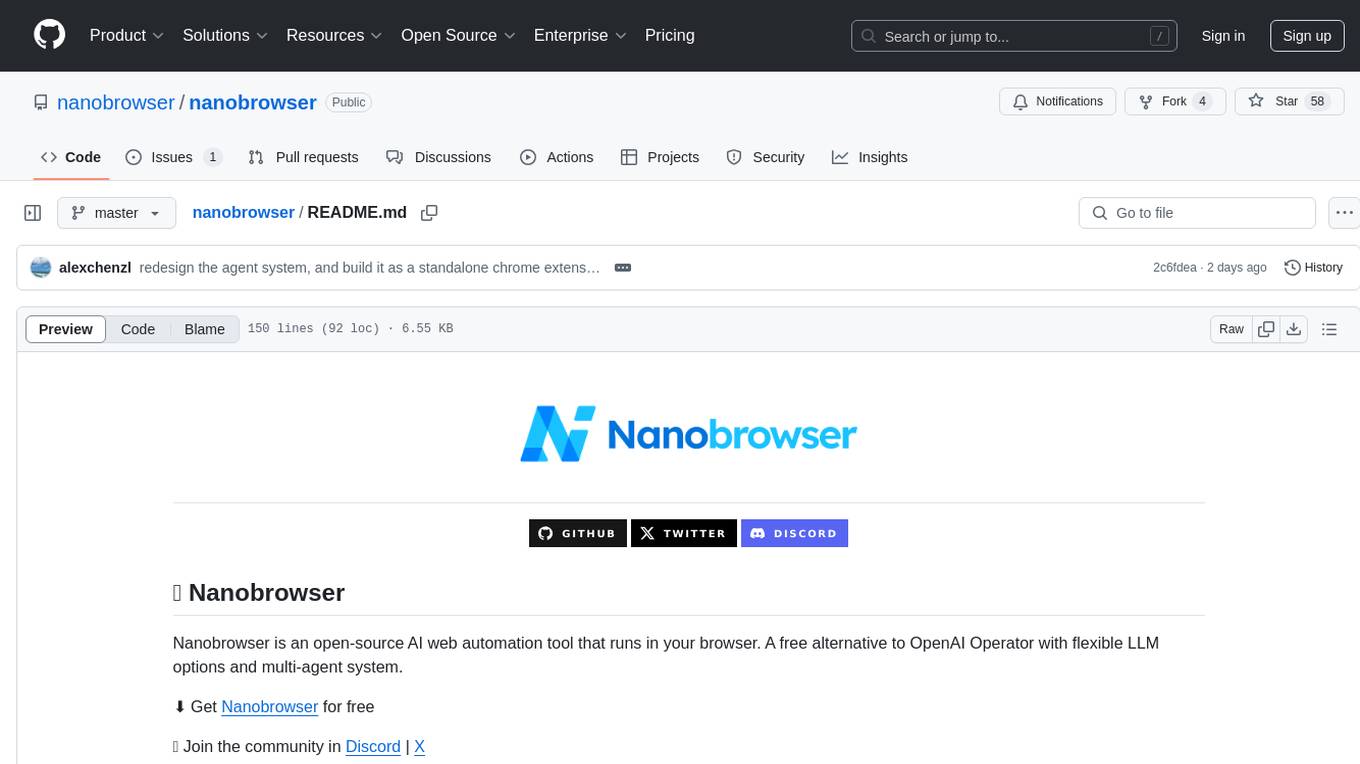
nanobrowser
Nanobrowser is an open-source AI web automation tool that runs in your browser. It is a free alternative to OpenAI Operator with flexible LLM options and a multi-agent system. Nanobrowser offers premium web automation capabilities while keeping users in complete control, with features like a multi-agent system, interactive side panel, task automation, follow-up questions, and multiple LLM support. Users can easily download and install Nanobrowser as a Chrome extension, configure agent models, and accomplish tasks such as news summary, GitHub research, and shopping research with just a sentence. The tool uses a specialized multi-agent system powered by large language models to understand and execute complex web tasks. Nanobrowser is actively developed with plans to expand LLM support, implement security measures, optimize memory usage, enable session replay, and develop specialized agents for domain-specific tasks. Contributions from the community are welcome to improve Nanobrowser and build the future of web automation.
For similar tasks
open-wearables
Open Wearables is an open-source platform that unifies wearable device data from multiple providers and enables AI-powered health insights through natural language automations. It provides a single API for building health applications faster, with embeddable widgets and webhook notifications. Developers can integrate multiple wearable providers, access normalized health data, and build AI-powered insights. The platform simplifies the process of supporting multiple wearables, handling OAuth flows, data mapping, and sync logic, allowing users to focus on product development. Use cases include fitness coaching apps, healthcare platforms, wellness applications, research projects, and personal use.
MahoShojo-Generator
MahoShojo-Generator is a web-based AI structured generation tool that allows players to create personalized and evolving magical girls (or quirky characters) and related roles. It offers exciting cyber battles, storytelling activities, and even a ranking feature. The project also includes AI multi-channel polling, user system, public data card sharing, and sensitive word detection. It supports various functionalities such as character generation, arena system, growth and social interaction, cloud and sharing, and other features like scenario generation, tavern ecosystem linkage, and content safety measures.
csghub-server
CSGHub Server is a part of the open source and reliable large model assets management platform - CSGHub. It focuses on management of models, datasets, and other LLM assets through REST API. Key features include creation and management of users and organizations, auto-tagging of model and dataset labels, search functionality, online preview of dataset files, content moderation for text and image, download of individual files, tracking of model and dataset activity data. The tool is extensible and customizable, supporting different git servers, flexible LFS storage system configuration, and content moderation options. The roadmap includes support for more Git servers, Git LFS, dataset online viewer, model/dataset auto-tag, S3 protocol support, model format conversion, and model one-click deploy. The project is licensed under Apache 2.0 and welcomes contributions.
devb.io
devb.io is an innovative platform that automatically generates professional developer portfolios directly from GitHub profiles, leveraging AI to enhance and update professional representations. It offers one-click GitHub profile connection, automatic portfolio generation, AI-powered bio generation, dynamic activity tracking, and zero manual maintenance. The tech stack includes HTML, CSS for frontend, Fast API for backend, Redis for database, Groq for AI services, and Python for scripting.
For similar jobs
sweep
Sweep is an AI junior developer that turns bugs and feature requests into code changes. It automatically handles developer experience improvements like adding type hints and improving test coverage.
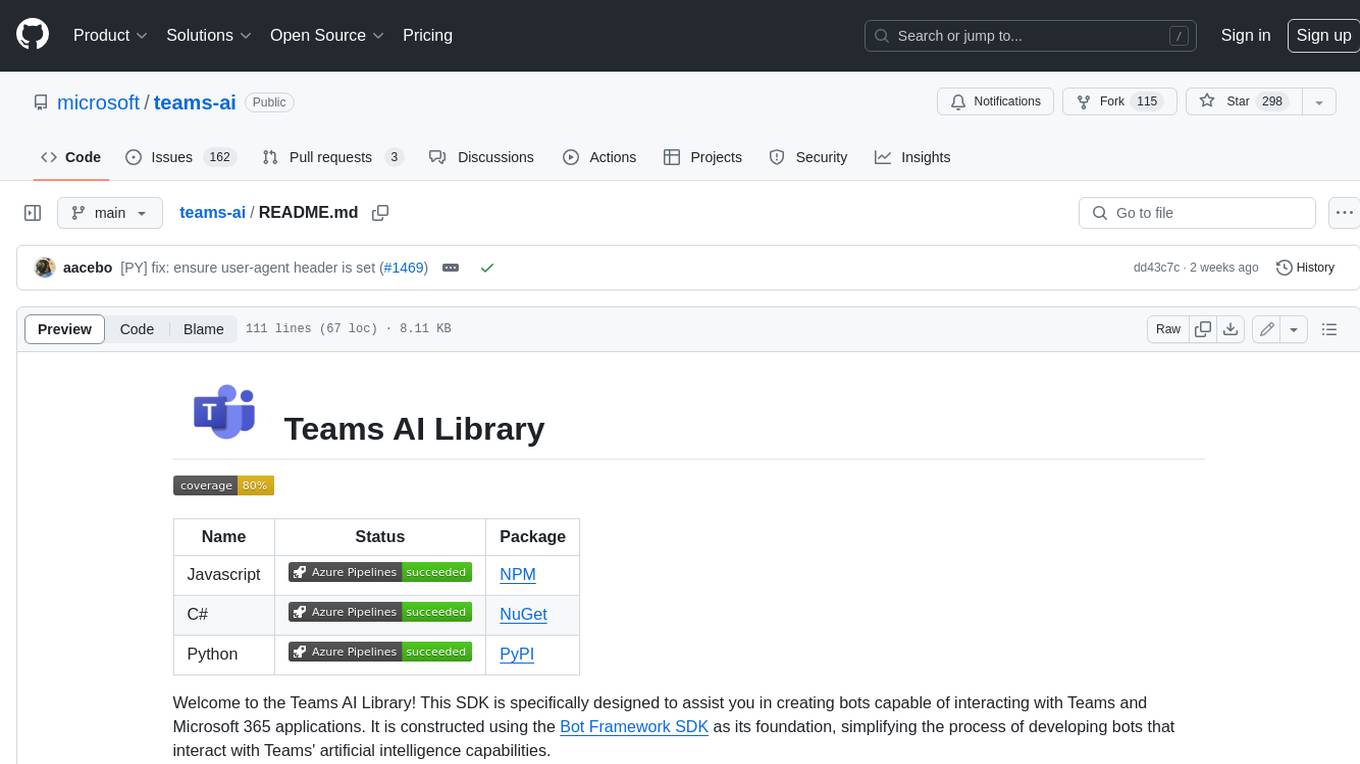
teams-ai
The Teams AI Library is a software development kit (SDK) that helps developers create bots that can interact with Teams and Microsoft 365 applications. It is built on top of the Bot Framework SDK and simplifies the process of developing bots that interact with Teams' artificial intelligence capabilities. The SDK is available for JavaScript/TypeScript, .NET, and Python.
ai-guide
This guide is dedicated to Large Language Models (LLMs) that you can run on your home computer. It assumes your PC is a lower-end, non-gaming setup.
classifai
Supercharge WordPress Content Workflows and Engagement with Artificial Intelligence. Tap into leading cloud-based services like OpenAI, Microsoft Azure AI, Google Gemini and IBM Watson to augment your WordPress-powered websites. Publish content faster while improving SEO performance and increasing audience engagement. ClassifAI integrates Artificial Intelligence and Machine Learning technologies to lighten your workload and eliminate tedious tasks, giving you more time to create original content that matters.
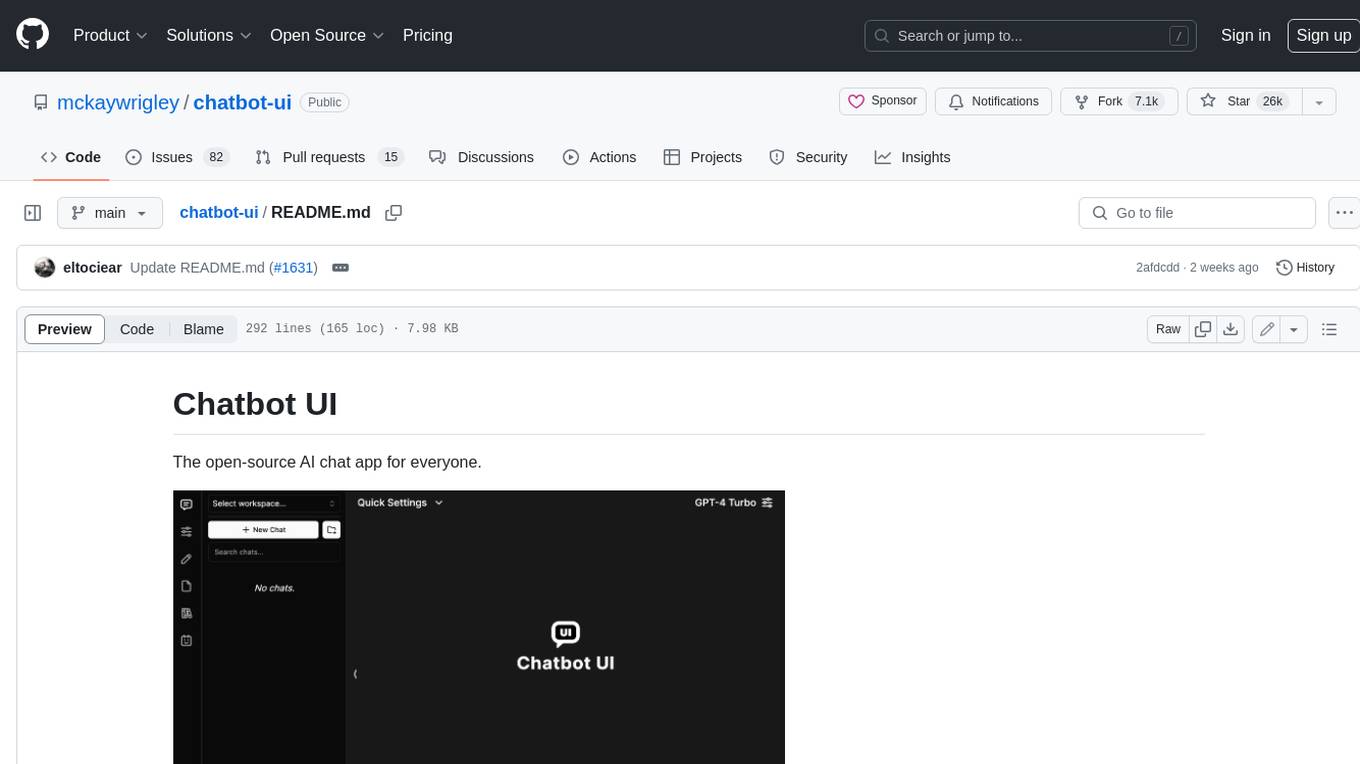
chatbot-ui
Chatbot UI is an open-source AI chat app that allows users to create and deploy their own AI chatbots. It is easy to use and can be customized to fit any need. Chatbot UI is perfect for businesses, developers, and anyone who wants to create a chatbot.
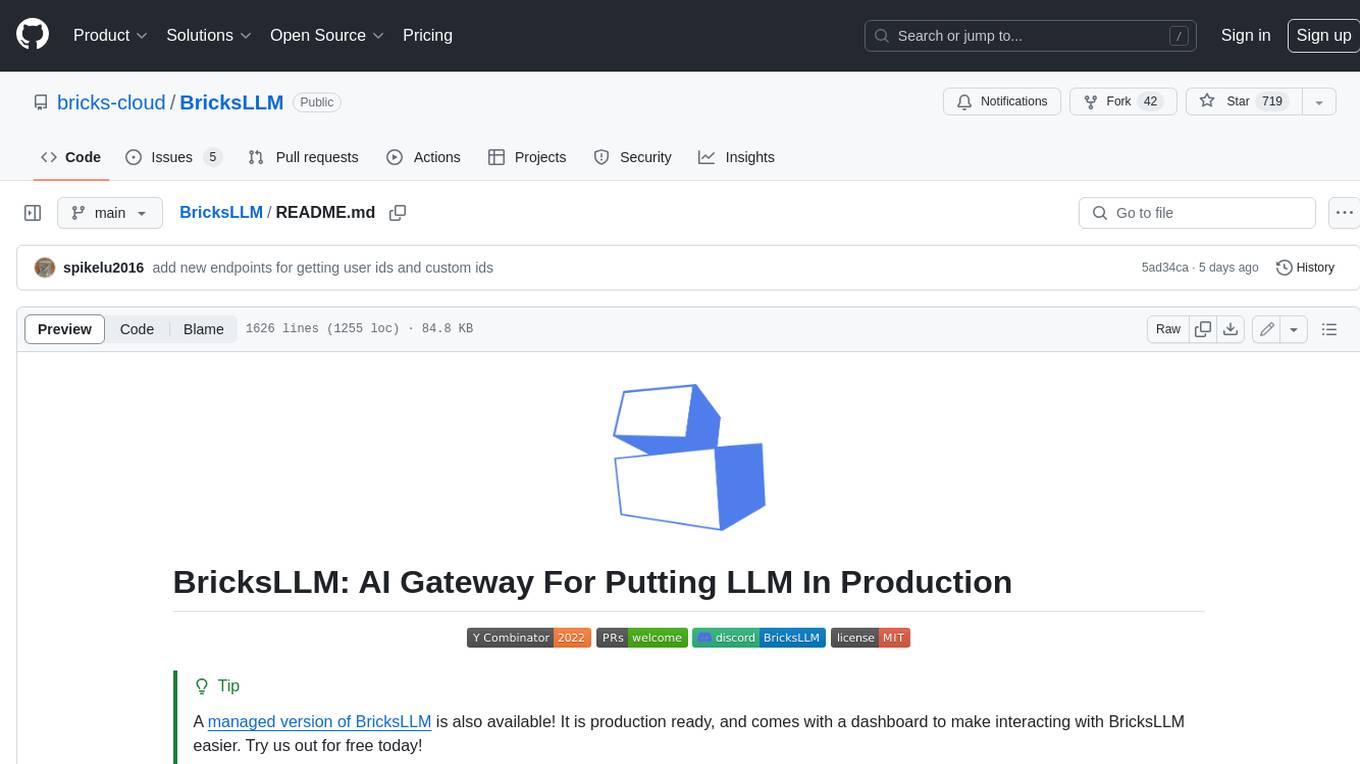
BricksLLM
BricksLLM is a cloud native AI gateway written in Go. Currently, it provides native support for OpenAI, Anthropic, Azure OpenAI and vLLM. BricksLLM aims to provide enterprise level infrastructure that can power any LLM production use cases. Here are some use cases for BricksLLM: * Set LLM usage limits for users on different pricing tiers * Track LLM usage on a per user and per organization basis * Block or redact requests containing PIIs * Improve LLM reliability with failovers, retries and caching * Distribute API keys with rate limits and cost limits for internal development/production use cases * Distribute API keys with rate limits and cost limits for students
uAgents
uAgents is a Python library developed by Fetch.ai that allows for the creation of autonomous AI agents. These agents can perform various tasks on a schedule or take action on various events. uAgents are easy to create and manage, and they are connected to a fast-growing network of other uAgents. They are also secure, with cryptographically secured messages and wallets.
griptape
Griptape is a modular Python framework for building AI-powered applications that securely connect to your enterprise data and APIs. It offers developers the ability to maintain control and flexibility at every step. Griptape's core components include Structures (Agents, Pipelines, and Workflows), Tasks, Tools, Memory (Conversation Memory, Task Memory, and Meta Memory), Drivers (Prompt and Embedding Drivers, Vector Store Drivers, Image Generation Drivers, Image Query Drivers, SQL Drivers, Web Scraper Drivers, and Conversation Memory Drivers), Engines (Query Engines, Extraction Engines, Summary Engines, Image Generation Engines, and Image Query Engines), and additional components (Rulesets, Loaders, Artifacts, Chunkers, and Tokenizers). Griptape enables developers to create AI-powered applications with ease and efficiency.