


superinterface
Superinterface is an AI assistants library for building AI capabilities into your app or website. You use React components and hooks to build AI-first assistants-based interfaces like chats and wizards.
Stars: 177
Superinterface is an AI assistants library for building AI capabilities into your app or website. It allows you to use React components and hooks to create AI-first assistants-based interfaces such as chats and wizards. The project is currently in the process of writing documentation. For more information, visit https://superinterface.ai. Examples are hosted at https://examples-next.superinterface.ai.
README:
Superinterface is an AI assistants library for building AI capabilities into your app or website. You use React components and hooks to build AI-first assistants-based interfaces like chats and wizards.
Docs are in the process of being written.
More info about the project: https://superinterface.ai
Examples are hosted here: https://examples-next.superinterface.ai (see code here)
For Tasks:
Click tags to check more tools for each tasksFor Jobs:
Alternative AI tools for superinterface
Similar Open Source Tools
superinterface
Superinterface is an AI assistants library for building AI capabilities into your app or website. It allows you to use React components and hooks to create AI-first assistants-based interfaces such as chats and wizards. The project is currently in the process of writing documentation. For more information, visit https://superinterface.ai. Examples are hosted at https://examples-next.superinterface.ai.
langbase-examples
Langbase Examples is an open-source repository showcasing projects built using Langbase, a composable AI infrastructure for creating and deploying AI agents with hyper-personalized memory. Langbase offers AI Pipes for building custom AI agents as APIs and Memory (RAG) for managed search engine capabilities. The platform also includes AI Studio for collaboration and deployment of AI projects, providing a complete AI developer platform for teams to work together on building and deploying AI features.
ai_gallery
AI Gallery is a showcase site built using React and Nextjs for static site generation, featuring interactive visualizations of classic algorithms, classic games implementation, and various interesting widgets. The project utilizes AI assistance from Claude 3.5 and GPT-4 to create components and enhance the development process. It aims to continually add more components with AI assistance, providing a platform for contributors to leverage AI in frontend development.
motleycrew
Motleycrew is an ultimate framework for building multi-agent AI systems, allowing users to mix and match AI agents and tools from popular frameworks, design advanced workflows, and leverage dynamic knowledge graphs with simplicity and elegance. It acts as a conductor orchestrating a symphony of AI agents and tools, providing building blocks for creating AI systems and enabling users to focus on high-level design while taking care of the rest. The framework offers integration with various tools, flexibility in providing agents with tools or other agents, advanced flow design capabilities, and built-in observability and caching features.
ai-cookbook
The AI Cookbook is a collection of examples and tutorials designed to assist developers in building AI systems. It provides ready-to-use code snippets that can be easily integrated into various projects. The content covers practical guidance on creating AI solutions that are functional in real-world scenarios. The repository aims to support learners, freelancers, and businesses seeking AI expertise by offering valuable resources and insights.
coze-studio
Coze Studio is an all-in-one AI agent development tool that offers the most convenient AI agent development environment, from development to deployment. It provides core technologies for AI agent development, complete app templates, and build frameworks. Coze Studio aims to simplify creating, debugging, and deploying AI agents through visual design and build tools, enabling powerful AI app development and customized business logic. The tool is developed using Golang for the backend, React + TypeScript for the frontend, and follows microservices architecture based on domain-driven design principles.
lsp-ai
LSP-AI is an open source language server designed to enhance software engineers' productivity by integrating AI-powered functionality into various text editors. It serves as a backend for completion with large language models and offers features like unified AI capabilities, simplified plugin development, enhanced collaboration, broad compatibility with editors supporting Language Server Protocol, flexible LLM backend support, and commitment to staying updated with the latest advancements in LLM-driven software development. The tool aims to centralize open-source development work, provide a collaborative platform for developers, and offer a future-ready solution for AI-powered assistants in text editors.
nocobase
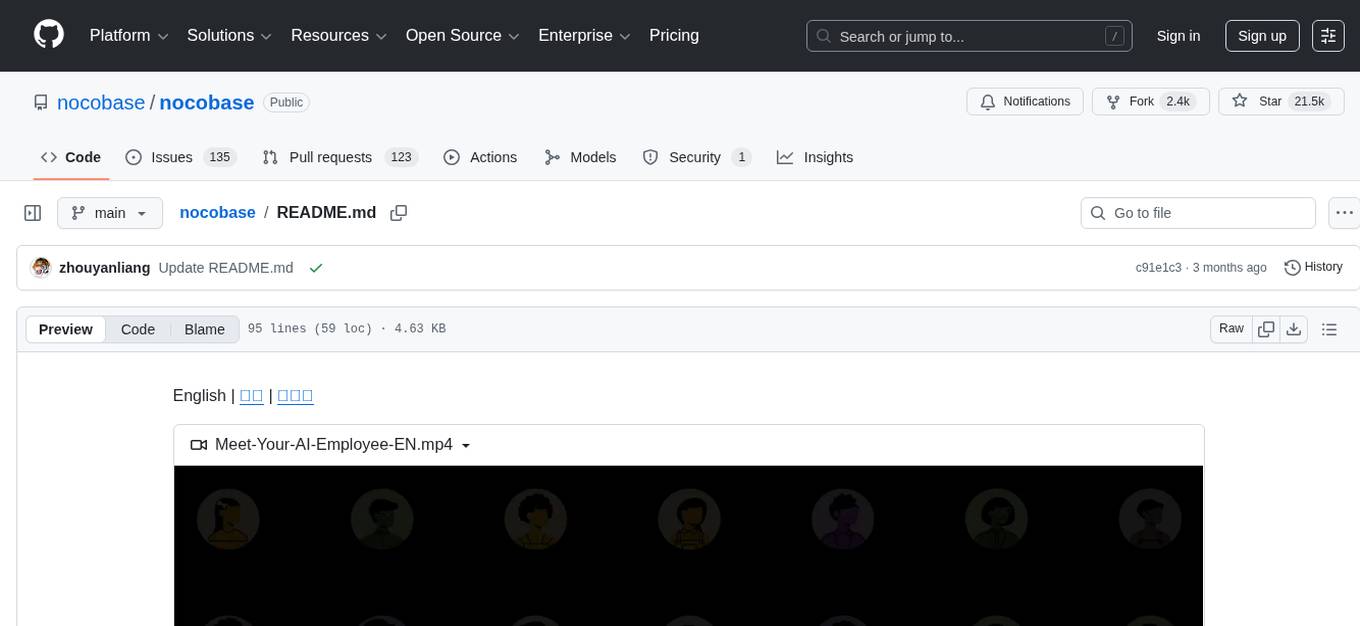
NocoBase is an extensible AI-powered no-code platform that offers total control, infinite extensibility, and AI collaboration. It enables teams to adapt quickly and reduce costs without the need for years of development or wasted resources. With NocoBase, users can deploy the platform in minutes and have complete control over their projects. The platform is data model-driven, allowing for unlimited possibilities by decoupling UI and data structure. It integrates AI capabilities seamlessly into business systems, enabling roles such as translator, analyst, researcher, or assistant. NocoBase provides a simple and intuitive user experience with a 'what you see is what you get' approach. It is designed for extension through its plugin-based architecture, allowing users to customize and extend functionalities easily.
dust
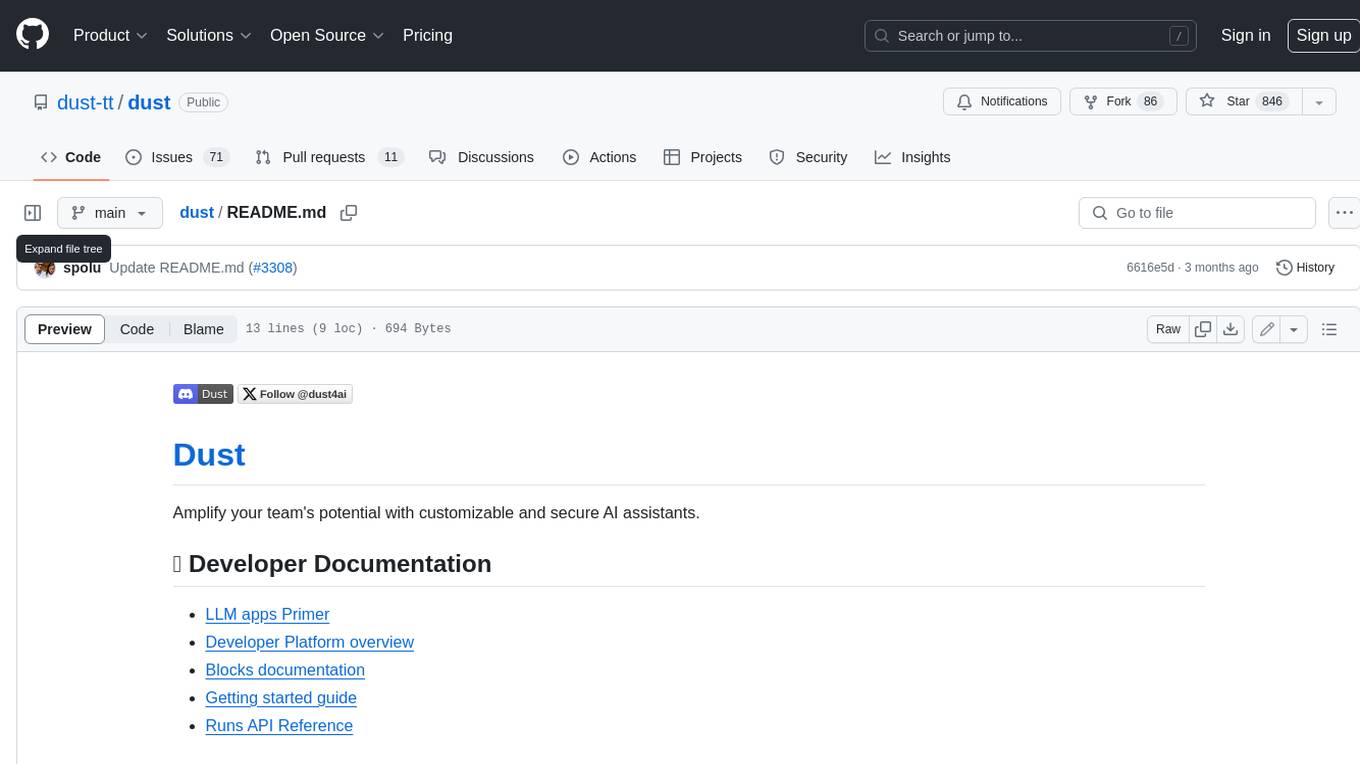
Dust is a platform that provides customizable and secure AI assistants to amplify your team's potential. With Dust, you can build and deploy AI assistants that are tailored to your specific needs, without the need for extensive technical expertise. Dust's platform is easy to use and provides a variety of features to help you get started quickly, including a library of pre-built blocks, a developer platform, and an API reference.
intro-to-intelligent-apps
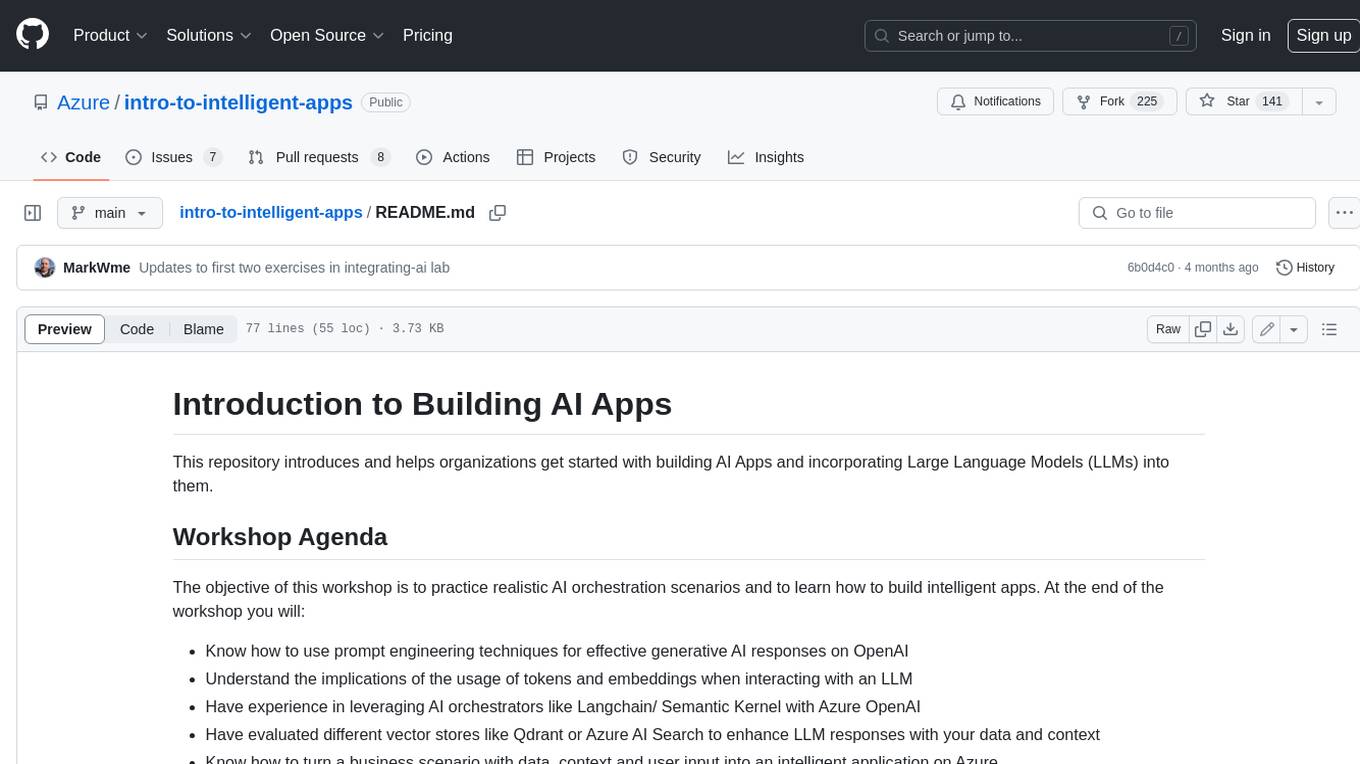
This repository introduces and helps organizations get started with building AI Apps and incorporating Large Language Models (LLMs) into them. The workshop covers topics such as prompt engineering, AI orchestration, and deploying AI apps. Participants will learn how to use Azure OpenAI, Langchain/ Semantic Kernel, Qdrant, and Azure AI Search to build intelligent applications.

awesome-ai-tools
Awesome AI Tools is a curated list of popular tools and resources for artificial intelligence enthusiasts. It includes a wide range of tools such as machine learning libraries, deep learning frameworks, data visualization tools, and natural language processing resources. Whether you are a beginner or an experienced AI practitioner, this repository aims to provide you with a comprehensive collection of tools to enhance your AI projects and research. Explore the list to discover new tools, stay updated with the latest advancements in AI technology, and find the right resources to support your AI endeavors.
TagUI
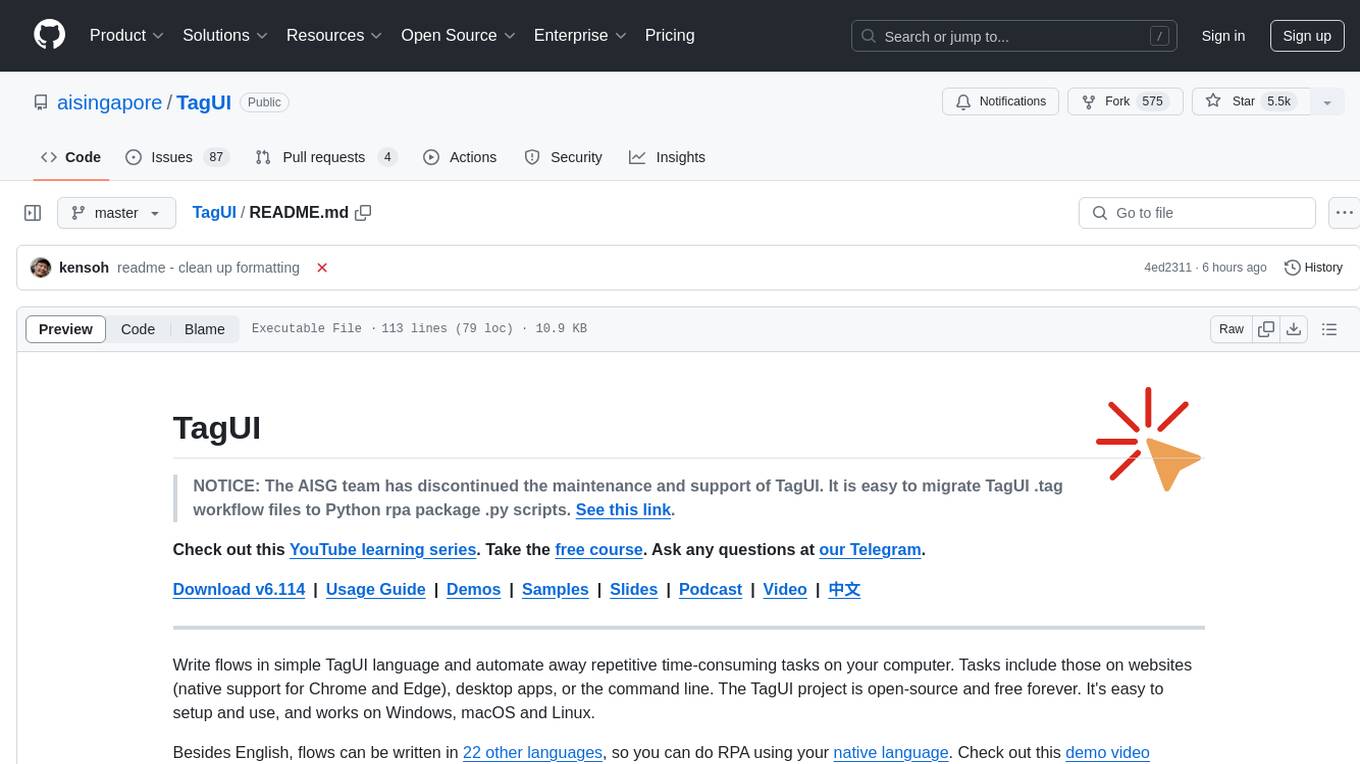
TagUI is an open-source RPA tool that allows users to automate repetitive tasks on their computer, including tasks on websites, desktop apps, and the command line. It supports multiple languages and offers features like interacting with identifiers, automating data collection, moving data between TagUI and Excel, and sending Telegram notifications. Users can create RPA robots using MS Office Plug-ins or text editors, run TagUI on the cloud, and integrate with other RPA tools. TagUI prioritizes enterprise security by running on users' computers and not storing data. It offers detailed logs, enterprise installation guides, and support for centralised reporting.
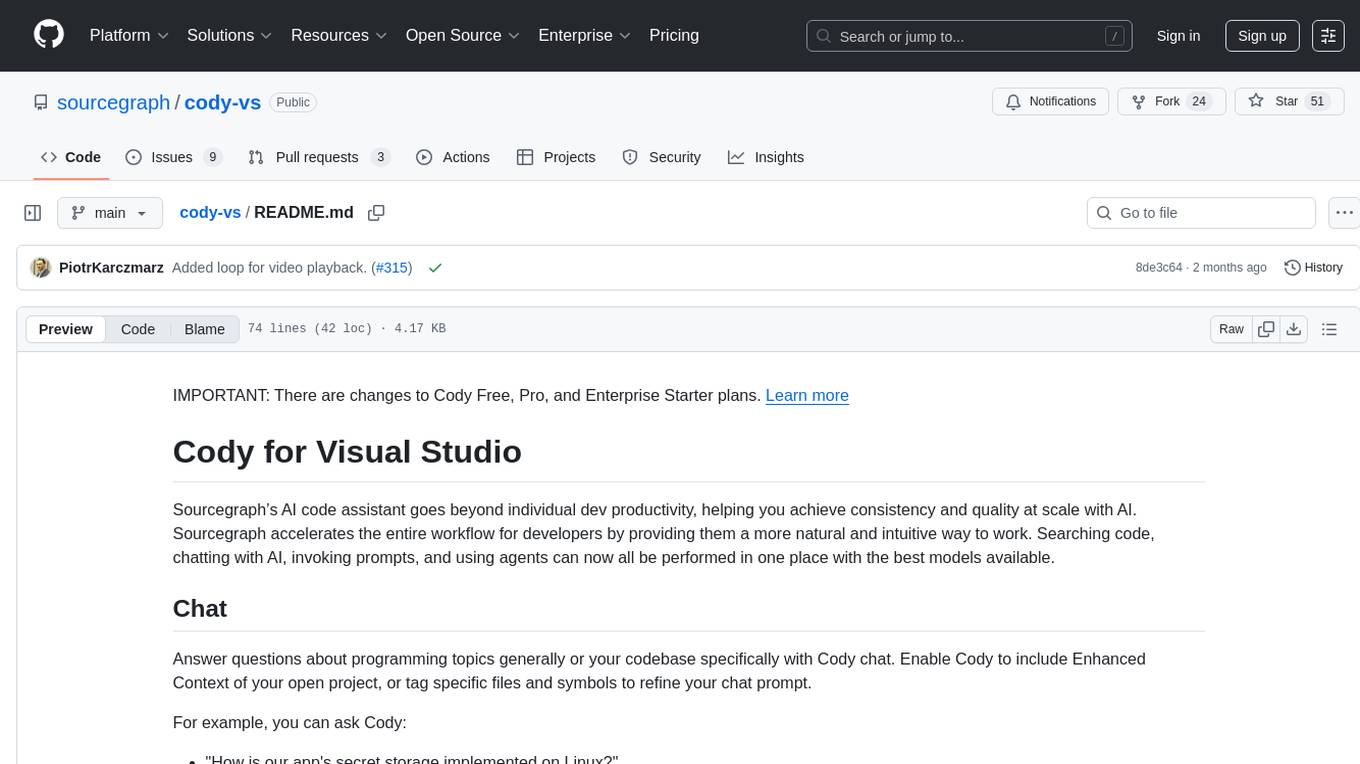
cody-vs
Sourcegraph’s AI code assistant, Cody for Visual Studio, enhances developer productivity by providing a natural and intuitive way to work. It offers features like chat, auto-edit, prompts, and works with various IDEs. Cody focuses on team productivity, offering whole codebase context and shared prompts for consistency. Users can choose from different LLM models like Claude, Gemini Pro, and OpenAI's GPT. Engineered for enterprise use, Cody supports flexible deployment and enterprise security. Suitable for any programming language, Cody excels with Python, Go, JavaScript, and TypeScript code.
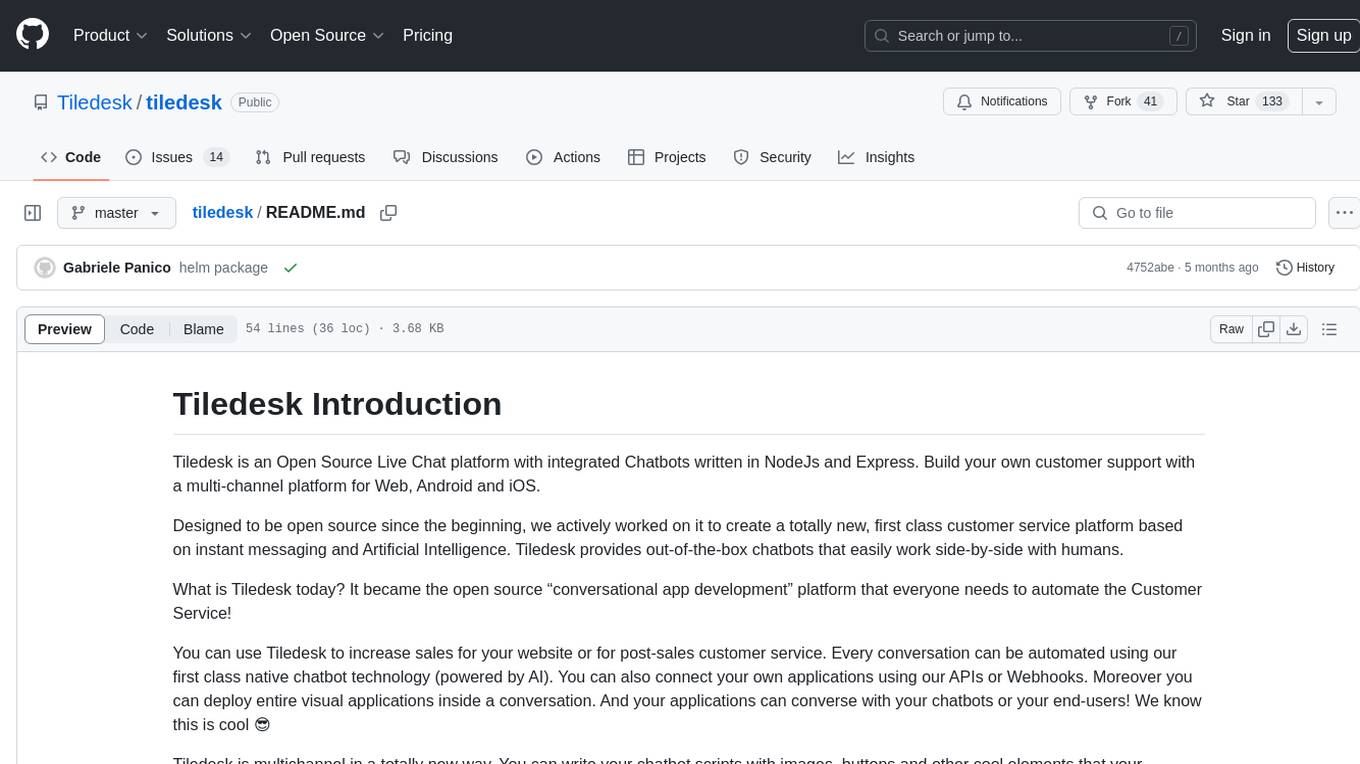
tiledesk
Tiledesk is an Open Source Live Chat platform with integrated Chatbots written in NodeJs and Express. It provides a multi-channel platform for Web, Android, and iOS, offering out-of-the-box chatbots that work alongside humans. Users can automate conversations using native chatbot technology powered by AI, connect applications via APIs or Webhooks, deploy visual applications within conversations, and enable applications to interact with chatbots or end-users. Tiledesk is multichannel, allowing chatbot scripts with images and buttons to run on various channels like Whatsapp, Facebook Messenger, and Telegram. The project includes Tiledesk Server, Dashboard, Design Studio, Chat21 ionic, Web Widget, Server, Http Server, MongoDB, and a proxy. It offers Helm charts for Kubernetes deployment, but customization is recommended for production environments, such as integrating with external MongoDB or monitoring/logging tools. Enterprise customers can request private Docker images by contacting [email protected].
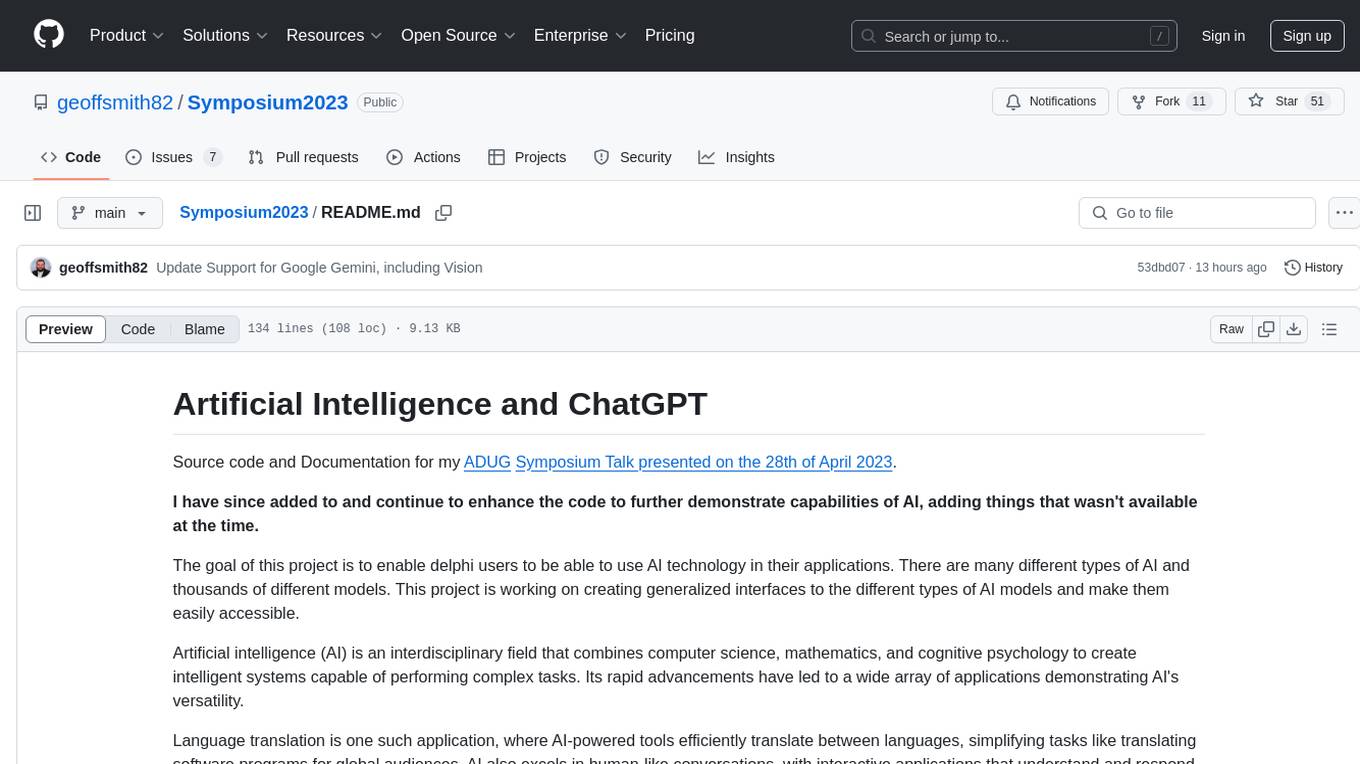
Symposium2023
Symposium2023 is a project aimed at enabling Delphi users to incorporate AI technology into their applications. It provides generalized interfaces to different AI models, making them easily accessible. The project showcases AI's versatility in tasks like language translation, human-like conversations, image generation, data analysis, and more. Users can experiment with different AI models, change providers easily, and avoid vendor lock-in. The project supports various AI features like vision support and function calling, utilizing providers like Google, Microsoft Azure, Amazon, OpenAI, and more. It includes example programs demonstrating tasks such as text-to-speech, language translation, face detection, weather querying, audio transcription, voice recognition, image generation, invoice processing, and API testing. The project also hints at potential future research areas like using embeddings for data search and integrating Python AI libraries with Delphi.
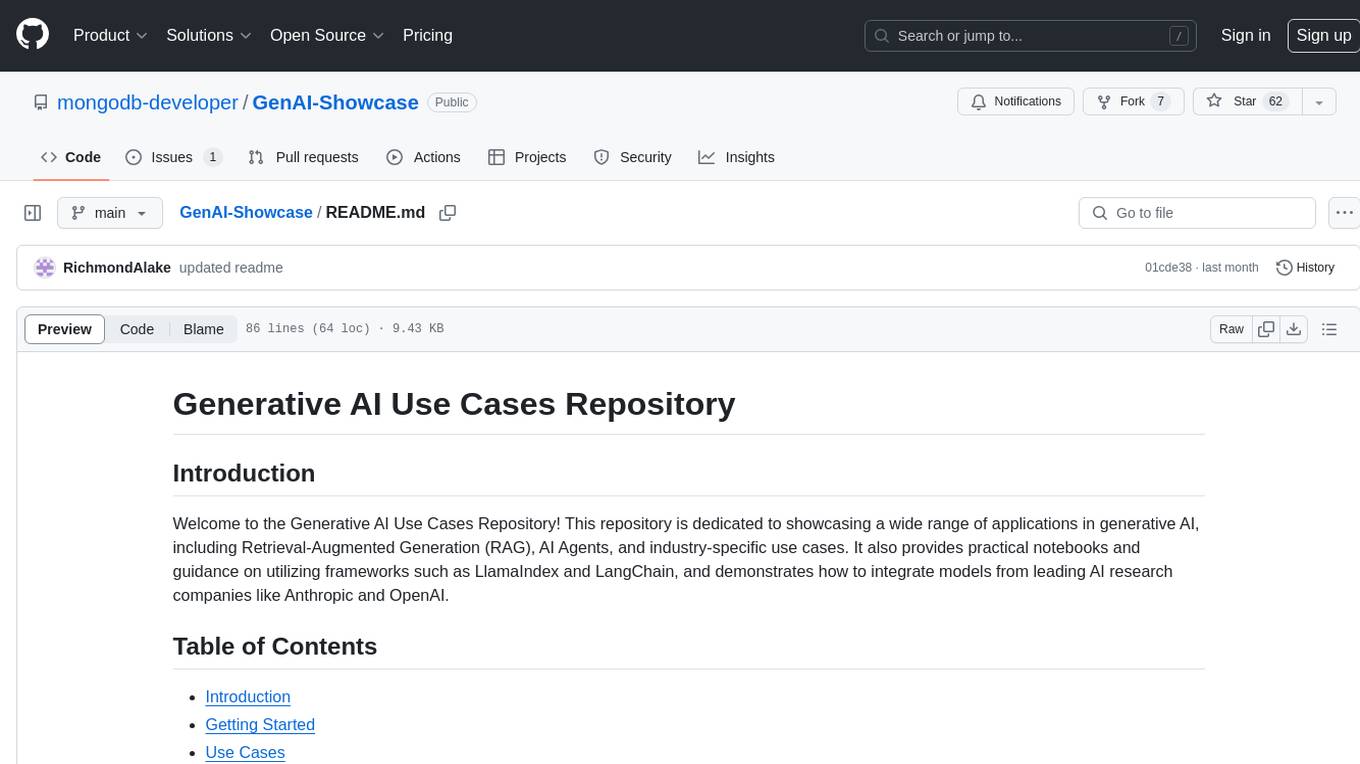
GenAI-Showcase
The Generative AI Use Cases Repository showcases a wide range of applications in generative AI, including Retrieval-Augmented Generation (RAG), AI Agents, and industry-specific use cases. It provides practical notebooks and guidance on utilizing frameworks such as LlamaIndex and LangChain, and demonstrates how to integrate models from leading AI research companies like Anthropic and OpenAI.
For similar tasks
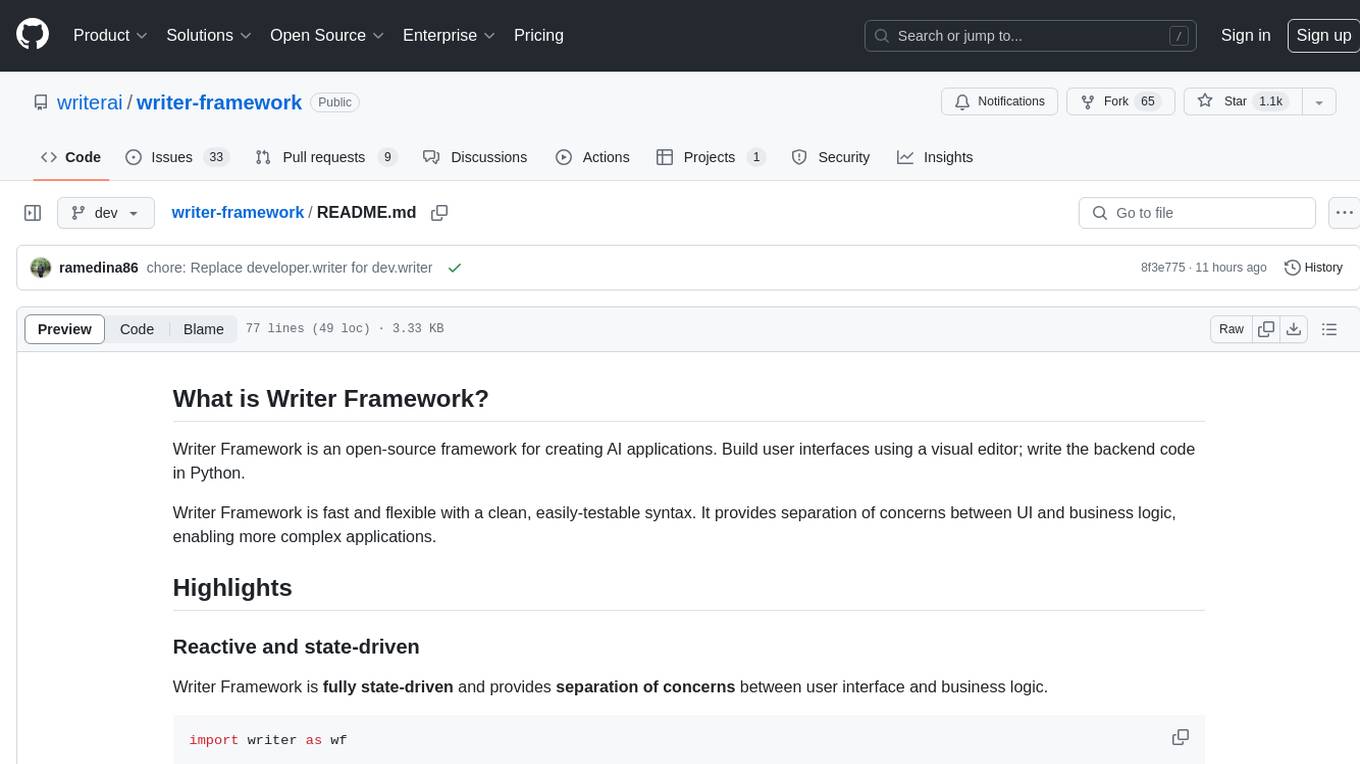
writer-framework
Writer Framework is an open-source framework for creating AI applications. It allows users to build user interfaces using a visual editor and write the backend code in Python. The framework is fast, flexible, and developer-friendly, providing separation of concerns between UI and business logic. It is reactive and state-driven, allowing for highly customizable elements without the need for CSS. Writer Framework is designed to be fast, with minimal overhead on Python code, and uses WebSockets for synchronization. It is contained in a standard Python package, supports local code editing with instant refreshes, and enables editing the UI while the app is running.
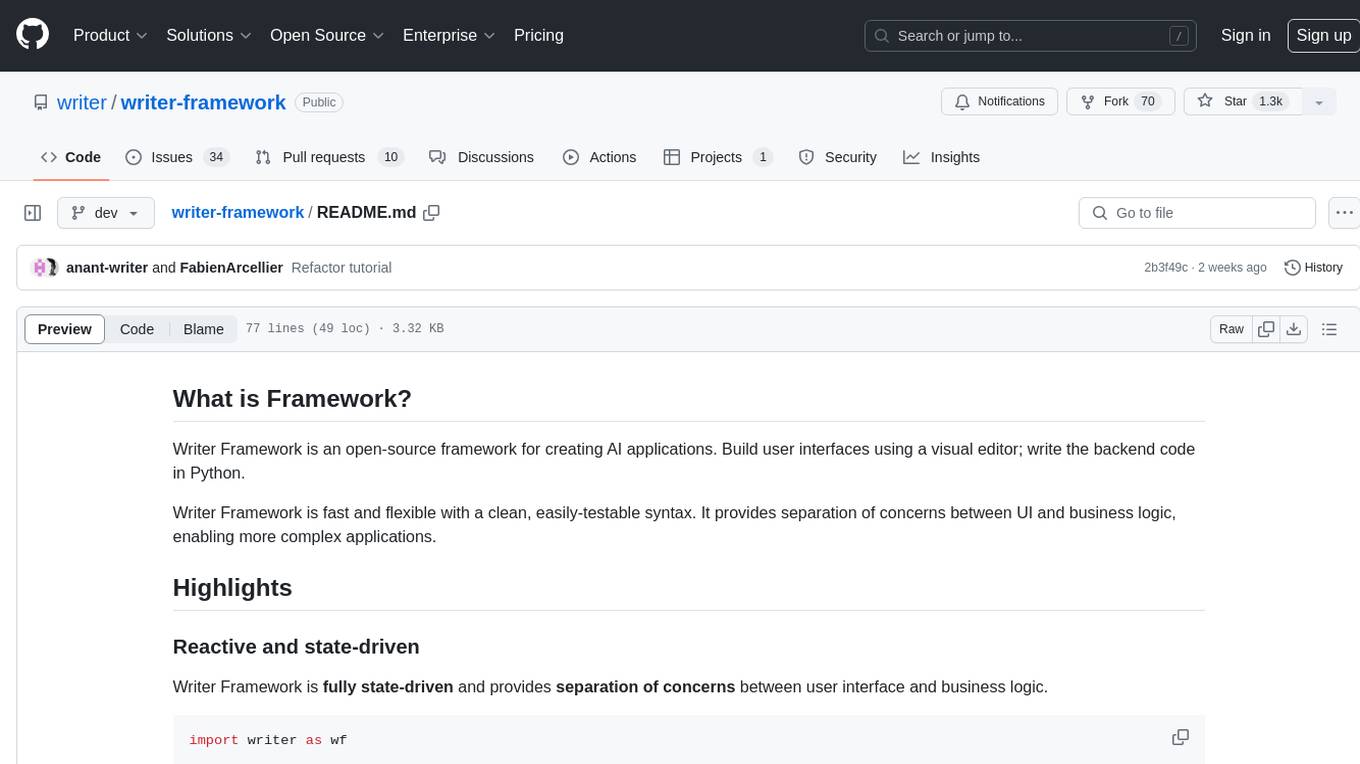
writer-framework
Writer Framework is an open-source framework for creating AI applications. It allows users to build user interfaces using a visual editor and write the backend code in Python. The framework is fast, flexible, and provides separation of concerns between UI and business logic. It is reactive and state-driven, highly customizable without requiring CSS, fast in event handling, developer-friendly with easy installation and quick start options, and contains full documentation for using its AI module and deployment options.
superinterface
Superinterface is an AI assistants library for building AI capabilities into your app or website. It allows you to use React components and hooks to create AI-first assistants-based interfaces such as chats and wizards. The project is currently in the process of writing documentation. For more information, visit https://superinterface.ai. Examples are hosted at https://examples-next.superinterface.ai.
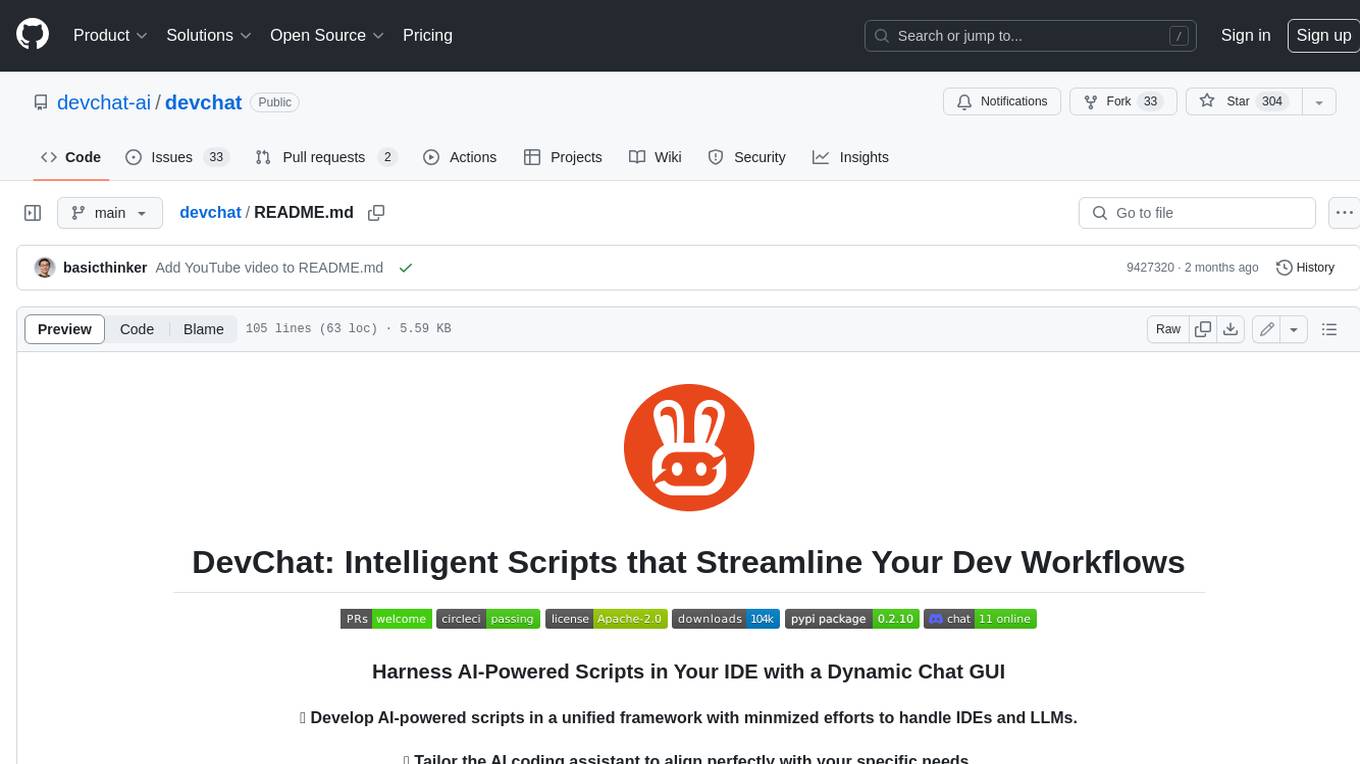
devchat
DevChat is an open-source workflow engine that enables developers to create intelligent, automated workflows for engaging with users through a chat panel within their IDEs. It combines script writing flexibility, latest AI models, and an intuitive chat GUI to enhance user experience and productivity. DevChat simplifies the integration of AI in software development, unlocking new possibilities for developers.
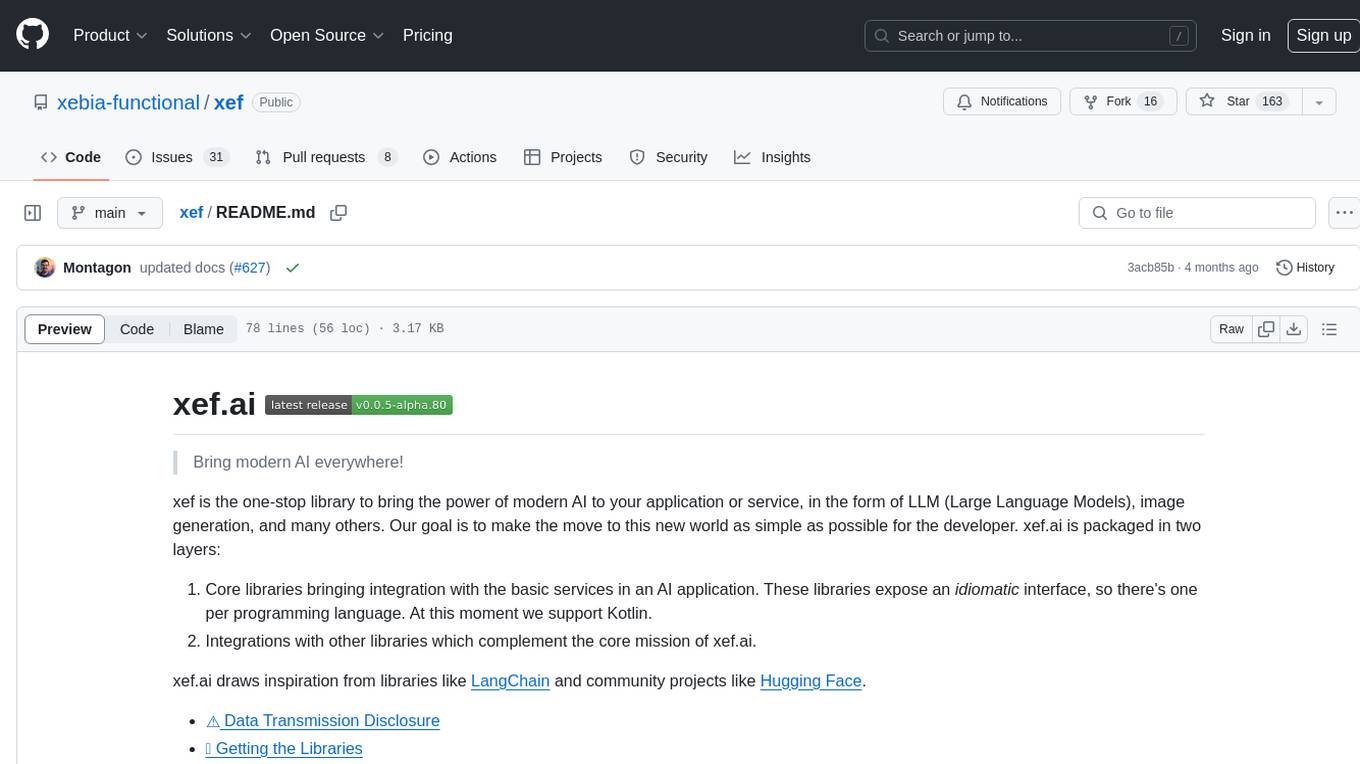
xef
xef.ai is a one-stop library designed to bring the power of modern AI to applications and services. It offers integration with Large Language Models (LLM), image generation, and other AI services. The library is packaged in two layers: core libraries for basic AI services integration and integrations with other libraries. xef.ai aims to simplify the transition to modern AI for developers by providing an idiomatic interface, currently supporting Kotlin. Inspired by LangChain and Hugging Face, xef.ai may transmit source code and user input data to third-party services, so users should review privacy policies and take precautions. Libraries are available in Maven Central under the `com.xebia` group, with `xef-core` as the core library. Developers can add these libraries to their projects and explore examples to understand usage.
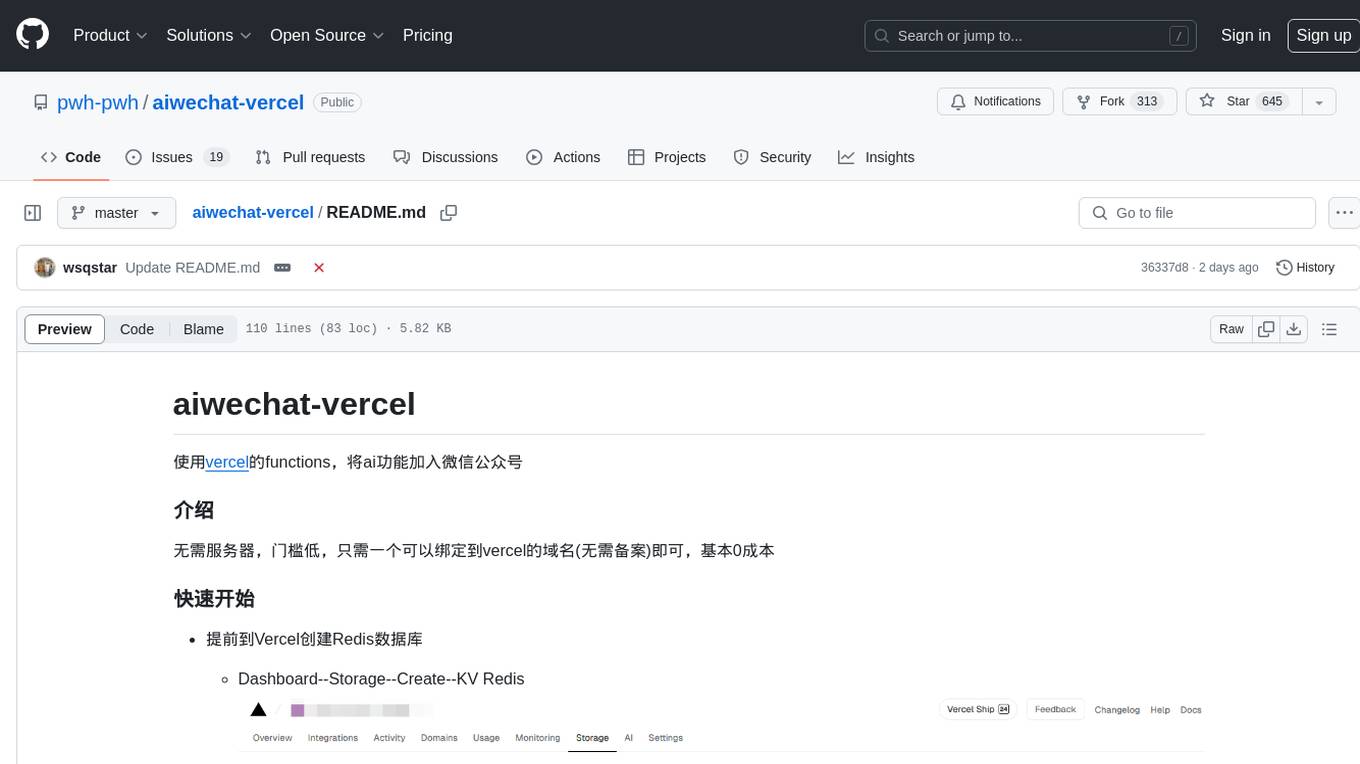
aiwechat-vercel
aiwechat-vercel is a tool that integrates AI capabilities into WeChat public accounts using Vercel functions. It requires minimal server setup, low entry barriers, and only needs a domain name that can be bound to Vercel, with almost zero cost. The tool supports various AI models, continuous Q&A sessions, chat functionality, system prompts, and custom commands. It aims to provide a platform for learning and experimentation with AI integration in WeChat public accounts.
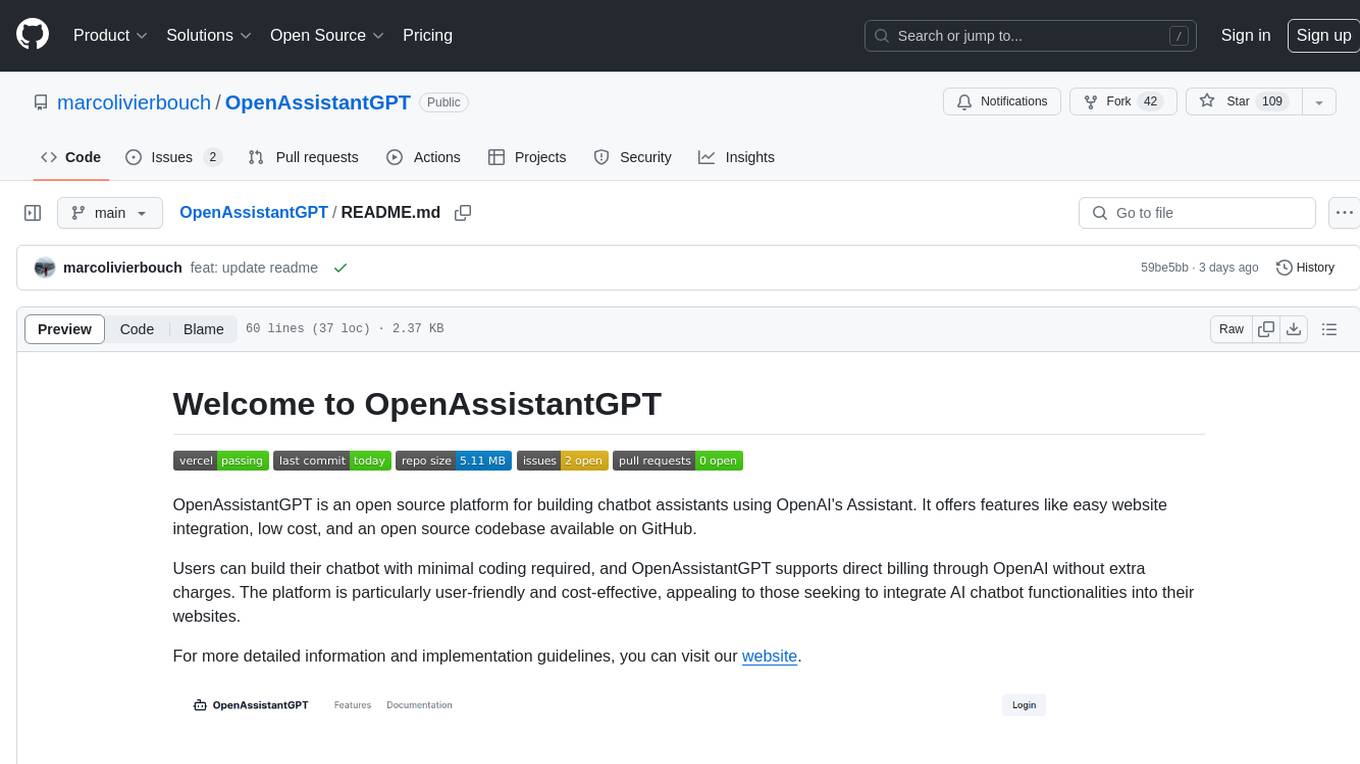
OpenAssistantGPT
OpenAssistantGPT is an open source platform for building chatbot assistants using OpenAI's Assistant. It offers features like easy website integration, low cost, and an open source codebase available on GitHub. Users can build their chatbot with minimal coding required, and OpenAssistantGPT supports direct billing through OpenAI without extra charges. The platform is user-friendly and cost-effective, appealing to those seeking to integrate AI chatbot functionalities into their websites.
ai-demos
The 'ai-demos' repository is a collection of example code from presentations focusing on building with AI and LLMs. It serves as a resource for developers looking to explore practical applications of artificial intelligence in their projects. The code snippets showcase various techniques and approaches to leverage AI technologies effectively. The repository aims to inspire and educate developers on integrating AI solutions into their applications.
For similar jobs
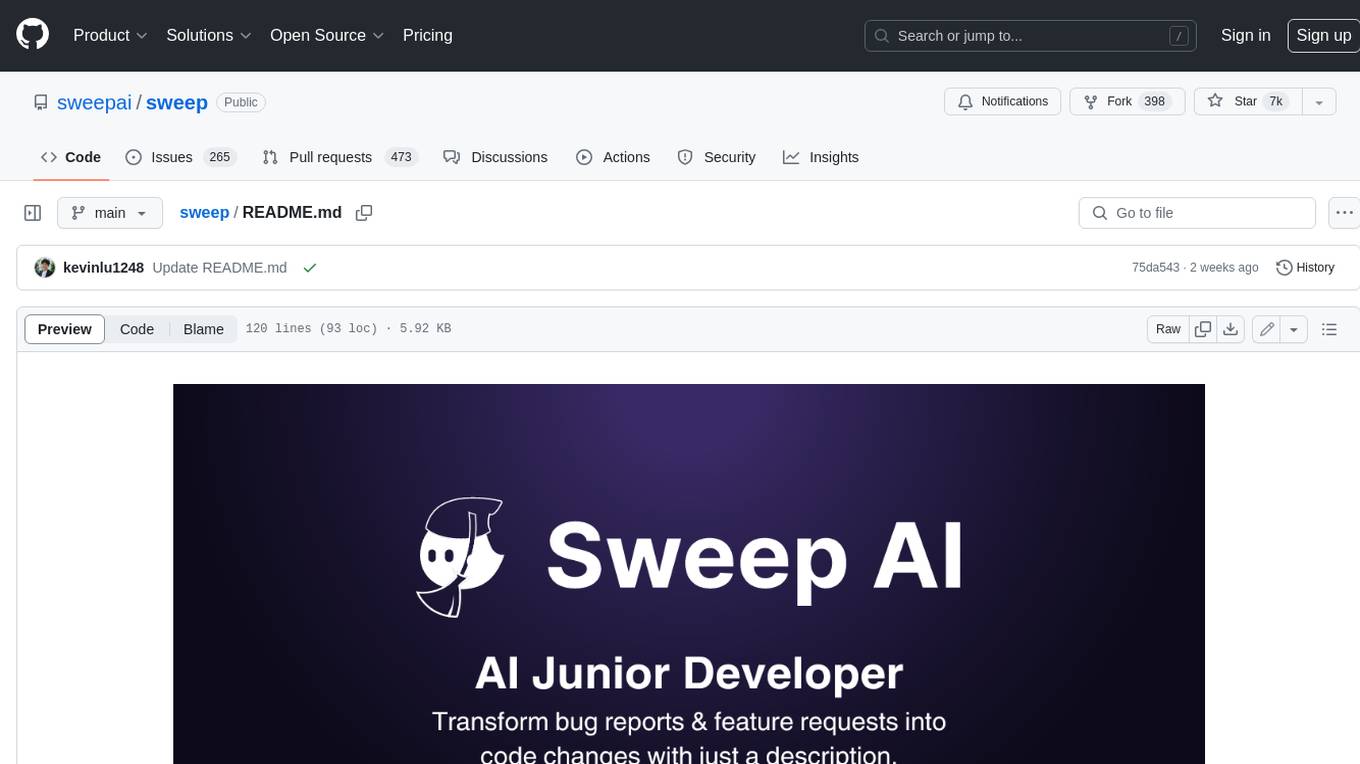
sweep
Sweep is an AI junior developer that turns bugs and feature requests into code changes. It automatically handles developer experience improvements like adding type hints and improving test coverage.
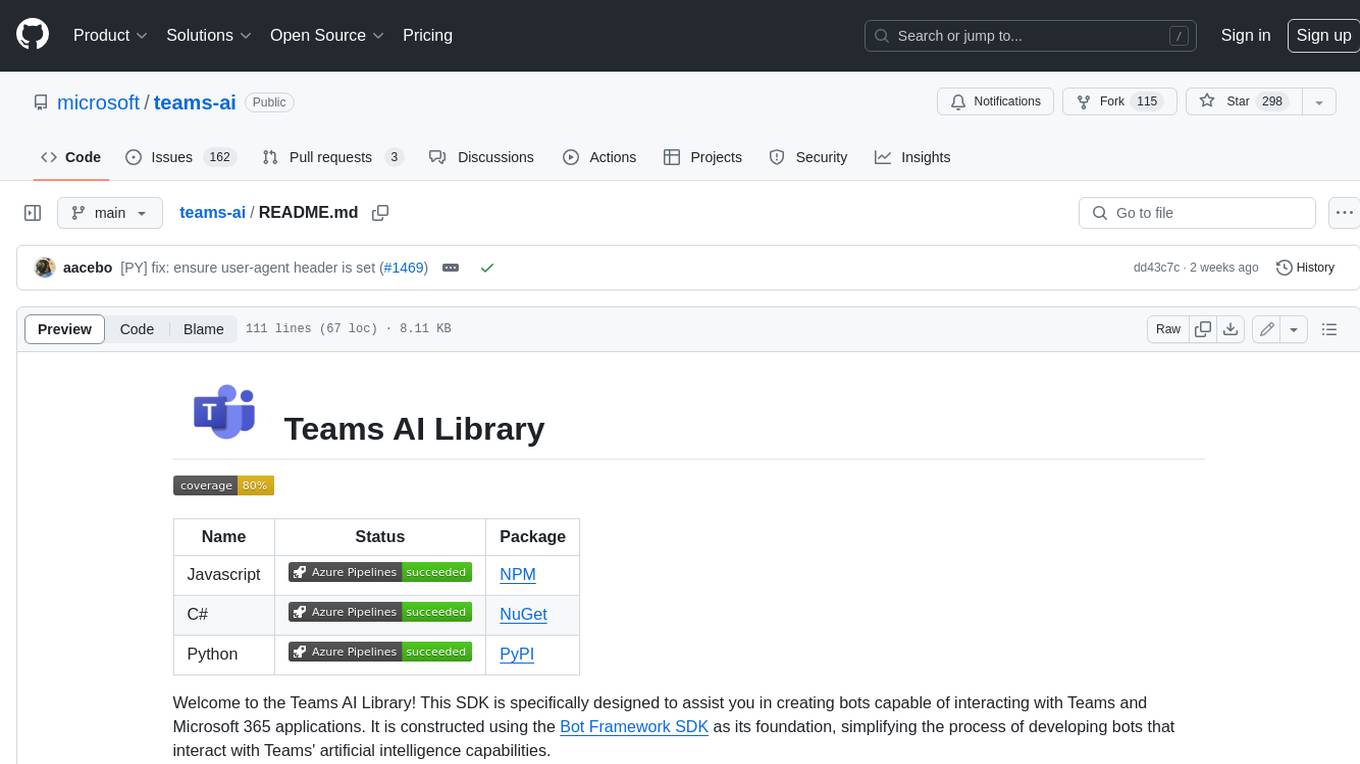
teams-ai
The Teams AI Library is a software development kit (SDK) that helps developers create bots that can interact with Teams and Microsoft 365 applications. It is built on top of the Bot Framework SDK and simplifies the process of developing bots that interact with Teams' artificial intelligence capabilities. The SDK is available for JavaScript/TypeScript, .NET, and Python.
ai-guide
This guide is dedicated to Large Language Models (LLMs) that you can run on your home computer. It assumes your PC is a lower-end, non-gaming setup.
classifai
Supercharge WordPress Content Workflows and Engagement with Artificial Intelligence. Tap into leading cloud-based services like OpenAI, Microsoft Azure AI, Google Gemini and IBM Watson to augment your WordPress-powered websites. Publish content faster while improving SEO performance and increasing audience engagement. ClassifAI integrates Artificial Intelligence and Machine Learning technologies to lighten your workload and eliminate tedious tasks, giving you more time to create original content that matters.
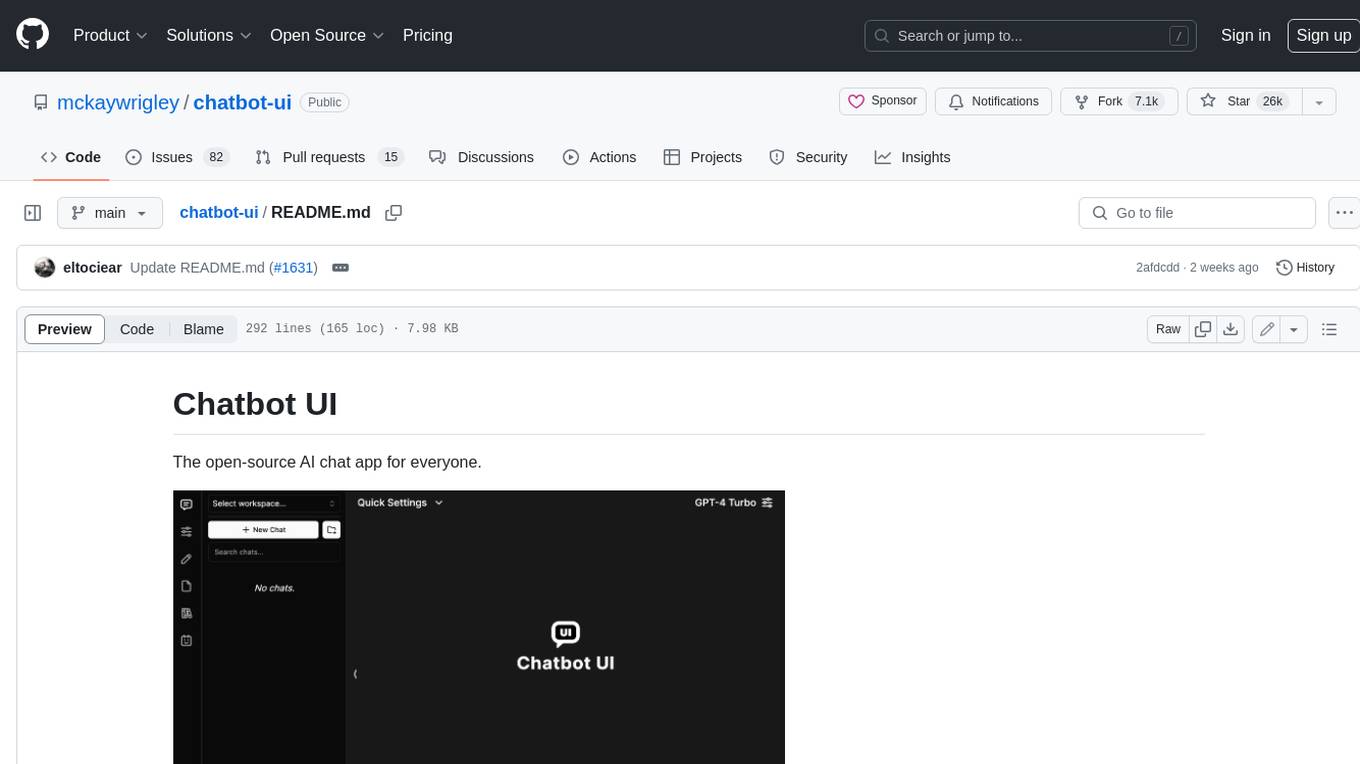
chatbot-ui
Chatbot UI is an open-source AI chat app that allows users to create and deploy their own AI chatbots. It is easy to use and can be customized to fit any need. Chatbot UI is perfect for businesses, developers, and anyone who wants to create a chatbot.
BricksLLM
BricksLLM is a cloud native AI gateway written in Go. Currently, it provides native support for OpenAI, Anthropic, Azure OpenAI and vLLM. BricksLLM aims to provide enterprise level infrastructure that can power any LLM production use cases. Here are some use cases for BricksLLM: * Set LLM usage limits for users on different pricing tiers * Track LLM usage on a per user and per organization basis * Block or redact requests containing PIIs * Improve LLM reliability with failovers, retries and caching * Distribute API keys with rate limits and cost limits for internal development/production use cases * Distribute API keys with rate limits and cost limits for students
uAgents
uAgents is a Python library developed by Fetch.ai that allows for the creation of autonomous AI agents. These agents can perform various tasks on a schedule or take action on various events. uAgents are easy to create and manage, and they are connected to a fast-growing network of other uAgents. They are also secure, with cryptographically secured messages and wallets.
griptape
Griptape is a modular Python framework for building AI-powered applications that securely connect to your enterprise data and APIs. It offers developers the ability to maintain control and flexibility at every step. Griptape's core components include Structures (Agents, Pipelines, and Workflows), Tasks, Tools, Memory (Conversation Memory, Task Memory, and Meta Memory), Drivers (Prompt and Embedding Drivers, Vector Store Drivers, Image Generation Drivers, Image Query Drivers, SQL Drivers, Web Scraper Drivers, and Conversation Memory Drivers), Engines (Query Engines, Extraction Engines, Summary Engines, Image Generation Engines, and Image Query Engines), and additional components (Rulesets, Loaders, Artifacts, Chunkers, and Tokenizers). Griptape enables developers to create AI-powered applications with ease and efficiency.