


learn-modern-ai-python
Learn Modern AI Assisted Python with Type Hints
Stars: 523

This repository is part of the Certified Agentic & Robotic AI Engineer program, covering the first quarter of the course work. It focuses on Modern AI Python Programming, emphasizing static typing for robust and scalable AI development. The course includes modules on Python fundamentals, object-oriented programming, advanced Python concepts, AI-assisted Python programming, web application basics with Python, and the future of Python in AI. Upon completion, students will be able to write proficient Modern Python code, apply OOP principles, implement asynchronous programming, utilize AI-powered tools, develop basic web applications, and understand the future directions of Python in AI.
README:
This repo is part of the Certified Agentic & Robotic AI Engineer program. It covers the first quarter of the course work:
AI-101 is your comprehensive gateway to Python programming for Artificial Intelligence. This course is laser-focused on equipping you with Modern Python skills, emphasizing static typing, the cornerstone of robust and scalable AI development. Uniquely, you will also learn to harness the power of AI to write Python code, accelerating your learning and development process. From foundational concepts to advanced techniques and practical web application development, AI-101 provides everything you need to excel in AI-driven projects and beyond.
Key Learning Modules:
-
Module 1: Python Fundamentals & Modern Typing: Establish a strong foundation in Python syntax, data structures (lists, dictionaries, sets, tuples), control flow, and functions. Critically, we introduce Python's type hinting system, emphasizing its importance for code clarity, error prevention, and maintainability, especially in complex AI projects.
-
Module 2: Object-Oriented Programming (OOP) in Python for AI: Master the principles of OOP (classes, objects, inheritance, polymorphism, encapsulation) and understand how to apply them effectively in AI development. Learn to structure complex AI systems using object-oriented design for modularity and reusability.
-
Module 3: Advanced Python Concepts: Asynchronous Programming & Performance: Dive into advanced Python features like asynchronous programming (
asyncio) for building efficient and concurrent applications, crucial for handling large datasets and complex AI workloads. Explore performance optimization techniques and understand the role of Python's Global Interpreter Lock (GIL) and upcoming solutions like "No GIL" for enhanced concurrency. -
Module 4: AI-Assisted Python Programming: Leverage the power of AI tools to enhance your Python coding skills. This module will introduce you to techniques and tools that utilize AI to generate code snippets, debug programs, refactor code, and improve your overall Python development workflow. Learn to work with AI to become a more efficient Python programmer.
-
Module 5: Web Application Basics with Python (UV, Streamlit, GitHub): Gain practical experience in building basic web applications using Python. We will explore lightweight web frameworks and tools including UV for environment management, and Streamlit for rapid UI creation. You'll also learn essential version control using GitHub for collaborative development and project management.
-
Module 6: Future of Python & Python in AI: Explore the evolving landscape of Python, including upcoming features and performance improvements. Discuss the continued dominance of Python in the AI field and its application in cutting-edge AI domains like Machine Learning, Deep Learning, and Agentic AI.
Course Outcomes:
Upon successful completion of this course, students will be able to:
- Write proficient Modern Python code utilizing static typing for robust and maintainable AI applications.
- Apply Object-Oriented Programming principles effectively in Python for structuring complex AI systems.
- Implement asynchronous programming in Python for building high-performance AI applications.
- Utilize AI-powered tools and techniques to enhance their Python coding efficiency and quality.
- Develop basic Python web applications using modern tools and understand fundamental web development concepts.
- Articulate the future directions of Python and its continued crucial role in the field of Artificial Intelligence.

Watch Class Video Playlist by Hamza and Najam
Watch Class Video Playlist by Qasim
Google Colab is a free, cloud-based Jupyter Notebook service developed by Google. It enables users to write and execute Python code through a web browser, offering seamless integration with Google Drive for easy storage and sharing of notebooks. Colab is particularly beneficial for tasks in machine learning, data analysis, and education, as it provides access to powerful computing resources, including GPUs and TPUs, without requiring any local setup.
Key Features of Google Colab:
-
No Setup Required: Users can start coding immediately without the need to install any software or manage local environments.
-
Free Access to Computing Resources: Colab offers free access to computing resources, including GPUs and TPUs, facilitating the execution of complex computations and machine learning models.
-
Collaboration: Notebooks can be easily shared and collaboratively edited, similar to Google Docs, enhancing teamwork and knowledge sharing.
-
Integration with Google Drive: Notebooks are stored in Google Drive, allowing for straightforward organization and access across devices.
-
Support for Various Libraries: Colab supports popular Python libraries such as TensorFlow, Keras, and NumPy, making it versatile for various data science and machine learning projects.
Recent Developments:
Recently, Google expanded Colab's AI-powered code assistance features to all users in eligible locales, including those on free plans. These features assist in generating code from natural language prompts and provide a code-assisting chatbot to enhance programming efficiency and comprehension.
Getting Started with Google Colab:
To begin using Google Colab:
-
Access Colab: Navigate to the Google Colab website.
-
Create a New Notebook: Click on "File" > "New Notebook" to create a new Jupyter Notebook.
-
Write and Execute Code: Enter your Python code in the code cells and execute them to see the results.
-
Save and Share: Your notebooks are automatically saved in your Google Drive, and you can share them with others by clicking the "Share" button.
For more detailed information and tutorials, refer to the Colaboratory Frequently Asked Questions and the Colab Help Center.
Google Colab is a valuable tool for both beginners and professionals in data science and machine learning, offering an accessible platform to develop and share projects efficiently.
For Tasks:
Click tags to check more tools for each tasksFor Jobs:
Alternative AI tools for learn-modern-ai-python
Similar Open Source Tools
learn-modern-ai-python
This repository is part of the Certified Agentic & Robotic AI Engineer program, covering the first quarter of the course work. It focuses on Modern AI Python Programming, emphasizing static typing for robust and scalable AI development. The course includes modules on Python fundamentals, object-oriented programming, advanced Python concepts, AI-assisted Python programming, web application basics with Python, and the future of Python in AI. Upon completion, students will be able to write proficient Modern Python code, apply OOP principles, implement asynchronous programming, utilize AI-powered tools, develop basic web applications, and understand the future directions of Python in AI.
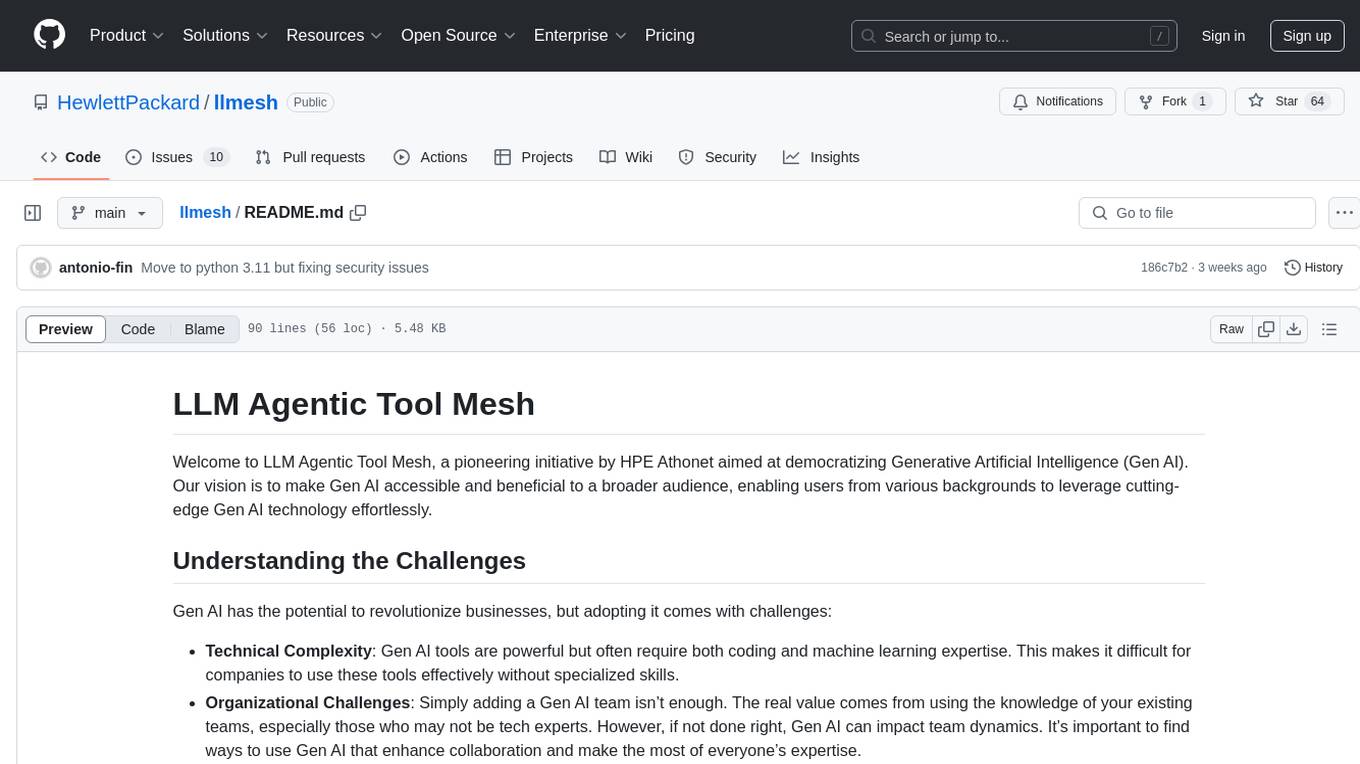
llmesh
LLM Agentic Tool Mesh is a platform by HPE Athonet that democratizes Generative Artificial Intelligence (Gen AI) by enabling users to create tools and web applications using Gen AI with Low or No Coding. The platform simplifies the integration process, focuses on key user needs, and abstracts complex libraries into easy-to-understand services. It empowers both technical and non-technical teams to develop tools related to their expertise and provides orchestration capabilities through an agentic Reasoning Engine based on Large Language Models (LLMs) to ensure seamless tool integration and enhance organizational functionality and efficiency.
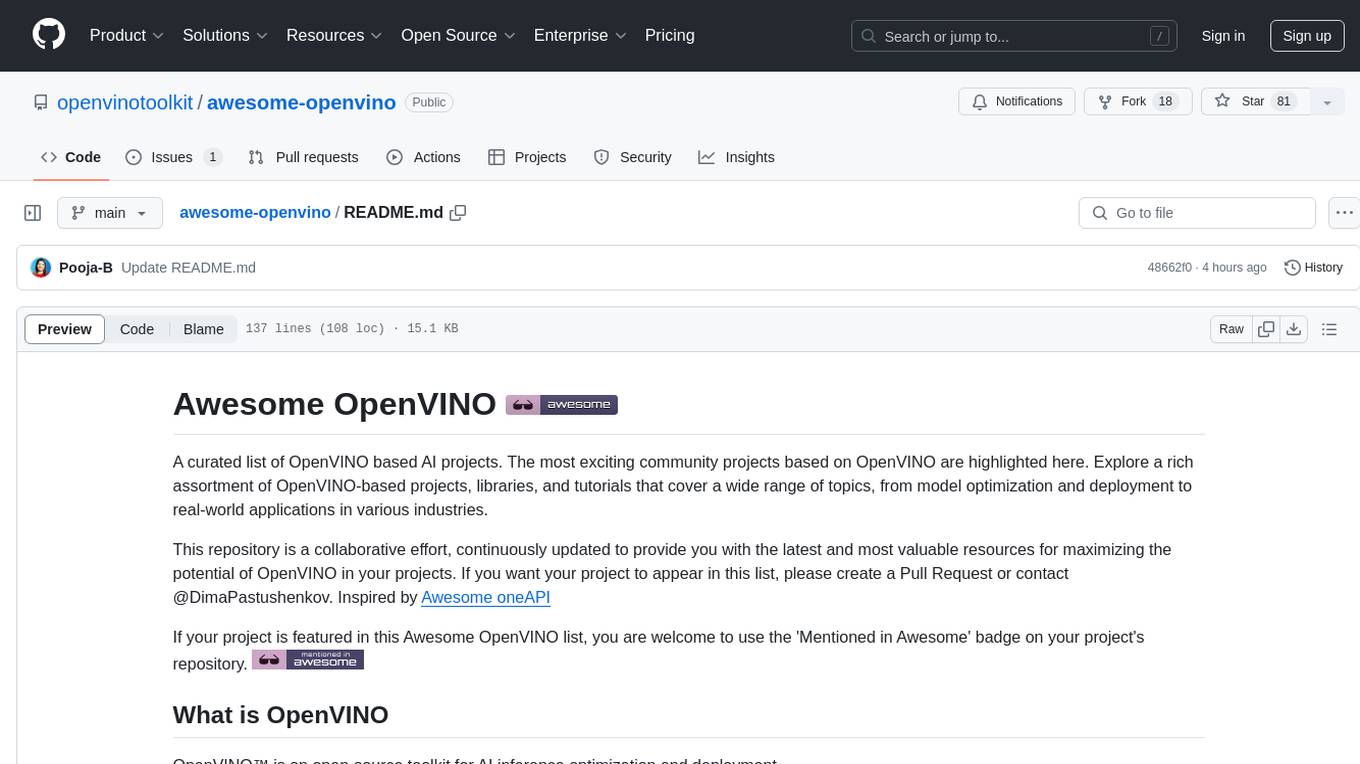
awesome-openvino
Awesome OpenVINO is a curated list of AI projects based on the OpenVINO toolkit, offering a rich assortment of projects, libraries, and tutorials covering various topics like model optimization, deployment, and real-world applications across industries. It serves as a valuable resource continuously updated to maximize the potential of OpenVINO in projects, featuring projects like Stable Diffusion web UI, Visioncom, FastSD CPU, OpenVINO AI Plugins for GIMP, and more.
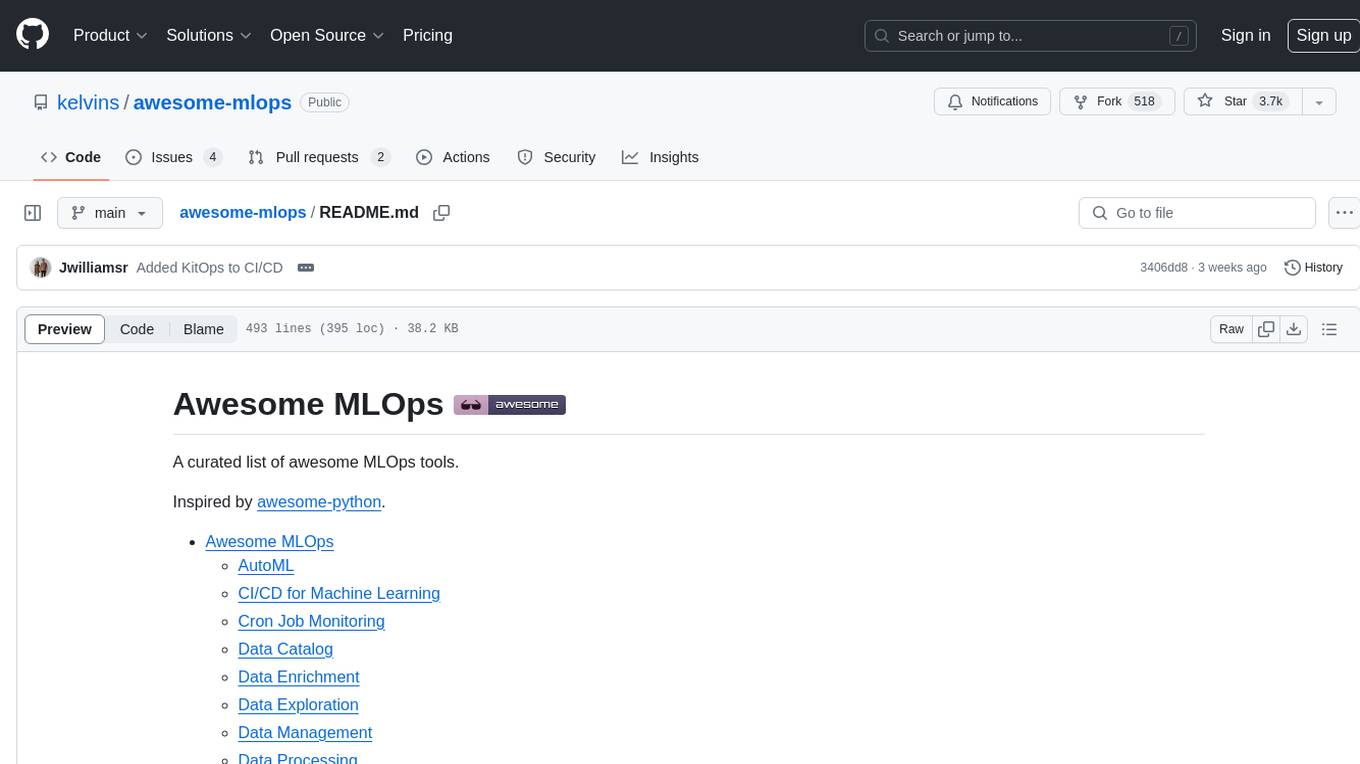
awesome-mlops
Awesome MLOps is a curated list of tools related to Machine Learning Operations, covering areas such as AutoML, CI/CD for Machine Learning, Data Cataloging, Data Enrichment, Data Exploration, Data Management, Data Processing, Data Validation, Data Visualization, Drift Detection, Feature Engineering, Feature Store, Hyperparameter Tuning, Knowledge Sharing, Machine Learning Platforms, Model Fairness and Privacy, Model Interpretability, Model Lifecycle, Model Serving, Model Testing & Validation, Optimization Tools, Simplification Tools, Visual Analysis and Debugging, and Workflow Tools. The repository provides a comprehensive collection of tools and resources for individuals and teams working in the field of MLOps.
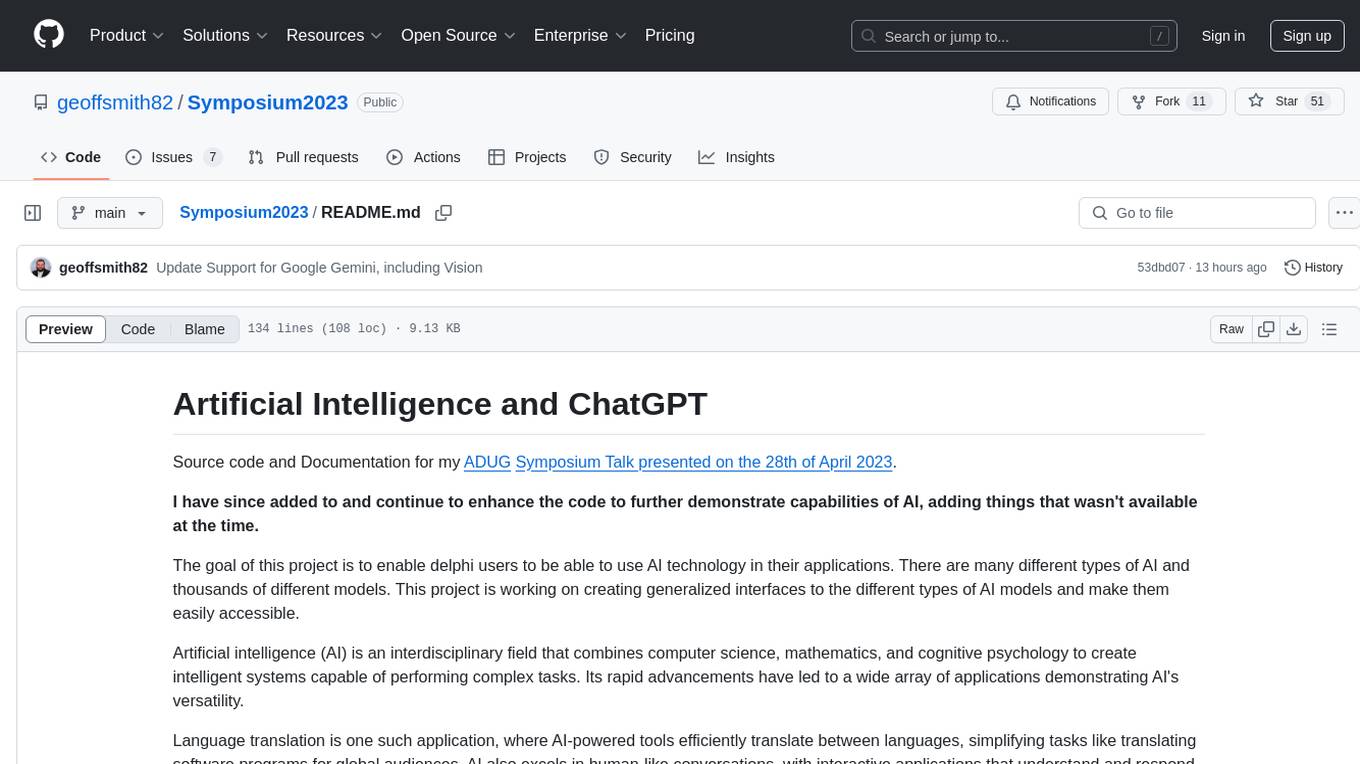
Symposium2023
Symposium2023 is a project aimed at enabling Delphi users to incorporate AI technology into their applications. It provides generalized interfaces to different AI models, making them easily accessible. The project showcases AI's versatility in tasks like language translation, human-like conversations, image generation, data analysis, and more. Users can experiment with different AI models, change providers easily, and avoid vendor lock-in. The project supports various AI features like vision support and function calling, utilizing providers like Google, Microsoft Azure, Amazon, OpenAI, and more. It includes example programs demonstrating tasks such as text-to-speech, language translation, face detection, weather querying, audio transcription, voice recognition, image generation, invoice processing, and API testing. The project also hints at potential future research areas like using embeddings for data search and integrating Python AI libraries with Delphi.
akeru
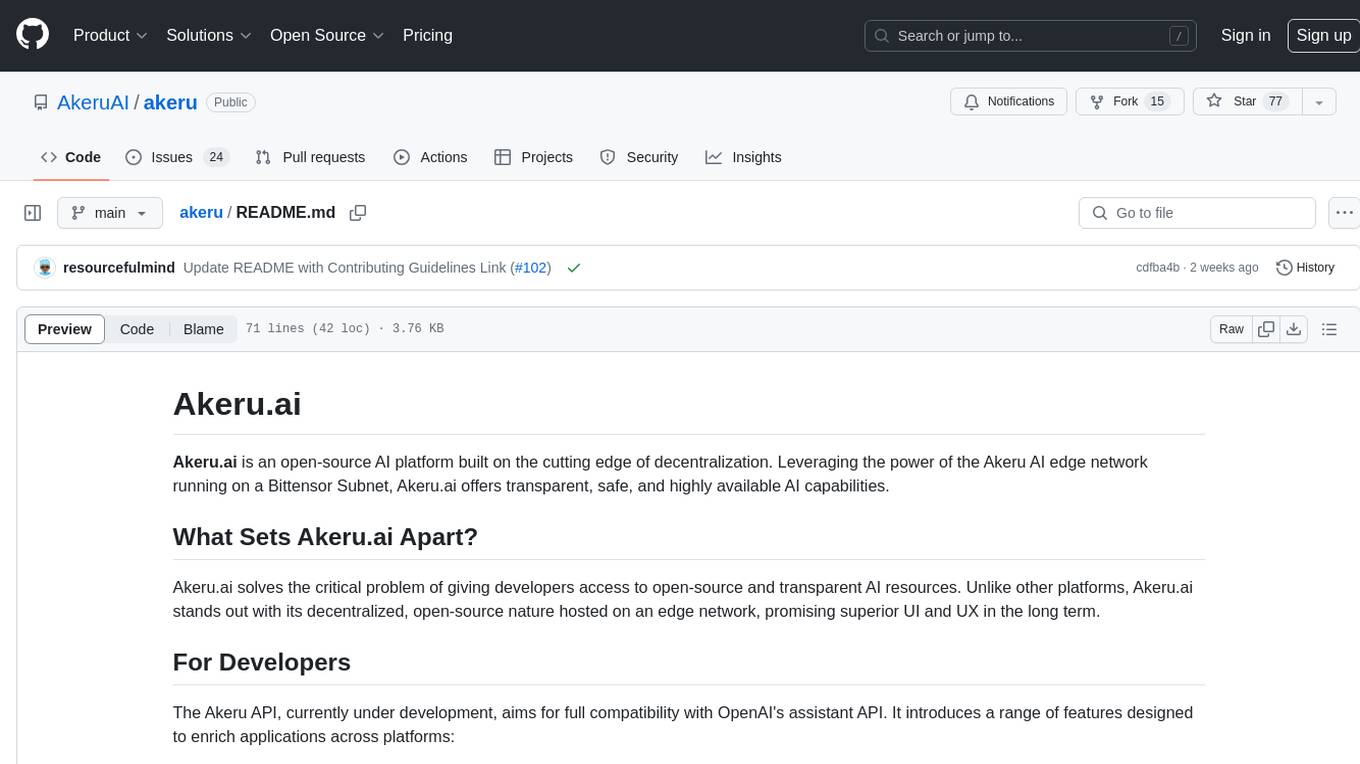
Akeru.ai is an open-source AI platform leveraging the power of decentralization. It offers transparent, safe, and highly available AI capabilities. The platform aims to give developers access to open-source and transparent AI resources through its decentralized nature hosted on an edge network. Akeru API introduces features like retrieval, function calling, conversation management, custom instructions, data input optimization, user privacy, testing and iteration, and comprehensive documentation. It is ideal for creating AI agents and enhancing web and mobile applications with advanced AI capabilities. The platform runs on a Bittensor Subnet design that aims to democratize AI technology and promote an equitable AI future. Akeru.ai embraces decentralization challenges to ensure a decentralized and equitable AI ecosystem with security features like watermarking and network pings. The API architecture integrates with technologies like Bun, Redis, and Elysia for a robust, scalable solution.
llmariner
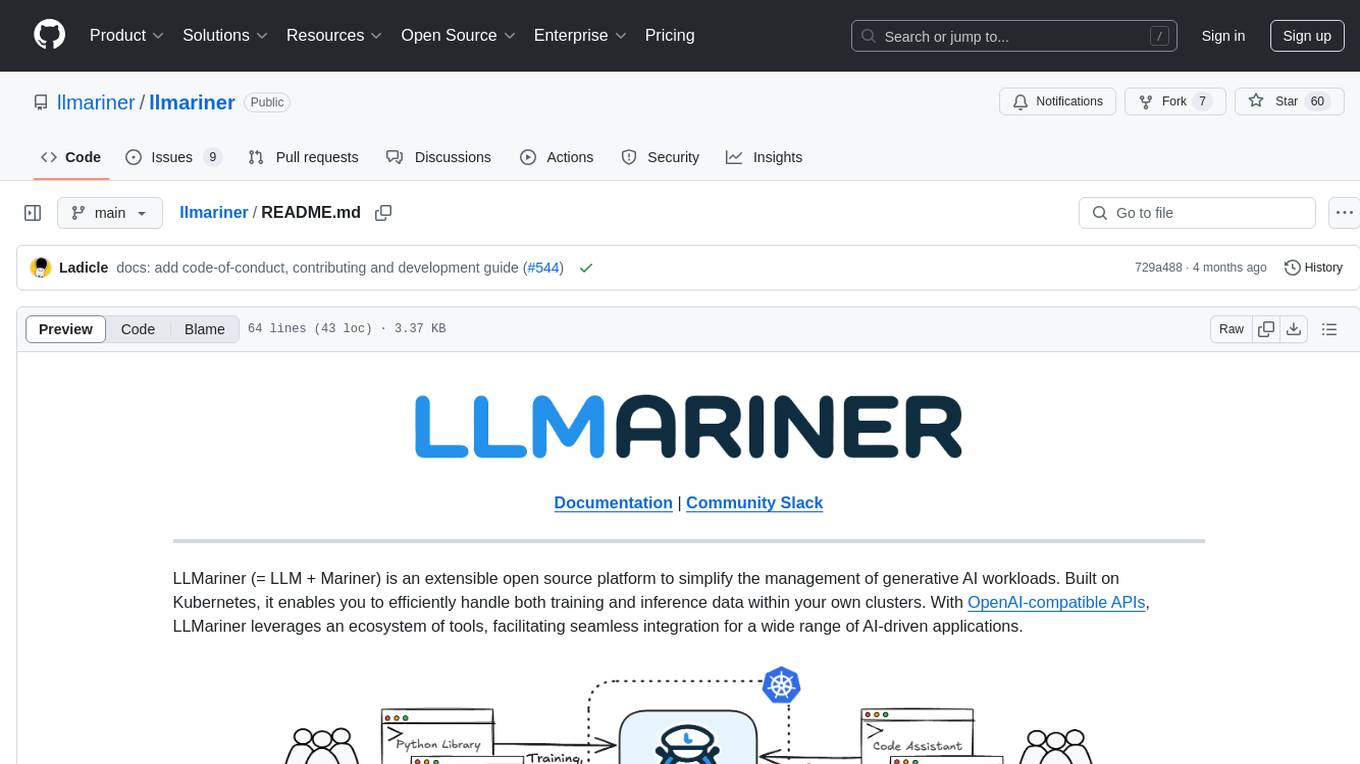
LLMariner is an extensible open source platform built on Kubernetes to simplify the management of generative AI workloads. It enables efficient handling of training and inference data within clusters, with OpenAI-compatible APIs for seamless integration with a wide range of AI-driven applications.

oreilly-hands-on-gpt-llm
This repository contains code for the O'Reilly Live Online Training for Deploying GPT & LLMs. Learn how to use GPT-4, ChatGPT, OpenAI embeddings, and other large language models to build applications for experimenting and production. Gain practical experience in building applications like text generation, summarization, question answering, and more. Explore alternative generative models such as Cohere and GPT-J. Understand prompt engineering, context stuffing, and few-shot learning to maximize the potential of GPT-like models. Focus on deploying models in production with best practices and debugging techniques. By the end of the training, you will have the skills to start building applications with GPT and other large language models.
llm-universe
This project is a tutorial on developing large model applications for novice developers. It aims to provide a comprehensive introduction to large model development, focusing on Alibaba Cloud servers and integrating personal knowledge assistant projects. The tutorial covers the following topics: 1. **Introduction to Large Models**: A simplified introduction for novice developers on what large models are, their characteristics, what LangChain is, and how to develop an LLM application. 2. **How to Call Large Model APIs**: This section introduces various methods for calling APIs of well-known domestic and foreign large model products, including calling native APIs, encapsulating them as LangChain LLMs, and encapsulating them as Fastapi calls. It also provides a unified encapsulation for various large model APIs, such as Baidu Wenxin, Xunfei Xinghuo, and Zh譜AI. 3. **Knowledge Base Construction**: Loading, processing, and vector database construction of different types of knowledge base documents. 4. **Building RAG Applications**: Integrating LLM into LangChain to build a retrieval question and answer chain, and deploying applications using Streamlit. 5. **Verification and Iteration**: How to implement verification and iteration in large model development, and common evaluation methods. The project consists of three main parts: 1. **Introduction to LLM Development**: A simplified version of V1 aims to help beginners get started with LLM development quickly and conveniently, understand the general process of LLM development, and build a simple demo. 2. **LLM Development Techniques**: More advanced LLM development techniques, including but not limited to: Prompt Engineering, processing of multiple types of source data, optimizing retrieval, recall ranking, Agent framework, etc. 3. **LLM Application Examples**: Introduce some successful open source cases, analyze the ideas, core concepts, and implementation frameworks of these application examples from the perspective of this course, and help beginners understand what kind of applications they can develop through LLM. Currently, the first part has been completed, and everyone is welcome to read and learn; the second and third parts are under creation. **Directory Structure Description**: requirements.txt: Installation dependencies in the official environment notebook: Notebook source code file docs: Markdown documentation file figures: Pictures data_base: Knowledge base source file used
llama-github
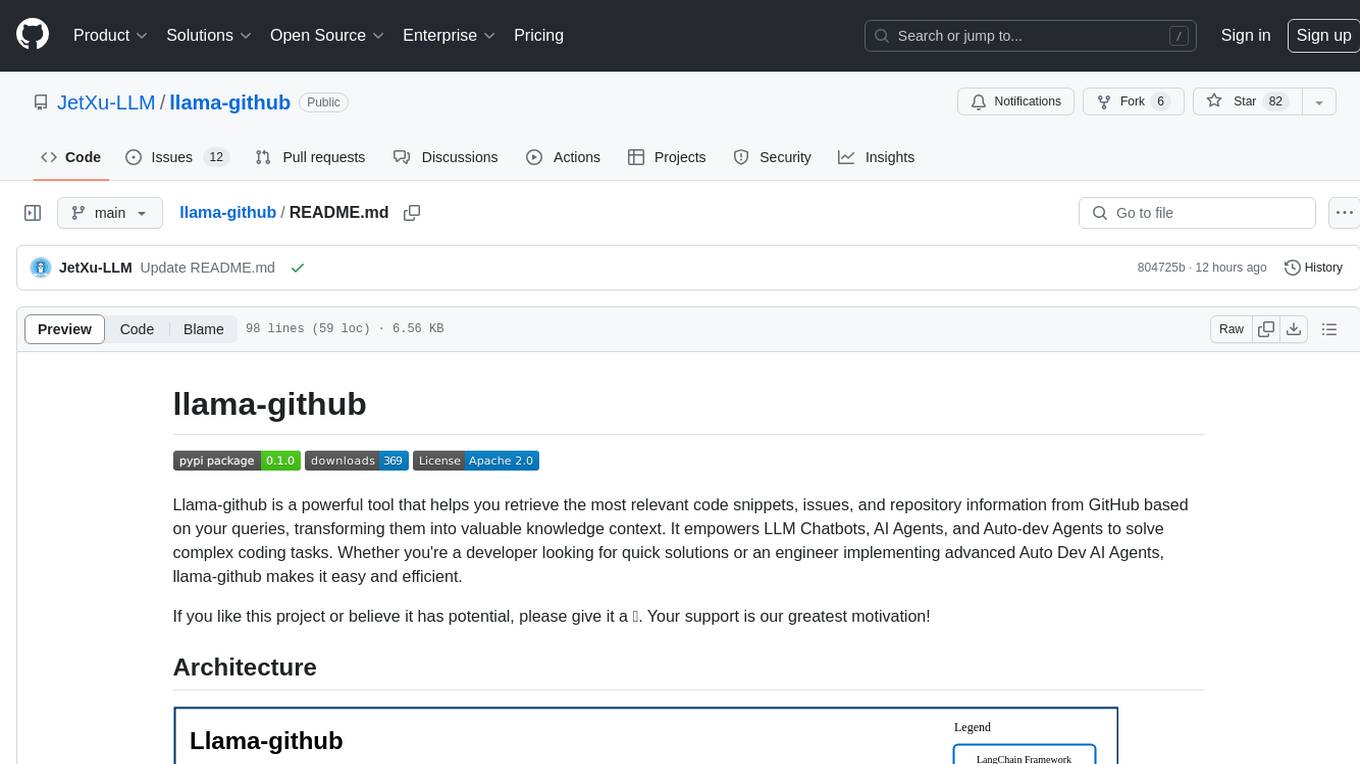
Llama-github is a powerful tool that helps retrieve relevant code snippets, issues, and repository information from GitHub based on queries. It empowers AI agents and developers to solve coding tasks efficiently. With features like intelligent GitHub retrieval, repository pool caching, LLM-powered question analysis, and comprehensive context generation, llama-github excels at providing valuable knowledge context for development needs. It supports asynchronous processing, flexible LLM integration, robust authentication options, and logging/error handling for smooth operations and troubleshooting. The vision is to seamlessly integrate with GitHub for AI-driven development solutions, while the roadmap focuses on empowering LLMs to automatically resolve complex coding tasks.
aitour26-WRK541-real-world-code-migration-with-github-copilot-agent-mode
Microsoft AI Tour 2026 WRK541 is a workshop focused on real-world code migration using GitHub Copilot Agent Mode. The session is designed for technologists interested in applying AI pair-programming techniques to challenging tasks like migrating or translating code between different programming languages. Participants will learn advanced GitHub Copilot techniques, differences between Python and C#, JSON serialization and deserialization in C#, developing and validating endpoints, integrating Swagger/OpenAPI documentation, and writing unit tests with MSTest. The workshop aims to help users gain hands-on experience in using GitHub Copilot for real-world code migration scenarios.
awesome-ai
Awesome AI is a curated list of artificial intelligence resources including courses, tools, apps, and open-source projects. It covers a wide range of topics such as machine learning, deep learning, natural language processing, robotics, conversational interfaces, data science, and more. The repository serves as a comprehensive guide for individuals interested in exploring the field of artificial intelligence and its applications across various domains.
coze-studio
Coze Studio is an all-in-one AI agent development tool that offers the most convenient AI agent development environment, from development to deployment. It provides core technologies for AI agent development, complete app templates, and build frameworks. Coze Studio aims to simplify creating, debugging, and deploying AI agents through visual design and build tools, enabling powerful AI app development and customized business logic. The tool is developed using Golang for the backend, React + TypeScript for the frontend, and follows microservices architecture based on domain-driven design principles.
yao
YAO is an open-source application engine written in Golang, suitable for developing business systems, website/APP API, admin panel, and self-built low-code platforms. It adopts a flow-based programming model to implement functions by writing YAO DSL or using JavaScript. Yao allows developers to create web services by processes, creating a database model, writing API services, and describing dashboard interfaces just by JSON for web & hardware, and 10x productivity. It is based on the flow-based programming idea, developed in Go language, and supports multiple ways to expand the data stream processor. Yao has a built-in data management system, making it suitable for quickly making various management backgrounds, CRM, ERP, and other internal enterprise systems. It is highly versatile, efficient, and performs better than PHP, JAVA, and other languages.
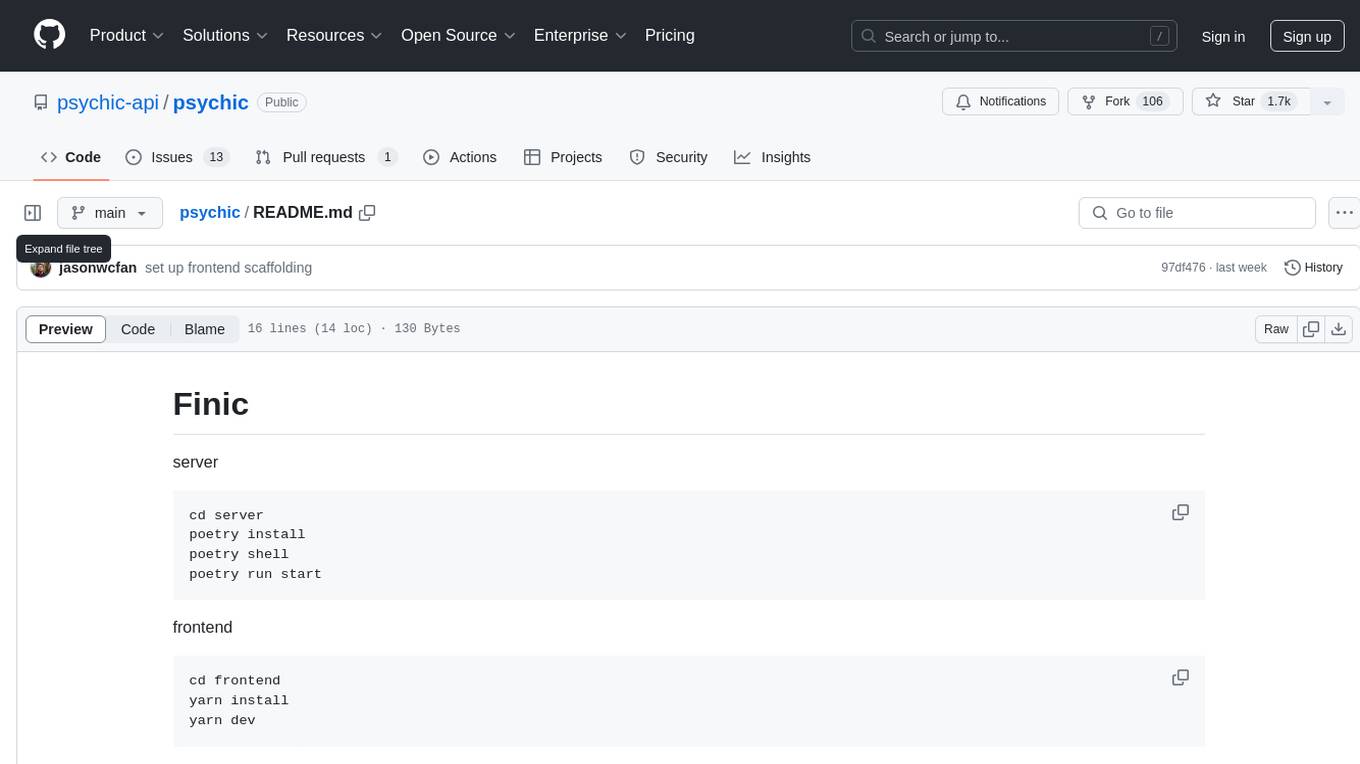
psychic
Psychic is a tool that provides a platform for users to access psychic readings and services. It offers a range of features such as tarot card readings, astrology consultations, and spiritual guidance. Users can connect with experienced psychics and receive personalized insights and advice on various aspects of their lives. The platform is designed to be user-friendly and intuitive, making it easy for users to navigate and explore the different services available. Whether you're looking for guidance on love, career, or personal growth, Psychic has you covered.
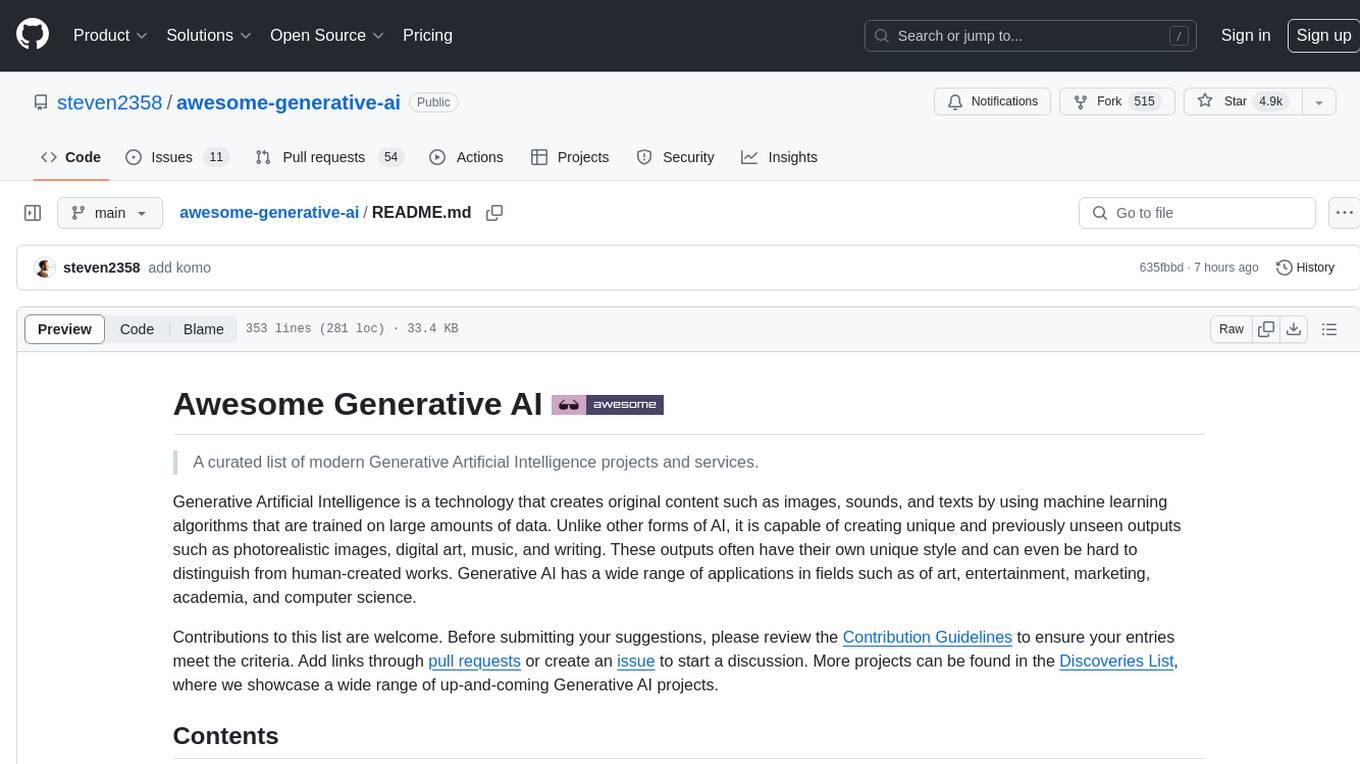
awesome-generative-ai
Awesome Generative AI is a curated list of modern Generative Artificial Intelligence projects and services. Generative AI technology creates original content like images, sounds, and texts using machine learning algorithms trained on large data sets. It can produce unique and realistic outputs such as photorealistic images, digital art, music, and writing. The repo covers a wide range of applications in art, entertainment, marketing, academia, and computer science.
For similar tasks
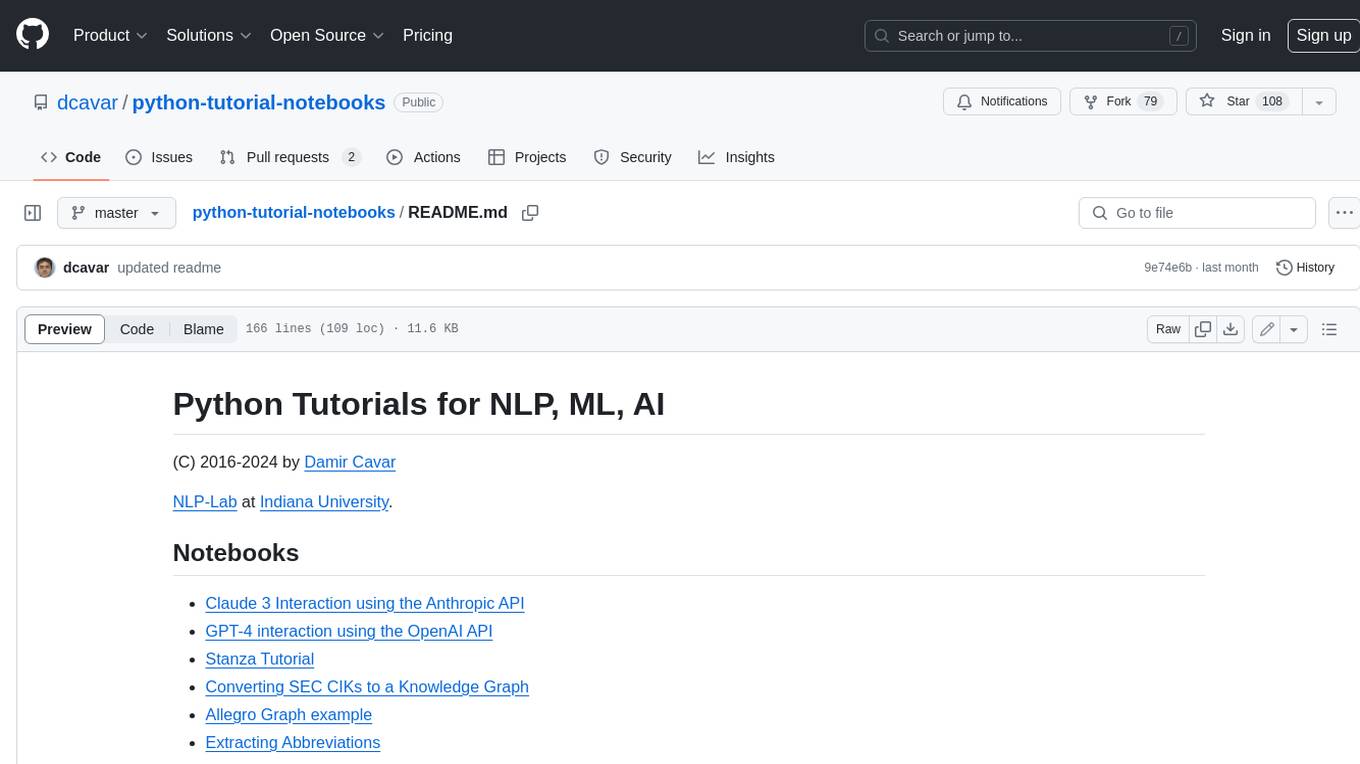
python-tutorial-notebooks
This repository contains Jupyter-based tutorials for NLP, ML, AI in Python for classes in Computational Linguistics, Natural Language Processing (NLP), Machine Learning (ML), and Artificial Intelligence (AI) at Indiana University.
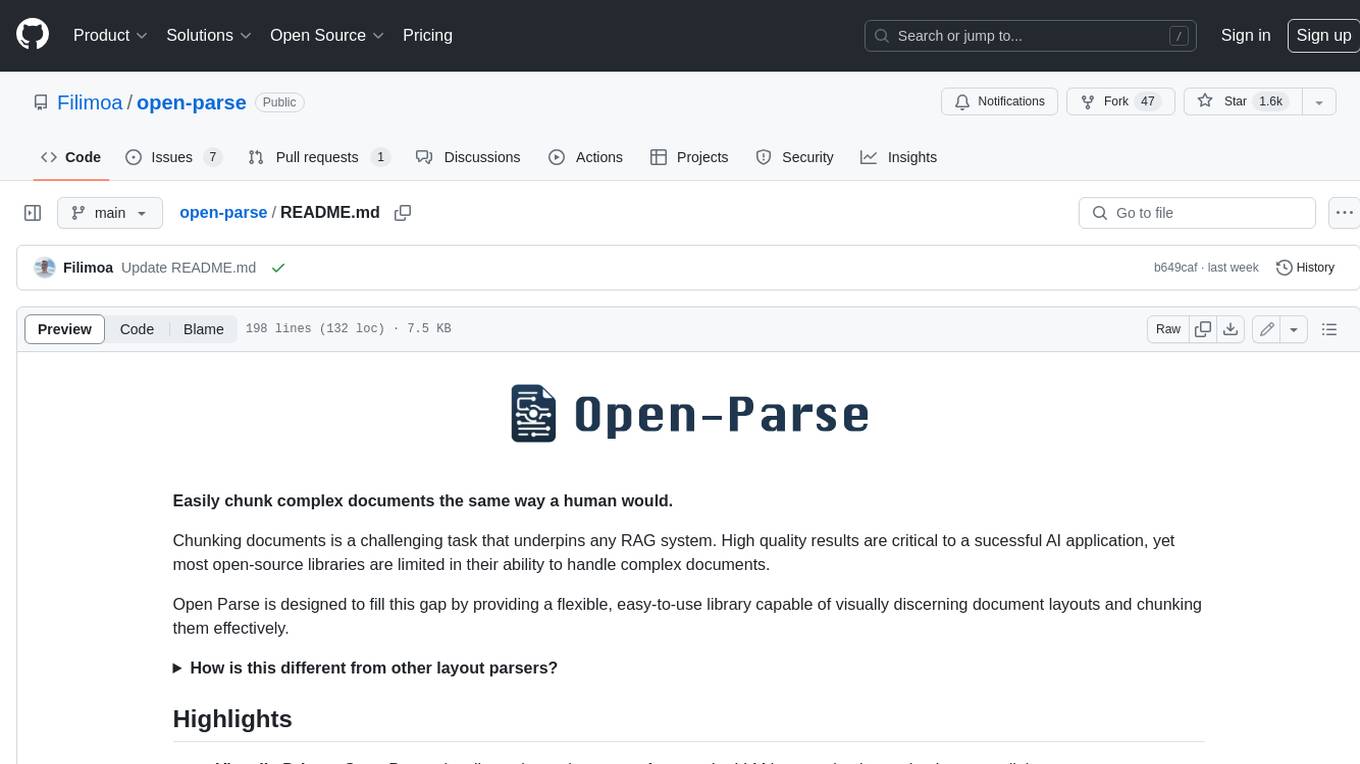
open-parse
Open Parse is a Python library for visually discerning document layouts and chunking them effectively. It is designed to fill the gap in open-source libraries for handling complex documents. Unlike text splitting, which converts a file to raw text and slices it up, Open Parse visually analyzes documents for superior LLM input. It also supports basic markdown for parsing headings, bold, and italics, and has high-precision table support, extracting tables into clean Markdown formats with accuracy that surpasses traditional tools. Open Parse is extensible, allowing users to easily implement their own post-processing steps. It is also intuitive, with great editor support and completion everywhere, making it easy to use and learn.
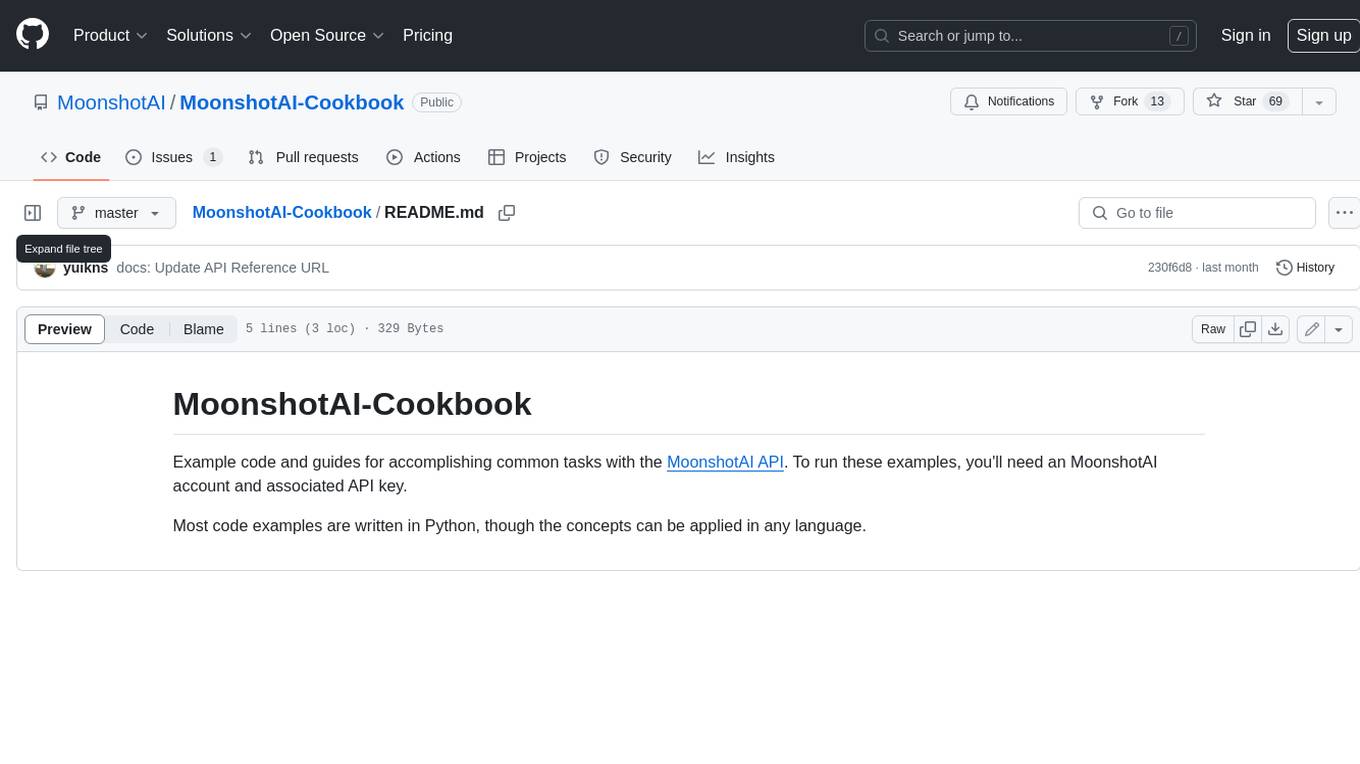
MoonshotAI-Cookbook
The MoonshotAI-Cookbook provides example code and guides for accomplishing common tasks with the MoonshotAI API. To run these examples, you'll need an MoonshotAI account and associated API key. Most code examples are written in Python, though the concepts can be applied in any language.
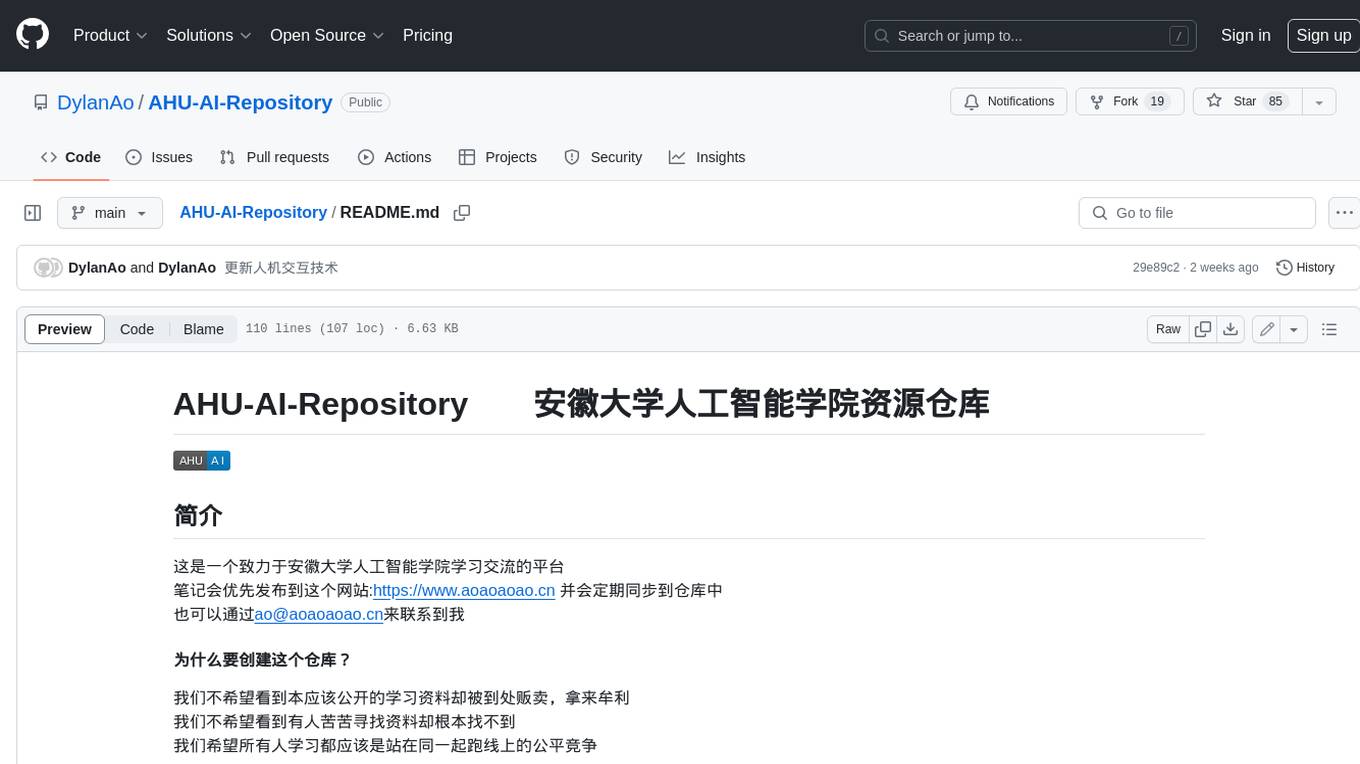
AHU-AI-Repository
This repository is dedicated to the learning and exchange of resources for the School of Artificial Intelligence at Anhui University. Notes will be published on this website first: https://www.aoaoaoao.cn and will be synchronized to the repository regularly. You can also contact me at [email protected].
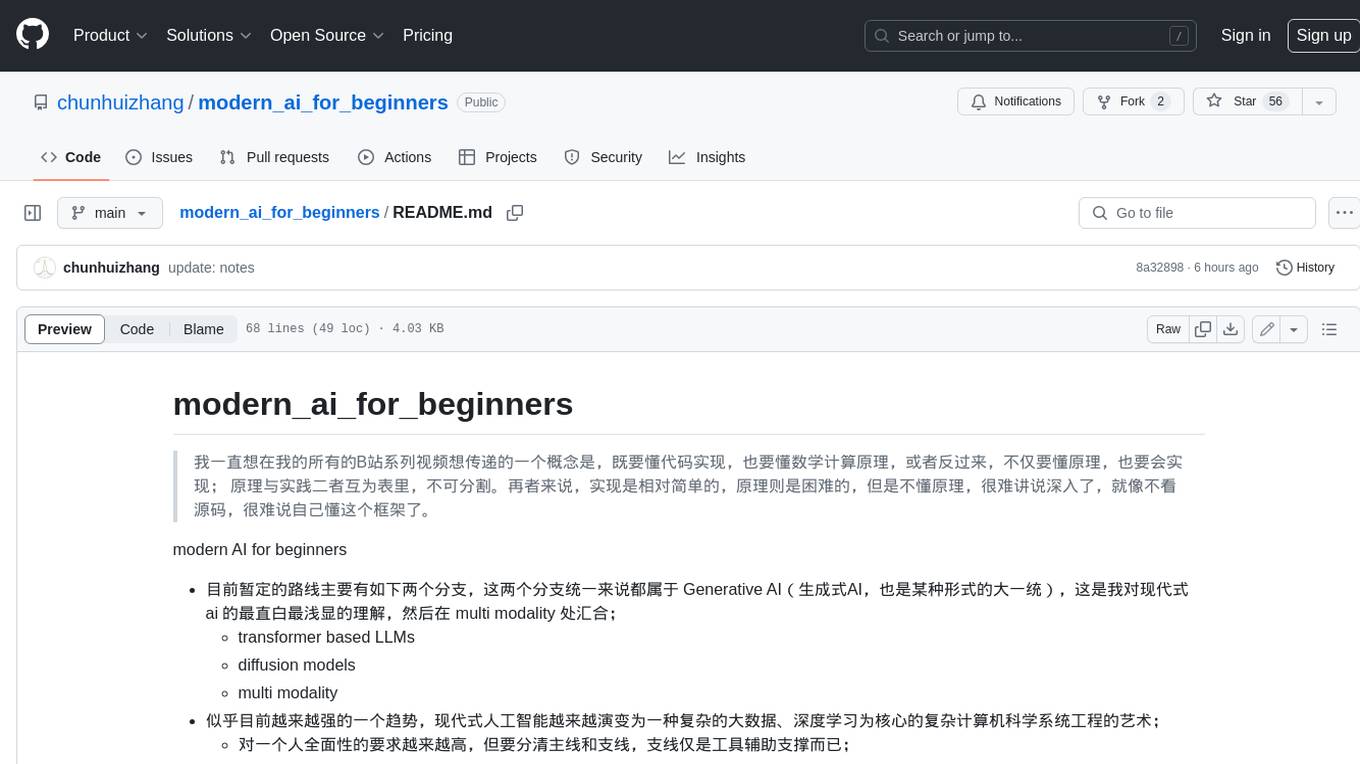
modern_ai_for_beginners
This repository provides a comprehensive guide to modern AI for beginners, covering both theoretical foundations and practical implementation. It emphasizes the importance of understanding both the mathematical principles and the code implementation of AI models. The repository includes resources on PyTorch, deep learning fundamentals, mathematical foundations, transformer-based LLMs, diffusion models, software engineering, and full-stack development. It also features tutorials on natural language processing with transformers, reinforcement learning, and practical deep learning for coders.
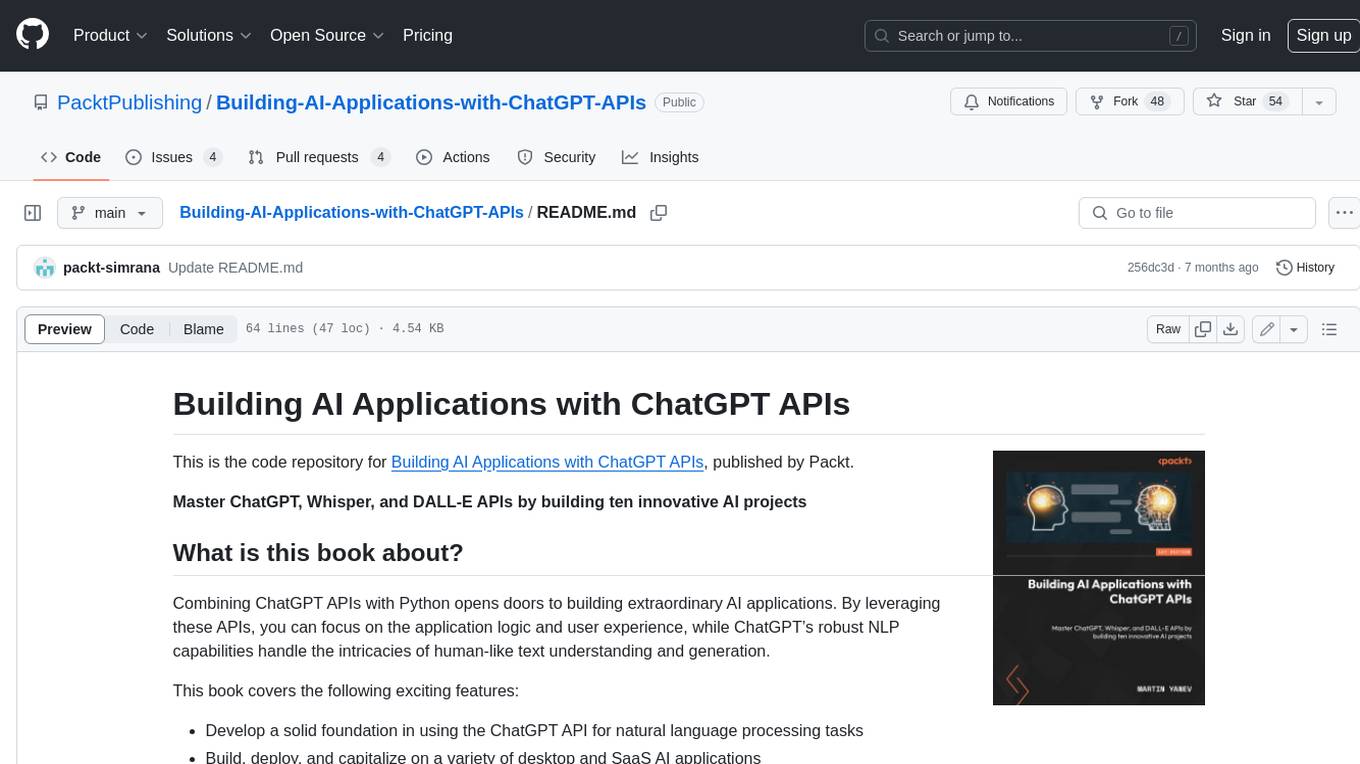
Building-AI-Applications-with-ChatGPT-APIs
This repository is for the book 'Building AI Applications with ChatGPT APIs' published by Packt. It provides code examples and instructions for mastering ChatGPT, Whisper, and DALL-E APIs through building innovative AI projects. Readers will learn to develop AI applications using ChatGPT APIs, integrate them with frameworks like Flask and Django, create AI-generated art with DALL-E APIs, and optimize ChatGPT models through fine-tuning.
examples
This repository contains a collection of sample applications and Jupyter Notebooks for hands-on experience with Pinecone vector databases and common AI patterns, tools, and algorithms. It includes production-ready examples for review and support, as well as learning-optimized examples for exploring AI techniques and building applications. Users can contribute, provide feedback, and collaborate to improve the resource.
lingoose
LinGoose is a modular Go framework designed for building AI/LLM applications. It offers the flexibility to import only the necessary modules, abstracts features for customization, and provides a comprehensive solution for developing AI/LLM applications from scratch. The framework simplifies the process of creating intelligent applications by allowing users to choose preferred implementations or create their own. LinGoose empowers developers to leverage its capabilities to streamline the development of cutting-edge AI and LLM projects.
For similar jobs
sweep
Sweep is an AI junior developer that turns bugs and feature requests into code changes. It automatically handles developer experience improvements like adding type hints and improving test coverage.
teams-ai
The Teams AI Library is a software development kit (SDK) that helps developers create bots that can interact with Teams and Microsoft 365 applications. It is built on top of the Bot Framework SDK and simplifies the process of developing bots that interact with Teams' artificial intelligence capabilities. The SDK is available for JavaScript/TypeScript, .NET, and Python.
ai-guide
This guide is dedicated to Large Language Models (LLMs) that you can run on your home computer. It assumes your PC is a lower-end, non-gaming setup.
classifai
Supercharge WordPress Content Workflows and Engagement with Artificial Intelligence. Tap into leading cloud-based services like OpenAI, Microsoft Azure AI, Google Gemini and IBM Watson to augment your WordPress-powered websites. Publish content faster while improving SEO performance and increasing audience engagement. ClassifAI integrates Artificial Intelligence and Machine Learning technologies to lighten your workload and eliminate tedious tasks, giving you more time to create original content that matters.
chatbot-ui
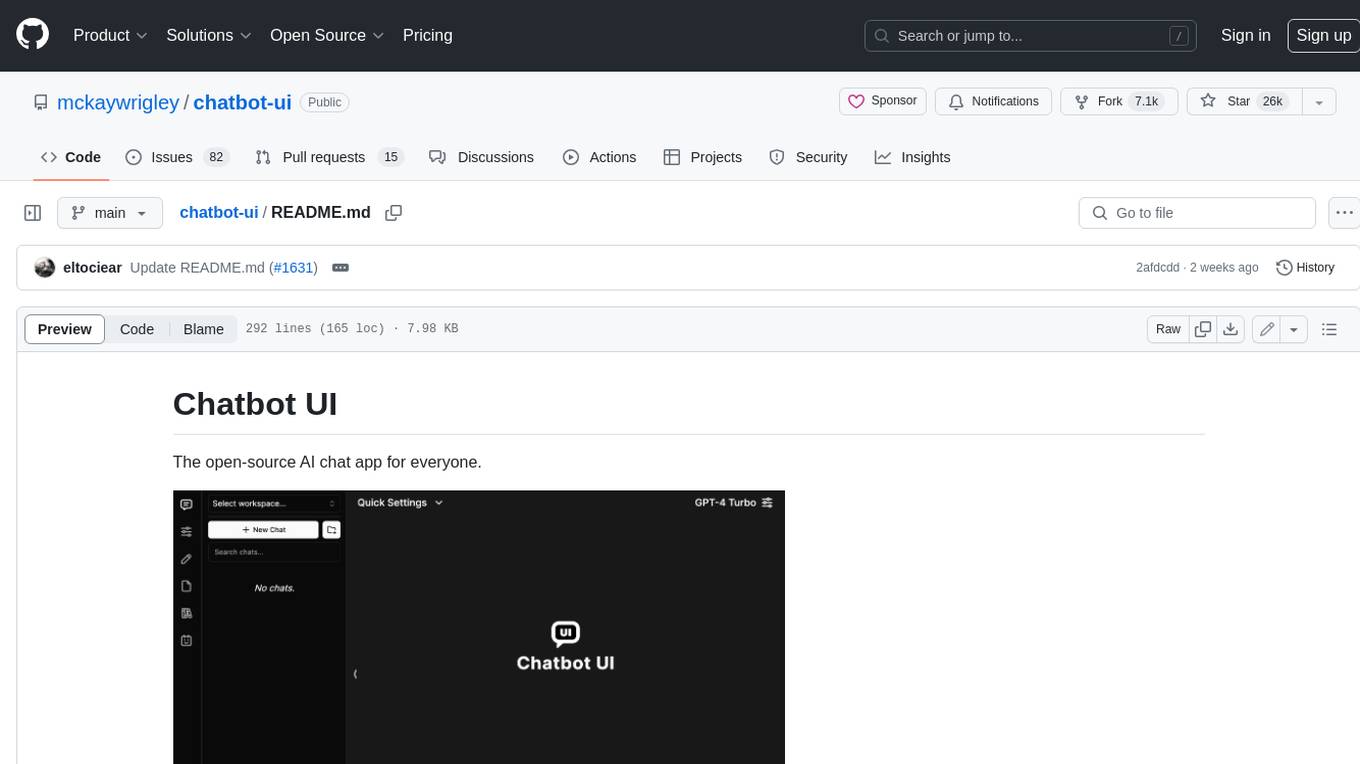
Chatbot UI is an open-source AI chat app that allows users to create and deploy their own AI chatbots. It is easy to use and can be customized to fit any need. Chatbot UI is perfect for businesses, developers, and anyone who wants to create a chatbot.
BricksLLM
BricksLLM is a cloud native AI gateway written in Go. Currently, it provides native support for OpenAI, Anthropic, Azure OpenAI and vLLM. BricksLLM aims to provide enterprise level infrastructure that can power any LLM production use cases. Here are some use cases for BricksLLM: * Set LLM usage limits for users on different pricing tiers * Track LLM usage on a per user and per organization basis * Block or redact requests containing PIIs * Improve LLM reliability with failovers, retries and caching * Distribute API keys with rate limits and cost limits for internal development/production use cases * Distribute API keys with rate limits and cost limits for students
uAgents
uAgents is a Python library developed by Fetch.ai that allows for the creation of autonomous AI agents. These agents can perform various tasks on a schedule or take action on various events. uAgents are easy to create and manage, and they are connected to a fast-growing network of other uAgents. They are also secure, with cryptographically secured messages and wallets.
griptape
Griptape is a modular Python framework for building AI-powered applications that securely connect to your enterprise data and APIs. It offers developers the ability to maintain control and flexibility at every step. Griptape's core components include Structures (Agents, Pipelines, and Workflows), Tasks, Tools, Memory (Conversation Memory, Task Memory, and Meta Memory), Drivers (Prompt and Embedding Drivers, Vector Store Drivers, Image Generation Drivers, Image Query Drivers, SQL Drivers, Web Scraper Drivers, and Conversation Memory Drivers), Engines (Query Engines, Extraction Engines, Summary Engines, Image Generation Engines, and Image Query Engines), and additional components (Rulesets, Loaders, Artifacts, Chunkers, and Tokenizers). Griptape enables developers to create AI-powered applications with ease and efficiency.