


aitour-interact-with-llms
None
Stars: 69

This repository is for the AI Tour workshop: Interacting with Multimodal models in Azure AI Foundry. The workshop provides a hands-on introduction to core concepts and best practices for interacting with OpenAI models in Azure AI Foundry portal. Participants can innovate with Azure OpenAI's GPT-4o multimodal model to generate text, sound, and images using GPT-4o-mini, DALL-E, and GPT-4o-realtime. The workshop also covers creating AI Agents to enhance user experiences and drive innovation. It includes instructions, resources for continued learning, and information on responsible AI practices.
README:
This repository is for the AI Tour workshop: Interacting with Multimodal models in Azure AI Foundry

This workshop is designed to give you a hands-on introduction to the core concepts and best practices for interacting with OpenAI models in Azure AI Foundry portal. If you have been provided with a Skillable Environment, you'll be using the VM and pre-provisioned Azure resources provided to you to complete the lab. If you are running this workshop on your own, you will need to have an Azure subscription and provision the resources yourself by deploying the resources to Azure.
Innovate with Azure OpenAI's GPT-4o multimodal model in this hands-on experience in Azure AI Foundry. Learn the core concepts and best practices to effectively generate with text, sound, and images using GPT-4o-mini, DALL-E and GPT-4o-realtime. Create AI Agents that enhance user experiences and drive innovation.
75 Minutes
| Language | Code | Link to Translated README | Last Updated |
|---|---|---|---|
| Chinese (Simplified) | zh | Chinese Translation (Simplified) | 2025-03-05 |
| Chinese (Traditional) | tw | Chinese Translation (Traditional) | 2025-03-05 |
| Japanese | ja | Japanese Translation | 2025-03-05 |
| Korean | ko | Korean Translation | 2025-03-05 |
- Understand how Large Language Models work, including what tokens are.
- Explore Prompt Engineering techniques and best practices
- Understand how models apply existing knowledge
- Get started with building an Azure AI Agents
- Implementing function calling in LLM applications
- Azure AI Foundry portal
The step by step workshop instructions can be found as follows:
- Skillable Workshop Instructions
- Workshop Instructions if you are deploying directly on Azure - for Field Stops
| Resources | Links | Description |
|---|---|---|
| Session Slides | View | Review the slides presented during the workshop at your own pace |
| Intro to Azure OpenAI Service | Microsoft Learn module | Learn more about Azure OpenAI Service |
| Azure OpenAI Service documentation | Azure OpenAI Service documentation | Learn more about Azure OpenAI Service |
| Azure OpenAI Service pricing | Pricing details | Learn more about Azure OpenAI Service pricing |
| Transparency Note for Azure OpenAI Service | Transparency Note | Learn more about Azure OpenAI Service use cases, capabilities and limitations |
 Gustavo Cordido 📢 |
 Bethany Jepchumba 📢 |
Microsoft is committed to helping our customers use our AI products responsibly, sharing our learnings, and building trust-based partnerships through tools like Transparency Notes and Impact Assessments. Many of these resources can be found at https://aka.ms/RAI. Microsoft’s approach to responsible AI is grounded in our AI principles of fairness, reliability and safety, privacy and security, inclusiveness, transparency, and accountability.
Large-scale natural language, image, and speech models - like the ones used in this sample - can potentially behave in ways that are unfair, unreliable, or offensive, in turn causing harms. Please consult the Azure OpenAI service Transparency note to be informed about risks and limitations.
The recommended approach to mitigating these risks is to include a safety system in your architecture that can detect and prevent harmful behavior. Azure AI Content Safety provides an independent layer of protection, able to detect harmful user-generated and AI-generated content in applications and services. Azure AI Content Safety includes text and image APIs that allow you to detect material that is harmful. Within Azure AI Foundry portal, the Content Safety service allows you to view, explore and try out sample code for detecting harmful content across different modalities. The following quickstart documentation guides you through making requests to the service.
Another aspect to take into account is the overall application performance. With multi-modal and multi-models applications, we consider performance to mean that the system performs as you and your users expect, including not generating harmful outputs. It's important to assess the performance of your overall application using Performance and Quality and Risk and Safety evaluators. You also have the ability to create and evaluate with custom evaluators.
You can evaluate your AI application in your development environment using the Azure AI Evaluation SDK. Given either a test dataset or a target, your generative AI application generations are quantitatively measured with built-in evaluators or custom evaluators of your choice. To get started with the azure ai evaluation sdk to evaluate your system, you can follow the quickstart guide. Once you execute an evaluation run, you can visualize the results in Azure AI Foundry portal .
For Tasks:
Click tags to check more tools for each tasksFor Jobs:
Alternative AI tools for aitour-interact-with-llms
Similar Open Source Tools
aitour-interact-with-llms
This repository is for the AI Tour workshop: Interacting with Multimodal models in Azure AI Foundry. The workshop provides a hands-on introduction to core concepts and best practices for interacting with OpenAI models in Azure AI Foundry portal. Participants can innovate with Azure OpenAI's GPT-4o multimodal model to generate text, sound, and images using GPT-4o-mini, DALL-E, and GPT-4o-realtime. The workshop also covers creating AI Agents to enhance user experiences and drive innovation. It includes instructions, resources for continued learning, and information on responsible AI practices.
AI-in-a-Box
AI-in-a-Box is a curated collection of solution accelerators that can help engineers establish their AI/ML environments and solutions rapidly and with minimal friction, while maintaining the highest standards of quality and efficiency. It provides essential guidance on the responsible use of AI and LLM technologies, specific security guidance for Generative AI (GenAI) applications, and best practices for scaling OpenAI applications within Azure. The available accelerators include: Azure ML Operationalization in-a-box, Edge AI in-a-box, Doc Intelligence in-a-box, Image and Video Analysis in-a-box, Cognitive Services Landing Zone in-a-box, Semantic Kernel Bot in-a-box, NLP to SQL in-a-box, Assistants API in-a-box, and Assistants API Bot in-a-box.
chat-with-your-data-solution-accelerator
Chat with your data using OpenAI and AI Search. This solution accelerator uses an Azure OpenAI GPT model and an Azure AI Search index generated from your data, which is integrated into a web application to provide a natural language interface, including speech-to-text functionality, for search queries. Users can drag and drop files, point to storage, and take care of technical setup to transform documents. There is a web app that users can create in their own subscription with security and authentication.
awesome-crewai
Awesome CrewAI is a curated collection of open-source projects built by the CrewAI community, aimed at unlocking the full potential of AI agents for supercharging business processes and decision-making. It includes integrations, tutorials, and tools that showcase the capabilities of CrewAI in various domains.
rag-cookbooks
Welcome to the comprehensive collection of advanced + agentic Retrieval-Augmented Generation (RAG) techniques. This repository covers the most effective advanced + agentic RAG techniques with clear implementations and explanations. It aims to provide a helpful resource for researchers and developers looking to use advanced RAG techniques in their projects, offering ready-to-use implementations and guidance on evaluation methods. The RAG framework addresses limitations of Large Language Models by using external documents for in-context learning, ensuring contextually relevant and accurate responses. The repository includes detailed descriptions of various RAG techniques, tools used, and implementation guidance for each technique.
intro-to-intelligent-apps
This repository introduces and helps organizations get started with building AI Apps and incorporating Large Language Models (LLMs) into them. The workshop covers topics such as prompt engineering, AI orchestration, and deploying AI apps. Participants will learn how to use Azure OpenAI, Langchain/ Semantic Kernel, Qdrant, and Azure AI Search to build intelligent applications.
Large-Language-Model-Notebooks-Course
This practical free hands-on course focuses on Large Language models and their applications, providing a hands-on experience using models from OpenAI and the Hugging Face library. The course is divided into three major sections: Techniques and Libraries, Projects, and Enterprise Solutions. It covers topics such as Chatbots, Code Generation, Vector databases, LangChain, Fine Tuning, PEFT Fine Tuning, Soft Prompt tuning, LoRA, QLoRA, Evaluate Models, Knowledge Distillation, and more. Each section contains chapters with lessons supported by notebooks and articles. The course aims to help users build projects and explore enterprise solutions using Large Language Models.
GenAI-Showcase
The Generative AI Use Cases Repository showcases a wide range of applications in generative AI, including Retrieval-Augmented Generation (RAG), AI Agents, and industry-specific use cases. It provides practical notebooks and guidance on utilizing frameworks such as LlamaIndex and LangChain, and demonstrates how to integrate models from leading AI research companies like Anthropic and OpenAI.
Multi-Agent-Custom-Automation-Engine-Solution-Accelerator
The Multi-Agent -Custom Automation Engine Solution Accelerator is an AI-driven orchestration system that manages a group of AI agents to accomplish tasks based on user input. It uses a FastAPI backend to handle HTTP requests, processes them through various specialized agents, and stores stateful information using Azure Cosmos DB. The system allows users to focus on what matters by coordinating activities across an organization, enabling GenAI to scale, and is applicable to most industries. It is intended for developing and deploying custom AI solutions for specific customers, providing a foundation to accelerate building out multi-agent systems.
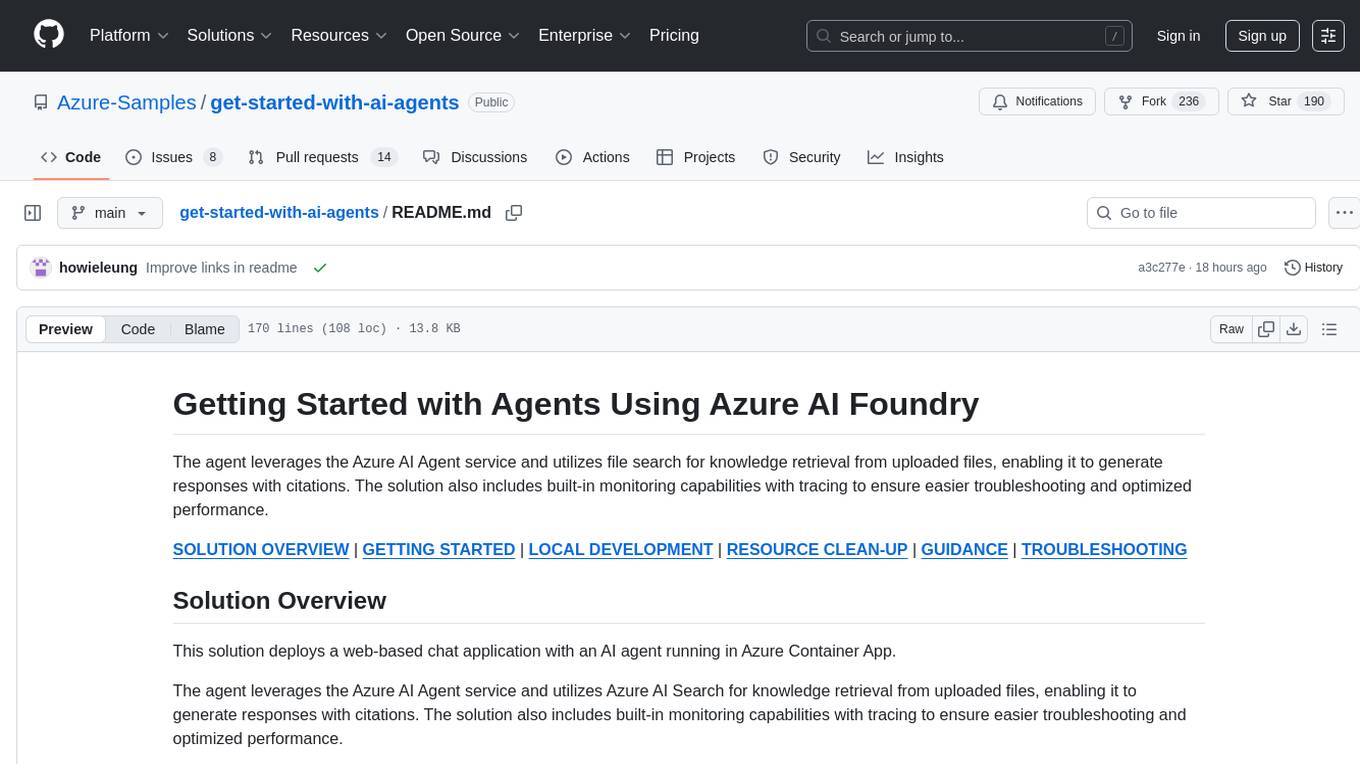
get-started-with-ai-agents
The 'Getting Started with Agents Using Azure AI Foundry' repository provides a solution that deploys a web-based chat application with an AI agent running in Azure Container App. The agent leverages Azure AI services for knowledge retrieval from uploaded files, enabling it to generate responses with citations. The solution includes built-in monitoring capabilities for easier troubleshooting and optimized performance. Users can deploy AI models, customize the agent, and evaluate its performance. The repository offers flexible deployment options through GitHub Codespaces, VS Code Dev Containers, or local environments.
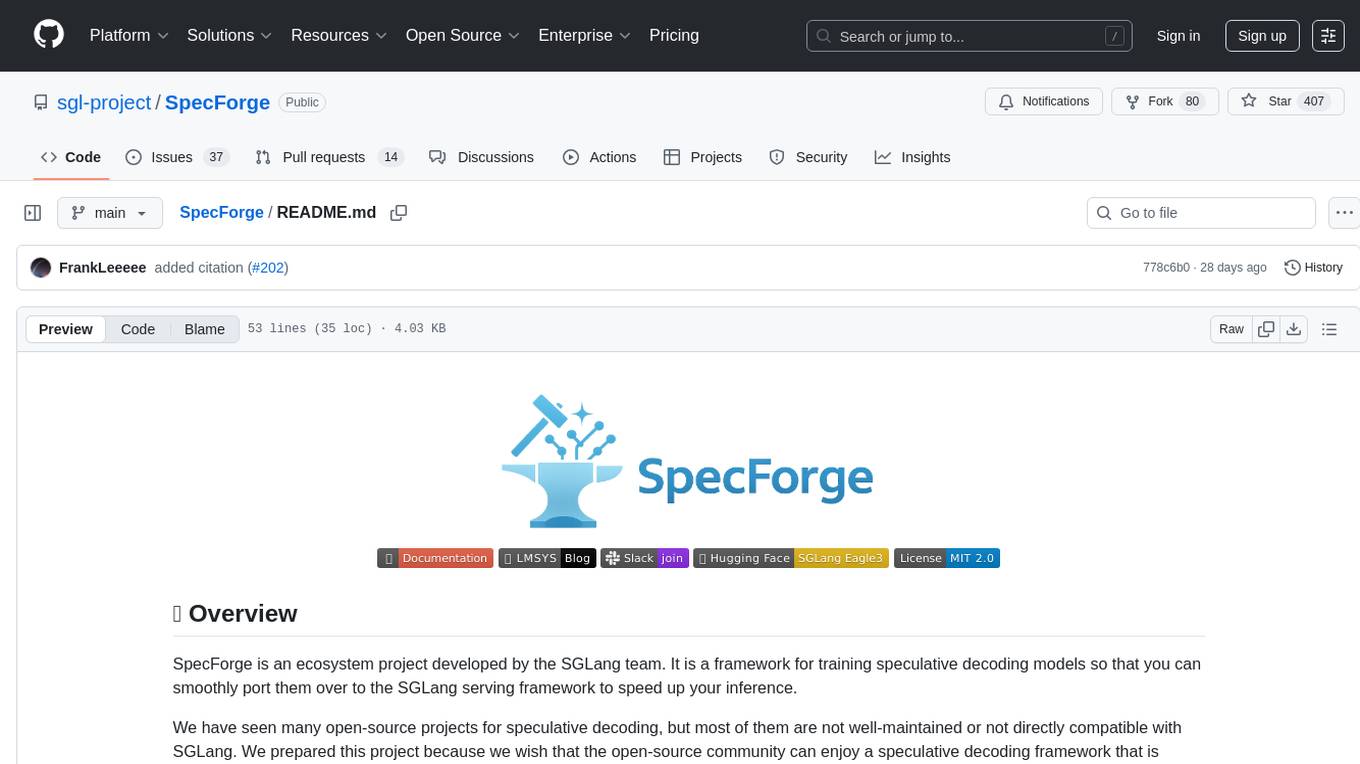
SpecForge
SpecForge is a powerful tool for generating API specifications from code. It helps developers to easily create and maintain accurate API documentation by extracting information directly from the codebase. With SpecForge, users can streamline the process of documenting APIs, ensuring consistency and reducing manual effort. The tool supports various programming languages and frameworks, making it versatile and adaptable to different development environments. By automating the generation of API specifications, SpecForge enhances collaboration between developers and stakeholders, improving overall project efficiency and quality.
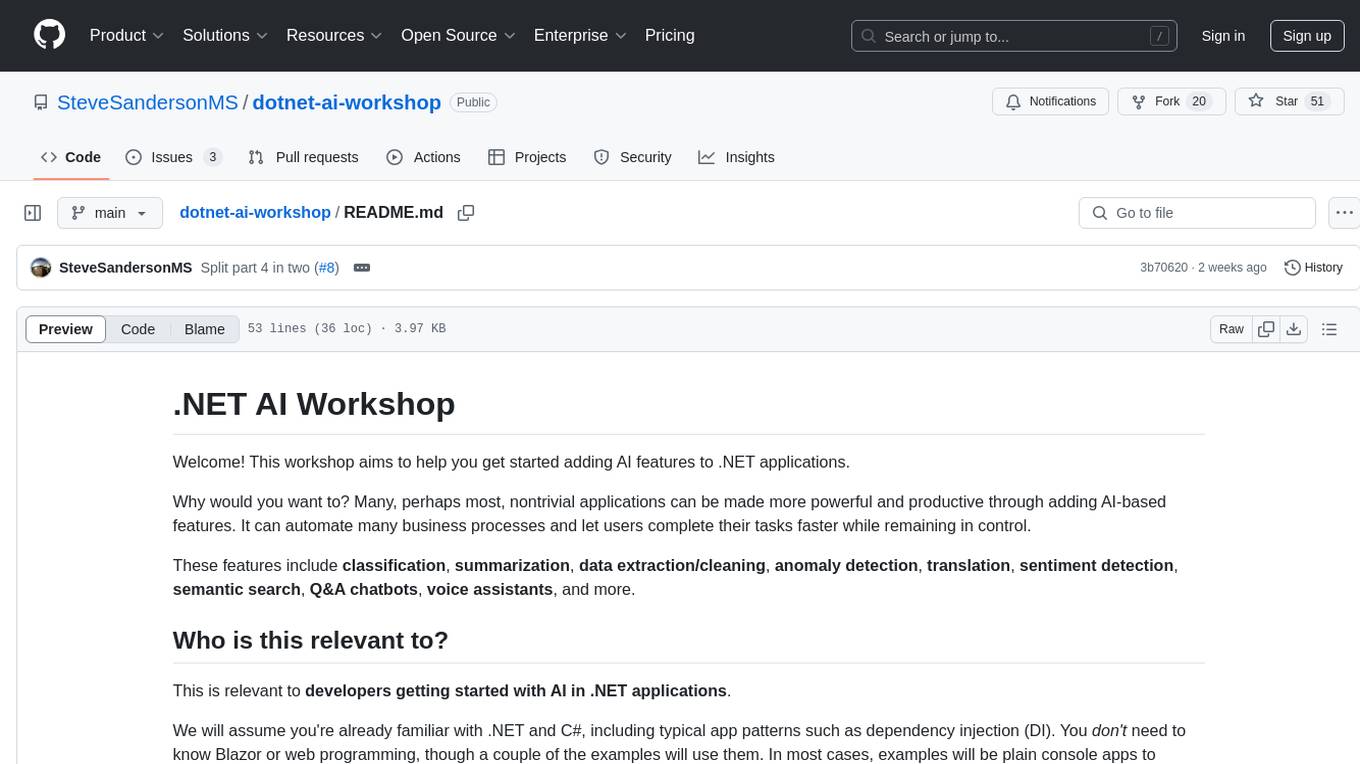
dotnet-ai-workshop
The .NET AI Workshop is a comprehensive guide designed to help developers add AI features to .NET applications. It covers various AI-based features such as classification, summarization, data extraction/cleaning, anomaly detection, translation, sentiment detection, semantic search, Q&A chatbots, and voice assistants. The workshop is tailored for developers new to AI in .NET applications, focusing on the usage of AI services without the need for prior AI technology knowledge. It provides examples using .NET and C# with a focus on AI topics, aiming to enhance productivity and automation in applications.
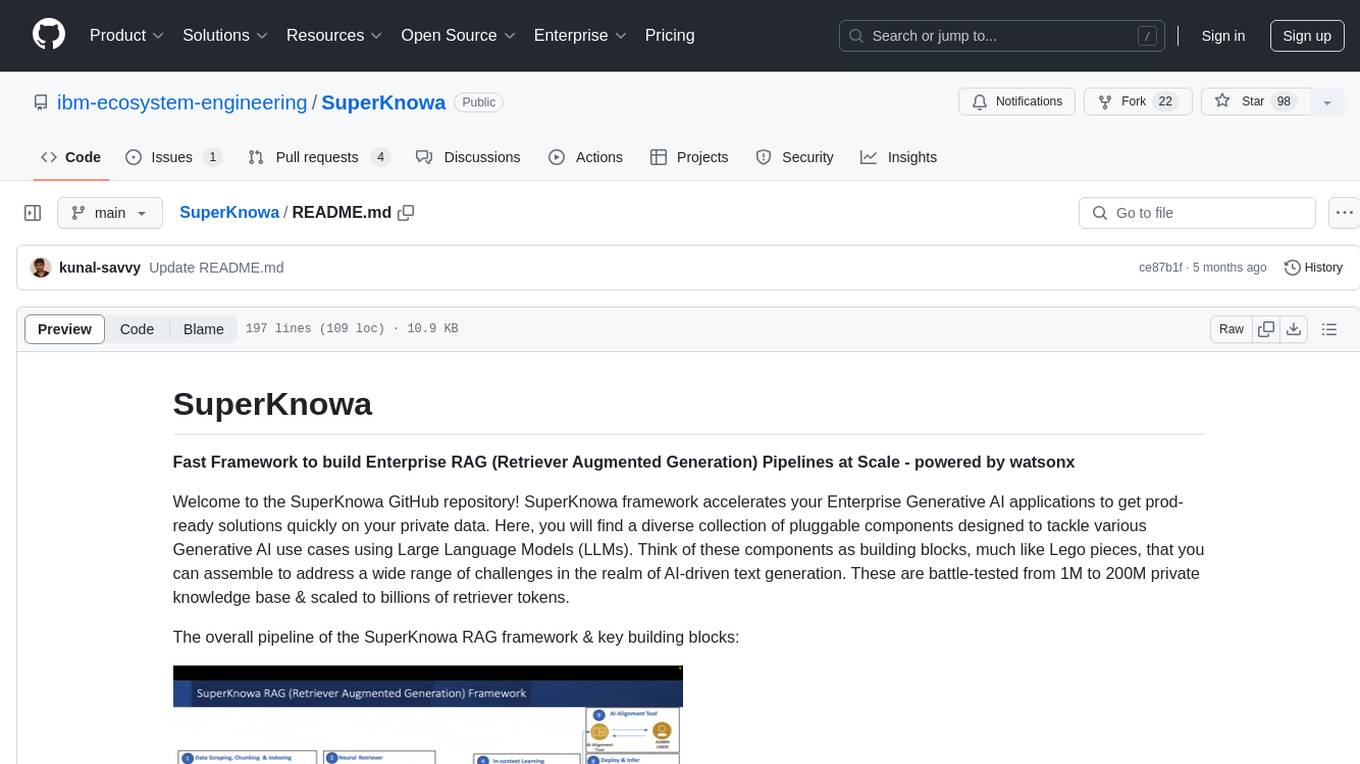
SuperKnowa
SuperKnowa is a fast framework to build Enterprise RAG (Retriever Augmented Generation) Pipelines at Scale, powered by watsonx. It accelerates Enterprise Generative AI applications to get prod-ready solutions quickly on private data. The framework provides pluggable components for tackling various Generative AI use cases using Large Language Models (LLMs), allowing users to assemble building blocks to address challenges in AI-driven text generation. SuperKnowa is battle-tested from 1M to 200M private knowledge base & scaled to billions of retriever tokens.
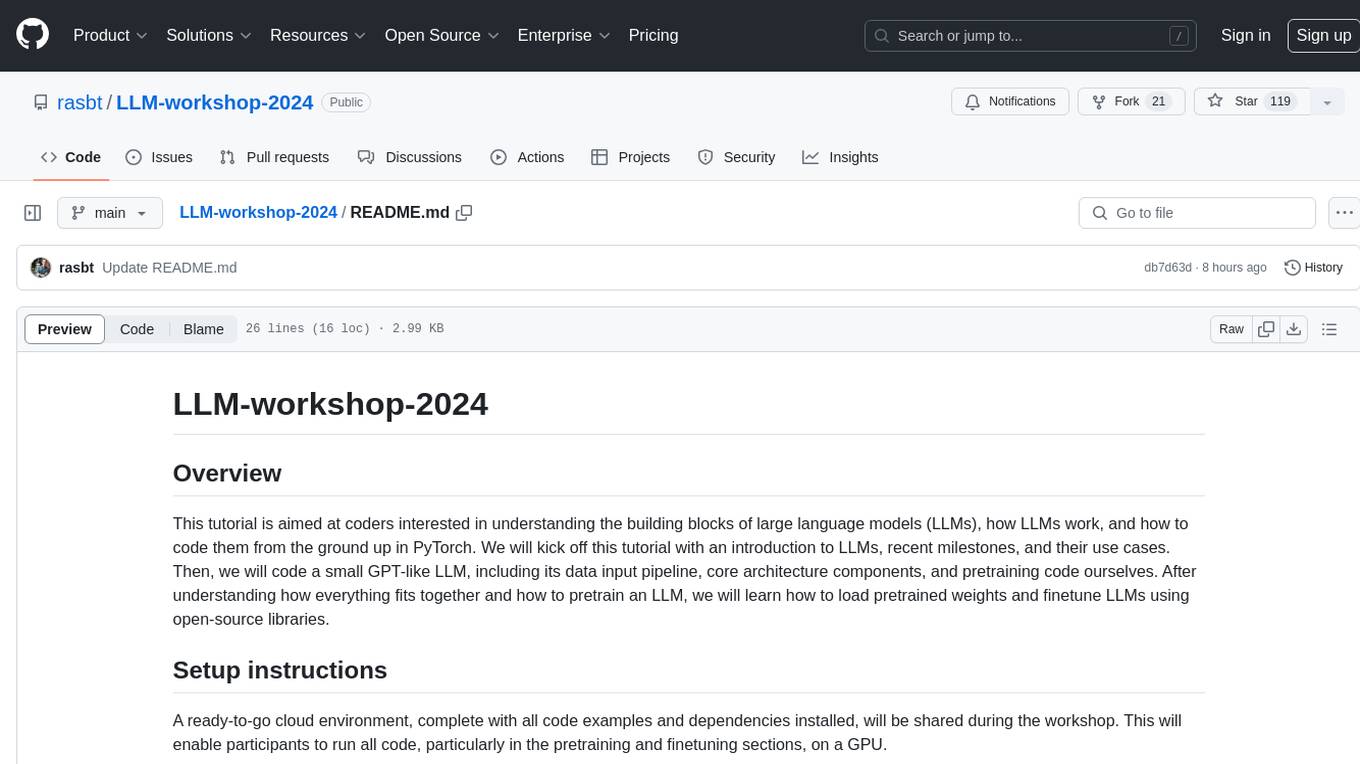
LLM-workshop-2024
LLM-workshop-2024 is a tutorial designed for coders interested in understanding the building blocks of large language models (LLMs), how LLMs work, and how to code them from scratch in PyTorch. The tutorial covers topics such as introduction to LLMs, understanding LLM input data, coding LLM architecture, pretraining LLMs, loading pretrained weights, and finetuning LLMs using open-source libraries. Participants will learn to implement a small GPT-like LLM, including data input pipeline, core architecture components, and pretraining code.
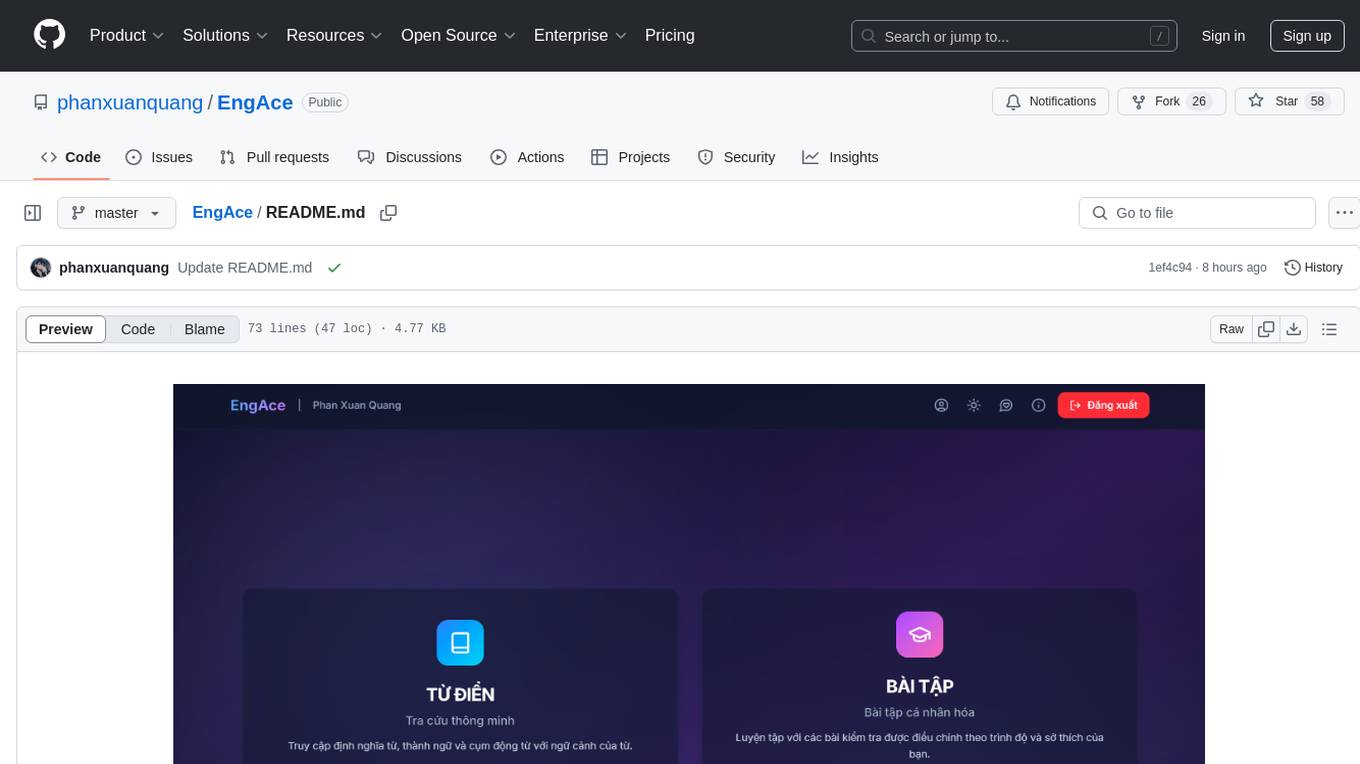
EngAce
EngAce is a cutting-edge, generative AI-powered application revolutionizing Vietnamese English learning. It offers personalized learning experiences combining AI with comprehensive features. The repository contains source code, documentation, and resources for the app.
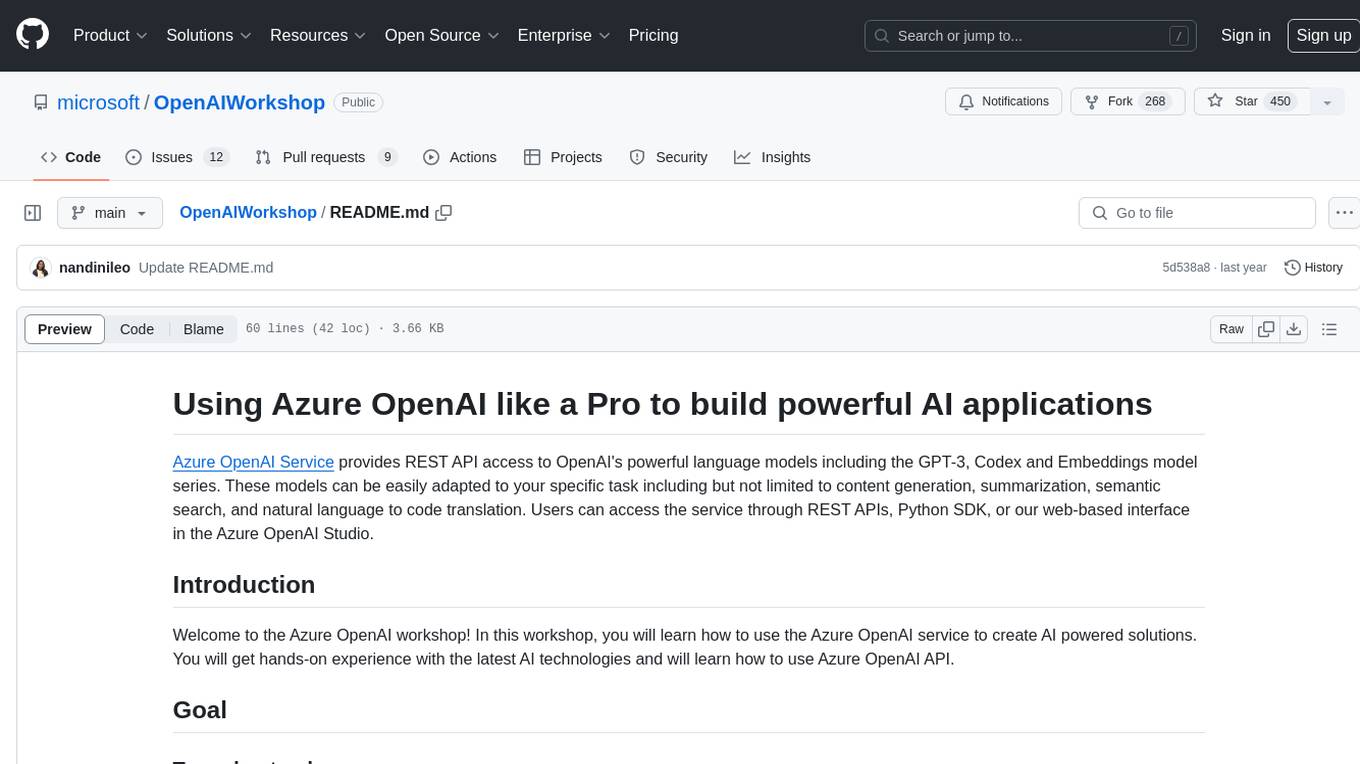
OpenAIWorkshop
Azure OpenAI Service provides REST API access to OpenAI's powerful language models including GPT-3, Codex and Embeddings. Users can easily adapt models for content generation, summarization, semantic search, and natural language to code translation. The workshop covers basics, prompt engineering, common NLP tasks, generative tasks, conversational dialog, and learning methods. It guides users to build applications with PowerApp, query SQL data, create data pipelines, and work with proprietary datasets. Target audience includes Power Users, Software Engineers, Data Scientists, and AI architects and Managers.
For similar tasks
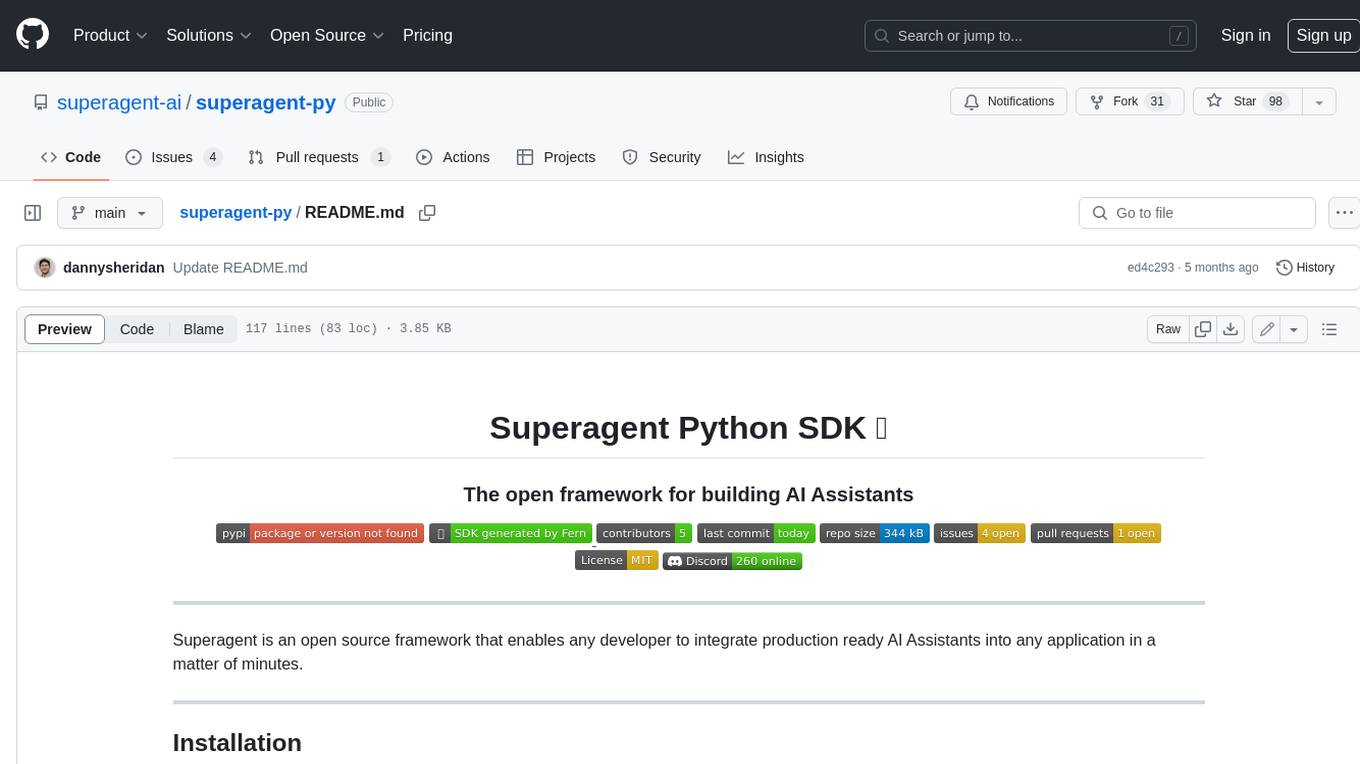
superagent-py
Superagent is an open-source framework that enables developers to integrate production-ready AI assistants into any application quickly and easily. It provides a Python SDK for interacting with the Superagent API, allowing developers to create, manage, and invoke AI agents. The SDK simplifies the process of building AI-powered applications, making it accessible to developers of all skill levels.
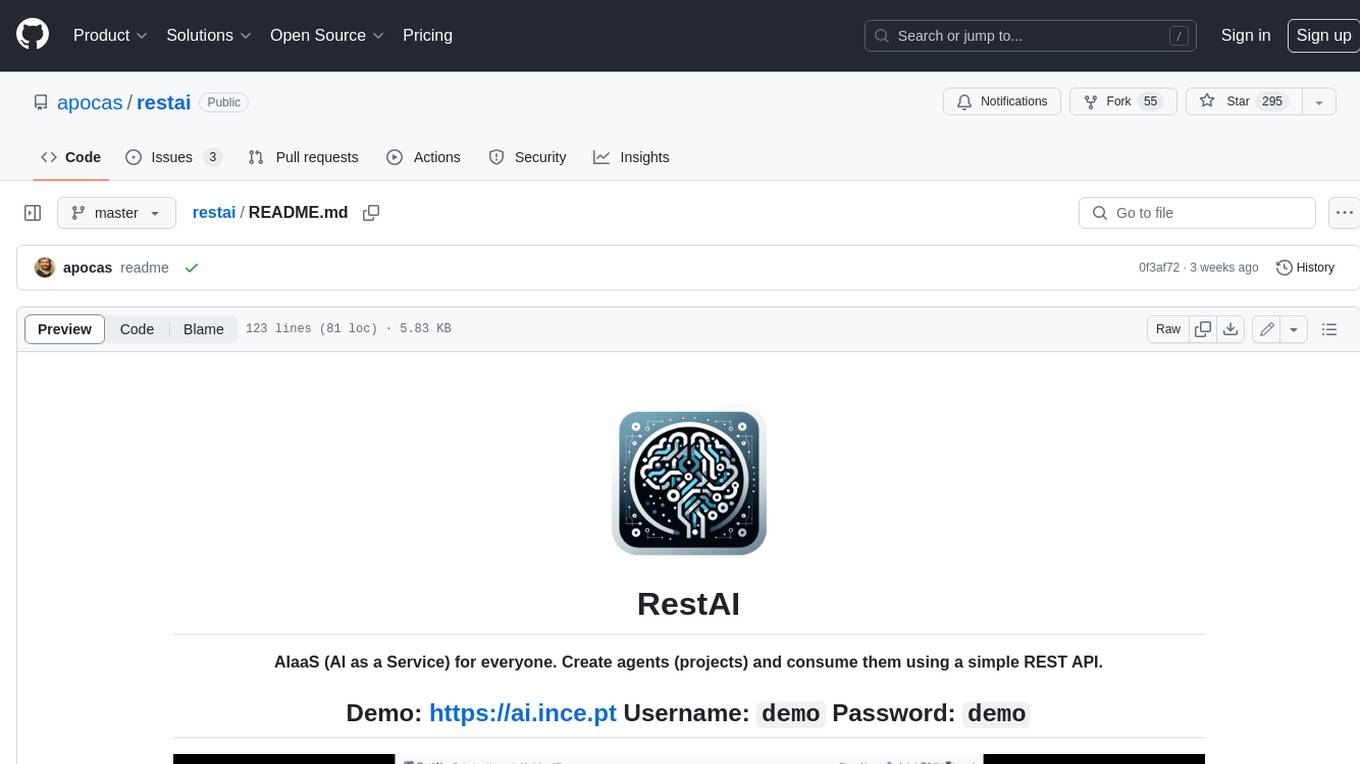
restai
RestAI is an AIaaS (AI as a Service) platform that allows users to create and consume AI agents (projects) using a simple REST API. It supports various types of agents, including RAG (Retrieval-Augmented Generation), RAGSQL (RAG for SQL), inference, vision, and router. RestAI features automatic VRAM management, support for any public LLM supported by LlamaIndex or any local LLM supported by Ollama, a user-friendly API with Swagger documentation, and a frontend for easy access. It also provides evaluation capabilities for RAG agents using deepeval.
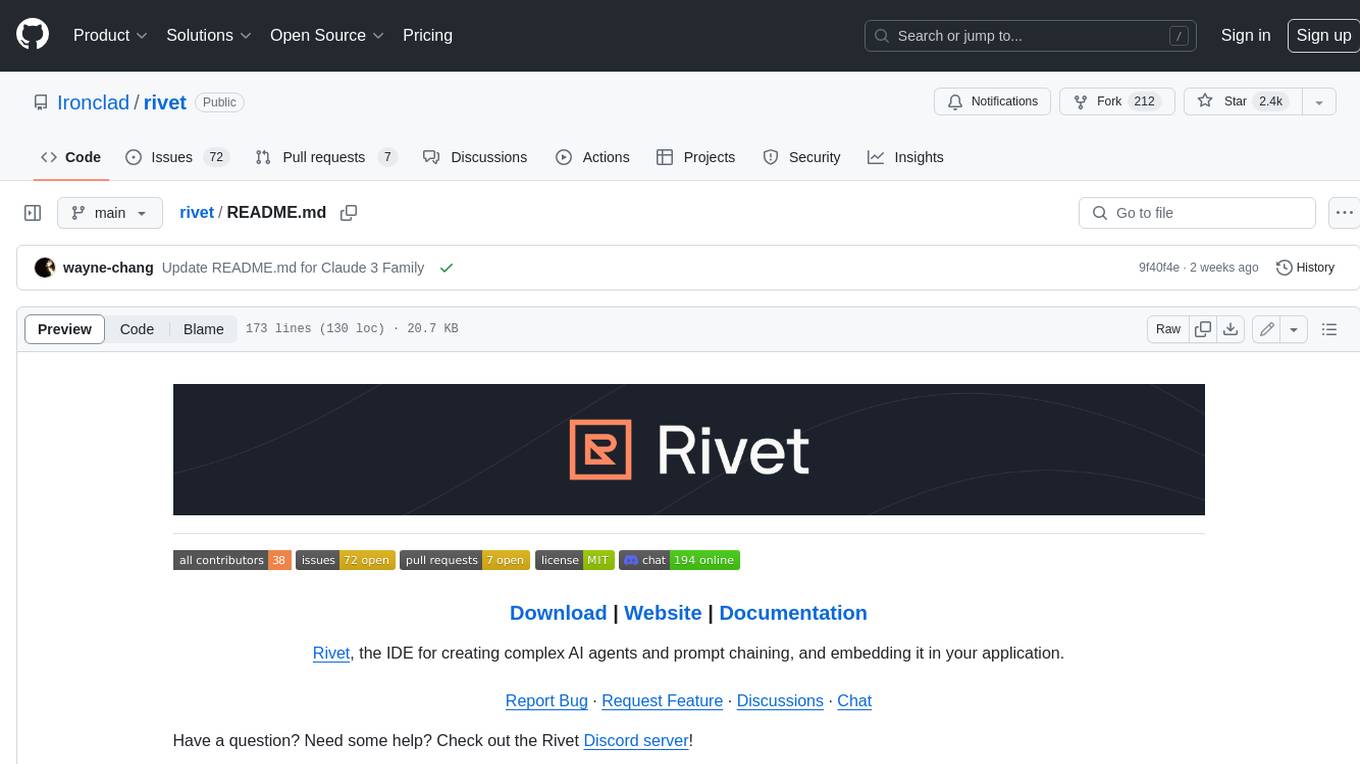
rivet
Rivet is a desktop application for creating complex AI agents and prompt chaining, and embedding it in your application. Rivet currently has LLM support for OpenAI GPT-3.5 and GPT-4, Anthropic Claude Instant and Claude 2, [Anthropic Claude 3 Haiku, Sonnet, and Opus](https://www.anthropic.com/news/claude-3-family), and AssemblyAI LeMUR framework for voice data. Rivet has embedding/vector database support for OpenAI Embeddings and Pinecone. Rivet also supports these additional integrations: Audio Transcription from AssemblyAI. Rivet core is a TypeScript library for running graphs created in Rivet. It is used by the Rivet application, but can also be used in your own applications, so that Rivet can call into your own application's code, and your application can call into Rivet graphs.
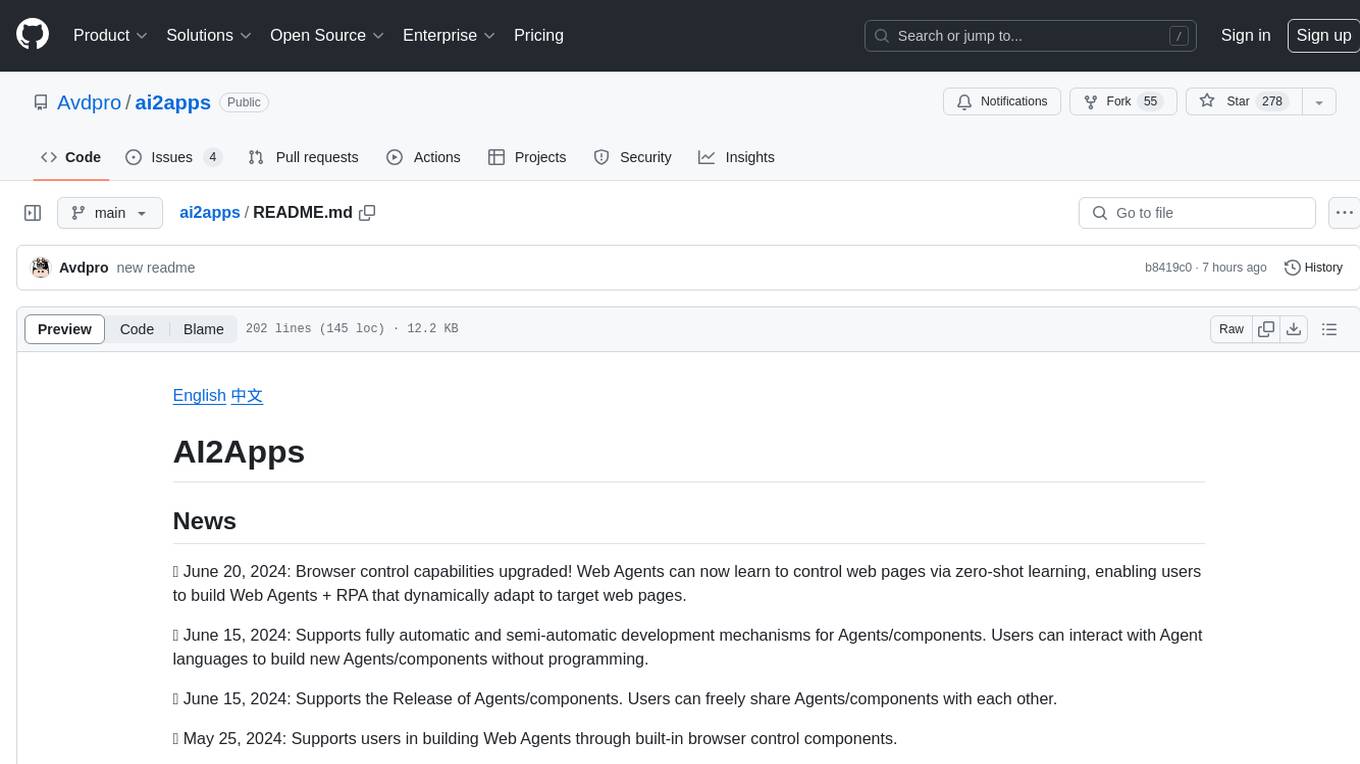
ai2apps
AI2Apps is a visual IDE for building LLM-based AI agent applications, enabling developers to efficiently create AI agents through drag-and-drop, with features like design-to-development for rapid prototyping, direct packaging of agents into apps, powerful debugging capabilities, enhanced user interaction, efficient team collaboration, flexible deployment, multilingual support, simplified product maintenance, and extensibility through plugins.
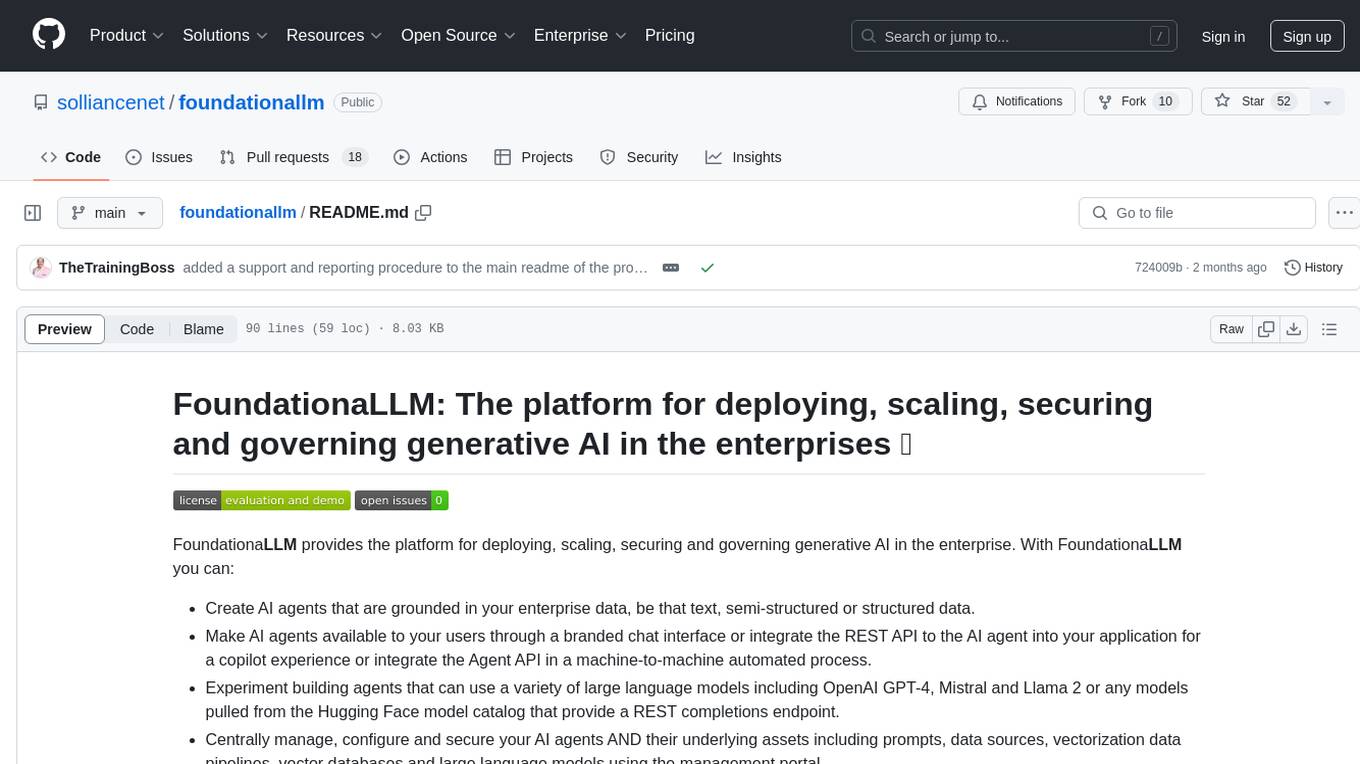
foundationallm
FoundationaLLM is a platform designed for deploying, scaling, securing, and governing generative AI in enterprises. It allows users to create AI agents grounded in enterprise data, integrate REST APIs, experiment with large language models, centrally manage AI agents and assets, deploy scalable vectorization data pipelines, enable non-developer users to create their own AI agents, control access with role-based access controls, and harness capabilities from Azure AI and Azure OpenAI. The platform simplifies integration with enterprise data sources, provides fine-grain security controls, load balances across multiple endpoints, and is extensible to new data sources and orchestrators. FoundationaLLM addresses the need for customized copilots or AI agents that are secure, licensed, flexible, and suitable for enterprise-scale production.
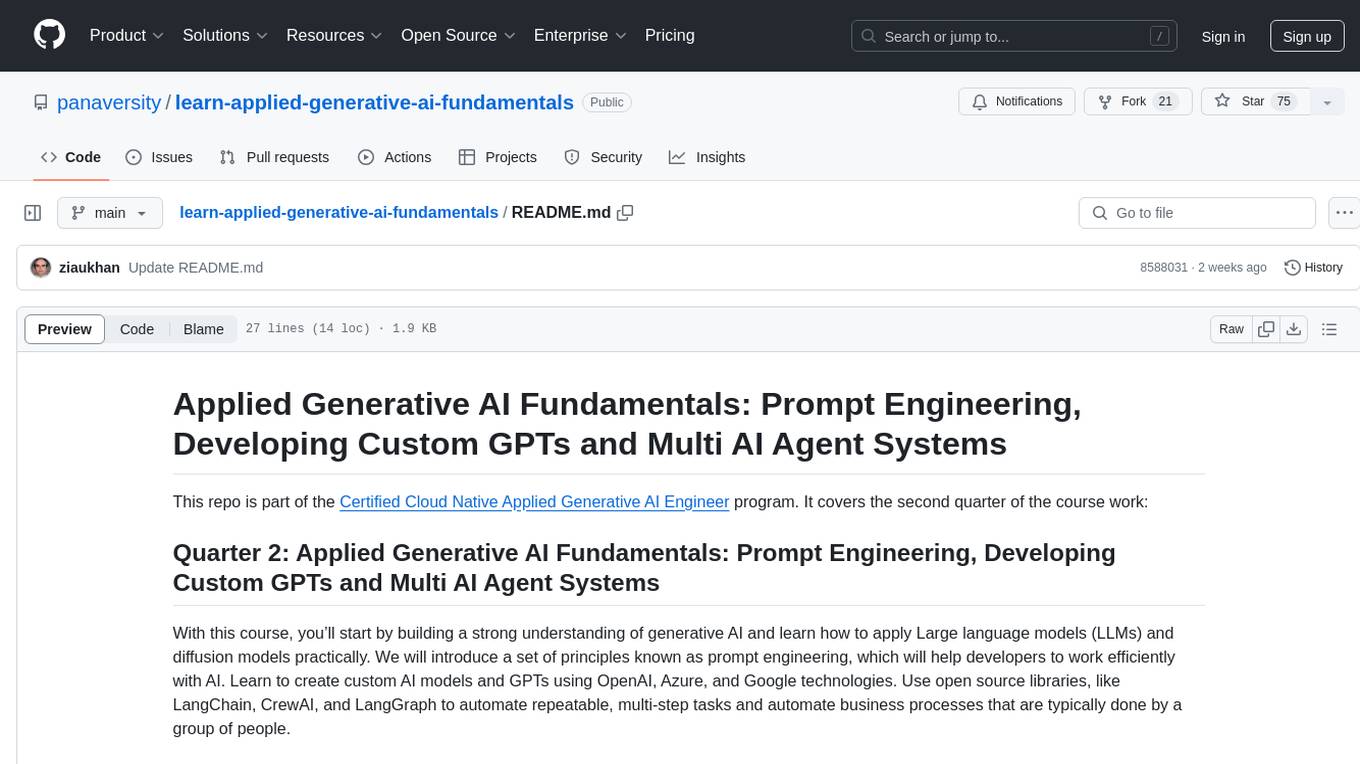
learn-applied-generative-ai-fundamentals
This repository is part of the Certified Cloud Native Applied Generative AI Engineer program, focusing on Applied Generative AI Fundamentals. It covers prompt engineering, developing custom GPTs, and Multi AI Agent Systems. The course helps in building a strong understanding of generative AI, applying Large Language Models (LLMs) and diffusion models practically. It introduces principles of prompt engineering to work efficiently with AI, creating custom AI models and GPTs using OpenAI, Azure, and Google technologies. It also utilizes open source libraries like LangChain, CrewAI, and LangGraph to automate tasks and business processes.
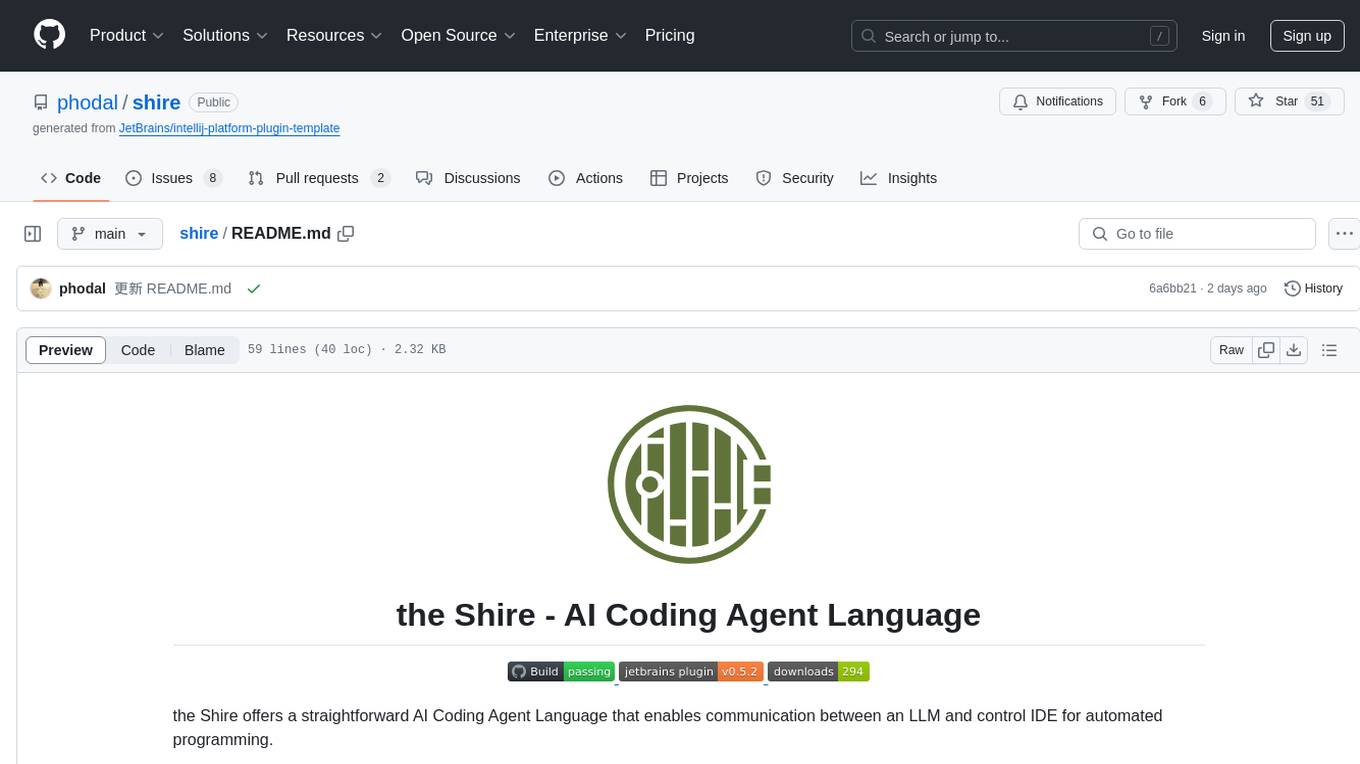
shire
The Shire is an AI Coding Agent Language that facilitates communication between an LLM and control IDE for automated programming. It offers a straightforward approach to creating AI agents tailored to individual IDEs, enabling users to build customized AI-driven development environments. The concept of Shire originated from AutoDev, a subproject of UnitMesh, with DevIns as its precursor. The tool provides documentation and resources for implementing AI in software engineering projects.
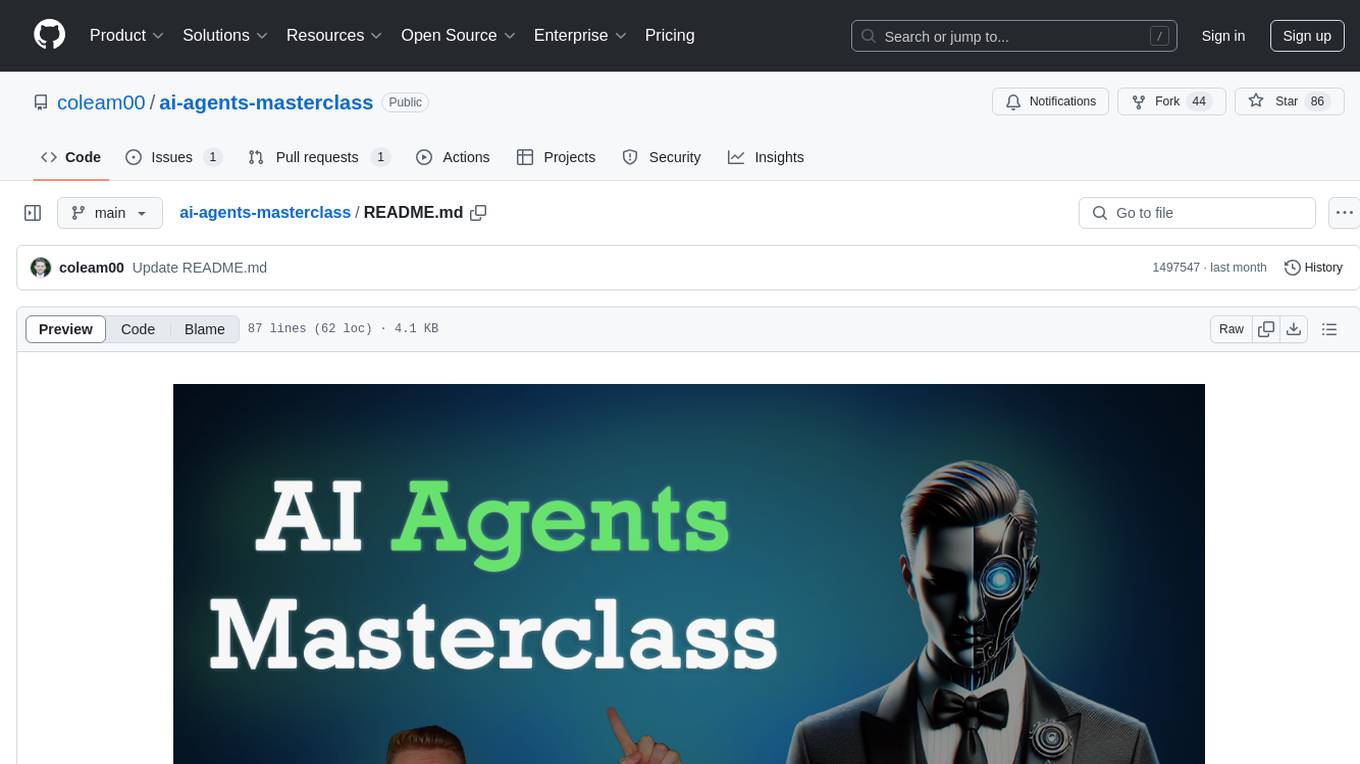
ai-agents-masterclass
AI Agents Masterclass is a repository dedicated to teaching developers how to use AI agents to transform businesses and create powerful software. It provides weekly videos with accompanying code folders, guiding users on setting up Python environments, using environment variables, and installing necessary packages to run the code. The focus is on Large Language Models that can interact with the outside world to perform tasks like drafting emails, booking appointments, and managing tasks, enabling users to create innovative applications with minimal coding effort.
For similar jobs
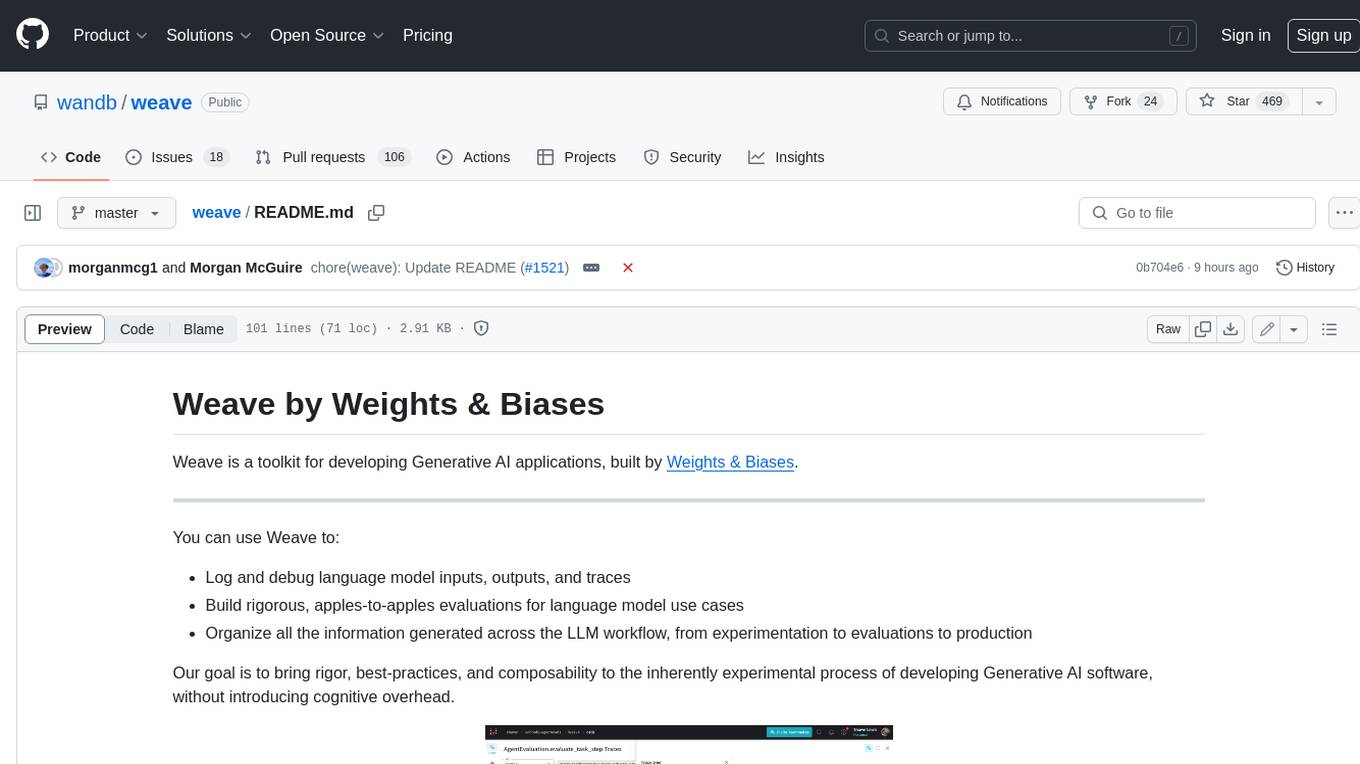
weave
Weave is a toolkit for developing Generative AI applications, built by Weights & Biases. With Weave, you can log and debug language model inputs, outputs, and traces; build rigorous, apples-to-apples evaluations for language model use cases; and organize all the information generated across the LLM workflow, from experimentation to evaluations to production. Weave aims to bring rigor, best-practices, and composability to the inherently experimental process of developing Generative AI software, without introducing cognitive overhead.
LLMStack
LLMStack is a no-code platform for building generative AI agents, workflows, and chatbots. It allows users to connect their own data, internal tools, and GPT-powered models without any coding experience. LLMStack can be deployed to the cloud or on-premise and can be accessed via HTTP API or triggered from Slack or Discord.
VisionCraft
The VisionCraft API is a free API for using over 100 different AI models. From images to sound.
kaito
Kaito is an operator that automates the AI/ML inference model deployment in a Kubernetes cluster. It manages large model files using container images, avoids tuning deployment parameters to fit GPU hardware by providing preset configurations, auto-provisions GPU nodes based on model requirements, and hosts large model images in the public Microsoft Container Registry (MCR) if the license allows. Using Kaito, the workflow of onboarding large AI inference models in Kubernetes is largely simplified.
PyRIT
PyRIT is an open access automation framework designed to empower security professionals and ML engineers to red team foundation models and their applications. It automates AI Red Teaming tasks to allow operators to focus on more complicated and time-consuming tasks and can also identify security harms such as misuse (e.g., malware generation, jailbreaking), and privacy harms (e.g., identity theft). The goal is to allow researchers to have a baseline of how well their model and entire inference pipeline is doing against different harm categories and to be able to compare that baseline to future iterations of their model. This allows them to have empirical data on how well their model is doing today, and detect any degradation of performance based on future improvements.
tabby
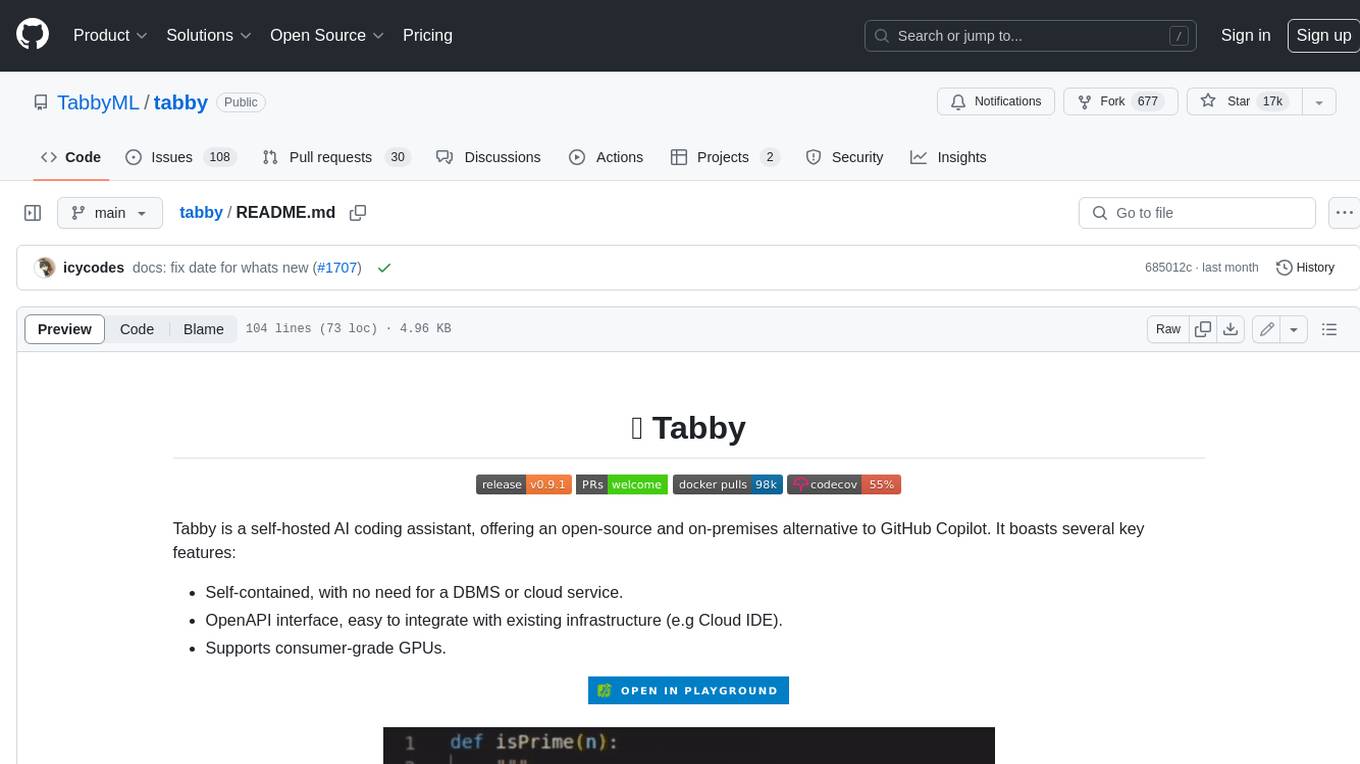
Tabby is a self-hosted AI coding assistant, offering an open-source and on-premises alternative to GitHub Copilot. It boasts several key features: * Self-contained, with no need for a DBMS or cloud service. * OpenAPI interface, easy to integrate with existing infrastructure (e.g Cloud IDE). * Supports consumer-grade GPUs.
spear
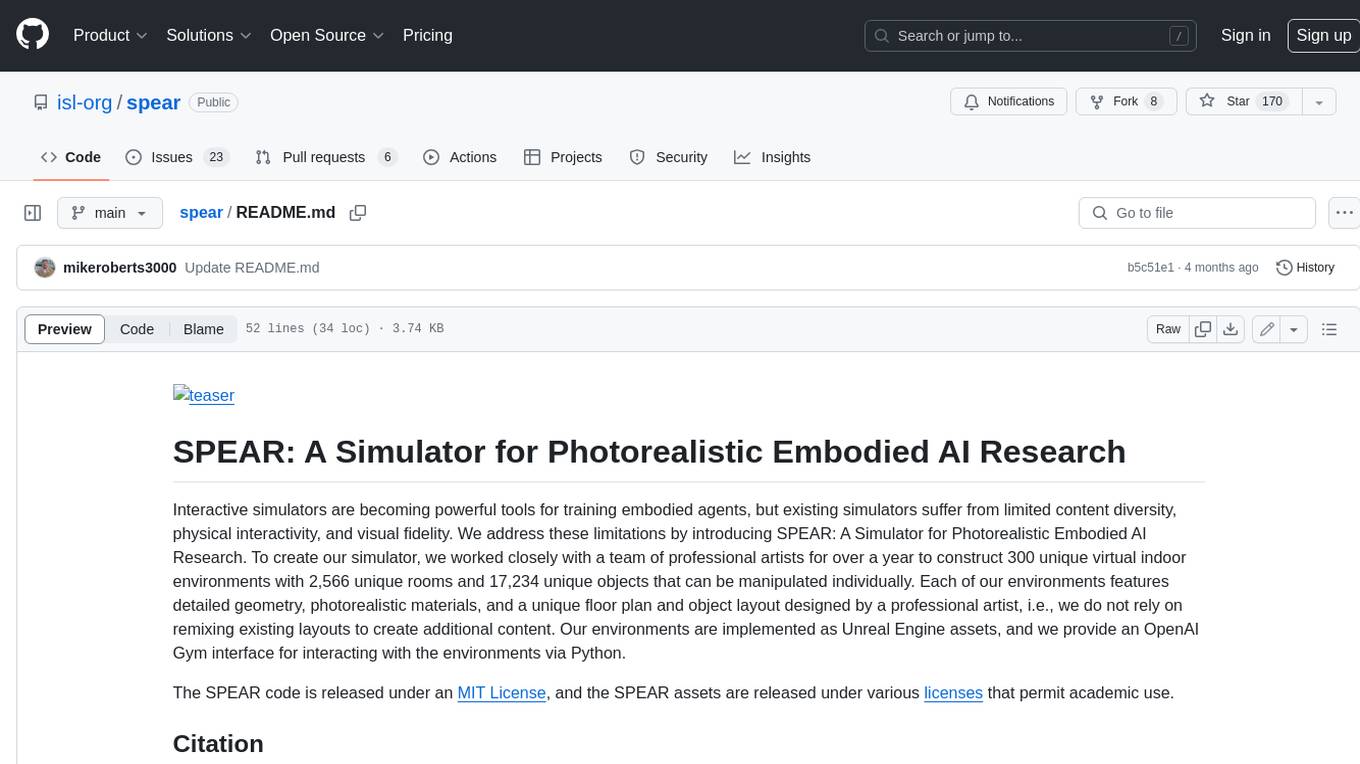
SPEAR (Simulator for Photorealistic Embodied AI Research) is a powerful tool for training embodied agents. It features 300 unique virtual indoor environments with 2,566 unique rooms and 17,234 unique objects that can be manipulated individually. Each environment is designed by a professional artist and features detailed geometry, photorealistic materials, and a unique floor plan and object layout. SPEAR is implemented as Unreal Engine assets and provides an OpenAI Gym interface for interacting with the environments via Python.
Magick
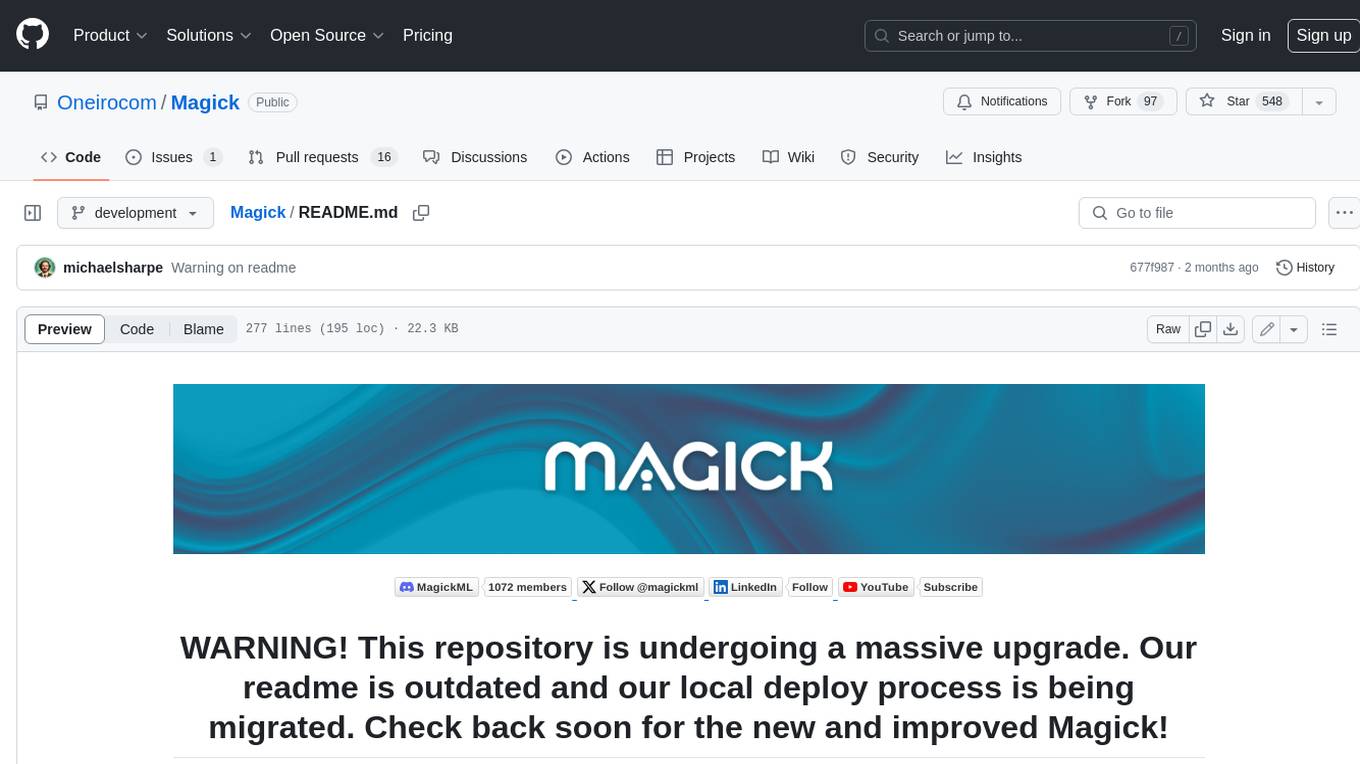
Magick is a groundbreaking visual AIDE (Artificial Intelligence Development Environment) for no-code data pipelines and multimodal agents. Magick can connect to other services and comes with nodes and templates well-suited for intelligent agents, chatbots, complex reasoning systems and realistic characters.