


aegis-stack
CLI for creating and evolving modular full stack Python applications over time, built on tools you already know.
Stars: 69
Aegis Stack is a system for creating and evolving modular Python applications quickly, without the need for extensive testing or clean architecture. It allows users to go from idea to working prototype rapidly, using familiar tools. The stack includes a CLI, a built-in system dashboard called Overseer, and an optional conversational interface named Illiana. Users can start with basic components and add or remove features as needed, without being locked into initial choices. Aegis Stack aims to provide a flexible and efficient development environment for Python applications.
README:







You need to ship reliable software, but management only gave you 2 weeks.
No time for health checks, proper testing, or clean architecture. Just enough time for duct tape and hope.
What if you could go from idea to working prototype in the time it takes to grab coffee?

Aegis Stack is a system for creating and evolving modular Python applications over time, built on tools you already know.
- Python 3.11+
-
Docker & Docker Compose - Required for the standard development workflow (
make serve). Generated projects use Docker for consistent environments and service dependencies (Redis for workers, health monitoring, etc.).
# Run instantly without installation
uvx aegis-stack init my-api

# Create with user authentication
uvx aegis-stack init user-app --services auth

# Create with background processing
uvx aegis-stack init task-processor --components scheduler,worker

# Start building
cd my-api && uv sync && cp .env.example .env && make serve
Installation alternatives: See the Installation Guide for uv tool install, pip install, and development setup.

Overseer is the built-in system dashboard that ships with every Aegis Stack project.
It provides a live view of what your application is doing at runtime - across core components (Backend, Database, Workers, Scheduler) and services (Auth, AI, Comms) - through a web UI.
Overseer goes beyond simple health checks. You can inspect worker queues, scheduled jobs, database state, and AI usage, all in one place, without wiring up external tools.
No Datadog. No New Relic. No vendor lock-in.
Just a clear view of your system, included from day one.

The Aegis CLI is a first-class interface to your running system.
It goes beyond simple health checks, exposing rich, component-specific commands for inspecting and understanding your application from the terminal.
Query worker queues, scheduler activity, database state, AI usage, and service configuration, all without leaving the CLI.
The same system intelligence that powers Overseer and Illiana is available here, optimized for terminal workflows.

When the AI service is enabled, Aegis exposes an additional interface: Illiana.
Illiana is a conversational interface that answers questions about your running system using live telemetry and optional RAG over your codebase.
She is not required to use Aegis Stack, and nothing in the system depends on her being present. When enabled, she becomes another way, alongside the CLI and Overseer, to understand what your application is doing and why.
Your choices aren't permanent. Start with what you need today, add components when requirements change, remove what you outgrow.
# Monday: Ship MVP
aegis init my-api

# Week 3: Add scheduled reports
aegis add scheduler --project-path ./my-api

# Month 2: Need async workers
aegis add worker --project-path ./my-api

# Month 6: Scheduler not needed
aegis remove scheduler --project-path ./my-api

# Stay current with template improvements
aegis update| Starter | Add Later? | Remove Later? | Git Conflicts? |
|---|---|---|---|
| Others | ❌ Locked at init | ❌ Manual deletion | |
| Aegis Stack | ✅ One command | ✅ One command | ✅ Auto-handled |

Most starters lock you in at init. Aegis Stack doesn't. See Evolving Your Stack for the complete guide.
Components (infrastructure)
- Core → FastAPI + Pydantic V2 + Uvicorn
- Database → Postgres / SQLite
- Cache/Queue → Redis
- Scheduler → APScheduler
- Worker → Arq / Taskiq
Services (business logic)
- Auth → JWT authentication
- AI → PydanticAI / LangChain
- Comms → Resend + Twilio
Components Docs → | Services Docs →
- CLI Reference - Complete command reference
- About - The philosophy and vision behind Aegis Stack
- Evolving Your Stack - Add/remove components as needs change
- Technology Stack - Battle-tested technology choices

No reinventing the wheel. Just the tools you already know, pre-configured and ready to compose.
Aegis Stack respects your expertise. No custom abstractions or proprietary patterns to learn. Pick your components, get a production-ready foundation, and build your way.
Aegis gets out of your way so you can get started.
For Tasks:
Click tags to check more tools for each tasksFor Jobs:
Alternative AI tools for aegis-stack
Similar Open Source Tools
aegis-stack
Aegis Stack is a system for creating and evolving modular Python applications quickly, without the need for extensive testing or clean architecture. It allows users to go from idea to working prototype rapidly, using familiar tools. The stack includes a CLI, a built-in system dashboard called Overseer, and an optional conversational interface named Illiana. Users can start with basic components and add or remove features as needed, without being locked into initial choices. Aegis Stack aims to provide a flexible and efficient development environment for Python applications.
TaskingAI
TaskingAI brings Firebase's simplicity to **AI-native app development**. The platform enables the creation of GPTs-like multi-tenant applications using a wide range of LLMs from various providers. It features distinct, modular functions such as Inference, Retrieval, Assistant, and Tool, seamlessly integrated to enhance the development process. TaskingAI’s cohesive design ensures an efficient, intelligent, and user-friendly experience in AI application development.
clearml
ClearML is an auto-magical suite of tools designed to streamline AI workflows. It includes modules for experiment management, MLOps/LLMOps, data management, model serving, and more. ClearML offers features like experiment tracking, model serving, orchestration, and automation. It supports various ML/DL frameworks and integrates with Jupyter Notebook and PyCharm for remote debugging. ClearML aims to simplify collaboration, automate processes, and enhance visibility in AI projects.
Ivy-Framework
Ivy-Framework is a powerful tool for building internal applications with AI assistance using C# codebase. It provides a CLI for project initialization, authentication integrations, database support, LLM code generation, secrets management, container deployment, hot reload, dependency injection, state management, routing, and external widget framework. Users can easily create data tables for sorting, filtering, and pagination. The framework offers a seamless integration of front-end and back-end development, making it ideal for developing robust internal tools and dashboards.
gptme
Personal AI assistant/agent in your terminal, with tools for using the terminal, running code, editing files, browsing the web, using vision, and more. A great coding agent that is general-purpose to assist in all kinds of knowledge work, from a simple but powerful CLI. An unconstrained local alternative to ChatGPT with 'Code Interpreter', Cursor Agent, etc. Not limited by lack of software, internet access, timeouts, or privacy concerns if using local models.
DevoxxGenieIDEAPlugin
Devoxx Genie is a Java-based IntelliJ IDEA plugin that integrates with local and cloud-based LLM providers to aid in reviewing, testing, and explaining project code. It supports features like code highlighting, chat conversations, and adding files/code snippets to context. Users can modify REST endpoints and LLM parameters in settings, including support for cloud-based LLMs. The plugin requires IntelliJ version 2023.3.4 and JDK 17. Building and publishing the plugin is done using Gradle tasks. Users can select an LLM provider, choose code, and use commands like review, explain, or generate unit tests for code analysis.
trigger.dev
Trigger.dev is an open source platform and SDK for creating long-running background jobs. It provides features like JavaScript and TypeScript SDK, no timeouts, retries, queues, schedules, observability, React hooks, Realtime API, custom alerts, elastic scaling, and works with existing tech stack. Users can create tasks in their codebase, deploy tasks using the SDK, manage tasks in different environments, and have full visibility of job runs. The platform offers a trace view of every task run for detailed monitoring. Getting started is easy with account creation, project setup, and onboarding instructions. Self-hosting and development guides are available for users interested in contributing or hosting Trigger.dev.
RWKV_APP
RWKV App is an experimental application that enables users to run Large Language Models (LLMs) offline on their edge devices. It offers a privacy-first, on-device LLM experience for everyday devices. Users can engage in multi-turn conversations, text-to-speech, visual understanding, and more, all without requiring an internet connection. The app supports switching between different models, running locally without internet, and exploring various AI tasks such as chat, speech generation, and visual understanding. It is built using Flutter and Dart FFI for cross-platform compatibility and efficient communication with the C++ inference engine. The roadmap includes integrating features into the RWKV Chat app, supporting more model weights, hardware, operating systems, and devices.
actionbook
Actionbook is a browser action engine designed for AI agents, providing up-to-date action manuals and DOM structure to enable instant website operations without guesswork. It offers faster execution, token savings, resilient automation, and universal compatibility, making it ideal for building reliable browser agents. Actionbook integrates seamlessly with AI coding assistants and offers three integration methods: CLI, MCP Server, and JavaScript SDK. The tool is well-documented and actively developed in a monorepo setup using pnpm workspaces and Turborepo.
orbit
ORBIT (Open Retrieval-Based Inference Toolkit) is a middleware platform that provides a unified API for AI inference. It acts as a central gateway, allowing you to connect various local and remote AI models with your private data sources like SQL databases, vector stores, and local files. ORBIT uses a flexible adapter architecture to connect your data to AI models, creating specialized 'agents' for specific tasks. It supports scenarios like Knowledge Base Q&A and Chat with Your SQL Database, enabling users to interact with AI models seamlessly. The tool offers a RESTful API for programmatic access and includes features like authentication, API key management, system prompts, health monitoring, and file management. ORBIT is designed to streamline AI inference tasks and facilitate interactions between users and AI models.
db2rest
DB2Rest is a modern low code REST DATA API platform that enables the rapid development of intelligent applications by combining databases, language models, and vector stores. It facilitates context-aware, reasoning applications without vendor lock-in. The tool accelerates application delivery, fosters faster innovation with AI, serves as a secure database gateway, and simplifies integration. It supports various databases like PostgreSQL, MySQL, MS SQL Server, Oracle, MongoDB, and more, with planned support for additional databases. Users can connect on Discord for support and contact [email protected] for inquiries.
refact
This repository contains Refact WebUI for fine-tuning and self-hosting of code models, which can be used inside Refact plugins for code completion and chat. Users can fine-tune open-source code models, self-host them, download and upload Lloras, use models for code completion and chat inside Refact plugins, shard models, host multiple small models on one GPU, and connect GPT-models for chat using OpenAI and Anthropic keys. The repository provides a Docker container for running the self-hosted server and supports various models for completion, chat, and fine-tuning. Refact is free for individuals and small teams under the BSD-3-Clause license, with custom installation options available for GPU support. The community and support include contributing guidelines, GitHub issues for bugs, a community forum, Discord for chatting, and Twitter for product news and updates.
ai-flow
AI Flow is an open-source, user-friendly UI application that empowers you to seamlessly connect multiple AI models together, specifically leveraging the capabilities of multiples AI APIs such as OpenAI, StabilityAI and Replicate. In a nutshell, AI Flow provides a visual platform for crafting and managing AI-driven workflows, thereby facilitating diverse and dynamic AI interactions.
LynxHub
LynxHub is a platform that allows users to seamlessly install, configure, launch, and manage all their AI interfaces from a single, intuitive dashboard. It offers features like AI interface management, arguments manager, custom run commands, pre-launch actions, extension management, in-app tools like terminal and web browser, AI information dashboard, Discord integration, and additional features like theme options and favorite interface pinning. The platform supports modular design for custom AI modules and upcoming extensions system for complete customization. LynxHub aims to streamline AI workflow and enhance user experience with a user-friendly interface and comprehensive functionalities.
tuff
Tuff is a local-first, AI-native, and infinitely extensible desktop command center designed to enhance workflow efficiency. It offers a seamless integration of core utilities, AI-powered search, contextual intelligence, and extensibility through custom plugins. With a beautiful UI design, rich functionality, simple operations, and a focus on security and reliability, Tuff provides users with a cross-platform desktop software that is easy to use and offers a good user experience.
sematic
Sematic is an open-source ML development platform that allows ML Engineers and Data Scientists to write complex end-to-end pipelines with Python. It can be executed locally, on a cloud VM, or on a Kubernetes cluster. Sematic enables chaining data processing jobs with model training into reproducible pipelines that can be monitored and visualized in a web dashboard. It offers features like easy onboarding, local-to-cloud parity, end-to-end traceability, access to heterogeneous compute resources, and reproducibility.
For similar tasks
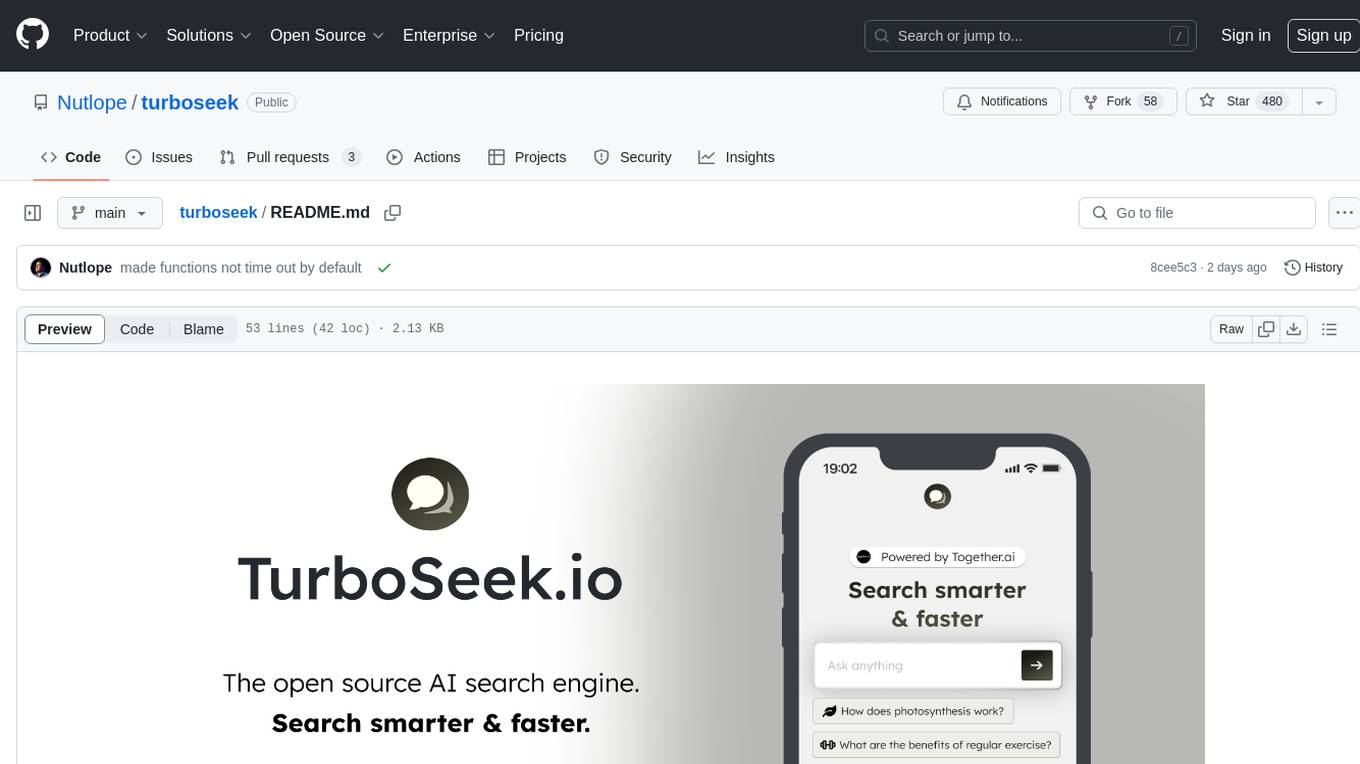
turboseek
TurboSeek is an open source AI search engine powered by Together.ai. It utilizes Next.js with Tailwind for the app router, Together AI for LLM inference, Mixtral 8x7B & Llama-3 for the LLMs, Bing for the search API, Helicone for observability, and Plausible for website analytics. The tool takes a user's question, queries the Bing search API for top results, scrapes text from the links, sends the question and context to Mixtral-8x7B, and generates follow-up questions using Llama-3-8B. Future tasks include optimizing source parsing, ignoring video links, adding regeneration option, ensuring proper citations, enabling sharing, implementing scrolling during answers, fixing hard refresh, adding caching with upstash redis, incorporating advanced RAG techniques, and adding authentication with Clerk and postgres/prisma.
aegis-stack
Aegis Stack is a system for creating and evolving modular Python applications quickly, without the need for extensive testing or clean architecture. It allows users to go from idea to working prototype rapidly, using familiar tools. The stack includes a CLI, a built-in system dashboard called Overseer, and an optional conversational interface named Illiana. Users can start with basic components and add or remove features as needed, without being locked into initial choices. Aegis Stack aims to provide a flexible and efficient development environment for Python applications.
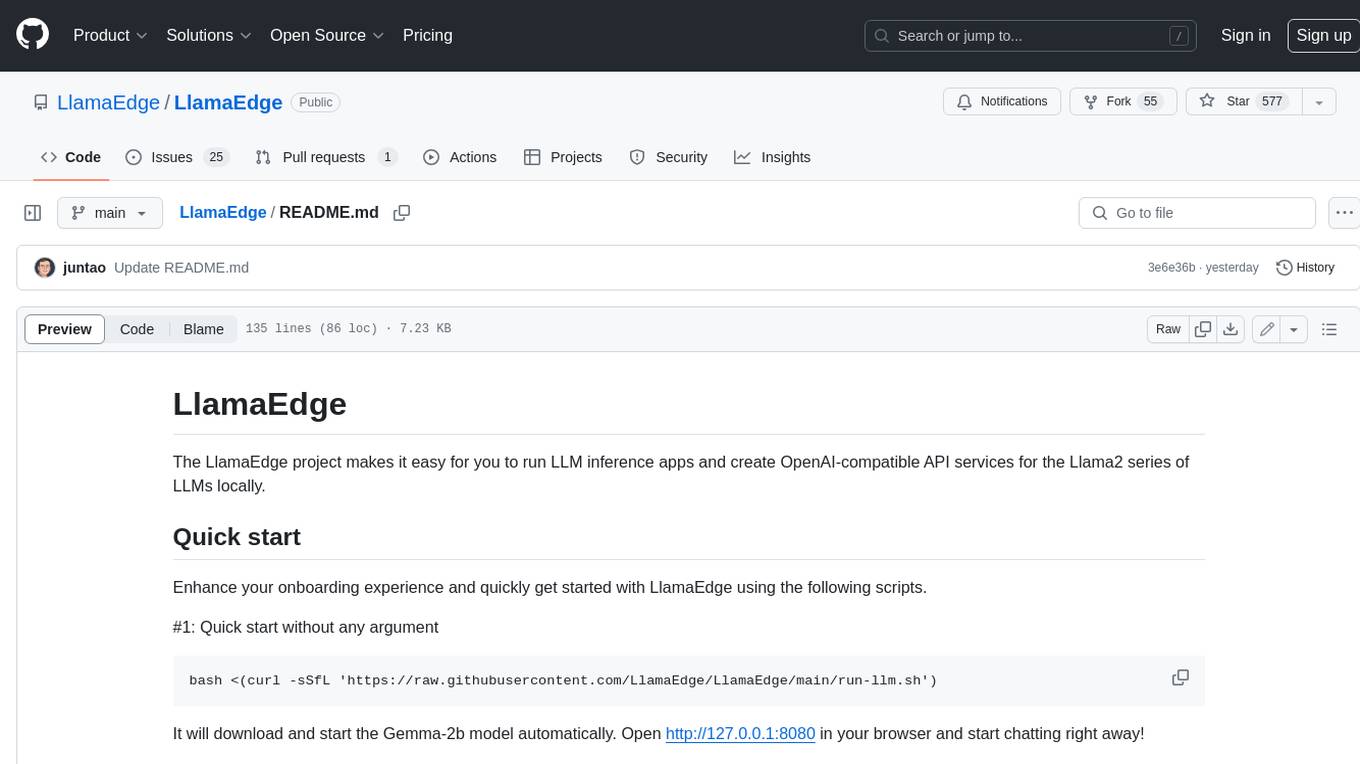
LlamaEdge
The LlamaEdge project makes it easy to run LLM inference apps and create OpenAI-compatible API services for the Llama2 series of LLMs locally. It provides a Rust+Wasm stack for fast, portable, and secure LLM inference on heterogeneous edge devices. The project includes source code for text generation, chatbot, and API server applications, supporting all LLMs based on the llama2 framework in the GGUF format. LlamaEdge is committed to continuously testing and validating new open-source models and offers a list of supported models with download links and startup commands. It is cross-platform, supporting various OSes, CPUs, and GPUs, and provides troubleshooting tips for common errors.
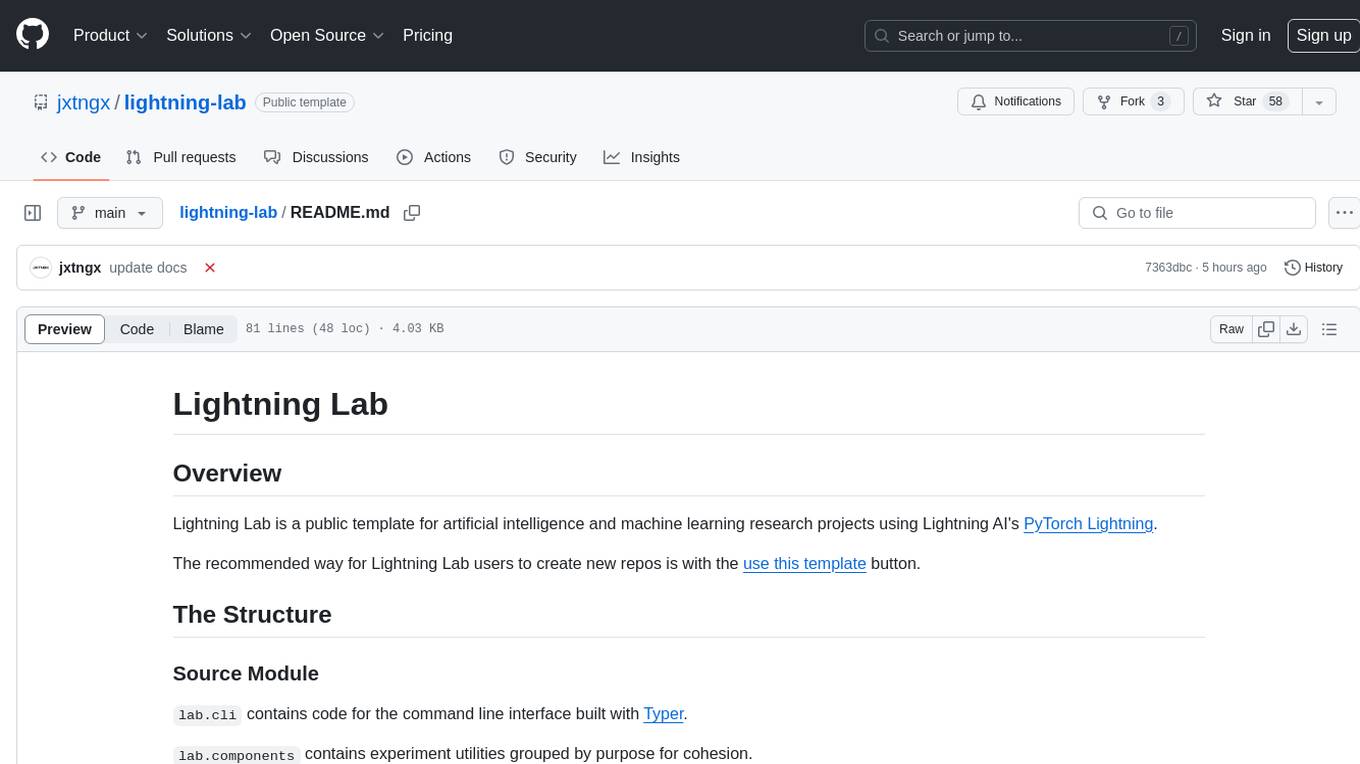
lightning-lab
Lightning Lab is a public template for artificial intelligence and machine learning research projects using Lightning AI's PyTorch Lightning. It provides a structured project layout with modules for command line interface, experiment utilities, Lightning Module and Trainer, data acquisition and preprocessing, model serving APIs, project configurations, training checkpoints, technical documentation, logs, notebooks for data analysis, requirements management, testing, and packaging. The template simplifies the setup of deep learning projects and offers extras for different domains like vision, text, audio, reinforcement learning, and forecasting.
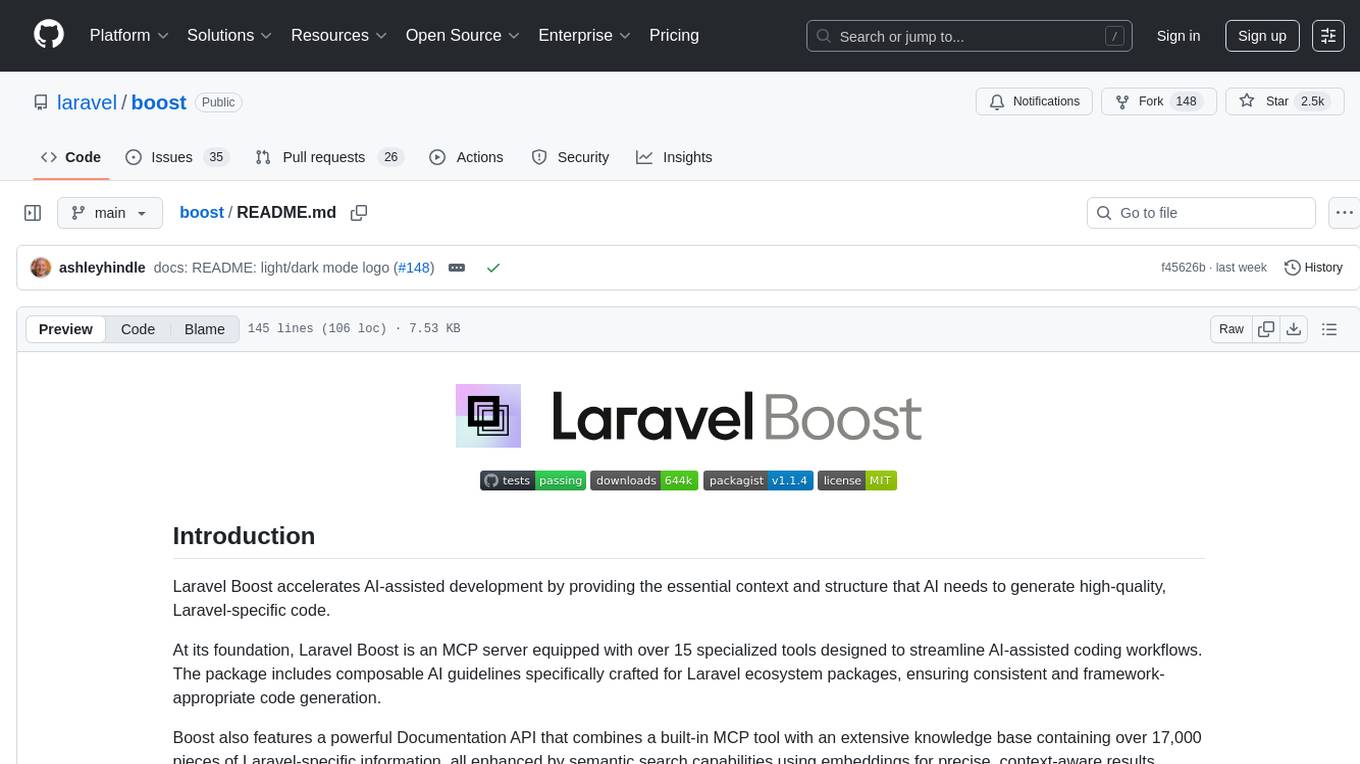
boost
Laravel Boost accelerates AI-assisted development by providing essential context and structure for generating high-quality, Laravel-specific code. It includes an MCP server with specialized tools, AI guidelines, and a Documentation API. Boost is designed to streamline AI-assisted coding workflows by offering precise, context-aware results and extensive Laravel-specific information.
For similar jobs
weave
Weave is a toolkit for developing Generative AI applications, built by Weights & Biases. With Weave, you can log and debug language model inputs, outputs, and traces; build rigorous, apples-to-apples evaluations for language model use cases; and organize all the information generated across the LLM workflow, from experimentation to evaluations to production. Weave aims to bring rigor, best-practices, and composability to the inherently experimental process of developing Generative AI software, without introducing cognitive overhead.
agentcloud
AgentCloud is an open-source platform that enables companies to build and deploy private LLM chat apps, empowering teams to securely interact with their data. It comprises three main components: Agent Backend, Webapp, and Vector Proxy. To run this project locally, clone the repository, install Docker, and start the services. The project is licensed under the GNU Affero General Public License, version 3 only. Contributions and feedback are welcome from the community.
oss-fuzz-gen
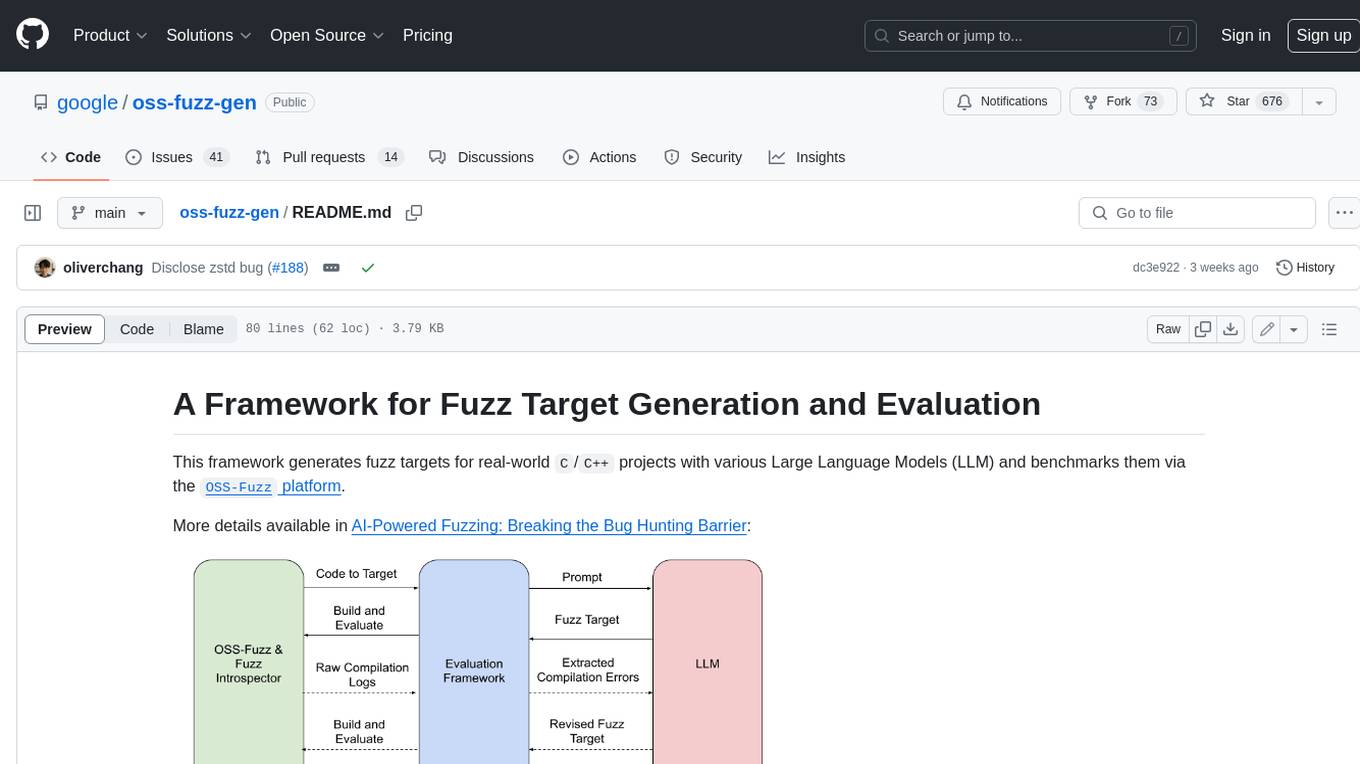
This framework generates fuzz targets for real-world `C`/`C++` projects with various Large Language Models (LLM) and benchmarks them via the `OSS-Fuzz` platform. It manages to successfully leverage LLMs to generate valid fuzz targets (which generate non-zero coverage increase) for 160 C/C++ projects. The maximum line coverage increase is 29% from the existing human-written targets.
LLMStack
LLMStack is a no-code platform for building generative AI agents, workflows, and chatbots. It allows users to connect their own data, internal tools, and GPT-powered models without any coding experience. LLMStack can be deployed to the cloud or on-premise and can be accessed via HTTP API or triggered from Slack or Discord.
VisionCraft
The VisionCraft API is a free API for using over 100 different AI models. From images to sound.
kaito
Kaito is an operator that automates the AI/ML inference model deployment in a Kubernetes cluster. It manages large model files using container images, avoids tuning deployment parameters to fit GPU hardware by providing preset configurations, auto-provisions GPU nodes based on model requirements, and hosts large model images in the public Microsoft Container Registry (MCR) if the license allows. Using Kaito, the workflow of onboarding large AI inference models in Kubernetes is largely simplified.
PyRIT
PyRIT is an open access automation framework designed to empower security professionals and ML engineers to red team foundation models and their applications. It automates AI Red Teaming tasks to allow operators to focus on more complicated and time-consuming tasks and can also identify security harms such as misuse (e.g., malware generation, jailbreaking), and privacy harms (e.g., identity theft). The goal is to allow researchers to have a baseline of how well their model and entire inference pipeline is doing against different harm categories and to be able to compare that baseline to future iterations of their model. This allows them to have empirical data on how well their model is doing today, and detect any degradation of performance based on future improvements.
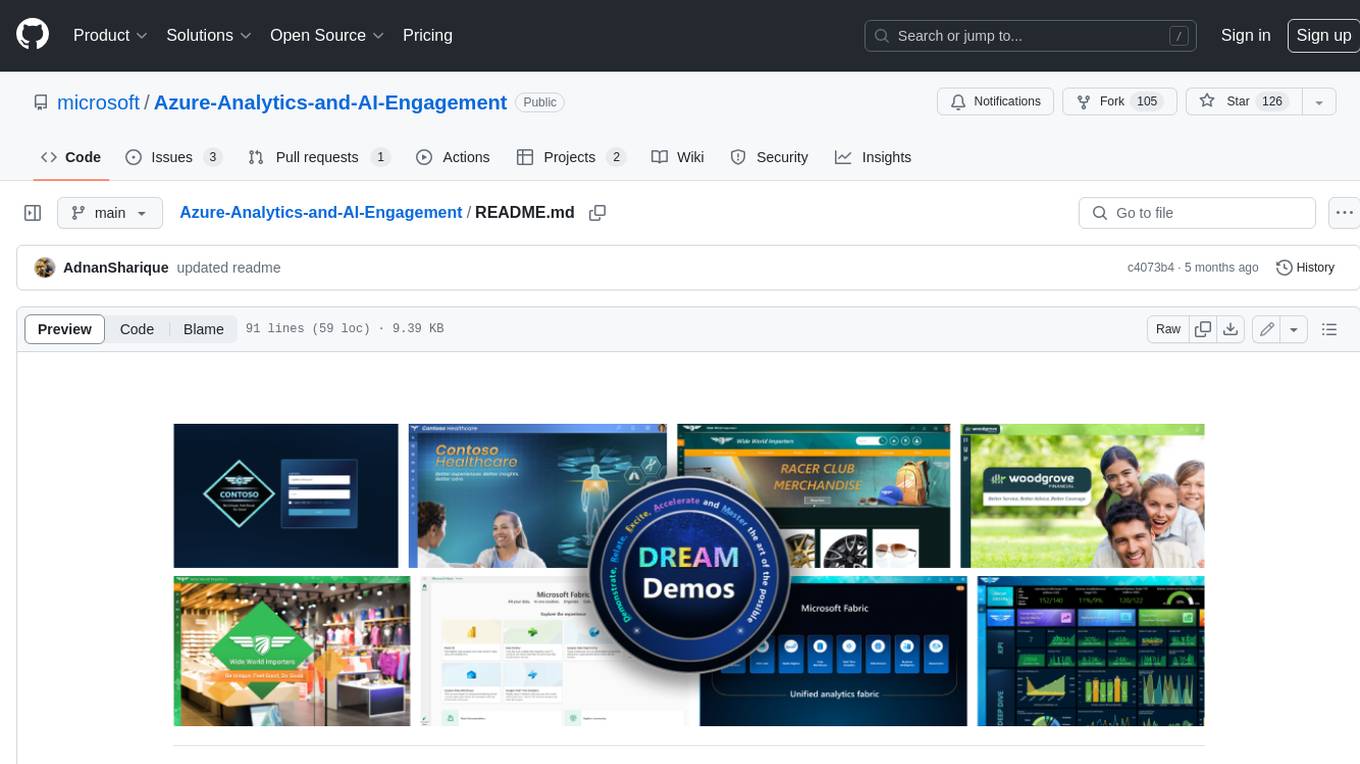
Azure-Analytics-and-AI-Engagement
The Azure-Analytics-and-AI-Engagement repository provides packaged Industry Scenario DREAM Demos with ARM templates (Containing a demo web application, Power BI reports, Synapse resources, AML Notebooks etc.) that can be deployed in a customer’s subscription using the CAPE tool within a matter of few hours. Partners can also deploy DREAM Demos in their own subscriptions using DPoC.