


god-level-ai
A collection of scientific methods, processes, algorithms, and systems to build stories & models.
Stars: 3544
A drill of scientific methods, processes, algorithms, and systems to build stories & models. An in-depth learning resource for humans. This is a drill for people who aim to be in the top 1% of Data and AI experts. The repository provides a routine for deep and shallow work sessions, covering topics from Python to AI/ML System Design and Personal Branding & Portfolio. It emphasizes the importance of continuous effort and action in the tech field.
README:

A drill of scientific methods, processes, algorithms, and systems to build stories & models. An in-depth learning resource for humans.
This is a drill for people who aim to be in the top 1% of Data and AI experts.
You can do the drill by watching video sessions or text content.
I will recommend video sessions and use text content as go-to notes.
You can be in one of the following categories:-
- either you are working on a leadership position
- or you are working as a professional
- or you are a student
No matter what position you are working in currently, you need to put in the same amount of effort to be in the top 1%.
Spoiler alert - There are NO Shortcuts in the tech field.
This is for all humans who want to improve in the field and are courageous enough to take action.
You will find all the topics explained here and whatever is needed to understand it completely.
The drill is all action-oriented.
To be the authority/best in the AI field, I created a routine that includes:
- 4 hours of deep work sessions every day
- Deep work session rules:
- no phone/notifications
- no talking to anyone
- coffee/chai allowed
- Deep work session rules:
- 2 hours of shallow work sessions every day
- Shallow work session rules:
- phone allowed
- talking allowed
- include sharing your work online
- Shallow work session rules:
You can customize the learning sessions according to your time availability.
For Tasks:
Click tags to check more tools for each tasksFor Jobs:
Alternative AI tools for god-level-ai
Similar Open Source Tools
god-level-ai
A drill of scientific methods, processes, algorithms, and systems to build stories & models. An in-depth learning resource for humans. This is a drill for people who aim to be in the top 1% of Data and AI experts. The repository provides a routine for deep and shallow work sessions, covering topics from Python to AI/ML System Design and Personal Branding & Portfolio. It emphasizes the importance of continuous effort and action in the tech field.
AI-Engineer-Headquarters
AI Engineer Headquarters is a comprehensive learning resource designed to help individuals master scientific methods, processes, algorithms, and systems to build stories and models in the field of Data and AI. The repository provides in-depth content through video sessions and text materials, catering to individuals aspiring to be in the top 1% of Data and AI experts. It covers various topics such as AI engineering foundations, large language models, retrieval-augmented generation, fine-tuning LLMs, reinforcement learning, ethical AI, agentic workflows, and career acceleration. The learning approach emphasizes action-oriented drills and routines, encouraging consistent effort and dedication to excel in the AI field.
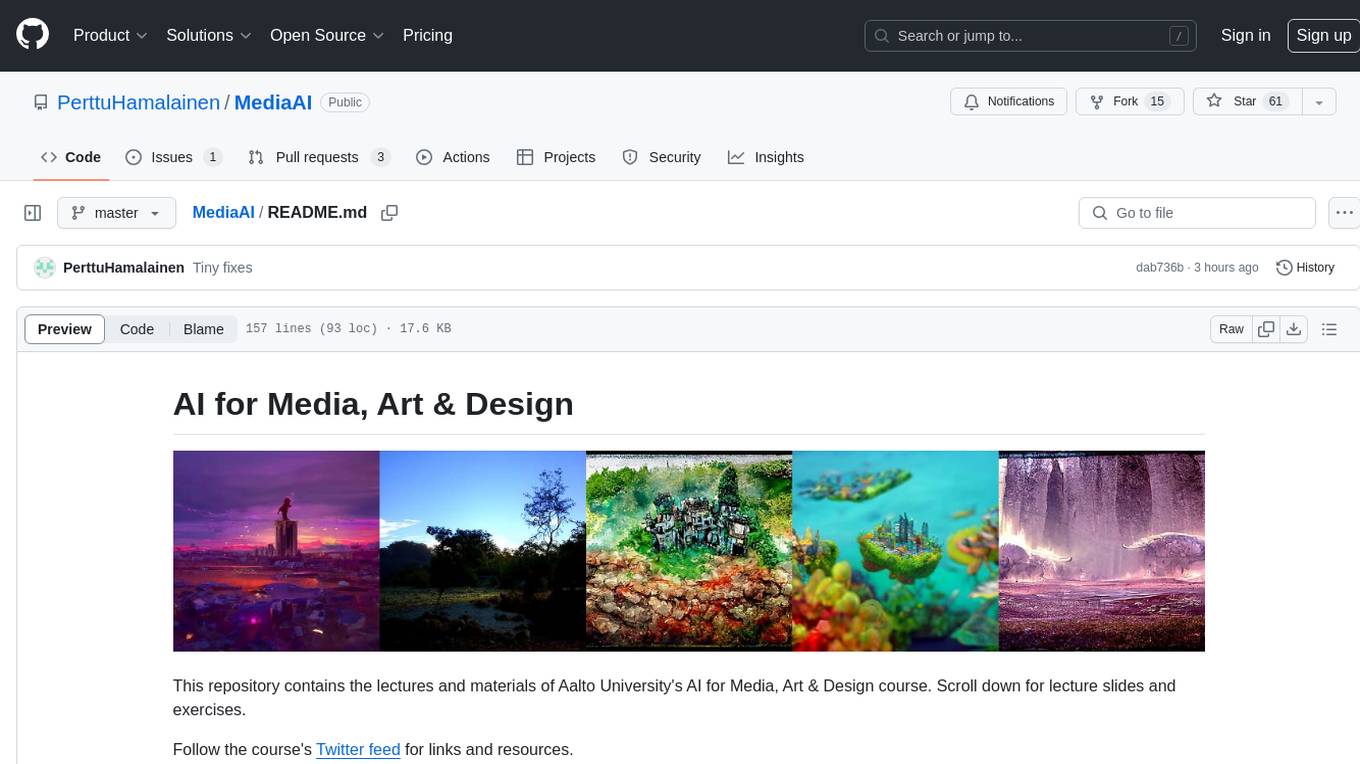
MediaAI
MediaAI is a repository containing lectures and materials for Aalto University's AI for Media, Art & Design course. The course is a hands-on, project-based crash course focusing on deep learning and AI techniques for artists and designers. It covers common AI algorithms & tools, their applications in art, media, and design, and provides hands-on practice in designing, implementing, and using these tools. The course includes lectures, exercises, and a final project based on students' interests. Students can complete the course without programming by creatively utilizing existing tools like ChatGPT and DALL-E. The course emphasizes collaboration, peer-to-peer tutoring, and project-based learning. It covers topics such as text generation, image generation, optimization, and game AI.
mlforpublicpolicylab
The Machine Learning for Public Policy Lab is a project-based course focused on solving real-world problems using machine learning in the context of public policy and social good. Students will gain hands-on experience building end-to-end machine learning systems, developing skills in problem formulation, working with messy data, communicating with non-technical stakeholders, model interpretability, and understanding algorithmic bias & disparities. The course covers topics such as project scoping, data acquisition, feature engineering, model evaluation, bias and fairness, and model interpretability. Students will work in small groups on policy projects, with graded components including project proposals, presentations, and final reports.
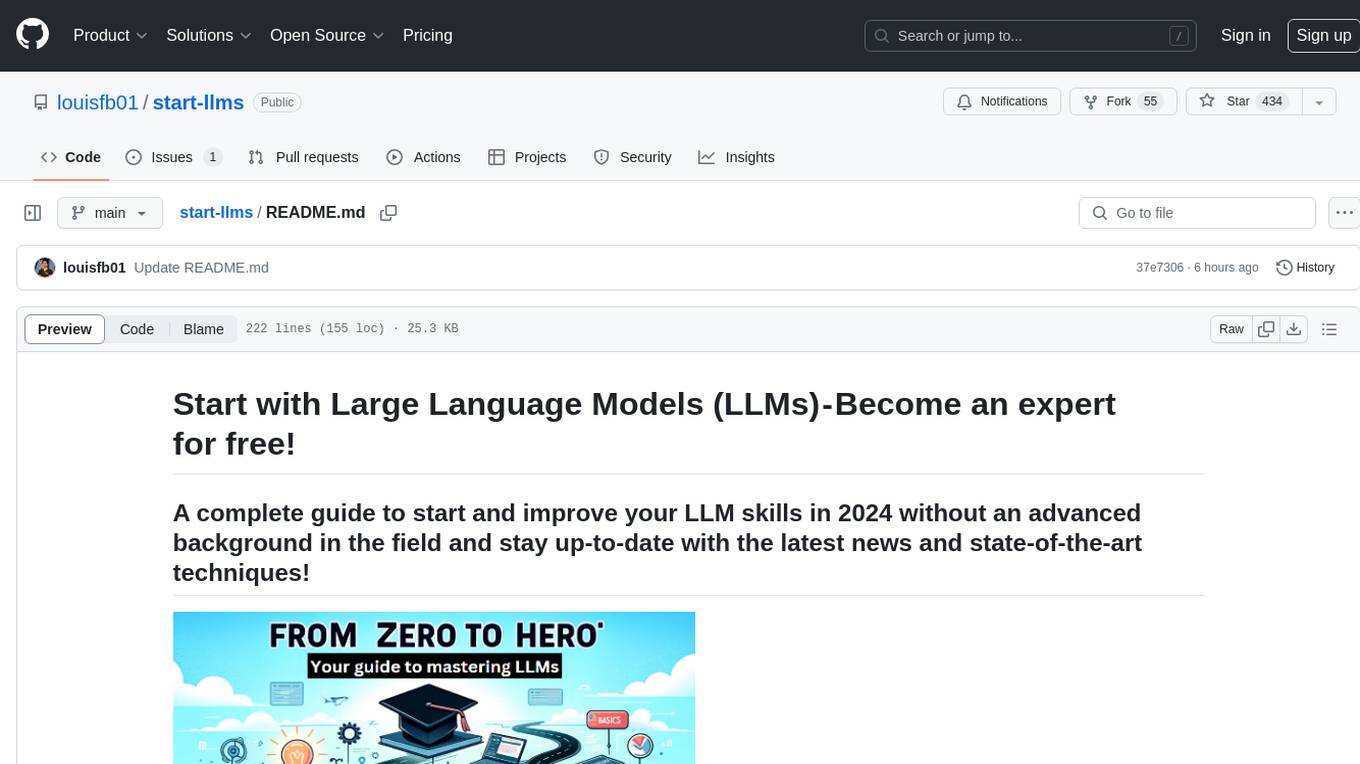
start-llms
This repository is a comprehensive guide for individuals looking to start and improve their skills in Large Language Models (LLMs) without an advanced background in the field. It provides free resources, online courses, books, articles, and practical tips to become an expert in machine learning. The guide covers topics such as terminology, transformers, prompting, retrieval augmented generation (RAG), and more. It also includes recommendations for podcasts, YouTube videos, and communities to stay updated with the latest news in AI and LLMs.
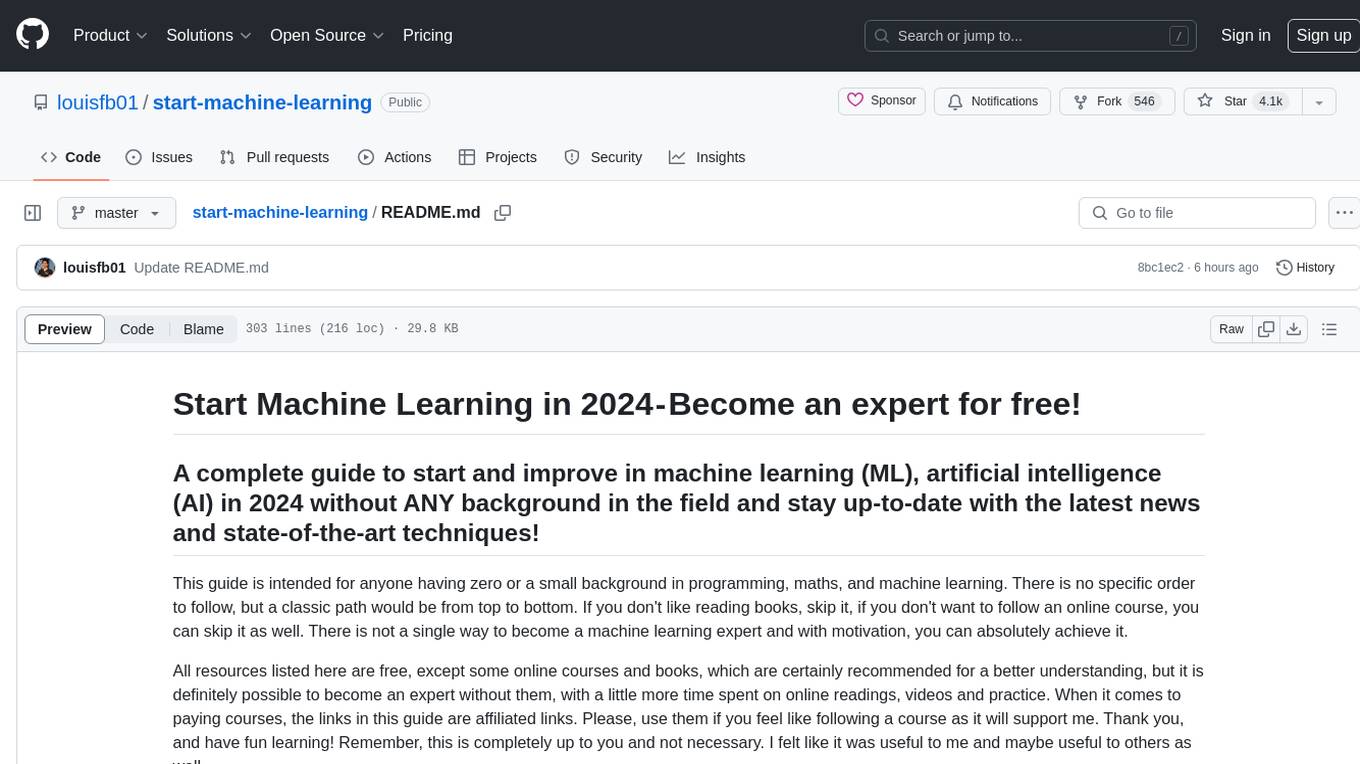
start-machine-learning
Start Machine Learning in 2024 is a comprehensive guide for beginners to advance in machine learning and artificial intelligence without any prior background. The guide covers various resources such as free online courses, articles, books, and practical tips to become an expert in the field. It emphasizes self-paced learning and provides recommendations for learning paths, including videos, podcasts, and online communities. The guide also includes information on building language models and applications, practicing through Kaggle competitions, and staying updated with the latest news and developments in AI. The goal is to empower individuals with the knowledge and resources to excel in machine learning and AI.
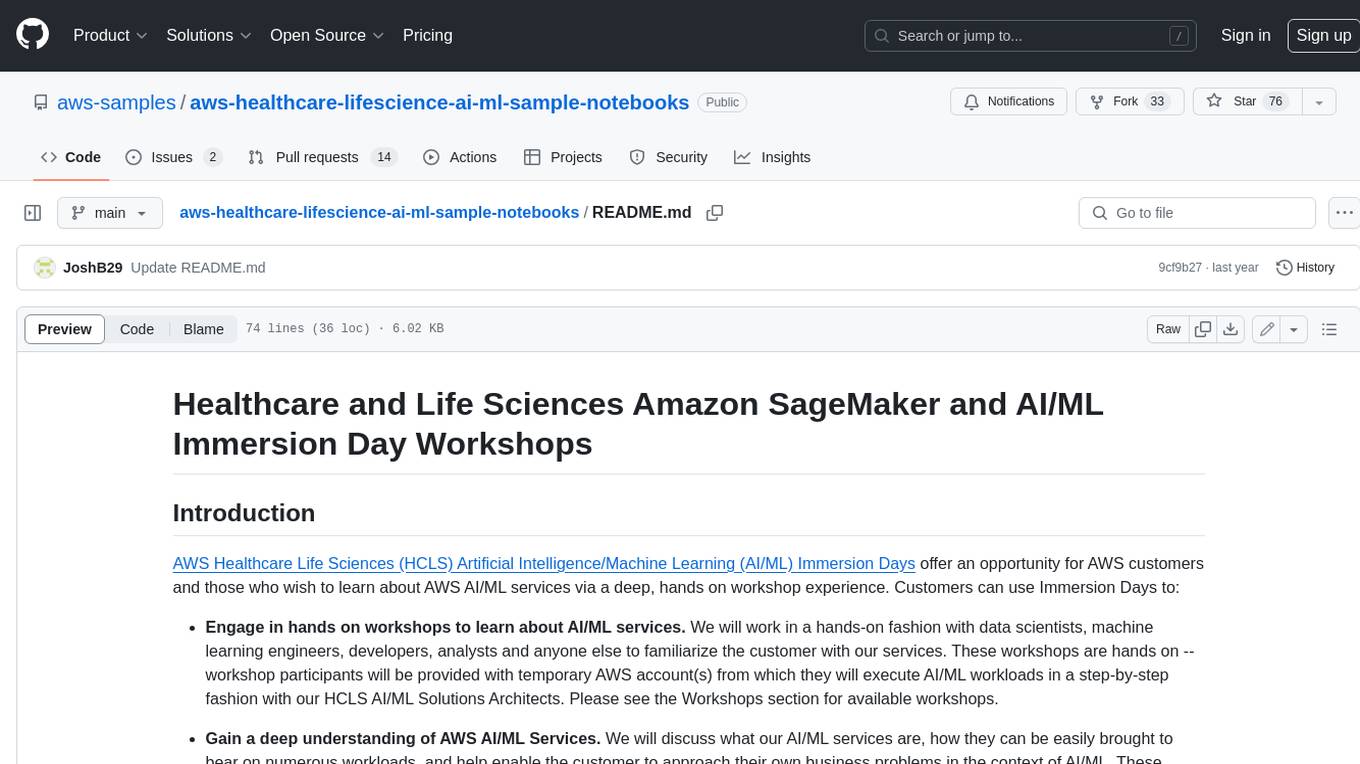
aws-healthcare-lifescience-ai-ml-sample-notebooks
The AWS Healthcare and Life Sciences AI/ML Immersion Day workshops provide hands-on experience for customers to learn about AI/ML services, gain a deep understanding of AWS AI/ML services, and understand best practices for using AI/ML in the context of HCLS applications. The workshops cater to individuals at all levels, from machine learning experts to developers and managers, and cover topics such as training, testing, MLOps, deployment practices, and software development life cycle in the context of AI/ML. The repository contains notebooks that can be used in AWS Instructure-Led Labs or self-paced labs, offering a comprehensive learning experience for integrating AI/ML into applications.
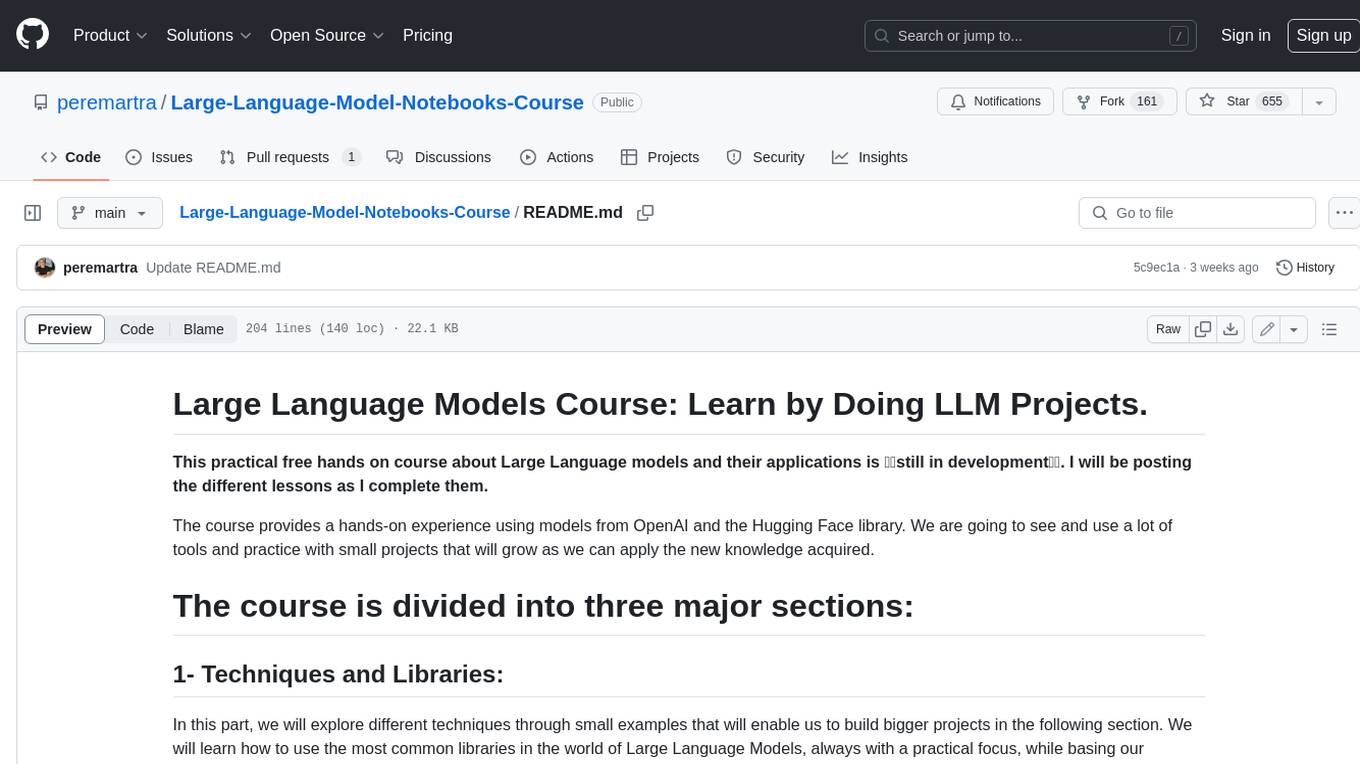
Large-Language-Model-Notebooks-Course
This practical free hands-on course focuses on Large Language models and their applications, providing a hands-on experience using models from OpenAI and the Hugging Face library. The course is divided into three major sections: Techniques and Libraries, Projects, and Enterprise Solutions. It covers topics such as Chatbots, Code Generation, Vector databases, LangChain, Fine Tuning, PEFT Fine Tuning, Soft Prompt tuning, LoRA, QLoRA, Evaluate Models, Knowledge Distillation, and more. Each section contains chapters with lessons supported by notebooks and articles. The course aims to help users build projects and explore enterprise solutions using Large Language Models.
chatgpt-universe
ChatGPT is a large language model that can generate human-like text, translate languages, write different kinds of creative content, and answer your questions in a conversational way. It is trained on a massive amount of text data, and it is able to understand and respond to a wide range of natural language prompts. Here are 5 jobs suitable for this tool, in lowercase letters: 1. content writer 2. chatbot assistant 3. language translator 4. creative writer 5. researcher
examples
This repository contains a collection of sample applications and Jupyter Notebooks for hands-on experience with Pinecone vector databases and common AI patterns, tools, and algorithms. It includes production-ready examples for review and support, as well as learning-optimized examples for exploring AI techniques and building applications. Users can contribute, provide feedback, and collaborate to improve the resource.
learn-generative-ai
Learn Cloud Applied Generative AI Engineering (GenEng) is a course focusing on the application of generative AI technologies in various industries. The course covers topics such as the economic impact of generative AI, the role of developers in adopting and integrating generative AI technologies, and the future trends in generative AI. Students will learn about tools like OpenAI API, LangChain, and Pinecone, and how to build and deploy Large Language Models (LLMs) for different applications. The course also explores the convergence of generative AI with Web 3.0 and its potential implications for decentralized intelligence.
Mastering-NLP-from-Foundations-to-LLMs
This code repository is for the book 'Mastering NLP from Foundations to LLMs', which provides an in-depth introduction to Natural Language Processing (NLP) techniques. It covers mathematical foundations of machine learning, advanced NLP applications such as large language models (LLMs) and AI applications, as well as practical skills for working on real-world NLP business problems. The book includes Python code samples and expert insights into current and future trends in NLP.
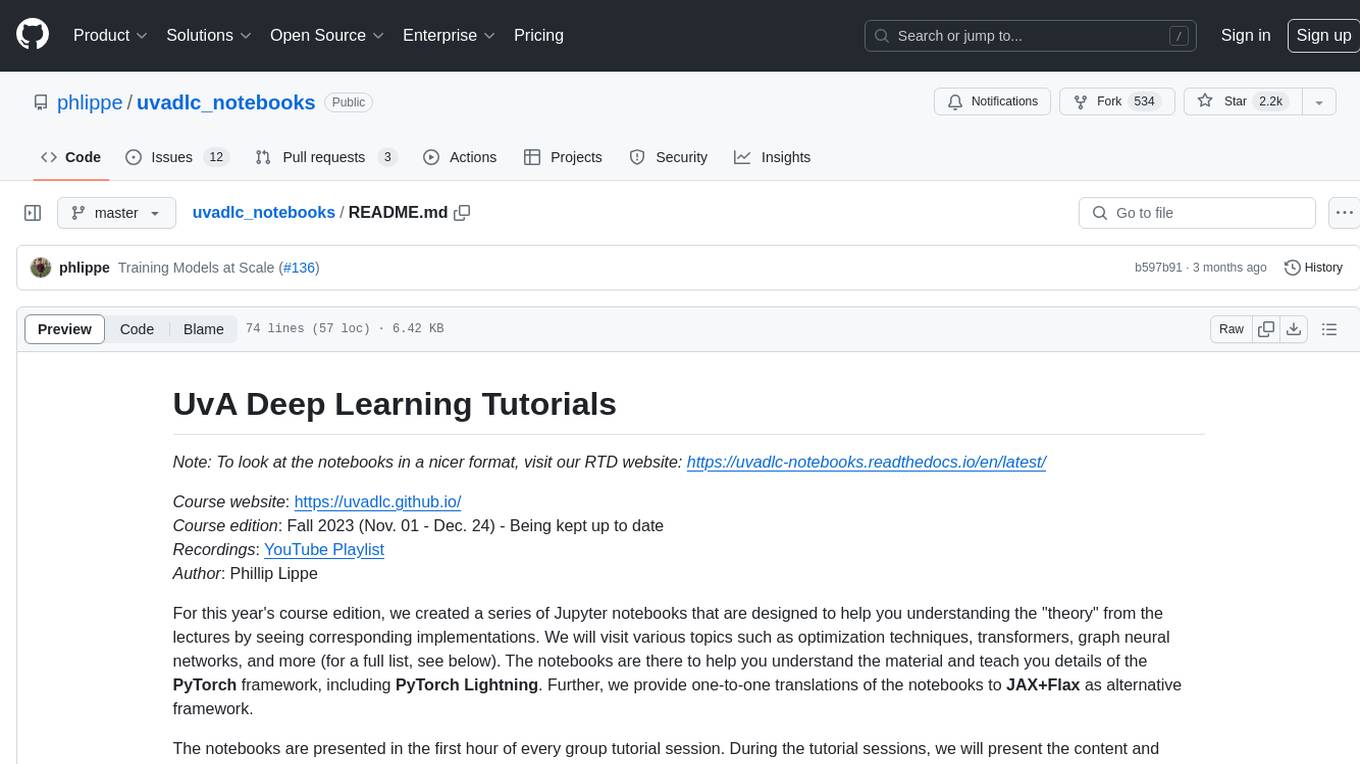
uvadlc_notebooks
The UvA Deep Learning Tutorials repository contains a series of Jupyter notebooks designed to help understand theoretical concepts from lectures by providing corresponding implementations. The notebooks cover topics such as optimization techniques, transformers, graph neural networks, and more. They aim to teach details of the PyTorch framework, including PyTorch Lightning, with alternative translations to JAX+Flax. The tutorials are integrated as official tutorials of PyTorch Lightning and are relevant for graded assignments and exams.
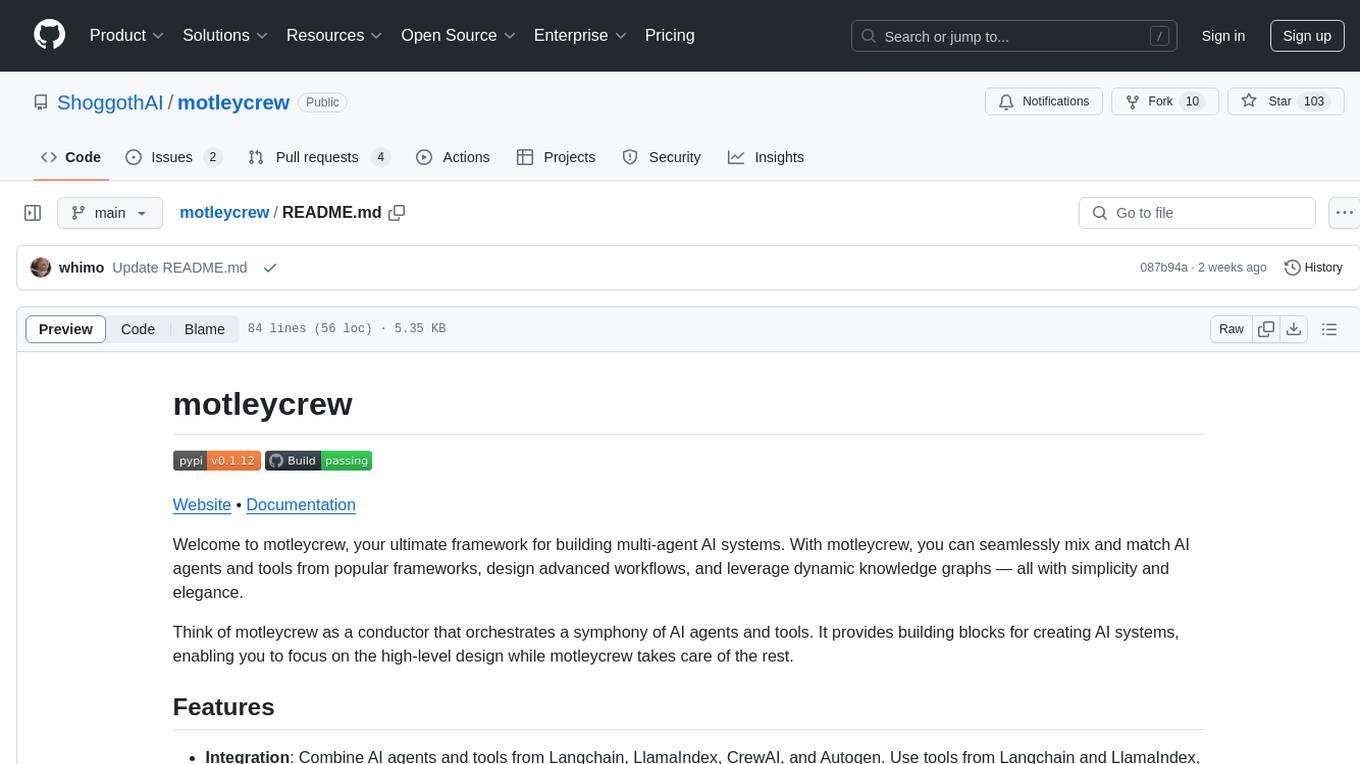
motleycrew
Motleycrew is an ultimate framework for building multi-agent AI systems, allowing users to mix and match AI agents and tools from popular frameworks, design advanced workflows, and leverage dynamic knowledge graphs with simplicity and elegance. It acts as a conductor orchestrating a symphony of AI agents and tools, providing building blocks for creating AI systems and enabling users to focus on high-level design while taking care of the rest. The framework offers integration with various tools, flexibility in providing agents with tools or other agents, advanced flow design capabilities, and built-in observability and caching features.
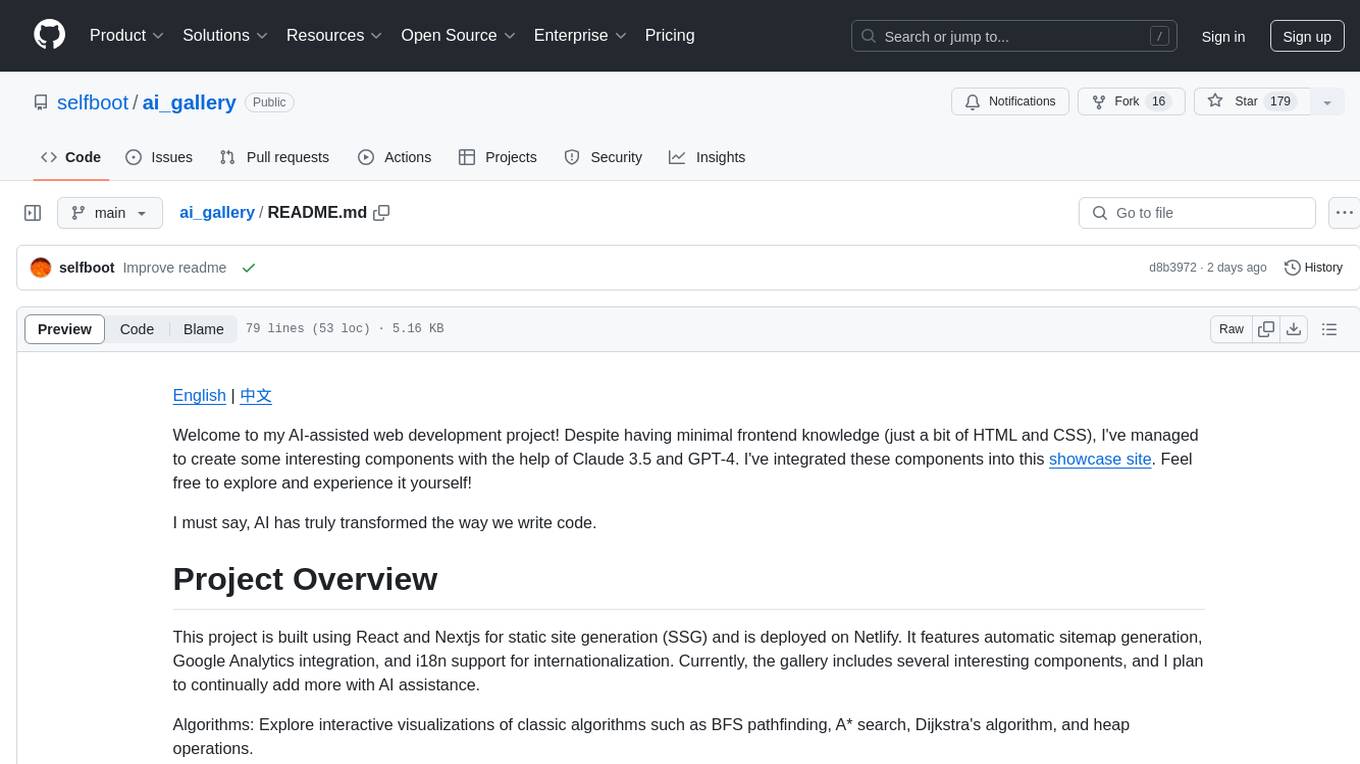
ai_gallery
AI Gallery is a showcase site built using React and Nextjs for static site generation, featuring interactive visualizations of classic algorithms, classic games implementation, and various interesting widgets. The project utilizes AI assistance from Claude 3.5 and GPT-4 to create components and enhance the development process. It aims to continually add more components with AI assistance, providing a platform for contributors to leverage AI in frontend development.
metaflow
Metaflow is a user-friendly library designed to assist scientists and engineers in developing and managing real-world data science projects. Initially created at Netflix, Metaflow aimed to enhance the productivity of data scientists working on diverse projects ranging from traditional statistics to cutting-edge deep learning. For further information, refer to Metaflow's website and documentation.
For similar tasks
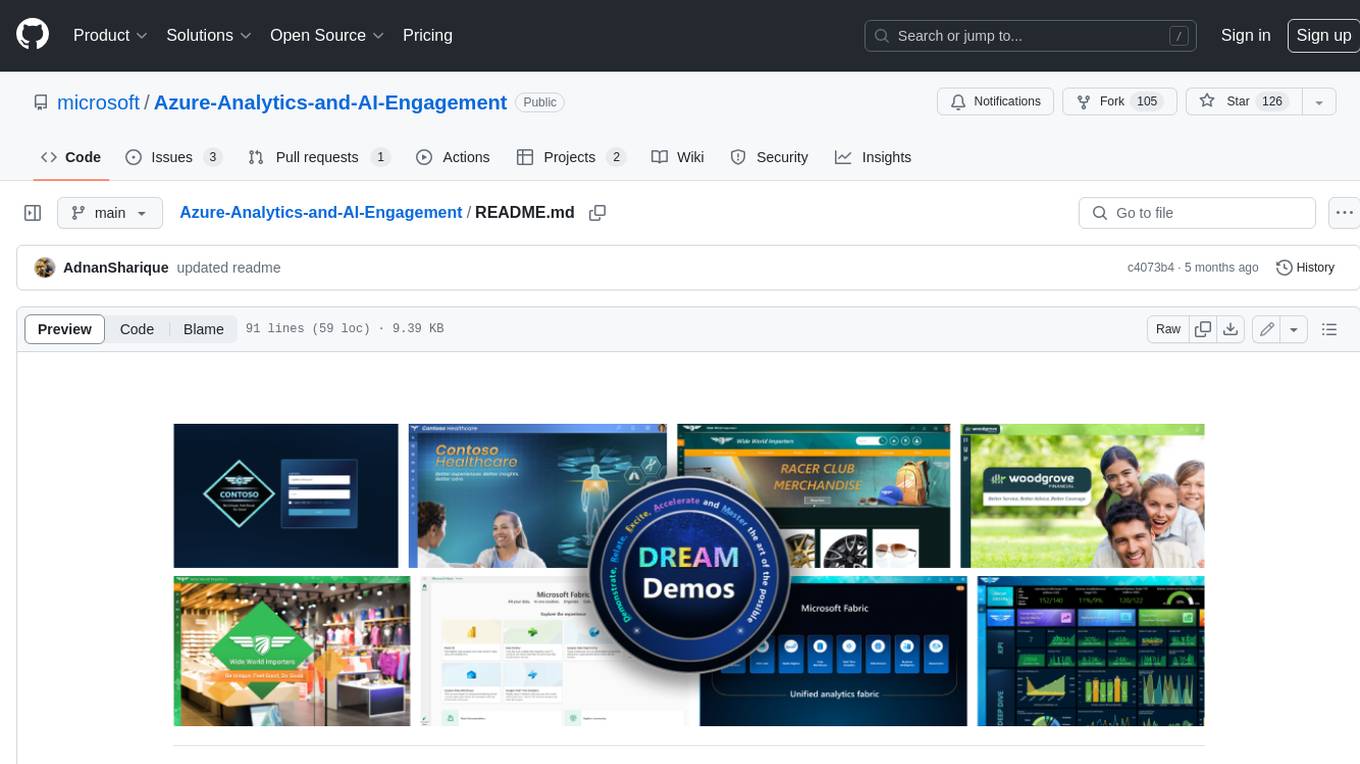
Azure-Analytics-and-AI-Engagement
The Azure-Analytics-and-AI-Engagement repository provides packaged Industry Scenario DREAM Demos with ARM templates (Containing a demo web application, Power BI reports, Synapse resources, AML Notebooks etc.) that can be deployed in a customer’s subscription using the CAPE tool within a matter of few hours. Partners can also deploy DREAM Demos in their own subscriptions using DPoC.
sorrentum
Sorrentum is an open-source project that aims to combine open-source development, startups, and brilliant students to build machine learning, AI, and Web3 / DeFi protocols geared towards finance and economics. The project provides opportunities for internships, research assistantships, and development grants, as well as the chance to work on cutting-edge problems, learn about startups, write academic papers, and get internships and full-time positions at companies working on Sorrentum applications.
tidb
TiDB is an open-source distributed SQL database that supports Hybrid Transactional and Analytical Processing (HTAP) workloads. It is MySQL compatible and features horizontal scalability, strong consistency, and high availability.

zep-python
Zep is an open-source platform for building and deploying large language model (LLM) applications. It provides a suite of tools and services that make it easy to integrate LLMs into your applications, including chat history memory, embedding, vector search, and data enrichment. Zep is designed to be scalable, reliable, and easy to use, making it a great choice for developers who want to build LLM-powered applications quickly and easily.
telemetry-airflow
This repository codifies the Airflow cluster that is deployed at workflow.telemetry.mozilla.org (behind SSO) and commonly referred to as "WTMO" or simply "Airflow". Some links relevant to users and developers of WTMO: * The `dags` directory in this repository contains some custom DAG definitions * Many of the DAGs registered with WTMO don't live in this repository, but are instead generated from ETL task definitions in bigquery-etl * The Data SRE team maintains a WTMO Developer Guide (behind SSO)
mojo
Mojo is a new programming language that bridges the gap between research and production by combining Python syntax and ecosystem with systems programming and metaprogramming features. Mojo is still young, but it is designed to become a superset of Python over time.
pandas-ai
PandasAI is a Python library that makes it easy to ask questions to your data in natural language. It helps you to explore, clean, and analyze your data using generative AI.
databend
Databend is an open-source cloud data warehouse that serves as a cost-effective alternative to Snowflake. With its focus on fast query execution and data ingestion, it's designed for complex analysis of the world's largest datasets.
For similar jobs
weave
Weave is a toolkit for developing Generative AI applications, built by Weights & Biases. With Weave, you can log and debug language model inputs, outputs, and traces; build rigorous, apples-to-apples evaluations for language model use cases; and organize all the information generated across the LLM workflow, from experimentation to evaluations to production. Weave aims to bring rigor, best-practices, and composability to the inherently experimental process of developing Generative AI software, without introducing cognitive overhead.
LLMStack
LLMStack is a no-code platform for building generative AI agents, workflows, and chatbots. It allows users to connect their own data, internal tools, and GPT-powered models without any coding experience. LLMStack can be deployed to the cloud or on-premise and can be accessed via HTTP API or triggered from Slack or Discord.
VisionCraft
The VisionCraft API is a free API for using over 100 different AI models. From images to sound.
kaito
Kaito is an operator that automates the AI/ML inference model deployment in a Kubernetes cluster. It manages large model files using container images, avoids tuning deployment parameters to fit GPU hardware by providing preset configurations, auto-provisions GPU nodes based on model requirements, and hosts large model images in the public Microsoft Container Registry (MCR) if the license allows. Using Kaito, the workflow of onboarding large AI inference models in Kubernetes is largely simplified.
PyRIT
PyRIT is an open access automation framework designed to empower security professionals and ML engineers to red team foundation models and their applications. It automates AI Red Teaming tasks to allow operators to focus on more complicated and time-consuming tasks and can also identify security harms such as misuse (e.g., malware generation, jailbreaking), and privacy harms (e.g., identity theft). The goal is to allow researchers to have a baseline of how well their model and entire inference pipeline is doing against different harm categories and to be able to compare that baseline to future iterations of their model. This allows them to have empirical data on how well their model is doing today, and detect any degradation of performance based on future improvements.
tabby
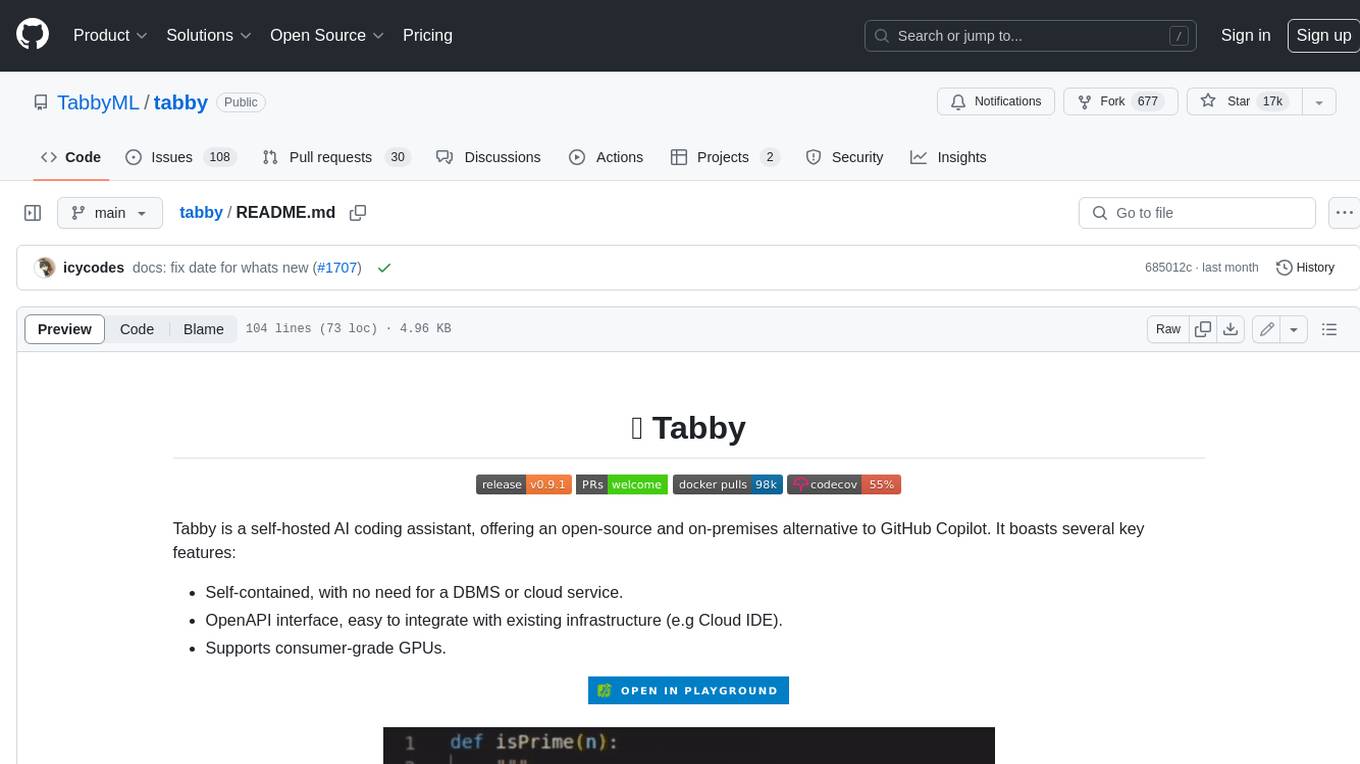
Tabby is a self-hosted AI coding assistant, offering an open-source and on-premises alternative to GitHub Copilot. It boasts several key features: * Self-contained, with no need for a DBMS or cloud service. * OpenAPI interface, easy to integrate with existing infrastructure (e.g Cloud IDE). * Supports consumer-grade GPUs.
spear
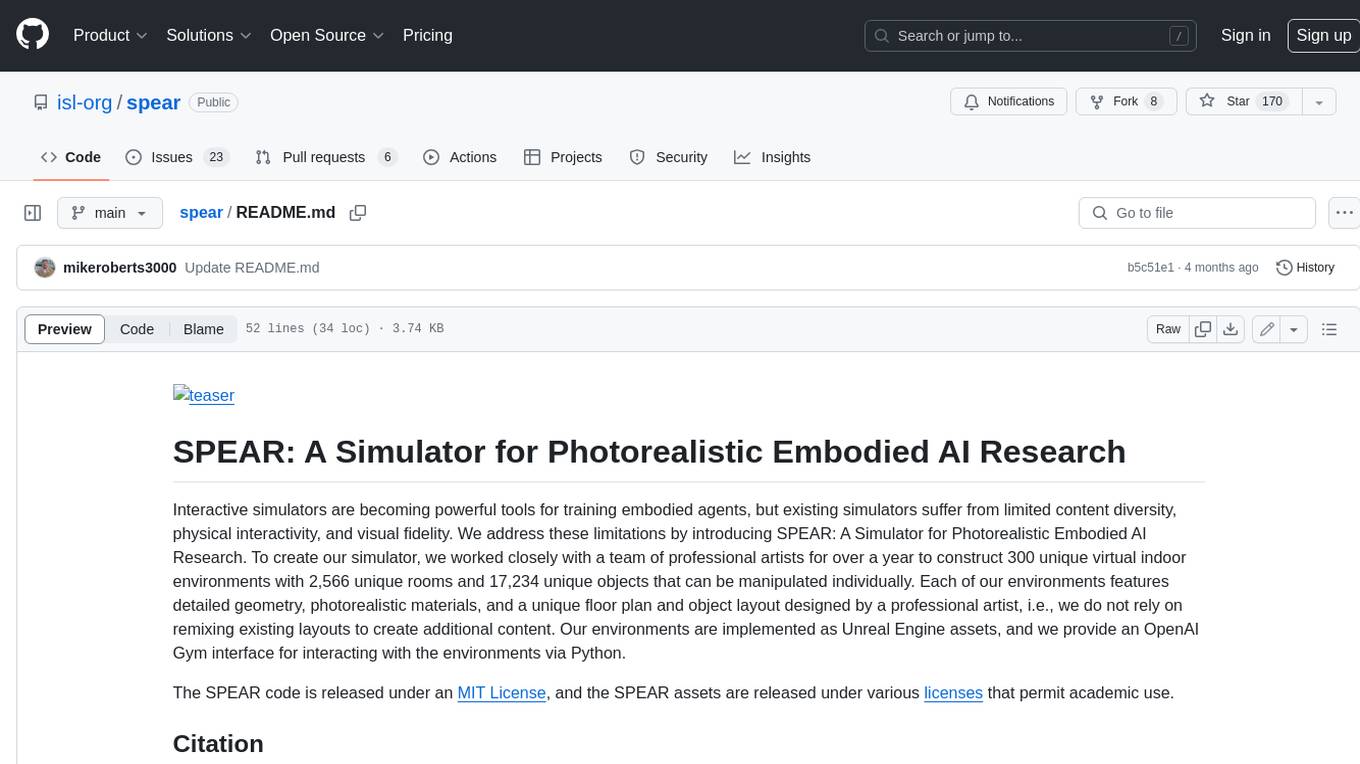
SPEAR (Simulator for Photorealistic Embodied AI Research) is a powerful tool for training embodied agents. It features 300 unique virtual indoor environments with 2,566 unique rooms and 17,234 unique objects that can be manipulated individually. Each environment is designed by a professional artist and features detailed geometry, photorealistic materials, and a unique floor plan and object layout. SPEAR is implemented as Unreal Engine assets and provides an OpenAI Gym interface for interacting with the environments via Python.
Magick
Magick is a groundbreaking visual AIDE (Artificial Intelligence Development Environment) for no-code data pipelines and multimodal agents. Magick can connect to other services and comes with nodes and templates well-suited for intelligent agents, chatbots, complex reasoning systems and realistic characters.