


hertzbeat
An AI-powered next-generation open source real-time observability system.
Stars: 7078
Hertzbeat is a simple and lightweight tool for monitoring the performance of web applications. It allows users to easily track the response time and availability of their web services in real-time. With Hertzbeat, users can set up custom alerts to be notified of any performance issues, helping them ensure their applications are running smoothly at all times.
README:











Home: hertzbeat.apache.org
Email: Mail to [email protected] to subscribe mailing lists
Apache HertzBeat™ is an AI-powered next-generation open source real-time observability system. Unified metrics and logs collection, centralized alerting distribution, intelligent management and analysis. No Agent required, high performance cluster, provides powerful custom monitoring and status page building capabilities.
- Integrates collection + analysis + alerting + notification into one platform, with new AI-powered interactions and features under HertzBeat AI, and built-in MCP Server capabilities.
- Unified metrics platform, agentless, Prometheus-compatible, supports application services, programs, databases, caches, operating systems, big data, middleware, web servers, cloud-native, networks, custom monitoring and more.
- Unified logging platform, seamlessly integrates multiple log sources through OTLP protocol for reporting.
- Unified alerting platform, integrates internal alerts with various external alert sources, unified alert processing and analysis, flexible real-time and periodic threshold rules, grouping convergence, silence, suppression, etc.
- Unified message distribution, alerts processed by the alerting platform are distributed via
EmailDiscordSlackTelegramDingTalkWeChatFeiShuSMSWebhookServerChanand other methods. - Makes protocols such as
Http, Jmx, Ssh, Snmp, Jdbc, Prometheusconfigurable, allowing you to collect any metrics by simply configuring the templateYMLfile online. Imagine being able to quickly adapt to a new monitoring type like K8s or Docker simply by configuring online with HertzBeat. - High performance, supports horizontal expansion of multi-collector clusters, multi-isolated network monitoring and cloud-edge collaboration.
- Provides powerful status page building capabilities, easily communicate the real-time status of your service to users.
HertzBeat's unified platform, AI intelligence, powerful customization, multi-type support, high performance, and easy expansion, aims to help users quickly and conveniently achieve observability requirements.

We define all metrics collection types such as
mysql,jvm, andk8sasYMLtemplates, allowing users to import them to support corresponding types of monitoring. Welcome everyone to contribute your customized general metrics type YML template during use.
- Website, Port Telnet, Http Api, Ping Connect, Jvm, SiteMap, Ssl Certificate, SpringBoot2, FTP Server, SpringBoot3, Udp Port, Dns, Pop3, Ntp, Api Code, Smtp, Nginx
- Mysql, PostgreSQL, MariaDB, Redis, ElasticSearch, SqlServer, Oracle, MongoDB, DM, OpenGauss, ClickHouse, IoTDB, Redis Cluster, Redis Sentinel Doris BE, Doris FE, Memcached, NebulaGraph
- Linux, Ubuntu, CentOS, Windows, EulerOS, Fedora CoreOS, OpenSUSE, Rocky Linux, Red Hat, FreeBSD, AlmaLinux, Debian Linux
- Tomcat, Nacos, Zookeeper, RabbitMQ, Flink, Kafka, ShenYu, DynamicTp, Jetty, ActiveMQ, Spring Gateway, EMQX MQTT, AirFlow, Hive, Spark, Hadoop
- Kubernetes, Docker
- CiscoSwitch, HpeSwitch, HuaweiSwitch, TpLinkSwitch, H3cSwitch
- And More Your Custom Template.
- Notified Support
DiscordSlackTelegramEmailDingtalkWeChatFeiShuWebhookSMSServerChan.
- If you wish to deploy HertzBeat locally, please refer to the following Deployment Documentation for instructions.
HertzBeat supports installation through source code, docker or package, cpu support x86/arm64.
-
Just one command to get started
docker run -d -p 1157:1157 -p 1158:1158 --name hertzbeat apache/hertzbeat
-
Access
http://localhost:1157to start, default account:admin/hertzbeat -
Deploy collector clusters (Optional)
docker run -d -e IDENTITY=custom-collector-name -e MANAGER_HOST=127.0.0.1 -e MANAGER_PORT=1158 --name hertzbeat-collector apache/hertzbeat-collector
-
-e IDENTITY=custom-collector-name: set the collector unique identity name. -
-e MODE=public: set the running mode(public or private), public cluster or private cloud-edge. -
-e MANAGER_HOST=127.0.0.1: set the main hertzbeat server ip. -
-e MANAGER_PORT=1158: set the main hertzbeat server port, default 1158.
-
Detailed config refer to Install HertzBeat via Docker
- Download the release package
hertzbeat-xx.tar.gzDownload - Configure the HertzBeat configuration yml file
hertzbeat/config/application.yml(optional) - Run command
$ ./bin/startup.shorbin/startup.bat - Access
http://localhost:1157to start, default account:admin/hertzbeat - Deploy collector clusters (Optional)
- Download the release package
hertzbeat-collector-xx.tar.gzto new machine Download - Configure the collector configuration yml file
hertzbeat-collector/config/application.yml: uniqueidentityname, runningmode(public or private), hertzbeatmanager-host, hertzbeatmanager-portcollector: dispatch: entrance: netty: enabled: true identity: ${IDENTITY:} mode: ${MODE:public} manager-host: ${MANAGER_HOST:127.0.0.1} manager-port: ${MANAGER_PORT:1158}
- Run command
$ ./bin/startup.shorbin/startup.bat - Access
http://localhost:1157and you will see the registered new collector in dashboard
- Download the release package
Detailed config refer to Install HertzBeat via Package
- Local source code debugging needs to start the back-end project
hertzbeat-startupand the front-end projectweb-app. - Backend:need
maven3+,java17,lombok, add VM options in IDE:--add-opens=java.base/java.nio=org.apache.arrow.memory.core,ALL-UNNAMED, then start thehertzbeat-startupservice. - Web:need
nodejs npm angular-clienvironment, Runng serve --openinweb-appdirectory after backend startup. - Access
http://localhost:4200to start, default account:admin/hertzbeat
Detailed steps refer to CONTRIBUTING
Install the postgresql/mysql database, victoria-metrics/iotdb/tdengine database and hertzbeat at one time through docker-compose deployment script.
Detailed steps refer to Install via Docker-Compose
Install HertzBeat cluster in a Kubernetes cluster by Helm chart.
Detailed steps refer to Artifact Hub
HAVE FUN
Thanks to these wonderful people, welcome to join us:
Contributor Guide


Join the Mailing Lists : Mail to [email protected] to subscribe mailing lists.
WeChat Group : Add friend ahertzbeat and invite to the group.
WeChat Public : Search ID usthecom.
QQ Group : Group num 1035688434
HertzBeat is built on so many great open source projects, thanks to them!
Java Spring SpringBoot Jpa Maven Assembly Netty Lombok Sureness Protobuf HttpClient Guava SnakeYaml JsonPath ...TypeScript Angular NG-ZORRO NG-ALAIN NodeJs Npm Html Less Echarts Rxjs ZoneJs MonacoEditor SlickCarousel Docusaurus ...


HertzBeat has been included in the
CNCF Observability And Analysis - Observability Landscape.
For Tasks:
Click tags to check more tools for each tasksFor Jobs:
Alternative AI tools for hertzbeat
Similar Open Source Tools
hertzbeat
Hertzbeat is a simple and lightweight tool for monitoring the performance of web applications. It allows users to easily track the response time and availability of their web services in real-time. With Hertzbeat, users can set up custom alerts to be notified of any performance issues, helping them ensure their applications are running smoothly at all times.
web-bench
Web-bench is a simple tool for benchmarking web servers. It is designed to generate a large number of requests to a web server and measure the performance of the server under load. The tool allows users to specify the number of requests, concurrency level, and other parameters to simulate different traffic scenarios. Web-bench provides detailed statistics on response times, throughput, and errors encountered during the benchmarking process. It is a useful tool for web developers, system administrators, and anyone interested in evaluating the performance of web servers.
PentestGPT
PentestGPT provides advanced AI and integrated tools to help security teams conduct comprehensive penetration tests effortlessly. Scan, exploit, and analyze web applications, networks, and cloud environments with ease and precision, without needing expert skills. The tool utilizes Supabase for data storage and management, and Vercel for hosting the frontend. It offers a local quickstart guide for running the tool locally and a hosted quickstart guide for deploying it in the cloud. PentestGPT aims to simplify the penetration testing process for security professionals and enthusiasts alike.
InferenceMAX
InferenceMAX™ is an open-source benchmarking tool designed to track real-time performance improvements in popular open-source inference frameworks and models. It runs a suite of benchmarks every night to capture progress in near real-time, providing a live indicator of inference performance. The tool addresses the challenge of rapidly evolving software ecosystems by benchmarking the latest software packages, ensuring that benchmarks do not go stale. InferenceMAX™ is supported by industry leaders and contributors, providing transparent and reproducible benchmarks that help the ML community make informed decisions about hardware and software performance.
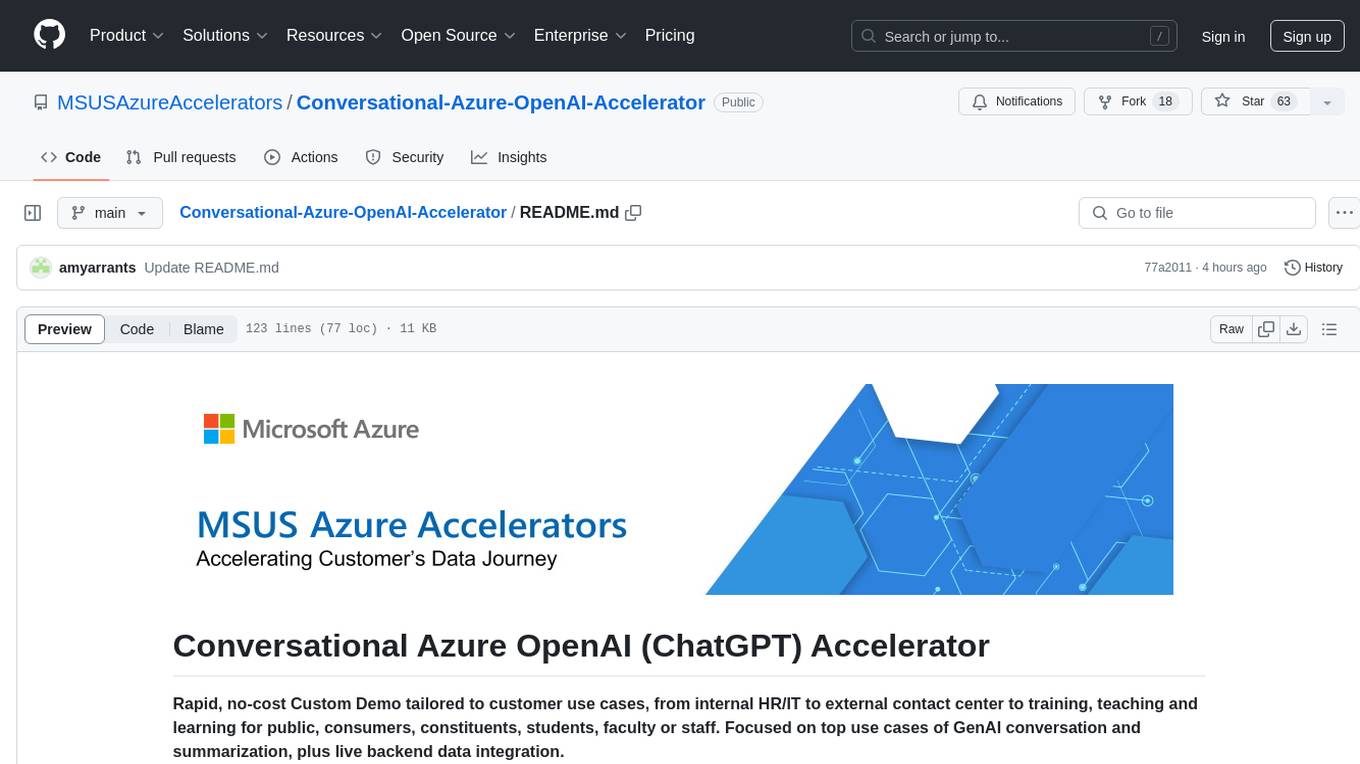
Conversational-Azure-OpenAI-Accelerator
The Conversational Azure OpenAI Accelerator is a tool designed to provide rapid, no-cost custom demos tailored to customer use cases, from internal HR/IT to external contact centers. It focuses on top use cases of GenAI conversation and summarization, plus live backend data integration. The tool automates conversations across voice and text channels, providing a valuable way to save money and improve customer and employee experience. By combining Azure OpenAI + Cognitive Search, users can efficiently deploy a ChatGPT experience using web pages, knowledge base articles, and data sources. The tool enables simultaneous deployment of conversational content to chatbots, IVR, voice assistants, and more in one click, eliminating the need for in-depth IT involvement. It leverages Microsoft's advanced AI technologies, resulting in a conversational experience that can converse in human-like dialogue, respond intelligently, and capture content for omni-channel unified analytics.
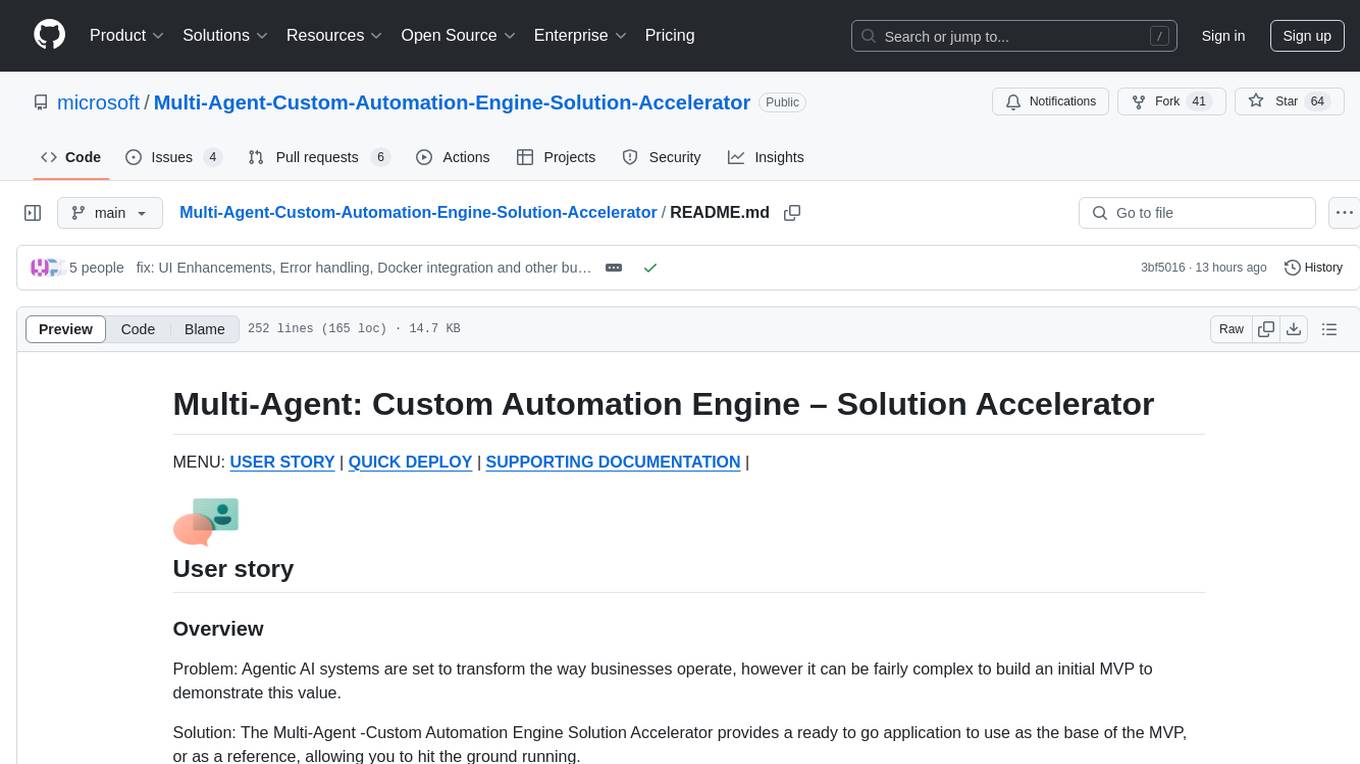
Multi-Agent-Custom-Automation-Engine-Solution-Accelerator
The Multi-Agent -Custom Automation Engine Solution Accelerator is an AI-driven orchestration system that manages a group of AI agents to accomplish tasks based on user input. It uses a FastAPI backend to handle HTTP requests, processes them through various specialized agents, and stores stateful information using Azure Cosmos DB. The system allows users to focus on what matters by coordinating activities across an organization, enabling GenAI to scale, and is applicable to most industries. It is intended for developing and deploying custom AI solutions for specific customers, providing a foundation to accelerate building out multi-agent systems.
paig
PAIG is an open-source project focused on protecting Generative AI applications by ensuring security, safety, and observability. It offers a versatile framework to address the latest security challenges and integrate point security solutions without rewriting applications. The project aims to provide a secure environment for developing and deploying GenAI applications.
dioptra
Dioptra is a software test platform for assessing the trustworthy characteristics of artificial intelligence (AI). It supports the NIST AI Risk Management Framework by providing functionality to assess, analyze, and track identified AI risks. Dioptra provides a REST API and can be controlled via a web interface or Python client for designing, managing, executing, and tracking experiments. It aims to be reproducible, traceable, extensible, interoperable, modular, secure, interactive, shareable, and reusable.
DevOpsGPT
DevOpsGPT is an AI-driven software development automation solution that combines Large Language Models (LLM) with DevOps tools to convert natural language requirements into working software. It improves development efficiency by eliminating the need for tedious requirement documentation, shortens development cycles, reduces communication costs, and ensures high-quality deliverables. The Enterprise Edition offers features like existing project analysis, professional model selection, and support for more DevOps platforms. The tool automates requirement development, generates interface documentation, provides pseudocode based on existing projects, facilitates code refinement, enables continuous integration, and supports software version release. Users can run DevOpsGPT with source code or Docker, and the tool comes with limitations in precise documentation generation and understanding existing project code. The product roadmap includes accurate requirement decomposition, rapid import of development requirements, and integration of more software engineering and professional tools for efficient software development tasks under AI planning and execution.
mfish-nocode
Mfish-nocode is a low-code/no-code platform that aims to make development as easy as fishing. It breaks down technical barriers, allowing both developers and non-developers to quickly build business systems, increase efficiency, and unleash creativity. It is not only an efficiency tool for developers during leisure time, but also a website building tool for novices in the workplace, and even a secret weapon for leaders to prototype.
yao
YAO is an open-source application engine written in Golang, suitable for developing business systems, website/APP API, admin panel, and self-built low-code platforms. It adopts a flow-based programming model to implement functions by writing YAO DSL or using JavaScript. Yao allows developers to create web services by processes, creating a database model, writing API services, and describing dashboard interfaces just by JSON for web & hardware, and 10x productivity. It is based on the flow-based programming idea, developed in Go language, and supports multiple ways to expand the data stream processor. Yao has a built-in data management system, making it suitable for quickly making various management backgrounds, CRM, ERP, and other internal enterprise systems. It is highly versatile, efficient, and performs better than PHP, JAVA, and other languages.
intelligent-app-workshop
Welcome to the envisioning workshop designed to help you build your own custom Copilot using Microsoft's Copilot stack. This workshop aims to rethink user experience, architecture, and app development by leveraging reasoning engines and semantic memory systems. You will utilize Azure AI Foundry, Prompt Flow, AI Search, and Semantic Kernel. Work with Miyagi codebase, explore advanced capabilities like AutoGen and GraphRag. This workshop guides you through the entire lifecycle of app development, including identifying user needs, developing a production-grade app, and deploying on Azure with advanced capabilities. By the end, you will have a deeper understanding of leveraging Microsoft's tools to create intelligent applications.
metaflow
Metaflow is a user-friendly library designed to assist scientists and engineers in developing and managing real-world data science projects. Initially created at Netflix, Metaflow aimed to enhance the productivity of data scientists working on diverse projects ranging from traditional statistics to cutting-edge deep learning. For further information, refer to Metaflow's website and documentation.
naas
Naas (Notebooks as a service) is an open source platform that enables users to create powerful data engines combining automation, analytics, and AI from Jupyter notebooks. It offers features like templates for automated data jobs and reports, drivers for data connectivity, and production-ready environment with scheduling and notifications. Naas aims to provide an alternative to Google Colab with enhanced low-code layers.
Companion
Companion is a software tool designed to provide support and enhance development. It offers various features and functionalities to assist users in their projects and tasks. The tool aims to be user-friendly and efficient, helping individuals and teams to streamline their workflow and improve productivity.
Document-Knowledge-Mining-Solution-Accelerator
The Document Knowledge Mining Solution Accelerator leverages Azure OpenAI and Azure AI Document Intelligence to ingest, extract, and classify content from various assets, enabling chat-based insight discovery, analysis, and prompt guidance. It uses OCR and multi-modal LLM to extract information from documents like text, handwritten text, charts, graphs, tables, and form fields. Users can customize the technical architecture and data processing workflow. Key features include ingesting and extracting real-world entities, chat-based insights discovery, text and document data analysis, prompt suggestion guidance, and multi-modal information processing.
For similar tasks
giskard
Giskard is an open-source Python library that automatically detects performance, bias & security issues in AI applications. The library covers LLM-based applications such as RAG agents, all the way to traditional ML models for tabular data.
hertzbeat
Hertzbeat is a simple and lightweight tool for monitoring the performance of web applications. It allows users to easily track the response time and availability of their web services in real-time. With Hertzbeat, users can set up custom alerts to be notified of any performance issues, helping them ensure their applications are running smoothly at all times.
moon
Moon is a monitoring and alerting platform suitable for multiple domains, supporting various application scenarios such as cloud-native, Internet of Things (IoT), and Artificial Intelligence (AI). It simplifies operational work of cloud-native monitoring, boasts strong IoT and AI support capabilities, and meets diverse monitoring needs across industries. Capable of real-time data monitoring, intelligent alerts, and fault response for various fields.
For similar jobs
kaito
Kaito is an operator that automates the AI/ML inference model deployment in a Kubernetes cluster. It manages large model files using container images, avoids tuning deployment parameters to fit GPU hardware by providing preset configurations, auto-provisions GPU nodes based on model requirements, and hosts large model images in the public Microsoft Container Registry (MCR) if the license allows. Using Kaito, the workflow of onboarding large AI inference models in Kubernetes is largely simplified.
ai-on-gke
This repository contains assets related to AI/ML workloads on Google Kubernetes Engine (GKE). Run optimized AI/ML workloads with Google Kubernetes Engine (GKE) platform orchestration capabilities. A robust AI/ML platform considers the following layers: Infrastructure orchestration that support GPUs and TPUs for training and serving workloads at scale Flexible integration with distributed computing and data processing frameworks Support for multiple teams on the same infrastructure to maximize utilization of resources
tidb
TiDB is an open-source distributed SQL database that supports Hybrid Transactional and Analytical Processing (HTAP) workloads. It is MySQL compatible and features horizontal scalability, strong consistency, and high availability.
nvidia_gpu_exporter
Nvidia GPU exporter for prometheus, using `nvidia-smi` binary to gather metrics.
tracecat
Tracecat is an open-source automation platform for security teams. It's designed to be simple but powerful, with a focus on AI features and a practitioner-obsessed UI/UX. Tracecat can be used to automate a variety of tasks, including phishing email investigation, evidence collection, and remediation plan generation.
openinference
OpenInference is a set of conventions and plugins that complement OpenTelemetry to enable tracing of AI applications. It provides a way to capture and analyze the performance and behavior of AI models, including their interactions with other components of the application. OpenInference is designed to be language-agnostic and can be used with any OpenTelemetry-compatible backend. It includes a set of instrumentations for popular machine learning SDKs and frameworks, making it easy to add tracing to your AI applications.
BricksLLM
BricksLLM is a cloud native AI gateway written in Go. Currently, it provides native support for OpenAI, Anthropic, Azure OpenAI and vLLM. BricksLLM aims to provide enterprise level infrastructure that can power any LLM production use cases. Here are some use cases for BricksLLM: * Set LLM usage limits for users on different pricing tiers * Track LLM usage on a per user and per organization basis * Block or redact requests containing PIIs * Improve LLM reliability with failovers, retries and caching * Distribute API keys with rate limits and cost limits for internal development/production use cases * Distribute API keys with rate limits and cost limits for students
kong
Kong, or Kong API Gateway, is a cloud-native, platform-agnostic, scalable API Gateway distinguished for its high performance and extensibility via plugins. It also provides advanced AI capabilities with multi-LLM support. By providing functionality for proxying, routing, load balancing, health checking, authentication (and more), Kong serves as the central layer for orchestrating microservices or conventional API traffic with ease. Kong runs natively on Kubernetes thanks to its official Kubernetes Ingress Controller.