


swe-books-collection
A collection of software engineering books - This repo has been archived, new books will be updated on the link below
Stars: 64
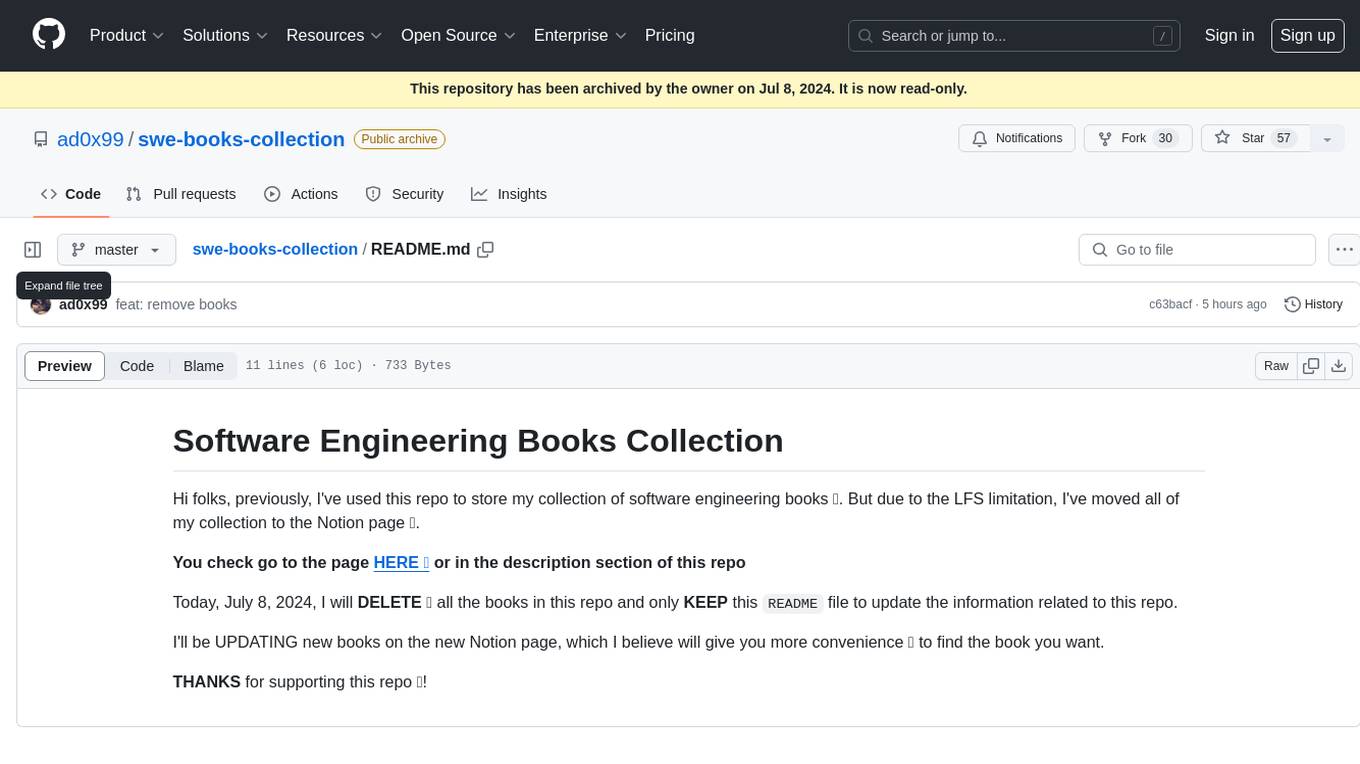
This repository, named swe-books-collection, was previously used to store a collection of software engineering books. However, due to limitations with LFS, the books have been moved to a Notion page. The repository now serves as a place to provide information and updates related to the software engineering books collection. Users can access the Notion page for the full collection. The repository aims to provide convenience in finding desired software engineering books.
README:
Hi folks, previously, I'd used this repo to store my collection of software engineering books 📚. But due to the LFS limitation, I had to move all of my collection to the Notion page 🏠.
Check it out HERE 🏠 or in the description section of this repo
All the books in this repo had been 🔥DELETED🔥 and I only KEEP this README file to update the information related to this repo.
I'll be UPDATING new books on the Notion page, which I believe will give you more convenience ✨ to find the book you want.
THANKS for supporting this repo 🫶!
For Tasks:
Click tags to check more tools for each tasksFor Jobs:
Alternative AI tools for swe-books-collection
Similar Open Source Tools
swe-books-collection
This repository, named swe-books-collection, was previously used to store a collection of software engineering books. However, due to limitations with LFS, the books have been moved to a Notion page. The repository now serves as a place to provide information and updates related to the software engineering books collection. Users can access the Notion page for the full collection. The repository aims to provide convenience in finding desired software engineering books.
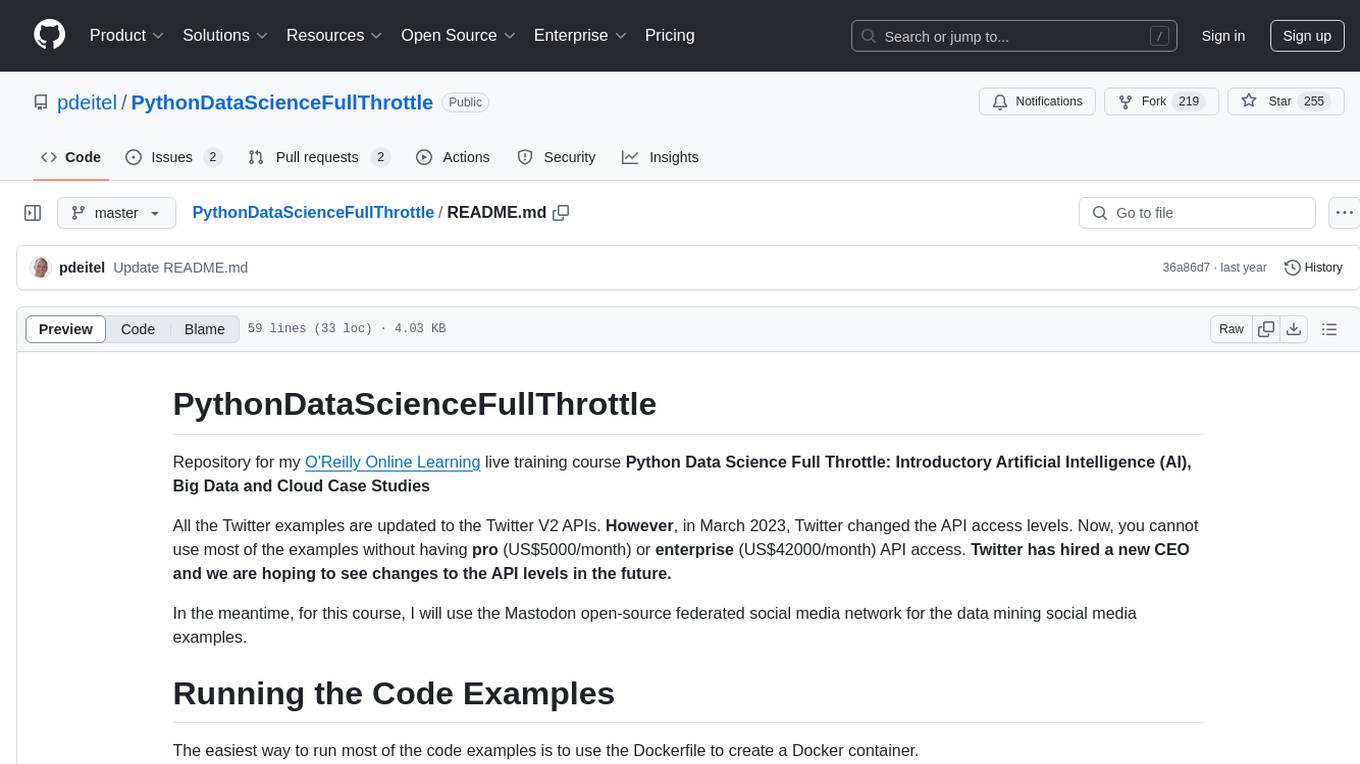
PythonDataScienceFullThrottle
PythonDataScienceFullThrottle is a comprehensive repository containing various Python scripts, libraries, and tools for data science enthusiasts. It includes a wide range of functionalities such as data preprocessing, visualization, machine learning algorithms, and statistical analysis. The repository aims to provide a one-stop solution for individuals looking to dive deep into the world of data science using Python.
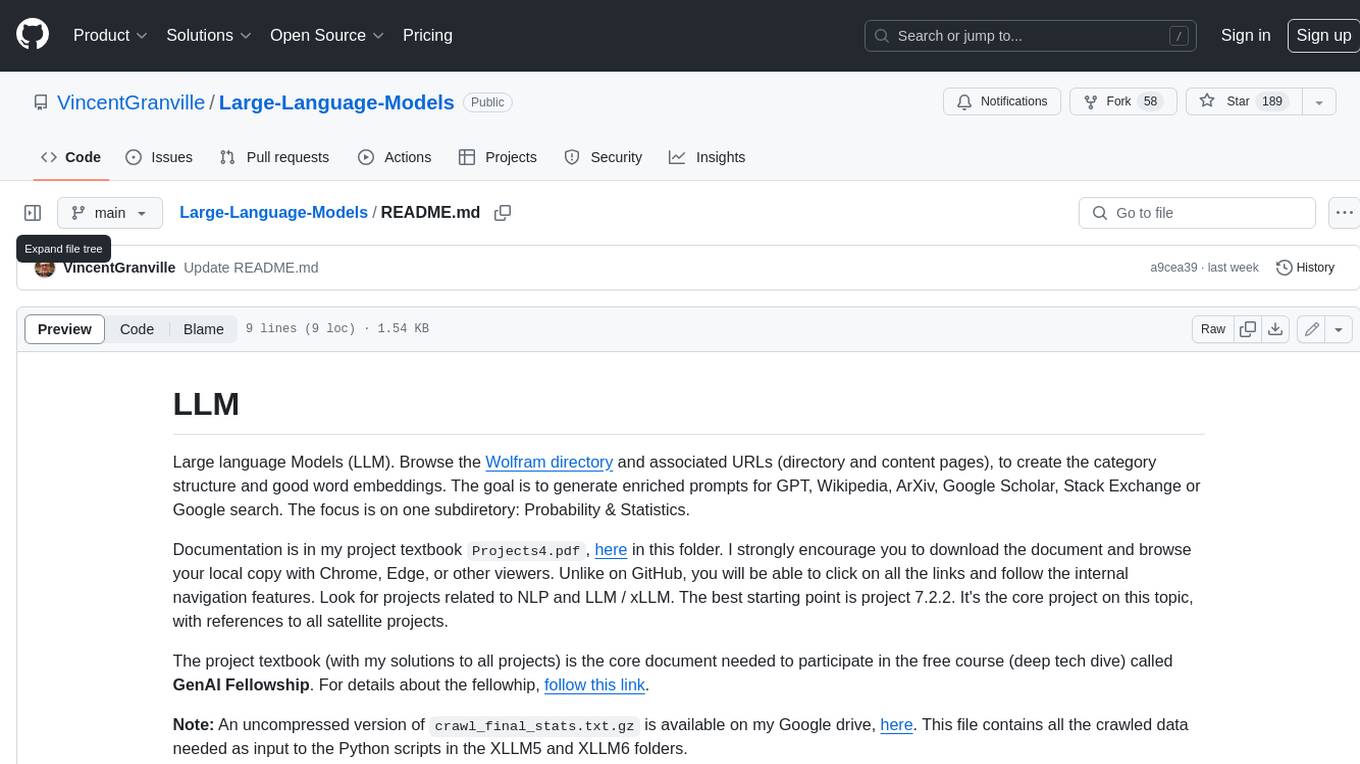
Large-Language-Models
Large Language Models (LLM) are used to browse the Wolfram directory and associated URLs to create the category structure and good word embeddings. The goal is to generate enriched prompts for GPT, Wikipedia, Arxiv, Google Scholar, Stack Exchange, or Google search. The focus is on one subdirectory: Probability & Statistics. Documentation is in the project textbook `Projects4.pdf`, which is available in the folder. It is recommended to download the document and browse your local copy with Chrome, Edge, or other viewers. Unlike on GitHub, you will be able to click on all the links and follow the internal navigation features. Look for projects related to NLP and LLM / xLLM. The best starting point is project 7.2.2, which is the core project on this topic, with references to all satellite projects. The project textbook (with solutions to all projects) is the core document needed to participate in the free course (deep tech dive) called **GenAI Fellowship**. For details about the fellowship, follow the link provided. An uncompressed version of `crawl_final_stats.txt.gz` is available on Google drive, which contains all the crawled data needed as input to the Python scripts in the XLLM5 and XLLM6 folders.
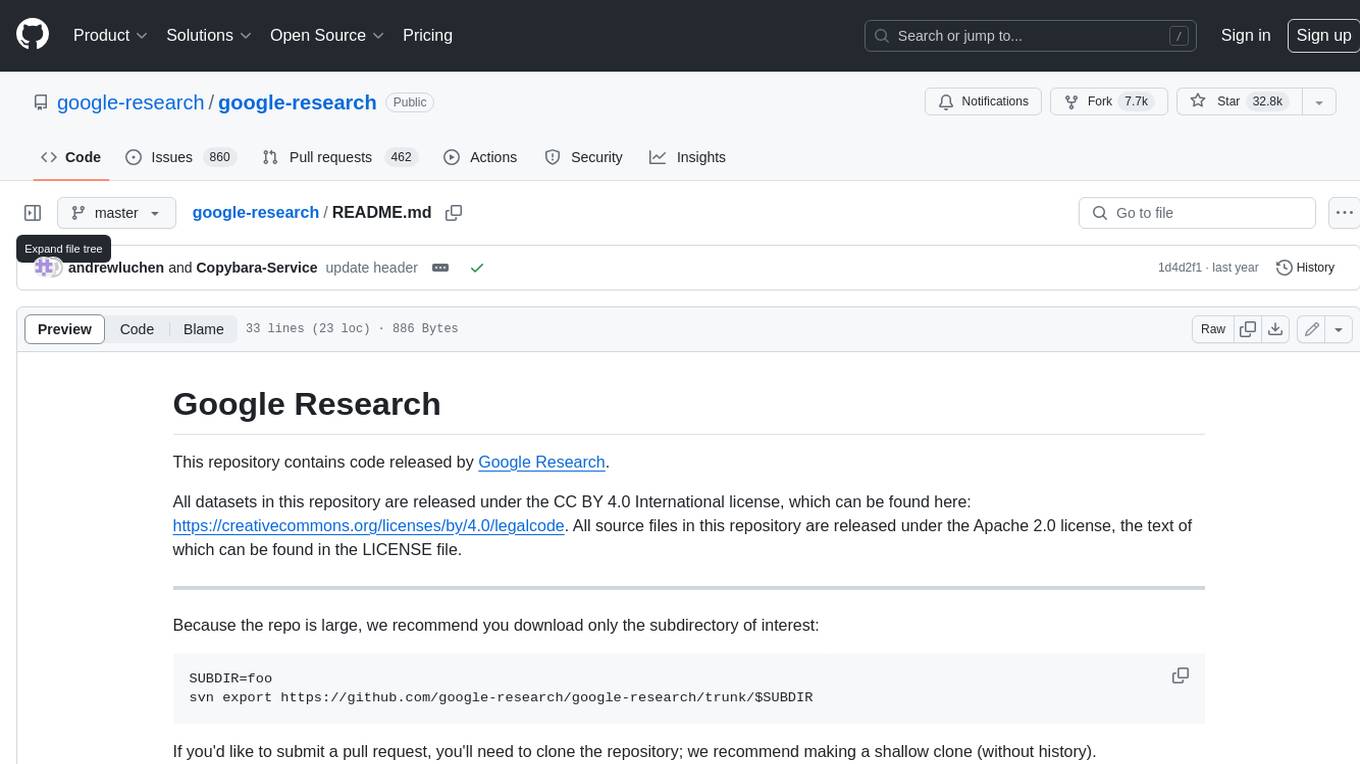
google-research
This repository contains code released by Google Research. All datasets in this repository are released under the CC BY 4.0 International license, which can be found here: https://creativecommons.org/licenses/by/4.0/legalcode. All source files in this repository are released under the Apache 2.0 license, the text of which can be found in the LICENSE file.
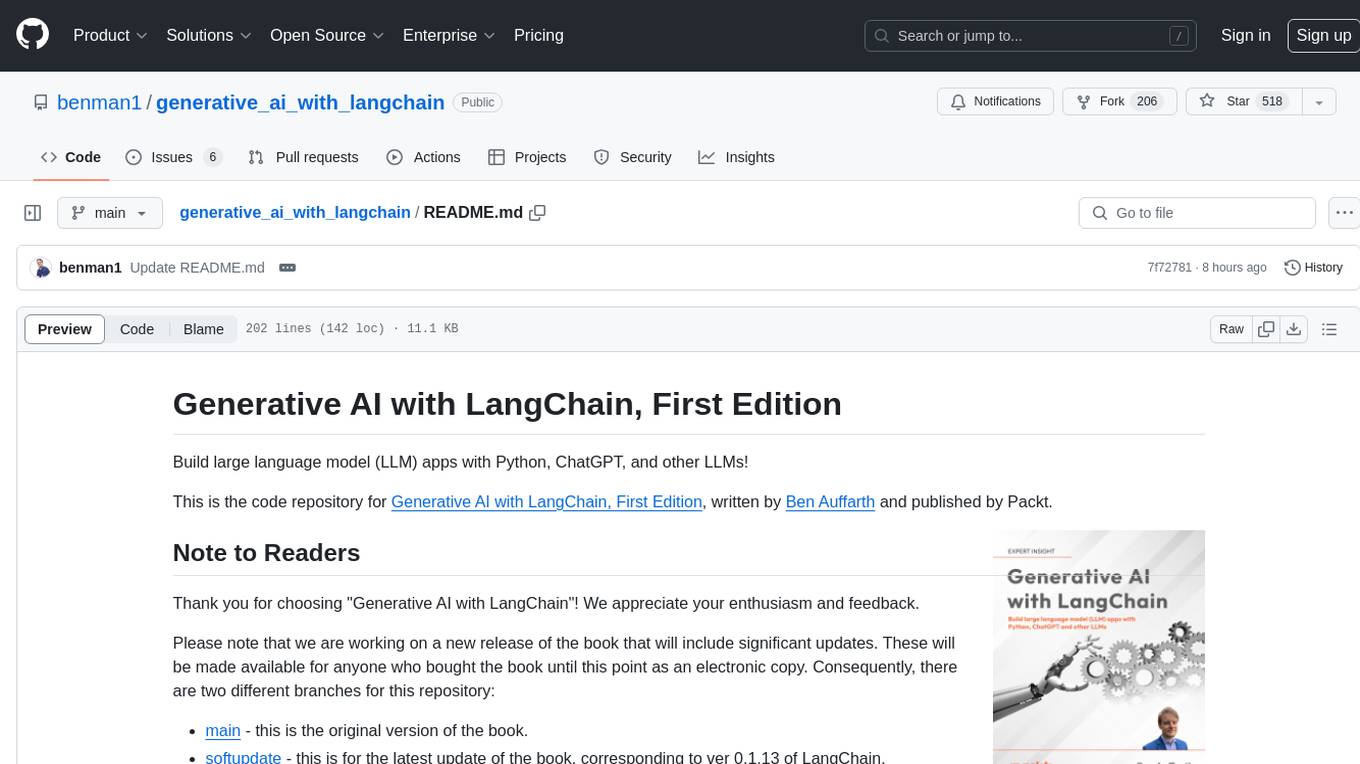
generative_ai_with_langchain
Generative AI with LangChain is a code repository for building large language model (LLM) apps with Python, ChatGPT, and other LLMs. The repository provides code examples, instructions, and configurations for creating generative AI applications using the LangChain framework. It covers topics such as setting up the development environment, installing dependencies with Conda or Pip, using Docker for environment setup, and setting API keys securely. The repository also emphasizes stability, code updates, and user engagement through issue reporting and feedback. It aims to empower users to leverage generative AI technologies for tasks like building chatbots, question-answering systems, software development aids, and data analysis applications.

NaLLM
The NaLLM project repository explores the synergies between Neo4j and Large Language Models (LLMs) through three primary use cases: Natural Language Interface to a Knowledge Graph, Creating a Knowledge Graph from Unstructured Data, and Generating a Report using static and LLM data. The repository contains backend and frontend code organized for easy navigation. It includes blog posts, a demo database, instructions for running demos, and guidelines for contributing. The project aims to showcase the potential of Neo4j and LLMs in various applications.
recognize
Recognize is a smart media tagging tool for Nextcloud that automatically categorizes photos and music by recognizing faces, animals, landscapes, food, vehicles, buildings, landmarks, monuments, music genres, and human actions in videos. It uses pre-trained models for object detection, landmark recognition, face comparison, music genre classification, and video classification. The tool ensures privacy by processing images locally without sending data to cloud providers. However, it cannot process end-to-end encrypted files. Recognize is rated positively for ethical AI practices in terms of open-source software, freely available models, and training data transparency, except for music genre recognition due to limited access to training data.
max
The Modular Accelerated Xecution (MAX) platform is an integrated suite of AI libraries, tools, and technologies that unifies commonly fragmented AI deployment workflows. MAX accelerates time to market for the latest innovations by giving AI developers a single toolchain that unlocks full programmability, unparalleled performance, and seamless hardware portability.
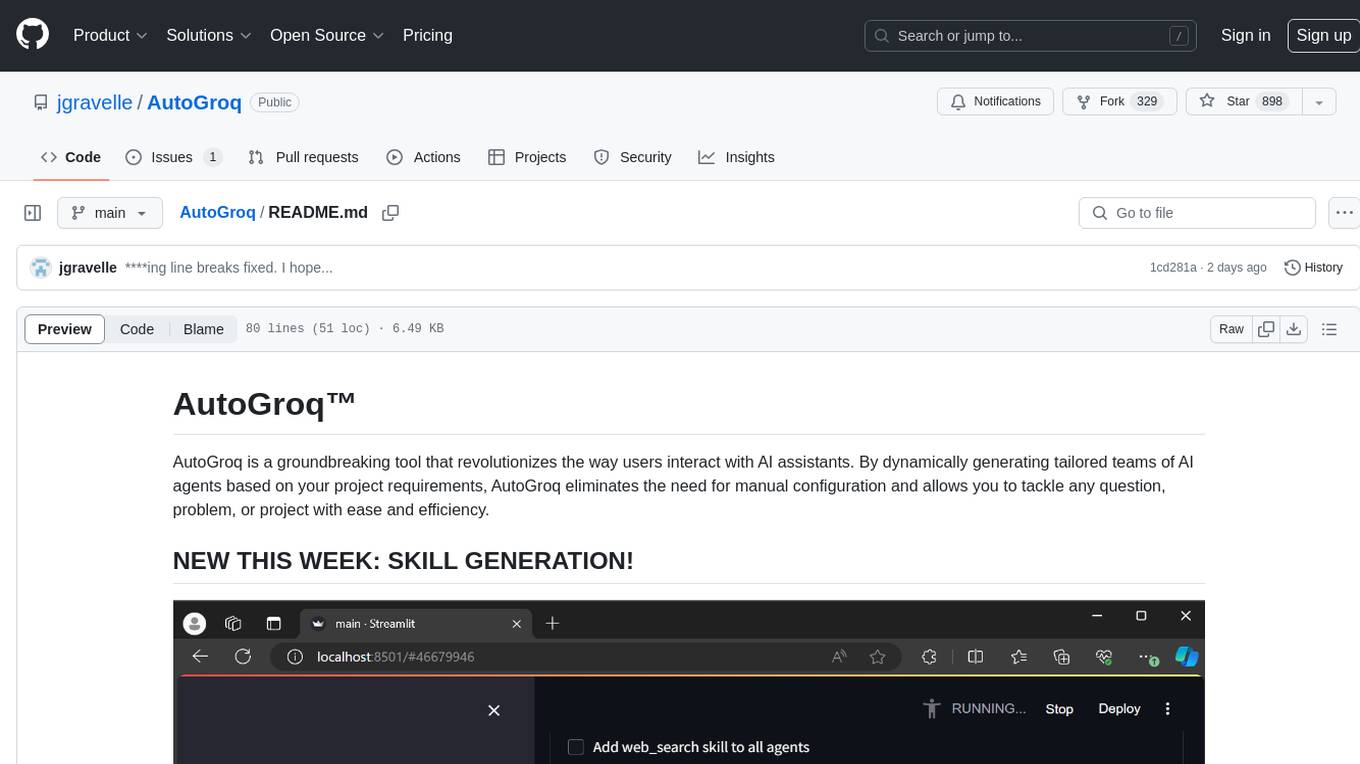
AutoGroq
AutoGroq is a revolutionary tool that dynamically generates tailored teams of AI agents based on project requirements, eliminating manual configuration. It enables users to effortlessly tackle questions, problems, and projects by creating expert agents, workflows, and skillsets with ease and efficiency. With features like natural conversation flow, code snippet extraction, and support for multiple language models, AutoGroq offers a seamless and intuitive AI assistant experience for developers and users.
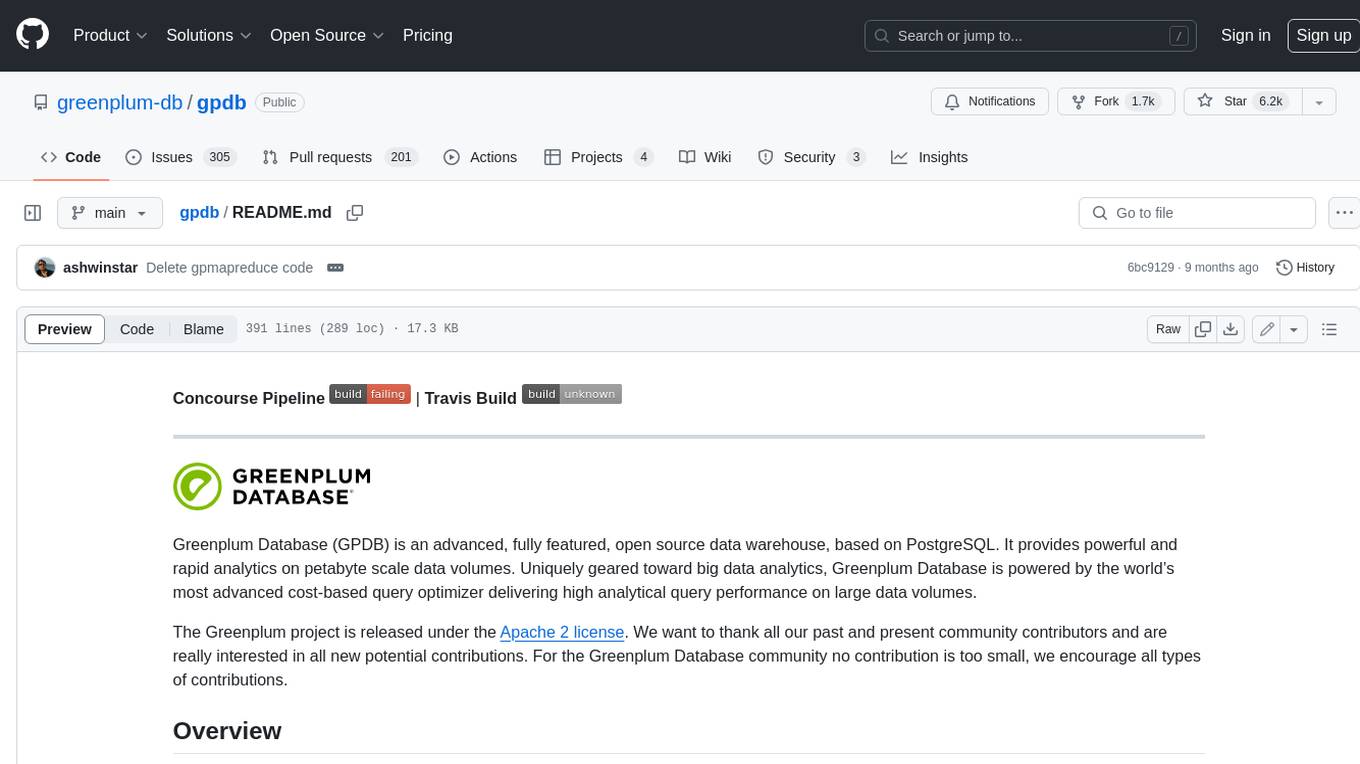
gpdb
Greenplum Database (GPDB) is an advanced, fully featured, open source data warehouse, based on PostgreSQL. It provides powerful and rapid analytics on petabyte scale data volumes. Uniquely geared toward big data analytics, Greenplum Database is powered by the world’s most advanced cost-based query optimizer delivering high analytical query performance on large data volumes.
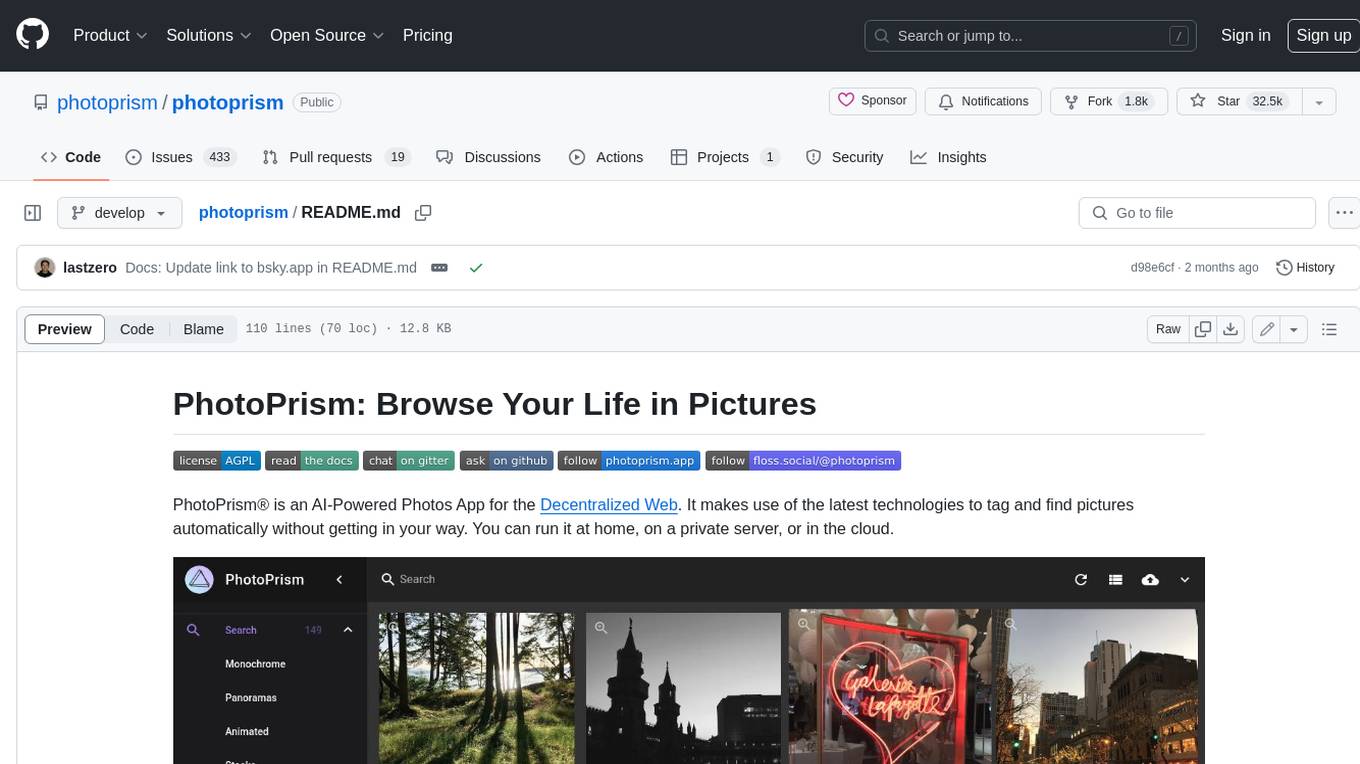
photoprism
PhotoPrism is an AI-powered photos app for the decentralized web. It uses the latest technologies to tag and find pictures automatically without getting in your way. You can run it at home, on a private server, or in the cloud.
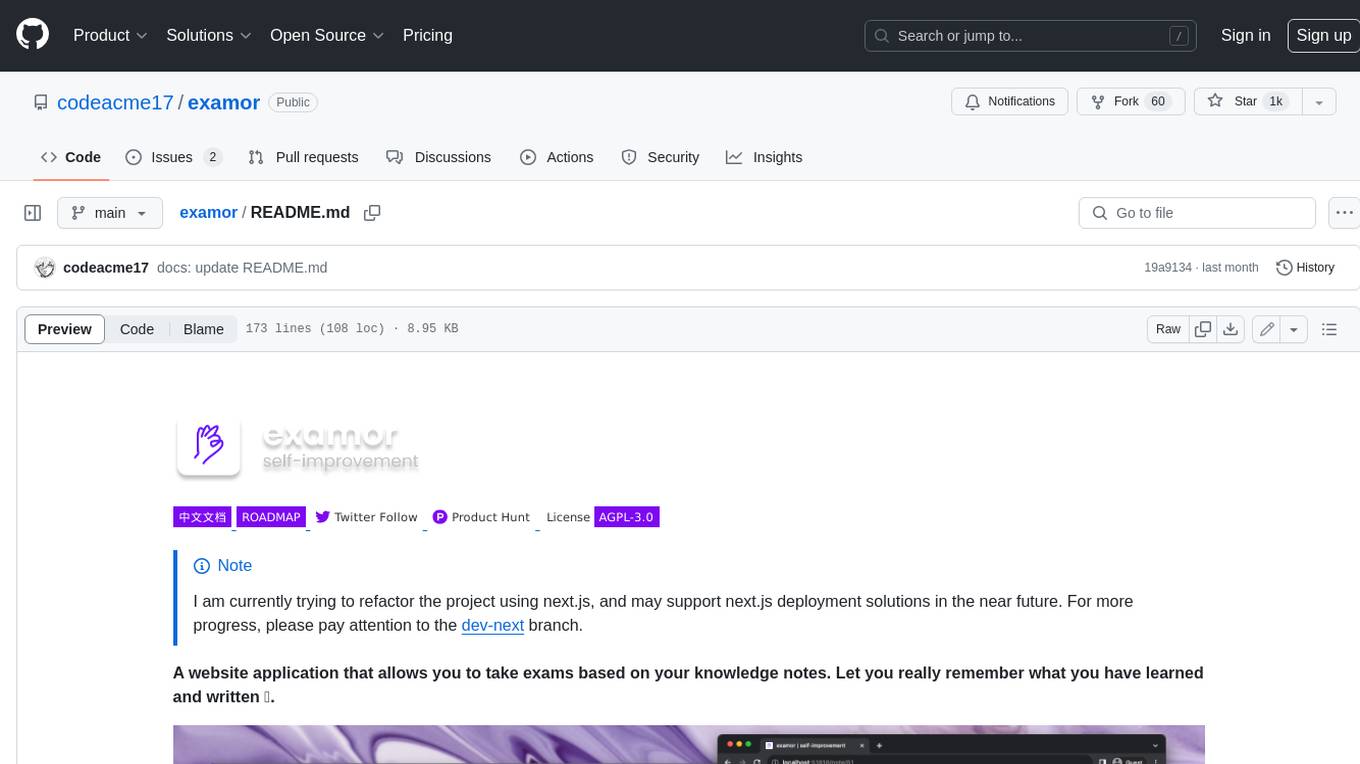
examor
Examor is a website application that allows you to take exams based on your knowledge notes. It helps you to remember what you have learned and written. The application generates a set of questions from the documents you upload, and you can answer them to test your knowledge. Examor also uses GPT to score and validate your answers, and provides you with feedback. The application is still in its early stages of development, but it has the potential to be a valuable tool for learners.
max
The Modular Accelerated Xecution (MAX) platform is an integrated suite of AI libraries, tools, and technologies that unifies commonly fragmented AI deployment workflows. MAX accelerates time to market for the latest innovations by giving AI developers a single toolchain that unlocks full programmability, unparalleled performance, and seamless hardware portability.
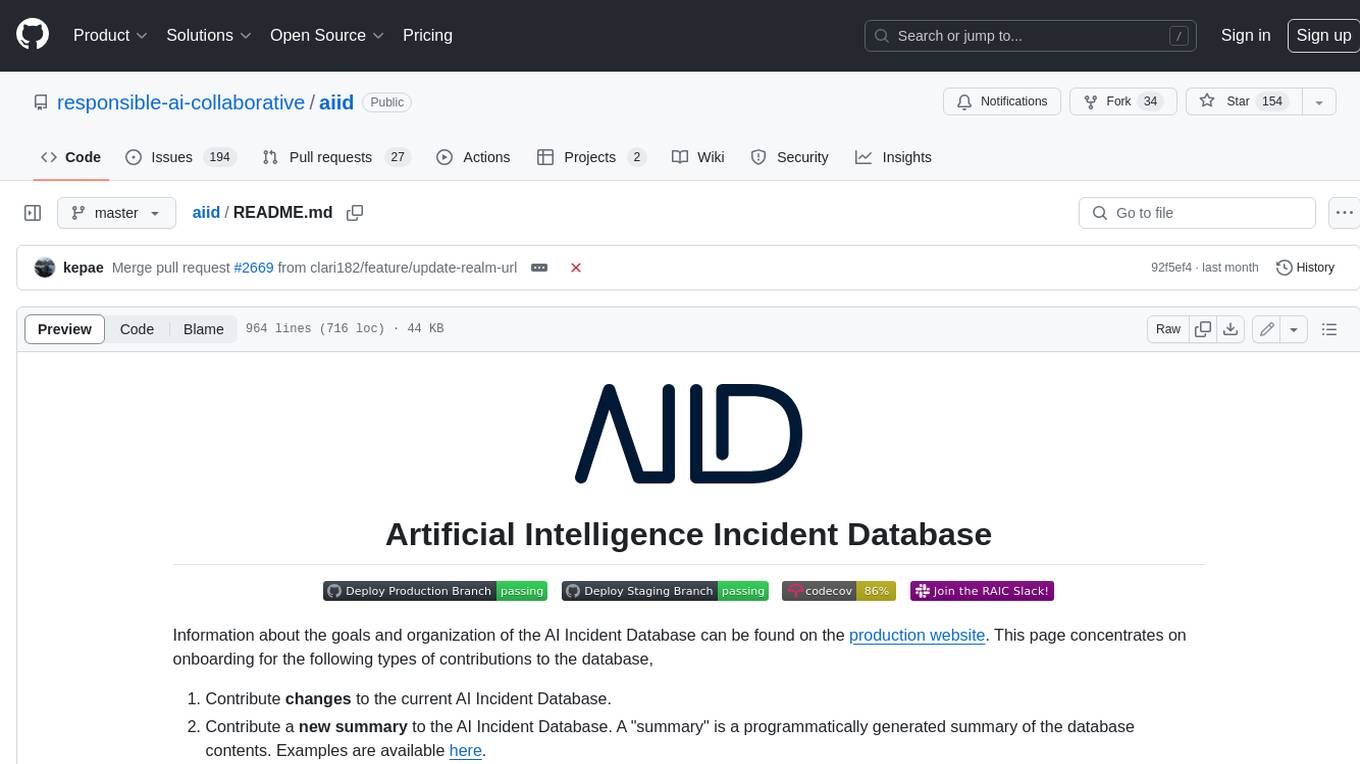
aiid
The Artificial Intelligence Incident Database (AIID) is a collection of incidents involving the development and use of artificial intelligence (AI). The database is designed to help researchers, policymakers, and the public understand the potential risks and benefits of AI, and to inform the development of policies and practices to mitigate the risks and promote the benefits of AI. The AIID is a collaborative project involving researchers from the University of California, Berkeley, the University of Washington, and the University of Toronto.
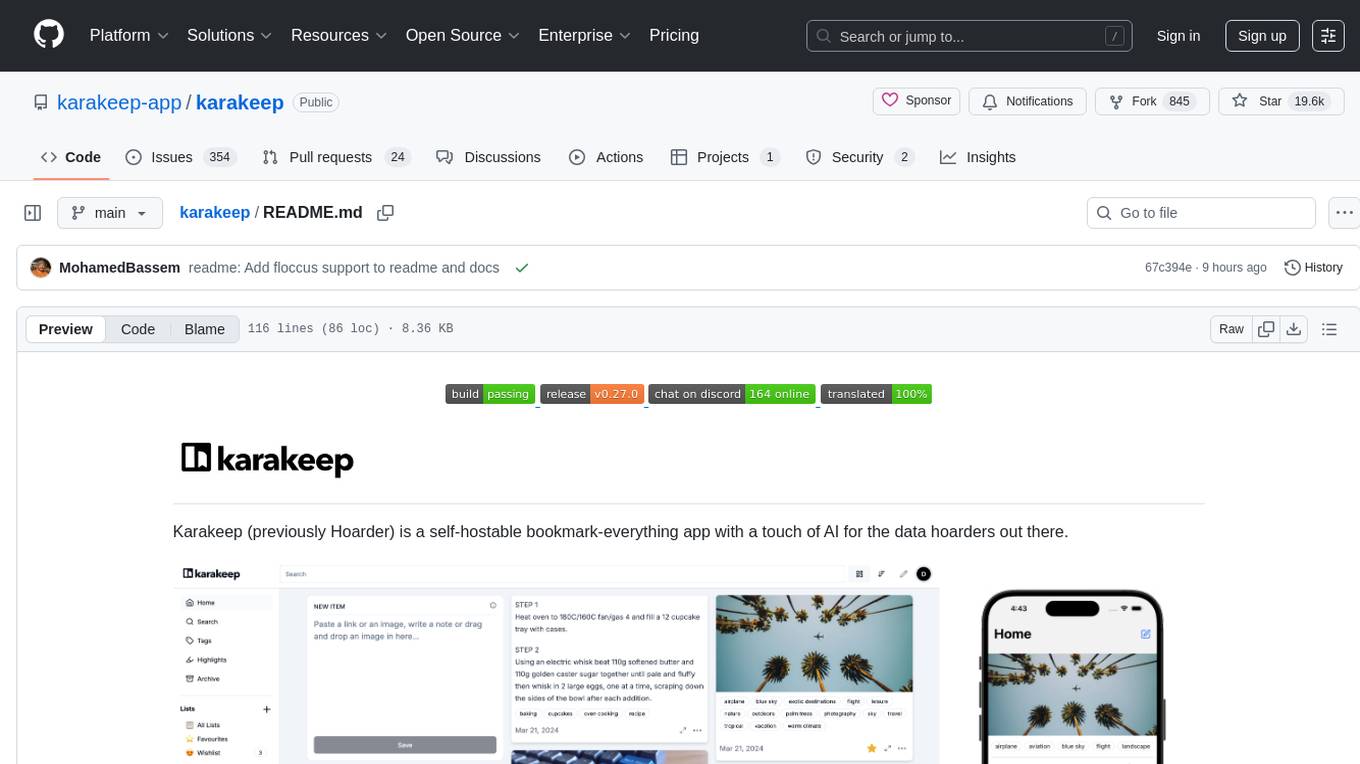
karakeep
Karakeep is a self-hostable bookmark-everything app with a touch of AI for data hoarders. It allows users to bookmark links, take notes, store images and pdfs, and offers features like automatic fetching, full-text search, AI-based tagging, OCR, rule-based engine, Chrome plugin, Firefox addon, iOS and Android apps, auto hoarding from RSS feeds, REST API, multi-language support, and more. The app is under heavy development and aims to provide a self-hosting first solution for managing bookmarks and content.
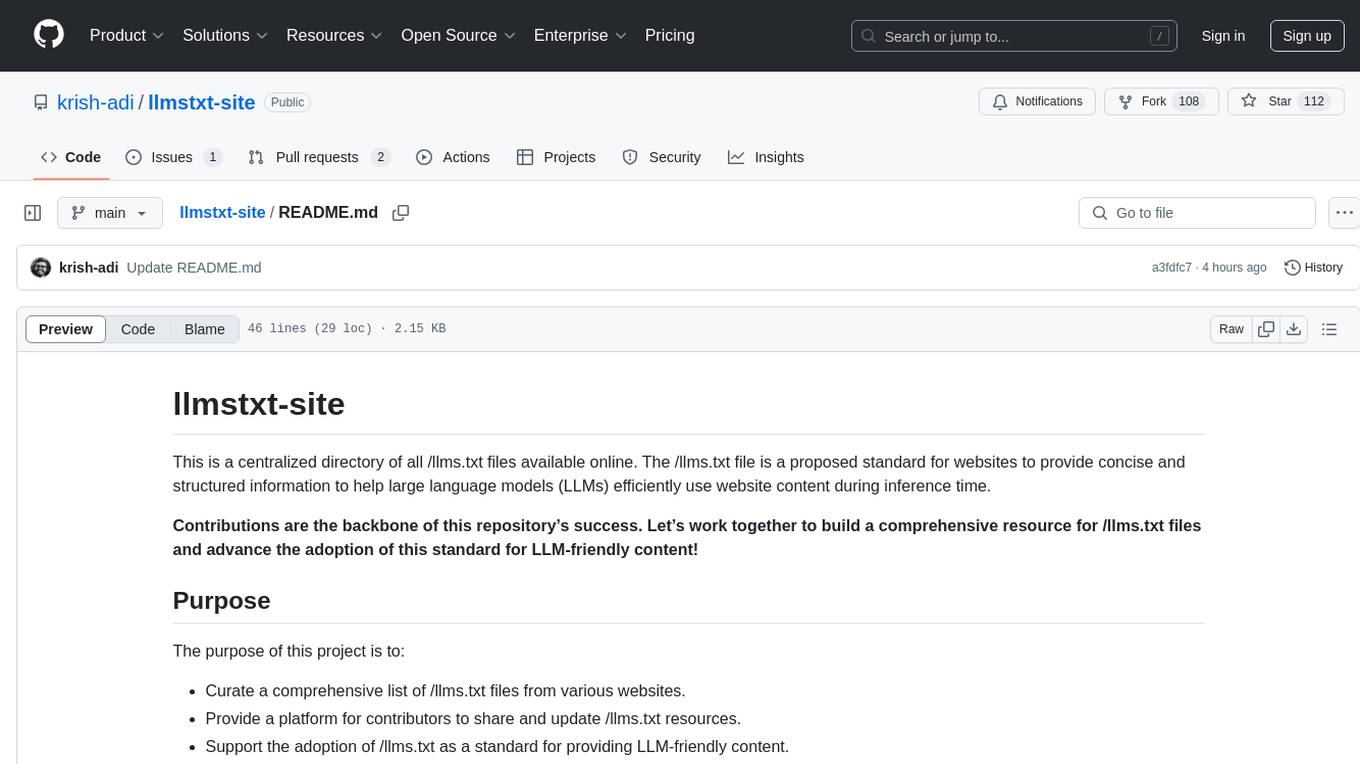
llmstxt-site
llmstxt-site is a centralized directory for /llms.txt files, a proposed standard for websites to provide concise and structured information for large language models (LLMs) during inference time. The project aims to curate a comprehensive list of /llms.txt files, provide a platform for sharing and updating resources, and support the adoption of /llms.txt as a standard for LLM-friendly content.
For similar tasks
swe-books-collection
This repository, named swe-books-collection, was previously used to store a collection of software engineering books. However, due to limitations with LFS, the books have been moved to a Notion page. The repository now serves as a place to provide information and updates related to the software engineering books collection. Users can access the Notion page for the full collection. The repository aims to provide convenience in finding desired software engineering books.
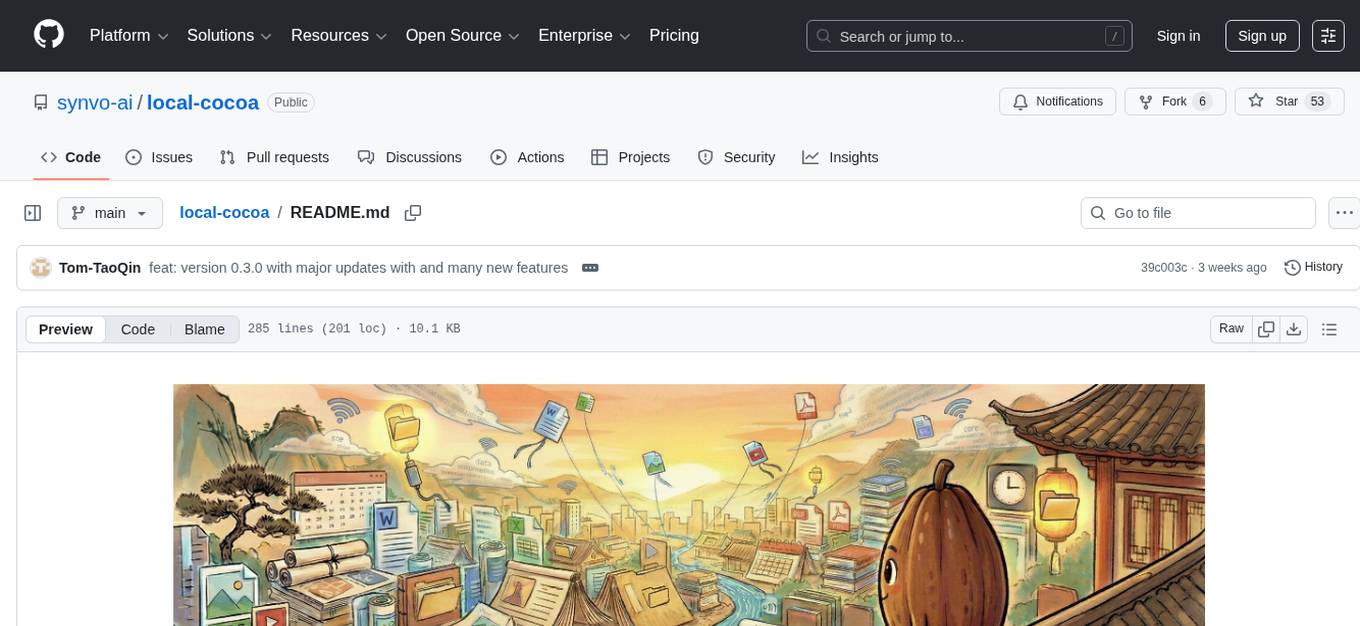
local-cocoa
Local Cocoa is a privacy-focused tool that runs entirely on your device, turning files into memory to spark insights and power actions. It offers features like fully local privacy, multimodal memory, vector-powered retrieval, intelligent indexing, vision understanding, hardware acceleration, focused user experience, integrated notes, and auto-sync. The tool combines file ingestion, intelligent chunking, and local retrieval to build a private on-device knowledge system. The ultimate goal includes more connectors like Google Drive integration, voice mode for local speech-to-text interaction, and a plugin ecosystem for community tools and agents. Local Cocoa is built using Electron, React, TypeScript, FastAPI, llama.cpp, and Qdrant.
For similar jobs
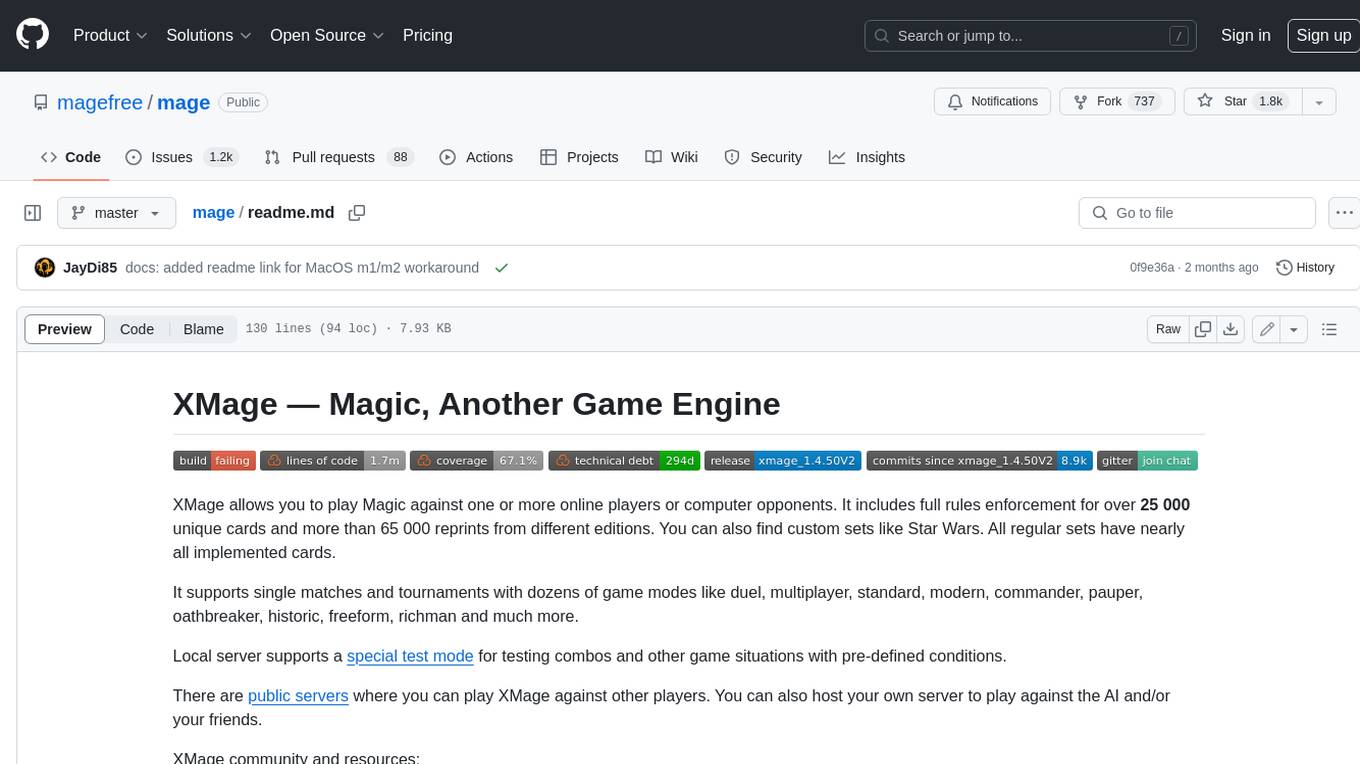
mage
XMage is an open-source, cross-platform application that allows users to play the collectible card game Magic: The Gathering online against other players or computer opponents. It supports over 25,000 unique cards and more than 65,000 reprints from different editions, including custom sets like Star Wars. XMage supports single matches and tournaments with dozens of game modes, including duel, multiplayer, standard, modern, commander, pauper, oathbreaker, historic, freeform, and richman. It also features a deck editor, a player rating system, and support for special formats like Commander, Oathbreaker, Cube, Tiny Leaders, Super Standard, and Historic Standard.
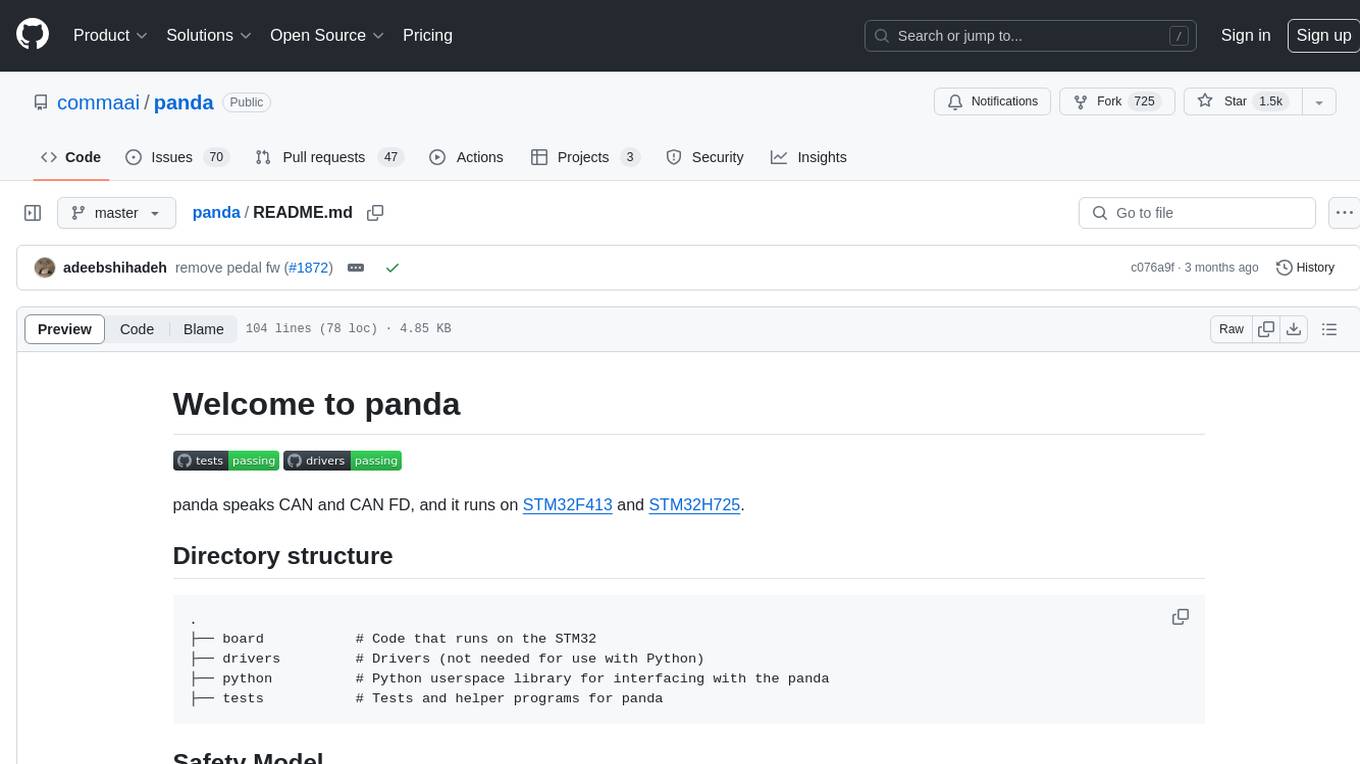
panda
Panda is a car interface tool that speaks CAN and CAN FD, running on STM32F413 and STM32H725. It provides safety modes and controls_allowed feature for message handling. The tool ensures code rigor through CI regression tests, including static code analysis, MISRA C:2012 violations check, unit tests, and hardware-in-the-loop tests. The software interface supports Python library, C++ library, and socketcan in kernel. Panda is licensed under the MIT license.
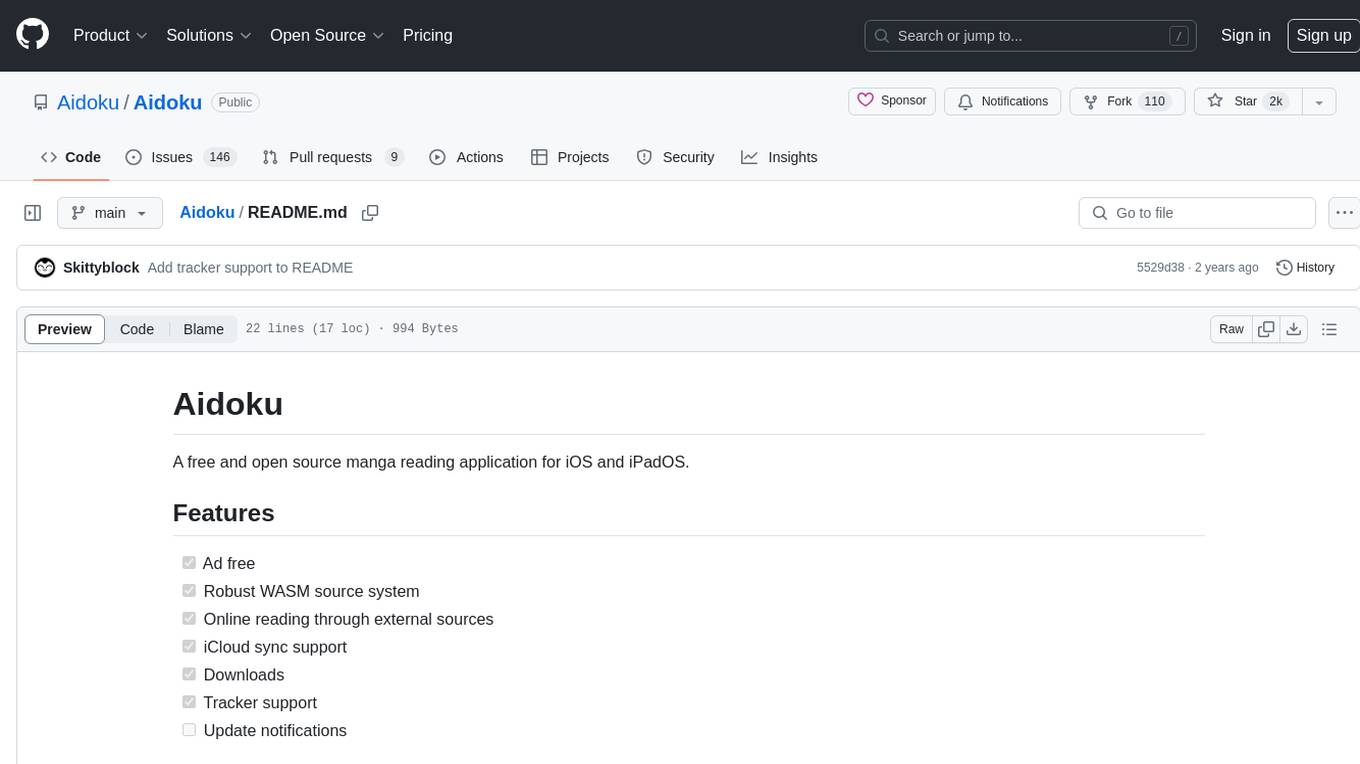
Aidoku
Aidoku is a free and open source manga reading application for iOS and iPadOS. It offers features like ad-free experience, robust WASM source system, online reading through external sources, iCloud sync support, downloads, and tracker support. Users can access the latest ipa from the releases page and join TestFlight via the Aidoku Discord for detailed installation instructions. The project is open to contributions, with planned features and fixes. Translation efforts are welcomed through Weblate for crowd-sourced translations.
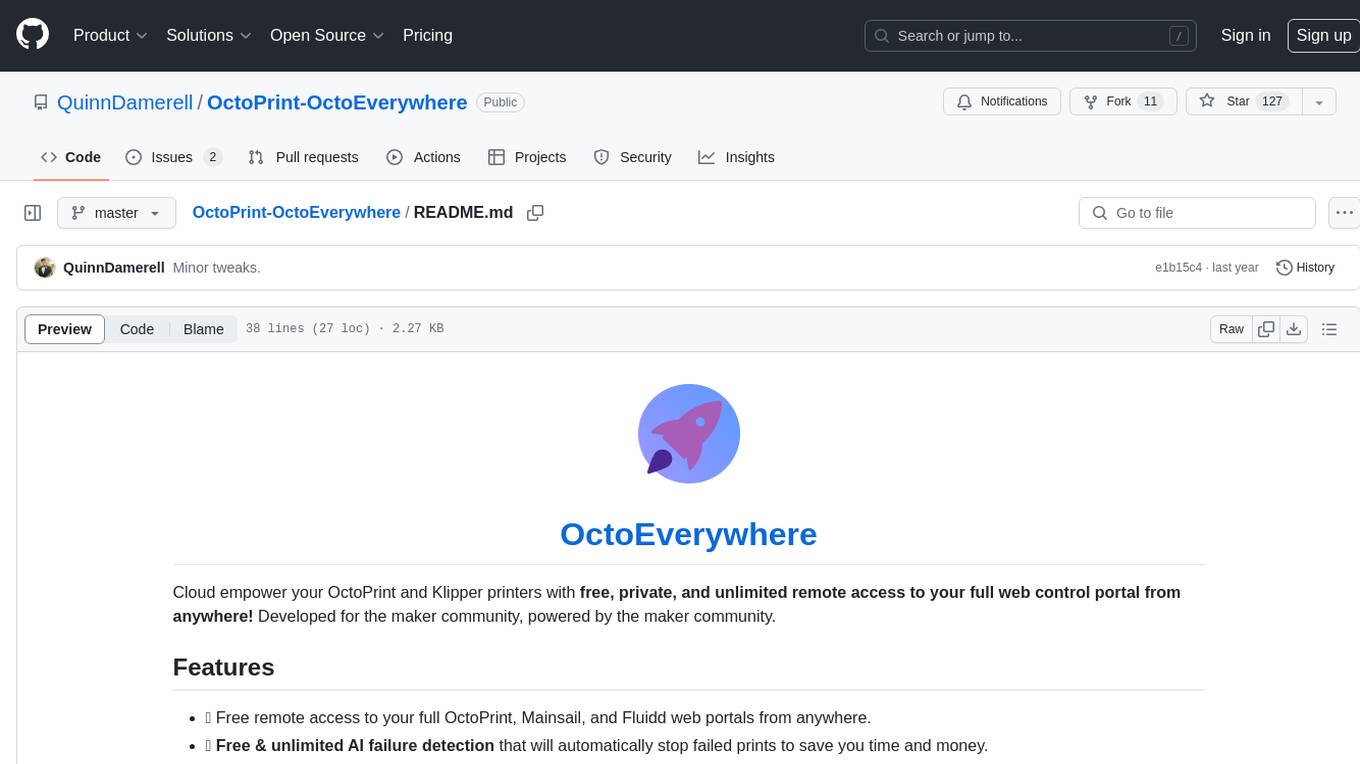
OctoPrint-OctoEverywhere
OctoEverywhere is a cloud-based tool designed to provide free, private, and unlimited remote access to OctoPrint and Klipper printers' web control portals from anywhere. It offers features such as free AI failure detection, webcam streaming, mobile app integration, live streaming, printer notifications, secure portal sharing, plugin functionality, and multicam support. With a high Trustpilot rating and a large user base, OctoEverywhere aims to empower the maker community with easy and efficient printer management.
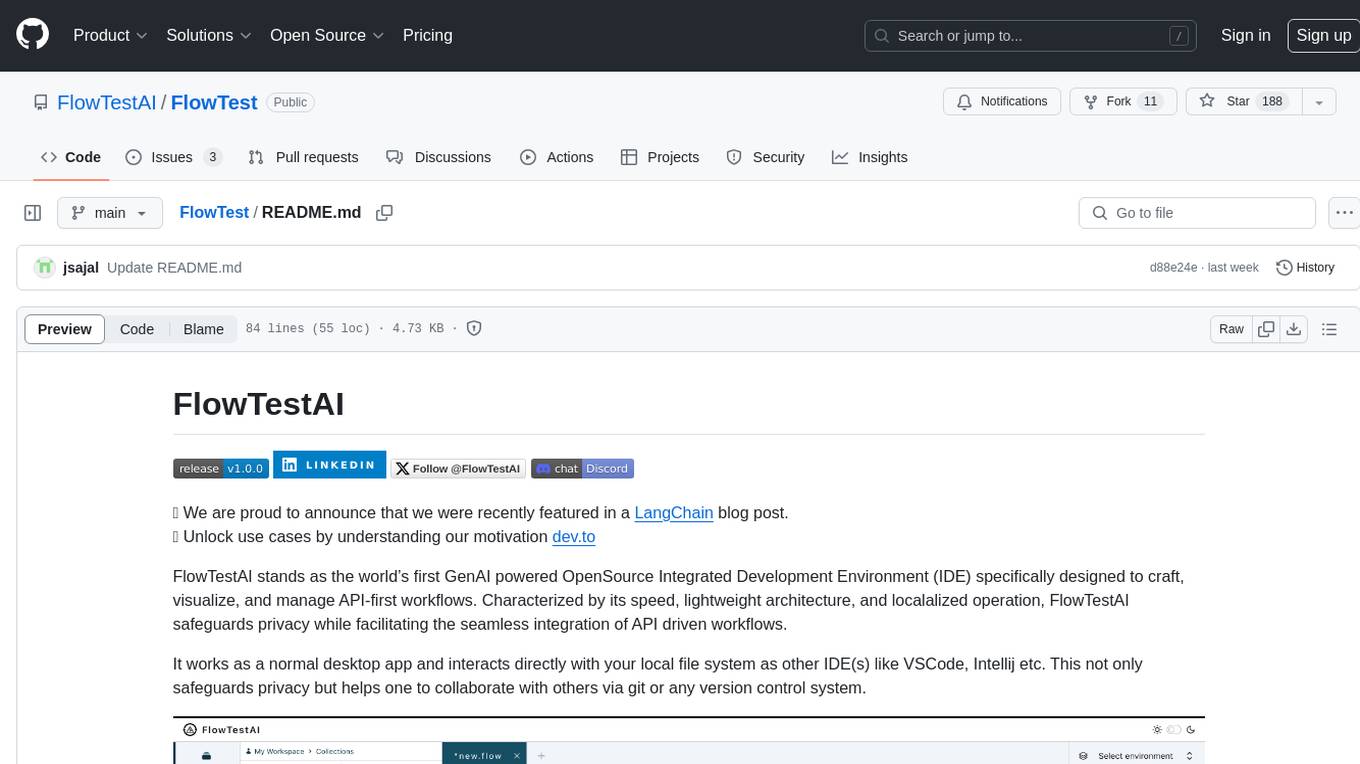
FlowTest
FlowTestAI is the world’s first GenAI powered OpenSource Integrated Development Environment (IDE) designed for crafting, visualizing, and managing API-first workflows. It operates as a desktop app, interacting with the local file system, ensuring privacy and enabling collaboration via version control systems. The platform offers platform-specific binaries for macOS, with versions for Windows and Linux in development. It also features a CLI for running API workflows from the command line interface, facilitating automation and CI/CD processes.
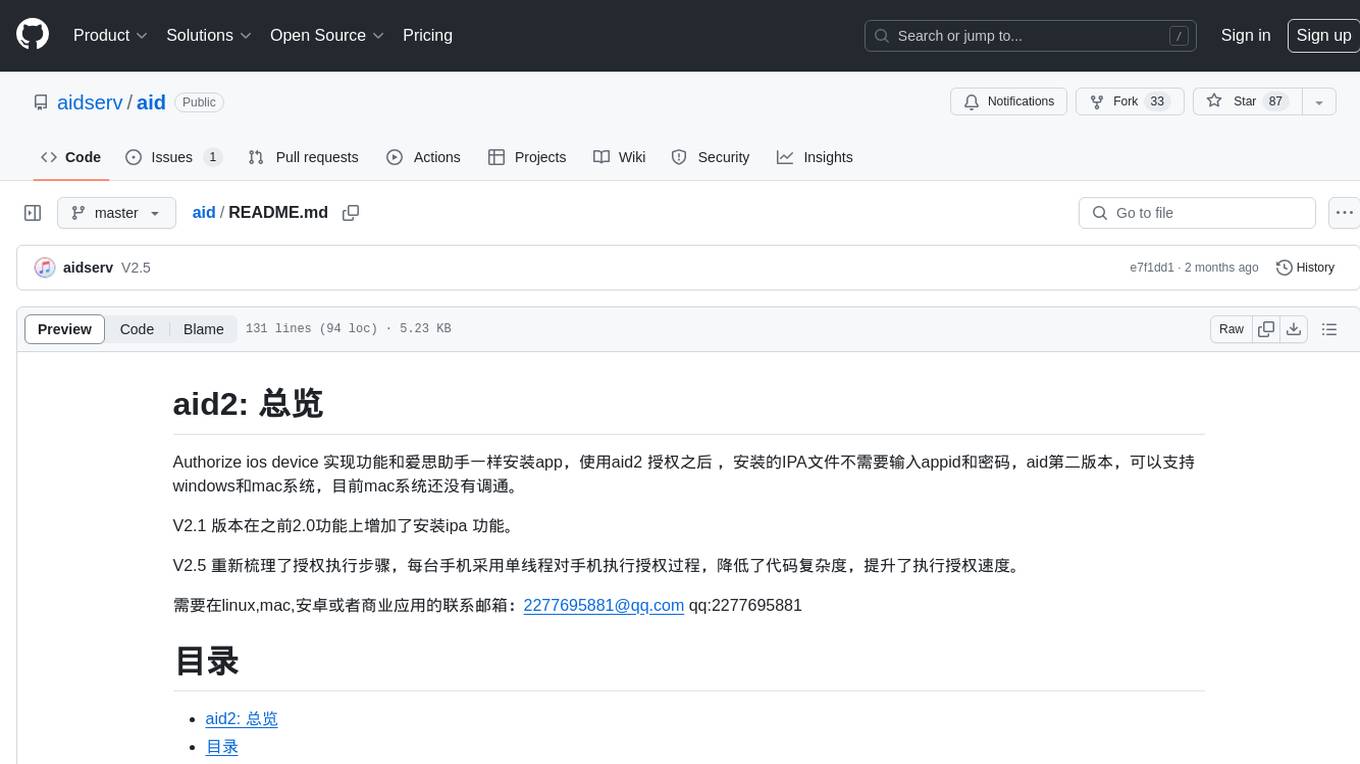
aid
Aid2 is a tool designed to authorize iOS devices and install apps similar to iTools. After authorizing with Aid2, the IPA files can be installed without entering the app ID and password. This second version of Aid supports both Windows and Mac systems, although the Mac system has not been fully tested yet. Version 2.1 added the functionality to install IPA files. Version 2.5 streamlined the authorization process, executing it on each device using a single thread to reduce code complexity and improve authorization speed. The tool requires a compilation environment with Vcpkg, gRPC, Protobuf, and OpenSSL, and users need to have access to a VPN for successful configuration.
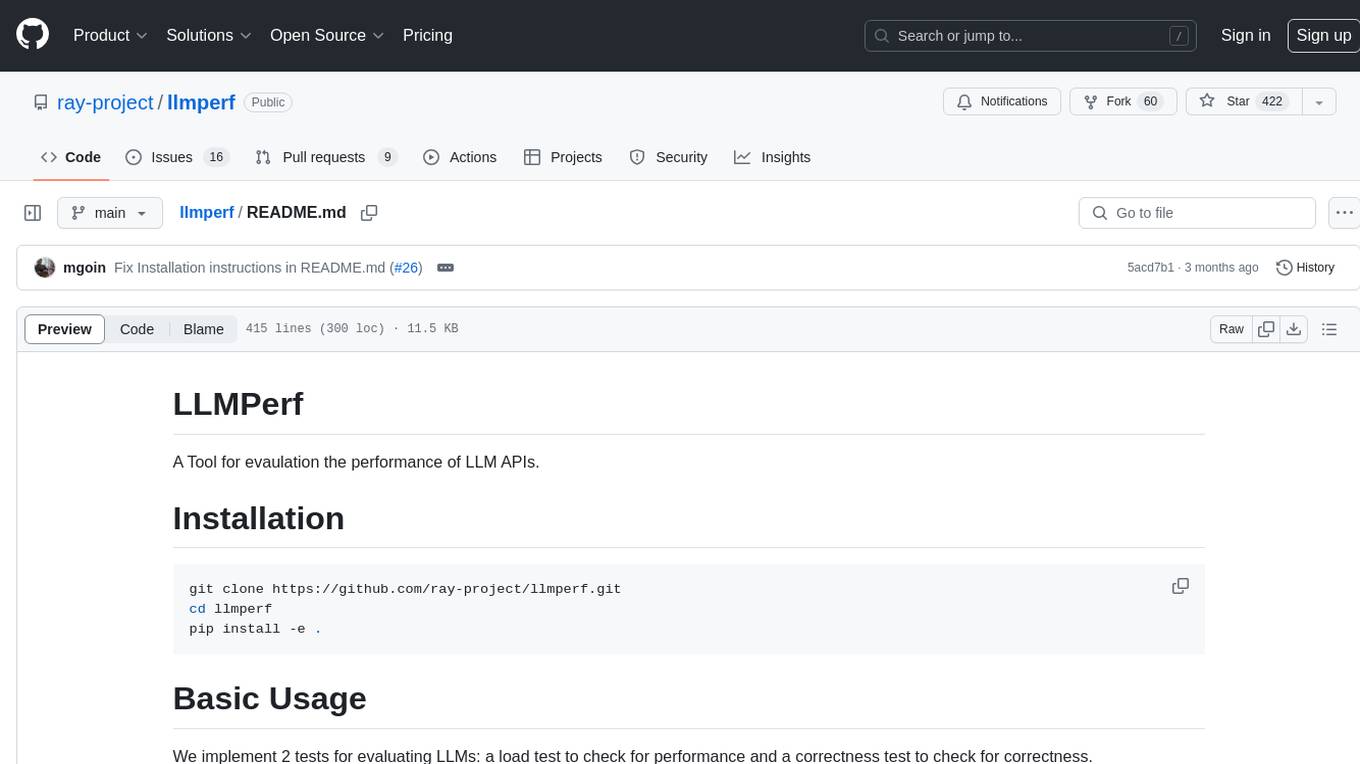
llmperf
LLMPerf is a tool designed for evaluating the performance of Language Model APIs. It provides functionalities for conducting load tests to measure inter-token latency and generation throughput, as well as correctness tests to verify the responses. The tool supports various LLM APIs including OpenAI, Anthropic, TogetherAI, Hugging Face, LiteLLM, Vertex AI, and SageMaker. Users can set different parameters for the tests and analyze the results to assess the performance of the LLM APIs. LLMPerf aims to standardize prompts across different APIs and provide consistent evaluation metrics for comparison.
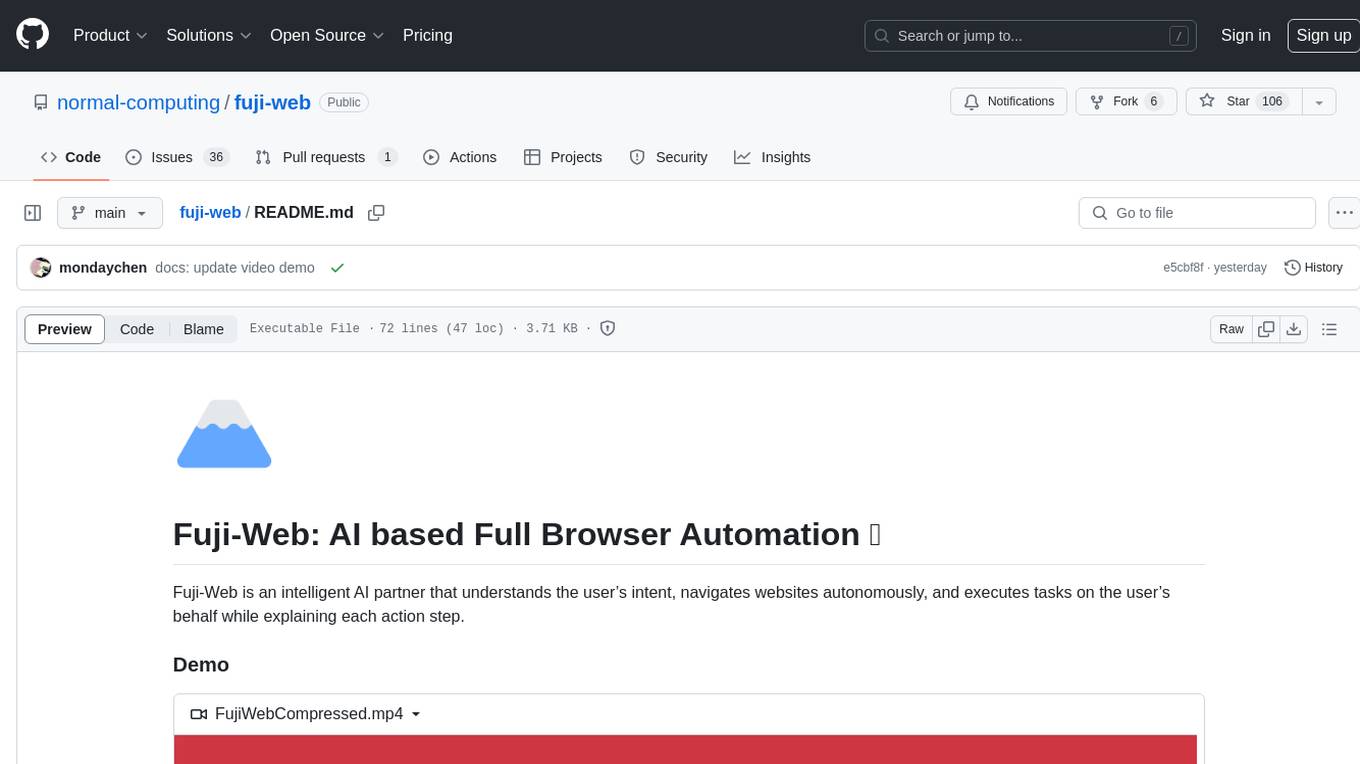
fuji-web
Fuji-Web is an intelligent AI partner designed for full browser automation. It autonomously navigates websites and performs tasks on behalf of the user while providing explanations for each action step. Users can easily install the extension in their browser, access the Fuji icon to input tasks, and interact with the tool to streamline web browsing tasks. The tool aims to enhance user productivity by automating repetitive web actions and providing a seamless browsing experience.