


ai-terminal
Your AI mate into your favourite terminal
Stars: 132
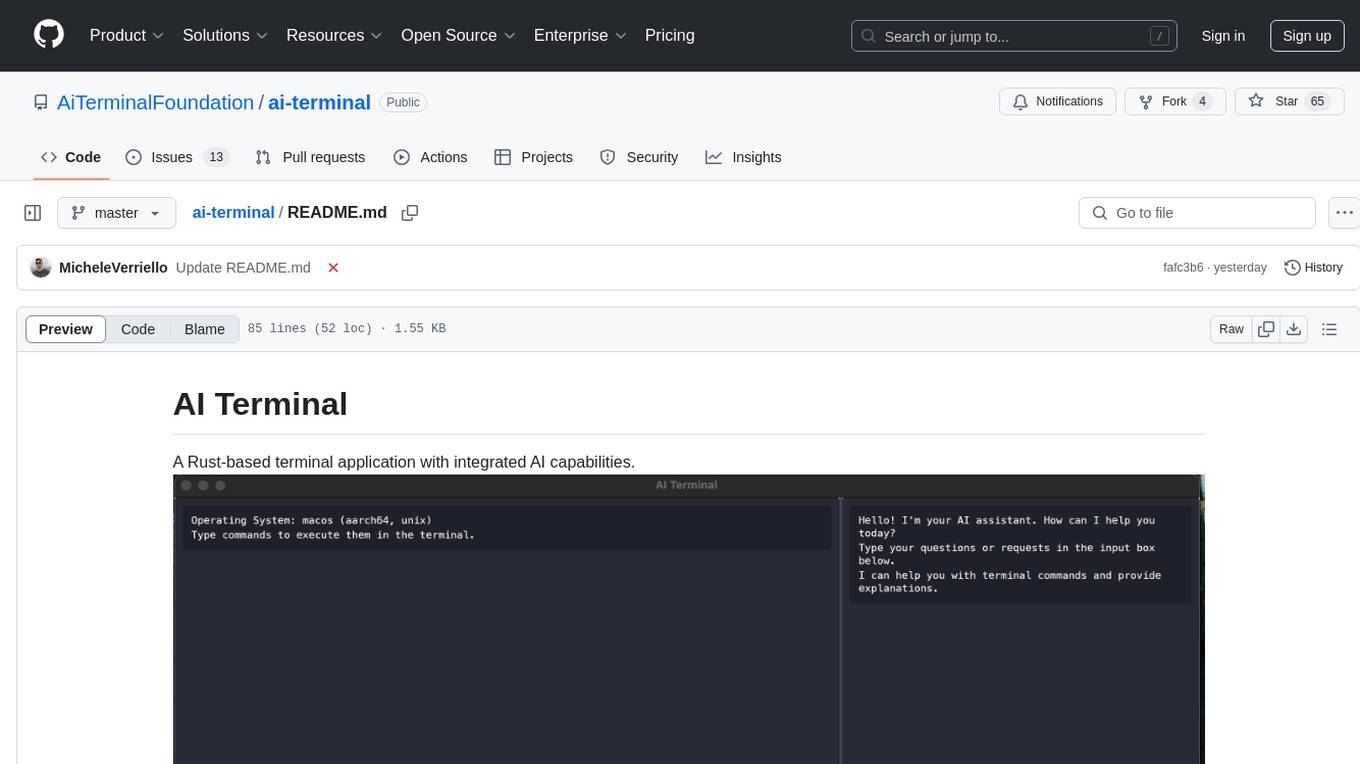
AI Terminal is a Tauri + Angular terminal application with integrated AI capabilities, offering natural language command interpretation, an integrated AI assistant, command history and auto-completion, and cross-platform support (macOS, Windows, Linux). The modern UI is built with Tauri and Angular. The tool requires Node.js 18+, Rust and Cargo, and Ollama for AI features. Users can build a universal binary for macOS, install the tool using Homebrew, and use Ollama to download specific models. Contributions are welcome under the MIT License.
README:
A Tauri + Angular terminal application with integrated AI capabilities.

- Natural language command interpretation
- Integrated AI assistant
- Command history and auto-completion
- Cross-platform support (macOS, Windows, Linux)
- Modern UI built with Tauri and Angular
- Node.js 18+
- Rust and Cargo
- For AI features: Ollama (can be installed with
brew install ollama)
-
Clone the repository:
git clone https://github.com/your-username/ai-terminal.git cd ai-terminal -
Install dependencies and run the project:
cd ai-terminal
npm install
npm run tauri dev
You can install AI Terminal using Homebrew:
brew tap AiTerminalFoundation/ai-terminal
brew install --cask ai-terminal
After installation, you can launch the application from Spotlight or run it from the terminal:
ai-terminal- Install Ollama
Open your terminal and run:
curl -fsSL https://ollama.com/install.sh | sh- Download the Model
Run the following command:
ollama pull macsdeve/BetterBash3- Download Ollama
- Visit Ollama download page.
- Click Download for macOS.
- Install Ollama
- Open the downloaded
.zipfile from yourDownloadsfolder. - Drag the
Ollama.appinto yourApplicationsfolder. - Open
Ollama.appand follow any prompts.
- Download the Model
Open Terminal and execute:
ollama pull macsdeve/BetterBash3Contributions are welcome! Please feel free to submit a Pull Request.
For Tasks:
Click tags to check more tools for each tasksFor Jobs:
Alternative AI tools for ai-terminal
Similar Open Source Tools
ai-terminal
AI Terminal is a Tauri + Angular terminal application with integrated AI capabilities, offering natural language command interpretation, an integrated AI assistant, command history and auto-completion, and cross-platform support (macOS, Windows, Linux). The modern UI is built with Tauri and Angular. The tool requires Node.js 18+, Rust and Cargo, and Ollama for AI features. Users can build a universal binary for macOS, install the tool using Homebrew, and use Ollama to download specific models. Contributions are welcome under the MIT License.
codewalk
CodeWalk is a native cross-platform client for OpenCode server mode, built with Flutter. It provides an AI chat interface for coding interactions, multi-server profile management, session lifecycle management, worktree management, speech-to-text input, and more. The project follows Clean Architecture with Flutter, Dart, Provider for state management, Dio for HTTP client, SharedPreferences for local storage, GetIt for dependency injection, and Material Design 3 for design system.
web-ui
WebUI is a user-friendly tool built on Gradio that enhances website accessibility for AI agents. It supports various Large Language Models (LLMs) and allows custom browser integration for seamless interaction. The tool eliminates the need for re-login and authentication challenges, offering high-definition screen recording capabilities.
Airshipper
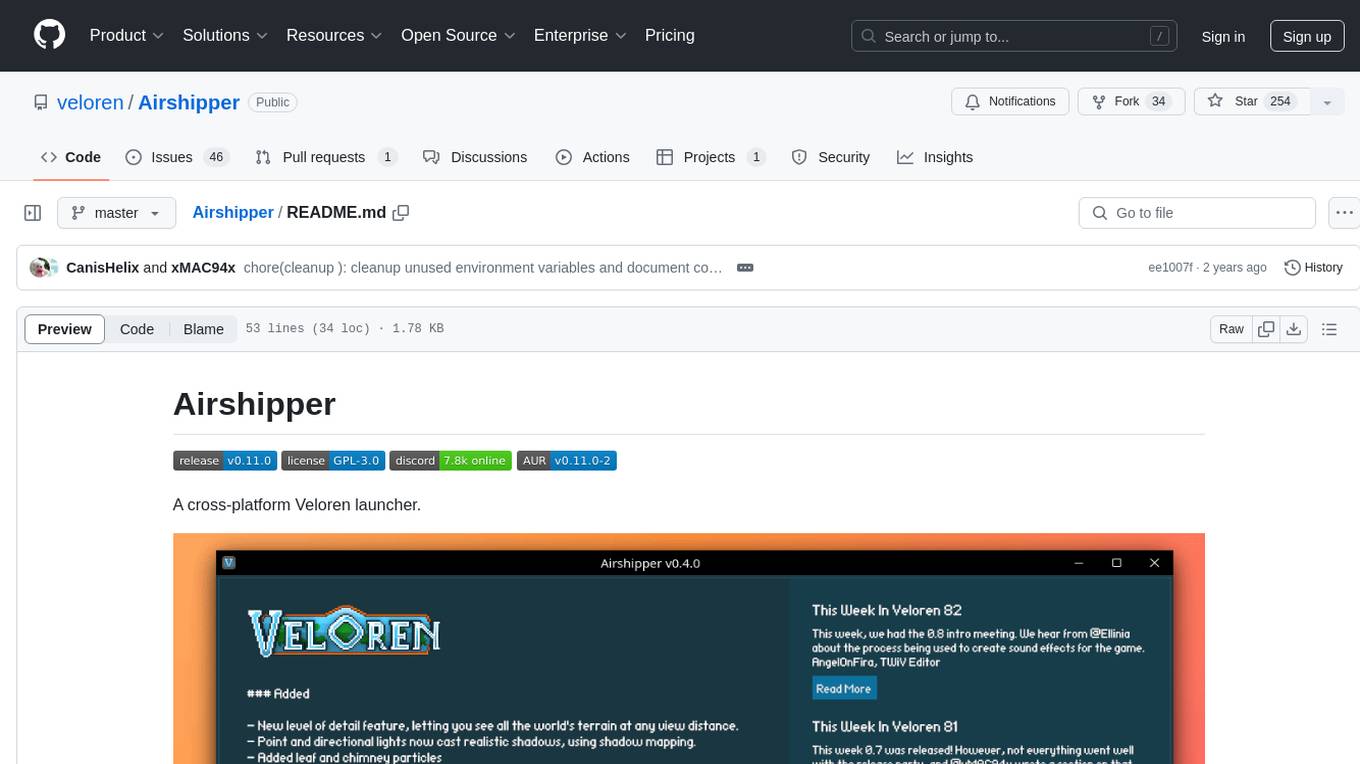
Airshipper is a cross-platform Veloren launcher that allows users to update/download and start nightly builds of the game. It features a fancy UI with self-updating capabilities on Windows. Users can compile it from source and also have the option to install Airshipper-Server for advanced configurations. Note that Airshipper is still in development and may not be stable for all users.
pastemax
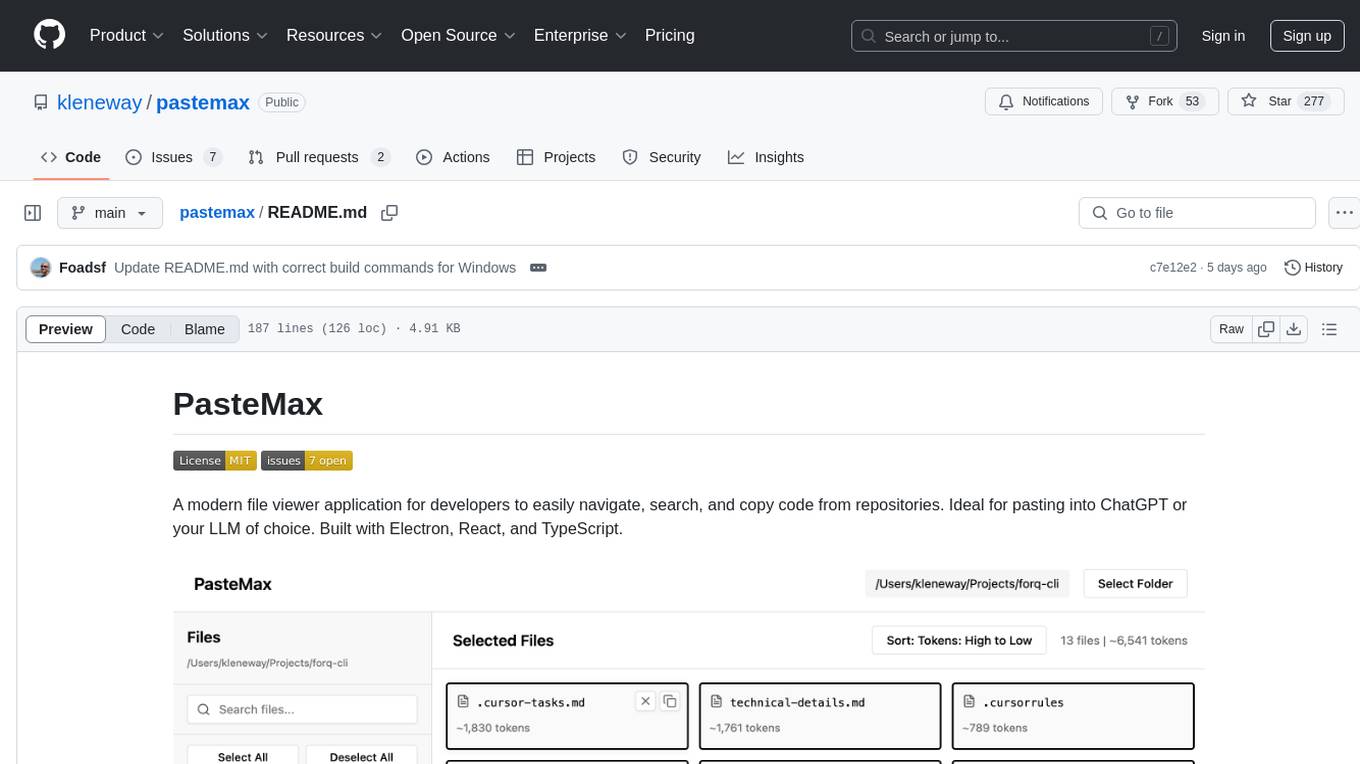
PasteMax is a modern file viewer application designed for developers to easily navigate, search, and copy code from repositories. It provides features such as file tree navigation, token counting, search capabilities, selection management, sorting options, dark mode, binary file detection, and smart file exclusion. Built with Electron, React, and TypeScript, PasteMax is ideal for pasting code into ChatGPT or other language models. Users can download the application or build it from source, and customize file exclusions. Troubleshooting steps are provided for common issues, and contributions to the project are welcome under the MIT License.
tgpt
tgpt is a cross-platform command-line interface (CLI) tool that allows users to interact with AI chatbots in the Terminal without needing API keys. It supports various AI providers such as KoboldAI, Phind, Llama2, Blackbox AI, and OpenAI. Users can generate text, code, and images using different flags and options. The tool can be installed on GNU/Linux, MacOS, FreeBSD, and Windows systems. It also supports proxy configurations and provides options for updating and uninstalling the tool.
agent-of-empires
Agent of Empires (AoE) is a terminal session manager designed for AI coding agents on Linux and macOS. It allows users to run multiple AI agents in parallel across different branches of their codebase, each in its own isolated session with optional Docker sandboxing. The tool provides a TUI dashboard for creating, monitoring, and managing sessions, along with features like status detection, Git worktrees, Docker sandboxing, diff view, per-repo config, profiles, and full functionality from both CLI and TUI interfaces.
openclaw.ai
OpenClaw.ai is a landing page for OpenClaw, a personal AI assistant. The page includes Quick Start, features, testimonials, and a visual grid of supported chat providers, AI models, platforms, and tools. It is built using Astro as the static site generator and hosted on GitHub Pages with custom CSS. The landing page also provides installer scripts for macOS, Linux, and Windows, along with UI controls for installation options and automation. OpenClaw.ai is automatically deployed to GitHub Pages on push to the main branch.
backend.ai-webui
Backend.AI Web UI is a user-friendly web and app interface designed to make AI accessible for end-users, DevOps, and SysAdmins. It provides features for session management, inference service management, pipeline management, storage management, node management, statistics, configurations, license checking, plugins, help & manuals, kernel management, user management, keypair management, manager settings, proxy mode support, service information, and integration with the Backend.AI Web Server. The tool supports various devices, offers a built-in websocket proxy feature, and allows for versatile usage across different platforms. Users can easily manage resources, run environment-supported apps, access a web-based terminal, use Visual Studio Code editor, manage experiments, set up autoscaling, manage pipelines, handle storage, monitor nodes, view statistics, configure settings, and more.
openclaw-android
OpenClaw on Android is a project that enables running an OpenClaw server on Android devices, providing a lightweight, low-power, and secure solution for hosting a server. The project eliminates the need for a Linux installation by patching compatibility issues directly, allowing OpenClaw to run in pure Termux. It offers a step-by-step setup guide, including enabling developer options, installing Termux, setting up OpenClaw, and accessing the dashboard from a PC. Additionally, the project includes compatibility patches for popular AI CLI tools like Claude Code, Gemini CLI, and Codex CLI, enabling users to install and run these tools on their Android devices. The project also provides an update mechanism and an uninstall script for easy removal.
morphic
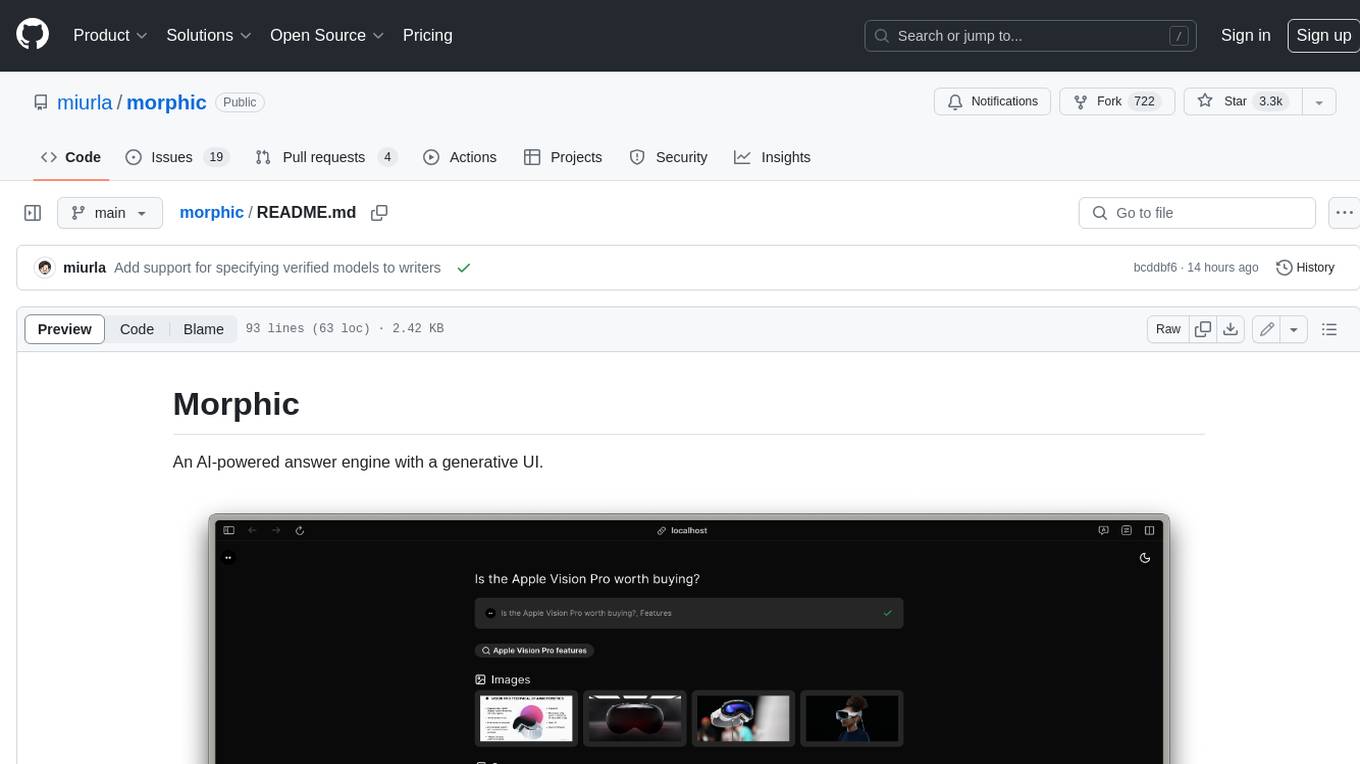
Morphic is an AI-powered answer engine with a generative UI. It utilizes a stack of Next.js, Vercel AI SDK, OpenAI, Tavily AI, shadcn/ui, Radix UI, and Tailwind CSS. To get started, fork and clone the repo, install dependencies, fill out secrets in the .env.local file, and run the app locally using 'bun dev'. You can also deploy your own live version of Morphic with Vercel. Verified models that can be specified to writers include Groq, LLaMA3 8b, and LLaMA3 70b.
recommendarr
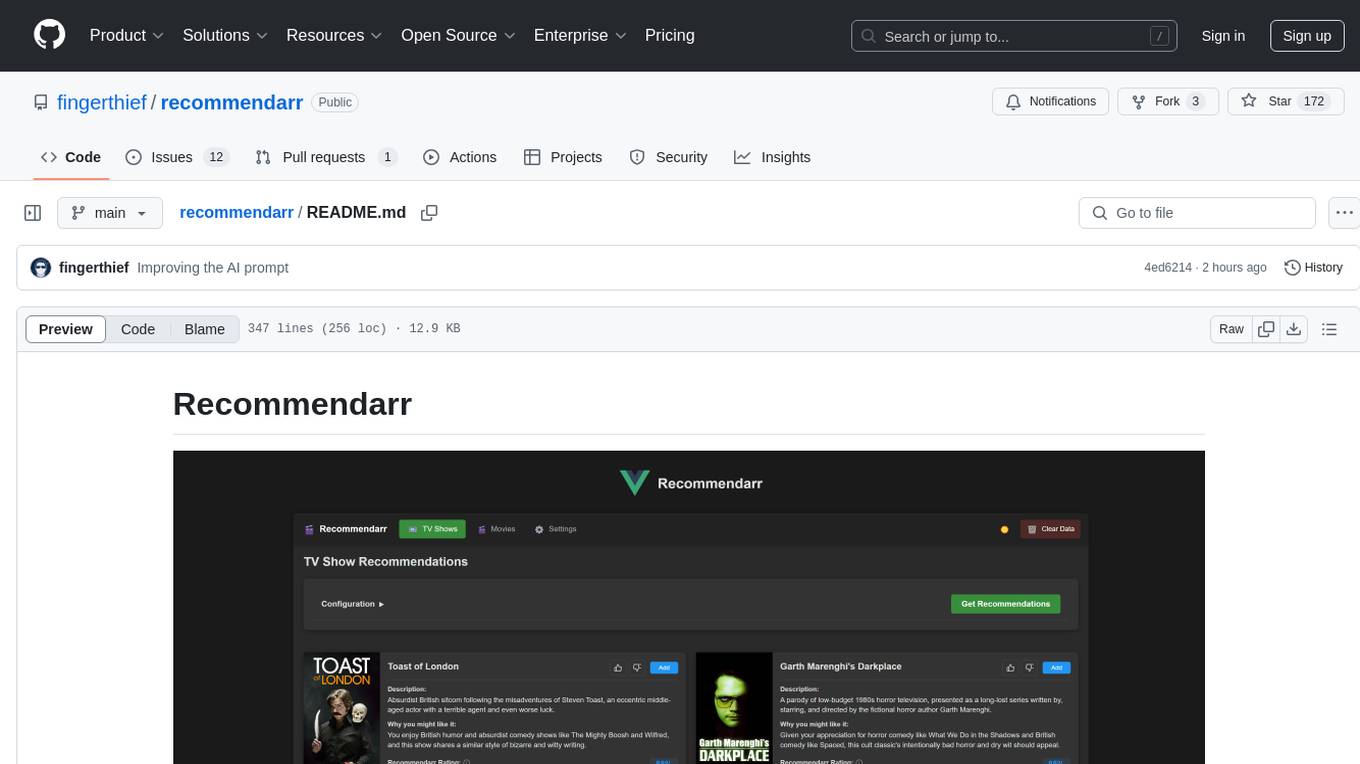
Recommendarr is a tool that generates personalized TV show and movie recommendations based on your Sonarr, Radarr, Plex, and Jellyfin libraries using AI. It offers AI-powered recommendations, media server integration, flexible AI support, watch history analysis, customization options, and dark/light mode toggle. Users can connect their media libraries and watch history services, configure AI service settings, and get personalized recommendations based on genre, language, and mood/vibe preferences. The tool works with any OpenAI-compatible API and offers various recommended models for different cost options and performance levels. It provides personalized suggestions, detailed information, filter options, watch history analysis, and one-click adding of recommended content to Sonarr/Radarr.
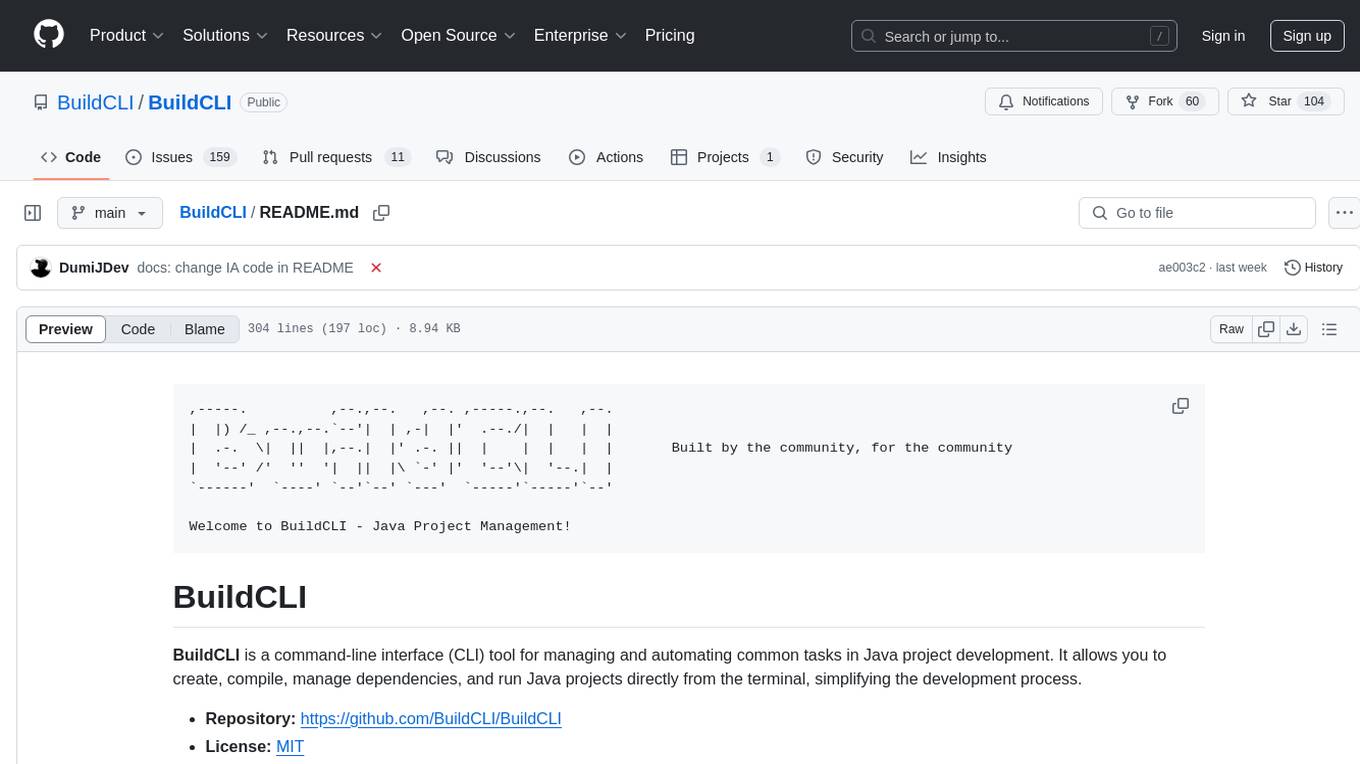
BuildCLI
BuildCLI is a command-line interface (CLI) tool designed for managing and automating common tasks in Java project development. It simplifies the development process by allowing users to create, compile, manage dependencies, run projects, generate documentation, manage configuration profiles, dockerize projects, integrate CI/CD tools, and generate structured changelogs. The tool aims to enhance productivity and streamline Java project management by providing a range of functionalities accessible directly from the terminal.
trieve
Trieve is an advanced relevance API for hybrid search, recommendations, and RAG. It offers a range of features including self-hosting, semantic dense vector search, typo tolerant full-text/neural search, sub-sentence highlighting, recommendations, convenient RAG API routes, the ability to bring your own models, hybrid search with cross-encoder re-ranking, recency biasing, tunable popularity-based ranking, filtering, duplicate detection, and grouping. Trieve is designed to be flexible and customizable, allowing users to tailor it to their specific needs. It is also easy to use, with a simple API and well-documented features.
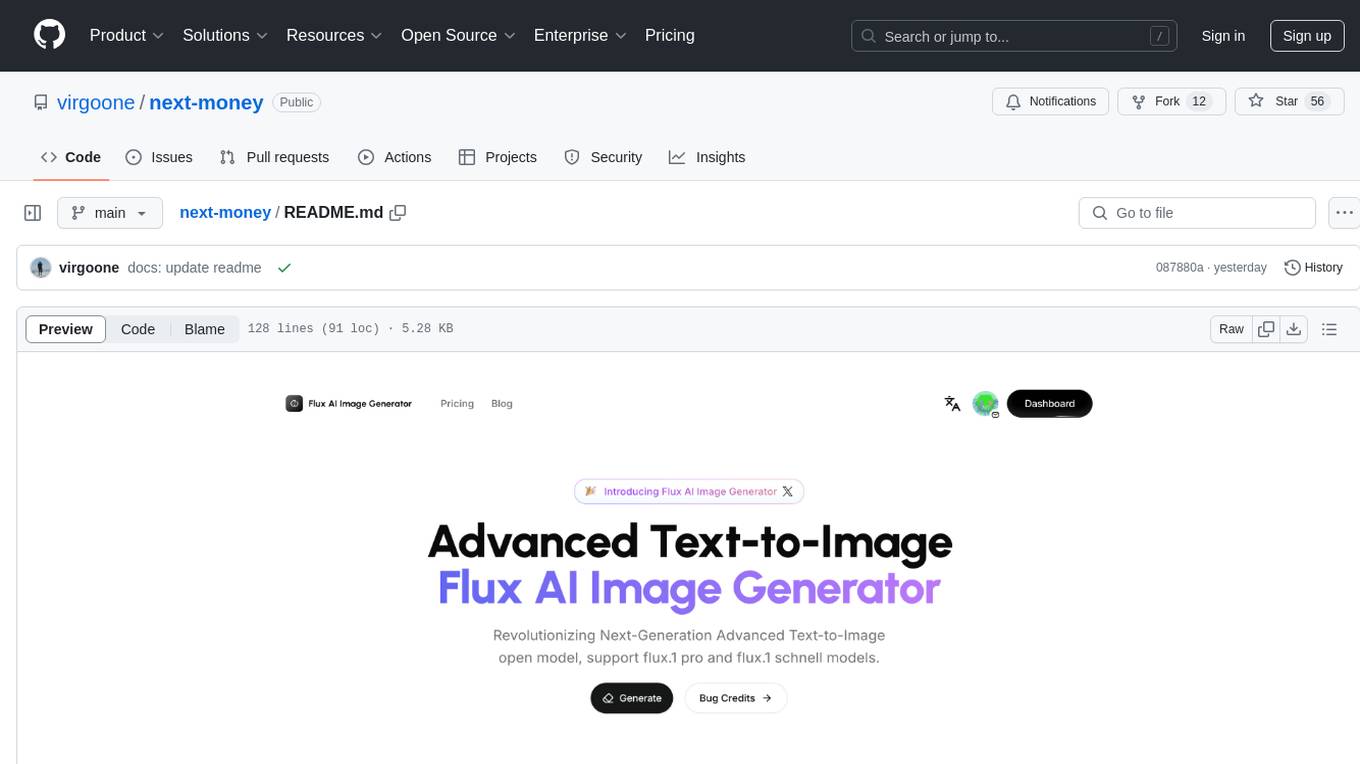
next-money
Next Money Stripe Starter is a SaaS Starter project that empowers your next project with a stack of Next.js, Prisma, Supabase, Clerk Auth, Resend, React Email, Shadcn/ui, and Stripe. It seamlessly integrates these technologies to accelerate your development and SaaS journey. The project includes frameworks, platforms, UI components, hooks and utilities, code quality tools, and miscellaneous features to enhance the development experience. Created by @koyaguo in 2023 and released under the MIT license.
chunkr
Chunkr is an open-source document intelligence API that provides a production-ready service for document layout analysis, OCR, and semantic chunking. It allows users to convert PDFs, PPTs, Word docs, and images into RAG/LLM-ready chunks. The API offers features such as layout analysis, OCR with bounding boxes, structured HTML and markdown output, and VLM processing controls. Users can interact with Chunkr through a Python SDK, enabling them to upload documents, process them, and export results in various formats. The tool also supports self-hosted deployment options using Docker Compose or Kubernetes, with configurations for different AI models like OpenAI, Google AI Studio, and OpenRouter. Chunkr is dual-licensed under the GNU Affero General Public License v3.0 (AGPL-3.0) and a commercial license, providing flexibility for different usage scenarios.
For similar tasks
ai-terminal
AI Terminal is a Tauri + Angular terminal application with integrated AI capabilities, offering natural language command interpretation, an integrated AI assistant, command history and auto-completion, and cross-platform support (macOS, Windows, Linux). The modern UI is built with Tauri and Angular. The tool requires Node.js 18+, Rust and Cargo, and Ollama for AI features. Users can build a universal binary for macOS, install the tool using Homebrew, and use Ollama to download specific models. Contributions are welcome under the MIT License.
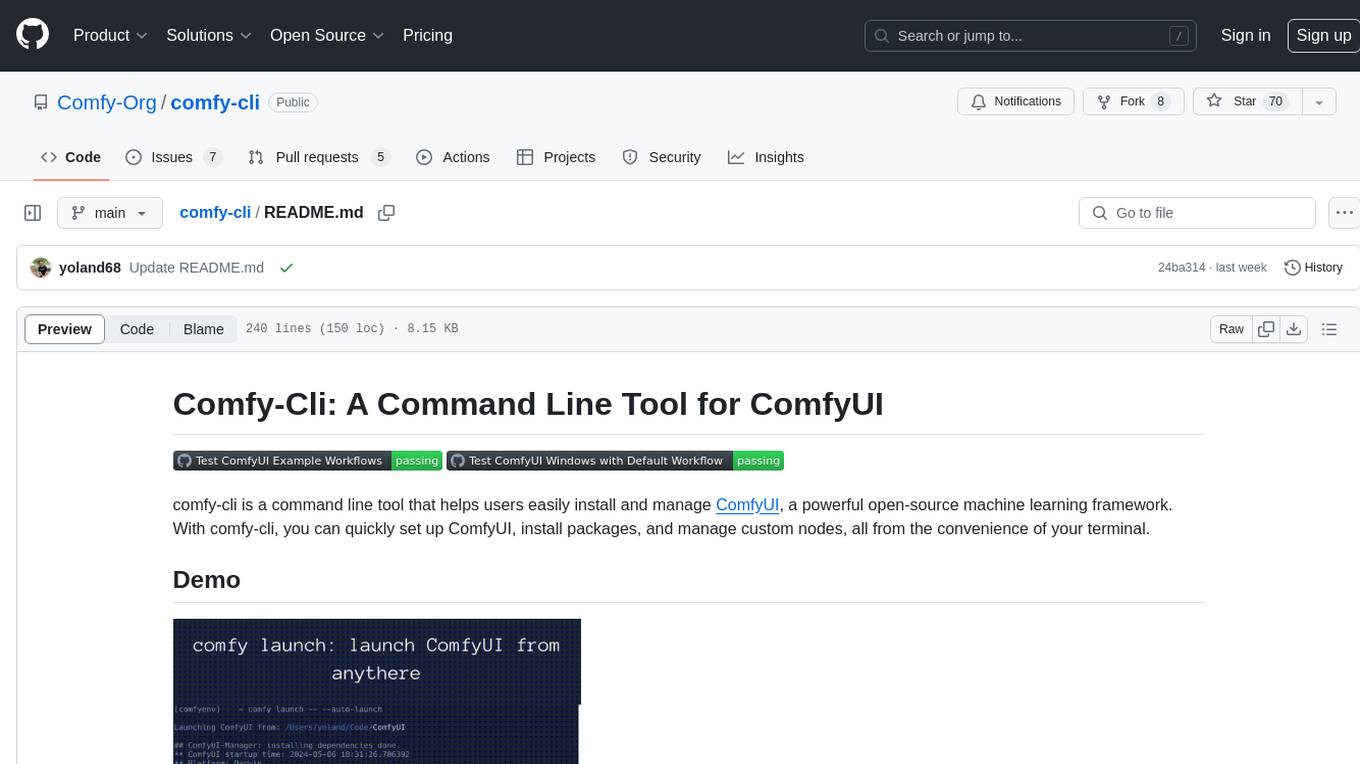
comfy-cli
Comfy-cli is a command line tool designed to facilitate the installation and management of ComfyUI, an open-source machine learning framework. Users can easily set up ComfyUI, install packages, and manage custom nodes directly from the terminal. The tool offers features such as easy installation, seamless package management, custom node management, checkpoint downloads, cross-platform compatibility, and comprehensive documentation. Comfy-cli simplifies the process of working with ComfyUI, making it convenient for users to handle various tasks related to the framework.
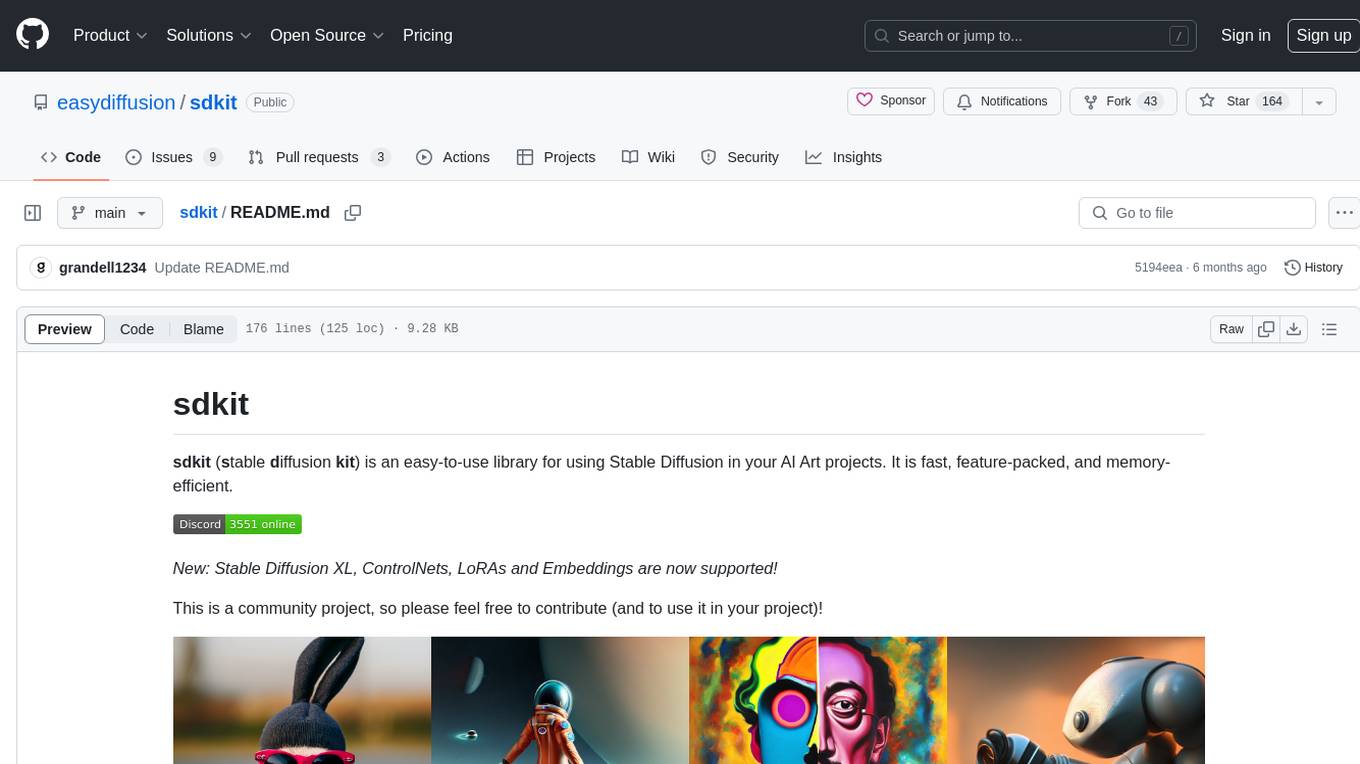
sdkit
sdkit (stable diffusion kit) is an easy-to-use library for utilizing Stable Diffusion in AI Art projects. It includes features like ControlNets, LoRAs, Textual Inversion Embeddings, GFPGAN, CodeFormer for face restoration, RealESRGAN for upscaling, k-samplers, support for custom VAEs, NSFW filter, model-downloader, parallel GPU support, and more. It offers a model database, auto-scanning for malicious models, and various optimizations. The API consists of modules for loading models, generating images, filters, model merging, and utilities, all managed through the sdkit.Context object.
Jlama
Jlama is a modern Java inference engine designed for large language models. It supports various model types such as Gemma, Llama, Mistral, GPT-2, BERT, and more. The tool implements features like Flash Attention, Mixture of Experts, and supports different model quantization formats. Built with Java 21 and utilizing the new Vector API for faster inference, Jlama allows users to add LLM inference directly to their Java applications. The tool includes a CLI for running models, a simple UI for chatting with LLMs, and examples for different model types.
olah
Olah is a self-hosted lightweight Huggingface mirror service that implements mirroring feature for Huggingface resources at file block level, enhancing download speeds and saving bandwidth. It offers cache control policies and allows administrators to configure accessible repositories. Users can install Olah with pip or from source, set up the mirror site, and download models and datasets using huggingface-cli. Olah provides additional configurations through a configuration file for basic setup and accessibility restrictions. Future work includes implementing an administrator and user system, OOS backend support, and mirror update schedule task. Olah is released under the MIT License.
gemma
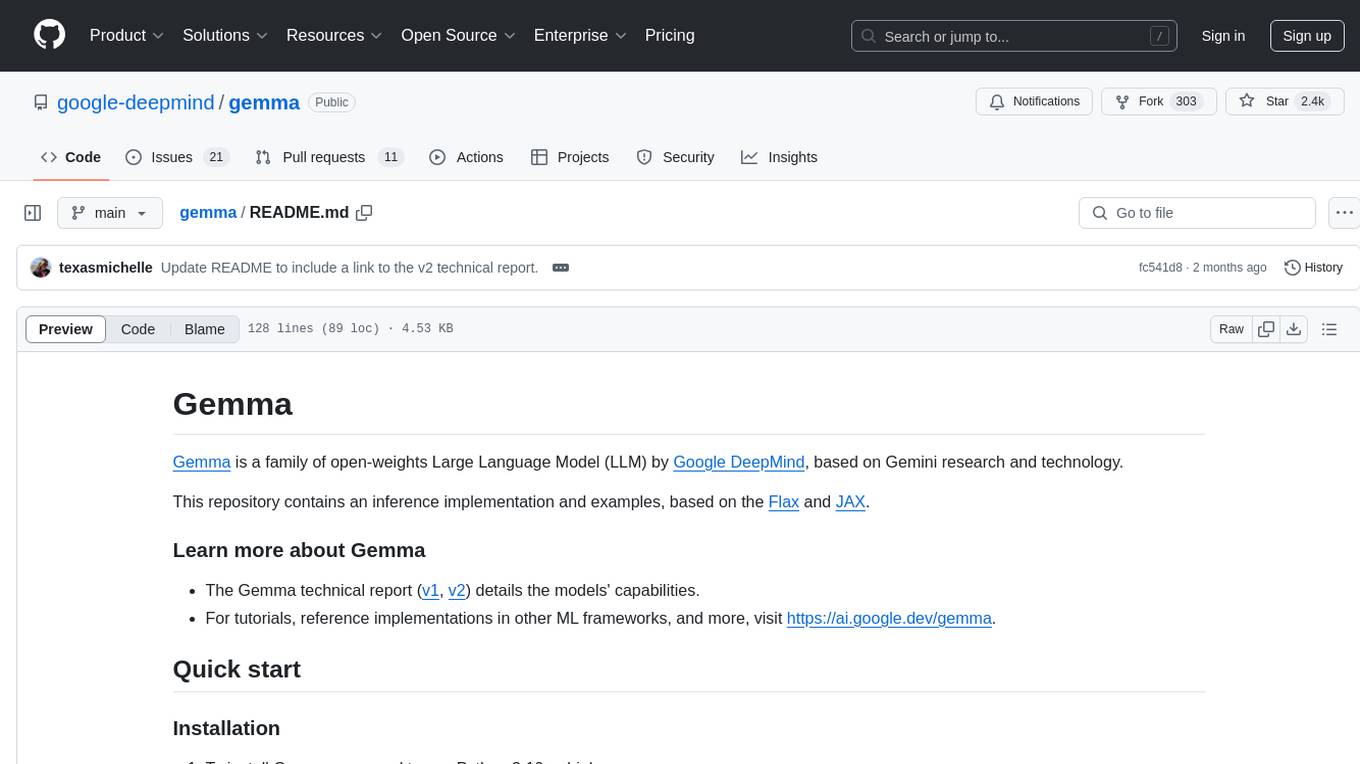
Gemma is a family of open-weights Large Language Model (LLM) by Google DeepMind, based on Gemini research and technology. This repository contains an inference implementation and examples, based on the Flax and JAX frameworks. Gemma can run on CPU, GPU, and TPU, with model checkpoints available for download. It provides tutorials, reference implementations, and Colab notebooks for tasks like sampling and fine-tuning. Users can contribute to Gemma through bug reports and pull requests. The code is licensed under the Apache License, Version 2.0.
FireRedTTS
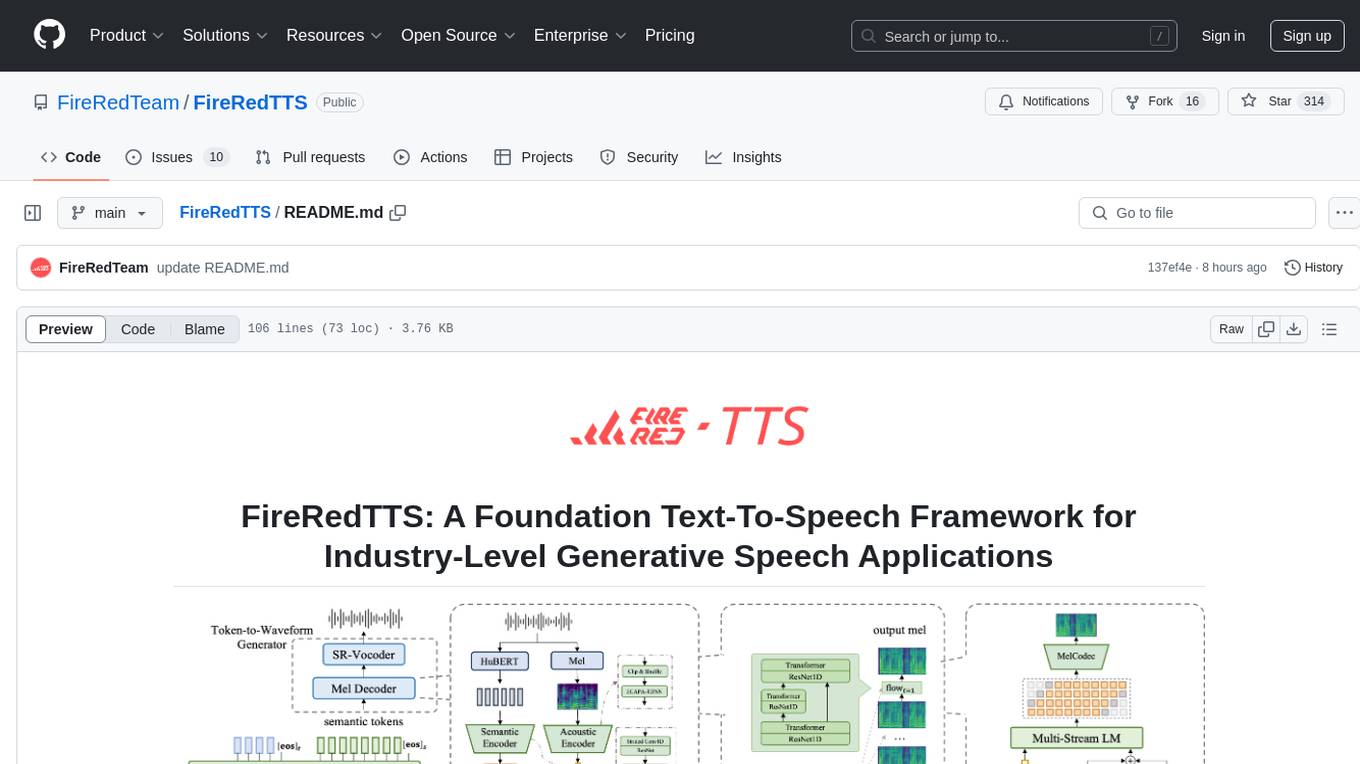
FireRedTTS is a foundation text-to-speech framework designed for industry-level generative speech applications. It offers a rich-punctuation model with expanded punctuation coverage and enhanced audio production consistency. The tool provides pre-trained checkpoints, inference code, and an interactive demo space. Users can clone the repository, create a conda environment, download required model files, and utilize the tool for synthesizing speech in various languages. FireRedTTS aims to enhance stability and provide controllable human-like speech generation capabilities.
ai-dev-gallery
The AI Dev Gallery is an app designed to help Windows developers integrate AI capabilities within their own apps and projects. It contains over 25 interactive samples powered by local AI models, allows users to explore, download, and run models from Hugging Face and GitHub, and provides the ability to view the C# source code and export a standalone Visual Studio project for each sample. The app is open-source and welcomes contributions and suggestions from the community.
For similar jobs
sweep
Sweep is an AI junior developer that turns bugs and feature requests into code changes. It automatically handles developer experience improvements like adding type hints and improving test coverage.
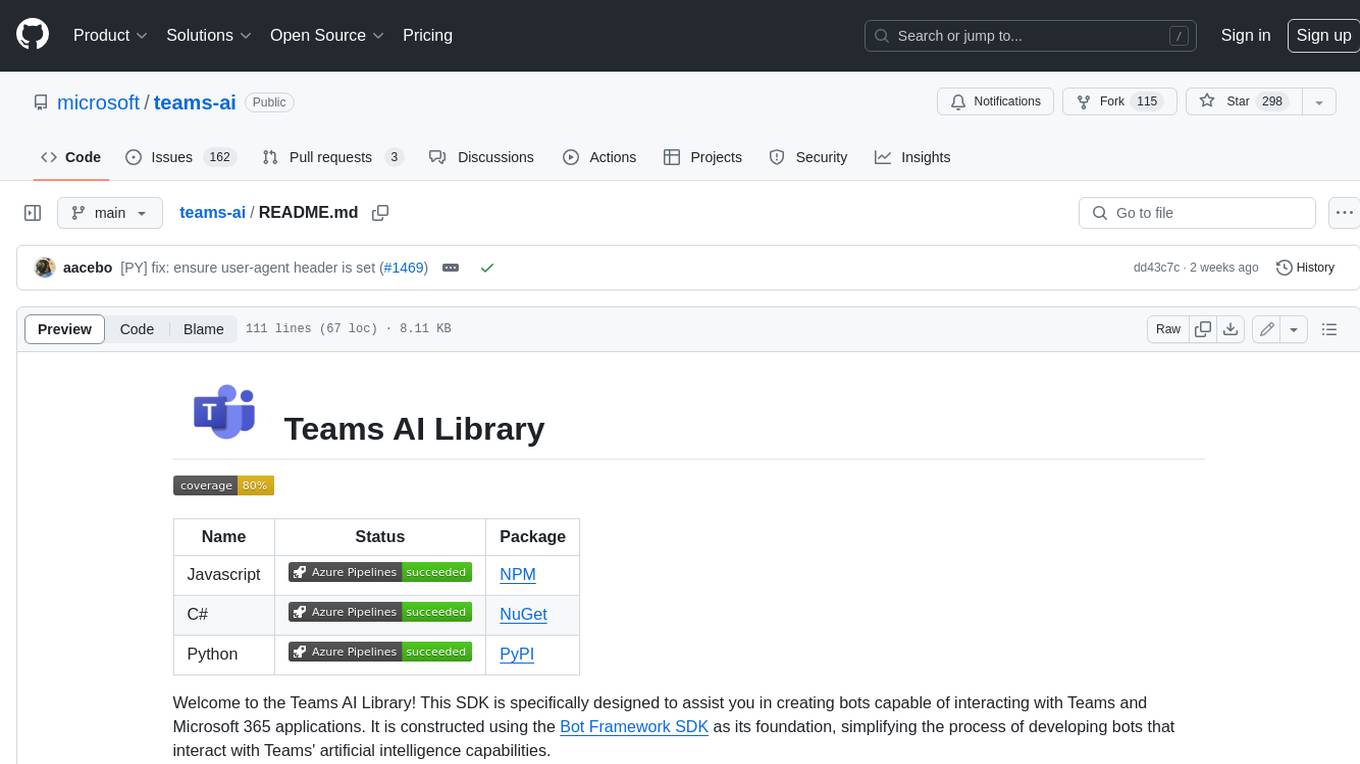
teams-ai
The Teams AI Library is a software development kit (SDK) that helps developers create bots that can interact with Teams and Microsoft 365 applications. It is built on top of the Bot Framework SDK and simplifies the process of developing bots that interact with Teams' artificial intelligence capabilities. The SDK is available for JavaScript/TypeScript, .NET, and Python.
ai-guide
This guide is dedicated to Large Language Models (LLMs) that you can run on your home computer. It assumes your PC is a lower-end, non-gaming setup.
classifai
Supercharge WordPress Content Workflows and Engagement with Artificial Intelligence. Tap into leading cloud-based services like OpenAI, Microsoft Azure AI, Google Gemini and IBM Watson to augment your WordPress-powered websites. Publish content faster while improving SEO performance and increasing audience engagement. ClassifAI integrates Artificial Intelligence and Machine Learning technologies to lighten your workload and eliminate tedious tasks, giving you more time to create original content that matters.
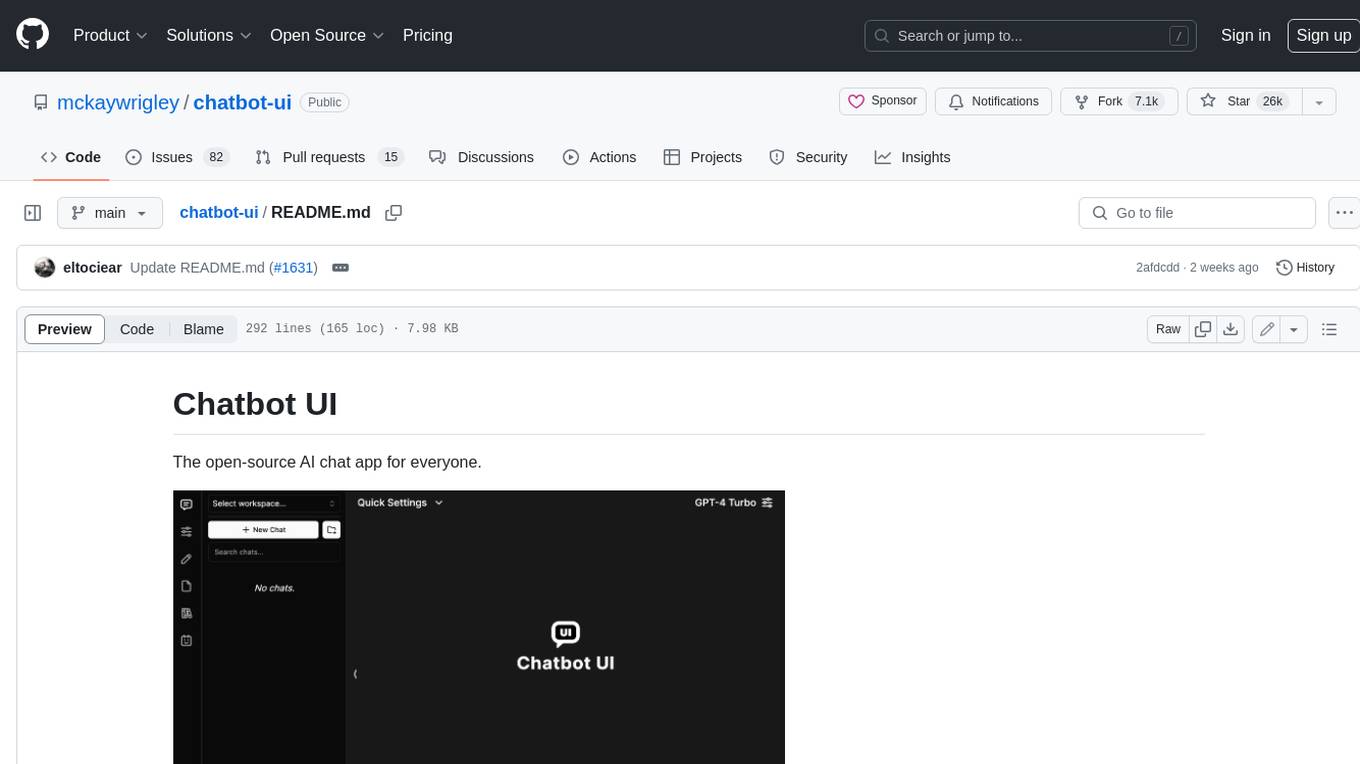
chatbot-ui
Chatbot UI is an open-source AI chat app that allows users to create and deploy their own AI chatbots. It is easy to use and can be customized to fit any need. Chatbot UI is perfect for businesses, developers, and anyone who wants to create a chatbot.
BricksLLM
BricksLLM is a cloud native AI gateway written in Go. Currently, it provides native support for OpenAI, Anthropic, Azure OpenAI and vLLM. BricksLLM aims to provide enterprise level infrastructure that can power any LLM production use cases. Here are some use cases for BricksLLM: * Set LLM usage limits for users on different pricing tiers * Track LLM usage on a per user and per organization basis * Block or redact requests containing PIIs * Improve LLM reliability with failovers, retries and caching * Distribute API keys with rate limits and cost limits for internal development/production use cases * Distribute API keys with rate limits and cost limits for students
uAgents
uAgents is a Python library developed by Fetch.ai that allows for the creation of autonomous AI agents. These agents can perform various tasks on a schedule or take action on various events. uAgents are easy to create and manage, and they are connected to a fast-growing network of other uAgents. They are also secure, with cryptographically secured messages and wallets.
griptape
Griptape is a modular Python framework for building AI-powered applications that securely connect to your enterprise data and APIs. It offers developers the ability to maintain control and flexibility at every step. Griptape's core components include Structures (Agents, Pipelines, and Workflows), Tasks, Tools, Memory (Conversation Memory, Task Memory, and Meta Memory), Drivers (Prompt and Embedding Drivers, Vector Store Drivers, Image Generation Drivers, Image Query Drivers, SQL Drivers, Web Scraper Drivers, and Conversation Memory Drivers), Engines (Query Engines, Extraction Engines, Summary Engines, Image Generation Engines, and Image Query Engines), and additional components (Rulesets, Loaders, Artifacts, Chunkers, and Tokenizers). Griptape enables developers to create AI-powered applications with ease and efficiency.