


Bobble-AI
None
Stars: 68
AmbuFlow is a mobile application developed using HTML, CSS, JavaScript, and Google API to notify patients of nearby hospitals and provide estimated ambulance arrival times. It offers critical details like patient's location and enhances GPS route management with real-time traffic data for efficient navigation. The app helps users find nearby hospitals, track ambulances in real-time, and manage ambulance routes based on traffic and distance. It ensures quick emergency response, real-time tracking, enhanced communication, resource management, and a user-friendly interface for seamless navigation in high-stress situations.
README:

🚑 A Mobile Application built with HTML, CSS, JavaScript, and Google API, designed to notify patients of nearby hospitals and provide estimated ambulance arrival times. 🏥 It offers hospitals and ambulance drivers critical details like the patient’s location 📍 and enhances GPS route management with real-time traffic data 🚦 for scheduled routes, ensuring efficient navigation.
| 🌟 Stars | 🍴 Forks | 🐛 Issues | 🔔 Open PRs | 🔕 Close PRs |
 |
 |
 |
 |
 |


- DESCRIPTION
- Why We Need This Application
- Problem Statement
- Solution
- Key Features
- Contributing
- Contribution Guidelines
- Tech Stack
- User-Friendly Experience
- Future Enhancements
- Our Valuable Contributors
- Team
A mobile app using HTML, CSS, JavaScript, and Google API that helps users find nearby hospitals and track ambulances in real-time. It shows hospital locations, provides directions, and helps manage ambulance routes based on traffic and distance.
Please check out the Screenshots.md for more clarity on the description of the project.
- Quick Emergency Response: Ensures patients receive timely medical assistance by locating the nearest hospitals and ambulances.
- Real-Time Tracking: Provides real-time updates on ambulance locations and traffic conditions, optimizing route management.
- Enhanced Communication: Facilitates seamless communication between patients, hospitals, and ambulance drivers.
- Resource Management: Helps hospitals manage their resources efficiently by providing critical information and analytics.
- User-Friendly Interface: Designed for ease of use, ensuring that even in high-stress situations, users can navigate the app effortlessly.
While having the name and address of a hospital is useful, visualizing it on a map with precise directions is even more effective. This app aims to bridge that gap by delivering real-time location data and navigation assistance, ensuring users find the nearest hospital quickly and with ease. 🚑
In emergencies, time is of the essence. Quickly identifying the nearest hospital can be life-saving. This app provides that immediate support.
Visual information is key. Beyond just showing names and addresses, the app provides a map view with directions, offering users an intuitive way to locate nearby hospitals with ease.
This app offers a comprehensive list of nearby hospitals with essential details such as addresses, contact numbers, and user ratings. Users can filter based on hospital specialties, helping them find the appropriate medical help efficiently.
The built-in map feature shows exact hospital locations, provides directions, and highlights landmarks and real-time traffic conditions. This ensures users can navigate unfamiliar areas and choose the fastest route to get the care they need, right when they need it.
- 🔐 Registration & Sign-In: Operators can create accounts and securely log in for system access.
- 📍 Location Sharing: Operators can share their real-time location for precise tracking and coordination.
- 🚨 Service Request: Users can request ambulance services with just a few taps.
- 🏥 Hospital Info: Retrieve details on nearby hospitals and available ambulances.
- 📊 Real-Time Ambulance Tracking: Users can track the availability of ambulances to ensure timely assistance.
- 📡 GPS-Enabled Tracking: Monitors ambulances in real-time for optimal tracking and coordination.
- 🔔 Hospital Alerts: Sends patients notifications about nearby hospitals for quicker medical assistance.
- 🚦 Distance & Traffic Analysis: Calculates the fastest routes based on real-time traffic and distance.
- 🧑💼 Driver Management: Streamlines driver schedules and activities for efficient ambulance deployment.
We welcome all contributions from the open-source community! If you'd like to contribute, follow these steps:
- Fork the repository:
git clone https://github.com/yourusername/AmbuFlow.git- Create a new feature branch:
git checkout -b feature/your-feature-name- Commit your changes:
git add .
git commit -m "Add feature description"- Push to the branch:
git push origin feature/your-feature-name- Open a Pull Request: Go to your forked repo on GitHub and click "New Pull Request."
- Go to Backend folder and run command:
npm install-
Make mongodb database.
-
Go to server.js file and give your mongodb connection URL.
-
Run command:
node server.js-
Split terminal and go to index.html and open it with live server.
-
make sure that both Backend and index.html file run togethere.
We welcome all contributions to improve AmbuFlow! If you would like to contribute, please follow the Contributing.md to know how to get started.
To maintain quality and consistency, please follow these best practices:
- Code Style: Write clean, readable code following the project's coding style. Comments are highly appreciated.
- Commits: Use meaningful commit messages that clearly describe the purpose of the changes.
- Pull Requests: Keep PRs focused, well-explained, and reference any relevant issues.
- Testing: Ensure all changes are thoroughly tested locally and do not break existing functionality.
Refer to CODE_OF_CONDUCT.md for details on our community guidelines.
- Google API Keys 🔑: These are also used to access various Google services programmatically, such as Google Maps, Google Drive, etc.
This app is designed to be user-friendly, ensuring a seamless experience for both patients and ambulance drivers. The intuitive interface and real-time updates make it easy to navigate and use, even in high-stress situations.
- Integration with Emergency Services for faster response times.
- Real-Time Communication between patients and ambulance drivers.
- Advanced Analytics for hospitals to manage resources efficiently.
 |
|---|
|
Mansi Ruhil Project Admin |
 |
If you find this project helpful, please consider giving it a star on GitHub! Your support helps the project grow and reach more contributors.
For Tasks:
Click tags to check more tools for each tasksFor Jobs:
Alternative AI tools for Bobble-AI
Similar Open Source Tools
Bobble-AI
AmbuFlow is a mobile application developed using HTML, CSS, JavaScript, and Google API to notify patients of nearby hospitals and provide estimated ambulance arrival times. It offers critical details like patient's location and enhances GPS route management with real-time traffic data for efficient navigation. The app helps users find nearby hospitals, track ambulances in real-time, and manage ambulance routes based on traffic and distance. It ensures quick emergency response, real-time tracking, enhanced communication, resource management, and a user-friendly interface for seamless navigation in high-stress situations.
memU
MemU is an open-source memory framework designed for AI companions, offering high accuracy, fast retrieval, and cost-effectiveness. It serves as an intelligent 'memory folder' that adapts to various AI companion scenarios. With MemU, users can create AI companions that remember them, learn their preferences, and evolve through interactions. The framework provides advanced retrieval strategies, 24/7 support, and is specialized for AI companions. MemU offers cloud, enterprise, and self-hosting options, with features like memory organization, interconnected knowledge graph, continuous self-improvement, and adaptive forgetting mechanism. It boasts high memory accuracy, fast retrieval, and low cost, making it suitable for building intelligent agents with persistent memory capabilities.
meeting-minutes
An open-source AI assistant for taking meeting notes that captures live meeting audio, transcribes it in real-time, and generates summaries while ensuring user privacy. Perfect for teams to focus on discussions while automatically capturing and organizing meeting content without external servers or complex infrastructure. Features include modern UI, real-time audio capture, speaker diarization, local processing for privacy, and more. The tool also offers a Rust-based implementation for better performance and native integration, with features like live transcription, speaker diarization, and a rich text editor for notes. Future plans include database connection for saving meeting minutes, improving summarization quality, and adding download options for meeting transcriptions and summaries. The backend supports multiple LLM providers through a unified interface, with configurations for Anthropic, Groq, and Ollama models. System architecture includes core components like audio capture service, transcription engine, LLM orchestrator, data services, and API layer. Prerequisites for setup include Node.js, Python, FFmpeg, and Rust. Development guidelines emphasize project structure, testing, documentation, type hints, and ESLint configuration. Contributions are welcome under the MIT License.
nanobrowser
Nanobrowser is an open-source AI web automation tool that runs in your browser. It is a free alternative to OpenAI Operator with flexible LLM options and a multi-agent system. Nanobrowser offers premium web automation capabilities while keeping users in complete control, with features like a multi-agent system, interactive side panel, task automation, follow-up questions, and multiple LLM support. Users can easily download and install Nanobrowser as a Chrome extension, configure agent models, and accomplish tasks such as news summary, GitHub research, and shopping research with just a sentence. The tool uses a specialized multi-agent system powered by large language models to understand and execute complex web tasks. Nanobrowser is actively developed with plans to expand LLM support, implement security measures, optimize memory usage, enable session replay, and develop specialized agents for domain-specific tasks. Contributions from the community are welcome to improve Nanobrowser and build the future of web automation.
cherry-studio
Cherry Studio is a desktop client that supports multiple LLM providers on Windows, Mac, and Linux. It offers diverse LLM provider support, AI assistants & conversations, document & data processing, practical tools integration, and enhanced user experience. The tool includes features like support for major LLM cloud services, AI web service integration, local model support, pre-configured AI assistants, document processing for text, images, and more, global search functionality, topic management system, AI-powered translation, and cross-platform support with ready-to-use features and themes for a better user experience.
docq
Docq is a private and secure GenAI tool designed to extract knowledge from business documents, enabling users to find answers independently. It allows data to stay within organizational boundaries, supports self-hosting with various cloud vendors, and offers multi-model and multi-modal capabilities. Docq is extensible, open-source (AGPLv3), and provides commercial licensing options. The tool aims to be a turnkey solution for organizations to adopt AI innovation safely, with plans for future features like more data ingestion options and model fine-tuning.
TaskingAI
TaskingAI brings Firebase's simplicity to **AI-native app development**. The platform enables the creation of GPTs-like multi-tenant applications using a wide range of LLMs from various providers. It features distinct, modular functions such as Inference, Retrieval, Assistant, and Tool, seamlessly integrated to enhance the development process. TaskingAI’s cohesive design ensures an efficient, intelligent, and user-friendly experience in AI application development.
agent-zero
Agent Zero is a personal and organic AI framework designed to be dynamic, organically growing, and learning as you use it. It is fully transparent, readable, comprehensible, customizable, and interactive. The framework uses the computer as a tool to accomplish tasks, with no single-purpose tools pre-programmed. It emphasizes multi-agent cooperation, complete customization, and extensibility. Communication is key in this framework, allowing users to give proper system prompts and instructions to achieve desired outcomes. Agent Zero is capable of dangerous actions and should be run in an isolated environment. The framework is prompt-based, highly customizable, and requires a specific environment to run effectively.
tuff
Tuff is a local-first, AI-native, and infinitely extensible desktop command center designed to enhance workflow efficiency. It offers a seamless integration of core utilities, AI-powered search, contextual intelligence, and extensibility through custom plugins. With a beautiful UI design, rich functionality, simple operations, and a focus on security and reliability, Tuff provides users with a cross-platform desktop software that is easy to use and offers a good user experience.
codegate
CodeGate is a local gateway that enhances the safety of AI coding assistants by ensuring AI-generated recommendations adhere to best practices, safeguarding code integrity, and protecting individual privacy. Developed by Stacklok, CodeGate allows users to confidently leverage AI in their development workflow without compromising security or productivity. It works seamlessly with coding assistants, providing real-time security analysis of AI suggestions. CodeGate is designed with privacy at its core, keeping all data on the user's machine and offering complete control over data.
refact
This repository contains Refact WebUI for fine-tuning and self-hosting of code models, which can be used inside Refact plugins for code completion and chat. Users can fine-tune open-source code models, self-host them, download and upload Lloras, use models for code completion and chat inside Refact plugins, shard models, host multiple small models on one GPU, and connect GPT-models for chat using OpenAI and Anthropic keys. The repository provides a Docker container for running the self-hosted server and supports various models for completion, chat, and fine-tuning. Refact is free for individuals and small teams under the BSD-3-Clause license, with custom installation options available for GPU support. The community and support include contributing guidelines, GitHub issues for bugs, a community forum, Discord for chatting, and Twitter for product news and updates.
plandex
Plandex is an open source, terminal-based AI coding engine designed for complex tasks. It uses long-running agents to break up large tasks into smaller subtasks, helping users work through backlogs, navigate unfamiliar technologies, and save time on repetitive tasks. Plandex supports various AI models, including OpenAI, Anthropic Claude, Google Gemini, and more. It allows users to manage context efficiently in the terminal, experiment with different approaches using branches, and review changes before applying them. The tool is platform-independent and runs from a single binary with no dependencies.
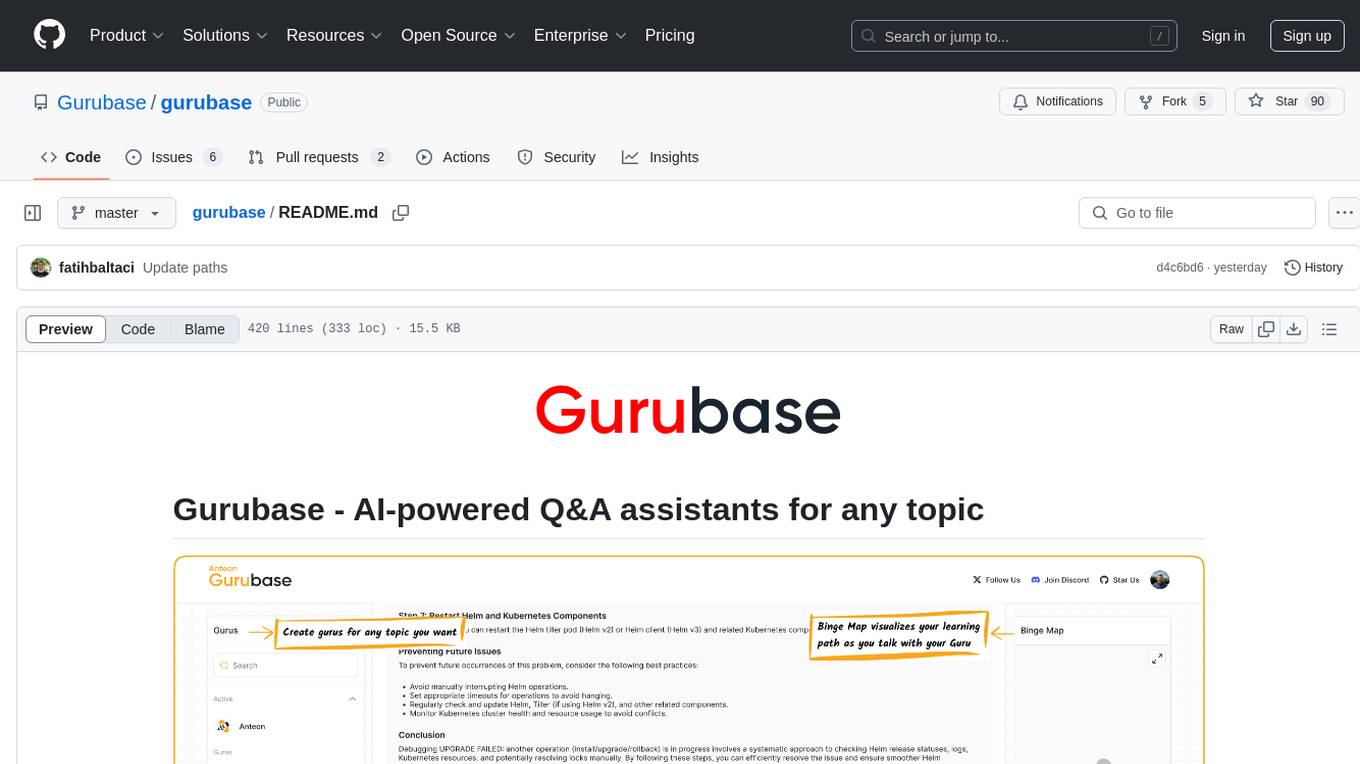
gurubase
Gurubase is an open-source RAG system that enables users to create AI-powered Q&A assistants ('Gurus') for various topics by integrating web pages, PDFs, YouTube videos, and GitHub repositories. It offers advanced LLM-based question answering, accurate context-aware responses through the RAG system, multiple data sources integration, easy website embedding, creation of custom AI assistants, real-time updates, personalized learning paths, and self-hosting options. Users can request Guru creation, manage existing Gurus, update datasources, and benefit from the system's features for enhancing user engagement and knowledge sharing.
Simplifine
Simplifine is an open-source library designed for easy LLM finetuning, enabling users to perform tasks such as supervised fine tuning, question-answer finetuning, contrastive loss for embedding tasks, multi-label classification finetuning, and more. It provides features like WandB logging, in-built evaluation tools, automated finetuning parameters, and state-of-the-art optimization techniques. The library offers bug fixes, new features, and documentation updates in its latest version. Users can install Simplifine via pip or directly from GitHub. The project welcomes contributors and provides comprehensive documentation and support for users.
kollektiv
Kollektiv is a Retrieval-Augmented Generation (RAG) system designed to enable users to chat with their favorite documentation easily. It aims to provide LLMs with access to the most up-to-date knowledge, reducing inaccuracies and improving productivity. The system utilizes intelligent web crawling, advanced document processing, vector search, multi-query expansion, smart re-ranking, AI-powered responses, and dynamic system prompts. The technical stack includes Python/FastAPI for backend, Supabase, ChromaDB, and Redis for storage, OpenAI and Anthropic Claude 3.5 Sonnet for AI/ML, and Chainlit for UI. Kollektiv is licensed under a modified version of the Apache License 2.0, allowing free use for non-commercial purposes.
gptme
Personal AI assistant/agent in your terminal, with tools for using the terminal, running code, editing files, browsing the web, using vision, and more. A great coding agent that is general-purpose to assist in all kinds of knowledge work, from a simple but powerful CLI. An unconstrained local alternative to ChatGPT with 'Code Interpreter', Cursor Agent, etc. Not limited by lack of software, internet access, timeouts, or privacy concerns if using local models.
For similar tasks
Bobble-AI
AmbuFlow is a mobile application developed using HTML, CSS, JavaScript, and Google API to notify patients of nearby hospitals and provide estimated ambulance arrival times. It offers critical details like patient's location and enhances GPS route management with real-time traffic data for efficient navigation. The app helps users find nearby hospitals, track ambulances in real-time, and manage ambulance routes based on traffic and distance. It ensures quick emergency response, real-time tracking, enhanced communication, resource management, and a user-friendly interface for seamless navigation in high-stress situations.
For similar jobs
Bobble-AI
AmbuFlow is a mobile application developed using HTML, CSS, JavaScript, and Google API to notify patients of nearby hospitals and provide estimated ambulance arrival times. It offers critical details like patient's location and enhances GPS route management with real-time traffic data for efficient navigation. The app helps users find nearby hospitals, track ambulances in real-time, and manage ambulance routes based on traffic and distance. It ensures quick emergency response, real-time tracking, enhanced communication, resource management, and a user-friendly interface for seamless navigation in high-stress situations.