


AI-Resume-Analyzer-and-LinkedIn-Scraper-using-Generative-AI
Developed an AI application using LLM to analyze user resumes and provided the summarization, strengths, weaknesses, suggestions, suitable job titles, and also scraping job details from LinkedIn using Selenium. This application reduces time by 30% and helps candidates tailor their resumes effectively.
Stars: 144
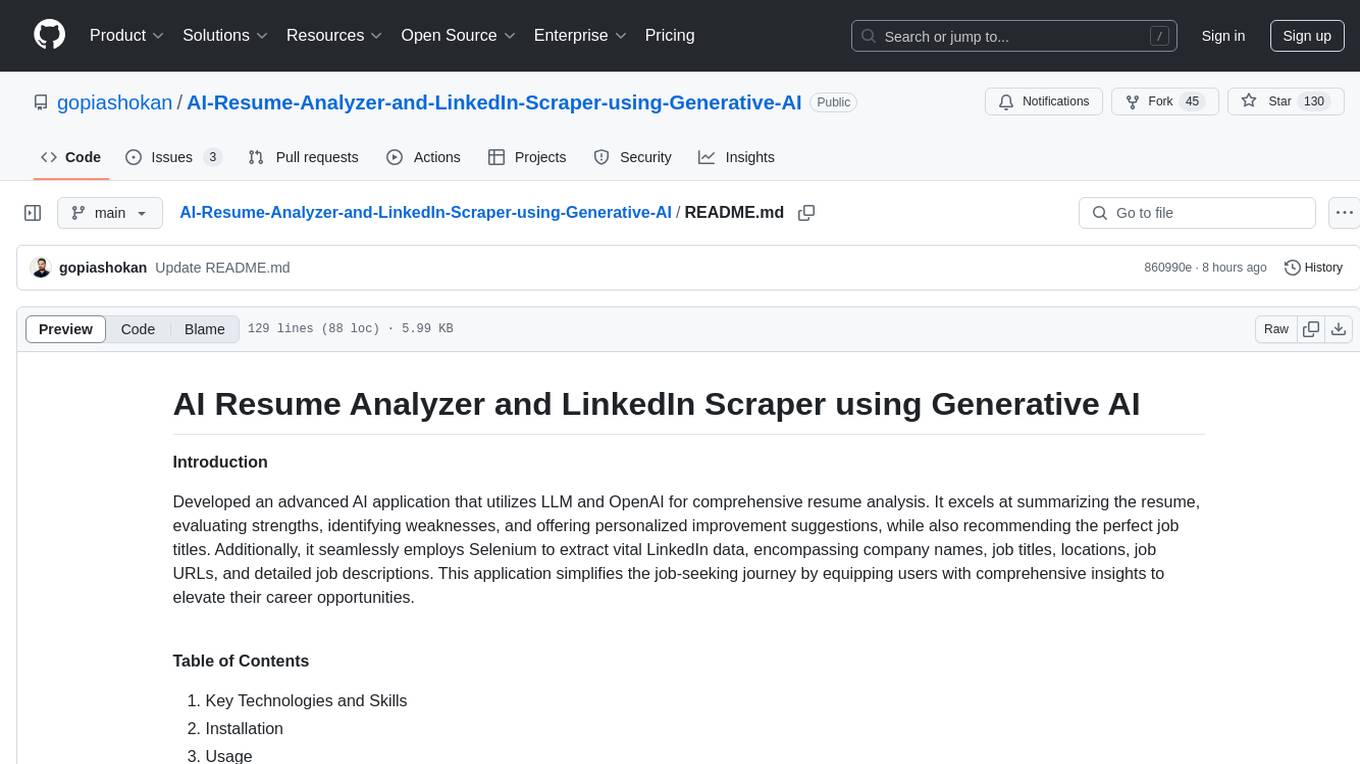
Developed an advanced AI application that utilizes LLM and OpenAI for comprehensive resume analysis. It excels at summarizing the resume, evaluating strengths, identifying weaknesses, and offering personalized improvement suggestions, while also recommending the perfect job titles. Additionally, it seamlessly employs Selenium to extract vital LinkedIn data, encompassing company names, job titles, locations, job URLs, and detailed job descriptions. This application simplifies the job-seeking journey by equipping users with comprehensive insights to elevate their career opportunities.
README:
Introduction
Developed an advanced AI application that leverages Retrieval-Augmented Generation (RAG), Large Language Models (LLM), and OpenAI for comprehensive resume analysis. It excels at summarizing the resume, evaluating strengths, identifying weaknesses, and offering personalized improvement suggestions while also recommending the perfect job titles. Additionally, it seamlessly employs Selenium to extract vital LinkedIn data, including company names, job titles, locations, job URLs, and detailed job descriptions. This application simplifies the job-seeking journey by equipping users with comprehensive insights to elevate their career opportunities.
Table of Contents
- Key Technologies and Skills
- Installation
- Usage
- Features
- Contributing
- License
- Contact
Key Technologies and Skills
- Python
- NumPy
- Pandas
- LangChain
- Large Language Model (LLM)
- Retrieval-Augmented Generation (RAG)
- OpenAI
- Selenium
- AWS
- Hugging Face
- Streamlit
Installation
To run this project, you need to install the following packages:
pip install numpy
pip install pandas
pip install streamlit
pip install streamlit_option_menu
pip install streamlit_extras
pip install PyPDF2
pip install langchain
pip install openai
pip install tiktoken
pip install faiss-cpu
pip install selenium
Usage
To use this project, follow these steps:
- Clone the repository:
https://github.com/gopiashokan/AI-Powered-Resume-Analyzer-and-LinkedIn-Scraper-with-Selenium.git - Install the required packages:
pip install -r requirements.txt - Run the Streamlit app:
streamlit run app.py - Access the app in your browser at
http://localhost:8501
Features
Easy User Experience:
- Resume Analyzer AI makes it easy for users. You can upload your resume and enter your OpenAI API key without any hassle. The application is designed to be user-friendly so that anyone can use its powerful resume analysis features.
- It also uses the PyPDF2 library to quickly extract text from your uploaded resume, which is the first step in doing a thorough analysis.
Smart Text Analysis with Langchain:
- What makes it special is how it analyzes text. It uses a smart method called the Langchain library to break long sections of text from resumes into smaller chunks, making them more meaningful.
- This clever technique improves the accuracy of the resume analysis, and it gives users practical advice on how to enhance their job prospects.
Enhanced OpenAI Integration with FAISS:
- Seamlessly connecting to OpenAI services, the application establishes a secure connection using your OpenAI API key. This integration forms the basis for robust interactions, facilitating advanced analysis and efficient information retrieval.
- It uses the FAISS(Facebook AI Similarity Search) library to convert both the text chunks and query text data into numerical vectors, simplifying the analysis process and enabling the retrieval of pertinent information.
Intelligent Chunk Selection in RAG and LLM:
- The application retrieves relevant text by comparing the user query with stored vector embeddings and selecting the Top K documents based on their similarity scores. This ensures that only the most relevant information is considered for further processing.
- Once the most relevant documents are selected, the system initializes a Large Language Model (LLM), specifically the ChatGPT 3.5 Turbo model to analyze and generate responses based on the retrieved content.
Robust Question-Answering Pipeline:
- The QA pipeline processes the Top K documents and the user query to generate meaningful responses. The system extracts relevant information from the retrieved content, ensuring accuracy and coherence.
- The LLM analyzes the selected documents and formulates responses by understanding the context within the retrieved text. This approach enhances response quality by focusing on the most relevant data instead of relying solely on the initial query.
Comprehensive Resume Analysis:
- Summary: Resume Analyzer AI provides a quick, comprehensive overview of resumes, emphasizing qualifications, key experience, skills, projects, and achievements. Users can swiftly grasp profiles, enhancing review efficiency and insight.
- Strength: Effortlessly conducting a comprehensive resume review, it analyzes qualifications, experience, and accomplishments. It subsequently highlights strengths, providing job seekers with a competitive edge.
- Weakness: AI conducts thorough analysis to pinpoint weaknesses and offers tailored solutions for transforming them into strengths, empowering job seekers.
- Suggestion: AI provides personalized job title recommendations that align closely with the user's qualifications and resume content, facilitating an optimized job search experience.
🚀 Streamlit application: https://huggingface.co/spaces/gopiashokan/Resume-Analyzer-AI
Selenium-Powered LinkedIn Data Scraping:
- Utilizing Selenium and a Webdriver automated test tool, this feature enables users to input job titles, automating the data scraping process from LinkedIn. The scraped data includes crucial details such as company names, job titles, locations, URLs, and comprehensive job descriptions.
- This streamlined process enables users to easily review scraped job details and apply for positions, simplifying their job search and application experience.
🎥 Project Demo Video: https://youtu.be/wFouWeK7NPg
Contributing
Contributions to this project are welcome! If you encounter any issues or have suggestions for improvements, please feel free to submit a pull request.
License
This project is licensed under the MIT License. Please review the LICENSE file for more details.
Contact
📧 Email: [email protected]
🌐 LinkedIn: linkedin.com/in/gopiashokan
For any further questions or inquiries, feel free to reach out. We are happy to assist you with any queries.
For Tasks:
Click tags to check more tools for each tasksFor Jobs:
Alternative AI tools for AI-Resume-Analyzer-and-LinkedIn-Scraper-using-Generative-AI
Similar Open Source Tools
AI-Resume-Analyzer-and-LinkedIn-Scraper-using-Generative-AI
Developed an advanced AI application that utilizes LLM and OpenAI for comprehensive resume analysis. It excels at summarizing the resume, evaluating strengths, identifying weaknesses, and offering personalized improvement suggestions, while also recommending the perfect job titles. Additionally, it seamlessly employs Selenium to extract vital LinkedIn data, encompassing company names, job titles, locations, job URLs, and detailed job descriptions. This application simplifies the job-seeking journey by equipping users with comprehensive insights to elevate their career opportunities.
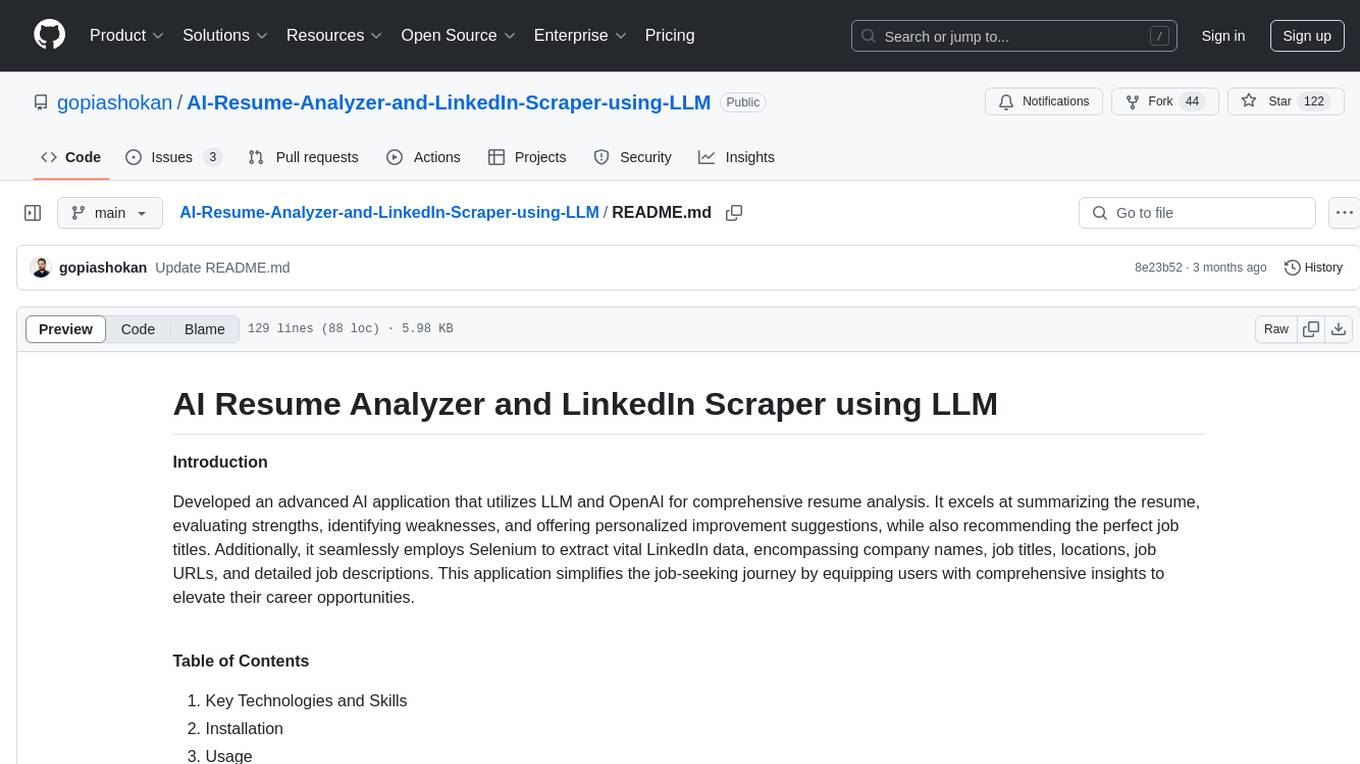
AI-Resume-Analyzer-and-LinkedIn-Scraper-using-LLM
Developed an advanced AI application that utilizes LLM and OpenAI for comprehensive resume analysis. It excels at summarizing the resume, evaluating strengths, identifying weaknesses, and offering personalized improvement suggestions, while also recommending the perfect job titles. Additionally, it seamlessly employs Selenium to extract vital LinkedIn data, encompassing company names, job titles, locations, job URLs, and detailed job descriptions. This application simplifies the job-seeking journey by equipping users with comprehensive insights to elevate their career opportunities.
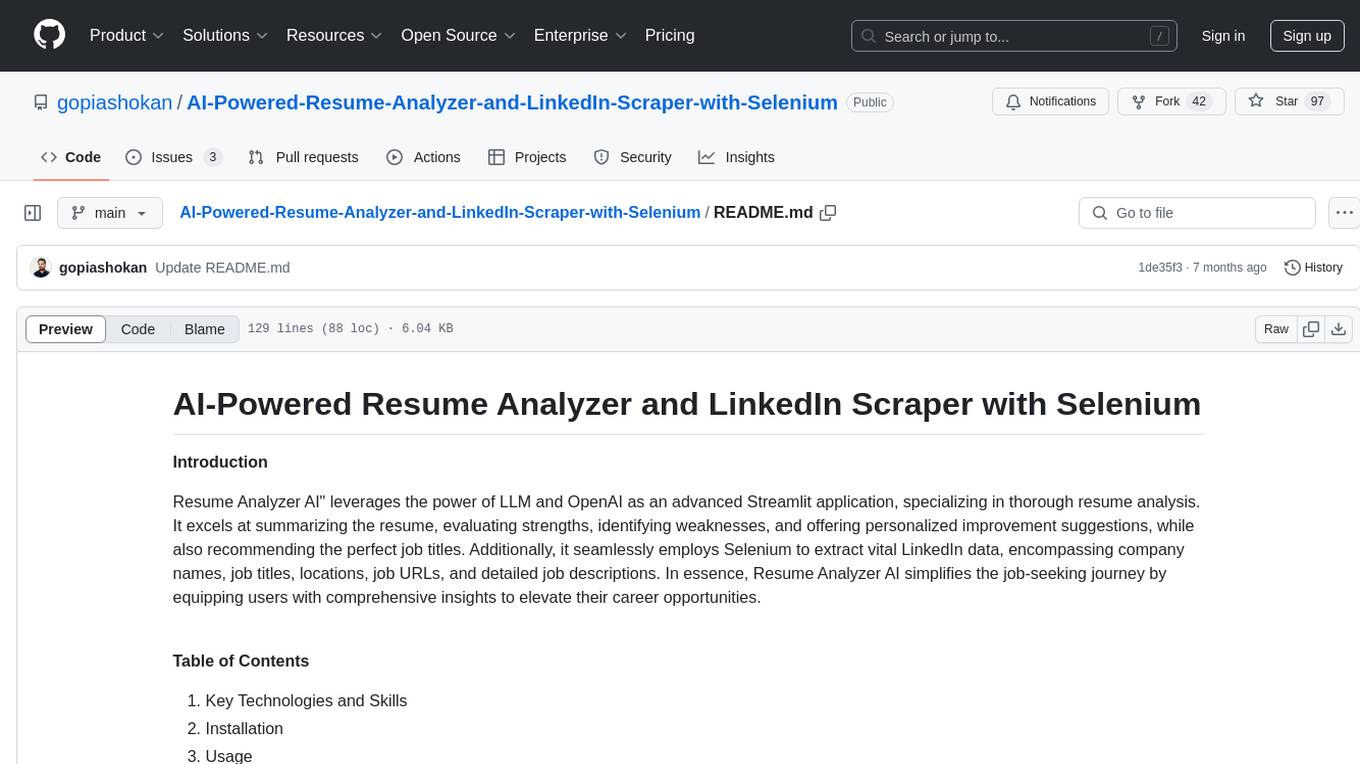
AI-Powered-Resume-Analyzer-and-LinkedIn-Scraper-with-Selenium
Resume Analyzer AI is an advanced Streamlit application that specializes in thorough resume analysis. It excels at summarizing resumes, evaluating strengths, identifying weaknesses, and offering personalized improvement suggestions. It also recommends job titles and uses Selenium to extract vital LinkedIn data. The tool simplifies the job-seeking journey by providing comprehensive insights to elevate career opportunities.
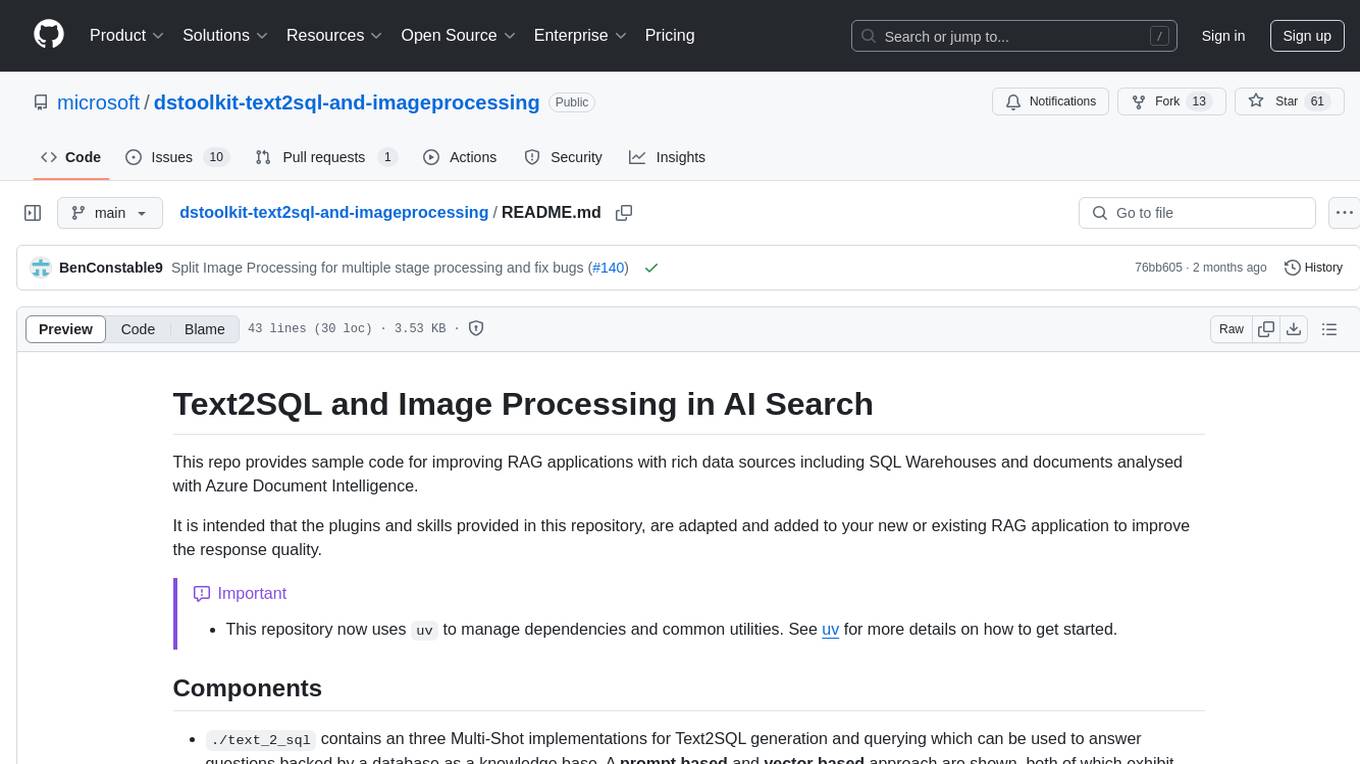
dstoolkit-text2sql-and-imageprocessing
This repository provides sample code for improving RAG applications with rich data sources including SQL Warehouses and documents analysed with Azure Document Intelligence. It includes components for Text2SQL generation and querying, linking Azure Document Intelligence with AI Search for processing complex documents, and deploying AI search indexes. The plugins and skills aim to enhance response quality in RAG applications by accessing and pulling data from SQL tables, drawing insights from complex charts and images, and intelligently grouping similar sentences.
llmops-promptflow-template
LLMOps with Prompt flow is a template and guidance for building LLM-infused apps using Prompt flow. It provides centralized code hosting, lifecycle management, variant and hyperparameter experimentation, A/B deployment, many-to-many dataset/flow relationships, multiple deployment targets, comprehensive reporting, BYOF capabilities, configuration-based development, local prompt experimentation and evaluation, endpoint testing, and optional Human-in-loop validation. The tool is customizable to suit various application needs.
Document-Knowledge-Mining-Solution-Accelerator
The Document Knowledge Mining Solution Accelerator leverages Azure OpenAI and Azure AI Document Intelligence to ingest, extract, and classify content from various assets, enabling chat-based insight discovery, analysis, and prompt guidance. It uses OCR and multi-modal LLM to extract information from documents like text, handwritten text, charts, graphs, tables, and form fields. Users can customize the technical architecture and data processing workflow. Key features include ingesting and extracting real-world entities, chat-based insights discovery, text and document data analysis, prompt suggestion guidance, and multi-modal information processing.
generative-ai-amazon-bedrock-langchain-agent-example
This repository provides a sample solution for building generative AI agents using Amazon Bedrock, Amazon DynamoDB, Amazon Kendra, Amazon Lex, and LangChain. The solution creates a generative AI financial services agent capable of assisting users with account information, loan applications, and answering natural language questions. It serves as a launchpad for developers to create personalized conversational agents for applications like chatbots and virtual assistants.
OpenAIWorkshop
Azure OpenAI Service provides REST API access to OpenAI's powerful language models including GPT-3, Codex and Embeddings. Users can easily adapt models for content generation, summarization, semantic search, and natural language to code translation. The workshop covers basics, prompt engineering, common NLP tasks, generative tasks, conversational dialog, and learning methods. It guides users to build applications with PowerApp, query SQL data, create data pipelines, and work with proprietary datasets. Target audience includes Power Users, Software Engineers, Data Scientists, and AI architects and Managers.
llmesh
LLM Agentic Tool Mesh is a platform by HPE Athonet that democratizes Generative Artificial Intelligence (Gen AI) by enabling users to create tools and web applications using Gen AI with Low or No Coding. The platform simplifies the integration process, focuses on key user needs, and abstracts complex libraries into easy-to-understand services. It empowers both technical and non-technical teams to develop tools related to their expertise and provides orchestration capabilities through an agentic Reasoning Engine based on Large Language Models (LLMs) to ensure seamless tool integration and enhance organizational functionality and efficiency.
aihub
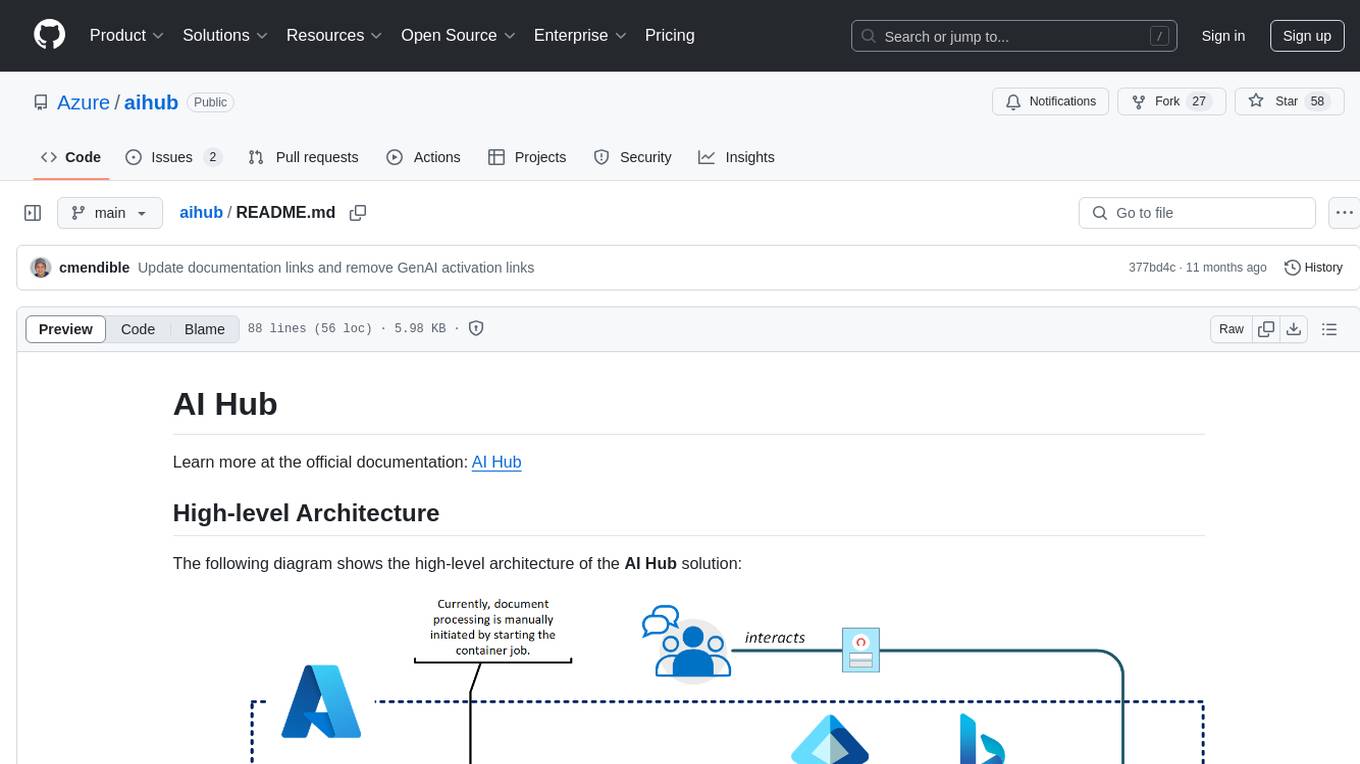
AI Hub is a comprehensive solution that leverages artificial intelligence and cloud computing to provide functionalities such as document search and retrieval, call center analytics, image analysis, brand reputation analysis, form analysis, document comparison, and content safety moderation. It integrates various Azure services like Cognitive Search, ChatGPT, Azure Vision Services, and Azure Document Intelligence to offer scalable, extensible, and secure AI-powered capabilities for different use cases and scenarios.
get-started-with-ai-agents
The 'Getting Started with Agents Using Azure AI Foundry' repository provides a solution that deploys a web-based chat application with an AI agent running in Azure Container App. The agent leverages Azure AI services for knowledge retrieval from uploaded files, enabling it to generate responses with citations. The solution includes built-in monitoring capabilities for easier troubleshooting and optimized performance. Users can deploy AI models, customize the agent, and evaluate its performance. The repository offers flexible deployment options through GitHub Codespaces, VS Code Dev Containers, or local environments.
data-formulator
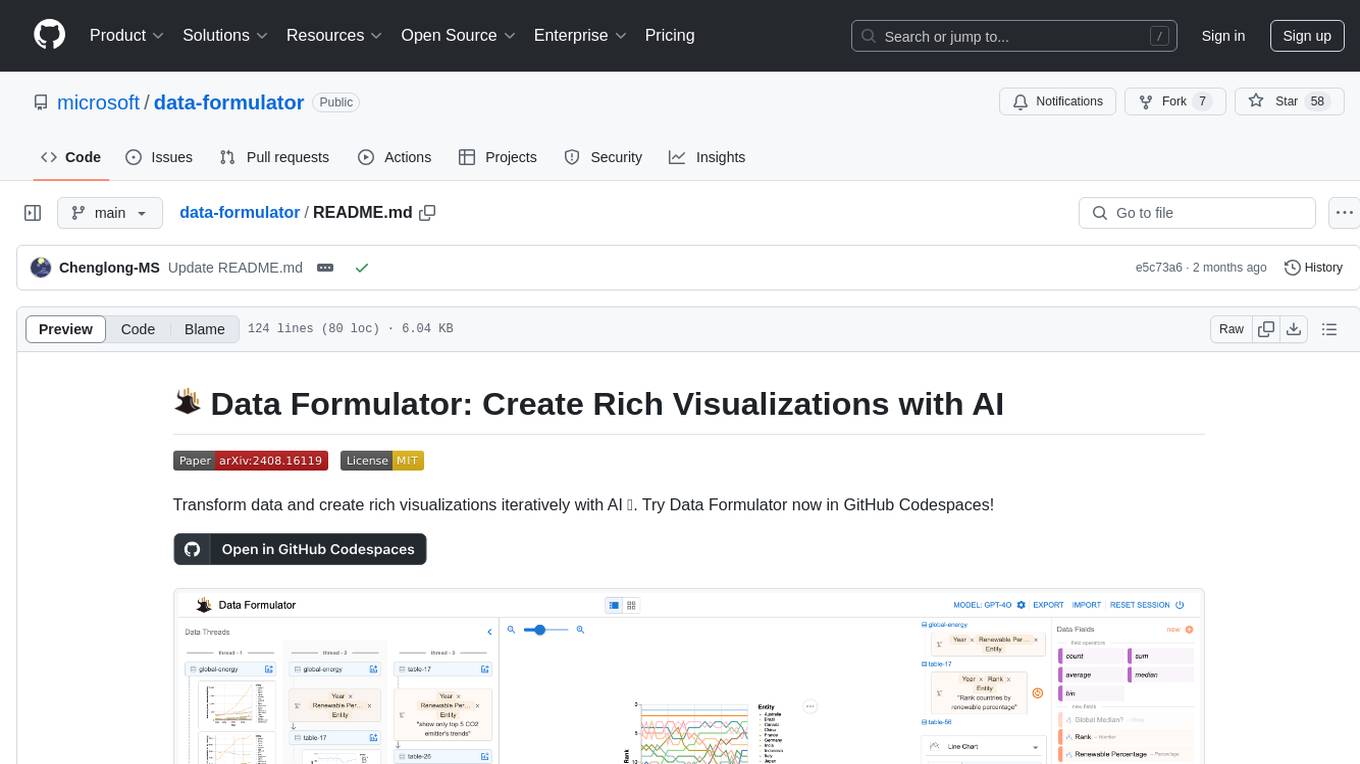
Data Formulator is an AI-powered tool developed by Microsoft Research to help data analysts create rich visualizations iteratively. It combines user interface interactions with natural language inputs to simplify the process of describing chart designs while delegating data transformation to AI. Users can utilize features like blended UI and NL inputs, data threads for history navigation, and code inspection to create impressive visualizations. The tool supports local installation for customization and Codespaces for quick setup. Developers can build new data analysis tools on top of Data Formulator, and research papers are available for further reading.
TI-Mindmap-GPT
TI MINDMAP GPT is an AI-powered tool designed to assist cyber threat intelligence teams in quickly synthesizing and visualizing key information from various Threat Intelligence sources. The tool utilizes Large Language Models (LLMs) to transform lengthy content into concise, actionable summaries, going beyond mere text reduction to provide insightful encapsulations of crucial points and themes. Users can leverage their own LLM keys for personalized and efficient information processing, streamlining data analysis and enabling teams to focus on strategic decision-making.
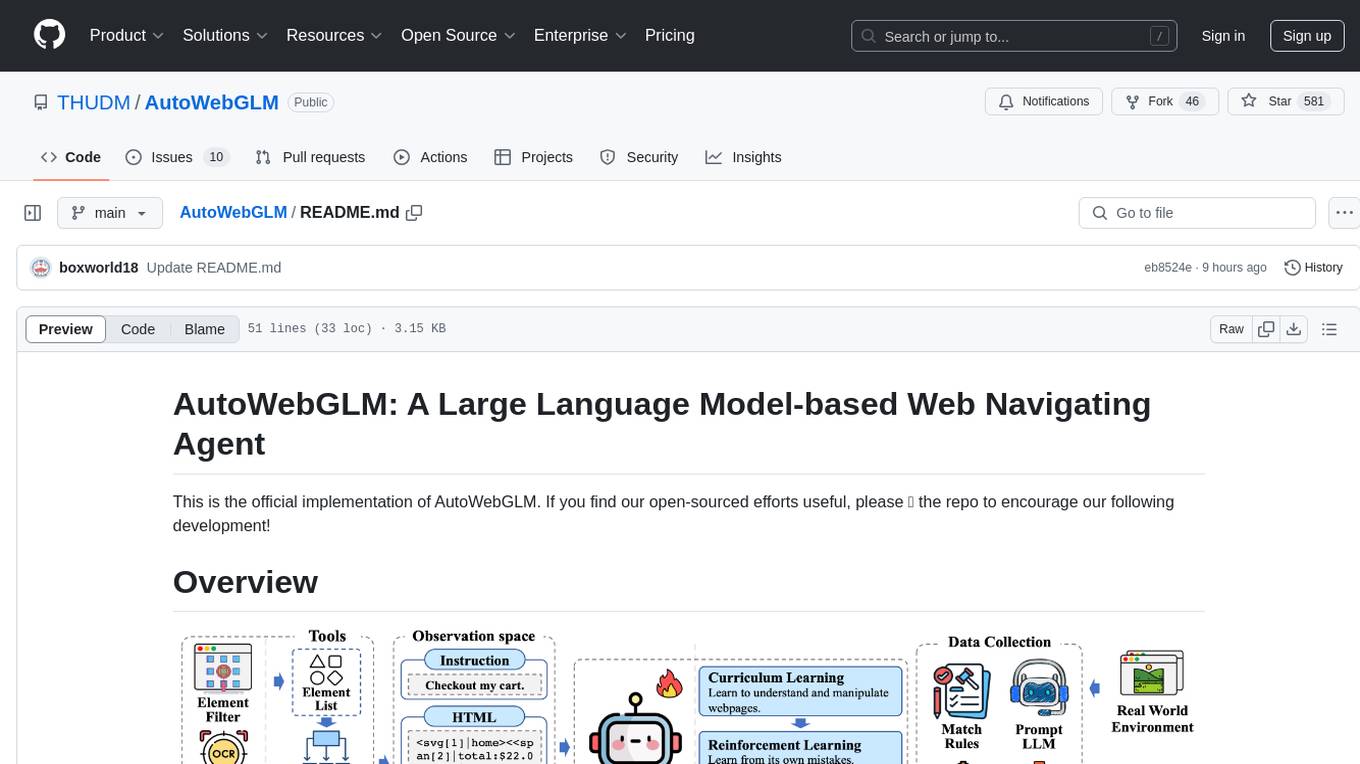
AutoWebGLM
AutoWebGLM is a project focused on developing a language model-driven automated web navigation agent. It extends the capabilities of the ChatGLM3-6B model to navigate the web more efficiently and address real-world browsing challenges. The project includes features such as an HTML simplification algorithm, hybrid human-AI training, reinforcement learning, rejection sampling, and a bilingual web navigation benchmark for testing AI web navigation agents.
DevOpsGPT
DevOpsGPT is an AI-driven software development automation solution that combines Large Language Models (LLM) with DevOps tools to convert natural language requirements into working software. It improves development efficiency by eliminating the need for tedious requirement documentation, shortens development cycles, reduces communication costs, and ensures high-quality deliverables. The Enterprise Edition offers features like existing project analysis, professional model selection, and support for more DevOps platforms. The tool automates requirement development, generates interface documentation, provides pseudocode based on existing projects, facilitates code refinement, enables continuous integration, and supports software version release. Users can run DevOpsGPT with source code or Docker, and the tool comes with limitations in precise documentation generation and understanding existing project code. The product roadmap includes accurate requirement decomposition, rapid import of development requirements, and integration of more software engineering and professional tools for efficient software development tasks under AI planning and execution.
graphrag
The GraphRAG project is a data pipeline and transformation suite designed to extract meaningful, structured data from unstructured text using LLMs. It enhances LLMs' ability to reason about private data. The repository provides guidance on using knowledge graph memory structures to enhance LLM outputs, with a warning about the potential costs of GraphRAG indexing. It offers contribution guidelines, development resources, and encourages prompt tuning for optimal results. The Responsible AI FAQ addresses GraphRAG's capabilities, intended uses, evaluation metrics, limitations, and operational factors for effective and responsible use.
For similar tasks
AI-Powered-Resume-Analyzer-and-LinkedIn-Scraper-with-Selenium
Resume Analyzer AI is an advanced Streamlit application that specializes in thorough resume analysis. It excels at summarizing resumes, evaluating strengths, identifying weaknesses, and offering personalized improvement suggestions. It also recommends job titles and uses Selenium to extract vital LinkedIn data. The tool simplifies the job-seeking journey by providing comprehensive insights to elevate career opportunities.
AI-Resume-Analyzer-and-LinkedIn-Scraper-using-LLM
Developed an advanced AI application that utilizes LLM and OpenAI for comprehensive resume analysis. It excels at summarizing the resume, evaluating strengths, identifying weaknesses, and offering personalized improvement suggestions, while also recommending the perfect job titles. Additionally, it seamlessly employs Selenium to extract vital LinkedIn data, encompassing company names, job titles, locations, job URLs, and detailed job descriptions. This application simplifies the job-seeking journey by equipping users with comprehensive insights to elevate their career opportunities.
AI-Resume-Analyzer-and-LinkedIn-Scraper-using-Generative-AI
Developed an advanced AI application that utilizes LLM and OpenAI for comprehensive resume analysis. It excels at summarizing the resume, evaluating strengths, identifying weaknesses, and offering personalized improvement suggestions, while also recommending the perfect job titles. Additionally, it seamlessly employs Selenium to extract vital LinkedIn data, encompassing company names, job titles, locations, job URLs, and detailed job descriptions. This application simplifies the job-seeking journey by equipping users with comprehensive insights to elevate their career opportunities.
open-webui-tools
Open WebUI Tools Collection is a set of tools for structured planning, arXiv paper search, Hugging Face text-to-image generation, prompt enhancement, and multi-model conversations. It enhances LLM interactions with academic research, image generation, and conversation management. Tools include arXiv Search Tool and Hugging Face Image Generator. Function Pipes like Planner Agent offer autonomous plan generation and execution. Filters like Prompt Enhancer improve prompt quality. Installation and configuration instructions are provided for each tool and pipe.
mutahunter
Mutahunter is an open-source language-agnostic mutation testing tool maintained by CodeIntegrity. It leverages LLM models to inject context-aware faults into codebase, ensuring comprehensive testing. The tool aims to empower companies and developers to enhance test suites and improve software quality by verifying the effectiveness of test cases through creating mutants in the code and checking if the test cases can catch these changes. Mutahunter provides detailed reports on mutation coverage, killed mutants, and survived mutants, enabling users to identify potential weaknesses in their test suites.
For similar jobs
weave
Weave is a toolkit for developing Generative AI applications, built by Weights & Biases. With Weave, you can log and debug language model inputs, outputs, and traces; build rigorous, apples-to-apples evaluations for language model use cases; and organize all the information generated across the LLM workflow, from experimentation to evaluations to production. Weave aims to bring rigor, best-practices, and composability to the inherently experimental process of developing Generative AI software, without introducing cognitive overhead.
LLMStack
LLMStack is a no-code platform for building generative AI agents, workflows, and chatbots. It allows users to connect their own data, internal tools, and GPT-powered models without any coding experience. LLMStack can be deployed to the cloud or on-premise and can be accessed via HTTP API or triggered from Slack or Discord.
VisionCraft
The VisionCraft API is a free API for using over 100 different AI models. From images to sound.
kaito
Kaito is an operator that automates the AI/ML inference model deployment in a Kubernetes cluster. It manages large model files using container images, avoids tuning deployment parameters to fit GPU hardware by providing preset configurations, auto-provisions GPU nodes based on model requirements, and hosts large model images in the public Microsoft Container Registry (MCR) if the license allows. Using Kaito, the workflow of onboarding large AI inference models in Kubernetes is largely simplified.
PyRIT
PyRIT is an open access automation framework designed to empower security professionals and ML engineers to red team foundation models and their applications. It automates AI Red Teaming tasks to allow operators to focus on more complicated and time-consuming tasks and can also identify security harms such as misuse (e.g., malware generation, jailbreaking), and privacy harms (e.g., identity theft). The goal is to allow researchers to have a baseline of how well their model and entire inference pipeline is doing against different harm categories and to be able to compare that baseline to future iterations of their model. This allows them to have empirical data on how well their model is doing today, and detect any degradation of performance based on future improvements.
tabby
Tabby is a self-hosted AI coding assistant, offering an open-source and on-premises alternative to GitHub Copilot. It boasts several key features: * Self-contained, with no need for a DBMS or cloud service. * OpenAPI interface, easy to integrate with existing infrastructure (e.g Cloud IDE). * Supports consumer-grade GPUs.
spear
SPEAR (Simulator for Photorealistic Embodied AI Research) is a powerful tool for training embodied agents. It features 300 unique virtual indoor environments with 2,566 unique rooms and 17,234 unique objects that can be manipulated individually. Each environment is designed by a professional artist and features detailed geometry, photorealistic materials, and a unique floor plan and object layout. SPEAR is implemented as Unreal Engine assets and provides an OpenAI Gym interface for interacting with the environments via Python.
Magick
Magick is a groundbreaking visual AIDE (Artificial Intelligence Development Environment) for no-code data pipelines and multimodal agents. Magick can connect to other services and comes with nodes and templates well-suited for intelligent agents, chatbots, complex reasoning systems and realistic characters.