


sec-gemini
Sec-Gemini v1 is a cutting-edge AI model designed to enhance cybersecurity capabilities and empower defenders in the ongoing battle against cyber threats.
Stars: 74
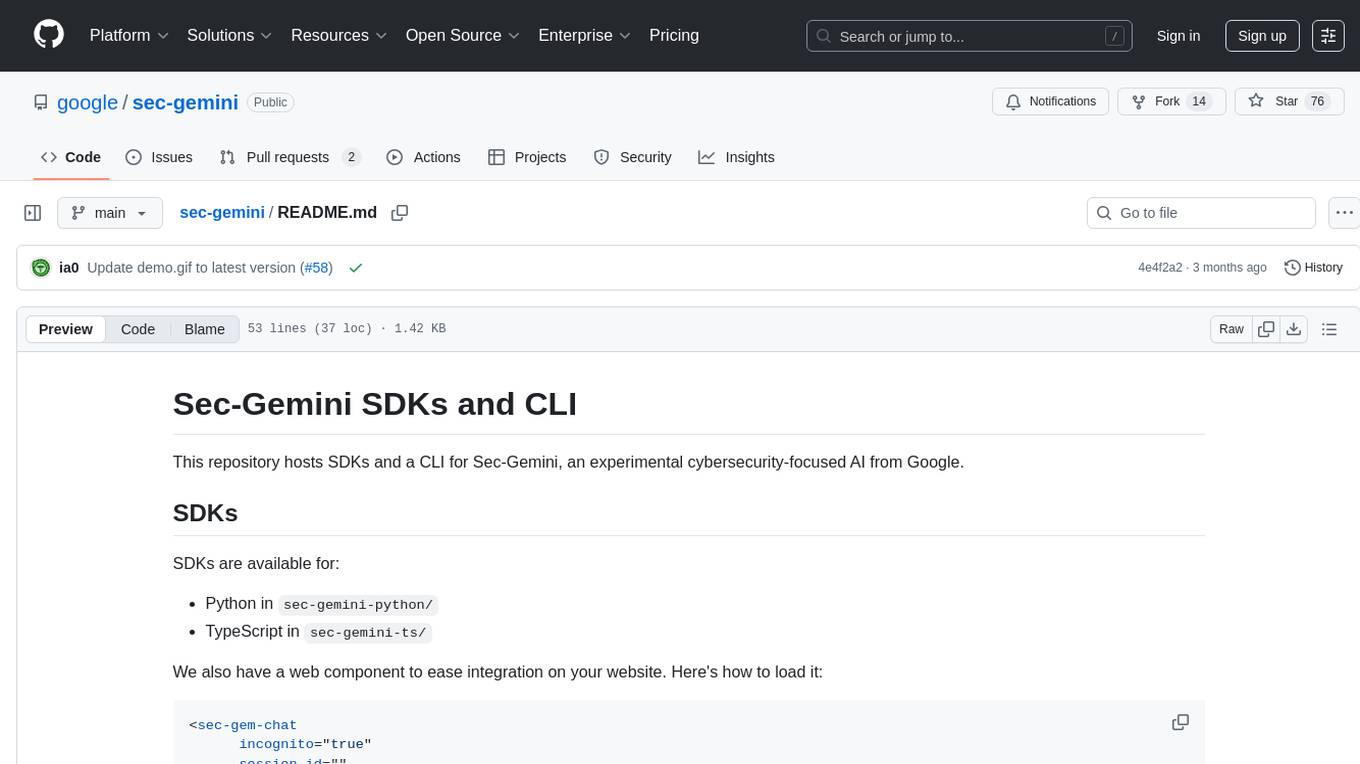
Sec-Gemini is an experimental cybersecurity-focused AI tool developed by Google. This repository contains SDKs and a CLI for Sec-Gemini, with SDKs available for Python and TypeScript. Additionally, there is a web component provided to facilitate integration on websites.
README:
This repository hosts SDKs and a CLI for Sec-Gemini, an experimental cybersecurity-focused AI from Google.
SDKs are available for:
- Python in
sec-gemini-python/ - TypeScript in
sec-gemini-ts/
We also have a web component to ease integration on your website. Here's how to load it:
<sec-gem-chat
      incognito="true"
      session-id=""
      session-name="TestName"
      session-description="TestDescription"
      session-prompt=""
      theme="dark"
      api-key="..."
    >
    </sec-gem-chat>
<script src='https://cdn.jsdelivr.net/npm/sec-gemini-web-component/dist/swc.iife.js'>The CLI can be installed on Linux and macOS:
curl --proto '=https' --tlsv1.2 -LsSf https://github.com/google/sec-gemini/releases/download/cli/sec-gemini-v0.0.4/sec-gemini-installer.sh | shAnd for Windows:
powershell -ExecutionPolicy Bypass -c "irm https://github.com/google/sec-gemini/releases/download/cli/sec-gemini-v0.0.4/sec-gemini-installer.ps1 | iex"
For more information on Sec-Gemini, visit https://secgemini.google.
This is not an officially supported Google product. This project is not eligible for the Google Open Source Software Vulnerability Rewards Program.
For Tasks:
Click tags to check more tools for each tasksFor Jobs:
Alternative AI tools for sec-gemini
Similar Open Source Tools
sec-gemini
Sec-Gemini is an experimental cybersecurity-focused AI tool developed by Google. This repository contains SDKs and a CLI for Sec-Gemini, with SDKs available for Python and TypeScript. Additionally, there is a web component provided to facilitate integration on websites.
freegenius
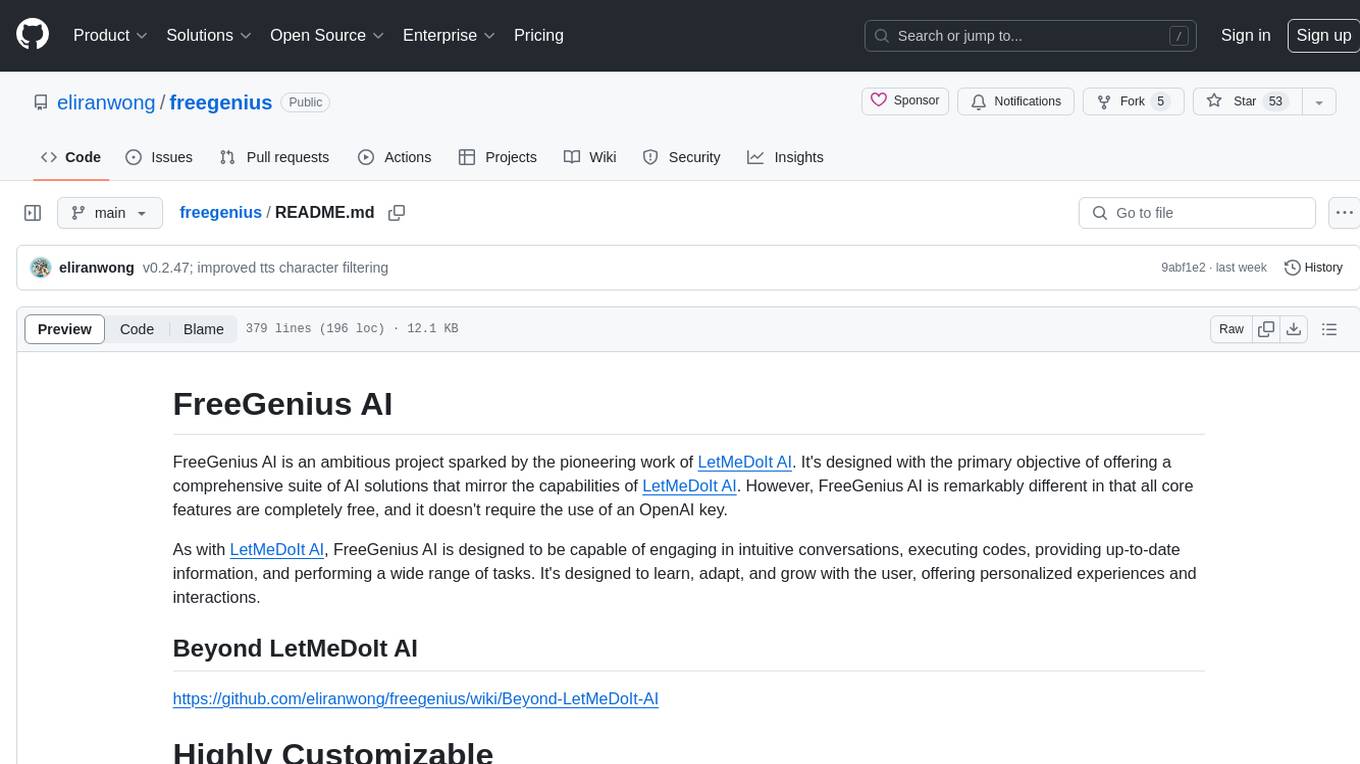
FreeGenius AI is an ambitious project offering a comprehensive suite of AI solutions that mirror the capabilities of LetMeDoIt AI. It is designed to engage in intuitive conversations, execute codes, provide up-to-date information, and perform various tasks. The tool is free, customizable, and provides access to real-time data and device information. It aims to support offline and online backends, open-source large language models, and optional API keys. Users can use FreeGenius AI for tasks like generating tweets, analyzing audio, searching financial data, checking weather, and creating maps.
aiexe
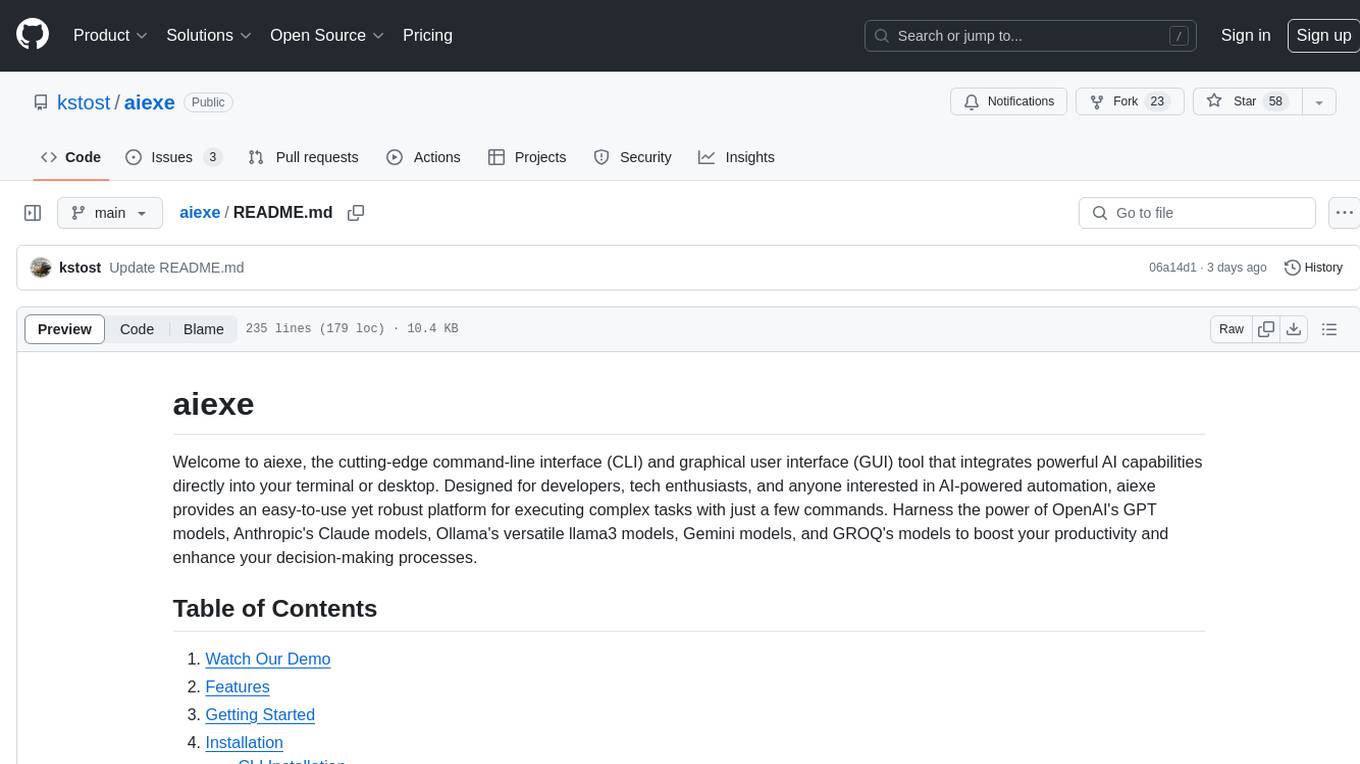
aiexe is a cutting-edge command-line interface (CLI) and graphical user interface (GUI) tool that integrates powerful AI capabilities directly into your terminal or desktop. It is designed for developers, tech enthusiasts, and anyone interested in AI-powered automation. aiexe provides an easy-to-use yet robust platform for executing complex tasks with just a few commands. Users can harness the power of various AI models from OpenAI, Anthropic, Ollama, Gemini, and GROQ to boost productivity and enhance decision-making processes.

spring-ai-alibaba
Spring AI Alibaba is an AI application framework for Java developers that seamlessly integrates with Alibaba Cloud QWen LLM services and cloud-native infrastructures. It provides features like support for various AI models, high-level AI agent abstraction, function calling, and RAG support. The framework aims to simplify the development, evaluation, deployment, and observability of AI native Java applications. It offers open-source framework and ecosystem integrations to support features like prompt template management, event-driven AI applications, and more.
langchain-google
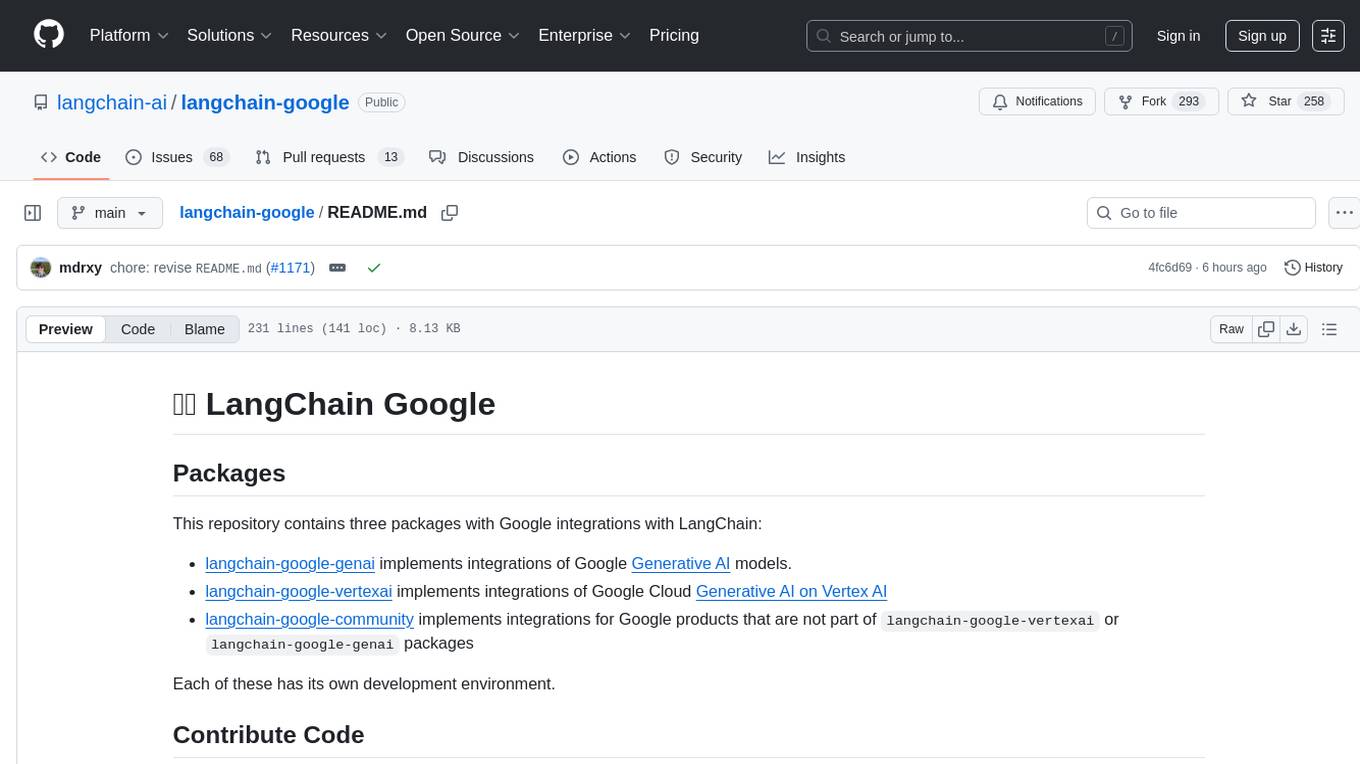
LangChain Google is a repository containing three packages with Google integrations: langchain-google-genai for Google Generative AI models, langchain-google-vertexai for Google Cloud Generative AI on Vertex AI, and langchain-google-community for other Google product integrations. The repository is organized as a monorepo with a structure including libs for different packages, and files like pyproject.toml and Makefile for building, linting, and testing. It provides guidelines for contributing, local development dependencies installation, formatting, linting, working with optional dependencies, and testing with unit and integration tests. The focus is on maintaining unit test coverage and avoiding excessive integration tests, with annotations for GCP infrastructure-dependent tests.
alan-sdk-web
Alan AI is a comprehensive AI solution that acts as a 'unified brain' for enterprises, interconnecting applications, APIs, and data sources to streamline workflows. It offers tools like Alan AI Studio for designing dialog scenarios, lightweight SDKs for embedding AI Agents, and a backend powered by advanced AI technologies. With Alan AI, users can create conversational experiences with minimal UI changes, benefit from a serverless environment, receive on-the-fly updates, and access dialog testing and analytics tools. The platform supports various frameworks like JavaScript, React, Angular, Vue, Ember, and Electron, and provides example web apps for different platforms. Users can also explore Alan AI SDKs for iOS, Android, Flutter, Ionic, Apache Cordova, and React Native.
zodiac
Zodiac is a frontend tool designed to interact with Google's Gemini Pro using vanilla JS. It provides a user-friendly interface for accessing the functionalities of Google AI Suite. The tool simplifies the process of utilizing Gemini Pro's capabilities through a straightforward web application. Users can easily integrate their API key and access various features offered by Google AI Suite. Zodiac aims to streamline the interaction with Gemini Pro and enhance the user experience by offering a simple and intuitive interface for managing AI tasks.
azure-openai-service-proxy
The Azure OpenAI Proxy service aims to simplify access to an Azure OpenAI `Playground-like` experience by supporting Azure OpenAI SDKs, LangChain, and REST endpoints for developer events, workshops, and hackathons. Users can access the service using a timebound `event code`. The solution documentation is available for reference.
aitour26-WRK541-real-world-code-migration-with-github-copilot-agent-mode
Microsoft AI Tour 2026 WRK541 is a workshop focused on real-world code migration using GitHub Copilot Agent Mode. The session is designed for technologists interested in applying AI pair-programming techniques to challenging tasks like migrating or translating code between different programming languages. Participants will learn advanced GitHub Copilot techniques, differences between Python and C#, JSON serialization and deserialization in C#, developing and validating endpoints, integrating Swagger/OpenAPI documentation, and writing unit tests with MSTest. The workshop aims to help users gain hands-on experience in using GitHub Copilot for real-world code migration scenarios.
admyral
Admyral is an open-source Cybersecurity Automation & Investigation Assistant that provides a unified console for investigations and incident handling, workflow automation creation, automatic alert investigation, and next step suggestions for analysts. It aims to tackle alert fatigue and automate security workflows effectively by offering features like workflow actions, AI actions, case management, alert handling, and more. Admyral combines security automation and case management to streamline incident response processes and improve overall security posture. The tool is open-source, transparent, and community-driven, allowing users to self-host, contribute, and collaborate on integrations and features.
gemini-pro-vision-playground
Gemini Pro Vision Playground is a simple project aimed at assisting developers in utilizing the Gemini Pro Vision and Gemini Pro AI models for building applications. It provides a playground environment for experimenting with these models and integrating them into apps. The project includes instructions for setting up the Google AI API key and running the development server to visualize the results. Developers can learn more about the Gemini API documentation and Next.js framework through the provided resources. The project encourages contributions and feedback from the community.
modus
Modus is an open-source, serverless framework for building APIs powered by WebAssembly. It simplifies integrating AI models, data, and business logic with sandboxed execution. Modus extracts metadata, compiles code with optimizations, caches compiled modules, prepares invocation plans, generates API schema, and activates endpoints. Users query the endpoint, and Modus loads compiled code into a sandboxed environment, runs code securely, queries data and AI models, and responds via API. It provides a production-ready scalable endpoint for AI-enabled apps, optimized for sub-second response times. Modus supports programming languages like AssemblyScript and Go, and can be hosted on Hypermode or any platform. Developed by Hypermode as an open-source project, Modus welcomes external contributions.
genai-factory
GenAI Factory is a collection of end-to-end blueprints to deploy generative AI infrastructures in Google Cloud Platform (GCP), following security best practices. It embraces Infrastructure as Code (IaC) best practices, implements infrastructure in Terraform, and follows the least-privilege principle. The tool is compatible with Cloud Foundation Fabric FAST project-factory and application templates, allowing users to deploy various AI applications and systems on GCP.
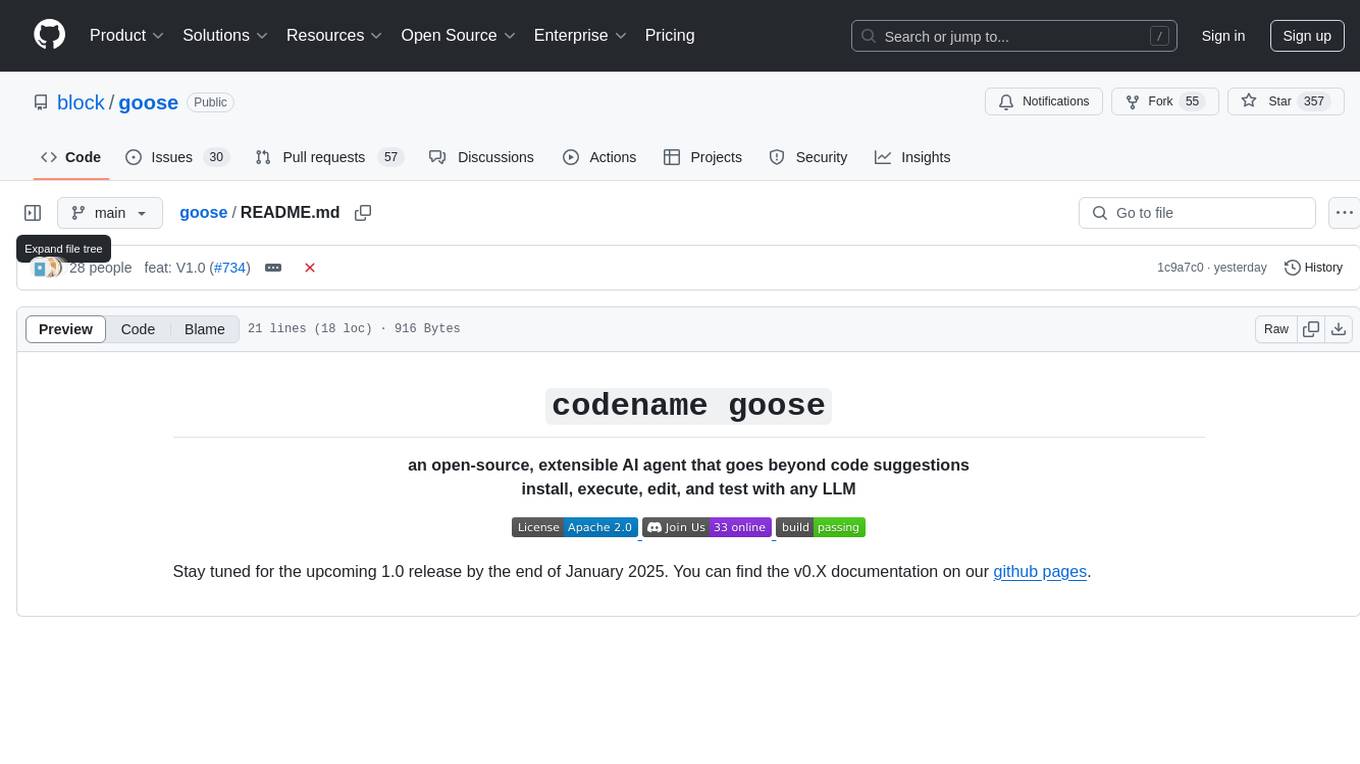
goose
Codename Goose is an open-source, extensible AI agent designed to provide functionalities beyond code suggestions. Users can install, execute, edit, and test with any LLM. The tool aims to enhance the coding experience by offering advanced features and capabilities. Stay updated for the upcoming 1.0 release scheduled by the end of January 2025. Explore the v0.X documentation available on the project's GitHub pages.
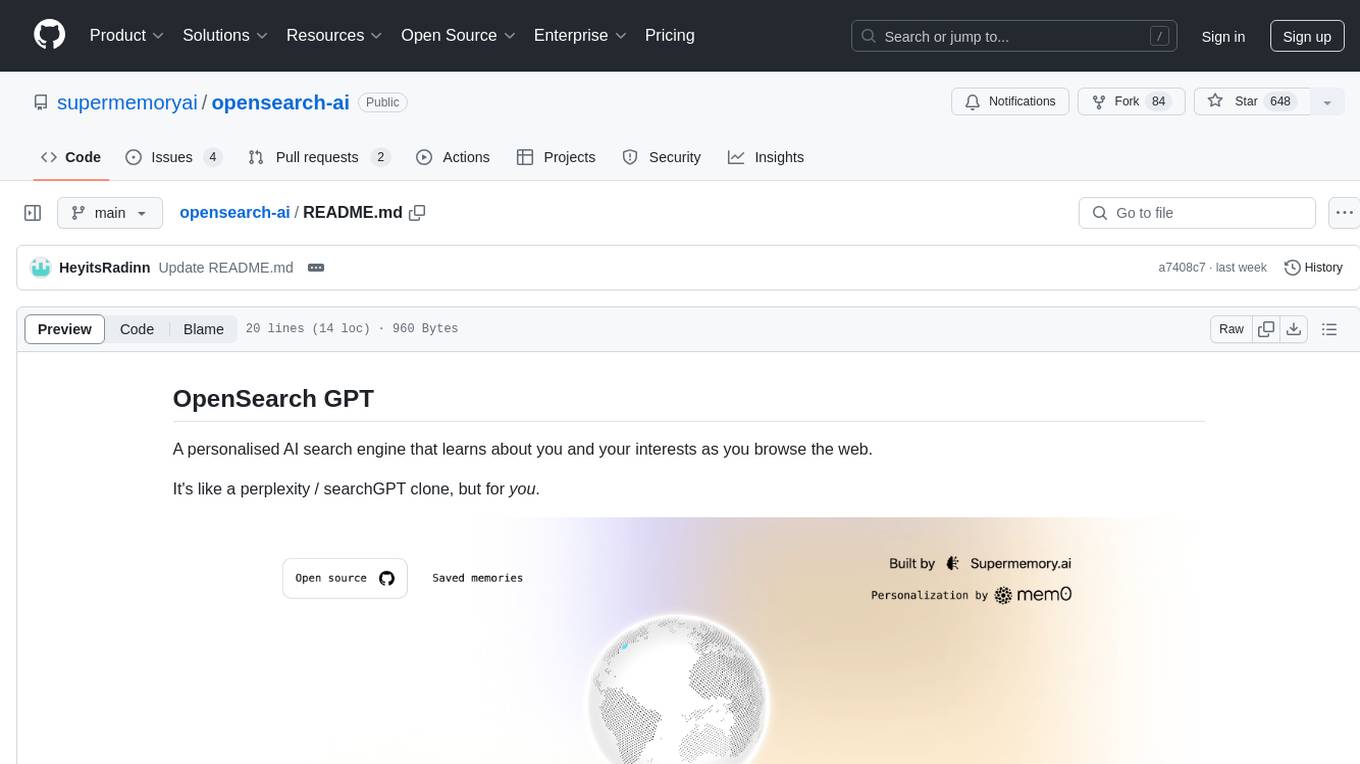
opensearch-ai
OpenSearch GPT is a personalized AI search engine that adapts to user interests while browsing the web. It utilizes advanced technologies like Mem0 for automatic memory collection, Vercel AI ADK for AI applications, Next.js for React framework, Tailwind CSS for styling, Shadcn UI for UI components, Cobe for globe animation, GPT-4o-mini for AI capabilities, and Cloudflare Pages for web application deployment. Developed by Supermemory.ai team.
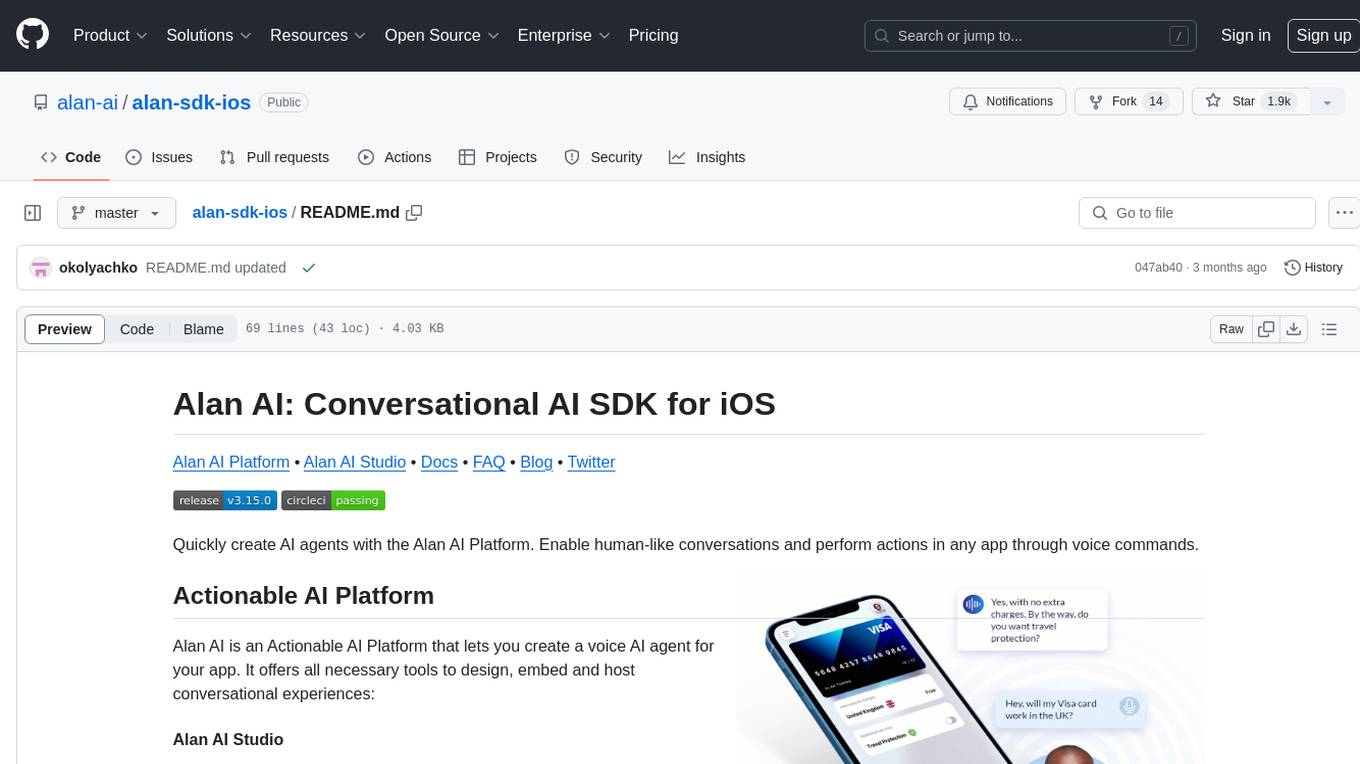
alan-sdk-ios
Alan AI SDK for iOS is a powerful tool that allows developers to quickly create AI agents for their iOS apps. With Alan AI Platform, users can easily design, embed, and host conversational experiences in their applications. The platform offers a web-based IDE called Alan AI Studio for creating dialog scenarios, lightweight SDKs for embedding AI agents, and a backend powered by top-notch speech recognition and natural language understanding technologies. Alan AI enables human-like conversations and actions through voice commands, with features like on-the-fly updates, dialog flow testing, and analytics.
For similar tasks
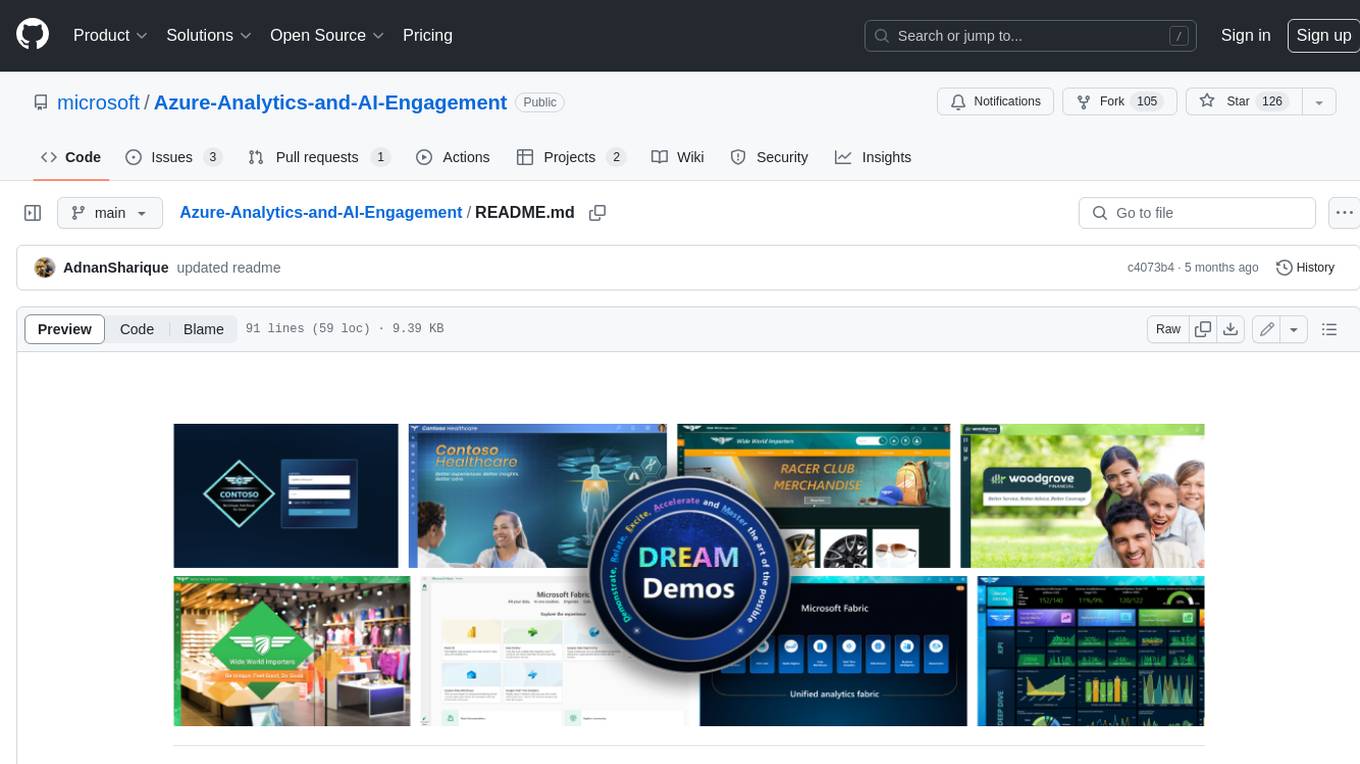
Azure-Analytics-and-AI-Engagement
The Azure-Analytics-and-AI-Engagement repository provides packaged Industry Scenario DREAM Demos with ARM templates (Containing a demo web application, Power BI reports, Synapse resources, AML Notebooks etc.) that can be deployed in a customer’s subscription using the CAPE tool within a matter of few hours. Partners can also deploy DREAM Demos in their own subscriptions using DPoC.
sorrentum
Sorrentum is an open-source project that aims to combine open-source development, startups, and brilliant students to build machine learning, AI, and Web3 / DeFi protocols geared towards finance and economics. The project provides opportunities for internships, research assistantships, and development grants, as well as the chance to work on cutting-edge problems, learn about startups, write academic papers, and get internships and full-time positions at companies working on Sorrentum applications.
tidb
TiDB is an open-source distributed SQL database that supports Hybrid Transactional and Analytical Processing (HTAP) workloads. It is MySQL compatible and features horizontal scalability, strong consistency, and high availability.

zep-python
Zep is an open-source platform for building and deploying large language model (LLM) applications. It provides a suite of tools and services that make it easy to integrate LLMs into your applications, including chat history memory, embedding, vector search, and data enrichment. Zep is designed to be scalable, reliable, and easy to use, making it a great choice for developers who want to build LLM-powered applications quickly and easily.
telemetry-airflow
This repository codifies the Airflow cluster that is deployed at workflow.telemetry.mozilla.org (behind SSO) and commonly referred to as "WTMO" or simply "Airflow". Some links relevant to users and developers of WTMO: * The `dags` directory in this repository contains some custom DAG definitions * Many of the DAGs registered with WTMO don't live in this repository, but are instead generated from ETL task definitions in bigquery-etl * The Data SRE team maintains a WTMO Developer Guide (behind SSO)
mojo
Mojo is a new programming language that bridges the gap between research and production by combining Python syntax and ecosystem with systems programming and metaprogramming features. Mojo is still young, but it is designed to become a superset of Python over time.
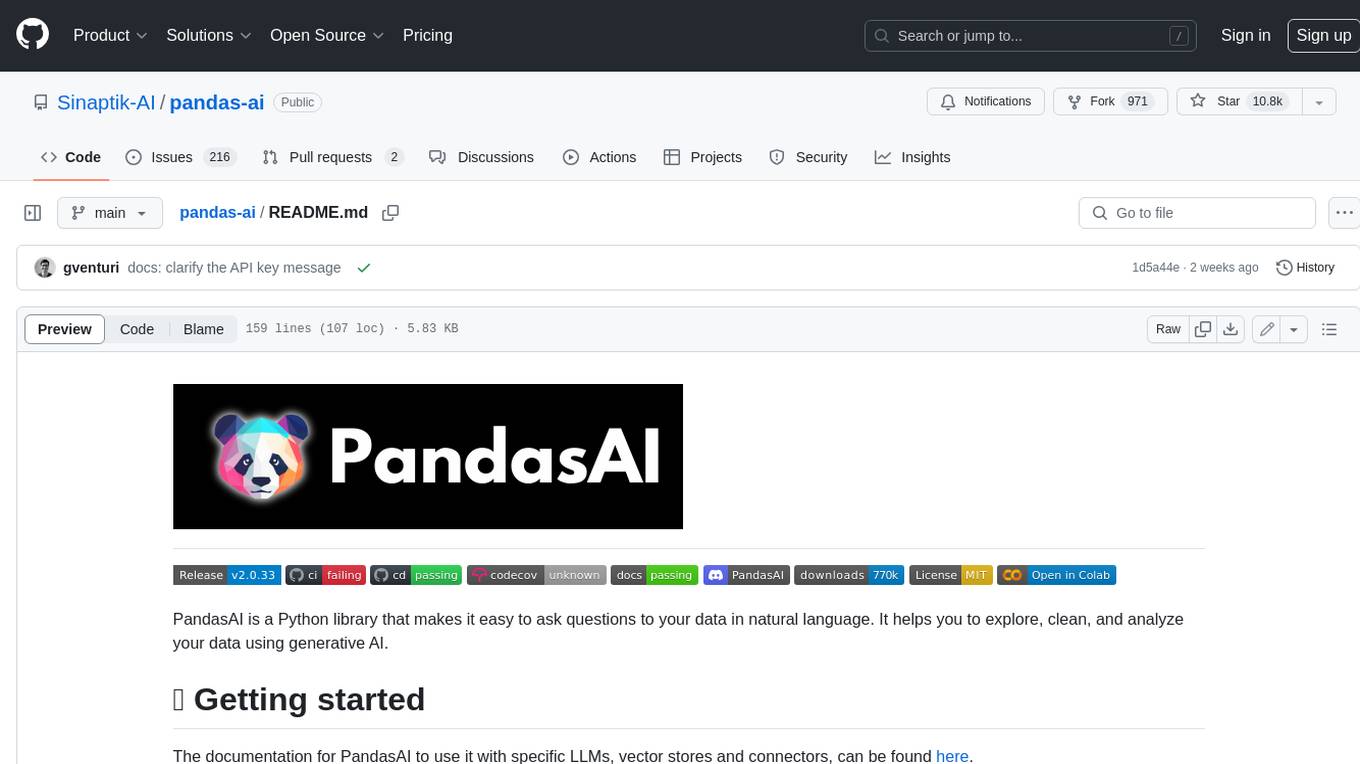
pandas-ai
PandasAI is a Python library that makes it easy to ask questions to your data in natural language. It helps you to explore, clean, and analyze your data using generative AI.
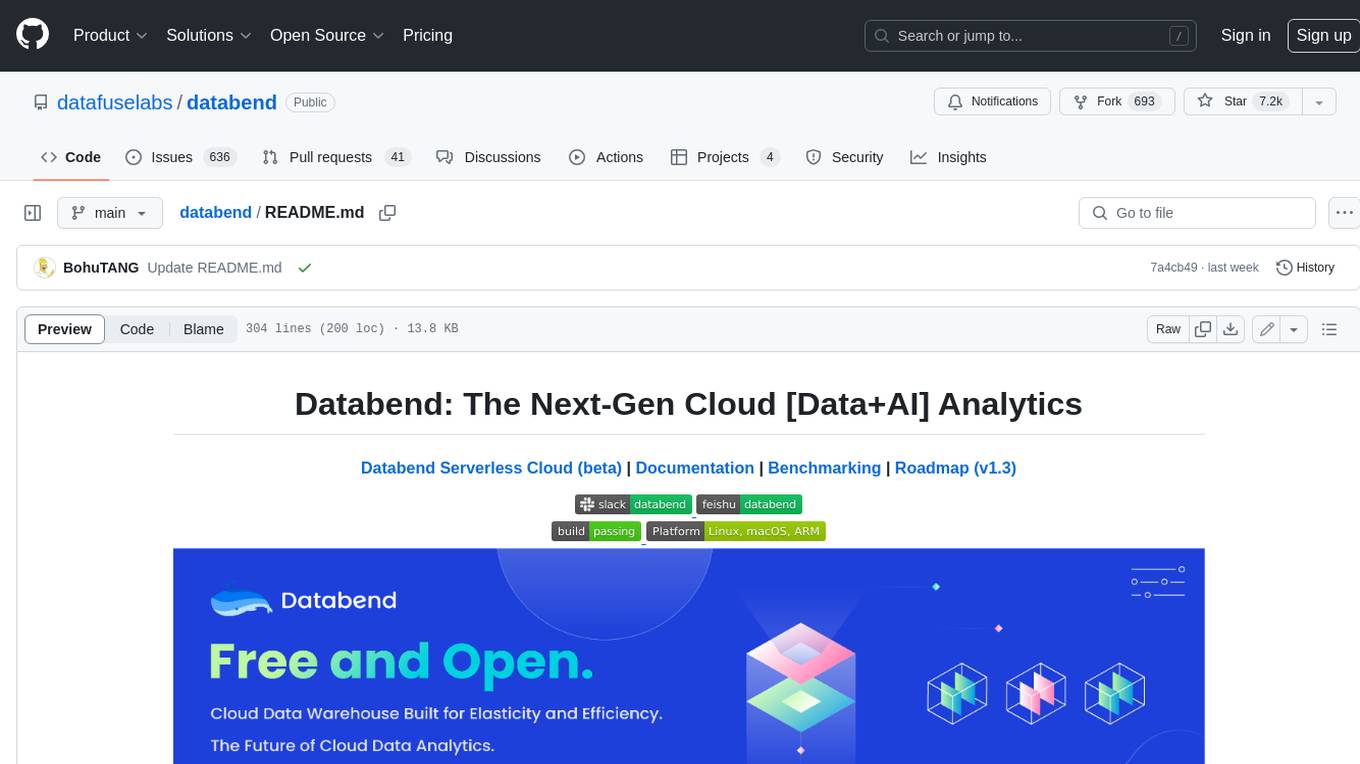
databend
Databend is an open-source cloud data warehouse that serves as a cost-effective alternative to Snowflake. With its focus on fast query execution and data ingestion, it's designed for complex analysis of the world's largest datasets.
For similar jobs
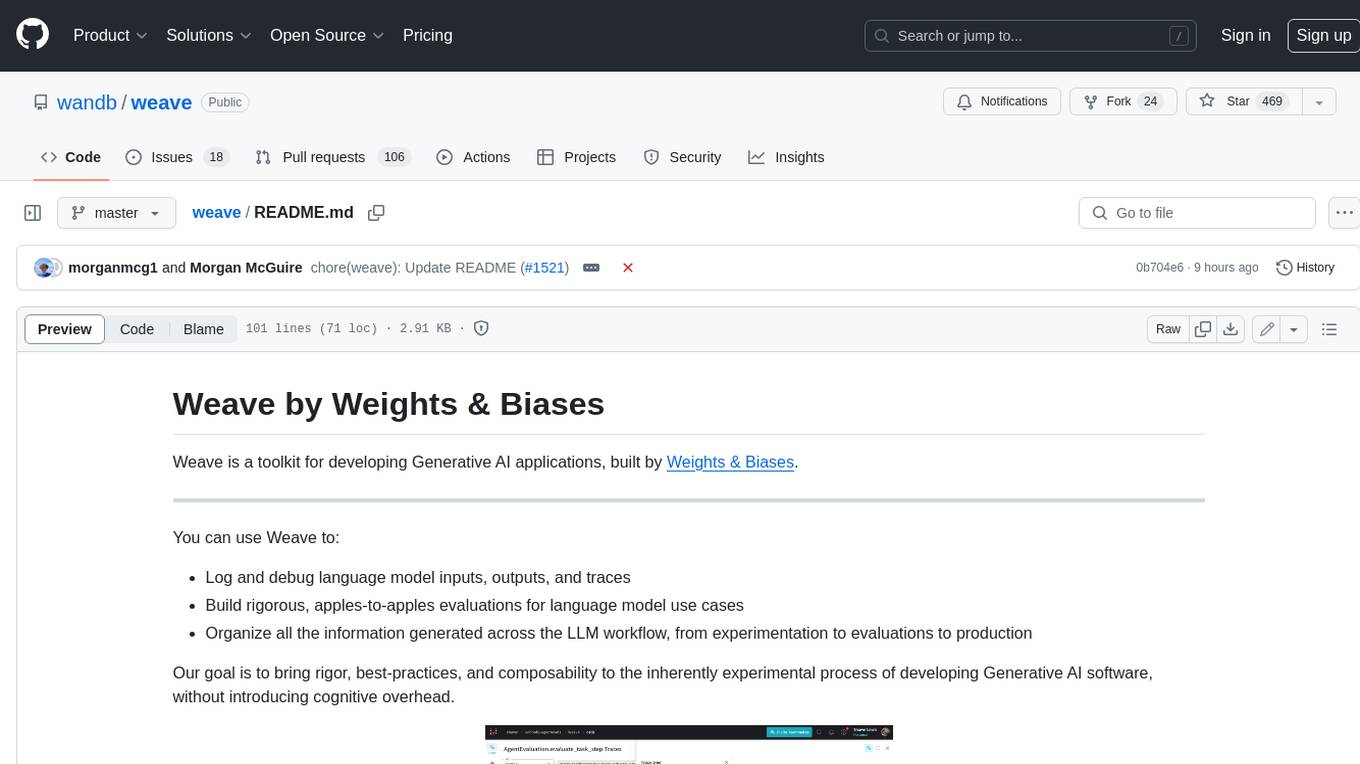
weave
Weave is a toolkit for developing Generative AI applications, built by Weights & Biases. With Weave, you can log and debug language model inputs, outputs, and traces; build rigorous, apples-to-apples evaluations for language model use cases; and organize all the information generated across the LLM workflow, from experimentation to evaluations to production. Weave aims to bring rigor, best-practices, and composability to the inherently experimental process of developing Generative AI software, without introducing cognitive overhead.
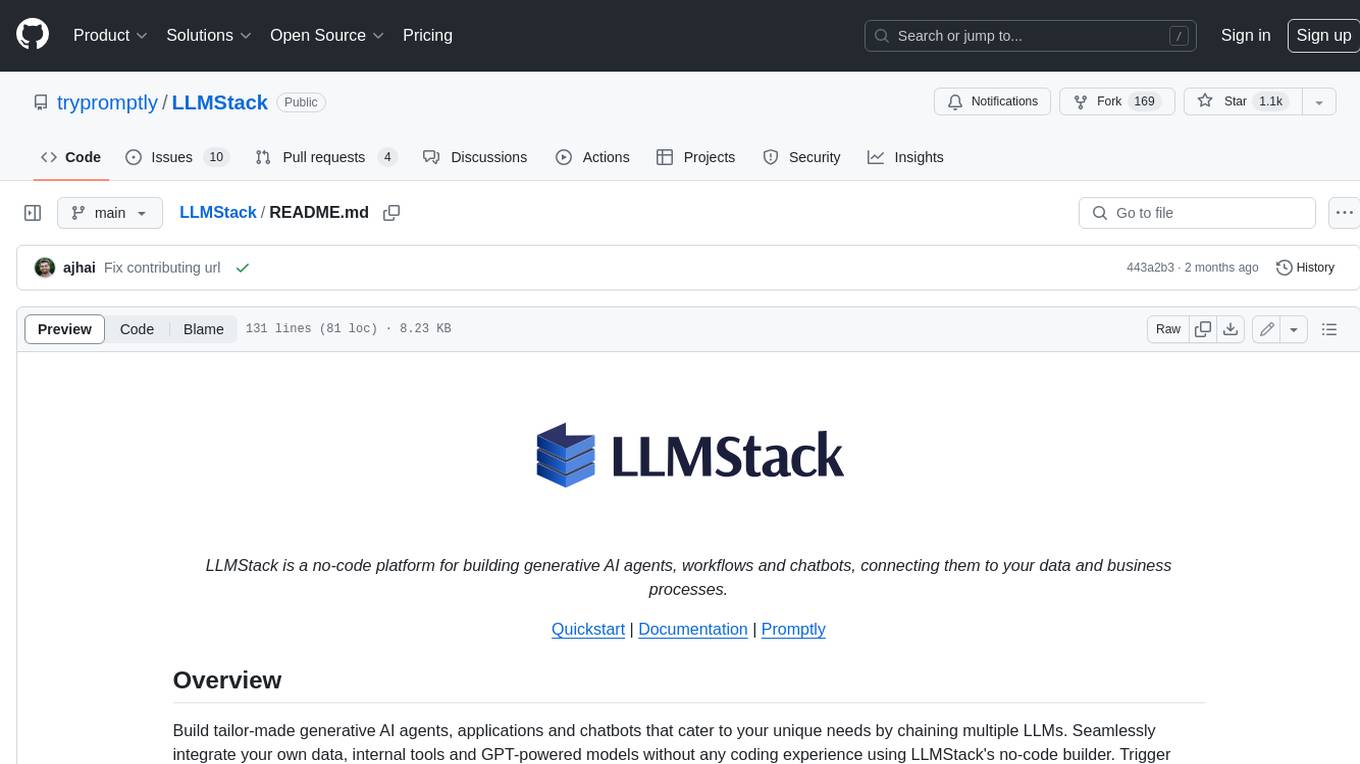
LLMStack
LLMStack is a no-code platform for building generative AI agents, workflows, and chatbots. It allows users to connect their own data, internal tools, and GPT-powered models without any coding experience. LLMStack can be deployed to the cloud or on-premise and can be accessed via HTTP API or triggered from Slack or Discord.
VisionCraft
The VisionCraft API is a free API for using over 100 different AI models. From images to sound.
kaito
Kaito is an operator that automates the AI/ML inference model deployment in a Kubernetes cluster. It manages large model files using container images, avoids tuning deployment parameters to fit GPU hardware by providing preset configurations, auto-provisions GPU nodes based on model requirements, and hosts large model images in the public Microsoft Container Registry (MCR) if the license allows. Using Kaito, the workflow of onboarding large AI inference models in Kubernetes is largely simplified.
PyRIT
PyRIT is an open access automation framework designed to empower security professionals and ML engineers to red team foundation models and their applications. It automates AI Red Teaming tasks to allow operators to focus on more complicated and time-consuming tasks and can also identify security harms such as misuse (e.g., malware generation, jailbreaking), and privacy harms (e.g., identity theft). The goal is to allow researchers to have a baseline of how well their model and entire inference pipeline is doing against different harm categories and to be able to compare that baseline to future iterations of their model. This allows them to have empirical data on how well their model is doing today, and detect any degradation of performance based on future improvements.
tabby
Tabby is a self-hosted AI coding assistant, offering an open-source and on-premises alternative to GitHub Copilot. It boasts several key features: * Self-contained, with no need for a DBMS or cloud service. * OpenAPI interface, easy to integrate with existing infrastructure (e.g Cloud IDE). * Supports consumer-grade GPUs.
spear
SPEAR (Simulator for Photorealistic Embodied AI Research) is a powerful tool for training embodied agents. It features 300 unique virtual indoor environments with 2,566 unique rooms and 17,234 unique objects that can be manipulated individually. Each environment is designed by a professional artist and features detailed geometry, photorealistic materials, and a unique floor plan and object layout. SPEAR is implemented as Unreal Engine assets and provides an OpenAI Gym interface for interacting with the environments via Python.
Magick
Magick is a groundbreaking visual AIDE (Artificial Intelligence Development Environment) for no-code data pipelines and multimodal agents. Magick can connect to other services and comes with nodes and templates well-suited for intelligent agents, chatbots, complex reasoning systems and realistic characters.