


honey
Bee is an AI, easy and high efficiency ORM framework,support JDBC,Cassandra,Mongodb,Sharding,Android,HarmonyOS. Honey is the implementation of the Bee.
Stars: 124
Bee is an ORM framework that provides easy and high-efficiency database operations, allowing developers to focus on business logic development. It supports various databases and features like automatic filtering, partial field queries, pagination, and JSON format results. Bee also offers advanced functionalities like sharding, transactions, complex queries, and MongoDB ORM. The tool is designed for rapid application development in Java, offering faster development for Java Web and Spring Cloud microservices. The Enterprise Edition provides additional features like financial computing support, automatic value insertion, desensitization, dictionary value conversion, multi-tenancy, and more.
README:
Easy for Stronger.
Bee is an ORM framework.
Bee is an easy and high efficiency ORM framework.
Coding Complexity is O(1),it means that Bee will do the Dao for you.
You don't need to write the Dao by yourself anymore.Help you to focus more on the development of business logic.
Good Feature: AI, Timesaving/Tasteful, Easy, Automatic (AiTeaSoft Style)
Newest version is:Bee V2.5.2 LTS(just 935k)
1.17.x LTS version:1.17.25
Sharding target: It is mainly transparent to business development and coding, with only a little sharding config.
Bee see:
https://github.com/automvc/bee
bee-ext:
https://github.com/automvc/bee-ext
Python ORM Bee:
https://github.com/automvc/BeePy
Easy to use:
- 1.Simple interface, convenient to use. The Suid interface provides four object-oriented methods corresponding to the SQL language's select, update, insert, and delete operations.
- 2.By using Bee, you no longer need to write separate DAO code. You can directly call Bee's API to perform operations on the database.
- 3.Convention-over-configuration: Javabean can no annotation, no xml.
- 4.Intelligent automatic filtering of null and empty string properties in entities eliminates the need for writing code to check for non-null values.
- 5.Easily implement partial field queries and native statement pagination.
- 6.Supports returning query results in JSON format; supports chaining.
- 7.Supports Sharding, both database and table Sharding; database-only Sharding; table-only Sharding; and read-write separation. This functionality is transparent to existing code and does not require additional coding.
- 8.Easily extendable with multiple database support (MySQL, MariaDB, Oracle, H2, SQLite, PostgreSQL, SQL Server, Access, Kingbase, Dameng, etc.), and theoretically supports any database supported by JDBC. Additionally, supports Android and Harmony.
- 9.Additional database pagination support for: MsAccess, Cubrid, HSQL, Derby, Firebird, etc.
- 10.Multiple databases can be used simultaneously (e.g., MySQL, Oracle, SQL Server).
Automatic, powerful:
- 11.Dynamic/arbitrary combination of query conditions without the need to prepare DAO interfaces in advance. New query requirements can be handled without modifying or adding interfaces.
- 12.Supports transactions, using the same connection for multiple ORM operations, FOR UPDATE, batch processing, executing native SQL statements, and stored procedures.
- 13.Supports object-oriented complex queries, multi-table queries (no N+1 problem), and supports one-to-one, one-to-many, many-to-one, and many-to-many relationships. The result structure can differ based on whether the sub-table uses List;multi-table association update, insert, and delete(2.1.8).
- 14.MongoDB ORM and support for MongoDB Sharding.
- 15.Supports register, interceptor, multi-tenancy, and custom TypeHandlers for handling ResultSet results in queries. SetParaTypeConvert converts PreparedStatement parameter types.
- 16.Custom dynamic SQL tags, such as @in, @toIsNULL1, @toIsNULL2, , . Allows dynamic SQL, converting lists into statements like in (1,2,3) without requiring foreach loops. Batch insertion also does not require foreach.
- 17.Complex query can be automatically parsed by the frontend and backend.
- 18.L1 cache, simple in concept and powerful in function; L1 cache can also be fine tuned like the JVM; Support updatable long-term cache list and update configuration table without restart. Inherently resistant to cache penetration. L2 cache extension support; Redis L2 cache support.
- 19.No third-party plugin dependencies; can be used with zero configuration.
- 20.High performance: close to the speed of JDBC; small file size: Bee V1.17.25 is only 520k, V2.5.2 is only 935k.
Assist function: -
- Provides a naturally simple solution for generating distributed primary keys: generates globally unique, monotonically increasing (within a worker ID) numeric IDs in a distributed environment.
- 22.Supports automatic generation of Javabean corresponding to tables(support Swagger), creating tables based on Javabean, and automatically generating backend Javaweb code based on templates. Can print executable SQL statements without placeholders for easy debugging. Supports generating SQL scripts in JSON format.
- 23.Supports reading Excel files and importing data into the database; simple operations. Supports generating database tables from Excel configurations.
- 24.Stream tool class StreamUtil;DateUtil date conversion, judge date format, calculate age.
- 25.Rich annotation support: PrimaryKey, Column, Datetime, Createtime, Updatetime; JustFetch, ReplaceInto (MySQL), Dict, DictI18n,GridFs, etc.
- 26.Use entity name _F (automatically generated) to reference entity field names, e.g., Users_F.name or in SuidRichExt interface using the format Users::getName.
2.5.2.1 New Year
- MongoDB update,delete,deleteById support for sharding
- MongoDB modify sharding cache enhance
- MongoDB index support for sharding
- add ShardingFullOpTemplate
- ObjSQLRich(SuidRich) add selectByTemplate for select
2.5.2.2 - fixed bug for MongodbShardingDdlEngine
- record and print sql execute time
bee.osql.showSqlExecuteTime=true
bee.osql.minSqlExecuteTime=0
8.use CQRS(Command Query Responsibility Segregation) operate database 2.5.2.6 - open some config in Honeyconfig as default
openEntityCanExtend = true
showSQL = true
showShardingSQL = true
showSqlExecuteTime = true
minSqlExecuteTime = 5; //ms - column allow use keyword
#there is a switch for it, default is true
bee.osql.naming.allowKeyWordInColumn=true
#define for append if bee do not contain them
bee.osql.naming.sqlKeyWordInColumn - separate logger; initialize config independently first
- BeeSimpleDataSourceBuilder is compatible with different style configurations
- GenFiles support genFileViaStream
- Genbean:update genFieldFile,toString, add method setUpperFieldNameInFieldFile
- update DoNotSetTabShadngValue tip message(Sharding insert need set the sharding value)
- SuidRich selectById,deleteById support sharding
- Condition support clone
- fixed bug:
sharding select all(no paging)
sharding modify cache
1.MySQL
2.Oracle
3.SQL Server
4.MariaDB
5.H2
6.SQLite
7.PostgreSQL
8.MS Access
9.Kingbase
10.DM
11.OceanBase
12.Cubrid,HSQL,Derby,Firebird
13.Other DB that support JDBC
NOSQL:
14.Mongodb
15.ElasticSearch
16.Cassandra
Mobile environment (database):
17.Android
18.Harmony
Test Evn : Local windows.
DB: MySQL (Version 5.6.24).
Test point: Batch Insert;Paging Select; Transaction(update and select).

Batch Insert(unit: ms) |
|||||
| 5k | 1w | 2w | 5w | 10w | |
| Bee | 529.00 | 458.33 | 550.00 | 1315.67 | 4056.67 |
| MyBatis | 1193 | 713 | 1292.67 | 1824.33 | Exception |
Paging Select(unit: ms) |
|||||
| 20 | 50 | 100 | 200 | 500 | |
| Bee | 17.33 | 58.67 | 52.33 | 38.33 | 57.33 |
| MyBatis | 314.33 | 446.00 | 1546.00 | 2294.33 | 6216.67 |
Transaction(update and select) (unit: ms) |
|||||
| 20 | 50 | 100 | 200 | 500 | |
| Bee | 1089.00 | 70.00 | 84.00 | 161.33 | 31509.33 |
| MyBatis | 1144 | 35 | 79.67 | 146.00 | 32155.33 |
Bee need files
orm\compare\bee\service\BeeOrdersService.java
MyBatis need files
orm\compare\mybatis\service\MybatisOrdersService.java
orm\compare\mybatis\dao\OrdersDao.java
orm\compare\mybatis\dao\OrdersMapper.java
orm\compare\mybatis\dao\impl\OrdersDaoImpl.java
common,Javabean and Service interface:
Orders.java
OrdersService.java
Performance comparison data of Bee application in app development
Operate 10000 records, and the use time comparison is as follows.
Operate 10000 records(unit: ms) |
|||
| insert | query | delete | |
| greenDao(Android) | 104666 | 600 | 47 |
| Bee(Android 8.1) | 747 | 184 | 25 |
| Bee(HarmonyOS P40 Pro simulator) | 339 | 143 | 2 |
       <dependency>
	      <groupId>org.teasoft</groupId>
	      <artifactId>bee-all</artifactId>
	      <version>2.5.2</version>
        </dependency>

	    <!-- Mysql config.You need change it to the real database config. -->
		<dependency>
			<groupId>mysql</groupId>
			<artifactId>mysql-connector-java</artifactId>
			<version>5.1.47</version>
			<scope>runtime</scope>
		</dependency>
Gradle
implementation group: 'org.teasoft', name: 'bee-all', version: '2.5.2'
//Gradle(Short)
implementation 'org.teasoft:bee-all:2.5.2'eg:
Create one database,default name is bee.
Create the tables and init the data by run the init-data(user-orders)-mysql.sql file(it is mysql sql script).
If no the bee.properties file, you can create it by yourself.
#bee.databaseName=MySQL
bee.db.dbName=MySQL
bee.db.driverName = com.mysql.jdbc.Driver
#bee.db.url =jdbc:mysql://localhost:3306/bee?characterEncoding=UTF-8
bee.db.url =jdbc:mysql://127.0.0.1:3306/bee?characterEncoding=UTF-8&useSSL=false
bee.db.username = root
bee.db.password =
#print log
bee.osql.showSQL=true
bee.osql.showSql.showType=true
bee.osql.showSql.showExecutableSql=true
# since 2.1.7 sqlFormat=true,will format the executable sql
bee.osql.showSql.sqlFormat=false
#log4j>slf4j>log4j2>androidLog>harmonyLog>systemLogger>fileLogger>noLogging>jdkLog>commonsLog
bee.osql.loggerType=systemLogger
Orders(Javabean)
Auto Genernate Javabean
import java.math.BigDecimal;
import java.util.List;

import org.teasoft.bee.osql.BeeException;
import org.teasoft.bee.osql.Suid;
import org.teasoft.honey.osql.core.BeeFactoryHelper;
import org.teasoft.honey.osql.core.Logger;

/**
 * @author Kingstar
 * @since 1.0
 */
public class SuidExamEN {

	public static void main(String[] args) {

		try {
			Suid suid = BeeFactoryHelper.getSuid();

			Orders orders1 = new Orders();//need gen the Javabean
			orders1.setId(100001L);
			orders1.setName("Bee(ORM Framework)");

			List<Orders> list1 = suid.select(orders1); // 1. select
			for (int i = 0; i < list1.size(); i++) {
				Logger.info(list1.get(i).toString());
			}

			//Condition condition=BF.getCondition(); // The SuidRich interface has many methods with the Condition parameter
               //condition.op(Orders_F.userid, Op.ge, 0); // userid>=0
              //Op supports: =,>,<,>=,<=,!=, Like, in, not in, etc

			orders1.setName("Bee(ORM Framework)");
			int updateNum = suid.update(orders1); //2. update
			Logger.info("update record:" + updateNum);

			Orders orders2 = new Orders();
			orders2.setUserid("bee");
			orders2.setName("Bee(ORM Framework)");
			orders2.setTotal(new BigDecimal("91.99"));
			orders2.setRemark(""); // empty String test

			int insertNum = suid.insert(orders2); // 3. insert
			Logger.info("insert record:" + insertNum);

			int deleteNum = suid.delete(orders2); // 4. delete
			Logger.info("delete record:" + deleteNum);
		} catch (BeeException e) {
			Logger.error("In SuidExamEN (BeeException):" + e.getMessage());
			//e.printStackTrace();
		} catch (Exception e) {
			Logger.error("In SuidExamEN (Exception):" + e.getMessage());
			//e.printStackTrace();
		}
	}

}
// notice: this is just a simple sample. Bee suport transaction,paging,complicate select,slect json,and so on. bee.db.isAndroid=true
bee.db.androidDbName=account.db
bee.db.androidDbVersion=1
bee.osql.loggerType=androidLog
#turn on query result field type conversion, and more types will be supported
bee.osql.openFieldTypeHandler=true
#If you are allowed to delete and update the whole table, you need to remove the comments
#bee.osql.notDeleteWholeRecords=false
#bee.osql.notUpdateWholeRecords=falsepublic class YourAppCreateAndUpgrade implements CreateAndUpgrade{
@Override
public void onCreate() {
// You can create tables in an object-oriented way
Ddl.createTable(new Orders(), false);
Ddl.createTable(new TestUser(), false);
}
@Override
public void onUpgrade(int oldVersion, int newVersion) {
if(newVersion==2) {
Ddl.createTable(new LeafAlloc(), true);
Log.i("onUpgrade", "你在没有卸载的情况下,在线更新到版本:"+newVersion);
}
}
}
Configure android:name to BeeApplication in AndroidManifest.xml file.
package com.aiteasoft.util;

import org.teasoft.bee.android.CreateAndUpgradeRegistry;
import org.teasoft.beex.android.ApplicationRegistry;

public class BeeApplication extends Application {
    private static Context context;
    @Override
    public void onCreate() {
       ApplicationRegistry.register(this);//注册上下文
       CreateAndUpgradeRegistry.register(YourAppCreateAndUpgrade.class);
    }
 }

// 并在AndroidManifest.xml,配置android:name为BeeApplication
 <application
        android:icon="@drawable/appicon"
        android:label="@string/app_name"
         android:name="com.aiteasoft.util.BeeApplication"
>Suid suid=BF.getSuid();
List<Orders> list = suid.select(new Orders()); Performance comparison data of Bee application in app development
Operate 10000 records, and the use time comparison is as follows.
Operate 10000 records(unit: ms) |
|||
| insert | query | delete | |
| greenDao(Android) | 104666 | 600 | 47 |
| Bee(Android 8.1) | 747 | 184 | 25 |
| Bee(HarmonyOS P40 Pro simulator) | 339 | 143 | 2 |
V2.1


Let Java more quicker programming than php and Rails.
Faster development of new combinations for Java Web:
Bee+Spring+SpringMVC
Faster development of new combinations for Spring Cloud microservices:
Bee + Spring Boot
Rapid Application Code Generation Platform--AiTea Soft made in China!
...
API-V1.17.x(Newest) SourceCode contain bee-1.17 CN & EN API,bee-1.17 CN SourceCode
API-V2.x(Newest) bee-2.5.2 EN API
Author's email: [email protected]
For Tasks:
Click tags to check more tools for each tasksFor Jobs:
Alternative AI tools for honey
Similar Open Source Tools
honey
Bee is an ORM framework that provides easy and high-efficiency database operations, allowing developers to focus on business logic development. It supports various databases and features like automatic filtering, partial field queries, pagination, and JSON format results. Bee also offers advanced functionalities like sharding, transactions, complex queries, and MongoDB ORM. The tool is designed for rapid application development in Java, offering faster development for Java Web and Spring Cloud microservices. The Enterprise Edition provides additional features like financial computing support, automatic value insertion, desensitization, dictionary value conversion, multi-tenancy, and more.
bee
Bee is an easy and high efficiency ORM framework that simplifies database operations by providing a simple interface and eliminating the need to write separate DAO code. It supports various features such as automatic filtering of properties, partial field queries, native statement pagination, JSON format results, sharding, multiple database support, and more. Bee also offers powerful functionalities like dynamic query conditions, transactions, complex queries, MongoDB ORM, cache management, and additional tools for generating distributed primary keys, reading Excel files, and more. The newest versions introduce enhancements like placeholder precompilation, default date sharding, ElasticSearch ORM support, and improved query capabilities.
CrackSQL
CrackSQL is a powerful SQL dialect translation tool that integrates rule-based strategies with large language models (LLMs) for high accuracy. It enables seamless conversion between dialects (e.g., PostgreSQL → MySQL) with flexible access through Python API, command line, and web interface. The tool supports extensive dialect compatibility, precision & advanced processing, and versatile access & integration. It offers three modes for dialect translation and demonstrates high translation accuracy over collected benchmarks. Users can deploy CrackSQL using PyPI package installation or source code installation methods. The tool can be extended to support additional syntax, new dialects, and improve translation efficiency. The project is actively maintained and welcomes contributions from the community.
kernel-memory
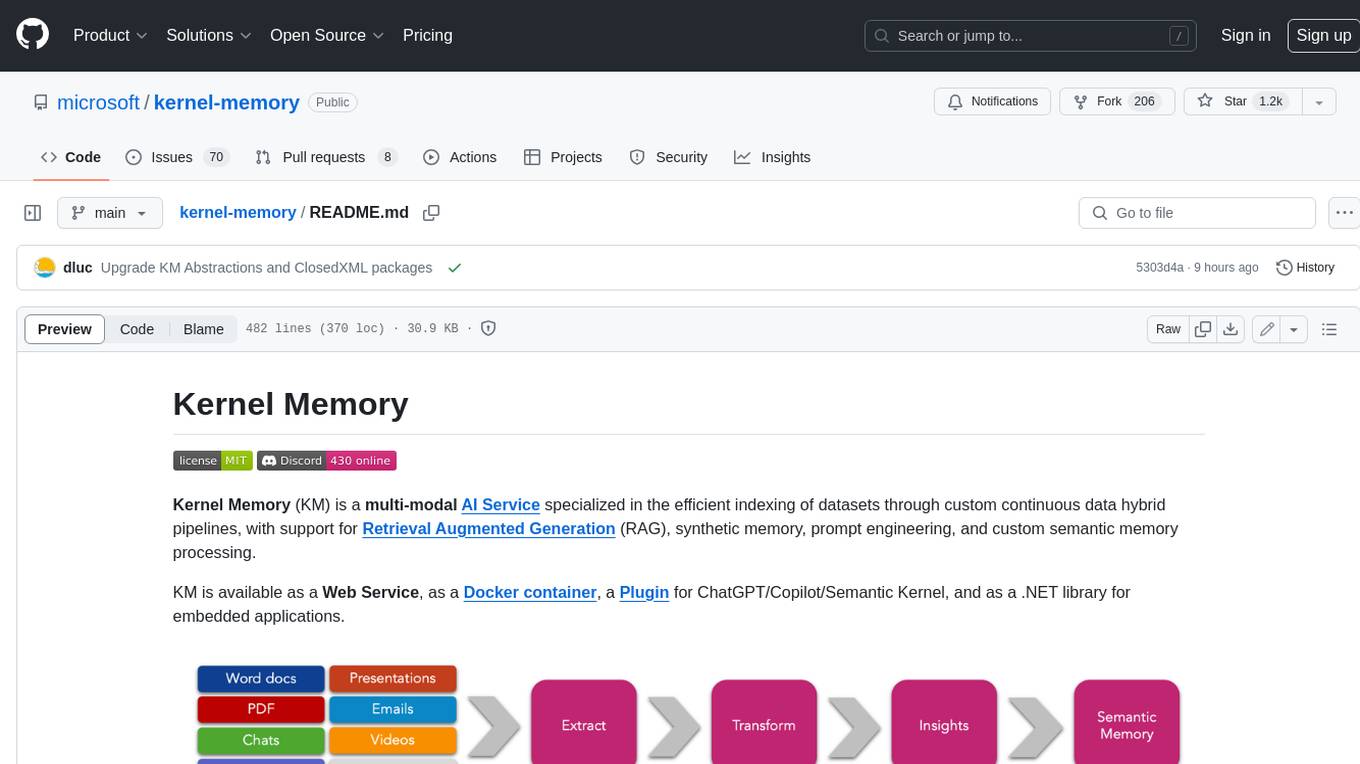
Kernel Memory (KM) is a multi-modal AI Service specialized in the efficient indexing of datasets through custom continuous data hybrid pipelines, with support for Retrieval Augmented Generation (RAG), synthetic memory, prompt engineering, and custom semantic memory processing. KM is available as a Web Service, as a Docker container, a Plugin for ChatGPT/Copilot/Semantic Kernel, and as a .NET library for embedded applications. Utilizing advanced embeddings and LLMs, the system enables Natural Language querying for obtaining answers from the indexed data, complete with citations and links to the original sources. Designed for seamless integration as a Plugin with Semantic Kernel, Microsoft Copilot and ChatGPT, Kernel Memory enhances data-driven features in applications built for most popular AI platforms.
UnrealGenAISupport
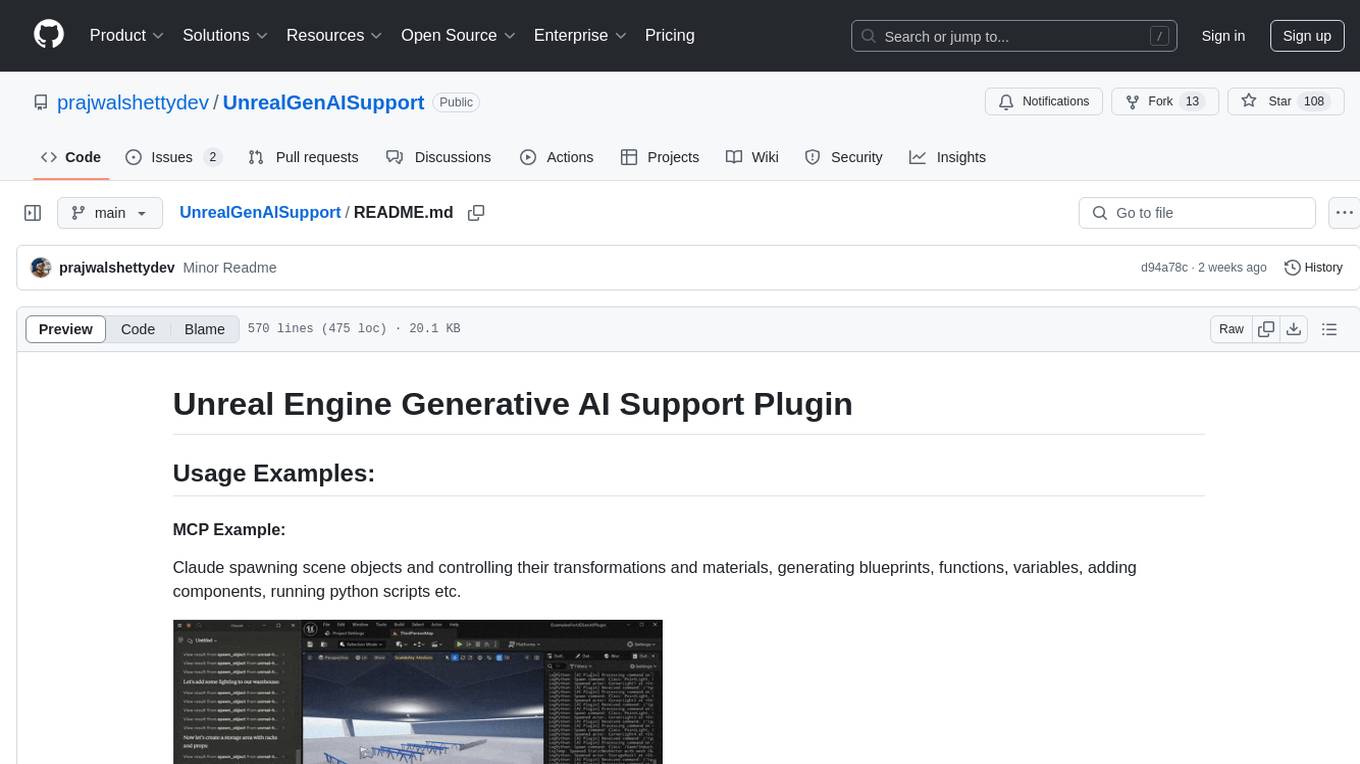
The Unreal Engine Generative AI Support Plugin is a tool designed to integrate various cutting-edge LLM/GenAI models into Unreal Engine for game development. It aims to simplify the process of using AI models for game development tasks, such as controlling scene objects, generating blueprints, running Python scripts, and more. The plugin currently supports models from organizations like OpenAI, Anthropic, XAI, Google Gemini, Meta AI, Deepseek, and Baidu. It provides features like API support, model control, generative AI capabilities, UI generation, project file management, and more. The plugin is still under development but offers a promising solution for integrating AI models into game development workflows.
crawl4ai
Crawl4AI is a powerful and free web crawling service that extracts valuable data from websites and provides LLM-friendly output formats. It supports crawling multiple URLs simultaneously, replaces media tags with ALT, and is completely free to use and open-source. Users can integrate Crawl4AI into Python projects as a library or run it as a standalone local server. The tool allows users to crawl and extract data from specified URLs using different providers and models, with options to include raw HTML content, force fresh crawls, and extract meaningful text blocks. Configuration settings can be adjusted in the `crawler/config.py` file to customize providers, API keys, chunk processing, and word thresholds. Contributions to Crawl4AI are welcome from the open-source community to enhance its value for AI enthusiasts and developers.
pixeltable
Pixeltable is a Python library designed for ML Engineers and Data Scientists to focus on exploration, modeling, and app development without the need to handle data plumbing. It provides a declarative interface for working with text, images, embeddings, and video, enabling users to store, transform, index, and iterate on data within a single table interface. Pixeltable is persistent, acting as a database unlike in-memory Python libraries such as Pandas. It offers features like data storage and versioning, combined data and model lineage, indexing, orchestration of multimodal workloads, incremental updates, and automatic production-ready code generation. The tool emphasizes transparency, reproducibility, cost-saving through incremental data changes, and seamless integration with existing Python code and libraries.
obsei
Obsei is an open-source, low-code, AI powered automation tool that consists of an Observer to collect unstructured data from various sources, an Analyzer to analyze the collected data with various AI tasks, and an Informer to send analyzed data to various destinations. The tool is suitable for scheduled jobs or serverless applications as all Observers can store their state in databases. Obsei is still in alpha stage, so caution is advised when using it in production. The tool can be used for social listening, alerting/notification, automatic customer issue creation, extraction of deeper insights from feedbacks, market research, dataset creation for various AI tasks, and more based on creativity.
vecs
vecs is a Python client for managing and querying vector stores in PostgreSQL with the pgvector extension. It allows users to create collections of vectors with associated metadata, index the collections for fast search performance, and query the collections based on specified filters. The tool simplifies the process of working with vector data in a PostgreSQL database, making it easier to store, retrieve, and analyze vector information.
EasySteer
EasySteer is a unified framework built on vLLM for high-performance LLM steering. It offers fast, flexible, and easy-to-use steering capabilities with features like high performance, modular design, fine-grained control, pre-computed steering vectors, and an interactive demo. Users can interactively configure models, adjust steering parameters, and test interventions without writing code. The tool supports OpenAI-compatible APIs and provides modules for hidden states extraction, analysis-based steering, learning-based steering, and a frontend web interface for interactive steering and ReFT interventions.
mcphub.nvim
MCPHub.nvim is a powerful Neovim plugin that integrates MCP (Model Context Protocol) servers into your workflow. It offers a centralized config file for managing servers and tools, with an intuitive UI for testing resources. Ideal for LLM integration, it provides programmatic API access and interactive testing through the `:MCPHub` command.
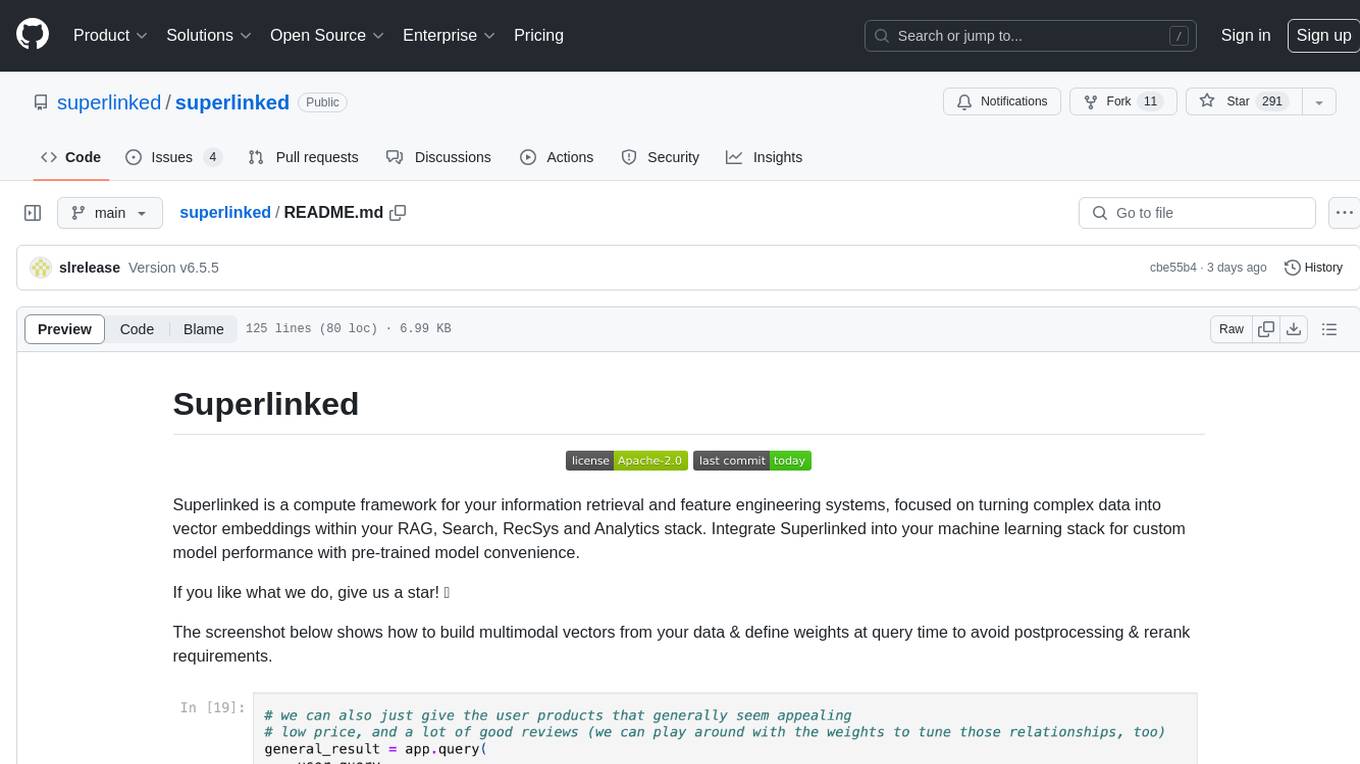
superlinked
Superlinked is a compute framework for information retrieval and feature engineering systems, focusing on converting complex data into vector embeddings for RAG, Search, RecSys, and Analytics stack integration. It enables custom model performance in machine learning with pre-trained model convenience. The tool allows users to build multimodal vectors, define weights at query time, and avoid postprocessing & rerank requirements. Users can explore the computational model through simple scripts and python notebooks, with a future release planned for production usage with built-in data infra and vector database integrations.
volga
Volga is a general purpose real-time data processing engine in Python for modern AI/ML systems. It aims to be a Python-native alternative to Flink/Spark Streaming with extended functionality for real-time AI/ML workloads. It provides a hybrid push+pull architecture, Entity API for defining data entities and feature pipelines, DataStream API for general data processing, and customizable data connectors. Volga can run on a laptop or a distributed cluster, making it suitable for building custom real-time AI/ML feature platforms or general data pipelines without relying on third-party platforms.
LLM4Decompile
LLM4Decompile is an open-source large language model dedicated to decompilation of Linux x86_64 binaries, supporting GCC's O0 to O3 optimization levels. It focuses on assessing re-executability of decompiled code through HumanEval-Decompile benchmark. The tool includes models with sizes ranging from 1.3 billion to 33 billion parameters, available on Hugging Face. Users can preprocess C code into binary and assembly instructions, then decompile assembly instructions into C using LLM4Decompile. Ongoing efforts aim to expand capabilities to support more architectures and configurations, integrate with decompilation tools like Ghidra and Rizin, and enhance performance with larger training datasets.
NextChat
NextChat is a well-designed cross-platform ChatGPT web UI tool that supports Claude, GPT4, and Gemini Pro. It offers a compact client for Linux, Windows, and MacOS, with features like self-deployed LLMs compatibility, privacy-first data storage, markdown support, responsive design, and fast loading speed. Users can create, share, and debug chat tools with prompt templates, access various prompts, compress chat history, and use multiple languages. The tool also supports enterprise-level privatization and customization deployment, with features like brand customization, resource integration, permission control, knowledge integration, security auditing, private deployment, and continuous updates.
aiobotocore
aiobotocore is an async client for Amazon services using botocore and aiohttp/asyncio. It provides a mostly full-featured asynchronous version of botocore, allowing users to interact with various AWS services asynchronously. The library supports operations such as uploading objects to S3, getting object properties, listing objects, and deleting objects. It also offers context manager examples for managing resources efficiently. aiobotocore supports multiple AWS services like S3, DynamoDB, SNS, SQS, CloudFormation, and Kinesis, with basic methods tested for each service. Users can run tests using moto for mocked tests or against personal Amazon keys. Additionally, the tool enables type checking and code completion for better development experience.
For similar tasks
venice
Venice is a derived data storage platform, providing the following characteristics: 1. High throughput asynchronous ingestion from batch and streaming sources (e.g. Hadoop and Samza). 2. Low latency online reads via remote queries or in-process caching. 3. Active-active replication between regions with CRDT-based conflict resolution. 4. Multi-cluster support within each region with operator-driven cluster assignment. 5. Multi-tenancy, horizontal scalability and elasticity within each cluster. The above makes Venice particularly suitable as the stateful component backing a Feature Store, such as Feathr. AI applications feed the output of their ML training jobs into Venice and then query the data for use during online inference workloads.
pinecone-ts-client
The official Node.js client for Pinecone, written in TypeScript. This client library provides a high-level interface for interacting with the Pinecone vector database service. With this client, you can create and manage indexes, upsert and query vector data, and perform other operations related to vector search and retrieval. The client is designed to be easy to use and provides a consistent and idiomatic experience for Node.js developers. It supports all the features and functionality of the Pinecone API, making it a comprehensive solution for building vector-powered applications in Node.js.
honey
Bee is an ORM framework that provides easy and high-efficiency database operations, allowing developers to focus on business logic development. It supports various databases and features like automatic filtering, partial field queries, pagination, and JSON format results. Bee also offers advanced functionalities like sharding, transactions, complex queries, and MongoDB ORM. The tool is designed for rapid application development in Java, offering faster development for Java Web and Spring Cloud microservices. The Enterprise Edition provides additional features like financial computing support, automatic value insertion, desensitization, dictionary value conversion, multi-tenancy, and more.
llama_index
LlamaIndex is a data framework for building LLM applications. It provides tools for ingesting, structuring, and querying data, as well as integrating with LLMs and other tools. LlamaIndex is designed to be easy to use for both beginner and advanced users, and it provides a comprehensive set of features for building LLM applications.
kernel-memory
Kernel Memory (KM) is a multi-modal AI Service specialized in the efficient indexing of datasets through custom continuous data hybrid pipelines, with support for Retrieval Augmented Generation (RAG), synthetic memory, prompt engineering, and custom semantic memory processing. KM is available as a Web Service, as a Docker container, a Plugin for ChatGPT/Copilot/Semantic Kernel, and as a .NET library for embedded applications. Utilizing advanced embeddings and LLMs, the system enables Natural Language querying for obtaining answers from the indexed data, complete with citations and links to the original sources. Designed for seamless integration as a Plugin with Semantic Kernel, Microsoft Copilot and ChatGPT, Kernel Memory enhances data-driven features in applications built for most popular AI platforms.
deeplake
Deep Lake is a Database for AI powered by a storage format optimized for deep-learning applications. Deep Lake can be used for: 1. Storing data and vectors while building LLM applications 2. Managing datasets while training deep learning models Deep Lake simplifies the deployment of enterprise-grade LLM-based products by offering storage for all data types (embeddings, audio, text, videos, images, pdfs, annotations, etc.), querying and vector search, data streaming while training models at scale, data versioning and lineage, and integrations with popular tools such as LangChain, LlamaIndex, Weights & Biases, and many more. Deep Lake works with data of any size, it is serverless, and it enables you to store all of your data in your own cloud and in one place. Deep Lake is used by Intel, Bayer Radiology, Matterport, ZERO Systems, Red Cross, Yale, & Oxford.
databend
Databend is an open-source cloud data warehouse that serves as a cost-effective alternative to Snowflake. With its focus on fast query execution and data ingestion, it's designed for complex analysis of the world's largest datasets.
db-ally
db-ally is a library for creating natural language interfaces to data sources. It allows developers to outline specific use cases for a large language model (LLM) to handle, detailing the desired data format and the possible operations to fetch this data. db-ally effectively shields the complexity of the underlying data source from the model, presenting only the essential information needed for solving the specific use cases. Instead of generating arbitrary SQL, the model is asked to generate responses in a simplified query language.
For similar jobs
db2rest
DB2Rest is a modern low-code REST DATA API platform that simplifies the development of intelligent applications. It seamlessly integrates existing and new databases with language models (LMs/LLMs) and vector stores, enabling the rapid delivery of context-aware, reasoning applications without vendor lock-in.
kitops
KitOps is a packaging and versioning system for AI/ML projects that uses open standards so it works with the AI/ML, development, and DevOps tools you are already using. KitOps simplifies the handoffs between data scientists, application developers, and SREs working with LLMs and other AI/ML models. KitOps' ModelKits are a standards-based package for models, their dependencies, configurations, and codebases. ModelKits are portable, reproducible, and work with the tools you already use.
kweaver
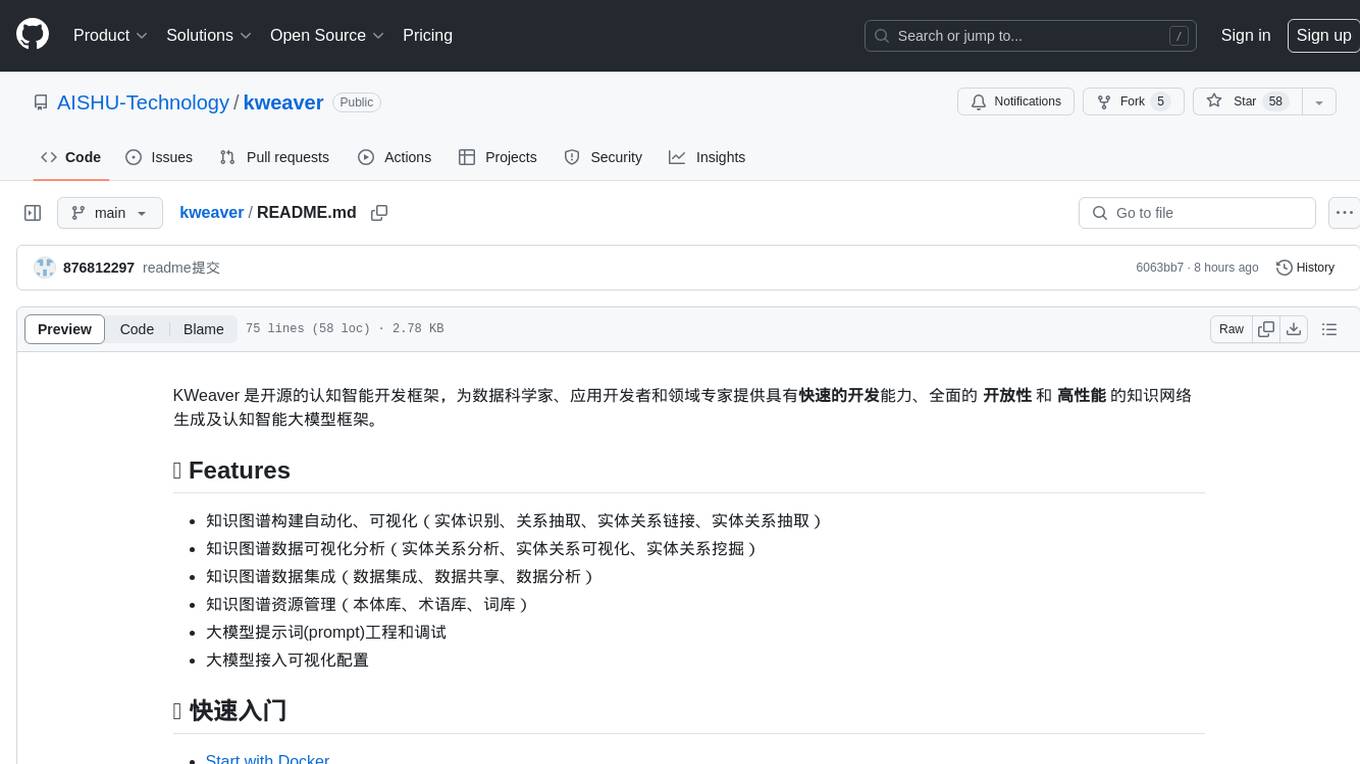
KWeaver is an open-source cognitive intelligence development framework that provides data scientists, application developers, and domain experts with the ability for rapid development, comprehensive openness, and high-performance knowledge network generation and cognitive intelligence large model framework. It offers features such as automated and visual knowledge graph construction, visualization and analysis of knowledge graph data, knowledge graph integration, knowledge graph resource management, large model prompt engineering and debugging, and visual configuration for large model access.
honey
Bee is an ORM framework that provides easy and high-efficiency database operations, allowing developers to focus on business logic development. It supports various databases and features like automatic filtering, partial field queries, pagination, and JSON format results. Bee also offers advanced functionalities like sharding, transactions, complex queries, and MongoDB ORM. The tool is designed for rapid application development in Java, offering faster development for Java Web and Spring Cloud microservices. The Enterprise Edition provides additional features like financial computing support, automatic value insertion, desensitization, dictionary value conversion, multi-tenancy, and more.
moxin
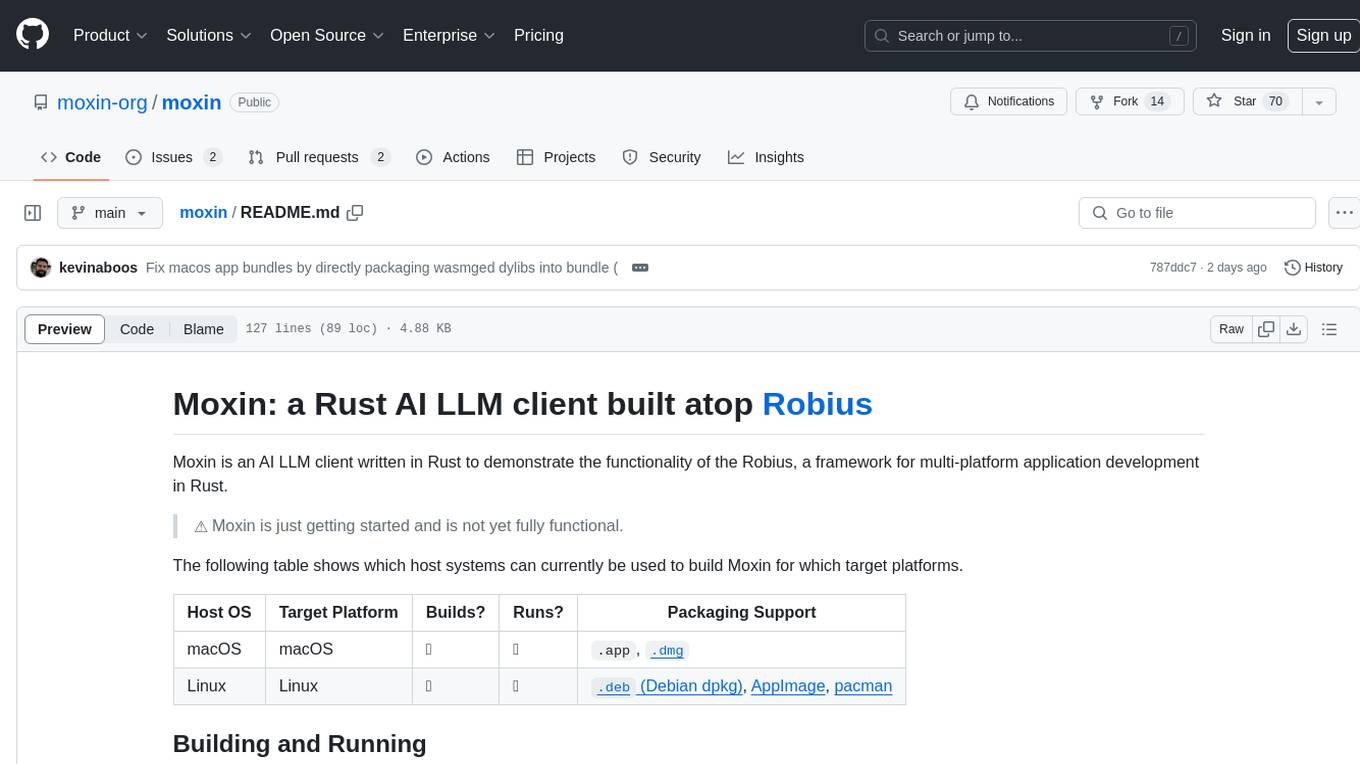
Moxin is an AI LLM client written in Rust to demonstrate the functionality of the Robius framework for multi-platform application development. It is currently in early stages of development and not fully functional. The tool supports building and running on macOS and Linux systems, with packaging options available for distribution. Users can install the required WasmEdge WASM runtime and dependencies to build and run Moxin. Packaging for distribution includes generating `.deb` Debian packages, AppImage, and pacman installation packages for Linux, as well as `.app` bundles and `.dmg` disk images for macOS. The macOS app is not signed, leading to a warning on installation, which can be resolved by removing the quarantine attribute from the installed app.
choco-builder
ChocoBuilder (aka Chocolate Factory) is an open-source LLM application development framework designed to help you easily create powerful software development SDLC + LLM generation assistants. It provides modules for integration into JVM projects, usage with RAGScript, and local deployment examples. ChocoBuilder follows a Domain Driven Problem-Solving design philosophy with key concepts like ProblemClarifier, ProblemAnalyzer, SolutionDesigner, SolutionReviewer, and SolutionExecutor. It offers use cases for desktop/IDE, server, and Android applications, with examples for frontend design, semantic code search, testcase generation, and code interpretation.
aidldemo
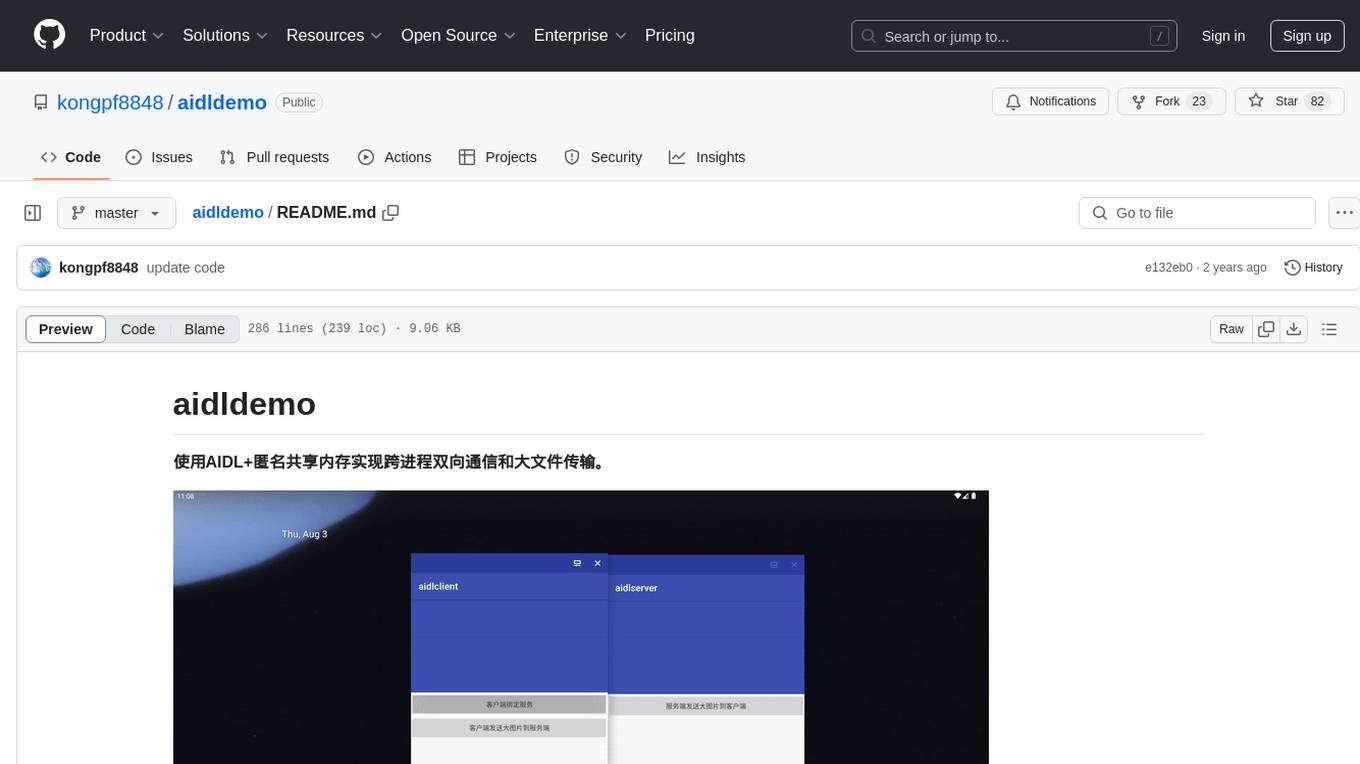
This repository demonstrates how to achieve cross-process bidirectional communication and large file transfer using AIDL and anonymous shared memory. AIDL is a way to implement Inter-Process Communication in Android, based on Binder. To overcome the data size limit of Binder, anonymous shared memory is used for large file transfer. Shared memory allows processes to share memory by mapping a common memory area into their respective process spaces. While efficient for transferring large data between processes, shared memory lacks synchronization mechanisms, requiring additional mechanisms like semaphores. Android's anonymous shared memory (Ashmem) is based on Linux shared memory and facilitates shared memory transfer using Binder and FileDescriptor. The repository provides practical examples of bidirectional communication and large file transfer between client and server using AIDL interfaces and MemoryFile in Android.
cube
Cube is a semantic layer for building data applications, helping data engineers and application developers access data from modern data stores, organize it into consistent definitions, and deliver it to every application. It works with SQL-enabled data sources, providing sub-second latency and high concurrency for API requests. Cube addresses SQL code organization, performance, and access control issues in data applications, enabling efficient data modeling, access control, and performance optimizations for various tools like embedded analytics, dashboarding, reporting, and data notebooks.