


aihwkit
IBM Analog Hardware Acceleration Kit
Stars: 335
The IBM Analog Hardware Acceleration Kit is an open-source Python toolkit for exploring and using the capabilities of in-memory computing devices in the context of artificial intelligence. It consists of two main components: Pytorch integration and Analog devices simulator. The Pytorch integration provides a series of primitives and features that allow using the toolkit within PyTorch, including analog neural network modules, analog training using torch training workflow, and analog inference using torch inference workflow. The Analog devices simulator is a high-performant (CUDA-capable) C++ simulator that allows for simulating a wide range of analog devices and crossbar configurations by using abstract functional models of material characteristics with adjustable parameters. Along with the two main components, the toolkit includes other functionalities such as a library of device presets, a module for executing high-level use cases, a utility to automatically convert a downloaded model to its equivalent Analog model, and integration with the AIHW Composer platform. The toolkit is currently in beta and under active development, and users are advised to be mindful of potential issues and keep an eye for improvements, new features, and bug fixes in upcoming versions.
README:



IBM Analog Hardware Acceleration Kit is an open source Python toolkit for exploring and using the capabilities of in-memory computing devices in the context of artificial intelligence.
⚠️ This library is currently in beta and under active development. Please be mindful of potential issues and keep an eye for improvements, new features and bug fixes in upcoming versions.
The toolkit consists of two main components:
A series of primitives and features that allow using the toolkit within
PyTorch:
- Analog neural network modules (fully connected layer, 1d/2d/3d convolution layers, LSTM layer, sequential container).
- Analog training using torch training workflow:
- Analog torch optimizers (SGD).
- Analog in-situ training using customizable device models and algorithms (Tiki-Taka).
- Analog inference using torch inference workflow:
- State-of-the-art statistical model of a phase-change memory (PCM) array calibrated on hardware measurements from a 1 million PCM devices chip.
- Hardware-aware training with hardware non-idealities and noise included in the forward pass to make the trained models more robust during inference on Analog hardware.
A high-performant (CUDA-capable) C++ simulator that allows for simulating a wide range of analog devices and crossbar configurations by using abstract functional models of material characteristics with adjustable parameters. Features include:
- Forward pass output-referred noise and device fluctuations, as well as adjustable ADC and DAC discretization and bounds
- Stochastic update pulse trains for rows and columns with finite weight update size per pulse coincidence
- Device-to-device systematic variations, cycle-to-cycle noise and adjustable asymmetry during analog update
- Adjustable device behavior for exploration of material specifications for training and inference
- State-of-the-art dynamic input scaling, bound management, and update management schemes
Along with the two main components, the toolkit includes other functionalities such as:
- A library of device presets that are calibrated to real hardware data and based on models in the literature, along with a configuration that specifies a particular device and optimizer choice.
- A module for executing high-level use cases ("experiments"), such as neural network training with minimal code overhead.
- A utility to automatically convert a downloaded model (e.g., pre-trained) to its equivalent Analog model by replacing all linear/conv layers to Analog layers (e.g., for convenient hardware-aware training).
- Integration with the AIHW Composer platform, a no-code web experience that allows executing experiments in the cloud.
In case you are using the IBM Analog Hardware Acceleration Kit for your research, please cite the AICAS21 paper that describes the toolkit:
Malte J. Rasch, Diego Moreda, Tayfun Gokmen, Manuel Le Gallo, Fabio Carta, Cindy Goldberg, Kaoutar El Maghraoui, Abu Sebastian, Vijay Narayanan. "A flexible and fast PyTorch toolkit for simulating training and inference on analog crossbar arrays" (2021 IEEE 3rd International Conference on Artificial Intelligence Circuits and Systems)
from torch import Tensor
from torch.nn.functional import mse_loss

# Import the aihwkit constructs.
from aihwkit.nn import AnalogLinear
from aihwkit.optim import AnalogSGD

x = Tensor([[0.1, 0.2, 0.4, 0.3], [0.2, 0.1, 0.1, 0.3]])
y = Tensor([[1.0, 0.5], [0.7, 0.3]])

# Define a network using a single Analog layer.
model = AnalogLinear(4, 2)

# Use the analog-aware stochastic gradient descent optimizer.
opt = AnalogSGD(model.parameters(), lr=0.1)
opt.regroup_param_groups(model)

# Train the network.
for epoch in range(10):
    pred = model(x)
    loss = mse_loss(pred, y)
    loss.backward()

    opt.step()
    print('Loss error: {:.16f}'.format(loss))
You can find more examples in the examples/ folder of the project, and
more information about the library in the documentation. Please note that
the examples have some additional dependencies - you can install them via
pip install -r requirements-examples.txt.
You can find interactive notebooks and tutorials in the notebooks/ directory.
We also recommend to take a look at the tutorial article that describes the usage of the toolkit that can be found here:
Manuel Le Gallo, Corey Lammie, Julian Buechel, Fabio Carta, Omobayode Fagbohungbe, Charles Mackin, Hsinyu Tsai, Vijay Narayanan, Abu Sebastian, Kaoutar El Maghraoui, Malte J. Rasch. "Using the IBM Analog In-Memory Hardware Acceleration Kit for Neural Network Training and Inference" (APL Machine Learning Journal:1(4) 2023)
In traditional hardware architecture, computation and memory are siloed in different locations. Information is moved back and forth between computation and memory units every time an operation is performed, creating a limitation called the von Neumann bottleneck.
Analog AI delivers radical performance improvements by combining compute and memory in a single device, eliminating the von Neumann bottleneck. By leveraging the physical properties of memory devices, computation happens at the same place where the data is stored. Such in-memory computing hardware increases the speed and energy efficiency needed for next-generation AI workloads.
An in-memory computing chip typically consists of multiple arrays of memory devices that communicate with each other. Many types of memory devices such as phase-change memory (PCM), resistive random-access memory (RRAM), and Flash memory can be used for in-memory computing.
Memory devices have the ability to store synaptic weights in their analog charge (Flash) or conductance (PCM, RRAM) state. When these devices are arranged in a crossbar configuration, it allows to perform an analog matrix-vector multiplication in a single time step, exploiting the advantages of analog storage capability and Kirchhoff’s circuits laws. You can learn more about it in our online demo.
In deep learning, data propagation through multiple layers of a neural network involves a sequence of matrix multiplications, as each layer can be represented as a matrix of synaptic weights. The devices are arranged in multiple crossbar arrays, creating an artificial neural network where all matrix multiplications are performed in-place in an analog manner. This structure allows to run deep learning models at reduced energy consumption.
- IBM Research blog: [Open-sourcing analog AI simulation]: https://research.ibm.com/blog/analog-ai-for-efficient-computing
- We are proud to share that the AIHWKIT and the companion cloud composer received the IEEE OPEN SOURCE SCIENCE award in 2023.
The preferred way to install this package is by using the Python package index:
pip install aihwkitThere is a conda package for aihwkit available in conda-forge. It can be installed in a conda environment running on a Linux or WSL in a Windows system.
-
CPU
conda install -c conda-forge aihwkit
-
GPU
conda install -c conda-forge aihwkit-gpu
If you encounter any issues during download or want to compile the package
for your environment, please take a look at the advanced installation guide.
That section describes the additional libraries and tools required for
compiling the sources using a build system based on cmake.
For GPU support, you can also build a docker container following the CUDA Dockerfile instructions. You can then run a GPU enabled docker container using the follwing command from your peoject dircetory
docker run --rm -it --gpus all -v $(pwd):$HOME --name aihwkit aihwkit:cuda bashIBM Research has developed IBM Analog Hardware Acceleration Kit, with Malte Rasch, Diego Moreda, Fabio Carta, Julian Büchel, Corey Lammie, Charles Mackin, Kim Tran, Tayfun Gokmen, Manuel Le Gallo-Bourdeau, and Kaoutar El Maghraoui as the initial core authors, along with many contributors.
You can contact us by opening a new issue in the repository or alternatively
at the [email protected] email address.
This project is licensed under Apache License 2.0.
For Tasks:
Click tags to check more tools for each tasksFor Jobs:
Alternative AI tools for aihwkit
Similar Open Source Tools
aihwkit
The IBM Analog Hardware Acceleration Kit is an open-source Python toolkit for exploring and using the capabilities of in-memory computing devices in the context of artificial intelligence. It consists of two main components: Pytorch integration and Analog devices simulator. The Pytorch integration provides a series of primitives and features that allow using the toolkit within PyTorch, including analog neural network modules, analog training using torch training workflow, and analog inference using torch inference workflow. The Analog devices simulator is a high-performant (CUDA-capable) C++ simulator that allows for simulating a wide range of analog devices and crossbar configurations by using abstract functional models of material characteristics with adjustable parameters. Along with the two main components, the toolkit includes other functionalities such as a library of device presets, a module for executing high-level use cases, a utility to automatically convert a downloaded model to its equivalent Analog model, and integration with the AIHW Composer platform. The toolkit is currently in beta and under active development, and users are advised to be mindful of potential issues and keep an eye for improvements, new features, and bug fixes in upcoming versions.
Nanoflow
NanoFlow is a throughput-oriented high-performance serving framework for Large Language Models (LLMs) that consistently delivers superior throughput compared to other frameworks by utilizing key techniques such as intra-device parallelism, asynchronous CPU scheduling, and SSD offloading. The framework proposes nano-batching to schedule compute-, memory-, and network-bound operations for simultaneous execution, leading to increased resource utilization. NanoFlow also adopts an asynchronous control flow to optimize CPU overhead and eagerly offloads KV-Cache to SSDs for multi-round conversations. The open-source codebase integrates state-of-the-art kernel libraries and provides necessary scripts for environment setup and experiment reproduction.
NeMo
NeMo Framework is a generative AI framework built for researchers and pytorch developers working on large language models (LLMs), multimodal models (MM), automatic speech recognition (ASR), and text-to-speech synthesis (TTS). The primary objective of NeMo is to provide a scalable framework for researchers and developers from industry and academia to more easily implement and design new generative AI models by being able to leverage existing code and pretrained models.
awesome-openvino
Awesome OpenVINO is a curated list of AI projects based on the OpenVINO toolkit, offering a rich assortment of projects, libraries, and tutorials covering various topics like model optimization, deployment, and real-world applications across industries. It serves as a valuable resource continuously updated to maximize the potential of OpenVINO in projects, featuring projects like Stable Diffusion web UI, Visioncom, FastSD CPU, OpenVINO AI Plugins for GIMP, and more.
NeMo
NVIDIA NeMo Framework is a scalable and cloud-native generative AI framework built for researchers and PyTorch developers working on Large Language Models (LLMs), Multimodal Models (MMs), Automatic Speech Recognition (ASR), Text to Speech (TTS), and Computer Vision (CV) domains. It is designed to help you efficiently create, customize, and deploy new generative AI models by leveraging existing code and pre-trained model checkpoints.
kdbai-samples
KDB.AI is a time-based vector database that allows developers to build scalable, reliable, and real-time applications by providing advanced search, recommendation, and personalization for Generative AI applications. It supports multiple index types, distance metrics, top-N and metadata filtered retrieval, as well as Python and REST interfaces. The repository contains samples demonstrating various use-cases such as temporal similarity search, document search, image search, recommendation systems, sentiment analysis, and more. KDB.AI integrates with platforms like ChatGPT, Langchain, and LlamaIndex. The setup steps require Unix terminal, Python 3.8+, and pip installed. Users can install necessary Python packages and run Jupyter notebooks to interact with the samples.
easydist
EasyDist is an automated parallelization system and infrastructure designed for multiple ecosystems. It offers usability by making parallelizing training or inference code effortless with just a single line of change. It ensures ecological compatibility by serving as a centralized source of truth for SPMD rules at the operator-level for various machine learning frameworks. EasyDist decouples auto-parallel algorithms from specific frameworks and IRs, allowing for the development and benchmarking of different auto-parallel algorithms in a flexible manner. The architecture includes MetaOp, MetaIR, and the ShardCombine Algorithm for SPMD sharding rules without manual annotations.

MemoryBear
MemoryBear is a next-generation AI memory system developed by RedBear AI, focusing on overcoming limitations in knowledge storage and multi-agent collaboration. It empowers AI with human-like memory capabilities, enabling deep knowledge understanding and cognitive collaboration. The system addresses challenges such as knowledge forgetting, memory gaps in multi-agent collaboration, and semantic ambiguity during reasoning. MemoryBear's core features include memory extraction engine, graph storage, hybrid search, memory forgetting engine, self-reflection engine, and FastAPI services. It offers a standardized service architecture for efficient integration and invocation across applications.
LLM-Viewer
LLM-Viewer is a tool for visualizing Language and Learning Models (LLMs) and analyzing performance on different hardware platforms. It enables network-wise analysis, considering factors such as peak memory consumption and total inference time cost. With LLM-Viewer, users can gain valuable insights into LLM inference and performance optimization. The tool can be used in a web browser or as a command line interface (CLI) for easy configuration and visualization. The ongoing project aims to enhance features like showing tensor shapes, expanding hardware platform compatibility, and supporting more LLMs with manual model graph configuration.
AI4U
AI4U is a tool that provides a framework for modeling virtual reality and game environments. It offers an alternative approach to modeling Non-Player Characters (NPCs) in Godot Game Engine. AI4U defines an agent living in an environment and interacting with it through sensors and actuators. Sensors provide data to the agent's brain, while actuators send actions from the agent to the environment. The brain processes the sensor data and makes decisions (selects an action by time). AI4U can also be used in other situations, such as modeling environments for artificial intelligence experiments.
Electronic-Component-Sorter
The Electronic Component Classifier is a project that uses machine learning and artificial intelligence to automate the identification and classification of electrical and electronic components. It features component classification into seven classes, user-friendly design, and integration with Flask for a user-friendly interface. The project aims to reduce human error in component identification, make the process safer and more reliable, and potentially help visually impaired individuals in identifying electronic components.
LangSim
LangSim is a tool developed to address the challenge of using simulation tools in computational chemistry and materials science, which typically require cryptic input files or programming experience. The tool provides a Large Language Model (LLM) extension with agents to couple the LLM to scientific simulation codes and calculate physical properties from a natural language interface. It aims to simplify the process of interacting with simulation tools by enabling users to query the large language model directly from a Python environment or a web-based interface.
bmf
BMF (Babit Multimedia Framework) is a cross-platform, multi-language, customizable multimedia processing framework developed by ByteDance. It offers native compatibility with Linux, Windows, and macOS, Python, Go, and C++ APIs, and high performance with strong GPU acceleration. BMF allows developers to enhance its features independently and provides efficient data conversion across popular frameworks and hardware devices. BMFLite is a client-side lightweight framework used in apps like Douyin/Xigua, serving over one billion users daily. BMF is widely used in video streaming, live transcoding, cloud editing, and mobile pre/post processing scenarios.
blades
Blades is a multimodal AI Agent framework in Go, supporting custom models, tools, memory, middleware, and more. It is well-suited for multi-turn conversations, chain reasoning, and structured output. The framework provides core components like Agent, Prompt, Chain, ModelProvider, Tool, Memory, and Middleware, enabling developers to build intelligent applications with flexible configuration and high extensibility. Blades leverages the characteristics of Go to achieve high decoupling and efficiency, making it easy to integrate different language model services and external tools. The project is in its early stages, inviting Go developers and AI enthusiasts to contribute and explore the possibilities of building AI applications in Go.
unified-cache-management
Unified Cache Manager (UCM) is a tool designed to persist the LLM KVCache and replace redundant computations through various retrieval mechanisms. It supports prefix caching and offers training-free sparse attention retrieval methods, enhancing performance for long sequence inference tasks. UCM also provides a PD disaggregation solution based on a storage-compute separation architecture, enabling easier management of heterogeneous computing resources. When integrated with vLLM, UCM significantly reduces inference latency in scenarios like multi-turn dialogue and long-context reasoning tasks.
jax-ai-stack
JAX AI Stack is a suite of libraries built around the JAX Python package for array-oriented computation and program transformation. It provides a growing ecosystem of packages for specialized numerical computing across various domains, encouraging modularity and innovation in domain-specific libraries. The stack includes core packages like JAX, flax for building neural networks, ml_dtypes for NumPy dtype extensions, optax for gradient processing and optimization, and orbax for checkpointing and persistence utilities. Optional packages like grain data loader and tensorflow are also available for installation.
For similar tasks
aihwkit
The IBM Analog Hardware Acceleration Kit is an open-source Python toolkit for exploring and using the capabilities of in-memory computing devices in the context of artificial intelligence. It consists of two main components: Pytorch integration and Analog devices simulator. The Pytorch integration provides a series of primitives and features that allow using the toolkit within PyTorch, including analog neural network modules, analog training using torch training workflow, and analog inference using torch inference workflow. The Analog devices simulator is a high-performant (CUDA-capable) C++ simulator that allows for simulating a wide range of analog devices and crossbar configurations by using abstract functional models of material characteristics with adjustable parameters. Along with the two main components, the toolkit includes other functionalities such as a library of device presets, a module for executing high-level use cases, a utility to automatically convert a downloaded model to its equivalent Analog model, and integration with the AIHW Composer platform. The toolkit is currently in beta and under active development, and users are advised to be mindful of potential issues and keep an eye for improvements, new features, and bug fixes in upcoming versions.
For similar jobs
weave
Weave is a toolkit for developing Generative AI applications, built by Weights & Biases. With Weave, you can log and debug language model inputs, outputs, and traces; build rigorous, apples-to-apples evaluations for language model use cases; and organize all the information generated across the LLM workflow, from experimentation to evaluations to production. Weave aims to bring rigor, best-practices, and composability to the inherently experimental process of developing Generative AI software, without introducing cognitive overhead.
agentcloud
AgentCloud is an open-source platform that enables companies to build and deploy private LLM chat apps, empowering teams to securely interact with their data. It comprises three main components: Agent Backend, Webapp, and Vector Proxy. To run this project locally, clone the repository, install Docker, and start the services. The project is licensed under the GNU Affero General Public License, version 3 only. Contributions and feedback are welcome from the community.
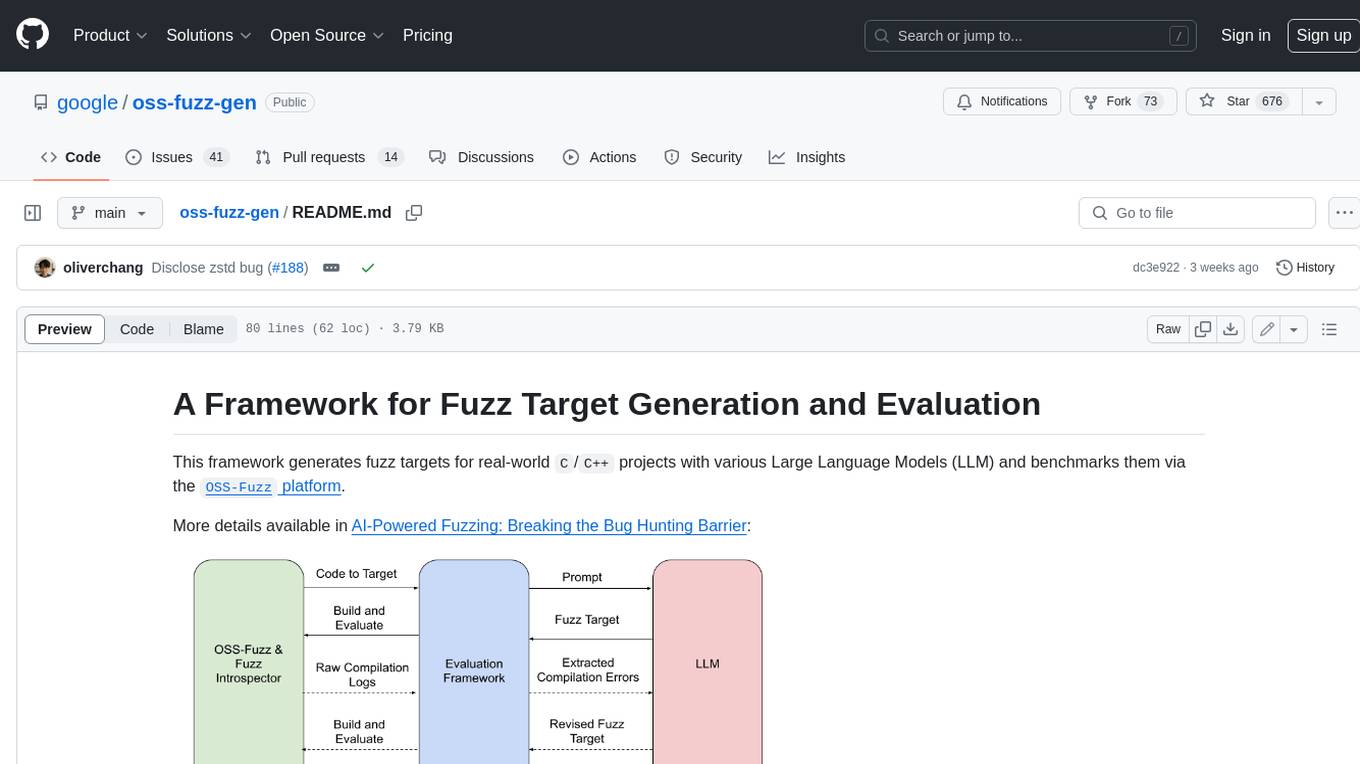
oss-fuzz-gen
This framework generates fuzz targets for real-world `C`/`C++` projects with various Large Language Models (LLM) and benchmarks them via the `OSS-Fuzz` platform. It manages to successfully leverage LLMs to generate valid fuzz targets (which generate non-zero coverage increase) for 160 C/C++ projects. The maximum line coverage increase is 29% from the existing human-written targets.

LLMStack
LLMStack is a no-code platform for building generative AI agents, workflows, and chatbots. It allows users to connect their own data, internal tools, and GPT-powered models without any coding experience. LLMStack can be deployed to the cloud or on-premise and can be accessed via HTTP API or triggered from Slack or Discord.
VisionCraft
The VisionCraft API is a free API for using over 100 different AI models. From images to sound.
kaito
Kaito is an operator that automates the AI/ML inference model deployment in a Kubernetes cluster. It manages large model files using container images, avoids tuning deployment parameters to fit GPU hardware by providing preset configurations, auto-provisions GPU nodes based on model requirements, and hosts large model images in the public Microsoft Container Registry (MCR) if the license allows. Using Kaito, the workflow of onboarding large AI inference models in Kubernetes is largely simplified.
PyRIT
PyRIT is an open access automation framework designed to empower security professionals and ML engineers to red team foundation models and their applications. It automates AI Red Teaming tasks to allow operators to focus on more complicated and time-consuming tasks and can also identify security harms such as misuse (e.g., malware generation, jailbreaking), and privacy harms (e.g., identity theft). The goal is to allow researchers to have a baseline of how well their model and entire inference pipeline is doing against different harm categories and to be able to compare that baseline to future iterations of their model. This allows them to have empirical data on how well their model is doing today, and detect any degradation of performance based on future improvements.

Azure-Analytics-and-AI-Engagement
The Azure-Analytics-and-AI-Engagement repository provides packaged Industry Scenario DREAM Demos with ARM templates (Containing a demo web application, Power BI reports, Synapse resources, AML Notebooks etc.) that can be deployed in a customer’s subscription using the CAPE tool within a matter of few hours. Partners can also deploy DREAM Demos in their own subscriptions using DPoC.