


m3p2i-aip
Code for the IEEE Robotics and Automation Letters paper titled "Multi-Modal MPPI and Active Inference for Reactive Task and Motion Planning"
Stars: 58
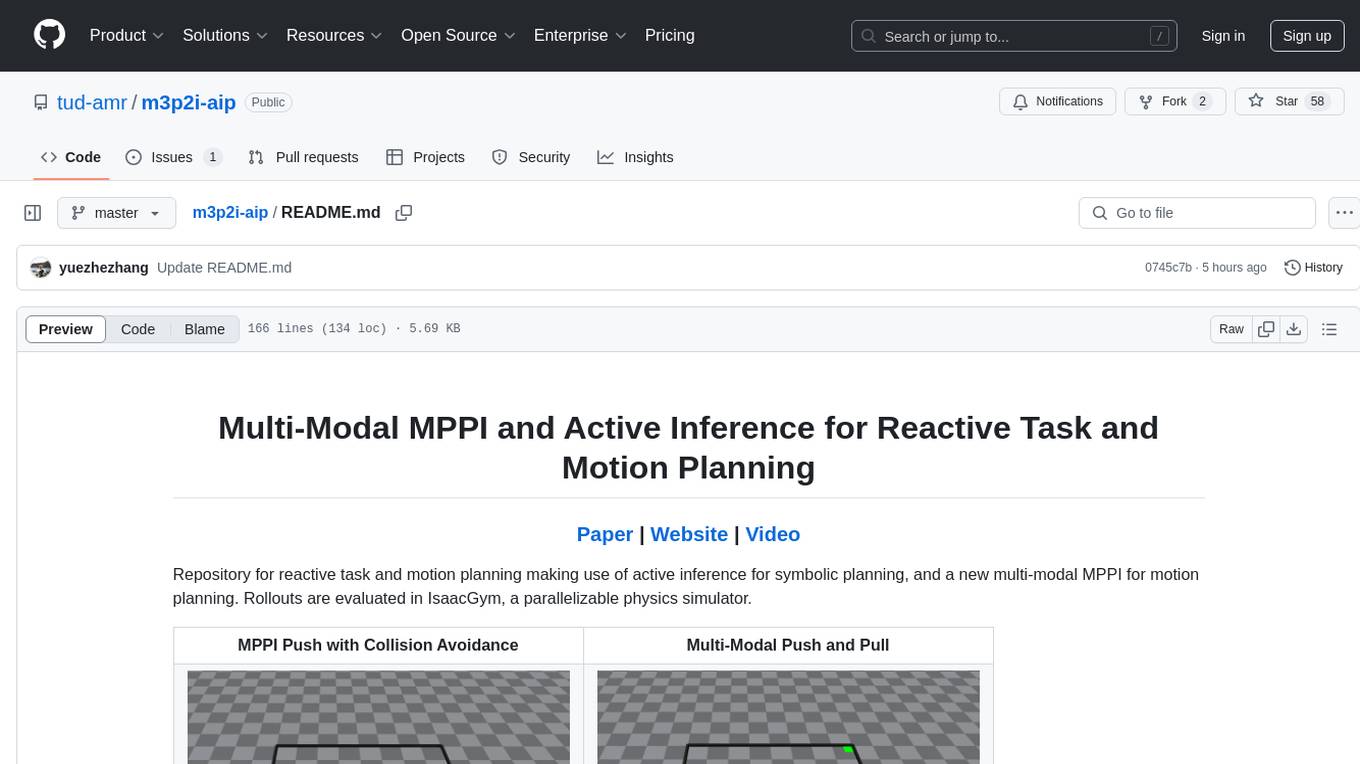
Repository for reactive task and motion planning using active inference for symbolic planning and multi-modal MPPI for motion planning. Rollouts are evaluated in IsaacGym, a parallelizable physics simulator. The tool provides functionalities for push, pull, pick, and multi-modal push-pull tasks with collision avoidance.
README:
Repository for reactive task and motion planning making use of active inference for symbolic planning, and a new multi-modal MPPI for motion planning. Rollouts are evaluated in IsaacGym, a parallelizable physics simulator.
| MPPI Push with Collision Avoidance | Multi-Modal Push and Pull |
|---|---|
 |
 |
| MPPI Reactive Pick | Multi-Modal Pick with Collision Avoidance |
 |
 |
First, clone the repo in your folder and create the conda environment.
cd <project_folder>
git clone https://github.com/tud-amr/m3p2i-aip.git

conda create -n m3p2i-aip python=3.8
conda activate m3p2i-aip
This project requires the source code of IsaacGym. Check for the prerequisites and troubleshooting. Download it from https://developer.nvidia.com/isaac-gym, unzip and paste it in the thirdparty folder. Move to IsaacGym and install the package.
cd <project_folder>/m3p2i-aip/thirdparty/IsaacGym_Preview_4_Package/isaacgym/python
pip install -e.
Then install the current package by:
cd <project_folder>/m3p2i-aip
pip install -e.
Now you are ready to test an example file, where you can drive the robot around with ASDW keys.
cd <project_folder>/m3p2i-aip/examples
python3 example_key.pyIf you want to test the TAMP framework, you will need two instances of Isaac Gym, one for throwing the rollouts and deriving the optimal solution, and one for updating the "real system". Please run the commands below in two terminals from the scripts folder with activated python environment.
Run this terminal first:
cd <project_folder>/m3p2i-aip/scripts
conda activate m3p2i-aip
python3 reactive_tamp.py
Then run the second terminal:
cd <project_folder>/m3p2i-aip/scripts
conda activate m3p2i-aip
python3 sim.py
Specifically, you can test the following:
python3 reactive_tamp.py task=navigation goal="[-3, 3]"python3 sim.py[!NOTE] Feel free to change the goal position.
python3 reactive_tamp.py task=push goal="[-1, -1]"python3 sim.py[!NOTE] Feel free to change the goal position. Pushing will always fail if the initial position is in the corner.
python3 reactive_tamp.py task=pull goal="[0, 0]"python3 sim.py task=pull[!NOTE] Feel free to change the goal position. Pulling will always fail if the goal is in the corner.
python3 reactive_tamp.py task=push_pull multi_modal=True goal="[-3.75, -3.75]"python3 sim.py task=push_pull[!NOTE] Feel free to change the goal position. The corner positions are [-3.75, -3.75], [3.75, 3.75], [3.75, -3.75], [-3.75, 3.75].
Pick the cube from the table:
python3 reactive_tamp.py -cn config_pandapython3 sim.py -cn config_panda[!NOTE] You can play with the cubes using ASDW keys and keyup, keydown, keyleft and keyright.
Pick the cube from the shelf:
python3 reactive_tamp.py -cn config_panda multi_modal=True cube_on_shelf=Truepython3 sim.py -cn config_panda multi_modal=True cube_on_shelf=True[!NOTE] You can play with the cubes using ASDW keys and keyup, keydown, keyleft and keyright.
If you find the code useful, please cite:
@article{zhang2024multi,
  title={Multi-Modal MPPI and Active Inference for Reactive Task and Motion Planning},
  author={Zhang, Yuezhe and Pezzato, Corrado and Trevisan, Elia and Salmi, Chadi and Corbato, Carlos Hern{\'a}ndez and Alonso-Mora, Javier},
  journal={IEEE Robotics and Automation Letters},
  year={2024},
  publisher={IEEE}
}- Isaac-mppi: an MPPI implementation that uses IsaacGym as a dynamic model (paper, website, code).
- Biased-mppi: an MPPI implementation whose sampling distribution is informed with ancillary controllers (paper, website, code).
- AIP: an Active Inference planner for decision making (paper, video, code).
We thank the pioneers (Grady Williams, pytorch_mppi, storm) who have paved the way and the future newcomers who will propel MPPI forward!
For Tasks:
Click tags to check more tools for each tasksFor Jobs:
Alternative AI tools for m3p2i-aip
Similar Open Source Tools
m3p2i-aip
Repository for reactive task and motion planning using active inference for symbolic planning and multi-modal MPPI for motion planning. Rollouts are evaluated in IsaacGym, a parallelizable physics simulator. The tool provides functionalities for push, pull, pick, and multi-modal push-pull tasks with collision avoidance.
Vitron
Vitron is a unified pixel-level vision LLM designed for comprehensive understanding, generating, segmenting, and editing static images and dynamic videos. It addresses challenges in existing vision LLMs such as superficial instance-level understanding, lack of unified support for images and videos, and insufficient coverage across various vision tasks. The tool requires Python >= 3.8, Pytorch == 2.1.0, and CUDA Version >= 11.8 for installation. Users can deploy Gradio demo locally and fine-tune their models for specific tasks.
BentoML
BentoML is an open-source model serving library for building performant and scalable AI applications with Python. It comes with everything you need for serving optimization, model packaging, and production deployment.
graphiti
Graphiti is a framework for building and querying temporally-aware knowledge graphs, tailored for AI agents in dynamic environments. It continuously integrates user interactions, structured and unstructured data, and external information into a coherent, queryable graph. The framework supports incremental data updates, efficient retrieval, and precise historical queries without complete graph recomputation, making it suitable for developing interactive, context-aware AI applications.
AutoAgent
AutoAgent is a fully-automated and zero-code framework that enables users to create and deploy LLM agents through natural language alone. It is a top performer on the GAIA Benchmark, equipped with a native self-managing vector database, and allows for easy creation of tools, agents, and workflows without any coding. AutoAgent seamlessly integrates with a wide range of LLMs and supports both function-calling and ReAct interaction modes. It is designed to be dynamic, extensible, customized, and lightweight, serving as a personal AI assistant.
exospherehost
Exosphere is an open source infrastructure designed to run AI agents at scale for large data and long running flows. It allows developers to define plug and playable nodes that can be run on a reliable backbone in the form of a workflow, with features like dynamic state creation at runtime, infinite parallel agents, persistent state management, and failure handling. This enables the deployment of production agents that can scale beautifully to build robust autonomous AI workflows.
Pixel-Reasoner
Pixel Reasoner is a framework that introduces reasoning in the pixel-space for Vision-Language Models (VLMs), enabling them to directly inspect, interrogate, and infer from visual evidences. This enhances reasoning fidelity for visual tasks by equipping VLMs with visual reasoning operations like zoom-in and select-frame. The framework addresses challenges like model's imbalanced competence and reluctance to adopt pixel-space operations through a two-phase training approach involving instruction tuning and curiosity-driven reinforcement learning. With these visual operations, VLMs can interact with complex visual inputs such as images or videos to gather necessary information, leading to improved performance across visual reasoning benchmarks.
RainbowGPT
RainbowGPT is a versatile tool that offers a range of functionalities, including Stock Analysis for financial decision-making, MySQL Management for database navigation, and integration of AI technologies like GPT-4 and ChatGlm3. It provides a user-friendly interface suitable for all skill levels, ensuring seamless information flow and continuous expansion of emerging technologies. The tool enhances adaptability, creativity, and insight, making it a valuable asset for various projects and tasks.
gpt-translate
Markdown Translation BOT is a GitHub action that translates markdown files into multiple languages using various AI models. It supports markdown, markdown-jsx, and json files only. The action can be executed by individuals with write permissions to the repository, preventing API abuse by non-trusted parties. Users can set up the action by providing their API key and configuring the workflow settings. The tool allows users to create comments with specific commands to trigger translations and automatically generate pull requests or add translated files to existing pull requests. It supports multiple file translations and can interpret any language supported by GPT-4 or GPT-3.5.
openai-kotlin
OpenAI Kotlin API client is a Kotlin client for OpenAI's API with multiplatform and coroutines capabilities. It allows users to interact with OpenAI's API using Kotlin programming language. The client supports various features such as models, chat, images, embeddings, files, fine-tuning, moderations, audio, assistants, threads, messages, and runs. It also provides guides on getting started, chat & function call, file source guide, and assistants. Sample apps are available for reference, and troubleshooting guides are provided for common issues. The project is open-source and licensed under the MIT license, allowing contributions from the community.
SciPIP
SciPIP is a scientific paper idea generation tool powered by a large language model (LLM) designed to assist researchers in quickly generating novel research ideas. It conducts a literature review based on user-provided background information and generates fresh ideas for potential studies. The tool is designed to help researchers in various fields by providing a GUI environment for idea generation, supporting NLP, multimodal, and CV fields, and allowing users to interact with the tool through a web app or terminal. SciPIP uses Neo4j as its database and provides functionalities for generating new ideas, fetching papers, and constructing the database.
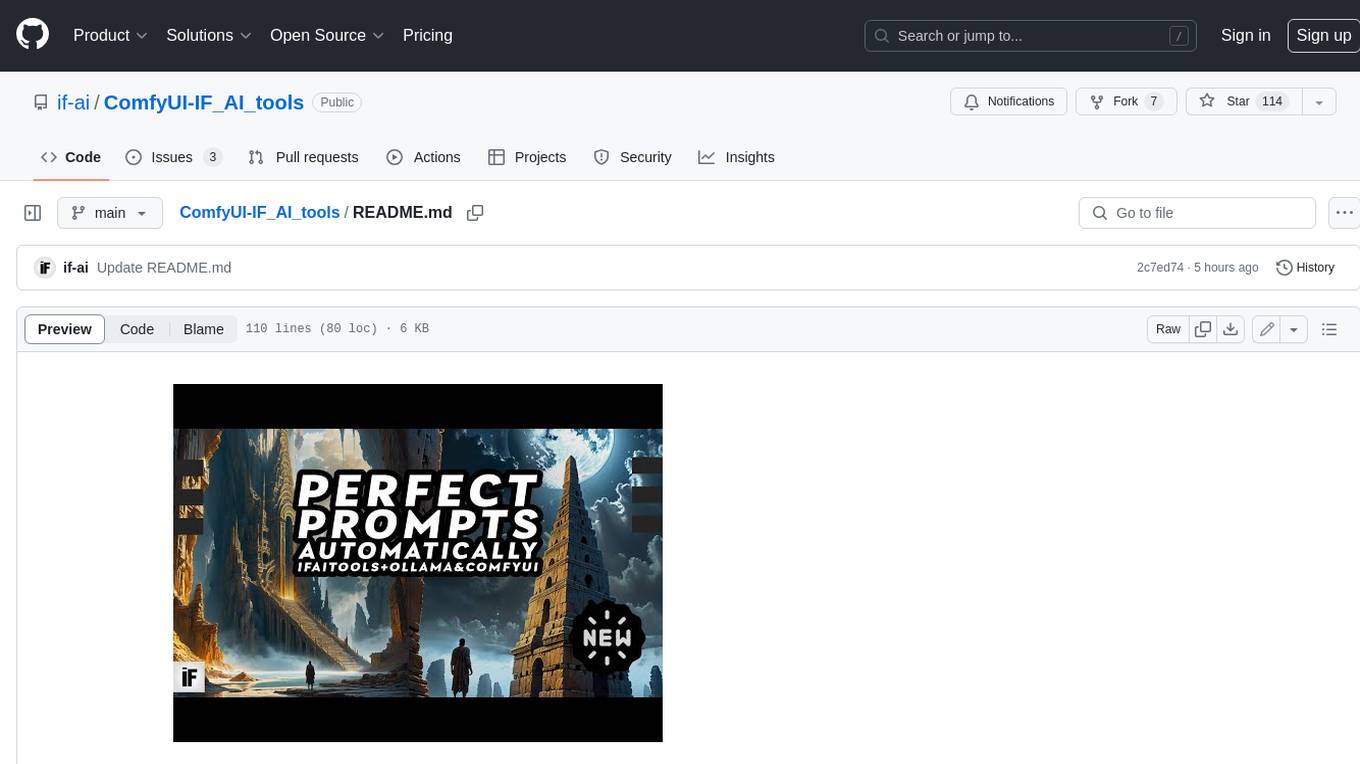
ComfyUI-IF_AI_tools
ComfyUI-IF_AI_tools is a set of custom nodes for ComfyUI that allows you to generate prompts using a local Large Language Model (LLM) via Ollama. This tool enables you to enhance your image generation workflow by leveraging the power of language models.
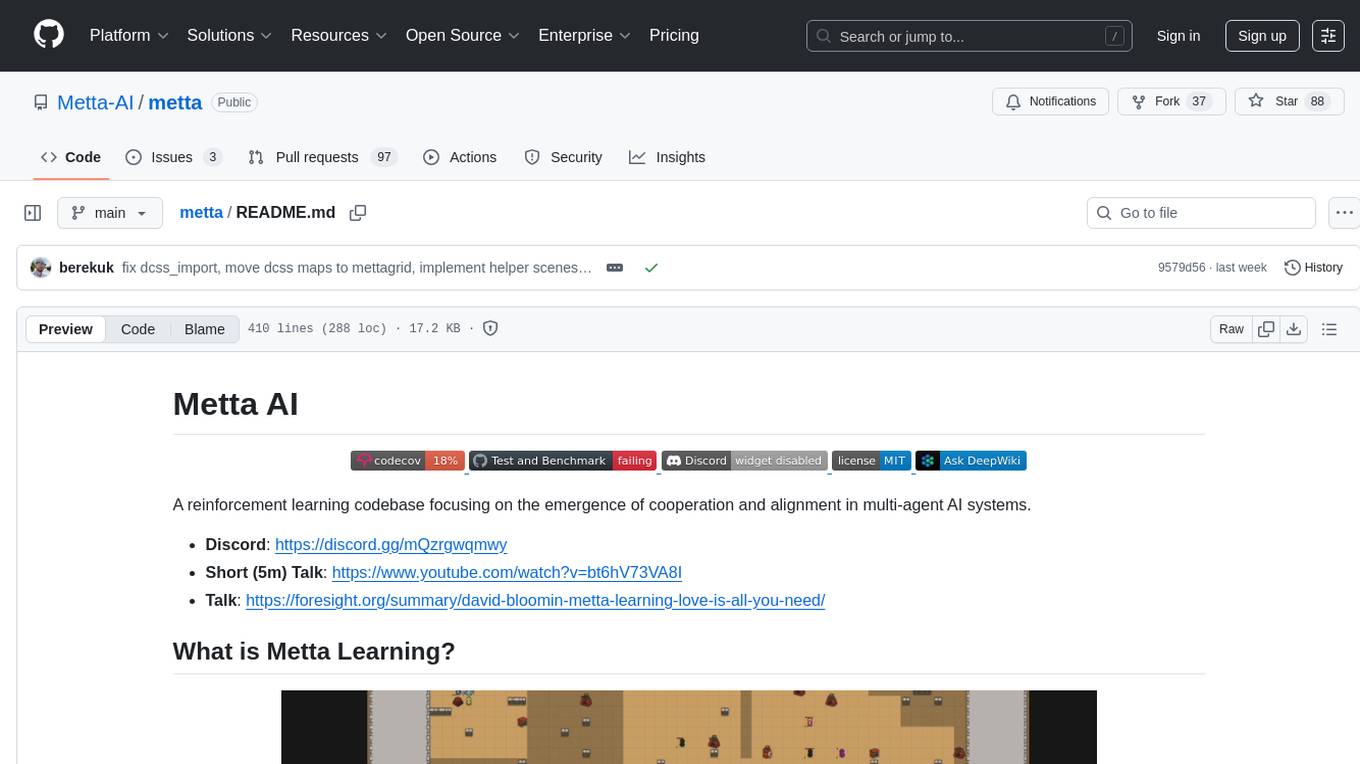
metta
Metta AI is an open-source research project focusing on the emergence of cooperation and alignment in multi-agent AI systems. It explores the impact of social dynamics like kinship and mate selection on learning and cooperative behaviors of AI agents. The project introduces a reward-sharing mechanism mimicking familial bonds and mate selection to observe the evolution of complex social behaviors among AI agents. Metta aims to contribute to the discussion on safe and beneficial AGI by creating an environment where AI agents can develop general intelligence through continuous learning and adaptation.
MemoryLLM
MemoryLLM is a large language model designed for self-updating capabilities. It offers pretrained models with different memory capacities and features, such as chat models. The repository provides training code, evaluation scripts, and datasets for custom experiments. MemoryLLM aims to enhance knowledge retention and performance on various natural language processing tasks.
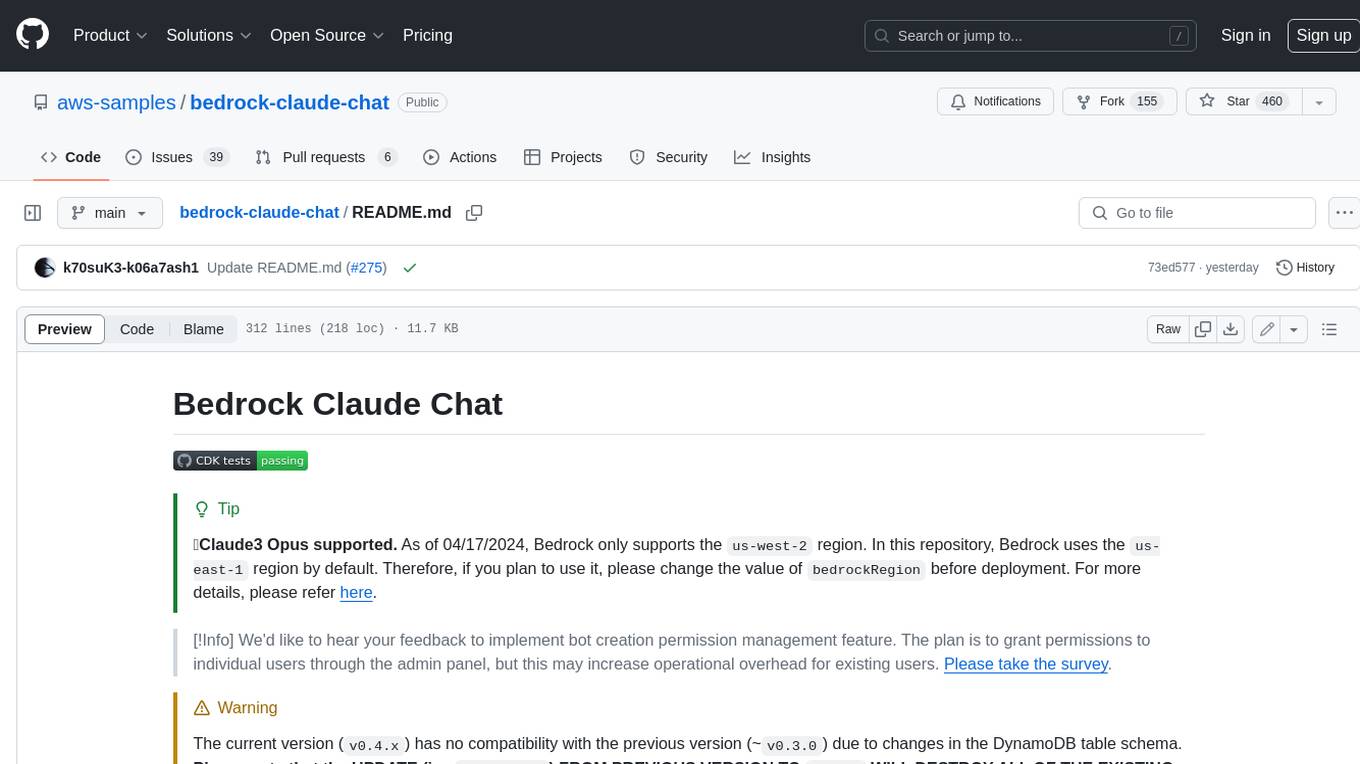
bedrock-claude-chat
This repository is a sample chatbot using the Anthropic company's LLM Claude, one of the foundational models provided by Amazon Bedrock for generative AI. It allows users to have basic conversations with the chatbot, personalize it with their own instructions and external knowledge, and analyze usage for each user/bot on the administrator dashboard. The chatbot supports various languages, including English, Japanese, Korean, Chinese, French, German, and Spanish. Deployment is straightforward and can be done via the command line or by using AWS CDK. The architecture is built on AWS managed services, eliminating the need for infrastructure management and ensuring scalability, reliability, and security.
KVCache-Factory
KVCache-Factory is a unified framework for KV Cache compression of diverse models. It supports multi-GPUs inference with big LLMs and various attention implementations. The tool enables KV cache compression without Flash Attention v2, multi-GPU inference, and specific models like Mistral. It also provides functions for KV cache budget allocation and batch inference. The visualization tools help in understanding the attention patterns of models.
For similar tasks
m3p2i-aip
Repository for reactive task and motion planning using active inference for symbolic planning and multi-modal MPPI for motion planning. Rollouts are evaluated in IsaacGym, a parallelizable physics simulator. The tool provides functionalities for push, pull, pick, and multi-modal push-pull tasks with collision avoidance.
For similar jobs
weave
Weave is a toolkit for developing Generative AI applications, built by Weights & Biases. With Weave, you can log and debug language model inputs, outputs, and traces; build rigorous, apples-to-apples evaluations for language model use cases; and organize all the information generated across the LLM workflow, from experimentation to evaluations to production. Weave aims to bring rigor, best-practices, and composability to the inherently experimental process of developing Generative AI software, without introducing cognitive overhead.
LLMStack
LLMStack is a no-code platform for building generative AI agents, workflows, and chatbots. It allows users to connect their own data, internal tools, and GPT-powered models without any coding experience. LLMStack can be deployed to the cloud or on-premise and can be accessed via HTTP API or triggered from Slack or Discord.
VisionCraft
The VisionCraft API is a free API for using over 100 different AI models. From images to sound.
kaito
Kaito is an operator that automates the AI/ML inference model deployment in a Kubernetes cluster. It manages large model files using container images, avoids tuning deployment parameters to fit GPU hardware by providing preset configurations, auto-provisions GPU nodes based on model requirements, and hosts large model images in the public Microsoft Container Registry (MCR) if the license allows. Using Kaito, the workflow of onboarding large AI inference models in Kubernetes is largely simplified.
PyRIT
PyRIT is an open access automation framework designed to empower security professionals and ML engineers to red team foundation models and their applications. It automates AI Red Teaming tasks to allow operators to focus on more complicated and time-consuming tasks and can also identify security harms such as misuse (e.g., malware generation, jailbreaking), and privacy harms (e.g., identity theft). The goal is to allow researchers to have a baseline of how well their model and entire inference pipeline is doing against different harm categories and to be able to compare that baseline to future iterations of their model. This allows them to have empirical data on how well their model is doing today, and detect any degradation of performance based on future improvements.
tabby
Tabby is a self-hosted AI coding assistant, offering an open-source and on-premises alternative to GitHub Copilot. It boasts several key features: * Self-contained, with no need for a DBMS or cloud service. * OpenAPI interface, easy to integrate with existing infrastructure (e.g Cloud IDE). * Supports consumer-grade GPUs.
spear
SPEAR (Simulator for Photorealistic Embodied AI Research) is a powerful tool for training embodied agents. It features 300 unique virtual indoor environments with 2,566 unique rooms and 17,234 unique objects that can be manipulated individually. Each environment is designed by a professional artist and features detailed geometry, photorealistic materials, and a unique floor plan and object layout. SPEAR is implemented as Unreal Engine assets and provides an OpenAI Gym interface for interacting with the environments via Python.
Magick
Magick is a groundbreaking visual AIDE (Artificial Intelligence Development Environment) for no-code data pipelines and multimodal agents. Magick can connect to other services and comes with nodes and templates well-suited for intelligent agents, chatbots, complex reasoning systems and realistic characters.