


prometheus-mcp-server
A Model Context Protocol (MCP) server that enables AI agents and LLMs to query and analyze Prometheus metrics through standardized interfaces.
Stars: 222
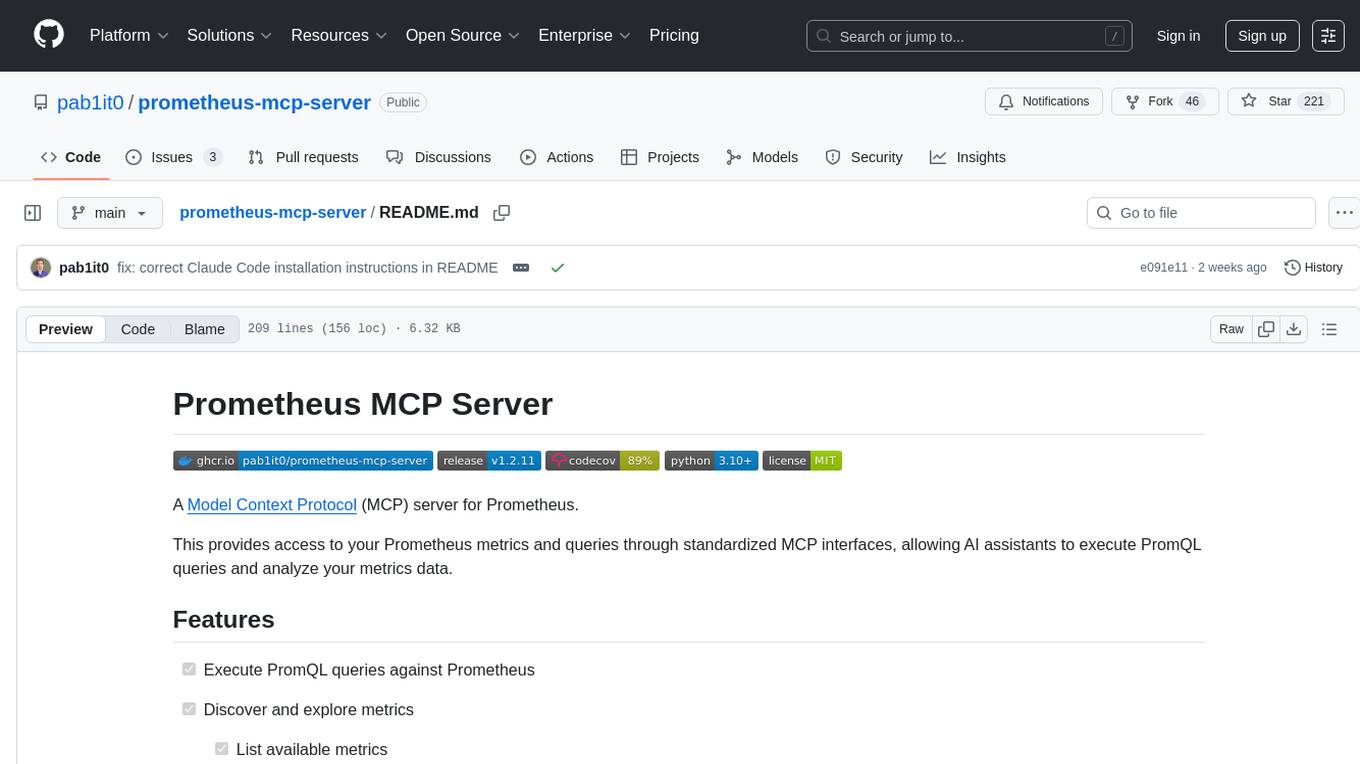
Prometheus MCP Server is a Model Context Protocol (MCP) server that provides access to Prometheus metrics and queries through standardized interfaces. It allows AI assistants to execute PromQL queries and analyze metrics data. The server supports executing queries, exploring metrics, listing available metrics, viewing query results, and authentication. It offers interactive tools for AI assistants and can be configured to choose specific tools. Installation methods include using Docker Desktop, MCP-compatible clients like Claude Desktop, VS Code, Cursor, and Windsurf, and manual Docker setup. Configuration options include setting Prometheus server URL, authentication credentials, organization ID, transport mode, and bind host/port. Contributions are welcome, and the project uses `uv` for managing dependencies and includes a comprehensive test suite for functionality testing.
README:



A Model Context Protocol (MCP) server for Prometheus.
This provides access to your Prometheus metrics and queries through standardized MCP interfaces, allowing AI assistants to execute PromQL queries and analyze your metrics data.
-
[x] Execute PromQL queries against Prometheus
-
[x] Discover and explore metrics
- [x] List available metrics
- [x] Get metadata for specific metrics
- [x] View instant query results
- [x] View range query results with different step intervals
-
[x] Authentication support
- [x] Basic auth from environment variables
- [x] Bearer token auth from environment variables
-
[x] Docker containerization support
-
[x] Provide interactive tools for AI assistants
The list of tools is configurable, so you can choose which tools you want to make available to the MCP client. This is useful if you don't use certain functionality or if you don't want to take up too much of the context window.
- Prometheus server accessible from your environment
- Docker Desktop (recommended) or Docker CLI
- MCP-compatible client (Claude Desktop, VS Code, Cursor, Windsurf, etc.)
Claude Desktop
Add to your Claude Desktop configuration:
{
  "mcpServers": {
    "prometheus": {
      "command": "docker",
      "args": [
        "run",
        "-i",
        "--rm",
        "-e",
        "PROMETHEUS_URL",
        "ghcr.io/pab1it0/prometheus-mcp-server:latest"
      ],
      "env": {
        "PROMETHEUS_URL": "<your-prometheus-url>"
      }
    }
  }
}
Claude Code
Install via the Claude Code CLI:
claude mcp add prometheus --env PROMETHEUS_URL=http://your-prometheus:9090 -- docker run -i --rm -e PROMETHEUS_URL ghcr.io/pab1it0/prometheus-mcp-server:latestVS Code / Cursor / Windsurf
Add to your MCP settings in the respective IDE:
{
  "prometheus": {
    "command": "docker",
    "args": [
      "run",
      "-i",
      "--rm",
      "-e",
      "PROMETHEUS_URL",
      "ghcr.io/pab1it0/prometheus-mcp-server:latest"
    ],
    "env": {
      "PROMETHEUS_URL": "<your-prometheus-url>"
    }
  }
}
Docker Desktop
The easiest way to run the Prometheus MCP server is through Docker Desktop:

-
Via MCP Catalog: Visit the Prometheus MCP Server on Docker Hub and click the button above
-
Via MCP Toolkit: Use Docker Desktop's MCP Toolkit extension to discover and install the server
-
Configure your connection using environment variables (see Configuration Options below)
Manual Docker Setup
Run directly with Docker:
# With environment variables
docker run -i --rm \
  -e PROMETHEUS_URL="http://your-prometheus:9090" \
  ghcr.io/pab1it0/prometheus-mcp-server:latest

# With authentication
docker run -i --rm \
  -e PROMETHEUS_URL="http://your-prometheus:9090" \
  -e PROMETHEUS_USERNAME="admin" \
  -e PROMETHEUS_PASSWORD="password" \
ghcr.io/pab1it0/prometheus-mcp-server:latest| Variable | Description | Required |
|---|---|---|
PROMETHEUS_URL |
URL of your Prometheus server | Yes |
PROMETHEUS_USERNAME |
Username for basic authentication | No |
PROMETHEUS_PASSWORD |
Password for basic authentication | No |
PROMETHEUS_TOKEN |
Bearer token for authentication | No |
ORG_ID |
Organization ID for multi-tenant setups | No |
PROMETHEUS_MCP_SERVER_TRANSPORT |
Transport mode (stdio, http, sse) | No (default: stdio) |
PROMETHEUS_MCP_BIND_HOST |
Host for HTTP transport | No (default: 127.0.0.1) |
PROMETHEUS_MCP_BIND_PORT |
Port for HTTP transport | No (default: 8080) |
Contributions are welcome! Please open an issue or submit a pull request if you have any suggestions or improvements.
This project uses uv to manage dependencies. Install uv following the instructions for your platform:
curl -LsSf https://astral.sh/uv/install.sh | shYou can then create a virtual environment and install the dependencies with:
uv venv
source .venv/bin/activate  # On Unix/macOS
.venv\Scripts\activate     # On Windows
uv pip install -e .The project includes a comprehensive test suite that ensures functionality and helps prevent regressions.
Run the tests with pytest:
# Install development dependencies
uv pip install -e ".[dev]"

# Run the tests
pytest

# Run with coverage report
pytest --cov=src --cov-report=term-missing
When adding new features, please also add corresponding tests.
| Tool | Category | Description |
|---|---|---|
execute_query |
Query | Execute a PromQL instant query against Prometheus |
execute_range_query |
Query | Execute a PromQL range query with start time, end time, and step interval |
list_metrics |
Discovery | List all available metrics in Prometheus |
get_metric_metadata |
Discovery | Get metadata for a specific metric |
get_targets |
Discovery | Get information about all scrape targets |
MIT
For Tasks:
Click tags to check more tools for each tasksFor Jobs:
Alternative AI tools for prometheus-mcp-server
Similar Open Source Tools
prometheus-mcp-server
Prometheus MCP Server is a Model Context Protocol (MCP) server that provides access to Prometheus metrics and queries through standardized interfaces. It allows AI assistants to execute PromQL queries and analyze metrics data. The server supports executing queries, exploring metrics, listing available metrics, viewing query results, and authentication. It offers interactive tools for AI assistants and can be configured to choose specific tools. Installation methods include using Docker Desktop, MCP-compatible clients like Claude Desktop, VS Code, Cursor, and Windsurf, and manual Docker setup. Configuration options include setting Prometheus server URL, authentication credentials, organization ID, transport mode, and bind host/port. Contributions are welcome, and the project uses `uv` for managing dependencies and includes a comprehensive test suite for functionality testing.
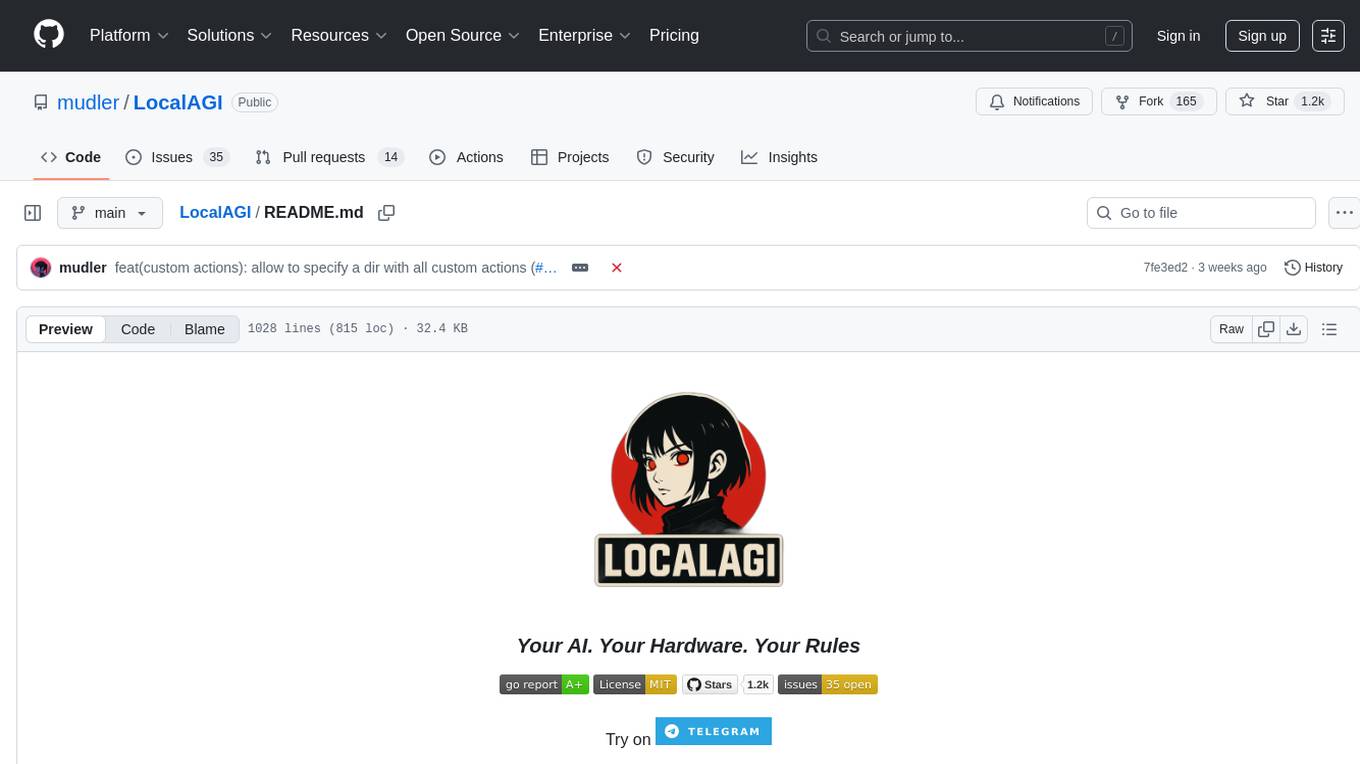
LocalAGI
LocalAGI is a powerful, self-hostable AI Agent platform that allows you to design AI automations without writing code. It provides a complete drop-in replacement for OpenAI's Responses APIs with advanced agentic capabilities. With LocalAGI, you can create customizable AI assistants, automations, chat bots, and agents that run 100% locally, without the need for cloud services or API keys. The platform offers features like no-code agents, web-based interface, advanced agent teaming, connectors for various platforms, comprehensive REST API, short & long-term memory capabilities, planning & reasoning, periodic tasks scheduling, memory management, multimodal support, extensible custom actions, fully customizable models, observability, and more.
BricksLLM
BricksLLM is a cloud native AI gateway written in Go. Currently, it provides native support for OpenAI, Anthropic, Azure OpenAI and vLLM. BricksLLM aims to provide enterprise level infrastructure that can power any LLM production use cases. Here are some use cases for BricksLLM: * Set LLM usage limits for users on different pricing tiers * Track LLM usage on a per user and per organization basis * Block or redact requests containing PIIs * Improve LLM reliability with failovers, retries and caching * Distribute API keys with rate limits and cost limits for internal development/production use cases * Distribute API keys with rate limits and cost limits for students
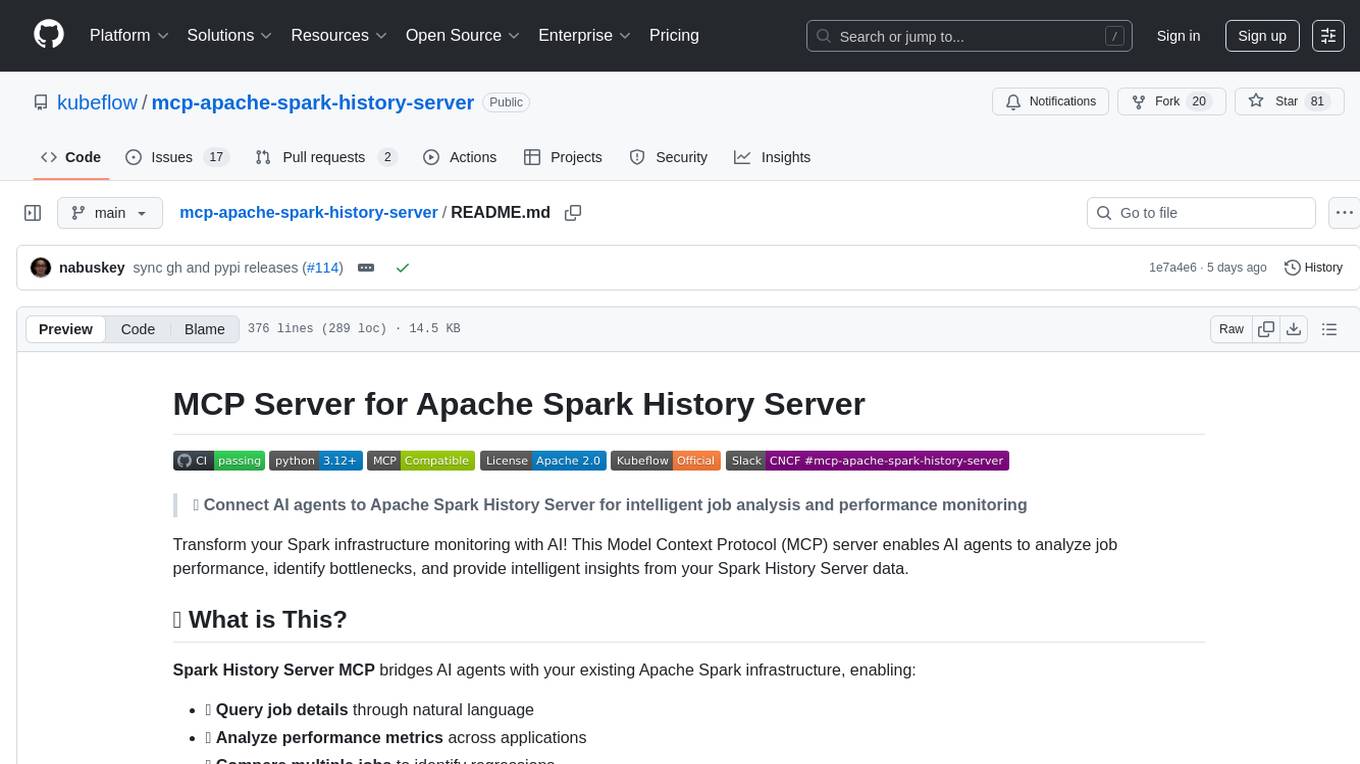
mcp-apache-spark-history-server
The MCP Server for Apache Spark History Server is a tool that connects AI agents to Apache Spark History Server for intelligent job analysis and performance monitoring. It enables AI agents to analyze job performance, identify bottlenecks, and provide insights from Spark History Server data. The server bridges AI agents with existing Apache Spark infrastructure, allowing users to query job details, analyze performance metrics, compare multiple jobs, investigate failures, and generate insights from historical execution data.
hud-python
hud-python is a Python library for creating interactive heads-up displays (HUDs) in video games. It provides a simple and flexible way to overlay information on the screen, such as player health, score, and notifications. The library is designed to be easy to use and customizable, allowing game developers to enhance the user experience by adding dynamic elements to their games. With hud-python, developers can create engaging HUDs that improve gameplay and provide important feedback to players.
SwiftAI
SwiftAI is a modern, type-safe Swift library for building AI-powered apps. It provides a unified API that works seamlessly across different AI models, including Apple's on-device models and cloud-based services like OpenAI. With features like model agnosticism, structured output, agent tool loop, conversations, extensibility, and Swift-native design, SwiftAI offers a powerful toolset for developers to integrate AI capabilities into their applications. The library supports easy installation via Swift Package Manager and offers detailed guidance on getting started, structured responses, tool use, model switching, conversations, and advanced constraints. SwiftAI aims to simplify AI integration by providing a type-safe and versatile solution for various AI tasks.
pr-pilot
PR Pilot is an AI-powered tool designed to assist users in their daily workflow by delegating routine work to AI with confidence and predictability. It integrates seamlessly with popular development tools and allows users to interact with it through a Command-Line Interface, Python SDK, REST API, and Smart Workflows. Users can automate tasks such as generating PR titles and descriptions, summarizing and posting issues, and formatting README files. The tool aims to save time and enhance productivity by providing AI-powered solutions for common development tasks.
oxylabs-mcp
The Oxylabs MCP Server acts as a bridge between AI models and the web, providing clean, structured data from any site. It enables scraping of URLs, rendering JavaScript-heavy pages, content extraction for AI use, bypassing anti-scraping measures, and accessing geo-restricted web data from 195+ countries. The implementation utilizes the Model Context Protocol (MCP) to facilitate secure interactions between AI assistants and web content. Key features include scraping content from any site, automatic data cleaning and conversion, bypassing blocks and geo-restrictions, flexible setup with cross-platform support, and built-in error handling and request management.
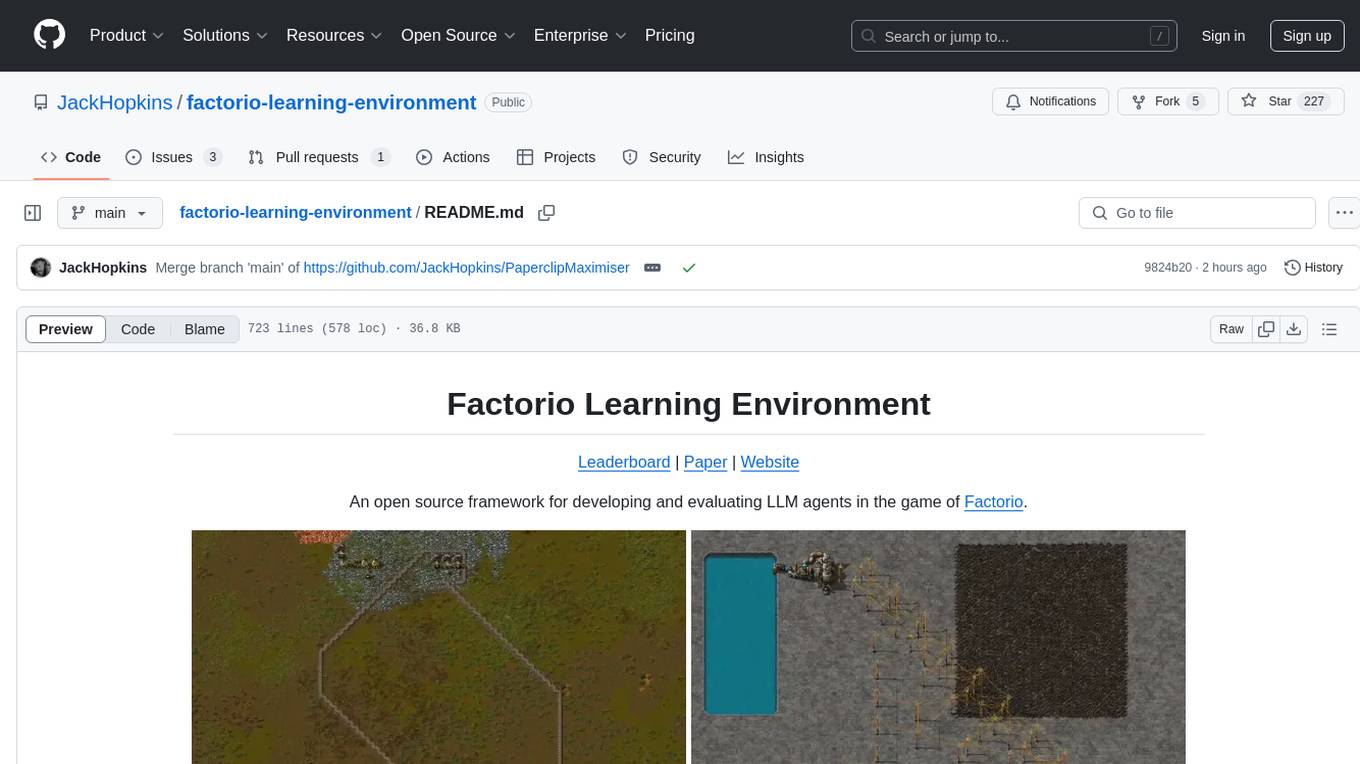
factorio-learning-environment
Factorio Learning Environment is an open source framework designed for developing and evaluating LLM agents in the game of Factorio. It provides two settings: Lab-play with structured tasks and Open-play for building large factories. Results show limitations in spatial reasoning and automation strategies. Agents interact with the environment through code synthesis, observation, action, and feedback. Tools are provided for game actions and state representation. Agents operate in episodes with observation, planning, and action execution. Tasks specify agent goals and are implemented in JSON files. The project structure includes directories for agents, environment, cluster, data, docs, eval, and more. A database is used for checkpointing agent steps. Benchmarks show performance metrics for different configurations.
OSA
OSA (Open-Source-Advisor) is a tool designed to improve the quality of scientific open source projects by automating the generation of README files, documentation, CI/CD scripts, and providing advice and recommendations for repositories. It supports various LLMs accessible via API, local servers, or osa_bot hosted on ITMO servers. OSA is currently under development with features like README file generation, documentation generation, automatic implementation of changes, LLM integration, and GitHub Action Workflow generation. It requires Python 3.10 or higher and tokens for GitHub/GitLab/Gitverse and LLM API key. Users can install OSA using PyPi or build from source, and run it using CLI commands or Docker containers.
gpt-load
GPT-Load is a high-performance, enterprise-grade AI API transparent proxy service designed for enterprises and developers needing to integrate multiple AI services. Built with Go, it features intelligent key management, load balancing, and comprehensive monitoring capabilities for high-concurrency production environments. The tool serves as a transparent proxy service, preserving native API formats of various AI service providers like OpenAI, Google Gemini, and Anthropic Claude. It supports dynamic configuration, distributed leader-follower deployment, and a Vue 3-based web management interface. GPT-Load is production-ready with features like dual authentication, graceful shutdown, and error recovery.
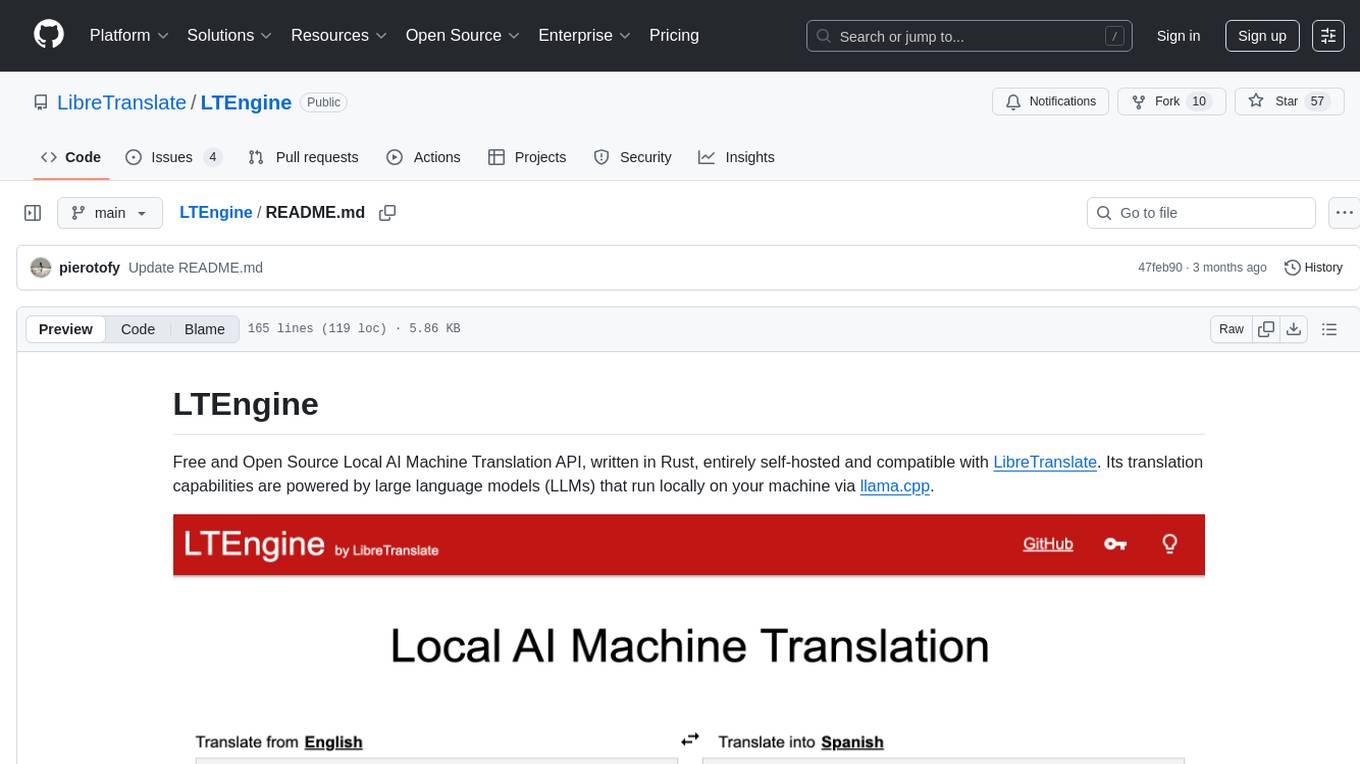
LTEngine
LTEngine is a free and open-source local AI machine translation API written in Rust. It is self-hosted and compatible with LibreTranslate. LTEngine utilizes large language models (LLMs) via llama.cpp, offering high-quality translations that rival or surpass DeepL for certain languages. It supports various accelerators like CUDA, Metal, and Vulkan, with the largest model 'gemma3-27b' fitting on a single consumer RTX 3090. LTEngine is actively developed, with a roadmap outlining future enhancements and features.
ai-gateway
LangDB AI Gateway is an open-source enterprise AI gateway built in Rust. It provides a unified interface to all LLMs using the OpenAI API format, focusing on high performance, enterprise readiness, and data control. The gateway offers features like comprehensive usage analytics, cost tracking, rate limiting, data ownership, and detailed logging. It supports various LLM providers and provides OpenAI-compatible endpoints for chat completions, model listing, embeddings generation, and image generation. Users can configure advanced settings, such as rate limiting, cost control, dynamic model routing, and observability with OpenTelemetry tracing. The gateway can be run with Docker Compose and integrated with MCP tools for server communication.
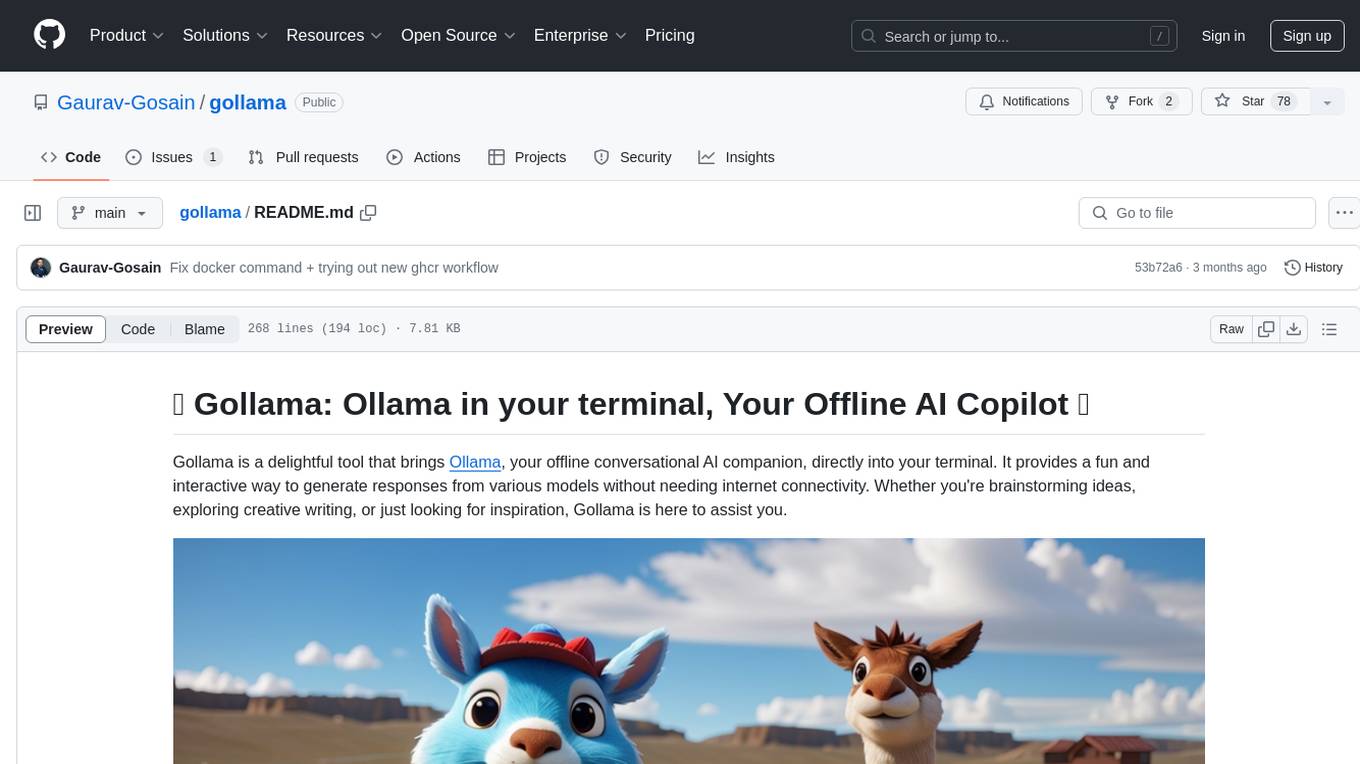
gollama
Gollama is a delightful tool that brings Ollama, your offline conversational AI companion, directly into your terminal. It provides a fun and interactive way to generate responses from various models without needing internet connectivity. Whether you're brainstorming ideas, exploring creative writing, or just looking for inspiration, Gollama is here to assist you. The tool offers an interactive interface, customizable prompts, multiple models selection, and visual feedback to enhance user experience. It can be installed via different methods like downloading the latest release, using Go, running with Docker, or building from source. Users can interact with Gollama through various options like specifying a custom base URL, prompt, model, and enabling raw output mode. The tool supports different modes like interactive, piped, CLI with image, and TUI with image. Gollama relies on third-party packages like bubbletea, glamour, huh, and lipgloss. The roadmap includes implementing piped mode, support for extracting codeblocks, copying responses/codeblocks to clipboard, GitHub Actions for automated releases, and downloading models directly from Ollama using the rest API. Contributions are welcome, and the project is licensed under the MIT License.
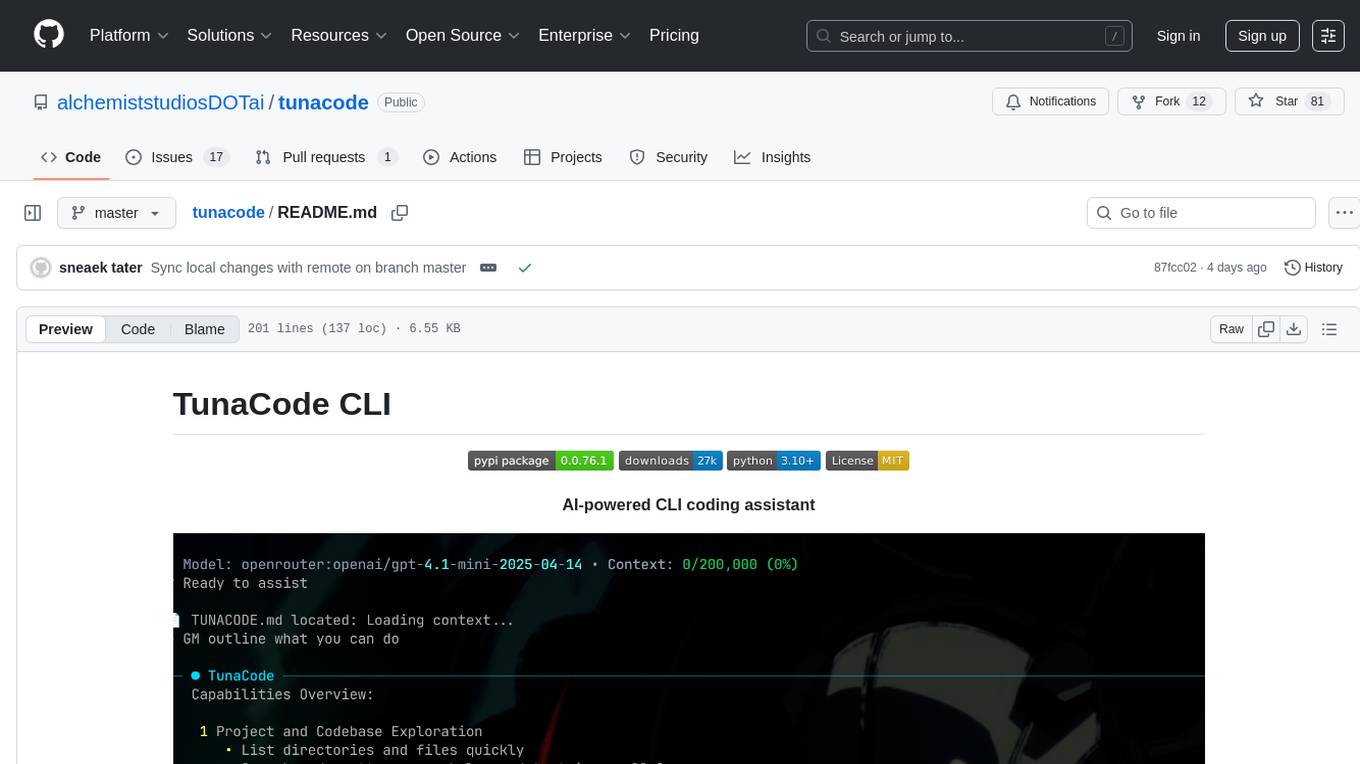
tunacode
TunaCode CLI is an AI-powered coding assistant that provides a command-line interface for developers to enhance their coding experience. It offers features like model selection, parallel execution for faster file operations, and various commands for code management. The tool aims to improve coding efficiency and provide a seamless coding environment for developers.
onnxruntime-server
ONNX Runtime Server is a server that provides TCP and HTTP/HTTPS REST APIs for ONNX inference. It aims to offer simple, high-performance ML inference and a good developer experience. Users can provide inference APIs for ONNX models without writing additional code by placing the models in the directory structure. Each session can choose between CPU or CUDA, analyze input/output, and provide Swagger API documentation for easy testing. Ready-to-run Docker images are available, making it convenient to deploy the server.
For similar tasks
prometheus-mcp-server
Prometheus MCP Server is a Model Context Protocol (MCP) server that provides access to Prometheus metrics and queries through standardized interfaces. It allows AI assistants to execute PromQL queries and analyze metrics data. The server supports executing queries, exploring metrics, listing available metrics, viewing query results, and authentication. It offers interactive tools for AI assistants and can be configured to choose specific tools. Installation methods include using Docker Desktop, MCP-compatible clients like Claude Desktop, VS Code, Cursor, and Windsurf, and manual Docker setup. Configuration options include setting Prometheus server URL, authentication credentials, organization ID, transport mode, and bind host/port. Contributions are welcome, and the project uses `uv` for managing dependencies and includes a comprehensive test suite for functionality testing.

aiomysql
aiomysql is a driver for accessing a MySQL database from the asyncio framework. It is based on PyMySQL and aims to provide the same API and functionality. Internally, aiomysql is a modified version of PyMySQL with async IO calls. It supports SQLAlchemy integration and offers a familiar experience for aiopg users.
For similar jobs
lollms-webui
LoLLMs WebUI (Lord of Large Language Multimodal Systems: One tool to rule them all) is a user-friendly interface to access and utilize various LLM (Large Language Models) and other AI models for a wide range of tasks. With over 500 AI expert conditionings across diverse domains and more than 2500 fine tuned models over multiple domains, LoLLMs WebUI provides an immediate resource for any problem, from car repair to coding assistance, legal matters, medical diagnosis, entertainment, and more. The easy-to-use UI with light and dark mode options, integration with GitHub repository, support for different personalities, and features like thumb up/down rating, copy, edit, and remove messages, local database storage, search, export, and delete multiple discussions, make LoLLMs WebUI a powerful and versatile tool.
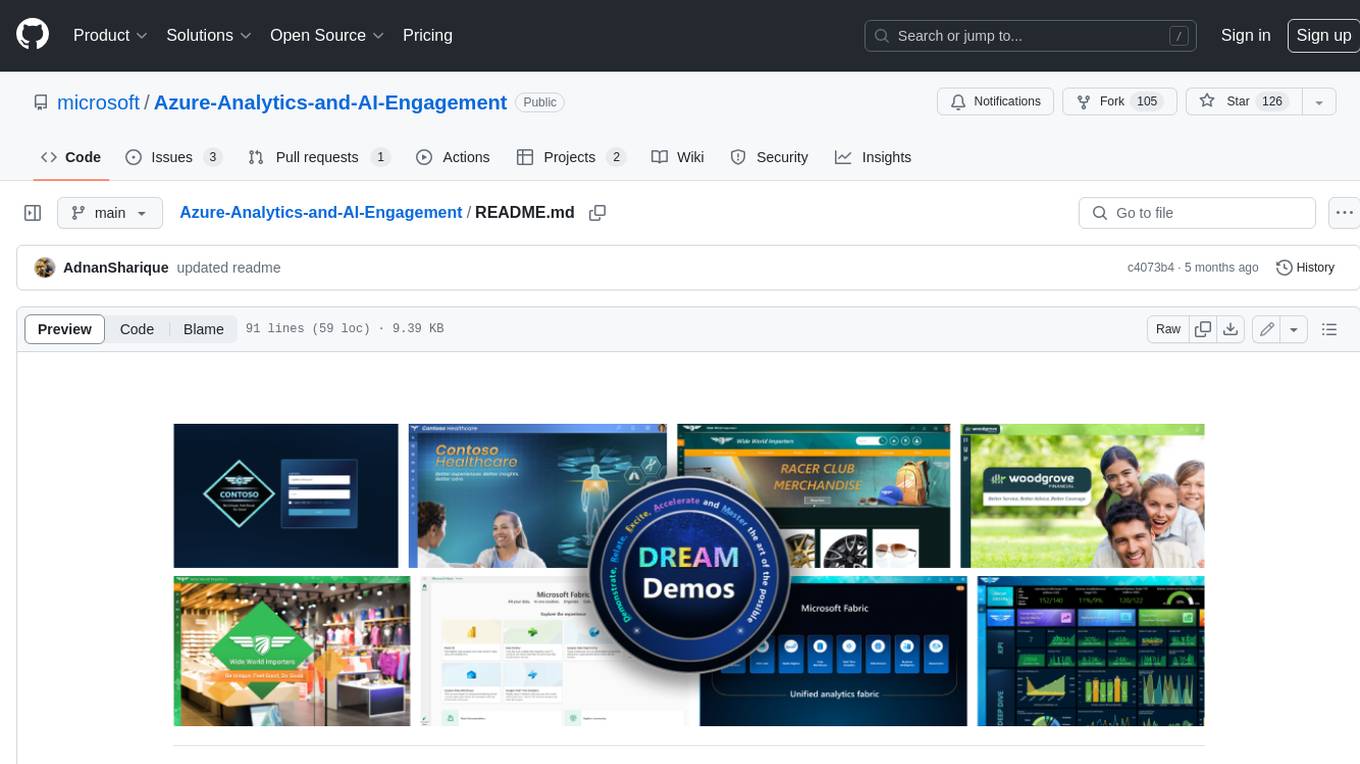
Azure-Analytics-and-AI-Engagement
The Azure-Analytics-and-AI-Engagement repository provides packaged Industry Scenario DREAM Demos with ARM templates (Containing a demo web application, Power BI reports, Synapse resources, AML Notebooks etc.) that can be deployed in a customer’s subscription using the CAPE tool within a matter of few hours. Partners can also deploy DREAM Demos in their own subscriptions using DPoC.
minio
MinIO is a High Performance Object Storage released under GNU Affero General Public License v3.0. It is API compatible with Amazon S3 cloud storage service. Use MinIO to build high performance infrastructure for machine learning, analytics and application data workloads.
mage-ai
Mage is an open-source data pipeline tool for transforming and integrating data. It offers an easy developer experience, engineering best practices built-in, and data as a first-class citizen. Mage makes it easy to build, preview, and launch data pipelines, and provides observability and scaling capabilities. It supports data integrations, streaming pipelines, and dbt integration.
AiTreasureBox
AiTreasureBox is a versatile AI tool that provides a collection of pre-trained models and algorithms for various machine learning tasks. It simplifies the process of implementing AI solutions by offering ready-to-use components that can be easily integrated into projects. With AiTreasureBox, users can quickly prototype and deploy AI applications without the need for extensive knowledge in machine learning or deep learning. The tool covers a wide range of tasks such as image classification, text generation, sentiment analysis, object detection, and more. It is designed to be user-friendly and accessible to both beginners and experienced developers, making AI development more efficient and accessible to a wider audience.
tidb
TiDB is an open-source distributed SQL database that supports Hybrid Transactional and Analytical Processing (HTAP) workloads. It is MySQL compatible and features horizontal scalability, strong consistency, and high availability.
airbyte
Airbyte is an open-source data integration platform that makes it easy to move data from any source to any destination. With Airbyte, you can build and manage data pipelines without writing any code. Airbyte provides a library of pre-built connectors that make it easy to connect to popular data sources and destinations. You can also create your own connectors using Airbyte's no-code Connector Builder or low-code CDK. Airbyte is used by data engineers and analysts at companies of all sizes to build and manage their data pipelines.
labelbox-python
Labelbox is a data-centric AI platform for enterprises to develop, optimize, and use AI to solve problems and power new products and services. Enterprises use Labelbox to curate data, generate high-quality human feedback data for computer vision and LLMs, evaluate model performance, and automate tasks by combining AI and human-centric workflows. The academic & research community uses Labelbox for cutting-edge AI research.