


KULLM
☁️ 구름(KULLM): 고려대학교에서 개발한, 한국어에 특화된 LLM
Stars: 527
KULLM (구름) is a Korean Large Language Model developed by Korea University NLP & AI Lab and HIAI Research Institute. It is based on the upstage/SOLAR-10.7B-v1.0 model and has been fine-tuned for instruction. The model has been trained on 8×A100 GPUs and is capable of generating responses in Korean language. KULLM exhibits hallucination and repetition phenomena due to its decoding strategy. Users should be cautious as the model may produce inaccurate or harmful results. Performance may vary in benchmarks without a fixed system prompt.
README:

- 2024.04.08: 🤗구름3(KULLM3) 양자화 모델(awq-4bit) 공개
- 2024.04.03: 🤗구름3(KULLM3) 공개
- 2023.06.23: 한국어 대화 평가 결과 공개
- 2023.06.08: 🤗Polyglot-ko 5.8B 기반 KULLM-Polyglot-5.8B-v2 fp16 모델 공개
- 2023.06.01: 구름(KULLM) 데이터셋 v2 HuggingFace Datasets 공개
- 2023.05.31: 🤗Polyglot-ko 12.8B 기반 KULLM-Polyglot-12.8B-v2 fp16 모델 공개
- 2023.05.30: 🤗Polyglot-ko 12.8B 기반 KULLM-Polyglot-12.8B fp16 모델 공개
KULLM(구름)은 고려대학교 NLP & AI 연구실과 HIAI 연구소가 개발한 한국어 Large Language Model (LLM) 입니다.
KULLM3을 공개합니다.
(이전 모델의 학습 방법 및 데이터는 kullm_v2 브랜치를 참고해 주세요.)


- torch / transformers / accelerate 설치
- (2024.04.03기준) transformers>=4.39.0 에서 generate 함수가 제대로 동작하지 않습니다. 4.38.2로 설치해주세요.
- (2024.04.28기준) transformers>=4.40.0 에서 정상 동작함을 확인했습니다.
pip install torch transformers==4.38.2 accelerate아래 예제 코드로 실행해볼 수 있습니다.
import torch
from transformers import AutoModelForCausalLM, AutoTokenizer, TextStreamer

MODEL_DIR = "nlpai-lab/KULLM3"
model = AutoModelForCausalLM.from_pretrained(MODEL_DIR, torch_dtype=torch.float16).to("cuda")
tokenizer = AutoTokenizer.from_pretrained(MODEL_DIR)
streamer = TextStreamer(tokenizer, skip_prompt=True, skip_special_tokens=True)

s = "고려대학교에 대해서 알고 있니?"
conversation = [{'role': 'user', 'content': s}]
inputs = tokenizer.apply_chat_template(
    conversation,
    tokenize=True,
    add_generation_prompt=True,
    return_tensors='pt').to("cuda")
_ = model.generate(inputs, streamer=streamer, max_new_tokens=1024, use_cache=True)

# 네, 고려대학교에 대해 알고 있습니다. 고려대학교는 대한민국 서울에 위치한 사립 대학교로, 1905년에 설립되었습니다. 이 대학교는 한국에서 가장 오래된 대학 중 하나로, 다양한 학부 및 대학원 프로그램을 제공합니다. 고려대학교는 특히 법학, 경제학, 정치학, 사회학, 문학, 과학 분야에서 높은 명성을 가지고 있습니다. 또한, 스포츠 분야에서도 활발한 활동을 보이며, 대한민국 대학 스포츠에서 중요한 역할을 하고 있습니다. 고려대학교는 국제적인 교류와 협력에도 적극적이며, 전 세계 다양한 대학과의 협력을 통해 글로벌 경쟁력을 강화하고 있습니다.- KULLM3은 upstage/SOLAR-10.7B-v1.0을 기반으로 instruction-tuning 된 모델입니다.
- 8×A100 GPU로 학습되었습니다.
- 다음 시스템 프롬프트가 주어진 상태로 학습하였습니다. (예제 코드에서도 시스템 프롬프트를 포함시키고 있습니다!)
당신은 고려대학교 NLP&AI 연구실에서 만든 AI 챗봇입니다.
당신의 이름은 'KULLM'으로, 한국어로는 '구름'을 뜻합니다.
당신은 비도덕적이거나, 성적이거나, 불법적이거나 또는 사회 통념적으로 허용되지 않는 발언은 하지 않습니다.
사용자와 즐겁게 대화하며, 사용자의 응답에 가능한 정확하고 친절하게 응답함으로써 최대한 도와주려고 노력합니다.
질문이 이상하다면, 어떤 부분이 이상한지 설명합니다. 거짓 정보를 발언하지 않도록 주의합니다.
- 대화 능력 평가는 다음을 참고하여 진행했습니다.
- G-Eval: NLG Evaluation using GPT-4 with Better Human Alignment (Yang Liu. et. al. 2023)
- MT-Eval
- 평가 모델은 GPT-4-Turbo(gpt-4-0125-preview)를 사용하였고, 평가 데이터셋은 yizhongw/self-instruct의 휴먼 평가 데이터셋인
user_oriented_instructions.jsonl을 deepl로 번역한 데이터셋을 사용하였습니다. - 주어진 prompt 데이터에 대해 모델이 응답을 생성하고, 그 응답을 OpenAI API를 사용하여 평가하는 방식입니다.
- 해당 평가 결과는 repo에서 재현할 수 있습니다.
모델 평가에 사용한 프롬프트는 다음과 같습니다.
실험 결과, 한국어보다 영어 프롬프트가 더 정확한 평가 결과를 보여주었습니다.
따라서 평가의 정확성을 위해 영어 프롬프트로 진행했습니다.
You will be given evaluation instruction, input and AI-generated response.
Your task is to rate the response on given metric.
Please make sure you read and understand these instructions carefully. Please keep this document open while reviewing, and refer to it as needed.

Evaluation Criteria:
- Fluency (1-5): The quality of the language used in the translation. A high-quality response should be grammatically correct, idiomatic, and free from spelling and punctuation errors.
- Coherence (1-5): A high score indicates that the response maintains consistent context. A low score is given if the response shifts context or language inappropriately from instruction(e.g. instruction's language is Korean, but response is English).
- Accuracy (1-5) - The correctness of the answer. The answer should be factually correct and directly answer the question asked
- Completeness (1-5) - The extent to which the response covers all aspects of the question. The response should not just address one part of the question, but should provide a comprehensive response.
- Overall Quality (1-5) - The overall effectiveness and excellence of the response, integrating considerations of all above criteria.

Evaluation Steps:
1. Read the instruction and input carefully and understand what it is asking.
2. Read the AI-generated response and Evaluation Criteria.
3. Assign a score for each criterion on a scale of 1 to 5, where 1 is the lowest and 5 is the highest.

Instruction:
{instruction}

Input:
{input}

Response:
{response}

Evaluation Form (scores ONLY):
- Fluency (1-5):
- Coherence (1-5):
- Accuracy (1-5):
- Completeness (1-5):
- Overall Quality (1-5):
- 환각(Hallucination) 현상과, decoding strategy에 따라 동어 반복 현상이 존재하는 모델입니다.
- KULLM이 생성한 결과는 부정확하거나 유해한 결과를 포함할 수 있습니다.
- 고정된 system prompt로 훈련된 모델이므로, system prompt를 주지 않는 벤치마크의 경우 성능이 본래보다 낮을 수 있습니다.
Apache-2.0
Please cite the repo if you use the data or code in this repo.
@misc{kullm3,
  author = {Kim, Jeongwook and Lee, Taemin and Jang, Yoonna and Moon, Hyeonseok and Son, Suhyune and Lee, Seungyoon and Kim, Dongjun},
  title = {KULLM3: Korea University Large Language Model 3},
  year = {2024},
  publisher = {GitHub},
  journal = {GitHub repository},
  howpublished = {\url{https://github.com/nlpai-lab/kullm}},
}
@inproceedings{lee2023kullm,
  title={KULLM: Learning to Construct Korean Instruction-following Large Language Models},
  author={Lee, SeungJun and Lee, Taemin and Lee, Jeongwoo and Jang, Yoona and Lim, Heuiseok},
  booktitle={Annual Conference on Human and Language Technology},
  pages={196--202},
  year={2023},
  organization={Human and Language Technology}
}
@misc{kullm,
  author = {NLP & AI Lab and Human-Inspired AI research},
  title = {KULLM: Korea University Large Language Model Project},
  year = {2023},
  publisher = {GitHub},
  journal = {GitHub repository},
  howpublished = {\url{https://github.com/nlpai-lab/kullm}},
}
For Tasks:
Click tags to check more tools for each tasksFor Jobs:
Alternative AI tools for KULLM
Similar Open Source Tools
KULLM
KULLM (구름) is a Korean Large Language Model developed by Korea University NLP & AI Lab and HIAI Research Institute. It is based on the upstage/SOLAR-10.7B-v1.0 model and has been fine-tuned for instruction. The model has been trained on 8×A100 GPUs and is capable of generating responses in Korean language. KULLM exhibits hallucination and repetition phenomena due to its decoding strategy. Users should be cautious as the model may produce inaccurate or harmful results. Performance may vary in benchmarks without a fixed system prompt.

rl
TorchRL is an open-source Reinforcement Learning (RL) library for PyTorch. It provides pytorch and **python-first** , low and high level abstractions for RL that are intended to be **efficient** , **modular** , **documented** and properly **tested**. The code is aimed at supporting research in RL. Most of it is written in python in a highly modular way, such that researchers can easily swap components, transform them or write new ones with little effort.
Eco2AI
Eco2AI is a python library for CO2 emission tracking that monitors energy consumption of CPU & GPU devices and estimates equivalent carbon emissions based on regional emission coefficients. Users can easily integrate Eco2AI into their Python scripts by adding a few lines of code. The library records emissions data and device information in a local file, providing detailed session logs with project names, experiment descriptions, start times, durations, power consumption, CO2 emissions, CPU and GPU names, operating systems, and countries.
sophia
Sophia is an open-source TypeScript platform designed for autonomous AI agents and LLM based workflows. It aims to automate processes, review code, assist with refactorings, and support various integrations. The platform offers features like advanced autonomous agents, reasoning/planning inspired by Google's Self-Discover paper, memory and function call history, adaptive iterative planning, and more. Sophia supports multiple LLMs/services, CLI and web interface, human-in-the-loop interactions, flexible deployment options, observability with OpenTelemetry tracing, and specific agents for code editing, software engineering, and code review. It provides a flexible platform for the TypeScript community to expand and support various use cases and integrations.
Ollama
Ollama SDK for .NET is a fully generated C# SDK based on OpenAPI specification using OpenApiGenerator. It supports automatic releases of new preview versions, source generator for defining tools natively through C# interfaces, and all modern .NET features. The SDK provides support for all Ollama API endpoints including chats, embeddings, listing models, pulling and creating new models, and more. It also offers tools for interacting with weather data and providing weather-related information to users.
ChatRex
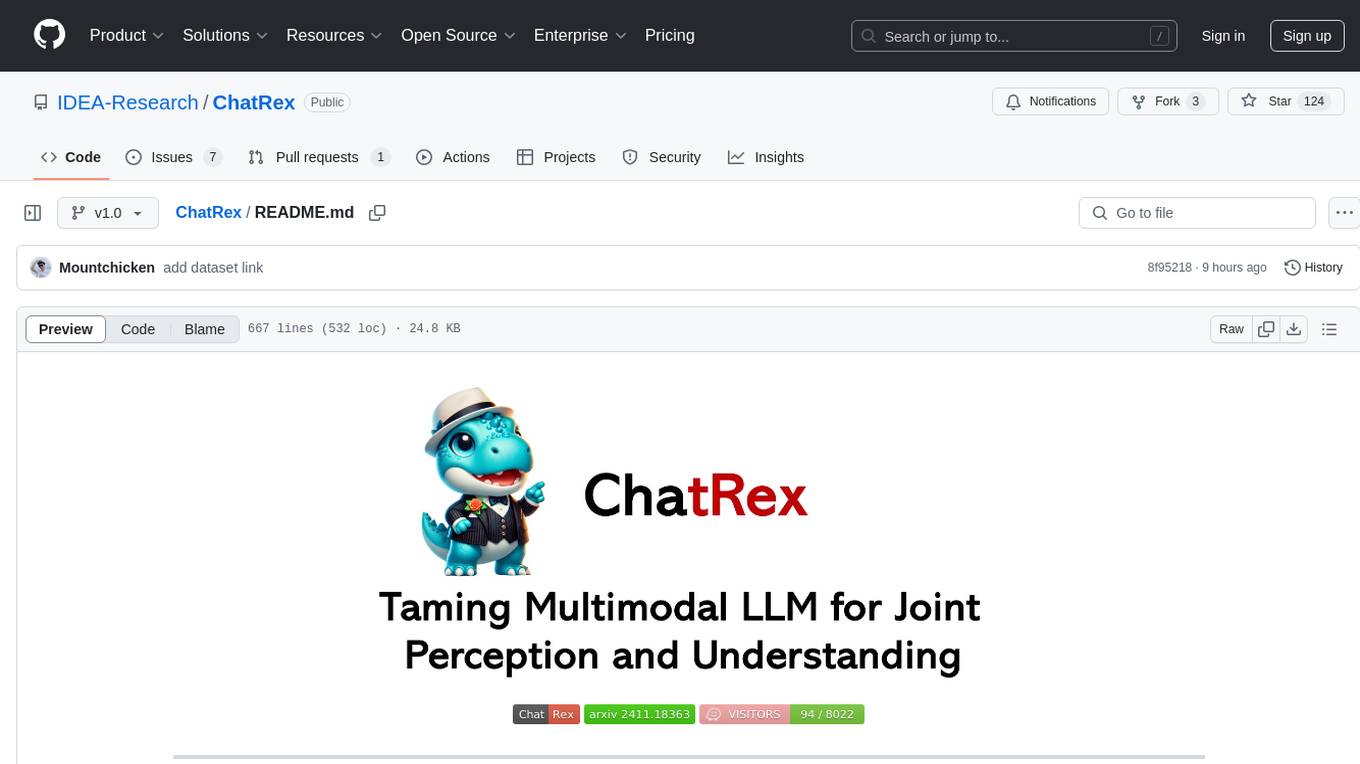
ChatRex is a Multimodal Large Language Model (MLLM) designed to seamlessly integrate fine-grained object perception and robust language understanding. By adopting a decoupled architecture with a retrieval-based approach for object detection and leveraging high-resolution visual inputs, ChatRex addresses key challenges in perception tasks. It is powered by the Rexverse-2M dataset with diverse image-region-text annotations. ChatRex can be applied to various scenarios requiring fine-grained perception, such as object detection, grounded conversation, grounded image captioning, and region understanding.
continuous-eval
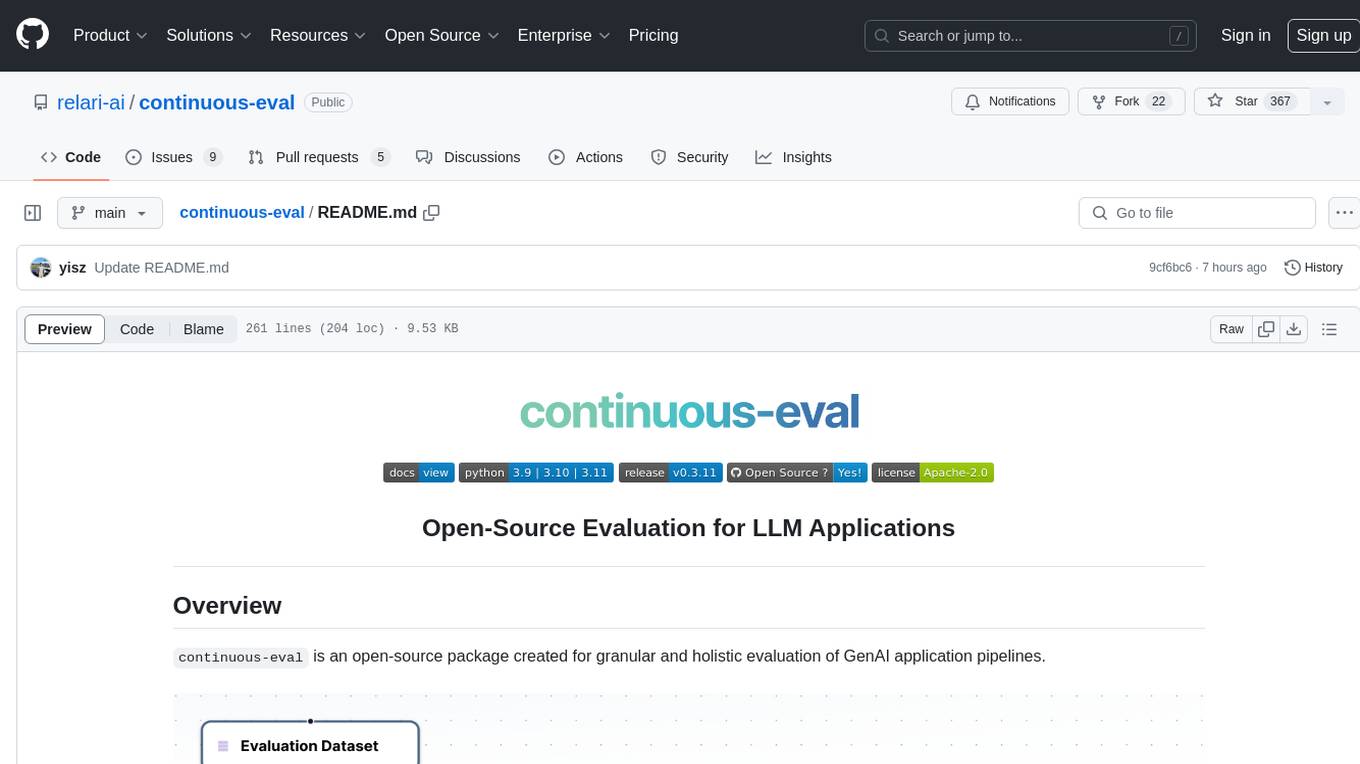
Open-Source Evaluation for LLM Applications. `continuous-eval` is an open-source package created for granular and holistic evaluation of GenAI application pipelines. It offers modularized evaluation, a comprehensive metric library covering various LLM use cases, the ability to leverage user feedback in evaluation, and synthetic dataset generation for testing pipelines. Users can define their own metrics by extending the Metric class. The tool allows running evaluation on a pipeline defined with modules and corresponding metrics. Additionally, it provides synthetic data generation capabilities to create user interaction data for evaluation or training purposes.
typedai
TypedAI is a TypeScript-first AI platform designed for developers to create and run autonomous AI agents, LLM based workflows, and chatbots. It offers advanced autonomous agents, software developer agents, pull request code review agent, AI chat interface, Slack chatbot, and supports various LLM services. The platform features configurable Human-in-the-loop settings, functional callable tools/integrations, CLI and Web UI interface, and can be run locally or deployed on the cloud with multi-user/SSO support. It leverages the Python AI ecosystem through executing Python scripts/packages and provides flexible run/deploy options like single user mode, Firestore & Cloud Run deployment, and multi-user SSO enterprise deployment. TypedAI also includes UI examples, code examples, and automated LLM function schemas for seamless development and execution of AI workflows.
lionagi
LionAGI is a powerful intelligent workflow automation framework that introduces advanced ML models into any existing workflows and data infrastructure. It can interact with almost any model, run interactions in parallel for most models, produce structured pydantic outputs with flexible usage, automate workflow via graph based agents, use advanced prompting techniques, and more. LionAGI aims to provide a centralized agent-managed framework for "ML-powered tools coordination" and to dramatically lower the barrier of entries for creating use-case/domain specific tools. It is designed to be asynchronous only and requires Python 3.10 or higher.
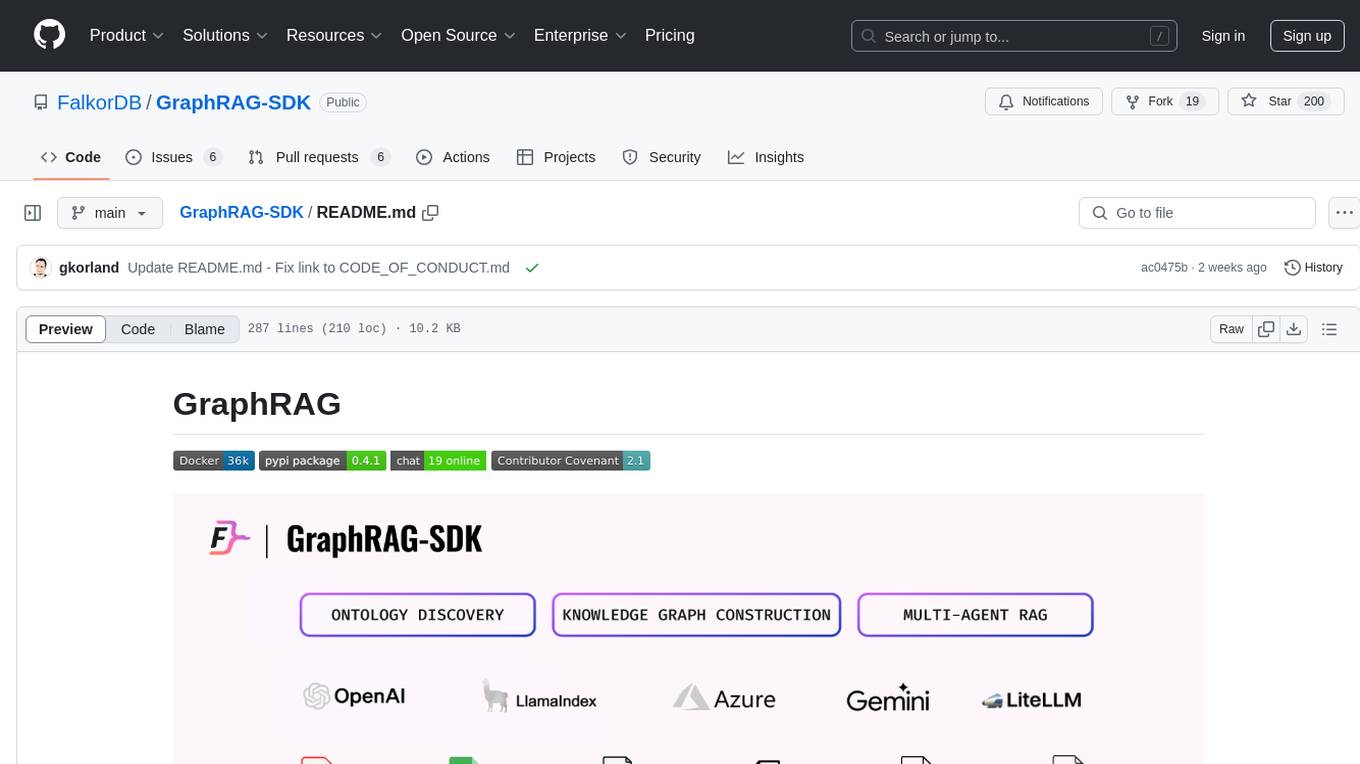
GraphRAG-SDK
Build fast and accurate GenAI applications with GraphRAG SDK, a specialized toolkit for building Graph Retrieval-Augmented Generation (GraphRAG) systems. It integrates knowledge graphs, ontology management, and state-of-the-art LLMs to deliver accurate, efficient, and customizable RAG workflows. The SDK simplifies the development process by automating ontology creation, knowledge graph agent creation, and query handling, enabling users to interact and query their knowledge graphs effectively. It supports multi-agent systems and orchestrates agents specialized in different domains. The SDK is optimized for FalkorDB, ensuring high performance and scalability for large-scale applications. By leveraging knowledge graphs, it enables semantic relationships and ontology-driven queries that go beyond standard vector similarity, enhancing retrieval-augmented generation capabilities.
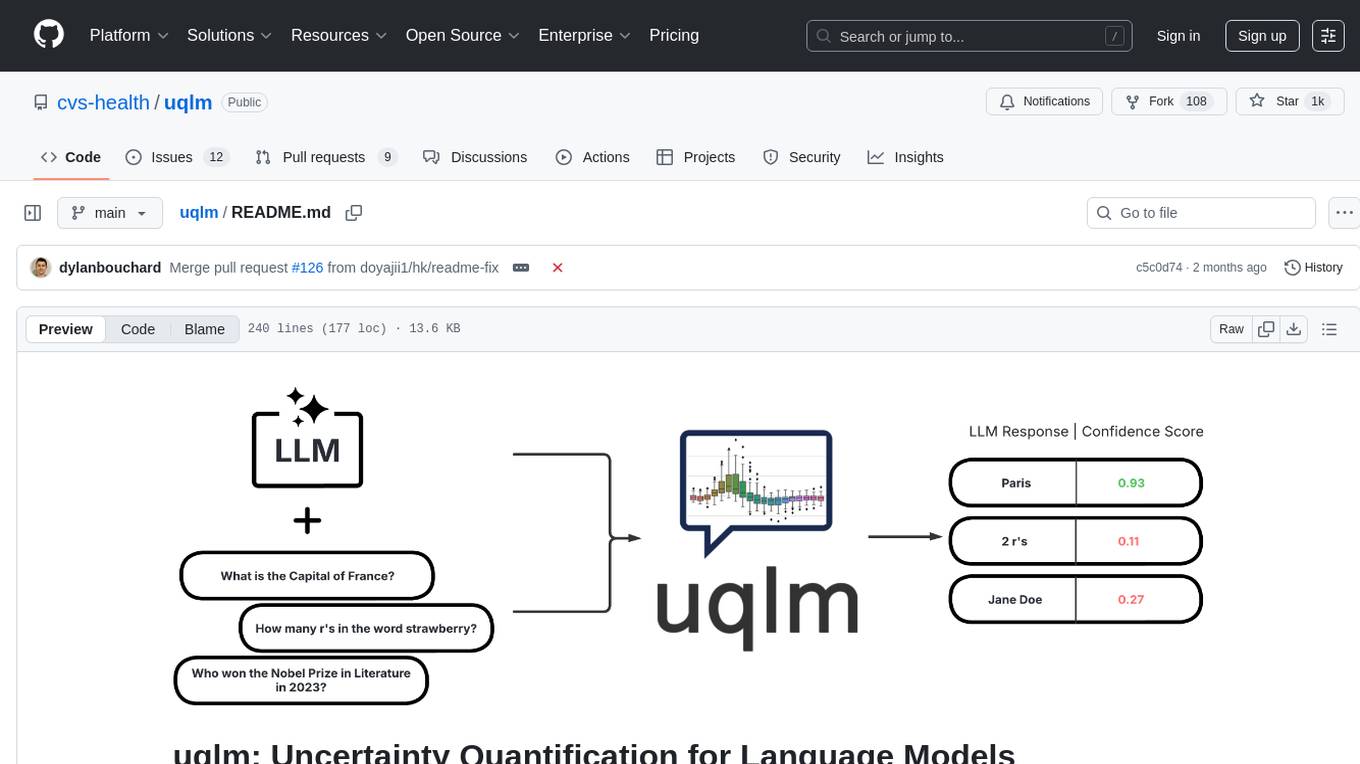
uqlm
UQLM is a Python library for Large Language Model (LLM) hallucination detection using state-of-the-art uncertainty quantification techniques. It provides response-level scorers for quantifying uncertainty of LLM outputs, categorized into four main types: Black-Box Scorers, White-Box Scorers, LLM-as-a-Judge Scorers, and Ensemble Scorers. Users can leverage different scorers to assess uncertainty in generated responses, with options for off-the-shelf usage or customization. The library offers illustrative code snippets and detailed information on available scorers for each type, along with example usage for conducting hallucination detection. Additionally, UQLM includes documentation, example notebooks, and associated research for further exploration and understanding.
MarkLLM
MarkLLM is an open-source toolkit designed for watermarking technologies within large language models (LLMs). It simplifies access, understanding, and assessment of watermarking technologies, supporting various algorithms, visualization tools, and evaluation modules. The toolkit aids researchers and the community in ensuring the authenticity and origin of machine-generated text.
inferable
Inferable is an open source platform that helps users build reliable LLM-powered agentic automations at scale. It offers a managed agent runtime, durable tool calling, zero network configuration, multiple language support, and is fully open source under the MIT license. Users can define functions, register them with Inferable, and create runs that utilize these functions to automate tasks. The platform supports Node.js/TypeScript, Go, .NET, and React, and provides SDKs, core services, and bootstrap templates for various languages.
mobius
Mobius is an AI infra platform including realtime computing and training. It is built on Ray, a distributed computing framework, and provides a number of features that make it well-suited for online machine learning tasks. These features include: * **Cross Language**: Mobius can run in multiple languages (only Python and Java are supported currently) with high efficiency. You can implement your operator in different languages and run them in one job. * **Single Node Failover**: Mobius has a special failover mechanism that only needs to rollback the failed node itself, in most cases, to recover the job. This is a huge benefit if your job is sensitive about failure recovery time. * **AutoScaling**: Mobius can generate a new graph with different configurations in runtime without stopping the job. * **Fusion Training**: Mobius can combine TensorFlow/Pytorch and streaming, then building an e2e online machine learning pipeline. Mobius is still under development, but it has already been used to power a number of real-world applications, including: * A real-time recommendation system for a major e-commerce company * A fraud detection system for a large financial institution * A personalized news feed for a major news organization If you are interested in using Mobius for your own online machine learning projects, you can find more information in the documentation.
wandb
Weights & Biases (W&B) is a platform that helps users build better machine learning models faster by tracking and visualizing all components of the machine learning pipeline, from datasets to production models. It offers tools for tracking, debugging, evaluating, and monitoring machine learning applications. W&B provides integrations with popular frameworks like PyTorch, TensorFlow/Keras, Hugging Face Transformers, PyTorch Lightning, XGBoost, and Sci-Kit Learn. Users can easily log metrics, visualize performance, and compare experiments using W&B. The platform also supports hosting options in the cloud or on private infrastructure, making it versatile for various deployment needs.
jsgrad
jsgrad is a modern ML library for JavaScript and TypeScript that aims to provide a fast and efficient way to run and train machine learning models. It is a rewrite of tinygrad in TypeScript, offering a clean and modern API with zero dependencies. The library supports multiple runtime backends such as WebGPU, WASM, and CLANG, making it versatile for various applications in browser and server environments. With a focus on simplicity and performance, jsgrad is designed to be easy to use for both model inference and training tasks.
For similar tasks
KULLM
KULLM (구름) is a Korean Large Language Model developed by Korea University NLP & AI Lab and HIAI Research Institute. It is based on the upstage/SOLAR-10.7B-v1.0 model and has been fine-tuned for instruction. The model has been trained on 8×A100 GPUs and is capable of generating responses in Korean language. KULLM exhibits hallucination and repetition phenomena due to its decoding strategy. Users should be cautious as the model may produce inaccurate or harmful results. Performance may vary in benchmarks without a fixed system prompt.
mindsdb
MindsDB is a platform for customizing AI from enterprise data. You can create, serve, and fine-tune models in real-time from your database, vector store, and application data. MindsDB "enhances" SQL syntax with AI capabilities to make it accessible for developers worldwide. With MindsDB’s nearly 200 integrations, any developer can create AI customized for their purpose, faster and more securely. Their AI systems will constantly improve themselves — using companies’ own data, in real-time.
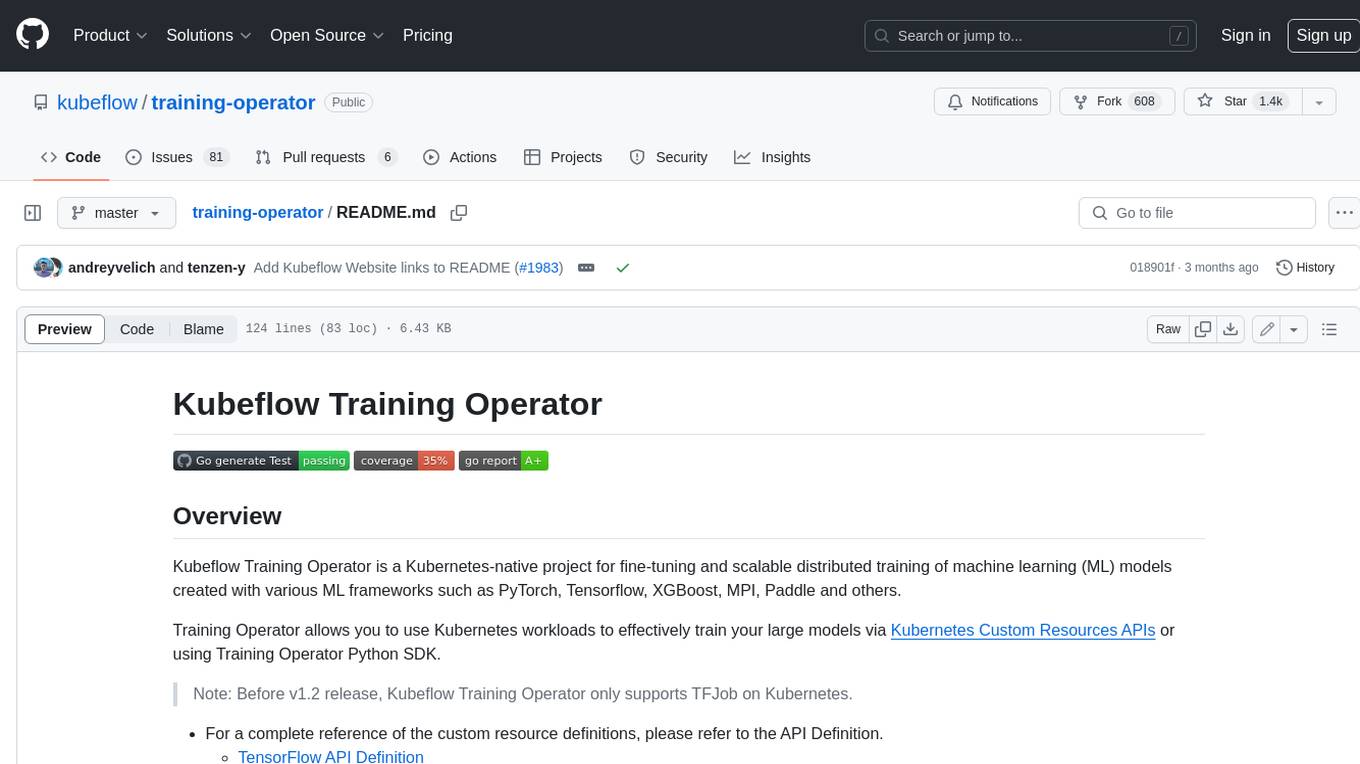
training-operator
Kubeflow Training Operator is a Kubernetes-native project for fine-tuning and scalable distributed training of machine learning (ML) models created with various ML frameworks such as PyTorch, Tensorflow, XGBoost, MPI, Paddle and others. Training Operator allows you to use Kubernetes workloads to effectively train your large models via Kubernetes Custom Resources APIs or using Training Operator Python SDK. > Note: Before v1.2 release, Kubeflow Training Operator only supports TFJob on Kubernetes. * For a complete reference of the custom resource definitions, please refer to the API Definition. * TensorFlow API Definition * PyTorch API Definition * Apache MXNet API Definition * XGBoost API Definition * MPI API Definition * PaddlePaddle API Definition * For details of all-in-one operator design, please refer to the All-in-one Kubeflow Training Operator * For details on its observability, please refer to the monitoring design doc.
helix
HelixML is a private GenAI platform that allows users to deploy the best of open AI in their own data center or VPC while retaining complete data security and control. It includes support for fine-tuning models with drag-and-drop functionality. HelixML brings the best of open source AI to businesses in an ergonomic and scalable way, optimizing the tradeoff between GPU memory and latency.
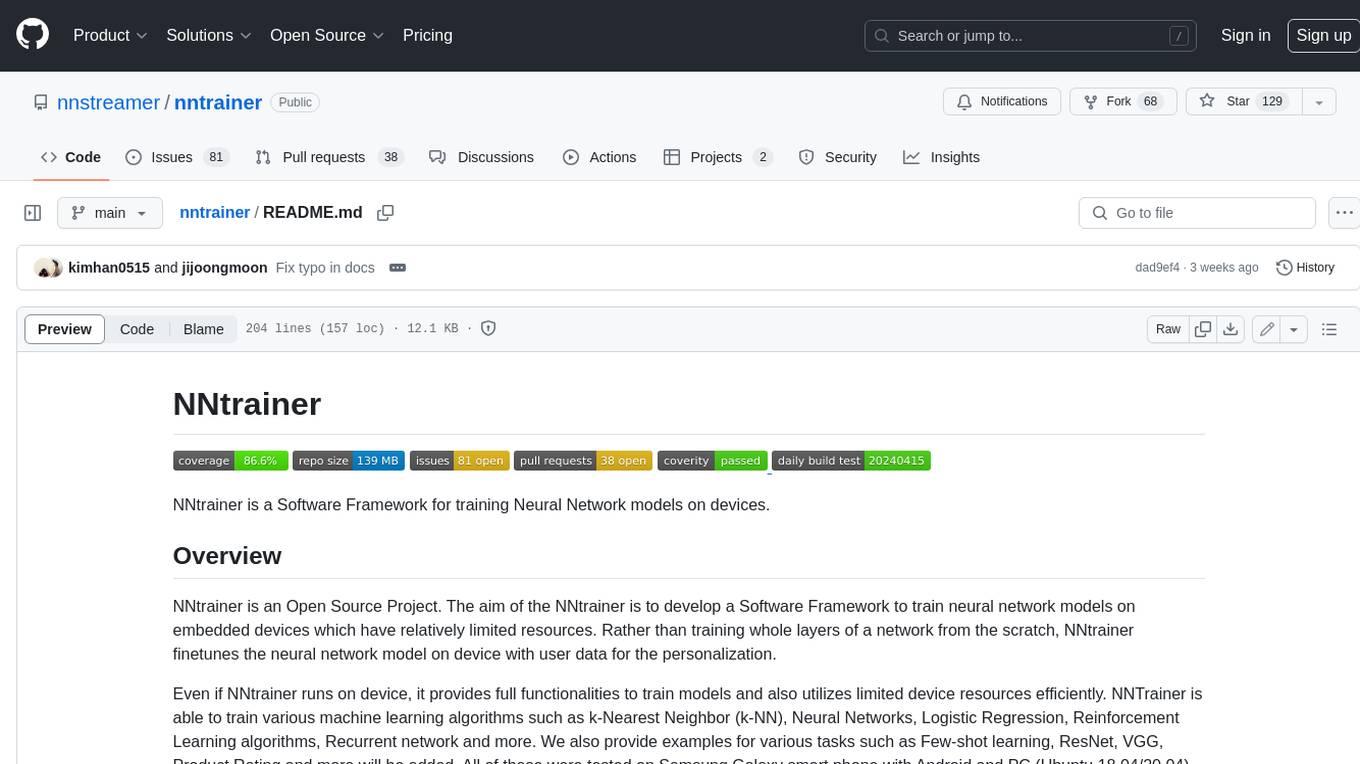
nntrainer
NNtrainer is a software framework for training neural network models on devices with limited resources. It enables on-device fine-tuning of neural networks using user data for personalization. NNtrainer supports various machine learning algorithms and provides examples for tasks such as few-shot learning, ResNet, VGG, and product rating. It is optimized for embedded devices and utilizes CBLAS and CUBLAS for accelerated calculations. NNtrainer is open source and released under the Apache License version 2.0.
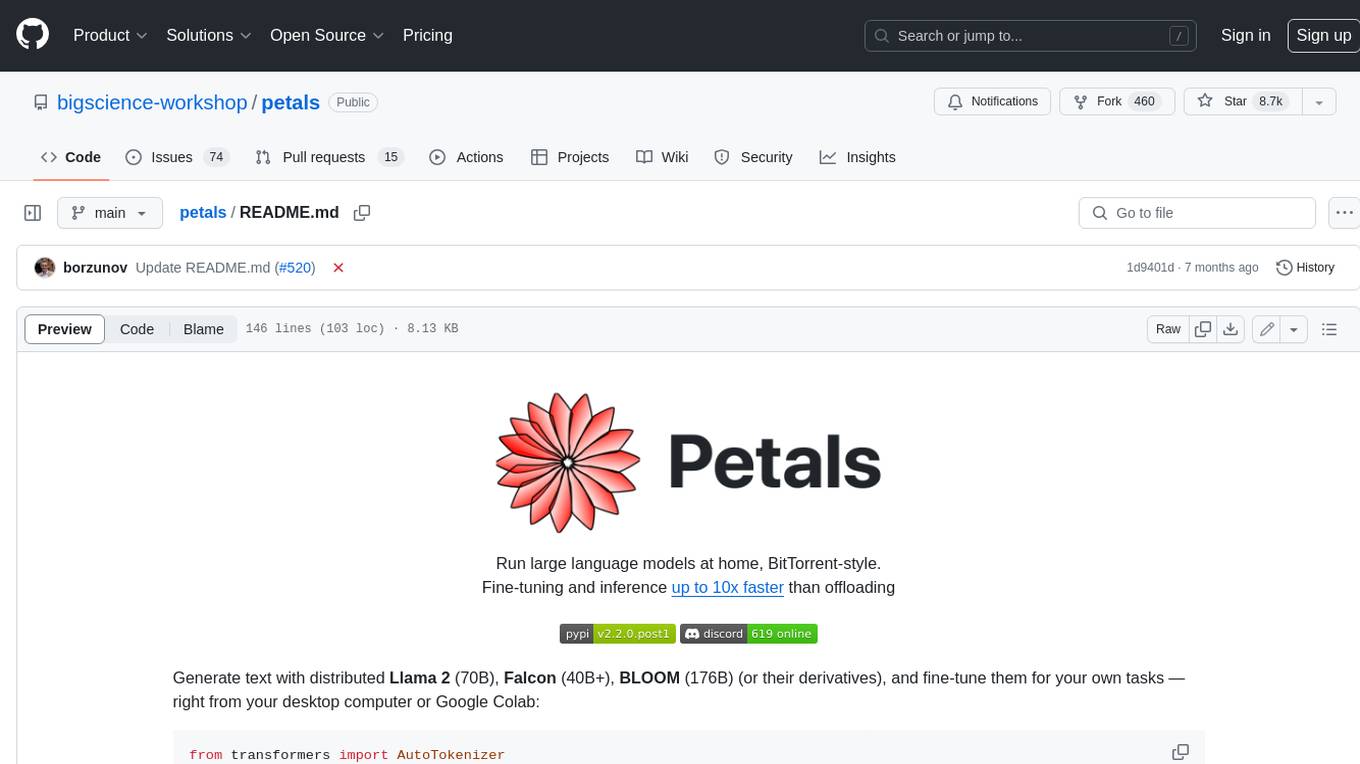
petals
Petals is a tool that allows users to run large language models at home in a BitTorrent-style manner. It enables fine-tuning and inference up to 10x faster than offloading. Users can generate text with distributed models like Llama 2, Falcon, and BLOOM, and fine-tune them for specific tasks directly from their desktop computer or Google Colab. Petals is a community-run system that relies on people sharing their GPUs to increase its capacity and offer a distributed network for hosting model layers.
LLaVA-pp
This repository, LLaVA++, extends the visual capabilities of the LLaVA 1.5 model by incorporating the latest LLMs, Phi-3 Mini Instruct 3.8B, and LLaMA-3 Instruct 8B. It provides various models for instruction-following LMMS and academic-task-oriented datasets, along with training scripts for Phi-3-V and LLaMA-3-V. The repository also includes installation instructions and acknowledgments to related open-source contributions.
Firefly
Firefly is an open-source large model training project that supports pre-training, fine-tuning, and DPO of mainstream large models. It includes models like Llama3, Gemma, Qwen1.5, MiniCPM, Llama, InternLM, Baichuan, ChatGLM, Yi, Deepseek, Qwen, Orion, Ziya, Xverse, Mistral, Mixtral-8x7B, Zephyr, Vicuna, Bloom, etc. The project supports full-parameter training, LoRA, QLoRA efficient training, and various tasks such as pre-training, SFT, and DPO. Suitable for users with limited training resources, QLoRA is recommended for fine-tuning instructions. The project has achieved good results on the Open LLM Leaderboard with QLoRA training process validation. The latest version has significant updates and adaptations for different chat model templates.
For similar jobs
Perplexica
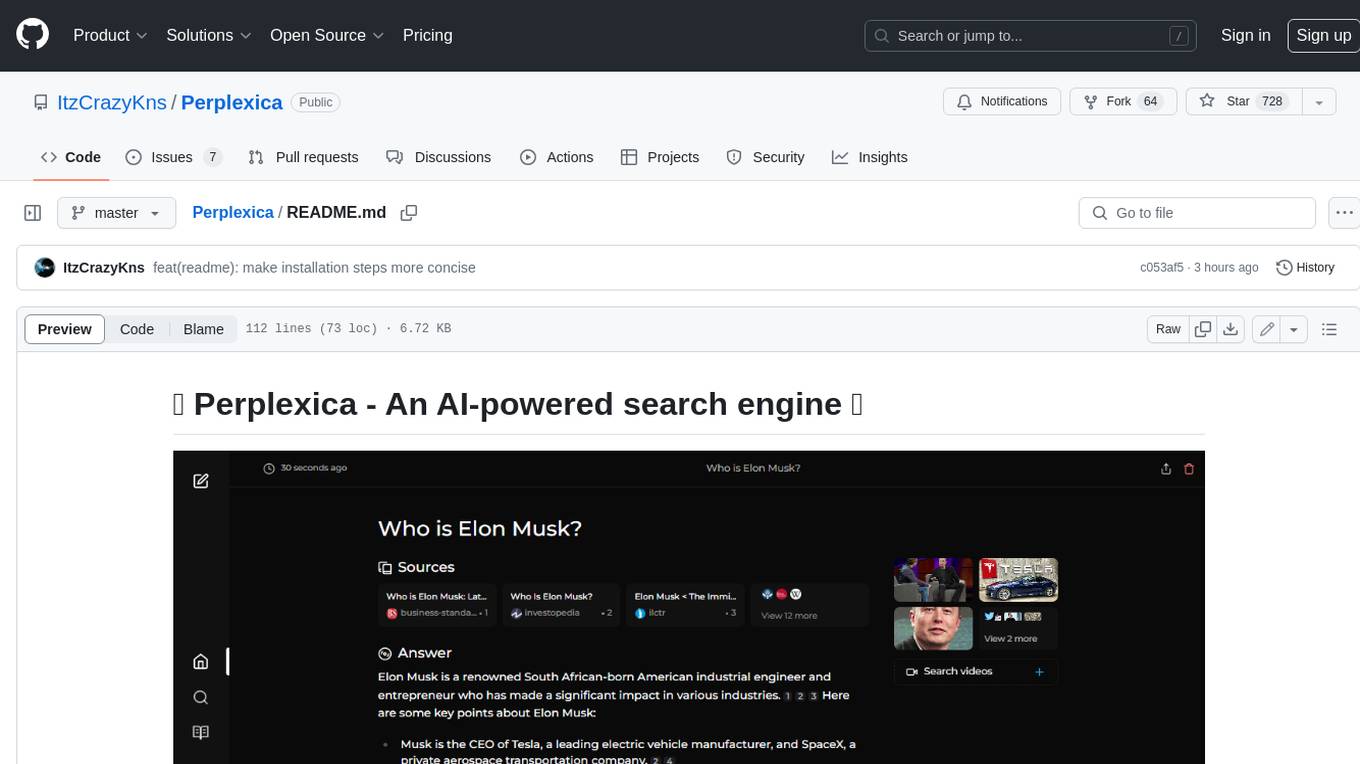
Perplexica is an open-source AI-powered search engine that utilizes advanced machine learning algorithms to provide clear answers with sources cited. It offers various modes like Copilot Mode, Normal Mode, and Focus Modes for specific types of questions. Perplexica ensures up-to-date information by using SearxNG metasearch engine. It also features image and video search capabilities and upcoming features include finalizing Copilot Mode and adding Discover and History Saving features.
KULLM
KULLM (구름) is a Korean Large Language Model developed by Korea University NLP & AI Lab and HIAI Research Institute. It is based on the upstage/SOLAR-10.7B-v1.0 model and has been fine-tuned for instruction. The model has been trained on 8×A100 GPUs and is capable of generating responses in Korean language. KULLM exhibits hallucination and repetition phenomena due to its decoding strategy. Users should be cautious as the model may produce inaccurate or harmful results. Performance may vary in benchmarks without a fixed system prompt.
MMMU
MMMU is a benchmark designed to evaluate multimodal models on college-level subject knowledge tasks, covering 30 subjects and 183 subfields with 11.5K questions. It focuses on advanced perception and reasoning with domain-specific knowledge, challenging models to perform tasks akin to those faced by experts. The evaluation of various models highlights substantial challenges, with room for improvement to stimulate the community towards expert artificial general intelligence (AGI).
1filellm
1filellm is a command-line data aggregation tool designed for LLM ingestion. It aggregates and preprocesses data from various sources into a single text file, facilitating the creation of information-dense prompts for large language models. The tool supports automatic source type detection, handling of multiple file formats, web crawling functionality, integration with Sci-Hub for research paper downloads, text preprocessing, and token count reporting. Users can input local files, directories, GitHub repositories, pull requests, issues, ArXiv papers, YouTube transcripts, web pages, Sci-Hub papers via DOI or PMID. The tool provides uncompressed and compressed text outputs, with the uncompressed text automatically copied to the clipboard for easy pasting into LLMs.
gpt-researcher
GPT Researcher is an autonomous agent designed for comprehensive online research on a variety of tasks. It can produce detailed, factual, and unbiased research reports with customization options. The tool addresses issues of speed, determinism, and reliability by leveraging parallelized agent work. The main idea involves running 'planner' and 'execution' agents to generate research questions, seek related information, and create research reports. GPT Researcher optimizes costs and completes tasks in around 3 minutes. Features include generating long research reports, aggregating web sources, an easy-to-use web interface, scraping web sources, and exporting reports to various formats.
ChatTTS
ChatTTS is a generative speech model optimized for dialogue scenarios, providing natural and expressive speech synthesis with fine-grained control over prosodic features. It supports multiple speakers and surpasses most open-source TTS models in terms of prosody. The model is trained with 100,000+ hours of Chinese and English audio data, and the open-source version on HuggingFace is a 40,000-hour pre-trained model without SFT. The roadmap includes open-sourcing additional features like VQ encoder, multi-emotion control, and streaming audio generation. The tool is intended for academic and research use only, with precautions taken to limit potential misuse.
HebTTS
HebTTS is a language modeling approach to diacritic-free Hebrew text-to-speech (TTS) system. It addresses the challenge of accurately mapping text to speech in Hebrew by proposing a language model that operates on discrete speech representations and is conditioned on a word-piece tokenizer. The system is optimized using weakly supervised recordings and outperforms diacritic-based Hebrew TTS systems in terms of content preservation and naturalness of generated speech.
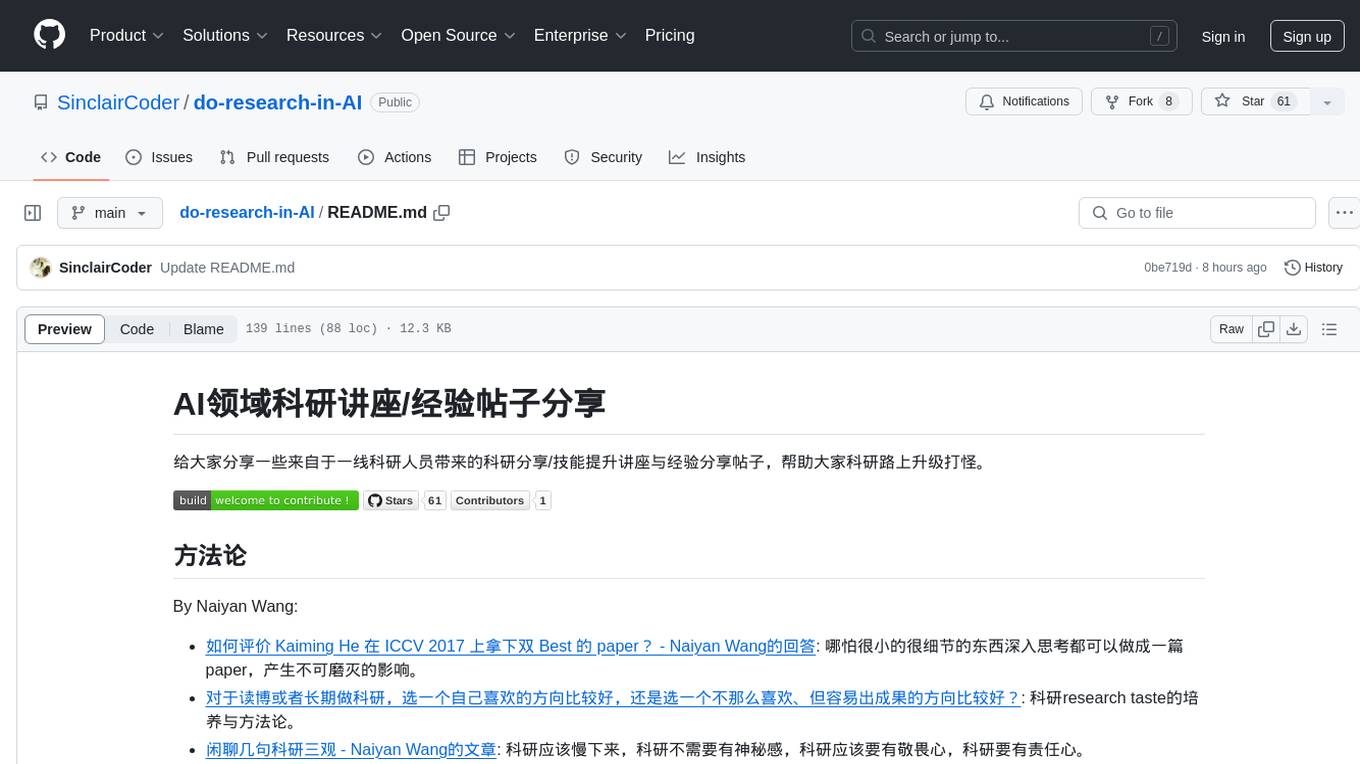
do-research-in-AI
This repository is a collection of research lectures and experience sharing posts from frontline researchers in the field of AI. It aims to help individuals upgrade their research skills and knowledge through insightful talks and experiences shared by experts. The content covers various topics such as evaluating research papers, choosing research directions, research methodologies, and tips for writing high-quality scientific papers. The repository also includes discussions on academic career paths, research ethics, and the emotional aspects of research work. Overall, it serves as a valuable resource for individuals interested in advancing their research capabilities in the field of AI.