


UMbreLLa
LLM Inference on consumer devices
Stars: 94
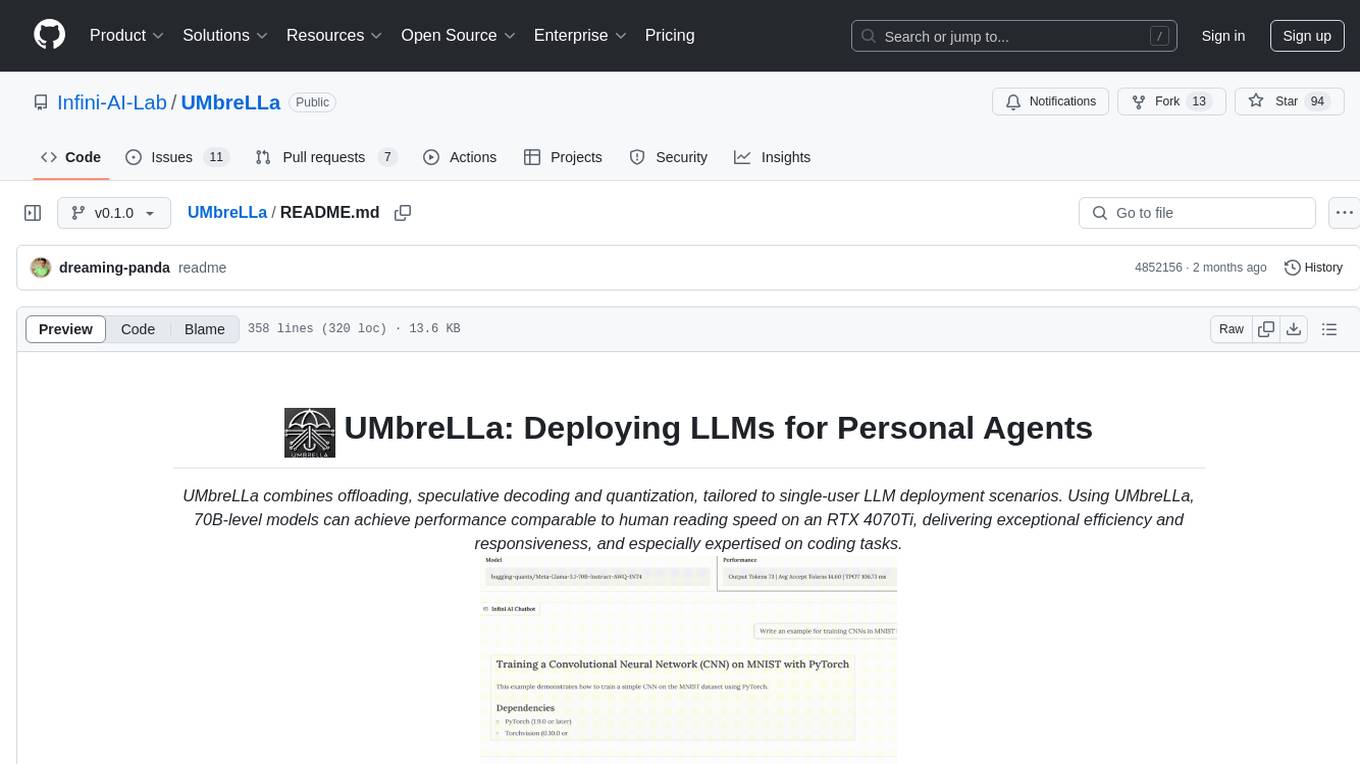
UMbreLLa is a tool designed for deploying Large Language Models (LLMs) for personal agents. It combines offloading, speculative decoding, and quantization to optimize single-user LLM deployment scenarios. With UMbreLLa, 70B-level models can achieve performance comparable to human reading speed on an RTX 4070Ti, delivering exceptional efficiency and responsiveness, especially for coding tasks. The tool supports deploying models on various GPUs and offers features like code completion and CLI/Gradio chatbots. Users can configure the LLM engine for optimal performance based on their hardware setup.
README:


The throughput is measured with a batch size of 1 to directly mirror the user experience.
| GPU | Model | Draft | Throughput (tokens/sec) | |
|---|---|---|---|---|
| Stochastic | Greedy | |||
| RTX 4090 | Llama3.1-70B-Instruct-AWQ | Llama3.1-8B-Instruct-AWQ | 7.2 | 8.6 |
| Llama3.3-70B-Instruct-AWQ | Llama3.1-8B-Instruct-AWQ | 7.0 | 7.4 | |
| Llama3.1-8B-Instruct | Llama3.2-1B-Instruct | 100.7 | 108.1 | |
| RTX 4080 SUPER | Llama3.1-70B-Instruct-AWQ | Llama3.1-8B-Instruct-AWQ | 7.4 | 8.4 |
| Llama3.3-70B-Instruct-AWQ | Llama3.1-8B-Instruct-AWQ | 6.7 | 7.2 | |
| RTX 4070 Ti | Llama3.1-70B-Instruct-AWQ | Llama3.2-1B-Instruct | 5.5 | 6.1 |
| Llama3.3-70B-Instruct-AWQ | Llama3.2-1B-Instruct | 5.2 | 5.5 | |
| L40 | Llama3.1-70B-Instruct-AWQ | Llama3.2-1B-Instruct | 37.0 | 38.5 |
| Llama3.3-70B-Instruct-AWQ | Llama3.2-1B-Instruct | 36.3 | 37.1 | |
Evaluated on ananyarn/Algorithm_and_Python_Source_Code.
| GPU | Model | Draft | Throughput (tokens/sec) |
|---|---|---|---|
| RTX 4090 | Llama3.1-70B-Instruct-AWQ | Llama3.1-8B-Instruct-AWQ | 11.4 |
| Llama3.3-70B-Instruct-AWQ | Llama3.1-8B-Instruct-AWQ | 11.2 | |
| Llama3.1-8B-Instruct | CodeDrafter-500M | 174.8 | |
| RTX 4080 SUPER | Llama3.1-70B-Instruct-AWQ | Llama3.1-8B-Instruct-AWQ | 12.2 |
| Llama3.3-70B-Instruct-AWQ | Llama3.1-8B-Instruct-AWQ | 12.1 | |
| Llama3.1-8B-Instruct-AWQ | CodeDrafter-500M | 195.3 | |
| RTX 4070 Ti | Llama3.1-70B-Instruct-AWQ | Llama3.2-1B-Instruct | 9.7 |
| Llama3.3-70B-Instruct-AWQ | Llama3.2-1B-Instruct | 9.6 | |
| Llama3.1-8B-Instruct-AWQ | CodeDrafter-500M | 162.3 | |
| L40 | Llama3.1-70B-Instruct-AWQ | CodeDrafter-500M | 45.6 |
| Llama3.3-70B-Instruct-AWQ | CodeDrafter-500M | 45.0 |
Offloading experiments heavily rely on the status of PCIE, and may vary across instances.
❌ UMbreLLa is not designed for large-scale LLM serving.
conda create -n umbrella python=3.10
bash install.shcd app
python chatbot.py --configuration ../configs/chat_config_24gb.jsonThen you can chat with the LLM specified in chat_config_24gb.json.
cd app
python gradio_chat.py --configuration ../configs/chat_config_24gb.json
Then you can chat with the LLM specified in chat_config_24gb.json in Gradio.
cd app
python api.py --configuration ../configs/chat_config_24gb.json --max_client 1 --port 65432
configuration specifies the LLM and speculative decoding details.
max_client is the maximum clients that can connect to the server.
port is the port of the server.
After the server is started, Client can be started and connect to the server by
from umbrella.api.client import APIClient
client = APIClient(port=port) #port should be the same as the server
client.run()
To get the LLM output,
input1 = {"context": text1, "max_new_tokens": 512, "temperature": 0.0}
output1 = client.get_output(**input1){
"model": "hugging-quants/Meta-Llama-3.1-70B-Instruct-AWQ-INT4",
"draft_model": "meta-llama/Llama-3.2-1B-Instruct",
"offload": true,
"cuda_graph": false,
"max_length": 4096,
"num_cache_layers": 0,
"generation_length": 256,
"max_turns": 12,
"topk": 32,
"temperature": 0.6,
"topp": 0.9,
"repetition_penalty": 1.05,
"growmap_path": "../umbrella/trees/sequoia_tree-3x4.json",
"width": 16,
"num_beams": 24,
"depth": 16,
"engine": "dynamic",
"template": "meta-llama3"
}-
model: Specifies the target LLM to serve, e.g.,
"hugging-quants/Meta-Llama-3.1-70B-Instruct-AWQ-INT4". -
draft_model: Lightweight draft model, e.g.,
"meta-llama/Llama-3.2-1B-Instruct". -
offload: Enables offloading of the target model to host memory or disk (
trueorfalse). - cuda_graph: Toggles CUDA graph optimization for the draft model (currently unsupported for AWQ models).
- max_length: The maximum token length for input and output combined.
- num_cache_layers: Sets the number of layers cached during inference (e.g., for memory optimization).
- generation_length: Maximum length of generated responses in tokens.
- max_turns: Limits the number of conversational turns retained in memory.
-
topk: Limits token selection during generation to the top
kmost likely tokens. - temperature: Controls randomness in token selection (lower values = more deterministic outputs).
-
topp: Enables nucleus sampling by limiting token selection to those with cumulative probability ≤
p. - repetition_penalty: Penalizes repetitive text generation (values > 1 discourage repetition).
-
growmap_path: Path to the speculative decoding tree used by the static engine (e.g.,
"../umbrella/trees/sequoia_tree-3x4.json").
-
engine: Defines the decoding strategy. Choose between:
-
"static": Optimized for on-device execution. -
"dynamic": Designed for offloading scenarios.
-
- width, num_beams, depth: Hyperparameters for speculative decoding in dynamic engines.
-
template: Defines the structure for input prompts. Supported values include:
-
"llama3-code": Optimized for code-related tasks. -
"meta-llama3": General-purpose instruction-following template.
-
./configs and ./umbrella/trees.
from umbrella.speculation.auto_engine import AutoEngine
DEVICE = "cuda:0"
engine = AutoEngine.from_config(device=DEVICE, **config)
engine.initialize()GEN_LEN = 512
text1 = "Tell me what you know about Reinforcement Learning in 100 words."
text2 = "Tell me what you know about LSH in 100 words."
engine.prefill(text1) # The first operation must be prefilling
engine.speculative_decoding(max_new_tokens=GEN_LEN)
engine.append(text2)
engine.speculative_decoding(max_new_tokens=GEN_LEN)output = engine.generate(
context=prompt,
max_new_tokens=max_new_tokens,
temperature=temperature,
top_p=top_p,
repetition_penalty=repetition_penalty,
)
# return a dict containing token ids and detokenized texts
# context=prompt (str) can be replaced by input_ids=tokens list[int]
stream = engine.generate_stream(
context=prompt,
max_new_tokens=max_new_tokens,
temperature=temperature,
top_p=top_p,
repetition_penalty=repetition_penalty,
)
# return a stream containing detokenized texts
# context=prompt (str) can be replaced by input_ids=tokens list[int]@article{chen2024sequoia,
title={Sequoia: Scalable, Robust, and Hardware-aware Speculative Decoding},
author={Chen, Zhuoming and May, Avner and Svirschevski, Ruslan and Huang, Yuhsun and Ryabinin, Max and Jia, Zhihao and Chen, Beidi},
journal={arXiv preprint arXiv:2402.12374},
year={2024}
}
@article{svirschevski2024specexec,
title={SpecExec: Massively Parallel Speculative Decoding for Interactive LLM Inference on Consumer Devices},
author={Svirschevski, Ruslan and May, Avner and Chen, Zhuoming and Chen, Beidi and Jia, Zhihao and Ryabinin, Max},
journal={arXiv preprint arXiv:2406.02532},
year={2024}
}For Tasks:
Click tags to check more tools for each tasksFor Jobs:
Alternative AI tools for UMbreLLa
Similar Open Source Tools
UMbreLLa
UMbreLLa is a tool designed for deploying Large Language Models (LLMs) for personal agents. It combines offloading, speculative decoding, and quantization to optimize single-user LLM deployment scenarios. With UMbreLLa, 70B-level models can achieve performance comparable to human reading speed on an RTX 4070Ti, delivering exceptional efficiency and responsiveness, especially for coding tasks. The tool supports deploying models on various GPUs and offers features like code completion and CLI/Gradio chatbots. Users can configure the LLM engine for optimal performance based on their hardware setup.
agentscope
AgentScope is a multi-agent platform designed to empower developers to build multi-agent applications with large-scale models. It features three high-level capabilities: Easy-to-Use, High Robustness, and Actor-Based Distribution. AgentScope provides a list of `ModelWrapper` to support both local model services and third-party model APIs, including OpenAI API, DashScope API, Gemini API, and ollama. It also enables developers to rapidly deploy local model services using libraries such as ollama (CPU inference), Flask + Transformers, Flask + ModelScope, FastChat, and vllm. AgentScope supports various services, including Web Search, Data Query, Retrieval, Code Execution, File Operation, and Text Processing. Example applications include Conversation, Game, and Distribution. AgentScope is released under Apache License 2.0 and welcomes contributions.
llm-context.py
LLM Context is a tool designed to assist developers in quickly injecting relevant content from code/text projects into Large Language Model chat interfaces. It leverages `.gitignore` patterns for smart file selection and offers a streamlined clipboard workflow using the command line. The tool also provides direct integration with Large Language Models through the Model Context Protocol (MCP). LLM Context is optimized for code repositories and collections of text/markdown/html documents, making it suitable for developers working on projects that fit within an LLM's context window. The tool is under active development and aims to enhance AI-assisted development workflows by harnessing the power of Large Language Models.
unsloth
Unsloth is a tool that allows users to fine-tune large language models (LLMs) 2-5x faster with 80% less memory. It is a free and open-source tool that can be used to fine-tune LLMs such as Gemma, Mistral, Llama 2-5, TinyLlama, and CodeLlama 34b. Unsloth supports 4-bit and 16-bit QLoRA / LoRA fine-tuning via bitsandbytes. It also supports DPO (Direct Preference Optimization), PPO, and Reward Modelling. Unsloth is compatible with Hugging Face's TRL, Trainer, Seq2SeqTrainer, and Pytorch code. It is also compatible with NVIDIA GPUs since 2018+ (minimum CUDA Capability 7.0).
cua
Cua is a tool for creating and running high-performance macOS and Linux virtual machines on Apple Silicon, with built-in support for AI agents. It provides libraries like Lume for running VMs with near-native performance, Computer for interacting with sandboxes, and Agent for running agentic workflows. Users can refer to the documentation for onboarding, explore demos showcasing AI-Gradio and GitHub issue fixing, and utilize accessory libraries like Core, PyLume, Computer Server, and SOM. Contributions are welcome, and the tool is open-sourced under the MIT License.
Q-Bench
Q-Bench is a benchmark for general-purpose foundation models on low-level vision, focusing on multi-modality LLMs performance. It includes three realms for low-level vision: perception, description, and assessment. The benchmark datasets LLVisionQA and LLDescribe are collected for perception and description tasks, with open submission-based evaluation. An abstract evaluation code is provided for assessment using public datasets. The tool can be used with the datasets API for single images and image pairs, allowing for automatic download and usage. Various tasks and evaluations are available for testing MLLMs on low-level vision tasks.
factorio-learning-environment
Factorio Learning Environment is an open source framework designed for developing and evaluating LLM agents in the game of Factorio. It provides two settings: Lab-play with structured tasks and Open-play for building large factories. Results show limitations in spatial reasoning and automation strategies. Agents interact with the environment through code synthesis, observation, action, and feedback. Tools are provided for game actions and state representation. Agents operate in episodes with observation, planning, and action execution. Tasks specify agent goals and are implemented in JSON files. The project structure includes directories for agents, environment, cluster, data, docs, eval, and more. A database is used for checkpointing agent steps. Benchmarks show performance metrics for different configurations.
candle-vllm
Candle-vllm is an efficient and easy-to-use platform designed for inference and serving local LLMs, featuring an OpenAI compatible API server. It offers a highly extensible trait-based system for rapid implementation of new module pipelines, streaming support in generation, efficient management of key-value cache with PagedAttention, and continuous batching. The tool supports chat serving for various models and provides a seamless experience for users to interact with LLMs through different interfaces.
evalchemy
Evalchemy is a unified and easy-to-use toolkit for evaluating language models, focusing on post-trained models. It integrates multiple existing benchmarks such as RepoBench, AlpacaEval, and ZeroEval. Key features include unified installation, parallel evaluation, simplified usage, and results management. Users can run various benchmarks with a consistent command-line interface and track results locally or integrate with a database for systematic tracking and leaderboard submission.
tunacode
TunaCode CLI is an AI-powered coding assistant that provides a command-line interface for developers to enhance their coding experience. It offers features like model selection, parallel execution for faster file operations, and various commands for code management. The tool aims to improve coding efficiency and provide a seamless coding environment for developers.
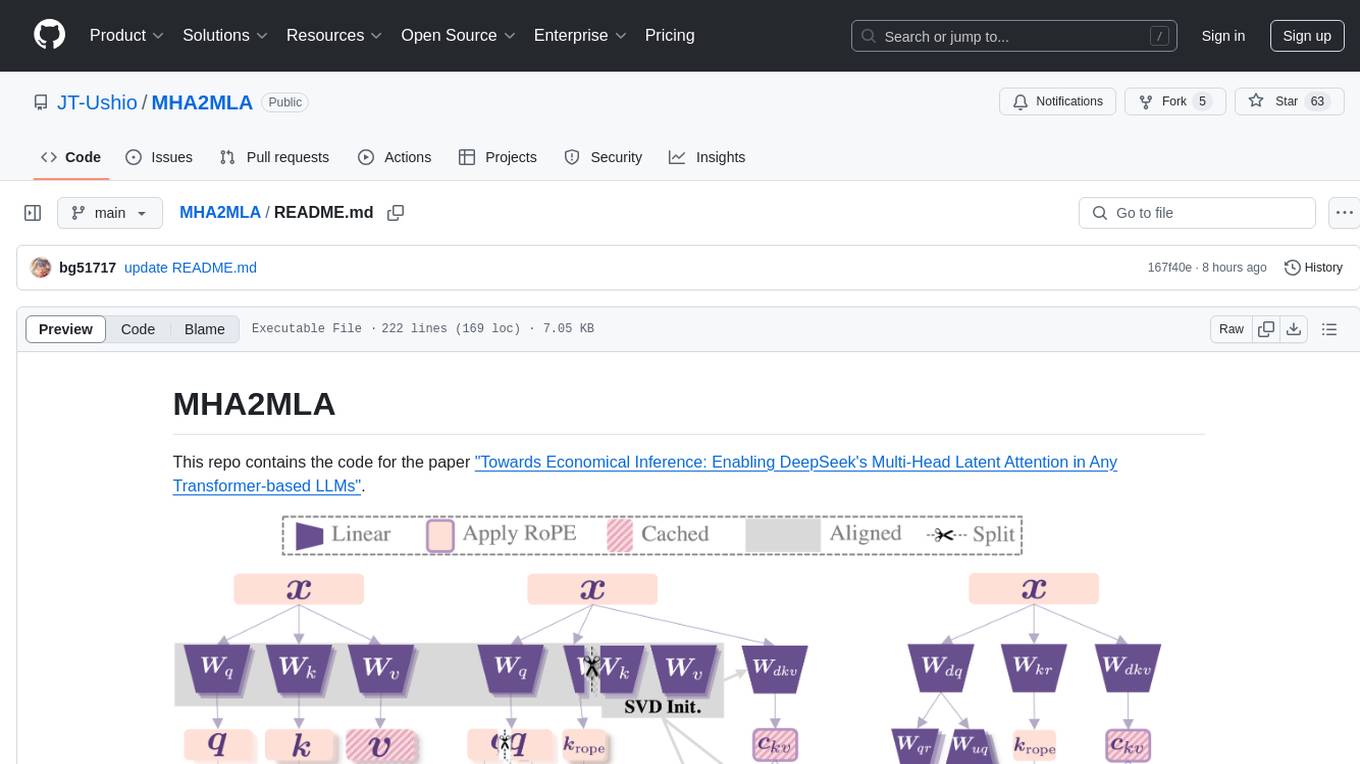
MHA2MLA
This repository contains the code for the paper 'Towards Economical Inference: Enabling DeepSeek's Multi-Head Latent Attention in Any Transformer-based LLMs'. It provides tools for fine-tuning and evaluating Llama models, converting models between different frameworks, processing datasets, and performing specific model training tasks like Partial-RoPE Fine-Tuning and Multiple-Head Latent Attention Fine-Tuning. The repository also includes commands for model evaluation using Lighteval and LongBench, along with necessary environment setup instructions.
dive
Dive is an AI toolkit for Go that enables the creation of specialized teams of AI agents and seamless integration with leading LLMs. It offers a CLI and APIs for easy integration, with features like creating specialized agents, hierarchical agent systems, declarative configuration, multiple LLM support, extended reasoning, model context protocol, advanced model settings, tools for agent capabilities, tool annotations, streaming, CLI functionalities, thread management, confirmation system, deep research, and semantic diff. Dive also provides semantic diff analysis, unified interface for LLM providers, tool system with annotations, custom tool creation, and support for various verified models. The toolkit is designed for developers to build AI-powered applications with rich agent capabilities and tool integrations.
LTEngine
LTEngine is a free and open-source local AI machine translation API written in Rust. It is self-hosted and compatible with LibreTranslate. LTEngine utilizes large language models (LLMs) via llama.cpp, offering high-quality translations that rival or surpass DeepL for certain languages. It supports various accelerators like CUDA, Metal, and Vulkan, with the largest model 'gemma3-27b' fitting on a single consumer RTX 3090. LTEngine is actively developed, with a roadmap outlining future enhancements and features.
mcp-apache-spark-history-server
The MCP Server for Apache Spark History Server is a tool that connects AI agents to Apache Spark History Server for intelligent job analysis and performance monitoring. It enables AI agents to analyze job performance, identify bottlenecks, and provide insights from Spark History Server data. The server bridges AI agents with existing Apache Spark infrastructure, allowing users to query job details, analyze performance metrics, compare multiple jobs, investigate failures, and generate insights from historical execution data.
TempCompass
TempCompass is a benchmark designed to evaluate the temporal perception ability of Video LLMs. It encompasses a diverse set of temporal aspects and task formats to comprehensively assess the capability of Video LLMs in understanding videos. The benchmark includes conflicting videos to prevent models from relying on single-frame bias and language priors. Users can clone the repository, install required packages, prepare data, run inference using examples like Video-LLaVA and Gemini, and evaluate the performance of their models across different tasks such as Multi-Choice QA, Yes/No QA, Caption Matching, and Caption Generation.
AutoGPTQ
AutoGPTQ is an easy-to-use LLM quantization package with user-friendly APIs, based on GPTQ algorithm (weight-only quantization). It provides a simple and efficient way to quantize large language models (LLMs) to reduce their size and computational cost while maintaining their performance. AutoGPTQ supports a wide range of LLM models, including GPT-2, GPT-J, OPT, and BLOOM. It also supports various evaluation tasks, such as language modeling, sequence classification, and text summarization. With AutoGPTQ, users can easily quantize their LLM models and deploy them on resource-constrained devices, such as mobile phones and embedded systems.
For similar tasks
UMbreLLa
UMbreLLa is a tool designed for deploying Large Language Models (LLMs) for personal agents. It combines offloading, speculative decoding, and quantization to optimize single-user LLM deployment scenarios. With UMbreLLa, 70B-level models can achieve performance comparable to human reading speed on an RTX 4070Ti, delivering exceptional efficiency and responsiveness, especially for coding tasks. The tool supports deploying models on various GPUs and offers features like code completion and CLI/Gradio chatbots. Users can configure the LLM engine for optimal performance based on their hardware setup.
glide
Glide is a cloud-native LLM gateway that provides a unified REST API for accessing various large language models (LLMs) from different providers. It handles LLMOps tasks such as model failover, caching, key management, and more, making it easy to integrate LLMs into applications. Glide supports popular LLM providers like OpenAI, Anthropic, Azure OpenAI, AWS Bedrock (Titan), Cohere, Google Gemini, OctoML, and Ollama. It offers high availability, performance, and observability, and provides SDKs for Python and NodeJS to simplify integration.
agents-flex
Agents-Flex is a LLM Application Framework like LangChain base on Java. It provides a set of tools and components for building LLM applications, including LLM Visit, Prompt and Prompt Template Loader, Function Calling Definer, Invoker and Running, Memory, Embedding, Vector Storage, Resource Loaders, Document, Splitter, Loader, Parser, LLMs Chain, and Agents Chain.
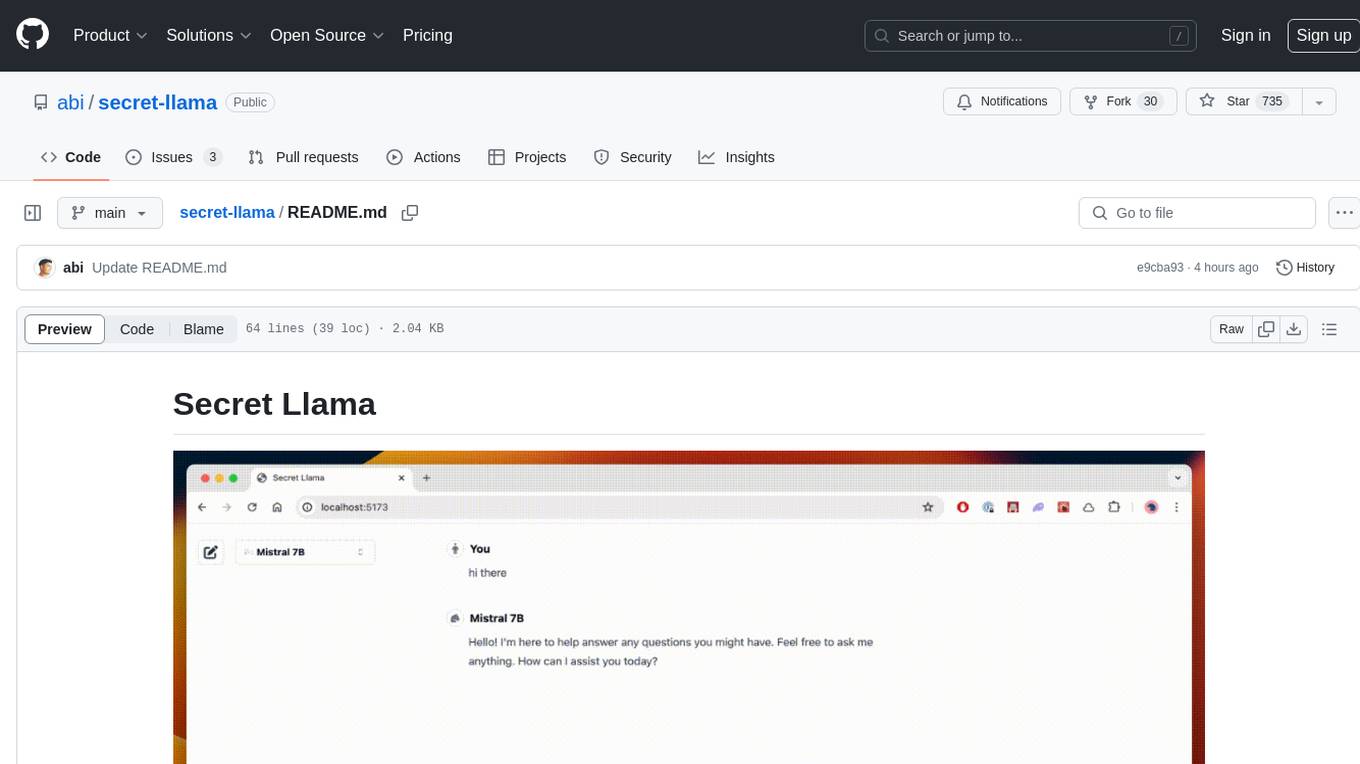
secret-llama
Entirely-in-browser, fully private LLM chatbot supporting Llama 3, Mistral and other open source models. Fully private = No conversation data ever leaves your computer. Runs in the browser = No server needed and no install needed! Works offline. Easy-to-use interface on par with ChatGPT, but for open source LLMs. System requirements include a modern browser with WebGPU support. Supported models include TinyLlama-1.1B-Chat-v0.4-q4f32_1-1k, Llama-3-8B-Instruct-q4f16_1, Phi1.5-q4f16_1-1k, and Mistral-7B-Instruct-v0.2-q4f16_1. Looking for contributors to improve the interface, support more models, speed up initial model loading time, and fix bugs.
shellgpt
ShellGPT is a tool that allows users to chat with a large language model (LLM) in the terminal. It can be used for various purposes such as generating shell commands, telling stories, and interacting with Linux terminal. The tool provides different modes of usage including direct mode for asking questions, REPL mode for chatting with LLM, and TUI mode tailored for inferring shell commands. Users can customize the tool by setting up different language model backends such as Ollama or using OpenAI compatible API endpoints. Additionally, ShellGPT comes with built-in system contents for general questions, correcting typos, generating URL slugs, programming questions, shell command inference, and git commit message generation. Users can define their own content or share customized contents in the discuss section.
Open-LLM-VTuber
Open-LLM-VTuber is a project in early stages of development that allows users to interact with Large Language Models (LLM) using voice commands and receive responses through a Live2D talking face. The project aims to provide a minimum viable prototype for offline use on macOS, Linux, and Windows, with features like long-term memory using MemGPT, customizable LLM backends, speech recognition, and text-to-speech providers. Users can configure the project to chat with LLMs, choose different backend services, and utilize Live2D models for visual representation. The project supports perpetual chat, offline operation, and GPU acceleration on macOS, addressing limitations of existing solutions on macOS.
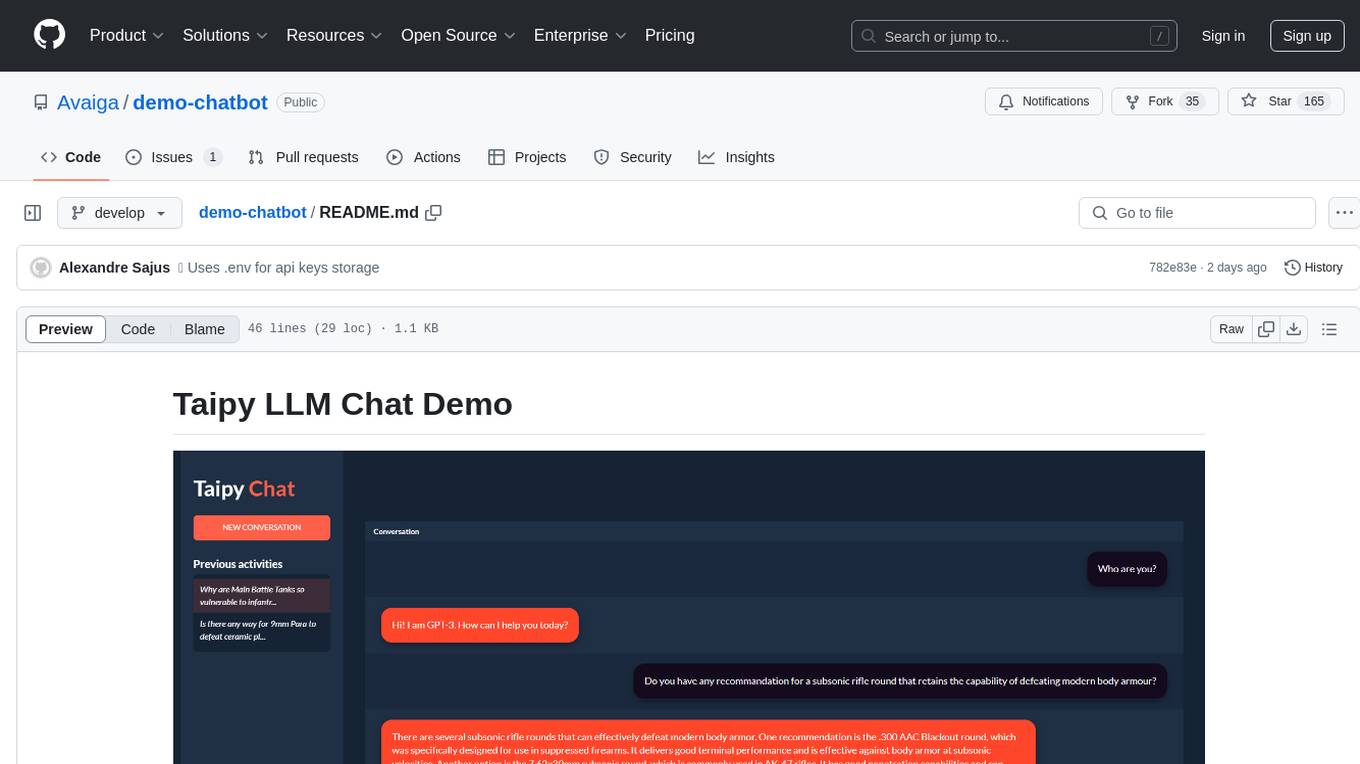
demo-chatbot
The demo-chatbot repository contains a simple app to chat with an LLM, allowing users to create any LLM Inference Web Apps using Python. The app utilizes OpenAI's GPT-4 API to generate responses to user messages, with the flexibility to switch to other APIs or models. The repository includes a tutorial in the Taipy documentation for creating the app. Users need an OpenAI account with an active API key to run the app by cloning the repository, installing dependencies, setting up the API key in a .env file, and running the main.py file.
For similar jobs
weave
Weave is a toolkit for developing Generative AI applications, built by Weights & Biases. With Weave, you can log and debug language model inputs, outputs, and traces; build rigorous, apples-to-apples evaluations for language model use cases; and organize all the information generated across the LLM workflow, from experimentation to evaluations to production. Weave aims to bring rigor, best-practices, and composability to the inherently experimental process of developing Generative AI software, without introducing cognitive overhead.
LLMStack
LLMStack is a no-code platform for building generative AI agents, workflows, and chatbots. It allows users to connect their own data, internal tools, and GPT-powered models without any coding experience. LLMStack can be deployed to the cloud or on-premise and can be accessed via HTTP API or triggered from Slack or Discord.
VisionCraft
The VisionCraft API is a free API for using over 100 different AI models. From images to sound.
kaito
Kaito is an operator that automates the AI/ML inference model deployment in a Kubernetes cluster. It manages large model files using container images, avoids tuning deployment parameters to fit GPU hardware by providing preset configurations, auto-provisions GPU nodes based on model requirements, and hosts large model images in the public Microsoft Container Registry (MCR) if the license allows. Using Kaito, the workflow of onboarding large AI inference models in Kubernetes is largely simplified.
PyRIT
PyRIT is an open access automation framework designed to empower security professionals and ML engineers to red team foundation models and their applications. It automates AI Red Teaming tasks to allow operators to focus on more complicated and time-consuming tasks and can also identify security harms such as misuse (e.g., malware generation, jailbreaking), and privacy harms (e.g., identity theft). The goal is to allow researchers to have a baseline of how well their model and entire inference pipeline is doing against different harm categories and to be able to compare that baseline to future iterations of their model. This allows them to have empirical data on how well their model is doing today, and detect any degradation of performance based on future improvements.
tabby
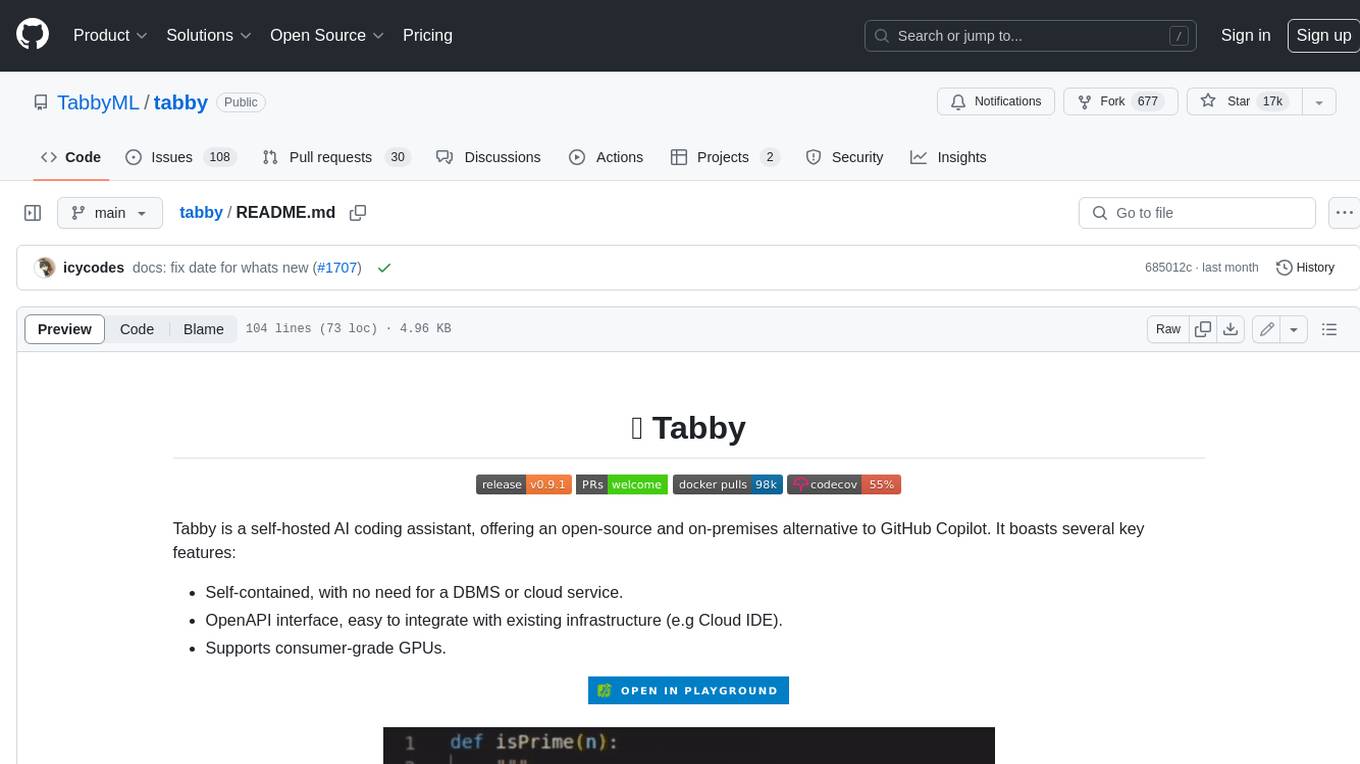
Tabby is a self-hosted AI coding assistant, offering an open-source and on-premises alternative to GitHub Copilot. It boasts several key features: * Self-contained, with no need for a DBMS or cloud service. * OpenAPI interface, easy to integrate with existing infrastructure (e.g Cloud IDE). * Supports consumer-grade GPUs.
spear
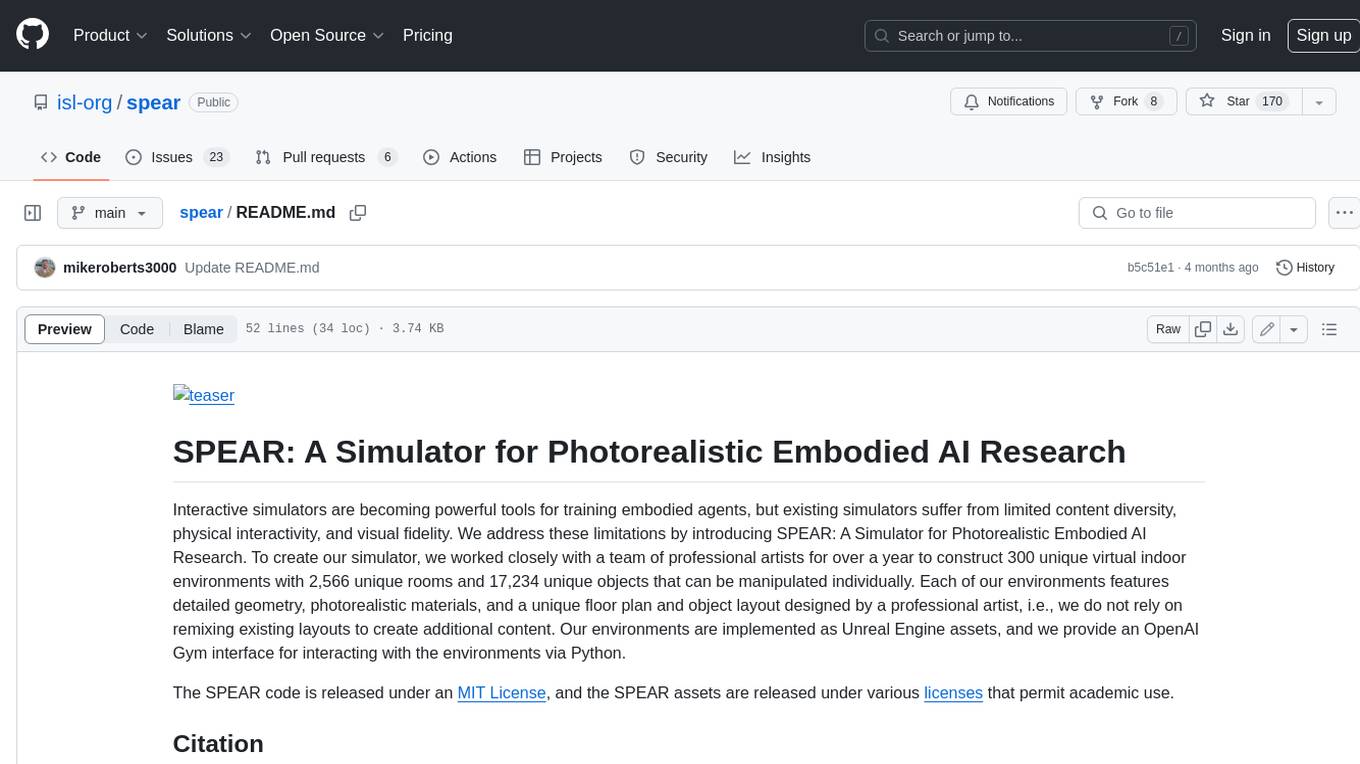
SPEAR (Simulator for Photorealistic Embodied AI Research) is a powerful tool for training embodied agents. It features 300 unique virtual indoor environments with 2,566 unique rooms and 17,234 unique objects that can be manipulated individually. Each environment is designed by a professional artist and features detailed geometry, photorealistic materials, and a unique floor plan and object layout. SPEAR is implemented as Unreal Engine assets and provides an OpenAI Gym interface for interacting with the environments via Python.
Magick
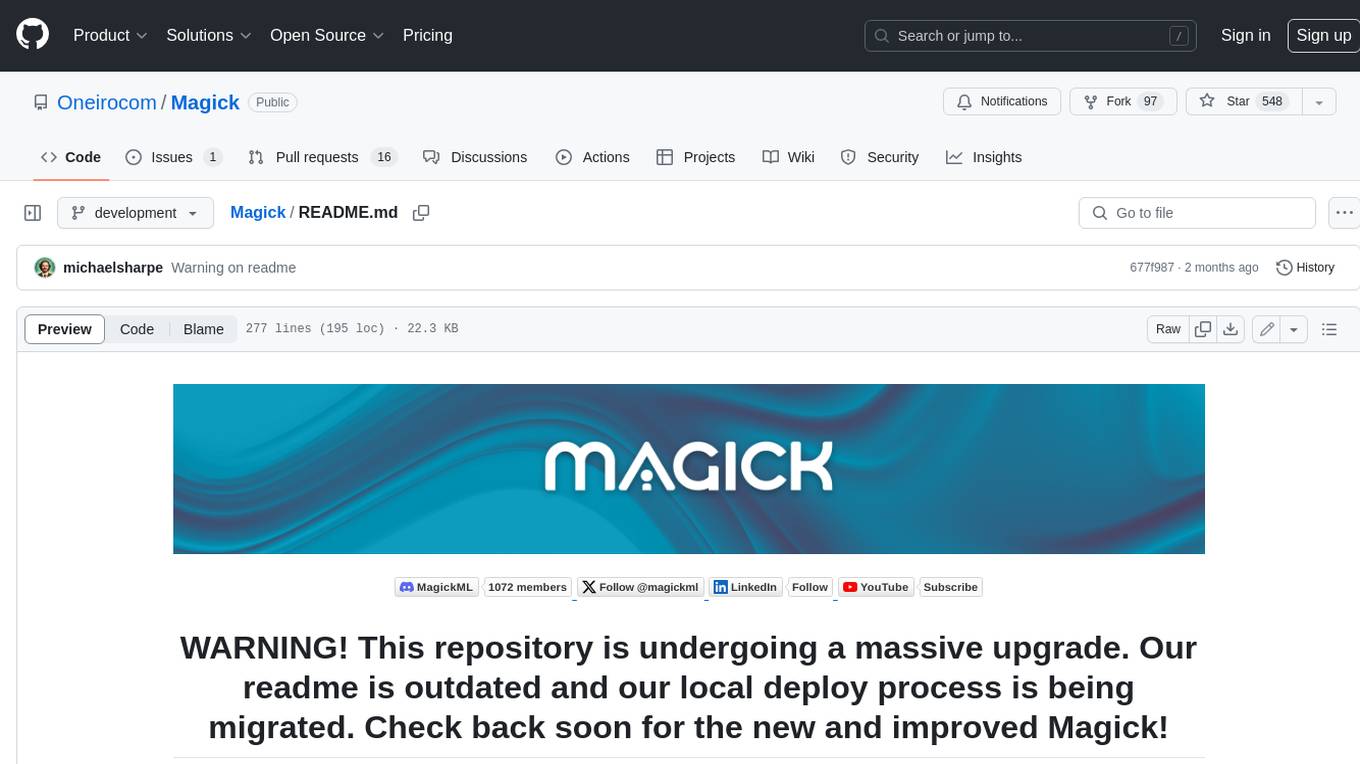
Magick is a groundbreaking visual AIDE (Artificial Intelligence Development Environment) for no-code data pipelines and multimodal agents. Magick can connect to other services and comes with nodes and templates well-suited for intelligent agents, chatbots, complex reasoning systems and realistic characters.